CONCEPTION AND MECHANICAL CHARACTERIZATION OF AN INSULATION BIO
1,3,*
Ernesto C. HOUEHANOU,
1,3Yvette TANKPINOU KIKI,
AISSE,
1Miguel HOUELEKOU,
2
Dominique C. K. SOHOUNHOUELE
1
Laboratory of Materials and Structures (LAMS),
Abomey
2
Laboratory of Study and Research in Applied Chemistry, Polytechnic School of Abomey Calavi, University,
3
National University of Sciences, Technologies, Engineering and Mathematics, (UNSTIM), Abomey, Benin
ARTICLE INFO ABSTRACT
Home comfort contributes to improving the living environment and several approaches to materials are implemented to improve thermal comfort in homes. This study focuses on the development and mechanical characterization of an insulating material based on
Beforehand, a chemical analysis on the tannin content of five concentrations ofNéré’s pod was carried out for three different time’s maceration. In view of the results, the concentrations 120 g/l and 180 g/l after 24 h
concentrations, two different types of mixtures were used: one from a macerate obtained by filtering the solution and the other with a macerate containing the broken
mixture produced with cow dung and water is also used for comparison. The mechanical strengths that have been obtained are between 0.54 and 0.67 MPa for compression and between 1.1 and 1.4 MPa for bending. The mechanical
pod are higher than those of the test pieces of the reference mixture. The values of the compressive and flexion strengths of the specimens made with the filtered extract are slightly high
the specimens made with the unfiltered extract (containing the pod debris).
Copyright © 2018, Ernesto C. HOUEHANOU et al. This
unrestricted use, distribution, and reproduction in any medium,
INTRODUCTION
The valorization of local materials and energy
research issues for the construction sector (Christophe 2004; Escadeillas 2006). In fact, energy consumption in buildings is becoming increasingly important in view of the energy crises in the countries of sub-Saharan Africa and increasing demographic pressure. Also, the energy consumed for air conditioning in homes can be reduced by the use of insulating material (Chenailler, 2012); this reduction in energy consumption, resulting from the use of insulating materials, also contributes to the reduction of greenhouse gas emissions and the protection of the environment (Escadeillas 2006; Chenailler, 2012).
*Corresponding author: 1,3,*Ernesto C. HOUEHANOU
1
Laboratory of Materials and Structures (LAMS), Laboratory of Energetics and Applied Mechanics (LEMA), Abomey University, Abomey-Calavi, Benin.
3
National University of Sciences, Technologies, Engineering and Mathematics, (UNSTIM), Abomey, Benin.
ISSN: 0975-833X
Vol.
Article History: Received 10th July, 2018
Received in revised form 25th August, 2018
Accepted 28th September, 2018
Published online 31st October, 2018
Citation:Ernesto C. HOUEHANOU, Yvette TANKPINOU KIKI, Fifa T. D. BOTHON, Gérard G
“Conception and mechanical characterization of an insulation bio Key Words:
Cow dung, Néré, Tannins, Insulation, Mechanical Strengths.
RESEARCH ARTICLE
CONCEPTION AND MECHANICAL CHARACTERIZATION OF AN INSULATION BIO
Yvette TANKPINOU KIKI,
2,3Fifa T. D. BOTHON,
Miguel HOUELEKOU,
3Alain A. N. ADOMOU.,
2Félicien AVLESSI and
Dominique C. K. SOHOUNHOUELE
Materials and Structures (LAMS), Laboratory of Energetics and Applied Mechanics (LEMA),
Abomey-Calavi University, Abomey-Calavi, Benin
Laboratory of Study and Research in Applied Chemistry, Polytechnic School of Abomey Calavi, University,
Abomey-Calavi, Benin
National University of Sciences, Technologies, Engineering and Mathematics, (UNSTIM), Abomey, Benin
ABSTRACT
Home comfort contributes to improving the living environment and several approaches to materials are implemented to improve thermal comfort in homes. This study focuses on the development and mechanical characterization of an insulating material based on Parkiabiglobosa
Beforehand, a chemical analysis on the tannin content of five concentrations ofNéré’s pod was carried out for three different time’s maceration. In view of the results, the concentrations 120 g/l and 180 g/l after 24 h of maceration were retained to make the different insulant specimens. For each of the two concentrations, two different types of mixtures were used: one from a macerate obtained by filtering the solution and the other with a macerate containing the broken
mixture produced with cow dung and water is also used for comparison. The mechanical strengths that have been obtained are between 0.54 and 0.67 MPa for compression and between 1.1 and 1.4 MPa for bending. The mechanical characteristics of the specimens containing decoctions from Néré's pod are higher than those of the test pieces of the reference mixture. The values of the compressive and flexion strengths of the specimens made with the filtered extract are slightly high
the specimens made with the unfiltered extract (containing the pod debris).
This is an open access article distributed under the Creative Commons medium, provided the original work is properly cited.
The valorization of local materials and energy efficiency are research issues for the construction sector (Christophe 2004; In fact, energy consumption in buildings is becoming increasingly important in view of the energy crises Saharan Africa and increasing emographic pressure. Also, the energy consumed for air conditioning in homes can be reduced by the use of insulating material (Chenailler, 2012); this reduction in energy consumption, resulting from the use of insulating materials, reduction of greenhouse gas emissions and the protection of the environment (Escadeillas 2006;
Ernesto C. HOUEHANOU,
Laboratory of Materials and Structures (LAMS), Laboratory of Mechanics (LEMA), Abomey-Calavi
National University of Sciences, Technologies, Engineering and
In this context, current research focuses on several materials including cow dung, known and used in construction for various applications (Mercier, 2011; Houehanou
Djossou et al., 2018). Cow dung is cow of the beefand, by extension, the dejection of any other cattle (ruminant with hollow horns). It is used in construction for wall construction, crack treatment, rendering and siding waterproofing
1998; Milligo et al. 2016; Houehan
with certain materials to serve as a binder and give a solid character. Plant extracts are often used as a binder in many traditions (Lemoine, 1998; Sorgbo
al., 2017). Some studies have already been done on cow dung
materials and Néré's pods (Sorgbo Mahamat, 2015; Houehanou et al.,
A study carried out in Burkina Faso indicates that the geomaterials elaborated with a sand
Néré's pods present values
monoaxial compression higher than those obtained without addition of tannin (Sorgbo, 2016). Work on laterite blocks containing different proportions of Néré's t
International Journal of Current Research Vol. 10, Issue, 10, pp.74470-74475, October, 2018
DOI: https://doi.org/10.24941/ijcr.32743.10.2018
Ernesto C. HOUEHANOU, Yvette TANKPINOU KIKI, Fifa T. D. BOTHON, Gérard GBAGUIDI AISSE, Miguel HOUELEKOU et al insulation bio-based materials”, International Journal of Current Research
Available online at http://www.journalcra.com
z
CONCEPTION AND MECHANICAL CHARACTERIZATION OF AN INSULATION BIO-BASED MATERIALS
Fifa T. D. BOTHON,
1Gérard GBAGUIDI
Félicien AVLESSI and
Laboratory of Energetics and Applied Mechanics (LEMA),
Laboratory of Study and Research in Applied Chemistry, Polytechnic School of Abomey Calavi, University,
National University of Sciences, Technologies, Engineering and Mathematics, (UNSTIM), Abomey, Benin
Home comfort contributes to improving the living environment and several approaches to materials are implemented to improve thermal comfort in homes. This study focuses on the development and
Parkiabiglobosa (Néré) and cow dung. Beforehand, a chemical analysis on the tannin content of five concentrations ofNéré’s pod was carried out for three different time’s maceration. In view of the results, the concentrations 120 g/l and 180 g/l of maceration were retained to make the different insulant specimens. For each of the two concentrations, two different types of mixtures were used: one from a macerate obtained by filtering the solution and the other with a macerate containing the broken pod debris (unfiltered).A reference mixture produced with cow dung and water is also used for comparison. The mechanical strengths that have been obtained are between 0.54 and 0.67 MPa for compression and between 1.1 and 1.4 characteristics of the specimens containing decoctions from Néré's pod are higher than those of the test pieces of the reference mixture. The values of the compressive and flexion strengths of the specimens made with the filtered extract are slightly higher than those of the specimens made with the unfiltered extract (containing the pod debris).
Commons Attribution License, which permits
In this context, current research focuses on several materials known and used in construction for various applications (Mercier, 2011; Houehanou et al., 2017; Cow dung is cow of the beefand, by extension, the dejection of any other cattle (ruminant with hollow horns). It is used in construction for wall construction, crack treatment, rendering and siding waterproofing (Lemoine, 2016; Houehanou et al., 2017). It mixes with certain materials to serve as a binder and give a solid character. Plant extracts are often used as a binder in many Sorgbo et al., 2016, Houehanou et
2017). Some studies have already been done on cow dung (Sorgbo et al., 2016; Kossi, 2016;
et al., 2017; Djossou et al., 2018). A study carried out in Burkina Faso indicates that the with a sand-clay-decoction mixture of present values of mechanical resistance in monoaxial compression higher than those obtained without addition of tannin (Sorgbo, 2016). Work on laterite blocks containing different proportions of Néré's thimble also
INTERNATIONAL JOURNAL OF CURRENT RESEARCH
BAGUIDI AISSE, Miguel HOUELEKOU et al.2018.
indicates that the use of Néré's pods influences the mechanical properties of the laterite blocks (Banakinao, 2016). Numerous studies on cow dung and pod materials indicate the value of fundamental research (Gana, 2011; Appiah, 2013; Banakinao, 2016; Houehanou et al., 2017). Before benefiting from the thermal gain associated with the use of the insulating material, it is necessary to ensure its mechanical behavior against the stresses in compression and bending. The purpose of this study is to assess the beneficial effect of using Néré's pod associated with cow dung. The study focuses on developing an insulating material based on cow dung and pod of Parkiabiglobosa
(Néré) which is a natural plant binder. It consists in evaluating first the tannin content of the Néré's pods and then the mechanical properties (compressive strength and flexion strength) of insulating materials obtained from cow dung and Néré's pods extract.
MATERIALS AND METHODS
Materials: The materials used in this study are: cow dung and
Parkiabiglobosa (Néré) pods.
Néré (Parkiabiglobosa) pods: Parkiabiglobosa of its scientific
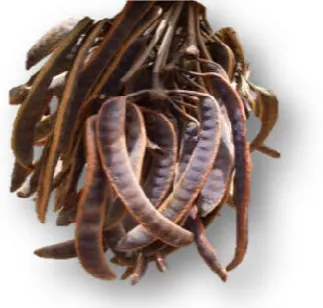
name, Néré is a tree of Mimosaceae family that grows in the humid regions of Africa and fruit in March. The fruits are in pod form (Figure 1). Néré's pods are the outer shells of Néré fruit and are found in abundance at the end of the harvest seasons. Those used in this study were harvested in Parakou in the department of Borgou, northern of Benin in April 2018. The pods are exposed to the open air to reduce the water content. They are then reduced into small pieces to facilitate immersion in water for extract preparation.
Cowdung: The cow dung is found in abundance in cattle
breeding areas. The used material "cow dung" in this study is in the shape of sawdust. The cow dung is taken on a site of experiment of breeding cattle belonging to the Faculty of Science of Agronomy (FSA) of the University of Abomey-Calavi (UAC) (Houehanou et al., 2017). The cow dung is taken fresh (within 24 hours after the defecation) is returned to the Laboratory of Materials and Structures ( LAMS), for a pre-sun-curing during ten (10) days then in the stove in a temperature of 60°C until constant mass. The dry material is reduced in the shape of sawdust using a mill of fine stitch of the Faculty of Science of Agronomy (FSA). The sawdust of dung of cow thus obtained has a density of 1.09. The water content of cow dung in fresh state (in the taking) is 300 %(Houehanou et al., 2017)
Methods and experimentation
Experimental program: The experimental program
implemented for the present study is in two (02) steps. The first step consists of the chemical evaluation of the tannin intake of the Néré’s pods for five (05) different concentrations (30g, 60g, 90g, 120g 180g). In the second step, two concentrations considered to be better for their tannin intake were chosen for mechanical experimentation. A reference mixture not containing Néré's pods and four (04) cow dung mixtures containing filtered and unfiltered decoctions of Néré's pod were used. Specimens were produced to evaluate the compressive and flexural strengths of the different mixtures.
Preparation of Néré’s pod extracts: Extracts were prepared at five different concentrations by pouring 500 ml of boiled
distilled water on respectively 30g, 60g, 90g, 120g 180g and 240g of Néré’s podspreviously cut. The mixture is boiled for 5 minutes before being left in a sealed jar for maceration. Maceration times are respectively 6h, 24h and 48h for each concentration.
Determination of tannins content as a function of
maceration time: The tannin determination was made
according to the modified method described in 2013 by Bothon
et al. (2013). To 200µl of each concentration extract, one (01) ml of methanolic solution of vanillin (mixture of equal volume of 8% (V/V) hydrochloric acidat 37% in methanol and 4% vanillin (m / v) in methanol) was added. The mixture was kept maintained at 30 ° C for 15 minutes and the absorbance read at 500 nm using a spectrophotometer Spectrum lab 752S. The tannins content was calculated from standard curves, and expressed in mg catechin equivalent per g of extract (mg CE / g Ext.).
Identification and mixtures composition: The reference
mixture is designated Control, does not contain Néré's pod. The four mixtures containing Néré's pod are identified by a combination of a letter and a number. The letter (F) for filtered extract and (U) for the unfiltered extract. The numbers 120 and 180 respectively for the concentrations of 120 g/l and 180 g/l. The identification characteristics and the composition of the four mixtures thus used in addition to the reference mixture are respectively presented in Table 1.
Making the insulants pecimens: For compressive strength and flexion strength testing, 4 x 4 x 16 cm3 specimens of insulant were made in metal molds previously coated with a thin layer of demolding oil. The molds are filled in two successive layers compacted manually until the elimination of the maximum possible vacuum in the test tube. The last layer is leveled with a ruler with a beveled end so as to obtain a smooth surface. The test specimens are demolded 48 hours after making and stored in a drying environment (50% relative humidity) for twelve (12) days. They are then stored at 50 °C in an oven for fourteen (14) days. The specimens are subjected to compression and flexion tests twenty eight (28) days after their manufacture.
Compressive and flexion strengths testing: The compressive
and flexion strengths are measured from a mechanical press fitted with a displacement sensor (figure 4). The press complies with EN 196-1. The bending device comprises two support rollers and a loading roller equidistant from the first two.
RESULTS
Tannin content as a function of maceration time: Table 2
shows the values of the amounts of tannin obtained for each of the five (05) concentrations tested. The concentration zero (0) represents the water without Néré's pods and is used for the control mixture. The tannin values obtained are between 42.99 and 71.09 mg/l. It is globally noted that the best results are those obtained at twenty-four hours (24 hours) of maceration.
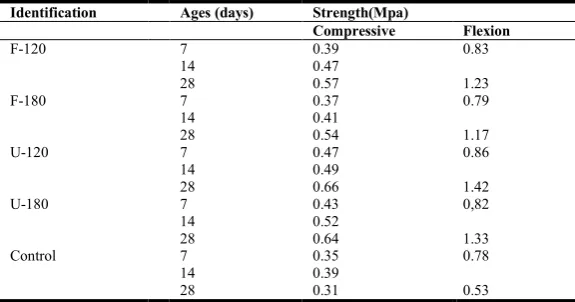
Compressive and flexion strengths: Table 3 presents the
compressive and flexion strengths values of each specimen from the four experimental mixtures. The values given are based on the average obtained on three (03) test pieces.
a. Néré’s pods uncut
Figure
a. Driedcowdung
74472 International Journal of Current Research,
Figure 1. Parkiabiglobosa fruit
a. Néré’s pods uncut b. Cut Néré’spods
Figure 2. Néré’spods (Parkiabiglobosa)
b. Ground cow dung
Figure 3. Cowdung
Figure 4. Insulant specimens
International Journal of Current Research, Vol. 10, Issue, 10, pp.74470-74475, October, 2018
b. Cut Néré’spods
b. Ground cow dung
[image:4.595.136.437.533.606.2]
Figure
Figure 7. Evolution
Table 1
N° Indentification Filteredextracts
1 Control
2 F-120 X
3 F-180 X
4 U-120
5 U-180
Table 2. Tannin content in different concentrations of extracts
Concentration (g/l)
0 60 120 180 240
Tableau
Identification
F-120
F-180
U-120
U-180
Control
0.0 0.2 0.4 0.6 0.8 1.0 1.2
0
T
a
n
n
in
c
o
n
te
n
t
(m
g
C
E
/
g
e
x
tr
a
c
t
)
74473 Ernesto C. HOUEHANOU
Figure 5. Compressive and flexion strengths device
Evolution of the tannin content according to the concentration
Table 1. Characteristics of mixtures identification
Filteredextracts Unfilteredextracts Concentration (g/l)
0 120 180
X
X
X
X X
X X
Tannin content in different concentrations of extracts
Tannin content (mg CE/g) Maceration time
6h 24h 48h
0 0 0
0.340 0.716 0.364
0.578 1.033 0.475
0.716 1.132 0.645
0.696 0.952 0.478
Tableau 3. Compressive and flexion strengths
Ages (days) Strength(Mpa)
Compressive Flexion
7 0.39 0.83
14 0.47
28 0.57 1.23
7 0.37 0.79
14 0.41
28 0.54 1.17
7 0.47 0.86
14 0.49
28 0.66 1.42
7 0.43 0,82
14 0.52
28 0.64 1.33
7 0.35 0.78
14 0.39
28 0.31 0.53
50 100 150 200 250
Concentration en g/l
Teneur en tanins à 6h Teneur en tanins à 24h Teneur en tanins à 48h
Ernesto C. HOUEHANOU et al.Conception and mechanical characterization of an insulation bio
Cowdung
X X X X X
250
[image:4.595.141.429.641.792.2]Figure 8. Compressive strength after 7, 14 and 28 days
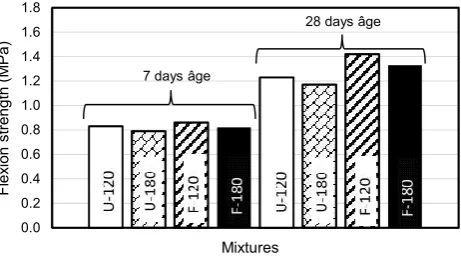
Figure 9. Flexion strength after 7 and 28 days
The values of compressive strengths are between 0.54 and 0.67 MPa while those of flexion strengths are between 1.1 and 1.4 MPa. The lowest values of compressive and flexion strengths are obtained on the Control. The highest values are obtained with the specimen prepared with the filtered extract.
DISCUSSION
Tannin content: The calibration curve of catechin has for
equation y = 12.857x with a coefficient of determination R2 = 0.9968. From this curve is derived Figure 7 showing the evolution of the tannin content as a function of the extract concentration for the different maceration duration. The determination of the tannin content shows that the best maceration time of Néré pods is 24 h with maximum tannin levels of 120 g/l and 180 g/l of extract. At less than 24 hours of maceration the tannin content is low for the same concentration. More than24 hours of maceration, fermentation is observed in the jars, this could justify the decrease in the tannin content observed on the graph. It is at the end of these observations that the concentrations of 120 g/l and 180 g/l of Néré's pods extract, after twenty four (24) hours maceration, were retained for making insulant specimens.
Compressive and flexion strengths (mechanical
characterization): Figures 8 and 9 respectively show the
evolution of the values of the compressive and flexion strengths of the various categories of tests specimens. Figure 8 shows the evolution of the compressive strength of the specimens according to the age evolution. The control specimen (not containing Néré's pods) present lower compressive strengths than specimens containing Néré’s pods.
The same trend is observed on the values of flexion strengths (figure 9). The compressive strength of the specimens containing Néré’s pods increased with the age evolution of the specimens, whereas for specimens made with water (not containing Néré's pod), the compressive strength significantly decreased from fourteen (14) days of age. The low compressive and flexion strengths observed on the specimens containing no Néré's thimble confirmed the binding effect of certain plant extracts, in particular those resulting from Néré's pods, which is essentially due to the presence of tannin (Sorgbo, 2016). The compressive strength values obtained on Néré's pod extract unfiltered are relatively higher than those obtained on unfiltered extract-based test specimens. This relative decrease in mechanical performance is due to the presence of debris which generates a probable decrease in the effective amount of tannin present in the mixture.The figure 8 shows that the compressive strength values of specimens produced with a concentration of 120 g/l of Néré’s pod extract are generally higher than those of the specimens produced with the concentration of 180 g/l. This tendency is systematic for the results at seven (07) and fourteen (14) days of age, for the samples based on filtered and unfiltered extracts.
Nv
In regards to flexion strengths, figure 9shows that the values obtained after twenty-eight (28) day are significantly higher than those obtained after seven (07) days; as well for specimens based on filtered and unfiltered extracts. But flexion strength values obtained on the samples with 120 g/l of extract are relatively higher than those produced with a concentration of 180 g/l. This suggests that the concentration of 120 g/l is of greater interest for the development of resistance in the cow dung/Néré’s pods matrix. The use of Néré’s pods debris in the mixture did not produce a beneficial effect for resistance development.Conclusion
This study shows that insulantspecimens containing a concentration of 120 and 180 g/l of Néré’s pods
(Parkiabiglobosa) extract present good compressive and
flexion strengths compare to the control. This because of their tannins content brought by Parkiabiglobosa pod extract. But specimens produced with filtered extract gave a higher compressive and flexion strengths more than those with unfiltered extract. Additional work such as acoustic and thermal characterizations is important to complete this study.
REFERENCES
Appiah, K. A. 2013. Improving the Structural Characteristics of Earth Blocks as an Input of Affordable Housing for Low Income Northern Communities of Ghana, international
journal of science and research, 8p, 1119-1127
Banakinao, S. 2016. Data of the use of tanin of néré (Parkiabiglobosa) as a solution for the sustainability of the soil constructions West Africa, data in brief, 9p, 474-483 Bothon, F.T.D., Debiton, E., Avlessi, F., Forestier, C.,
Teulade, JC., Sohounhloue, D.K.C. 2013. In vitro
biological effects of two anti-diabetic medicinal plants used in Benin as folk medicine. BMC Complementary and Alternative Medicine, 13: 51 : 1-8.
Chenailler H. 2012. L’efficacité d’usage énergétique pour une meilleure gestion de l’énergie électrique intégrant les occupants dans les bâtiments, Thèse de doctorat de l’université de Grenoble.
0.3 0.4 0.5 0.6 0.7
5 10 15 20 25 30
C
omp
ress
iv
e s
tr
en
g
th
(M
Pa)
Ages (days)
U-120
U-180
F-120
F-180
Control
0.0 0.2 0.4 0.6 0.8 1.0 1.2 1.4 1.6 1.8
Fl
ex
io
n
strength
(M
Pa)
Mixtures
7 days âge
28 days âge
[image:5.595.49.280.253.381.2]Christophe, J.D. 2004. La bouse : historique, importance et écosystème. Thèse de Doctorat de l'Ecole Nationale Vétérinaire de Toulouse
Djossou, A.A., Houehanou, E., Houngan, A.C., Ayena, V., Vianou, A. 2018. Thermal effusivity, thermal conductivity and compressive strength of cement stabilized laterites blended with cow dung. Journal of Applied Science and Technology, 22(1): 22-27.
Escadeillas,G. 2006. Les éco-matériaux dans la construction: enjeux et perspectives. Toulouse: INSA-UPA.
GanaA. K. 2011. Cowdung: soil amendment agent for the sandy upland sugarcane ecology in Nigeria. Journal of Agricultural Technology, 7(2): 497-505.
Houéhanou, E., Gbaguidi-Aisse, G., Tankpinou-Kiki, Y., Djossou, A., Houngan, A., Degan, G. 2017. Influence of the use of the dung of cow on the compressive strength of mortars of bar ground, Building and reconstruction.
Scientific and Technical Journal, 73(5): 67-80.
Kossi, B. 2016. Study of thermal and mechanical performance of laterite blocks mixed with néré pod for the thermal insulation of buildings. Physical science international journal, 11(2): 1-10.
Lemoine, F. 1998. La bouse de vache: folklore et traditions, thèse vétérinaire, ENVT.
Mahamat, A. D2015. Effect of cow’s dung on thermophysical characteristics of building materials based on clay.
Research journal of applied sciences, engineering and technology, 10(4): 464-470
Mercier, D. 2011. Les isolantsthermiquesnaturels: construction verte et efficacitéénergétique, 5p
Milligo, Y., Aubert, J. E., Séré, A. D., Fabbri, A. and Morel, J. C. 2016. Earth blocks stabilized by cow-dung. Materials and Structures, 49 (11): 4583–4594.
Sorgho, B., Bressollier, P., Guela, B., Zerboa, L., Ouedraogo, R., Gomina, M., Blanchart, P. 2016. Étude des propriétés mécaniques des géomateriaux argileux associant la décoction de Parkia Biglobosa (néré) Comptes Rendus Chimie,19(7) : 895-901