ISSN Online: 2160-889X ISSN Print: 2160-8881
DOI: 10.4236/opj.2017.78B007 Aug. 10, 2017 40 Optics and Photonics Journal
Optical and Network Performance Analysis
of XGS-PON System over Active
Co-Existence PON Systems
D. Tarsono, A. Ahmad, K. Khairi, K. A. Sharif, M. H. Othman, N. A. Ngah, Z. A. Manaf
Communication Technology, TM Research & Development, Cyberjaya, Malaysia
Abstract
We proposed an enhanced Reach Extender (RE) called Active Co-existence (ACEX) and investigate its performance with respect to XGS-PON system that co-exist with GPON and TWDM-PON system. The RE is consists of hy-brid optical amplifier integrated (EDFA and SOA) with Co-existence Element (CEX) module which is installed at the Central Office (CO) together with the OLT system and act as a booster and pre-amplifier for the downstream and upstream optical signal respectively. The results show that the proposed ACEX is capable to support XGS-PON operation for a maximum distance of 35 km with 128 splitting ratio and up to 44 dB link loss.
Keywords
GPON, XGS-PON, TWDM-PON, Co-Existence Element, Active Co-Existence, Reach Extender
1. Introduction
The IP traffic is expected to grow at Compound Annual Growth Rate (CAGR) of 22% from 2015 to 2020, rapidly driven by high bandwidth demand and high-end applications and services such as High-Definition Television (HDTV) which evolves towards 4 K - 8 K resolution, Machine to Machine (M2M) communica-tion and Internet of Everything (IoE) [1]. Due to the aggressive demand from the consumers and the need to expand the revenue by the network operators, the current optical access network should be upgraded by utilize co-existing PON technology with the Next Generation PON systems (NG-PON), capitalizing on the deployed optical distribution network (ODN) and optimizing the initial network investments.
How to cite this paper: Tarsono, D., Ah-mad, A., Khairi, K., Sharif, K.A., Othman, M.H., Ngah, N.A. and Manaf, Z.A. (2017) Optical and Network Performance Analysis of XGS-PON System over Active Co-Exis- tence PON Systems. Optics and Photonics Journal, 7, 40-48.
https://doi.org/10.4236/opj.2017.78B007
DOI: 10.4236/opj.2017.78B007 41 Optics and Photonics Journal
Current Gigabit PON (GPON) technology is widely deployed by many coun-tries in the world covering the distance up to 20 km or less with 32 splitting ratio and loss budget of 28 dB using Class B+ system [2]. XG-PON and 10 GEPON were then initiated to satisfy the increasing traffic demands with asymmetrical transmission (10 Gbps/2.5 Gbps) as speficied by ITU-T G.987 and IEEE stan-dard 802.3. [3]. The Full Service Access Network (FSAN) community has pro-posed Time Wavelength Division Multiplexing-PON (TWDM-PON) as a future candidate for NG-PON2 system by assigning several wavelengths for each OLT
port with dynamic wavelength and bandwidth allocation (DWBA) for its com-munication flow control [4]. However the deployment of the TWDM-PON is temporarily halted by the high cost of the tunable optical transceivers. As a tran-sition solution, 10 Gigabit Capable Symmetric Passive Optical Network (XGS- PON) is introduced to deliver 10 Gbps in both directions as well as supporting dual rate transmission [5]. The XGS-PON is complied with major requirements of NG-PON1 to co-existing with the current deployed G-PON system and util-izing its ODN that consumed 70% of the total investment in PON deployment [6].
The minimum requirement of XGS-PON is to support fiber distance of at least 20 km and 64 splitting ratio. In order to achieve longer reach, higher capac-ity, larger bandwidth and more users, ITU-T proposed the use of higher power transceivers and RE [7]. Previous work has proposed inline optical reach ex-tender which able to operate in hybrid PON system with maximum distance of 30 km and link loss budget of 31 dB [7]. An optical amplifier based GPON reach extender deployed underground and demonstrated an error free operation over 28 dB on distribution loss [10]. Another option is using an Optical-Electrical- Optical (O-E-O) as an inline RE which is located 80 km from the OLT providing 128 splitting ratio with 59 dB link loss budget [8]. However, there is no electrical power source supplied to the current ODN, and inline RE approach will increase complexity and cost. Distributed Raman amplification will prevent such prob-lem to arise [9] but the amplifier is not optimal for 1270 nm transmission and wide amplification spectrum could interfere, thus co-existence with other PON systems is not possible.
In this paper, we propose an enhanced reach extender called Active CEX (ACEX) that is installed together with the OLT systems at the CO. The per-formance of XGS-PON system co-existing with the current G-PON and TWDM-PON system in a single ODN setup is investigated. We characterize the gain and Noise Figure (NF) of the ACEX, and analyze the performance of the extended XGS-PON system in terms of frame loss and throughput for various values of distances and splitting ratios.
2. Experimental Setup
2.1. ACEX Experimental Setup for PON Systems
DOI: 10.4236/opj.2017.78B007 42 Optics and Photonics Journal
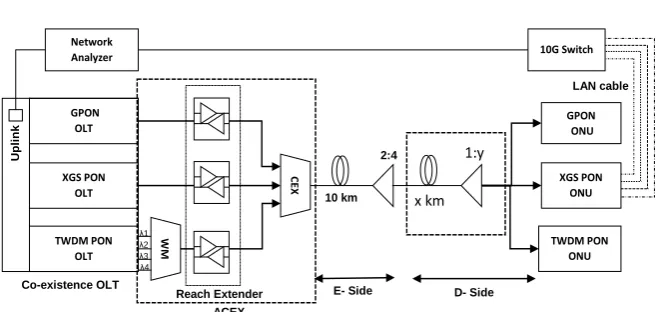
Figure 1. Experimental setup for coexistence system G-PON, XGS-PON and TWDM- PON.
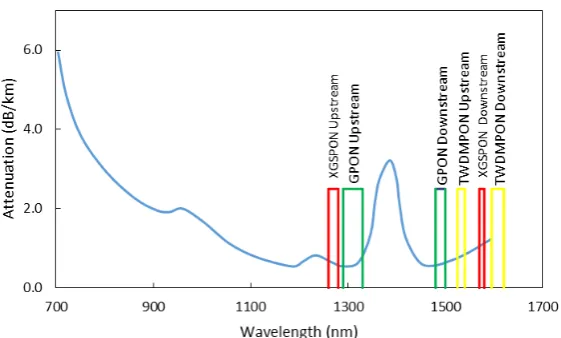
XGS-PON and TWDM-PON OLTs. The XGS-PON system utilizes 1577 nm and 1270 nm wavelengths for symmetrical 10 Gbps downstream and upstream transmission respectively.
Complete wavelength plans of the co-exist PON systems as shown in Figure 2, depicts the legacy PON (G-PON) that XGS-PON and TWDM-PON systems must be considered relative to migration and co-existence requirements.
In order to realize co-existing system, passive CEX is installed to combine all the PON systems into the same fiber link. Meanwhile the TWDM-PON system needs a Wavelength Multiplexer (WM) to stack four pairs of wavelengths that would support aggregated rates of 40 Gbps downstream and 10 Gbps upstream [6]. Each PON systems are also equipped with RE to provide longer distance and higher splitting ratio. Specifically for XGS-PON, we have developed RE using Erbium Doped Fiber Amplifier (EDFA) for the downstream and Semiconductor Optical Amplifier (SOA) for the upstream transmission. All the passive CEX, WM and RE are integrated to form ACEX as shown in Figure 1.
We also prepared a testbed for the ODN that comprised of 10 km fiber cable for the Exchange side (E-side) with a 2 × 4 optical splitter (1st stage). We vary the Distribution side (D-side) fiber cable distance from 15 to 35 km and the second stage (2nd stage) optical splitter from 1 × 4 to 1 × 32 forming maximum splitting ratio of 128.
The measurement are based on Ethernet frame loss and throughput analysis which is carried out using IXIA system on symmetrical 10 Gbps bidirectional Ethernet traffic with frame length of 1518 bytes. The throughput measurement is limited by four RJ-45 ports for Gigabit Ethernet interfaces on the Optical Net-work Unit (ONU) output ports which provides maximum total throughput of 4 Gbps symmetrical.
2.2. XGS PON Reach Extender
For XGS PON, we have developed bidirectional reach extender to cater the downstream and the upstream optical signal using a pair of Multi Wavelength Di-
GPON OLT XGS PON OLT TWDM PON OLT WM CE X GPON ONU XGS PON ONU TWDM PON ONU Co-existence OLT
[image:3.595.209.538.58.214.2]DOI: 10.4236/opj.2017.78B007 43 Optics and Photonics Journal
Figure 2. Complete wavelength plans across attenuation of G.652 single mode fiber (ITU- T.G.652).
vision Multiplexers (MWDM) as shown in Figure 3. The downstream extender is consisted of Erbium Doped Fiber Amplifier (EDFA) which operates at 1577 nm and semiconductor amplifier (SOA) at 1270 nm for the upstream transmission. The reach extender is also equipped with monitoring and controller to ease monitoring and configuration of the extender. The reach extender is located with the OLT to simplify future maintenance and maintaining the passive opti-cal access network.
3. Result and Discussion
In this section, the results are presented into two parts. The first part is the opti-cal performance of XGS-PON Reach Extender and the second is network per-formance of XGS-PON coexist with PON systems.
3.1. Optical Performance of XGS-PON Reach Extender
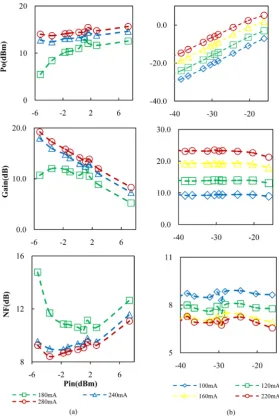
Figure 4 shows the optical performance in terms of Output Power (Po), Gain and Noise Figure (NF) as a function of several values of Input Power (Pin) of the incoming wavelengths, 1577 nm and 1270 nm for downstream and upstream respectively.
For downstream performance, it can be seen an amplified of incoming signal where the output power for all pump laser diode (LD) current setting was achieved. By taking the incoming input power is 0 dBm as a reference, it can be seen the output power was achieved up to 10 dBm with 10 dB gain and the NF at 8.2 dB. These values are adequate in order the signal transmitting over dB link loss to the receiving end (ONU).
DOI: 10.4236/opj.2017.78B007 44 Optics and Photonics Journal
Figure 3. XGS-PON reach extender configuration.
[image:5.595.232.512.274.694.2]DOI: 10.4236/opj.2017.78B007 45 Optics and Photonics Journal
respectively. It can be noticed that the gain and NF are consistent for all values of incoming upstream signal. This is due to the fact that the upstream SOA was operating in a saturation region. For this design, the NF performance achieved between 7 dB to 9 dB.
Figure 5 shows the measurement of loss of ODN for all network design. The results shows the loss of ODN propotional to the number of splitting ratio and distance. This is due to the fact that the difference value of insertion loss contri-buted from splitters as well as fiber distance. In our network design, the loss contributed from ODN which was consists of CEX, severals splitters, a distance of fiber and other passive components (connectors and adapters).
3.2. Network Performance of XGS-PON Reach Extender
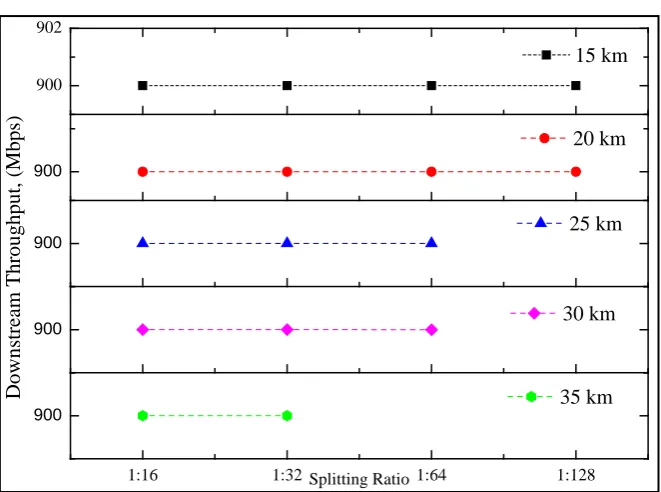
The system performance of coexistence PON system network with ACEX is then evaluated in throughput for both downstream and upstream. Figure 6 shows the downstream throughput as a function of splitting ratio with several distance of fiber. The splitting ratio was effected at second stage splitter (D-side) as shown in Figure 1. The through put performance achieved 900Mbps for all type of splitting (1:16, 1:32, 1:64 and 1:128) with respective distances. It can be seen that the network throughput was affected by the distance and splitting ratio as these parameters contributed to loss in the network. In order to maintain an optimum value of network throughput, the maximum splitting ratio is 1:128 with the dis-tance of 15 km, or up to 36.5 dB link loss.
[image:6.595.213.537.443.697.2]The upstream throughput performance is depicted in Figure 7. The maxi-mum throughput was achieved at 900 Mbps and the minimaxi-mum value is 876
Figure 5. Link Loss of ODN to the number of splitting ratio and distance.
1:16 1:32 1:64 1:128
26 28 30 32 34 36 38 40 42 44
L
os
s,(
dB
)
Splitting Ratio
DOI: 10.4236/opj.2017.78B007 46 Optics and Photonics Journal
Figure 6. Throughput performance against splitting ratio for downstream transmission.
Figure 7. Throughput performance against splitting ratio for upstream transmission.
Mbps. For all distances with splitting ratio of 1:16, the best value of network throughput (900 Mbps) was achieved. However, it can be seen the dropped of upstream throughput when the number of splitting ratio and distance increased. As mentioned earlier, the attenuation contributed by splitting ratio and distance which was affected the signal transmitted from ONU to OLT, and therefore the
900 902
900
900
900
1:16 1:32 1:64 1:128
900
15 km
20 km
D
ow
ns
tr
ea
m
T
hr
oughput
, (
M
bps
)
25 km
30 km
Splitting Ratio
35 km
1:16 1:32 1:64 1:128
876 898 900 902
U
ps
tr
ea
m
T
hr
oughput
,(
M
bps
)
Splitting Ratio
DOI: 10.4236/opj.2017.78B007 47 Optics and Photonics Journal
results are explained.
4. Conclusion
We demonstrated the performance of XGS-PON system performance over Ac-tive Co-existence (ACEX). From the result, the downstream throughput achiev- ed 100% regardless distance and splitting ratio. For the upstream performance, the throughput showed 97% up to 35 km distance with the maximum splitting ratio at 32. In addition, with an optimal performance of ACEX, in terms of NF and gain, the throughput obtained 99% at the distance of 15 km with the split-ting ratio at 128. The results showed that the proposed ACEX could compensate the link loss up to 43 dB. Based on the findings, the system performance is feasi-ble solution for future upgrading of Next Generation PON systems.
Acknowledgements
The Authors would like to express gratitude to Telekom Malaysia Berhad (TM) in general, and TM Research & Development for the grant.
References
[1] Cisco Visual Networking Index (2016) Forecast and Methodology, 2015-2020.
http://www.cisco.com/c/en/us/solutions/collateral/service-provider/visual-networki
ng-index-vni/complete-white-paper-c11-481360.html
[2] ITU-T.G.984.2 Amd 2. Gigabit-Capable Passive Optical Networks (G-PON): Physi-cal Media Dependent (PMD) Layer Specification. ITU-T Rec. G.984.2 (2003)/Amd.2 (03/2008). https://www.itu.int/rec/T-REC-G.984.2/en
[3] ITU-T.G.987.1. 10 Gigabit-Capable Passive Optical Networks (XG-PON): General Requirements. ITU-T Rec. G.987.1 (03/16).
https://www.itu.int/rec/T-REC-G.987.1/en
[4] Taguchi, K., Asaka, K., Fujiwara, M., Kaneko, S., Yoshida, T., Fujita, Y., Iwamura, H., Kashima, M., Furusawa, S., Sarashina, M., Tamai, H., Suzuki, A., Mukojima, T., Kimura, S., Suzuki, K.-I. and Otaka, A. (2016) Field Trial of Long-Reach and High- Splitting λ-Tunable TWDM-PON. J. Lightwave Technol, 34, 213-221.
https://doi.org/10.1109/JLT.2015.2494606
[5] ITU-T G.9807.1 (2016) 10 Gigabit-Capable Symmetric Passive Optical Network. ITU-T G.9807. https://www.itu.int/rec/T-REC-G.9807.1/en
[6] Huawei Technologies (2010) Next-Generation PON Evolution.
www.huawei.com/ilink/en/download/HW_077443
[7] Le Guyader, B., et al. (2012) Dual Reach Extender Based on Optical Amplification for G-PON and Symmetrical 10G-PON Systems. OFC/NFOEC, Los Angeles, 1-3.
https://doi.org/10.1364/NFOEC.2012.NTu1J.2
[8] KwangOk, K. and HwanSeok, C. (2016) Real-Time Demonstration of Extended 10G-EPON Capable of 128-Way Split on a 100 km Distance Using OEO-Based PON Extender. 2016 International Conference on Information and Communication Technology Convergence (ICTC), Jeju Island, 930-932.
https://doi.org/10.1109/ICTC.2016.7763333
DOI: 10.4236/opj.2017.78B007 48 Optics and Photonics Journal
Burst-Mode Analysis of XGPON Raman Reach Extender Employing Quantum-Dot Lasers. Electronics Letters, 52, 1157-1158.
[10] Nesset, D., et al. (2008) Field Experiment with a Hardened GPON Reach Extender with Dual Parenting Protection. Proc. ECOC, Th.2.F.3.
https://doi.org/10.1109/ECOC.2008.4729418
Submit or recommend next manuscript to SCIRP and we will provide best service for you:
Accepting pre-submission inquiries through Email, Facebook, LinkedIn, Twitter, etc. A wide selection of journals (inclusive of 9 subjects, more than 200 journals)
Providing 24-hour high-quality service User-friendly online submission system Fair and swift peer-review system
Efficient typesetting and proofreading procedure
Display of the result of downloads and visits, as well as the number of cited articles Maximum dissemination of your research work
Submit your manuscript at: http://papersubmission.scirp.org/