Break Date Estimation for Models with
Deterministic Structural Change
DAVID I. HARVEY
y
and STEPHEN J. LEYBOURNE
y
y
Granger Centre for Time Series Econometrics and
School of Economics, University of Nottingham, University Park,
Nottingham, NG7 2RD, UK
(e-mails: [email protected],
[email protected])
April 2013
Abstract
In this paper we consider estimating the timing of a break in level and/or trend when the order of integration and autocorrelation properties of the data are unknown. For stationary innovations, break point estimation is commonly per-formed by minimizing the sum of squared residuals across all candidate break points, using a regression of the levels of the series on the assumed deterministic components. For unit root processes, the obvious modi cation is to use a rst di erenced version of the regression, while a further alternative in a stationary au-toregressive setting is to consider a GLS-type quasi-di erenced regression. Given uncertainty over which of these approaches to adopt in practice, we develop a hybrid break fraction estimator that selects from the levels-based estimator, the rst-di erence-based estimator, and a range of quasi-di erence-based estimators, according to which achieves the global minimum sum of squared residuals. We establish the asymptotic properties of the estimators considered, and compare their performance in practically relevant sample sizes using simulation. We nd that the new hybrid estimator has desirable asymptotic properties and performs very well in nite samples, providing a reliable approach to break date estimation without requiring decisions to be made regarding the autocorrelation properties of the data.
Keywords: Break point estimation; Break in level; Break in trend; Local-to-zero breaks.
1
Introduction
The recent literature is replete with analysis focusing on structural change in the trend function of a time series, motivated by the apparent prevalence of breaks in level and/or trend in macroeconomic time series; see, for example, Stock and Watson (1996, 1999, 2005) and Perron and Zhu (2005). Correct speci cation of a break in the deterministic trend path of a series is vital for modelling, estimation and forecasting e orts, and is crucial for achieving reliable unit root test inference (see, inter alia, Perron (1989)). Given that in most macroeconomic series, uncertainty also exists as to whether the underlying stochastic component is best modelled by a stationary (I(0)) or unit root (I(1)) process, much recent work (e.g. Harvey et al. (2009, 2010), Perron and Yabu (2009), Sayg nsoy and Vogelsang (2011) and Vogelsang (1998)) has been directed at testing for the presence of structural break(s) when the true order of integration of the series is assumed unknown.
Of equal importance to the presence of a break in level and/or trend in a series is the related issue of the timing of the change, and it is the estimation of such break-points that this paper addresses. While a number of methods of break date estimation have been proposed in the literature, selection of an e cient break fraction estimator is complicated by the aforementioned fact that the order of integration is typically not known with certainty. In the context of stationary innovations, Bai (1994) and Bai and Perron (1998), inter alia, consider choosing the break date which corresponds to minimizing the sum of squared residuals, across all candidate break points, from a regression of the level of the series on the appropriate deterministic regressors. In a unit root setting, a more e cient approach is obtained by minimizing the sum of squared residuals from a rst-di erenced version of the relevant regression; see Harris
et al. (2009). A further alternative, adopted by Carrion-i-Silvestre et al. (2009) in an assumed local-to-unity setting, is to again date the break according to the mini-mum residual sum squares, but using a quasi-di erenced regression. Practitioners are then faced with choosing between a number of candidate break fraction estimators, inevitably without knowledge of the underlying integration properties of the series.
of a break at an unknown time.
The outline of the paper is as follows. In section 2, we begin by establishing, using a local-to-zero break magnitude assumption, the asymptotic properties of break fraction estimators based on both quasi-di erenced (which includes levels as a special case) and rst-di erenced regressions, and con rm that the former is to be preferred for a stationary series, and in general the latter for a unit root process. In section 3, we then develop a hybrid estimator which selects between the rst-di erenced-based estimator and a range of quasi-di erenced-based estimators according to which achieves the global minimum sum of squared residuals. The large sample behaviour of the new estimator is also established. Section 4 demonstrates through a nite sample Monte Carlo analysis that the hybrid estimator performs extremely well across a wide range of possible DGPs, outperforming established break fraction estimators (which perform badly outside of their respective assumptions regarding the integration order of the data). The hybrid estimator is simple to compute, and is found to comprise a reliable approach to break date estimation without requiring a priori decisions to be made regarding the autocorrelation properties of the data. Section 5 concludes. Proofs of the main results are provided in the online Appendix to this paper.
In the following, `b:c' denotes the integer part of its argument, `)' denote weak convergence, and 1(:) denotes the indicator function.
2
The model and standard break date estimators
We consider the following model allowing for a break in level and trend
yt = 1 + 2t+ 1DUt( ) + 2DTt( ) +ut; t= 1; :::; T; (1)
ut = ut 1+"t; t= 2; :::; T (2)
with u1 ="1, where DUt( ) = 1(t >b Tc) and DTt( ) = 1(t >b Tc)(t b Tc)
with b Tc the break point with associated break fraction and level and trend break magnitudes 1 and 2, respectively. Here is unknown but satis es 2 , where = [ L; U] with 0 < L < U <1. To make our theoretical developments as
transparent as possible, we assume that the innovation process f"tg of (2) is an IID
sequence with variance !2
" and nite fourth moment. The partial sum process of f"tg
then satis es a functional central limit theorem [FCLT],
T 1=2 bT rc
X
t=1
"t )!"W(r)
where W(r) is a standard Brownian motion process on [0;1].
We consider two cases for the order of integration of the autoregressive process,
ut. The I(0) case for ut is represented by setting j j < 1 in (2). In this situation the
long run variance of ut is given by !2u = !2"=(1 )2. Here we will also assume that
the appropriate Pitman drifts for the asymptotic analysis of break date estimators in this case. The I(1) case for ut is represented by setting = 1 in (2). Here we assume
1 = 1 and 2 = 2;T = 2T 1=2 which are now the appropriate scalings.1 For future brevity, the two cases are summarized as follows:
Assumption I(0): j j<1 with 1 = 1;T = 1T 1=2 and 2 = 2;T = 2T 3=2.
Assumption I(1): = 1 with 1 = 1 and 2 = 2;T = 2T 1=2.
We consider estimating by minimizing the residual sum of squares from a quasi-di erenced version of (1), i.e.
^ = arg min
2 S( ; )
whereS( ; ) denotes the residual sum of squares from an OLS regression ofy onZ ;
with
y = [y1; y2 y1; :::; yT yT 1]0;
Z ; = [x1;x2 x1; :::;xT xT 1]0 with xt= [1; t; DUt( ); DTt( )]0:
If were known, standard GLS-based e ciency considerations would lead us to set = . For example, if = 0, we would obtain ^0 from the levels of yt regressions as
^0 = arg min
2 S(0; )
= arg min
2 T
X
t=1
fyt ^1 ^2t ^1DUt( ) ^2DTt( )g2
while if = 1, we would obtain ^1 from the rst di erences of yt regressions as
^1 = arg min
2 S(1; )
= arg min
2 T
X
t=2
f yt ^2 ^1Dt( ) ^2DUt( )g2
with Dt( ) = 1(t =b Tc+ 1).2
In practice of course, the value of is typically unknown, so we begin by establishing the asymptotic behaviour of di erent estimators under both I(0) and I(1) speci cations. To this end, the next two theorems detail the large sample properties of ^ for an arbitrary where 1< 1.
1Note that the appropriate \scaling" on the level break in the I(1) case is O(1), and di ers from
theO(T1=2) Pitman drift appropriate when testing for the presence of a level break in an I(1) process. 2Here the OLS estimators ^
1, ^2, ^1 and ^2 are used in a generic sense. They are also functions
Theorem 1 Under Assumption I(0),
(i) for j j<1
^ ) arg sup
2
[A( 01; 02; ; ) B1( )C( 01; 02; )]0B2( ) 1[A( 01; 02; ; ) B1( )C( 01; 02; )]
L0( 01; 02; ) (3)
where
A( 01; 02; ; ) =
0
1G11( ; ) + 02G21( ; ) +W(1) W( ) 0
1G12( ; ) + 02G22( ; ) +
R1
(r )dW(r)
B1( ) =
(1 )(1 3 ) 6 (1 )
(1 )2 (1 )2(1 + 2 )
B2( ) =
(1 ) (1 3 + 3 2) 2(2 1) (1 )2
=2 2(2 1) (1 )2
=2 3(1 )3
=3
C( 01; 02; ) = 01(1 ) + 02(1 ) 2
=2 +W(1)
0
1(1 2)=2 + 02(1 ) 2
(2 + )=6 +R01rdW(r)
with 0
i = i=!u and
G11( ; ) = 1 1
G21( ; ) =
(1 ) (1 + 2 )=2
(1 )2=2
G12( ; ) =
(1 )2=2
(1 ) (1 + 2 )=2
G22( ; ) =
(1 )2(2 + 3 )=6
(1 )2(2 + 3 )=6 ;
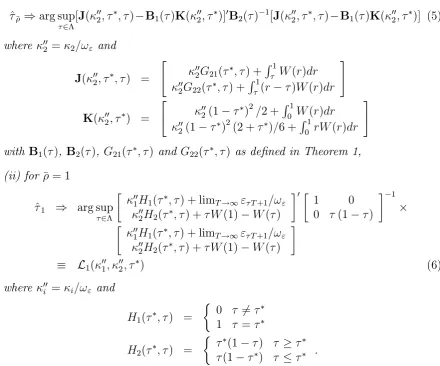
(ii) for = 1
^1 )arg sup 2
lim
T!1 u 2
T+1: (4)
Remark 1 It is shown by (3) that ^ has a limit distribution which is invariant to all
j j<1; this follows as a consequence of the asymptotic equivalence between levels and quasi-di erenced regression estimates in this context (see Grenander and Rosenblatt, 1957). However, the distribution does depend on via !u in 0i.
Remark 2 The corresponding limit (4) for ^ with = 1 can only be written in an implicit form, because it only depends on the two disturbances u T+1 and u T hence
no FCLT is applicable. The more pertinent feature here, however, is that (4) does
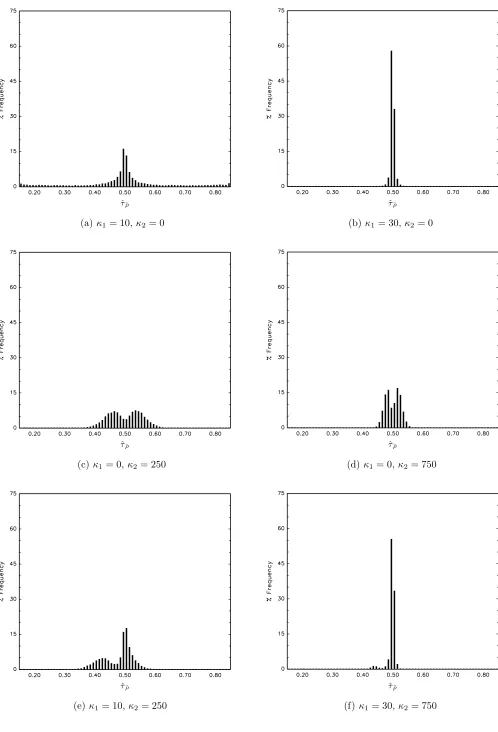
Figure 1 provides histograms of the limit distributionL0( 01; 02; ) for various com-binations of non-zero values of 1 and 2 for the case of = 0:5. Here we set = 0 and!" = 1, such that!u = 1 and hence 0i = i. We approximate the limit functionals
by normalized sums of 1,000 steps using normal IID(0;1) random variates. In the simulations here and in the remainder of the paper we set = [0:15;0:85] and employ 10,000 Monte Carlo replications. All simulations were programmed in Gauss 9.0. The results are largely as we would expect; accuracy of ^ , j j < 1 as an estimator of , measured subjectively, improves with increasing 1 and/or 2. When 1 is zero, ^ ,
j j < 1 has a bimodal and (near) symmetric distribution around = 0:5, and when neither 1 or 2 are zero the distribution is bimodal but not symmetric; both these properties are consistent with the results documented by Perron and Zhu (2005) under an assumption of xed magnitude (as opposed to local-to-zero) breaks.3
Theorem 2 Under Assumption I(1),
(i) for j j<1
^ )arg sup
2
[J( 002; ; ) B1( )K( 002; )]0B2( ) 1[J( 002; ; ) B1( )K( 002; )] (5) where 00
2 = 2=!" and
J( 002; ; ) =
"
00
2G21( ; ) +
R1
W(r)dr 00
2G22( ; ) +
R1
(r )W(r)dr
#
K( 002; ) =
"
00
2(1 )
2
=2 +R01W(r)dr 00
2(1 )
2
(2 + )=6 +R01rW(r)dr
#
with B1( ), B2( ), G21( ; ) and G22( ; ) as de ned in Theorem 1,
(ii) for = 1
^1 ) arg sup 2
00
1H1( ; ) + limT!1" T+1=!" 00
2H2( ; ) + W(1) W( ) 0
1 0
0 (1 )
1
00
1H1( ; ) + limT!1" T+1=!" 00
2H2( ; ) + W(1) W( )
L1( 001; 002; ) (6)
where 00i = i=!" and
H1( ; ) =
0 6=
1 =
H2( ; ) =
(1 )
(1 ) :
3We do not explore the consequences of di erent or !
Remark 3 It is shown by (5) that ^ has a limit distribution which is invariant to all j j<1. The more pertinent feature here, however, is that (5) doesnot involve 1. Hence, ^ with j j < 1 cannot be used to detect level breaks under Assumption I(1). Also, the limit expression (5) is very similar in structure to that of (3) - it is obtained from (3) by replacing dW(r) with W(r) and setting 01 = 0, 02 = 002. In contrast, as would be expected given its appropriateness under Assumption I(1), the limit of ^1 involves both 1 and 2.
Figure 2 provides histograms of the limit distributionL1( 001; 002; ) for various non-zero values of 1 and 2 when = 0:5. Again !" = 1, so that 00i = i. Once more we
observe the accuracy of ^1 improving with increasing 1 and/or 2. Figure 3 gives the corresponding histograms for ^ ,j j<1; note that Figures 3(a) and 3(b) are identical, since 2 = 0 here and the limit does not depend on 1 (see Remark 3). For non-zero trend break magnitudes, ^ , j j < 1 detects the break with increasing accuracy as 2 rises, but a comparison with the corresponding histograms for ^1 in Figure 2 shows that while it is competitive for 2 = 5 (although neither estimator could be considered anyway decent here), it is clearly inferior to ^1 for 2 = 15. In related work, Yang (2012) considers the relative performance of levels- and rst-di erenced-based estimators for a model with unit root errors and a local break in trend only, showing that the levels estimator can outperform the rst-di erenced estimator for very small breaks. However, for such small break magnitudes in this region, both break point estimators display very poor accuracy (cf. Figures 2(c) and 3(c)), so the relative di erences here are of limited practical importance.
3
A hybrid break date estimator
The above asymptotic results suggest, fairly unambiguously, that in constructing ^ , we should choose some j j<1 if j j<1, and choose = 1 if = 1. This follows since ^1 cannot be considered a suitable estimator of the break fraction under Assumption I(0), and ^ ,j j<1 is e ectively outperformed by ^1 under Assumption I(1). However, given that we consider the true value of to be unknown in practice, we now consider developing a hybrid break fraction estimator that selects between the ^ , j j< 1 and ^1 possibilities depending on the sample's properties. To begin, if we consider just two possible values for : = 0 where j 0j < 1, and = 1, i.e. ^ 0 and ^
1 are the only possible estimators of , then we might consider selecting between ^ 0 or ^1 according
to which corresponds to the lowest residual sum of squares, i.e. choose
^ 0 if min 2 S( 0; )<min 2 S(1; )
^1 if min 2 S( 0; )>min 2 S(1; ) :
Another way of writing this is to de ne the hybrid estimator
^D2 = arg min
2 ; 2D2
where D2 =f 0;1g.4
To examine the asymptotic behaviour of this hybrid estimator ^D2, we rst establish
the limiting properties of S( ; ) under Assumption I(0) and Assumption I(1).
Theorem 3 Under Assumption I(0), for j j<1 and = 1
T 1S( ; )) ! 2 "
1 2(1 +
2 2 )
for all .
Theorem 4 Under Assumption I(1),
(i) for j j<1
T 2S( ; ))Q( ; !2"; 002; ; )
where Q(:) is some non-degenerate distribution for all ,5
(ii) for = 1
T 1S(1; ))!2"
for all .
If we rst consider behaviour under Assumption I(1), where = 1, it follows from Theorem 4 that T 2S( 0; ) converges to a distribution while T 1S(1; ) converges to !2
" for all . Asymptotically then, min 2 S( 0; )> min 2 S(1; ) > 0. Next, under
Assumption I(0), wherej j<1, Theorem 3 implies that
T 1S( 0; ) T 1S(1; ) ) ! 2 "
1 2f(1 +
02 2 0 ) 2(1 )g
= !
2 "
1 2 (1
0) (2 0 1)
for all . Since 1 0 >0 here, it follows that, asymptotically,
min 2 S( 0; )<min
2 S(1; ) if <( 0+ 1)=2
min 2 S( 0; )>min
2 S(1; ) if >( 0+ 1)=2
: (7)
Consequently, we nd that ^D2 = ^1 asymptotically if = 1 which is as we would
desire. Forj j<1, (7) shows us that ^D2 = ^ 0, the desired outcome, unless > 0 and
is closer to 1 than it is to 0, in which case ^
D2 = ^1 which is the ine ective estimator
in the I(0) case. By way of an example, suppose j j<1 and we set 0 = 0 (so that ^D2
selects between the levels- and the rst di erences-based estimators ^0 and ^1); we nd that ^D2 = ^1 (the ine ective estimator) in the region > 0:5. If on the other hand
4That is,D
2 is a discrete set consisting of the two elements 0 and 1.
5The precise form ofQ(:) can easily be established from the results in the Appendix; we omit the
we choose 0 = 0:9, we nd that ^
D2 = ^1 now only in the region > 0:95. Purely
asymptotic considerations would therefore indicate that the problem region associated with j j <1 can be made arbitrarily small by setting 0 = 1 , where >0 is made
arbitrarily close to 0, thereby reducing the problem region to >1 =2.
Notwithstanding our asymptotic results under Assumption I(0), in nite samples the choice of 0 will have a signi cant in uence of the behaviour of ^
D2 even when the
condition < ( 0 + 1)=2 is satis ed. Therefore, from a nite sample (i.e. empirical)
perspective the idea of setting 0 = 1 is unlikely to prove an attractive proposition unless is actually very close to 1, despite its asymptotic appeal.
As noted above, e ciency considerations suggest we should (infeasibly) always set = . As a step in this direction we consider generalizing the hybrid estimator by at least allowing to cover a subset of possible values for , replacing the 2 element set D2 with the m element set Dm = f 01; 02; :::; 0m 1;1g where j 0ij < 1 for all i and,
without loss of generality, 1< 01 < 02 < ::: < 0m 1 <1. Therefore, we now consider the following hybrid (pseudo GLS) estimator
^Dm = arg min
2 ; 2Dm
S( ; ) (8)
Note that ^Dm could equivalently be de ned as choosing one of ^ 01;^ 20; :::;^ 0m 1;^1
according to which of these estimators achieves the smallest residual sum of squares. The next Corollary is a useful initial step in explaining the limit behaviour of ^Dm.
Corollary 5
(i) Under Assumption I(0),
arg min
2Dm
S( ; ))
8 > > < > > :
0
1 if < 01
arg min 2D0
mj j if
0
1 0m 1
0
m 1 if 0m 1 < <( 0m 1 + 1)=2
1 if >( 0
m 1+ 1)=2
for all .
(ii) Under Assumption I(1),
arg min
2Dm
S( ; ))1
for all .
Part (ii) follows directly from Theorem 4, since T 1S( ; ) diverges to +
1 in T
unless = 1. Part (i) follows from Theorem 3 since we have
arg min
2Dm
S( ; ) = arg min
2Dm
T 1S( ; )
) arg min
2Dm
!2 "
1 2(1 +
2 2 )
= arg min
2Dm
Now
d( 2 2 )
d = 2( )
and so arg min 2DmS( ; ) ) arg min 2Dmj j. When < 01, clearly arg min 2Dm
j j = 0
1. Also, when 01 0m 1, arg min 2Dmj j = arg min 2Dm0 j j.
6
For > 0m 1, arg min 2Dmj j = 0m 1 unless > ( 0m 1 + 1)=2 in which case arg min 2Dmj j = 1. Notice that this condition coincides with that in the second
part of (7) (on replacing 0 with 0
m 1). Intuitively, in the limit, arg min 2DmS( ; ) is
always the element of Dm closest to the true value of .
The asymptotic behaviour of ^Dm can now be established under both Assumption
I(0) and Assumption I(1).
Corollary 6
(i) Under Assumption I(0),
^Dm )
arg sup 2 limT!1 u2T+1 if >( 0m 1+ 1)=2
L0( 01; 02; ) otherwise
:
(ii) Under Assumption I(1),
^Dm ) L1(
00
1; 002; ):
For part (ii), Corollary 5 (ii) implies that, asymptotically, arg min 2 ; 2DmS( ; ) =
arg min 2 S(1; ) which has the limit distributionL1( 001; 002; ) of Theorem 2 (ii). Part (i) follows from Corollary 5 (i). Using the nal limit of Corollary 5 (i) we nd that when
> ( 0m 1 + 1)=2 then, asymptotically, arg min 2 ; 2DmS( ; ) = arg min 2 S(1; )
which has the limit given in (4). Otherwise, using the rst three limits of Corollary 5 (i) we nd that, asymptotically, arg min 2 ; 2DmS( ; ) = arg min 2 S(h; ) where
h is some element of f 01; 02; :::; 0m 1g. Since jhj < 1 the limit distribution is then
L0( 01; 02; ) of Theorem 1 (i).
We nd, therefore, that under Assumption I(1), the hybrid estimator ^Dm has the
same limit behaviour as ^1, as we would wish, while under Assumption I(0), it has the same asymptotic properties as ^ , j j < 1, again as desired, unless happens to lie in the problem region > ( 0
m 1 + 1)=2. The hybrid estimator therefore has a clear asymptotic appeal, particularly if one makes the judicious choice of setting 0m 1 very close to 1. In the next section, we examine the behaviour of ^Dm in samples of
practically relevant size.
Finally, our asymptotic results imply that ^Dm has the same asymptotic properties
as the following sequential break fraction estimator: in the rst step, minimize S( ; )
6Notice that if it happens to be the case that
2 Dm then arg min 2D0m j j = (at which
point the limit ofT 1S( ; ) is!2
across Dm for any single value of 2 , in the second step, minimize S( ; ) across
imposing the value of obtained from the rst step. Such a sequential approach, while asymptotically valid, is likely to perform rather poorly in nite samples, since it is entirely possible that two di erent choices for in the initial minimization will lead to two di erent and, consequently, two di erent break fraction estimates. We therefore do not advocate use of this two step approach, instead recommending ^Dm
as de ned in (8).
4
Finite sample performance
In this section we compare the nite sample performance of the hybrid estimator ^Dm
with the levels- and rst-di erence-based estimators ^0and ^1. The simulation DGP is (1) and (2), withu1 ="1,"t N IID(0;1) and 1 = 2 = 0 (without loss of generality). As in the asymptotic simulations, we use = 0:5. For cases where ut is I(0), we set
1 = 1T 1=2, 2 = 2T 3=2 with 1 =f0;10;20;30gand 2 =f0;250;500;750g; where ut is I(1), we set 1 = 1, 2 = 2T 1=2 with 1 = f0;1;2;3g and 2 = f0;5;10;15g. The combination 1 = 2 = 0 is provided as a no-break point of reference. We consider the sample sizes T = 150 and T = 300 and a range of values of .
A choice must be made regarding Dm. Here we set Dm = f0;0:2;0:4;0:6;0:8;0:9;
0:95; 0:975;1g. This choice is motivated by two empirical observations regarding eco-nomic time series. The rst is that serial correlation is not usually found to be negative, so that we exclude negative values of . The second is that the serial correlation is often found to be very strongly positive (as exempli ed by the ongoing I(0)/I(1) debate), so we include some large values of < 1 as well as = 1; moreover, inclusion of the value 0:975 con nes the problem region discussed above to the small interval region 0:9875< <1.
For further comparison, we also examine an AR(1)-based estimator of . This is calculated from minimizing the residual sum of squares from the tted OLS regression
yt= 1 + 2t+ yt 1+ 1Dt( ) + 2DUt( ) + 3DTt( ) +et; t= 2; :::; T;
across . Here the one-time dummy variable Dt( ) is included to identify a level break
in the I(1) case (corresponding here to = 1). We denote this estimator as ^AR.
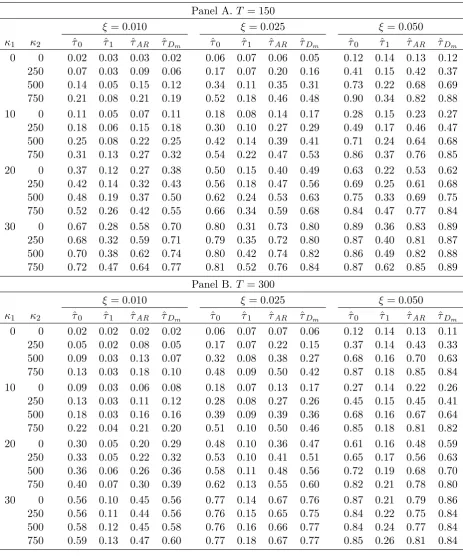
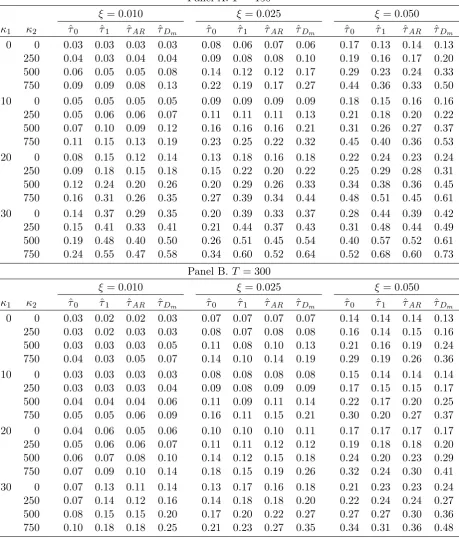
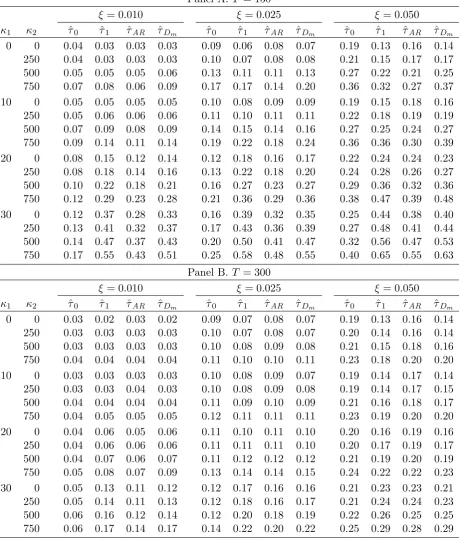
With four di erent break fraction estimators, sixteen combinations of break mag-nitude and two sample sizes, it is not practical to show full histograms across di erent values of . Instead, in Tables 1-5, we simply provide the empirical probability that each estimator lies in the range 0:010, 0:025 and 0:050. Other things equal, the larger these probabilities, then the better the estimator.
to the no-break reference case, in line with the result of Theorem 1 (ii) which showed that ^1 is asymptotically ine ective in this setting. We also see that, on balance, ^AR
does not perform as well as either ^0 or ^Dm. It is competitive when there is a pure
trend break, but loses out everywhere else. The estimators ^0 and ^Dm show almost
identical behaviour everywhere, highlighting the attractive performance of the hybrid estimator in this white noise case.
In Table 2 the errors are I(0), AR(1) with = 0:5. The comparative behaviour of the estimators remains pretty much the same as seen in Table 1, only with the di erences between worst and best being slightly less emphasized. Table 3 considers the case of I(0), AR(1) errors with = 0:925. Here, the stronger autoregressive component begins to diminish the ability of the estimators to identify the true break point, other than ^1, which improves relative to the = 0:5 case. However, rather encouragingly, it is the hybrid estimator ^Dm that shows the best performance overall.
Table 4 represents a problem case of I(0) but near I(1) errors, with = 0:994, this value of being chosen to lie in the middle of the asymptotic problem region for ^Dm. For T = 150, perhaps not surprisingly, given the strength of the autoregressive
component, ^1 is generally the best performing estimator here, although again ^Dm
performs very well and is a close competitor to ^1, comfortably out-performing ^AR
and ^0. When T = 300, although the probabilities associated with all the procedures are lower, it could be argued that ^1 is still the best performing estimator (despite its asymptotic shortcomings); once again, ^Dm behaves very similarly to ^1 here, so it
appears that the asymptotic problem region associated with ^Dm is unlikely to be of
much concern in any practical setting.
Table 5 shows the results for I(1), random walk errors, where ^1 now assumes the role of the optimal estimator. The worst performing estimator is now ^0, except for the pure trend break case, where ^AR performs most poorly. Both ^1 and ^Dm are very
clearly better performing estimators and behave very similarly everywhere. The results for T = 300 also show that the probabilities associated with ^0 are largely insensitive to 1, and close to the no-break reference case when 2 = 0, which accords with our asymptotic results in Theorem 2 (i).
Results for additional values of 0 < < 1 are reported in Harvey and Leybourne (2013). These further highlight the attractive properties of ^Dm discussed above; in
particular, we nd that as the value of increases further towards unity, results for ^Dm
become increasingly similar to those for ^1, with both these estimators outperforming ^0 and ^AR. This discussion paper also presents results for where "t follows an MA(1)
process. In summary, when the errors are ARMA(0,1), the behaviour of the estimators is actually qualitatively similar to that in Table 1, hence similar comments made above for this case apply here also. When the errors are ARIMA(0,1,1), the rankings of ^0, ^1 and ^AR appear quite highly dependent on the particular 1, 2 settings; what is clear throughout, however, is that ^Dm either performs the best, or if not, then virtually
always as well as the highest ranking of the other three estimators.
Finally, we also experimented with a ner grid of values for Dm, re-running all
re-sults to be almost identical to those obtained using our recommended grid, with the probabilities being within 0:01 of the values reported in the tables.
5
Conclusion
In summary, we have considered the asymptotic and nite sample performance of a number of minimum sum of squared residuals-based break fraction estimators. We rst considered the asymptotic performance of estimators based on a levels or quasi-di erenced regression of yt on the relevant deterministic components, and also an
es-timator based on a rst di erenced version of the regression. It was found that the levels/quasi-di erenced approach performed well under an assumption of I(0) errors, while the rst di erenced-based estimator was inappropriate in this context. Essen-tially the reverse was observed under I(1) errors, with the rst di erenced approach now preferred. Given this inherent lack of robustness in the performance of the estimators across I(0) and I(1) environments, we proposed a hybrid estimator, ^Dm, which selects
between the rst di erenced estimator and a number of quasi-di erenced alternatives according to which achieves the smallest minimum sum of squared residuals.
This new procedure was found to achieve most of the desirable properties of the appropriate estimators for the stationary and unit root worlds, without the inherent downsides involved in selecting purely one approach. This nding was also shown to carry over to sample sizes of practical relevance, with the hybrid estimator always competitive with the better of the levels- and rst di erenced-based estimators across a range of I(0) and I(1) data generating processes. Indeed, the qualitative behaviour of ^Dm would extend to more general dynamic processes, since the autoregressive ltering
inherent in ^Dm is only ever intended to remove the dominant autoregressive behaviour
present in a series; there is no need to whiten the series entirely.
An alternative approach to constructing ^Dm using a discrete number of
quasi-di erence parameters in Dm would be to use all values in the continuous set ( 1;1],
i.e. modify the pseduo GLS hybrid estimator (8) to instead minimize S( ; ) over
2 and 2 ( 1;1]. Such an approach would represent a considerable increase in the computational burden of the procedure, due to the requirement for numerical Newton-type minimization methods. Moreover, marginal changes in have an almost negligible e ect on the resulting quasi-di erenced break fraction estimator, and so implementing ^Dm using a reasonably ne set of discrete values for Dm (as in our
simulations) is entirely su cient.
In practical applications, where knowledge of the integration order of the stochastic component of a series cannot typically be taken as known, it is desirable to have available a break fraction estimator that works well without having to take a potentially incorrect and therefore costly stand on the data's order of integration. We consider that the hybrid estimator ^Dm proposed in this paper goes a long way in ful lling this role,
References
Bai, J. (1994). `Least squares estimation of a shift in linear process', Journal of Time Series Analysis, Vol. 15, pp. 453{472.
Bai, J. and Perron, P. (1998). `Estimating and testing linear models with multiple structural changes', Econometrica, Vol. 66, pp. 47{78.
Carrion-i-Silvestre, J. L., Kim, D. and Perron, P. (2009). `GLS-based unit root tests with multiple structural breaks both under the null and the alternative hypothe-ses', Econometric Theory, Vol. 25, pp. 1754{1792.
Grenander, U. and Rosenblatt, M. (1957). Statistical Analysis of Stationary Time Series, John Wiley, New York.
Harris, D., Harvey, D. I., Leybourne, S. J. and Taylor, A. M. R. (2009). `Testing for a unit root in the presence of a possible break in trend', Econometric Theory, Vol. 25, pp. 1545{1588.
Harvey, D. I. and Leybourne, S. J. (2013). `Break date estimation for models with deterministic structural change', Granger Centre Discussion Paper No. 13/02, School of Economics, University of Nottingham.
Harvey, D. I., Leybourne, S. J. and Taylor, A. M. R. (2009). `Simple, robust and powerful tests of the breaking trend hypothesis', Econometric Theory, Vol. 25, pp. 995{1029.
Harvey, D. I., Leybourne, S. J. and Taylor, A. M. R. (2010). `Robust methods for detecting multiple level breaks in autocorrelated time series', Journal of Econo-metrics, Vol. 157, pp. 342{358.
Perron, P. (1989). `The great crash, the oil price shock, and the unit root hypothesis',
Econometrica, Vol. 57, pp. 1361{1401.
Perron, P. and Yabu, T. (2009). `Testing for shifts in trend with an integrated or stationary noise component', Journal of Business and Economic Statistics, Vol. 27, pp. 369{396.
Perron, P. and Zhu, X. (2005). `Structural breaks with deterministic and stochastic trends',Journal of Econometrics, Vol. 129, pp. 65{119.
Sayg nsoy, •O. and Vogelsang, T. J. (2011). `Testing for a shift in trend at an unknown date: a xed-b analysis of heteroskedasticity autocorrelation robust OLS based tests', Econometric Theory, Vol. 27, pp. 992{1025.
Stock, J. H. and Watson, M. W. (1999). `A comparison of linear and nonlinear univariate models for forecasting macroeconomic time series', in R. F. Engle and H. White (eds.), Cointegration, Causality and Forecasting: A Festschrift in Honour of Clive W. J. Granger, Oxford University Press, Oxford, pp. 1{44.
Stock, J. and Watson, M. W. (2005). `Implications of dynamic factor analysis for VAR models', NBER Working Paper #11467.
Vogelsang, T. J. (1998). `Testing for a shift in mean without having to estimate serial-correlation parameters', Journal of Business and Economic Statistics, Vol. 16, pp. 73{80.
TABLE 1
Probability of break fraction estimators lying in the range τ∗±ξ; ρ= 0
Panel A. T = 150
ξ = 0.010 ξ = 0.025 ξ= 0.050
κ1 κ2 ˆτ0 ˆτ1 τˆAR τˆDm τˆ0 τˆ1 ˆτAR ˆτDm ˆτ0 ˆτ1 ˆτAR τˆDm
0 0 0.02 0.03 0.03 0.02 0.05 0.06 0.06 0.05 0.11 0.13 0.13 0.11 250 0.09 0.03 0.15 0.09 0.26 0.07 0.35 0.25 0.63 0.15 0.69 0.63 500 0.18 0.04 0.25 0.18 0.50 0.09 0.56 0.50 0.93 0.19 0.92 0.93 750 0.28 0.06 0.33 0.27 0.70 0.13 0.68 0.70 0.99 0.26 0.98 0.99 10 0 0.29 0.04 0.18 0.29 0.44 0.08 0.32 0.44 0.59 0.15 0.46 0.59 250 0.37 0.04 0.25 0.37 0.55 0.09 0.44 0.55 0.70 0.16 0.66 0.69 500 0.44 0.06 0.32 0.43 0.61 0.11 0.55 0.61 0.86 0.20 0.83 0.86 750 0.49 0.09 0.37 0.49 0.69 0.16 0.64 0.68 0.96 0.28 0.94 0.96 20 0 0.73 0.09 0.61 0.73 0.89 0.12 0.82 0.89 0.96 0.19 0.93 0.96 250 0.74 0.10 0.59 0.74 0.87 0.14 0.77 0.87 0.93 0.20 0.86 0.93 500 0.75 0.12 0.59 0.74 0.86 0.17 0.76 0.86 0.90 0.25 0.86 0.90 750 0.76 0.16 0.60 0.75 0.85 0.23 0.76 0.85 0.94 0.34 0.91 0.94 30 0 0.92 0.18 0.87 0.92 0.99 0.22 0.98 0.99 1.00 0.27 1.00 1.00 250 0.93 0.20 0.87 0.93 0.98 0.24 0.96 0.98 0.99 0.30 0.98 0.99 500 0.92 0.24 0.86 0.92 0.97 0.29 0.94 0.97 0.98 0.36 0.97 0.98 750 0.92 0.30 0.85 0.91 0.96 0.36 0.92 0.96 0.98 0.45 0.96 0.98
Panel B. T = 300
ξ = 0.010 ξ = 0.025 ξ= 0.050
κ1 κ2 ˆτ0 ˆτ1 τˆAR τˆDm τˆ0 τˆ1 ˆτAR ˆτDm ˆτ0 ˆτ1 ˆτAR τˆDm
TABLE 2
Probability of break fraction estimators lying in the range τ∗±ξ; ρ= 0.5
Panel A. T = 150
ξ = 0.010 ξ = 0.025 ξ= 0.050
κ1 κ2 ˆτ0 ˆτ1 τˆAR τˆDm τˆ0 τˆ1 ˆτAR ˆτDm ˆτ0 ˆτ1 ˆτAR τˆDm
0 0 0.02 0.03 0.03 0.02 0.06 0.07 0.06 0.05 0.12 0.14 0.13 0.12 250 0.07 0.03 0.09 0.06 0.17 0.07 0.20 0.16 0.41 0.15 0.42 0.37 500 0.14 0.05 0.15 0.12 0.34 0.11 0.35 0.31 0.73 0.22 0.68 0.69 750 0.21 0.08 0.21 0.19 0.52 0.18 0.46 0.48 0.90 0.34 0.82 0.88 10 0 0.11 0.05 0.07 0.11 0.18 0.08 0.14 0.17 0.28 0.15 0.23 0.27 250 0.18 0.06 0.15 0.18 0.30 0.10 0.27 0.29 0.49 0.17 0.46 0.47 500 0.25 0.08 0.22 0.25 0.42 0.14 0.39 0.41 0.71 0.24 0.64 0.68 750 0.31 0.13 0.27 0.32 0.54 0.22 0.47 0.53 0.86 0.37 0.76 0.85 20 0 0.37 0.12 0.27 0.38 0.50 0.15 0.40 0.49 0.63 0.22 0.53 0.62 250 0.42 0.14 0.32 0.43 0.56 0.18 0.47 0.56 0.69 0.25 0.61 0.68 500 0.48 0.19 0.37 0.50 0.62 0.24 0.53 0.63 0.75 0.33 0.69 0.75 750 0.52 0.26 0.42 0.55 0.66 0.34 0.59 0.68 0.84 0.47 0.77 0.84 30 0 0.67 0.28 0.58 0.70 0.80 0.31 0.73 0.80 0.89 0.36 0.83 0.89 250 0.68 0.32 0.59 0.71 0.79 0.35 0.72 0.80 0.87 0.40 0.81 0.87 500 0.70 0.38 0.62 0.74 0.80 0.42 0.74 0.82 0.86 0.49 0.82 0.88 750 0.72 0.47 0.64 0.77 0.81 0.52 0.76 0.84 0.87 0.62 0.85 0.89
Panel B. T = 300
ξ = 0.010 ξ = 0.025 ξ= 0.050
κ1 κ2 ˆτ0 ˆτ1 τˆAR τˆDm τˆ0 τˆ1 ˆτAR ˆτDm ˆτ0 ˆτ1 ˆτAR τˆDm
TABLE 3
Probability of break fraction estimators lying in the range τ∗±ξ; ρ= 0.925
Panel A. T = 150
ξ = 0.010 ξ = 0.025 ξ= 0.050
κ1 κ2 ˆτ0 ˆτ1 τˆAR τˆDm τˆ0 τˆ1 ˆτAR ˆτDm ˆτ0 ˆτ1 ˆτAR τˆDm
0 0 0.03 0.03 0.03 0.03 0.08 0.06 0.07 0.06 0.17 0.13 0.14 0.13 250 0.04 0.03 0.04 0.04 0.09 0.08 0.08 0.10 0.19 0.16 0.17 0.20 500 0.06 0.05 0.05 0.08 0.14 0.12 0.12 0.17 0.29 0.23 0.24 0.33 750 0.09 0.09 0.08 0.13 0.22 0.19 0.17 0.27 0.44 0.36 0.33 0.50 10 0 0.05 0.05 0.05 0.05 0.09 0.09 0.09 0.09 0.18 0.15 0.16 0.16 250 0.05 0.06 0.06 0.07 0.11 0.11 0.11 0.13 0.21 0.18 0.20 0.22 500 0.07 0.10 0.09 0.12 0.16 0.16 0.16 0.21 0.31 0.26 0.27 0.37 750 0.11 0.15 0.13 0.19 0.23 0.25 0.22 0.32 0.45 0.40 0.36 0.53 20 0 0.08 0.15 0.12 0.14 0.13 0.18 0.16 0.18 0.22 0.24 0.23 0.24 250 0.09 0.18 0.15 0.18 0.15 0.22 0.20 0.22 0.25 0.29 0.28 0.31 500 0.12 0.24 0.20 0.26 0.20 0.29 0.26 0.33 0.34 0.38 0.36 0.45 750 0.16 0.31 0.26 0.35 0.27 0.39 0.34 0.44 0.48 0.51 0.45 0.61 30 0 0.14 0.37 0.29 0.35 0.20 0.39 0.33 0.37 0.28 0.44 0.39 0.42 250 0.15 0.41 0.33 0.41 0.21 0.44 0.37 0.43 0.31 0.48 0.44 0.49 500 0.19 0.48 0.40 0.50 0.26 0.51 0.45 0.54 0.40 0.57 0.52 0.61 750 0.24 0.55 0.47 0.58 0.34 0.60 0.52 0.64 0.52 0.68 0.60 0.73
Panel B. T = 300
ξ = 0.010 ξ = 0.025 ξ= 0.050
κ1 κ2 ˆτ0 ˆτ1 τˆAR τˆDm τˆ0 τˆ1 ˆτAR ˆτDm ˆτ0 ˆτ1 ˆτAR τˆDm
TABLE 4
Probability of break fraction estimators lying in the range τ∗±ξ; ρ= 0.994
Panel A. T = 150
ξ = 0.010 ξ = 0.025 ξ= 0.050
κ1 κ2 ˆτ0 ˆτ1 τˆAR τˆDm τˆ0 τˆ1 ˆτAR ˆτDm ˆτ0 ˆτ1 ˆτAR τˆDm
0 0 0.04 0.03 0.03 0.03 0.09 0.06 0.08 0.07 0.19 0.13 0.16 0.14 250 0.04 0.03 0.03 0.03 0.10 0.07 0.08 0.08 0.21 0.15 0.17 0.17 500 0.05 0.05 0.05 0.06 0.13 0.11 0.11 0.13 0.27 0.22 0.21 0.25 750 0.07 0.08 0.06 0.09 0.17 0.17 0.14 0.20 0.36 0.32 0.27 0.37 10 0 0.05 0.05 0.05 0.05 0.10 0.08 0.09 0.09 0.19 0.15 0.18 0.16 250 0.05 0.06 0.06 0.06 0.11 0.10 0.11 0.11 0.22 0.18 0.19 0.19 500 0.07 0.09 0.08 0.09 0.14 0.15 0.14 0.16 0.27 0.25 0.24 0.27 750 0.09 0.14 0.11 0.14 0.19 0.22 0.18 0.24 0.36 0.36 0.30 0.39 20 0 0.08 0.15 0.12 0.14 0.12 0.18 0.16 0.17 0.22 0.24 0.24 0.23 250 0.08 0.18 0.14 0.16 0.13 0.22 0.18 0.20 0.24 0.28 0.26 0.27 500 0.10 0.22 0.18 0.21 0.16 0.27 0.23 0.27 0.29 0.36 0.32 0.36 750 0.12 0.29 0.23 0.28 0.21 0.36 0.29 0.36 0.38 0.47 0.39 0.48 30 0 0.12 0.37 0.28 0.33 0.16 0.39 0.32 0.35 0.25 0.44 0.38 0.40 250 0.13 0.41 0.32 0.37 0.17 0.43 0.36 0.39 0.27 0.48 0.41 0.44 500 0.14 0.47 0.37 0.43 0.20 0.50 0.41 0.47 0.32 0.56 0.47 0.53 750 0.17 0.55 0.43 0.51 0.25 0.58 0.48 0.55 0.40 0.65 0.55 0.63
Panel B. T = 300
ξ = 0.010 ξ = 0.025 ξ= 0.050
κ1 κ2 ˆτ0 ˆτ1 τˆAR τˆDm τˆ0 τˆ1 ˆτAR ˆτDm ˆτ0 ˆτ1 ˆτAR τˆDm
TABLE 5
Probability of break fraction estimators lying in the range τ∗±ξ; ρ= 1
Panel A. T = 150
ξ = 0.010 ξ = 0.025 ξ= 0.050
κ1 κ2 ˆτ0 ˆτ1 τˆAR τˆDm τˆ0 τˆ1 ˆτAR ˆτDm ˆτ0 ˆτ1 ˆτAR τˆDm
0 0 0.04 0.03 0.03 0.03 0.09 0.06 0.08 0.07 0.19 0.13 0.16 0.14 5 0.07 0.08 0.07 0.09 0.17 0.17 0.14 0.20 0.36 0.32 0.27 0.36 10 0.15 0.26 0.16 0.26 0.36 0.47 0.29 0.48 0.67 0.70 0.47 0.72 15 0.24 0.46 0.29 0.46 0.54 0.72 0.46 0.72 0.88 0.91 0.62 0.91 1 0 0.05 0.07 0.06 0.06 0.10 0.10 0.10 0.10 0.20 0.17 0.19 0.17 5 0.09 0.16 0.13 0.17 0.19 0.25 0.21 0.26 0.36 0.37 0.32 0.40 10 0.18 0.39 0.27 0.38 0.37 0.56 0.38 0.56 0.66 0.74 0.52 0.76 15 0.27 0.60 0.43 0.58 0.54 0.79 0.56 0.78 0.87 0.93 0.68 0.93 2 0 0.09 0.23 0.18 0.21 0.13 0.26 0.22 0.24 0.23 0.32 0.29 0.29 5 0.14 0.41 0.31 0.38 0.23 0.46 0.37 0.44 0.39 0.55 0.46 0.54 10 0.24 0.64 0.50 0.61 0.40 0.73 0.57 0.71 0.67 0.83 0.66 0.82 15 0.32 0.78 0.65 0.76 0.55 0.88 0.72 0.87 0.87 0.96 0.79 0.95 3 0 0.15 0.57 0.45 0.51 0.20 0.58 0.47 0.52 0.28 0.61 0.52 0.56 5 0.21 0.71 0.60 0.67 0.28 0.74 0.63 0.70 0.42 0.77 0.68 0.74 10 0.30 0.86 0.75 0.83 0.44 0.89 0.79 0.87 0.68 0.93 0.82 0.91 15 0.38 0.93 0.84 0.91 0.57 0.96 0.88 0.94 0.86 0.98 0.90 0.97
Panel B. T = 300
ξ = 0.010 ξ = 0.025 ξ= 0.050
κ1 κ2 ˆτ0 ˆτ1 τˆAR τˆDm τˆ0 τˆ1 ˆτAR ˆτDm ˆτ0 ˆτ1 ˆτAR τˆDm
ˆ
τ¯ρ ˆτ¯ρ
(a)κ1= 10,κ2= 0 (b)κ1= 30,κ2= 0
ˆ
τ¯ρ ˆτ¯ρ
(c) κ1= 0,κ2= 250 (d)κ1= 0,κ2= 750
ˆ
τ¯ρ ˆτ¯ρ
[image:21.595.47.545.31.763.2](e)κ1= 10,κ2= 250 (f) κ1= 30,κ2= 750
ˆ
τ1 τˆ1
(a)κ1= 1,κ2= 0 (b)κ1= 3,κ2= 0
ˆ
τ1 τˆ1
(c) κ1= 0,κ2= 5 (d)κ1= 0,κ2= 15
ˆ
τ1 τˆ1
[image:22.595.51.548.34.755.2](e) κ1= 1,κ2= 5 (f)κ1= 3,κ2= 15
ˆ
τ¯ρ ˆτ¯ρ
(a)κ1= 1,κ2= 0 (b)κ1= 3,κ2= 0
ˆ
τ¯ρ ˆτ¯ρ
(c) κ1= 0,κ2= 5 (d)κ1= 0,κ2= 15
ˆ
τ¯ρ ˆτ¯ρ
[image:23.595.47.548.33.754.2](e) κ1= 1,κ2= 5 (f)κ1= 3,κ2= 15
Appendix to \Break Date Estimation for Models
with Deterministic Structural Change"
In what follows we can set 1 = 2 = 0 in equation (1) of the paper without any loss of generality. By way of preliminaries, in addition to y , Z ; and S( ; ), we also de ne
u = [u1; u2 u1; :::; uT uT 1]0;
Z = [x1;x2 x1; :::;xT xT 1]0 with xt= [1; t]0
and use r to denote the residuals from a regression of y on Z ; and r ; ;34 to denote the T 2 residuals from a regression of the nal two columns ofZ ; , which we denote
Z ; ;34, on Z . De ne the sums of squared residuals S( ) = r0r and the 2 2 ma-trix S34( ; ) = r0; ;34r ; ;34. Straightforward application of the Frisch-Waugh-Lovell theorem then shows that we can write
S( ; ) =S( ) (r0; ;34r )0S34( ; ) 1(r0; ;34r );
which is a representation we shall use repeatedly in the proofs below. We will need the scaling matrices
1 =
T1=2 0
0 T3=2 ; 2 =
T2 0
0 T3 ; 3 =
1 0
0 T1=2 :
The following preliminary lemmas are also used. The terms involved in Lemma 1 do not involve any stochastic components and the proofs are entirely straightforward and are therefore not presented.
Lemma 1
(i) For j j<1
1 1 Z0Z
1
1 ! (1 )
2 1 1=2
1=2 1=3 ; (A.1)
1
1 Z0Z ; ;34 11 ! (1 )
2 (1 ) (1 )
2 =2 (1 2)=2 (1 )2
(2 + )=6 ; (A.2) 1
1 S34( ; ) 11 ! (1 ) 2B
where B2( ) is as de ned in Theorem 1.
(ii) For = 1
1
3 Z01Z1 31 !
1 0
0 1 ; (A.4)
1
3 Z01Z1; ;34 31 !
0 0
0 1 ; (A.5)
1
3 S34(1; ) 31 !
1 0
0 (1 ) : (A.6)
Lemma 2 Under Assumption I(0),
(i) for j j<1
T 1S( )) ! 2 "
1 2(1 +
2 2 ); (A.7)
1
1 r0; ;34r )(1 ) 2!
ufA( 01; 02; ; ) B1( )C( 01; 02; )g (A.8) where A( 0
1; 02; ; ), B1( ) and C( 01; 02; ) are as de ned in Theorem 1, (ii) for = 1
T 1S(1) ) 2! 2 "
1 + ; (A.9)
r01; ;34r1 =
u T+1
uT u T + (1 )u1
+o(1): (A.10)
Proof of Lemma 2
(i) Write
T 1S( ) =T 1y0y T 1y0Z 11[ 11Z0Z 11] 1 11Z0y :
Now
T 1y0y = T 1u0u +op(1)
= T 1u00u0+ 2T 1u00; 1u0; 1 2 T 1u00u0; 1+op(1)
) !
2 "
1 2(1 +
where u0; 1 is the vectoru0 lagged one period and
1
1 Z0y =
T 1=2y
1+ (1 )T 1=2PtT=2(yt yt 1) T 3=2y1+T 3=2
PT
t=2[t (t 1)](yt yt 1)
= (1 )
2T 1=2PT t=2yt
(1 )2T 3=2PTt=2tyt +op(1)
= (1 )
2T 1=2PT
t=2( 1T 1=2DUt( ) + 2T 3=2DTt( ) +ut)
(1 )2T 3=2PT
t=2t( 1T
1=2DU
t( ) + 2T 3=2DTt( ) +ut)
+op(1)
) (1 )2!u
0
1(1 ) + 02(1 ) 2
=2 +W(1)
0
1(1 2)=2 + 02(1 ) 2
(2 + )=6 +R01rdW(r) (A.12):
These results, together with (A.1) give (A.7). Next, write
1
1 r0; ;34r = 11Z0; ;34y 11Z0; ;34Z 11[ 11Z0Z 11] 1 11Z0y : Now
1
1 Z0; ;34y =
T 1=2(y T+1 y T) + (1 )T 1=2
PT
t= T+2(yt yt 1) T 3=2(y
T+1 y T) +T 3=2
PT
t= T+2[t T (t T 1)](yt yt 1)
= (1 )
2T 1=2PT
t= T+2yt (1 )2T 3=2PT
t= T+2(t T)yt
+op(1)
= (1 )
2T 1=2PT
t= T+2( 1T
1=2DU
t( ) + 2T 3=2DTt( ) +ut)
(1 )2T 3=2PTt= T+2(t T)( 1T 1=2DUt( ) + 2T 3=2DTt( ) +ut) +op(1)
) (1 )2!u
0
1G11( ; ) + 02G21( ; ) +W(1) W( ) 0
1G12( ; ) + 02G22( ; ) +
R1
(r )dW(r) (A.13)
where G11( ; ), G21( ; ), G12( ; ) and G22( ; ) are as de ned in Theorem 1. Combining (A.13), (A.2), (A.1) and (A.12) gives
1
1 r0; ;34r ) (1 ) 2!
ufA( 01; 02; ; )
(1 ) (1 2)=2
(1 )2=2 (1 )2(2 + )=6
1 1=2 1=2 1=3
1
C( 01; 02; )g = (1 )2!ufA( 01; 02; ; ) B1( )C( 01; 02; )g
i.e. (A.8).
(ii) Write
and
T 1y10y1 = T 1u01u1+op(1)
= T 1u00u0+T 1u00; 1u0; 1 2T 1u00u0; 1+op(1)
) !
2 "
1 22(1 )
= 2!
2 "
1 + ; (A.14)
Z01y1 = y1 yT
= u1
uT +O(T 1=2)
: (A.15)
Taking (A.14), (A.4) and (A.15) together establishes (A.9). Next, write
r01; ;34r1 =Z01; ;34y1 Z10; ;34Z1[Z01Z1] 1Z01y1 Now
Z01; ;34y1 =
y T+1 yT y T
= u T+1+O(T 1=2)
uT u T +O(T 1=2)
; (A.16)
Z01Z1 =
1 1
1 T ;
Z01; ;34Z1 =
0 1
0 T T
i.e.
r01; ;34r1 =
u T+1+O(T 1=2) uT u T +O(T 1=2)
0 1
0 T T
1 1
1 T
1
u1 uT +O(T 1=2)
= u T+1+O(T 1=2)
uT u T +O(T 1=2)
1 T 1 1 T 1 T T T 1 T T T 1 u1 uT +O(T 1=2)
= u T+1+O(T 1=2)
uT u T +O(T 1=2)
"
uT+O(T 1=2)
T 1
u1
T 1 [uT +O(T 1=2)]TT T1 u1TT T1
#
= u T+1
uT u T + (1 )u1
+op(1) (A.17)
Lemma 3 Under Assumption I(1),
(i) for j j<1
T 2S( ) ) (1 )2!2"f 2002(1 )3=3 +R01W(r)2dr+ 2 002R1(r )W(r)dr
K( 002; )0 1 1=2 1=2 1=3
1
K( 002; )g; (A.18)
T 1 11r0; ;34r )(1 )2!"fJ( 002; ; ) B1( )K( 002; )g; (A.19) where J( 002; ; ), B1( ) and K( 002; ) are as de ned in Theorems 1 and 2,
(ii) for = 1
T 1S(1) )!2"; (A.20)
1
3 r01; ;34r1 )!"
00
1H1( ; ) +" T+1=!" 00
2H2( ; ) + W(1) W( )
: (A.21)
where H1( ; ) and H2( ; ) are as de ned in Theorem 2.
Proof of Lemma 3
(i) Write
T 2S( ) = T 2y0y T 1y0Z 11[ 11Z0Z 11] 1T 1 11Z0y :
Now
T 2y0y = T 2y12+T 2PTt=2(yt yt 1)2 = (1 )2T 2PtT=2yt2+op(1)
= (1 )2T 2PTt=2( 1DUt( ) + 2T 1=2DTt( ) +ut)2+op(1)
) (1 )2!2"f 2002(1 )3=3 +R01W(r)2dr+ 2 002R1(r )W(r)drg;
T 1 11Z0y = T 3=2y
1+ (1 )T 3=2
PT
t=2(yt yt 1) T 5=2y
1+T 5=2PTt=2[t (t 1)](yt yt 1)
= (1 )
2T 3=2PT t=2yt
(1 )2T 5=2PT t=2tyt
+op(1)
= (1 )
2T 3=2PT
t=2( 1DUt( ) + 2T 1=2DTt( ) +ut)
(1 )2T 5=2PT
t=2t( 1DUt( ) + 2T 1=2DTt( ) +ut)
+op(1)
) (1 )2!"
"
00
2(1 )
2
=2 +R01W(r)dr 00
2(1 )
2
(2 + )=6 +R01rW(r)dr
#
(A.23)
Next,
T 1 11r0; ;34r =T 1 11Z0; ;34y 11Z0; ;34Z 11[ 11Z0Z 11] 1T 1 11Z0y :
Now
T 1 11Z0; ;34y
= T
3=2(y
T+1 y T) + (1 )T 3=2PTt= T+2(yt yt 1) T 5=2(y
T+1 y T) +T 5=2
PT
t= T+2[t T (t T 1)](yt yt 1)
= (1 )
2T 3=2PT
t= T+2yt (1 )2T 5=2PtT= T+2(t T)yt
+op(1)
= (1 )
2T 3=2PT
t= T+2( 1DUt( ) + 2T 1=2DTt( ) +ut)
(1 )2T 5=2PT
t= T+2(t T)( 1DUt( ) + 2T
1=2DT
t( ) +ut)
+op(1)
) (1 )2!"
"
00
2G21( ; ) +
R1
W(r)dr 00
2G22( ; ) +
R1
(r )W(r)dr
#
; (A.24)
T 1 11r0; ;34r ) (1 )2!"fJ( 002; ; )
(1 ) (1 2)=2
(1 )2=2 (1 )2(2 + )=6
1 1=2 1=2 1=3
1
K( 002; )g = (1 )2!"fJ( 002; ; ) B1( )K( 002; )g
Combining (A.24), (A.2), (A.1) and (A.23) gives (A.19).
(ii) Write
T 1S(1) =T 1y10y1 T 1y10Z1 31[ 1
3 Z01Z1 31]
1 1
3 Z01y1: Now
T 1y10y1 = T 1u01u1+op(1)
) !2";
1
3 Z01y1 )
u1
Next
1
3 r01; ;34r1 = 31Z01; ;34y1 31Z01; ;34Z1 31[ 1
3 Z01Z1 31]
1 1
3 Z01y1
= 31 y T+1
yT y T
1 3
0 1
0 T T
1 3 1 3 1 1 1 T 1 3 1 1 3 y1 yT = 2 4 1
1( T = T) + u T+1+O(T 1=2) T 1=2
1+ 2T 1(T T) T 1=2 11( T > T)
2T 1( T T)1( T > T) +T 1=2(uT u T)
3 5
0 T 1=2 0 1
1 T 1=2 T 1=2 1
1
u1 T 1=2
1+ 2T 1(T T) +T 1=2uT
) 11( = ) + limT!1" T+1
2(1 ) 2( )1( > ) +!"[W(1) W( )]
0 0
0 1
u1
2(1 ) +!"W(1)
= 11( = ) + limT!1" T+1
2(1 ) 2( )1( > ) +!"[W(1) W( )]
0
(1 )[ 2(1 ) +!"W(1)]
= !"
00
11( = ) + limT!1" T+1=!" 00
2(1 ) 002( )1( > ) + W(1) W( ) = !"
00
1H1( ; ) + limT!1" T+1=!" 00
2H2( ; ) + W(1) W( ) :
Proof of Theorem 1
(i) We have
^ = arg min
2 S( ; )
= arg min
2 [S( ) (r 0
; ;34r )0S34( ; ) 1(r0; ;34r )] = arg max
2 (r 0
; ;34r )0S34( ; ) 1(r0; ;34r ) = arg max
2 ( 1
1 r0; ;34r )0[ 11S34( ; ) 11] 1( 11r0; ;34r ): Then using (A.8) and (A.3) we obtain
^ ) arg sup
2
Since (1 )2!2
u appears only as a scaling constant in the limit function to which
arg sup 2 is applied, the result follows. (ii) We have
^1 = arg min
2 S(1; )
= arg max
2 (r 0
1; ;34r1)0S34(1; ) 1(r01; ;34r1): Now
S34(1; ) = Z01; ;34Z1; ;34 Z01; ;34Z1(Z01Z1) 1Z01Z1; ;34
= 1 1
1 T T
0 1
0 T T
1 1
1 T
1
0 0
1 T T
=
"
1 T11 1 TT T1
1 TT T1 T T (TTT1)2
#
;
and so, using (A.17)
^1 = arg max 2
u T+1+op(1)
uT u T + (1 )u1+op(1)
0 T T
T T+1
1 T T+1 1
T T+1
1 T 1
T 2 T T+1 u T+1+op(1)
uT u T + (1 )u1+op(1)
= arg max
2 [ u 2
T+1+op(1)]
) arg sup
2
lim
T!1 u 2
T+1:
Proof of Theorem 2
(i) We have
^ = arg max
2 (r 0
; ;34r )0S34( ; ) 1(r0; ;34r ) = arg max
2 T
1 1
1 (r0; ;34r )0[ 11S34( ; ) 11] 1T 1 11(r0; ;34r ): Then using (A.19) and (A.3) we obtain
^ )arg sup
2
(1 )2!2"[J( 002; ; ) B1( )K( 002; )]0B2( ) 1[J( 002; ; ) B1( )K( 002; )]:
(ii) We have
^1 = arg max 2 (r
0
1; ;34r1)0S34(1; ) 1(r01; ;34r1) = arg max
2 1
3 (r01; ;34r1)0[ 31S34(1; ) 31] 1 31(r01; ;34r1) and using (A.21) and (A.6) we nd
^1 ) arg sup 2
!2" 001H1( ; ) + limT!1" T+1=!" 00
2H2( ; ) + W(1) W( ) 0
1 0
0 (1 )
1
00
1H1( ; ) + limT!1" T+1=!" 00
2H2( ; ) + W(1) W( ) :
The result follows since !2" appears only as a scaling constant.
Proof of Theorem 3
Forj j<1 write
T 1S( ; ) = T 1S( ) T 1( 11r0; ;34r )0f 11S34( ; ) 11g 1( 11r0; ;34r ) = T 1S( ) +op(1)
) !
2 "
1 2(1 +
2 2 )
using (A.7), (A.8) and (A.3). For = 1,
T 1S(1; ) = T 1S(1) T 1( 31r10; ;34r1)0f 31S34(1; ) 31g 1
( 31r01; ;34r1) = T 1S(1) +op(1)
) 2!
2 "
1 +
using (A.9), (A.10) and (A.6). Since the second limit is simply the rst limit evaluated at = 1, the result is shown.
Proof of Theorem 4
(i) For j j<1 write
T 2S( ; ) =T 2S( ) T 2( 11r0; ;34r )0f 11S34( ; ) 11g
1( 1
1 r0; ;34r ) which has a limit distribution given by combining the results in (A.18), (A.19) and (A.3). This distribution is non-degenerate for all .
(ii) For = 1,
T 1S(1; ) = T 1S(1) T 1( 31r10; ;34r1)0f 31S34(1; ) 31g
1( 1
3 r01; ;34r1) = T 1S(1) +op(1)
) !2"