ISSN Online: 2332-2004 ISSN Print: 2332-1997
DOI: 10.4236/adr.2019.74016 Oct. 23, 2019 187 Art and Design Review
The Dynamics of Architectural Form:
Space, Emotion and Memory
Guopeng Li
School of Architecture and Fine Arts, Dalian University of Technology, Dalian, China
Abstract
The focus of this paper is in the area of architectural psychological impacts on human senses, behaviours and experiences. Such a study is important and es-sential in order to unite the senses, feelings and experiences together with the traditional architectural design theories and methods, and then understand how we should design and what we should concern about during design. This paper summarises an approach for architectural design on how to integrate multi-senses into practice and reflect human senses, behaviours and experi-ences in the realm of environmental psychology. This paper also recommends that architects should be aware of these psychological influences for future design; a consideration of environmental perception and responses should be taken during interior design, architectural design and urban planning.
Keywords
Architecture, Environmental Psychology, Senses, Behaviours, Experiences
1. Introduction
How to level up the visual standard of city landscape? How to enhance the social communication with the help of public space? How to lay out the classroom to promote the enthusiasm of study? How to design an office to improve the work efficiency?
Distinctly, all of these above connect the design of architectural spaces and places with our mind, senses and environmental-impact experiences, which are indeed vital aspects during design and planning. Architectural and scientific re-search studies on the relations of environmental factors and human psychologi-cal, physical behaviours and experiences have already directed architects to im-prove, or even change the way of design. These researches are mostly focusing How to cite this paper: Li, G. P. (2019).
The Dynamics of Architectural Form: Space, Emotion and Memory. Art and Design Review, 7, 187-205.
https://doi.org/10.4236/adr.2019.74016
Received: September 2, 2019 Accepted: October 20, 2019 Published: October 23, 2019
Copyright © 2019 by author(s) and Scientific Research Publishing Inc. This work is licensed under the Creative Commons Attribution International License (CC BY 4.0).
http://creativecommons.org/licenses/by/4.0/
DOI: 10.4236/adr.2019.74016 188 Art and Design Review on three objectives: The first one is to talk about the close relations of human senses and architecture. Steven Holl (1994), Pallasmaa (2005a, 2005b), and Peter
Zumthor (2006) write to explain the importance of human senses and
percep-tion; Rudolf Arnheim (1977) focuses on the dynamics of visual aspect; Malnar
and Vodvarka (2004) put forward multi-sensory concern in architectural and
landscape design. The second one is to describe the different psychological ex-periences from different architectural forms. In this area, there are many reports, studies, articles, and books about the relationships between architectural ele-ments, forms, spaces, places and human psychological experiences, such as Richard Weston’s description (2003) of the meanings of each material, and Benson Lau’s study (2007) on luminous environment in the Monastery of La Tourette. The last one is to find what people really need in the realm of archi-tecture and environment, which is called environmental psychology or architec-tural psychology. Edward Hall (1969) gives the basic theory of psychology; Bell,
Green, Fisher and Baum (2001) as well as Robert Gifford (2002) put the theories
into concrete practice.
Till now, these researches and studies have helped design in hospitals, schools, and unit residential. For example, in classrooms with increased natural light, students could achieve higher test scores than those in normal classrooms. And, at least according to research done in London, unfashionable “hospital green” walls did help speed up the healing process. In San Diego, hospital patients, their families and medical staff reported positive effects from exposure to uplifting art and healing gardens (Jarmusch, 2003).
Consequently, the prospect of design with concern about both architectural form and human psychological needs will make it possible for architects to ap-proach design in a new way, and also could have far-reaching social, personal and economic benefits in the field of urban planning, interior design and archi-tectural design theoretically and practically.
DOI: 10.4236/adr.2019.74016 189 Art and Design Review
2. People-Architecture Relations
Sir Winston Churchill says: “We shape our buildings, thereafter they shape us.”. Indeed, people are the creators of artificial environment especially the buildings, also we are influenced by architectural environment gradually and constantly.
2.1. Influences from Architecture as Buildings and Places
In accordance with the different needs and functions, we create different places such as supermarket and sports hall; then, consequentially, we join in and use these places. Afterwards, impacts from the different environmental factors we built lead us to distinct psychological responses and behaviour reactions, and sometimes the appearance of a new type of architectural form could change the original activity content, or even bring a fresh one. For instant, a newly-built swimming pool where accessing a swim, dive or water polo might bring people who live nearby a new habit—swim in the afternoon, but these people would hardly buy food from there. That is all because a place consists of not only the physical size but also the participations and responses from people. Similarly, architecture is not only a construction but also a media of communicating with us and representing the aesthetics, philosophy and our value idea which all give enormous impetus to the progress of human ourselves.
2.2. Influences from Architecture as History,
Culture, Politics and Society
Architecture itself not just has a close relationship with us, it reflects a social image. Most of the history, culture and politics of a city are exhibited as the fine art of architecture.
It is obvious that in the architectural history, besides the functions of resi-dence and work, a building is a remarkable promotion of economy and civiliza-tion. Take Acropolis, Athens as an example: The Acropolis of Athens was built in fifth century BC. Built on a flat-topped rock which rises 150 meters above sea level, the whole building complex was a monument of the golden period and a witness of fully prosperity of the city of Athens. The reason for its boom is that the construction of Acropolis had three clear themes: the first one is to celebrate and memorize the victory against the Persian army’s aggression. The second one is to glorify and decorate the city, to state and strengthen the status of Athens. The last one is to make the economy increase rapidly, which was the most im-portant aspect. The vast city-building provided a large number of employment opportunities and the extensive construction also attracted all the Greek phi-losophers, artists, craftsmen and other people to Athens. That made Athens which was originally a small town and did not attract so much attention to a rapid developed economic and cultural centre of Greece.
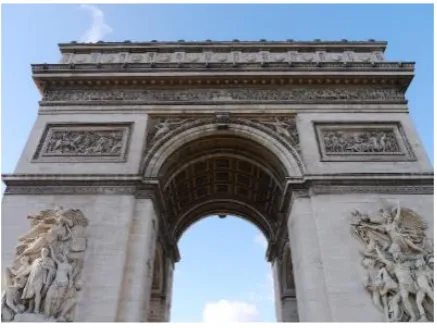
DOI: 10.4236/adr.2019.74016 190 Art and Design Review He believed that with the exception of military power, only the great architecture could perform the king of the great and solemn spirit. During this period, the construction of the Louvre East elevation, the Place Vendome and the Palace of Versailles were built for Louis XIV of the “great era” and the “great style”. Na-poleon also understood the political role of architecture. The Triumphal Arch
(Figure 1), the biggest “door” in the world with a construction of 49.4 meters
height, 44.8 meters width and 22.3 meters thick, was the best evidence to prove the “military honour”. Such form of the “Empire style” affected people’s cogni-tion of majesty; it brought a great impact on the 19th century European archi-tecture as well.
2.3. Concern with Human Senses, Behaviours and Experiences
Architecture itself not just has a close relationship with us, it reflects a social image. Most of the history, culture and politics of a city are exhibited as the fine art of architecture.
According to the state of the relationship between architecture and us, there-fore, the architectural creation is a communication between buildings and hu-man, and among physical elements (facades, structures and landscapes), social factors (history, culture and politics) and our psychological context (emotion, memory and behaviours). Thus, a good designer should not only consider the decisions made for the styles and forms, but also be awareness of the influence from the buildings and places on the people who are using these, and then, on the basis of the psychological responses and behaviour reactions, develop design methods to improve the environmental quality.
[image:4.595.265.484.547.711.2]Contrarily, less consideration of the psychological influences on human senses, behaviours and responses might cause social and psychological failure. The Pruitt-Igoe housing project (Figure 2 and Figure 3), built in St. Louis, Mis-souri, USA, has been regarded as one of the most infamous failures of public housing in American history. Katharine G. Bristol (1991) had described that “This version of the Pruitt-Igoe story is a myth. At the Core of the myth is the idea that architectural design was responsible for the demise of Pruitt-Igoe”.
DOI: 10.4236/adr.2019.74016 191 Art and Design Review
Figure 2. The Pruitt-Igoe housing project.
Figure 3. The demise of Pruitt-Igoe.
This project was designed in 1951 by architect Minoru Yamasaki (who would later design the World Trade Centre) as a part of the post-WWII federal housing program for bringing back the demobilized servicemen to the city life. However, owing to the inattention of social communication and human reac-tion, within a few years it quickly fell into disrepair and disuse, and heavily vandalized by its own residents. Even worse, many of the architectural design elements of Pruitt-Igoe which were innovations of modernist architecture (high-rise, high-tech, green plants, designed for sunlight and reducing industrial pollution) turned out to be at best inconveniences and breeding grounds for crime, such as its recreational galleries which no one would feel ownership of and “skip-stop” elevators which stopped only at fifth, seventh and tenth floors in an attempt to lessen congestion.
The buildings remained largely vacant for years, and after spending more than five million dollars and several failed attempts to rehabilitate the area, the first building was demolished on March 16, 1972. The demolition of the entire com-plex was completed in 1976.
3. Senses of Architectural Form
[image:5.595.262.488.255.409.2]DOI: 10.4236/adr.2019.74016 192 Art and Design Review senses of architectural forms, we could have perception and experience, and then we understand the world and ourselves much better.
3.1. Perception through Senses
“Our immediate awareness of the phenomenal world is given through percep-tion. We are highly dependent upon seeing our surroundings in a satisfactory manner. Not only do we have to find our way through the multitude of things,
but we should also ‘understand’ or ‘judge’ the things to make them serviceable to us.”Christian Norberg-Schulz (1963).
People attempt to make the environment surrounded familiar through per-ception, so that they could organize activities in it confidently and favourably. The varieties of senses to perception reflect different possibilities of understand-ing surroundunderstand-ings. Senses are joined together, so that we learn, followunderstand-ing we clear about what establishes important information. Thus, the way we understand surroundings including architecture is directly related to the way we process re-ceived environmental information from senses.
The five classical senses (sight, hearing, touch, smell and taste) are the most essential sensory experiences in architectural realm. We interact with the archi-tectural form through these senses. With these intersections, we could realize the value of spaces and places, and they become meaningful to us too.
It is also worth to remember that there are some more sensations we experi-ence that are not formally categorised as one of the five classical senses, such as orientation, gravity, balance, temperature, enclosure and moods.
3.2. Planning and Design for Human Senses
“The task of architecture is to strengthen our sense of the real, not to create set-tings of mere fabrication and fantasy. The essential mental task of the art of building is mediation and integration. Architecture articulates the experiences of being-in-the-world and it strengthens the sense of reality and self. It frames and structures experiences and projects a specific horizon of perception and mean-ing.” Juhani Pallasmaa (2005b).
Multi-sensory design is becoming more and more popular in unit residential, special schools and hospitals; in particular the ones focus on touching effects for the blind people. All these are concentrating on offering psychological experi-ences and multi-sensory responses which express the identities of these designs. Several architectures have been constructed on the basis of emphasising speci-fied senses, particularly the senses of sight and touch. The examples are The Church of Light (visual sense) (Figure 4), Civil Rights Memorial (sense of touch) (Figure 5) and Vietnam Veterans Memorial (sense of touch) (Figure 6).
DOI: 10.4236/adr.2019.74016 193 Art and Design Review
[image:7.595.276.472.287.439.2]Figure 4. The church of light.
Figure 5. Civil rights memorial.
Figure 6. Vietnam veterans memorial.
[image:7.595.274.473.467.620.2]DOI: 10.4236/adr.2019.74016 194 Art and Design Review
4. Impacts from Architectural Experiences
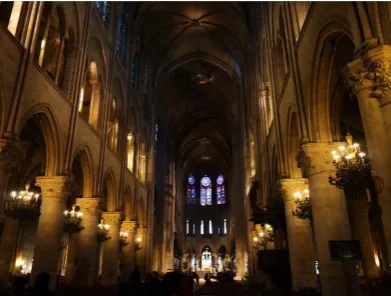
We have innate abilities to perceive the environment around us; our bodies can be aware of the subtleties of changes in patterns and proportions. Therefore, no matter consciously or unconsciously, the human body is physiologically receiv-ing information from surroundreceiv-ings which may be at work influencreceiv-ing us on psychological behaviours when we are living, working, studying or playing within the built environment. The investigation of artificial structures and their possible impact on human behaviours would surely, but not completely, confirm why and how people might behave in a particular space or place, such as people always show their awe at the sight of the awesome vertical interior of a Medieval or Gothic cathedral (Figure 7); a huge structure makes a person feel over-whelmed and vulnerable; a deviant temperature (too cold or too hot) or noise level (too noisy or too quiet) may cause a person psychological pressure. For re-vealing these emotionally or spiritually factors, the physical surroundings which would affect the senses in any environment should be concerned.
The psychological and behavioural effects between people and their physical environments are complex. However, when the elements, spaces and places are taken into account separately, they become quite clear.
4.1. Experiences from Elements
In a manner of speaking, if a building is a body, light & shadow, materials, col-our, water and structure are the spirit, muscle, skin, blood and bones respec-tively. Concrete elements such as material, colour and light (which are consid-ered as the main aspects of visual art by Donald Judd, 1994), and some other ambient environments, such as water, sound and temperature make up the whole built environment. These elements are experienced as characteristics of a building through the senses of body, including not only the visual sense, but also senses such as hearing, smell, touch and taste.
4.2. Experiences from Spaces
[image:8.595.275.471.554.702.2]“Space has since become such an integral part of our thinking about architecture
DOI: 10.4236/adr.2019.74016 195 Art and Design Review
that we are practically incapable of thinking about it at all without putting our main emphasis on the spatial displacement of the subject in time.” Kenneth
Frampton, 1995.
The experiences of spaces are from concepts of human inventions (such as scale, vertical or horizontal, straight or curve, order or disorder, symmetry or asymmetry, and mobility) which are not tangible but are observable and contain an element of measure. These concepts give form to building elements and help order these elements in order to describe a built environment.
4.3. Experiences from Places
The experiences of places with the help of architectural elements and spatial forms give meanings to spaces, memorable, fantastic, or common. Generally, the properties of places include religion and quotidian.
4.4. Planning and Design for Human Experiences
Naturally, people want to seek a place where they will experience the feelings of competent, confident, comfortable and enjoyable. Thus, the creation of an ap-propriate environment is believed to increase the good experience of well-being and behavioural effectiveness in people.
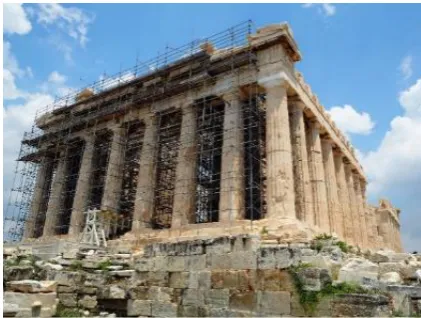
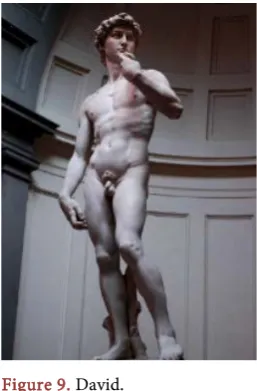
[image:9.595.267.478.548.707.2]For this reason, the most important thing is having attentions on how people notice their environment and understanding the meaning of each architectural elements and forms. For example, the understanding of people perceiving archi-tecture the applications of psychological responses from architectural elements and forms in Acropolis, Athens received huge rewards: besides the rectangular base and the canopy were designed with subtle curves (Figure 8), the corner columns of the Parthenon were designed to be thicker and spaced closer to sur-rounding columns to realize visually interpreted as being of equal size and spac-ing; the entire structure and the columns are slightly tapered. This method was also used in “David” (Figure 9), though it is not a building. Therefore, elements, spaces, and places of architecture seem to have the ability to influence and reflect the psychological experiences of its users.
DOI: 10.4236/adr.2019.74016 196 Art and Design Review
Figure 9. David.
5. Environment Psychologies: “Space, Emotion and Memory”
& Human Behaviours
Understanding human behaviours and psychological responses from architec-ture starts with understanding how people notice the environment surrounded.
5.1. Environmental Psychology
With the birth of architecture, it provides us an artificial environment different from nature; it is not only a space with three dimensions, but an important as-pect influencing our physiological, psychological and social consciousness. So carefully thinking about our bodies and the relationships between our bodies and environmental psychology is essential.
In the real lives, our behaviours and moods just occur in the context of an en-vironment which includes all the natural and built surroundings; they are meaningful only if they can be understood in terms of the environmental con-text. Thus, the environment determines whether or not behaviours are possible and significative, for instance, one cannot walk through where a wall blocks his way; one cannot lie on a bed where no bed exists. Therefore, when we change the environment to make buildings humane and suitable for activities, our behav-iours and experiences are changed and enriched by the environment. This study of psychological reaction in relation to environment is environmental psychol-ogy. Robert Gifford (2002) gives the definition of Environment Psychology that “Environmental Psychology is the study of transactions between individuals and their physical settings”.
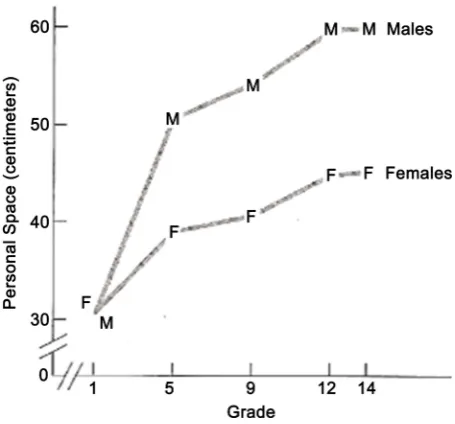
situa-DOI: 10.4236/adr.2019.74016 197 Art and Design Review tions plays an important role in forming individual environmental psychological responses. Duo to the differences of backgrounds and situations, the spatial and psychological behaviours vary widely. For instance, great changes took place in personal space with the change of gender and age: with the increase of ages, personal space increases with time for both men and women, and the growth rate of men is more obvious than that of women (Figure 101).
5.2. Planning and Design for Human Behaviours
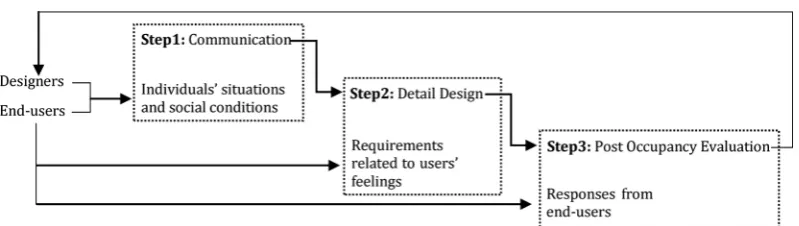
Ultimately, can environmental psychology contribute to a better planning or de-sign? The answer is absolutely yes. The aim of environmental psychology is ori-ented towards influencing the work of planning and design, which include ar-chitectural design, interior design, and urban planning, and improving the hu-man environment. In this circumstance, processing a planning or a design with the help of environmental psychology is essential, as shown in Figure 11.
[image:11.595.260.488.486.698.2]First of all, emphasize the importance of research in individuals’ situations (such as age, gender, lifestyle and background for private buildings) and social conditions (such as standard of living, culture and history for public construc-tions). That can minimize the gap between the designers and the people who will eventually live and work in these buildings. Sufficient communication between designers and clients should be taken at the first step. Second, design with con-cern about environmental psychology. The feelings of personal space, territorial-ity, crowding and privacy exist everywhere, even though they may change in a different condition. Designers should develop ways to fulfil these requirements, especially in detail design. The last but not the least, gather responses from these users, analyse them and then improve the design method for the coming pro-jects. After these three steps, substantive benefits could be seen and an im-proved, cleared idea can contribute for the future planning and design.
DOI: 10.4236/adr.2019.74016 198 Art and Design Review
Figure 11. Three steps processing designs with environmental psychology.
6. Design with Space, Emotion and Memory: Peter Zumthor’s
Thermal Bath as a Case Study
In 1990, Peter Zumthor designes the Thermal Bath Vals in Switzerland, in his book Peter Zumthor Works: buildings and projects 1979-1997 (1999), he writes, “Right from the start, there was a feeling for the mystical nature of a world of stone inside the mountain, for darkness and light, for the reflection of light upon the water, for the diffusion of light through steam-filled air, for the different sounds that water makes in stone surroundings, for warm stone and naked skin,
for the ritual of bathing.”. Indeed, this stone-made building provides us a com-prehensive understanding of design associated with applications of environ-mental psychology.
6.1. Senses from Thermal Bath
“The rays of light failing through the openings in the starry sky of the cupola illu-minate a room that could not be more perfect for bathing: water in stone basins,
rising steam luminous rays of light in semidarkness, a quiet relaxed atmosphere,
rooms that fade into the shadows; one can hear all the different sounds of water,
one can hear the rooms echoing. There was something serene, primeval, medita-tive about it that was utterly enthralling.”. Sigrid Hauser & Zumthor (2007) uses his beautiful words to describe this wonderful architecture. In other words, the water, stones, and light in the Thermal Bath give us a multi-sensory experience.
Water in Thermal Bath has two forms: one is vapour, and the other is water itself. The water steam with the help of refraction and reflection creates a psy-chedelic visual effect which relaxes people in a gentle atmosphere. While the spring water in stone basins is clear and fresh; together with different tempera-tures and colours in different pools, the water offers different senses of touching, smelling, and sighting. Due to the strong connection between skins and water, activities in pools always make water move in basins; the intimate relations be-tween water and stone basins with the water movements always produce sounds. Hereby, water also performs a role of acoustic tasting.
deter-DOI: 10.4236/adr.2019.74016 199 Art and Design Review mined by a conscious series of natural stones strata: layer upon layer of the Vals gneisses (Figure 12). The profile, destiny, and texture all strengthen the sense of reality and weight performance. Through touching the rough surface, we can feel both the history of the place and artificial power.
Light differs from main entrance to the central bath until the rest places or exterior bath in the Thermal Bath. From the entrance to the changing rooms, there are no windows, no view permissions towards exterior; only artificial lights are provided (Figure 13(a)); in the central indoor bath, there is no window too, but dim natural sunlight through the glass-covered fissures in the ceiling to-gether with the artificial lights (Figure 13(b)) offer the luminous environment; in the terraces (Figure 13(c)) or the outdoor bath (Figure 13(d)), there are all natural sunlight. Varieties of lightings, in this wise, give guests in the Thermal Bath different luminous experiences: natural light and artificial light, semidark-ness and bright, even shadows, which are all visual senses.
6.2. Thermal Bath and Psychological Experiences
[image:13.595.296.454.349.491.2]Actually, besides the feeling of calmness and massiness from horizontal layers of stones; the pithiness and intimity from the simple architectural form—block
Figure 12. Layers of Vals gneisses (Zumthor, 1998).
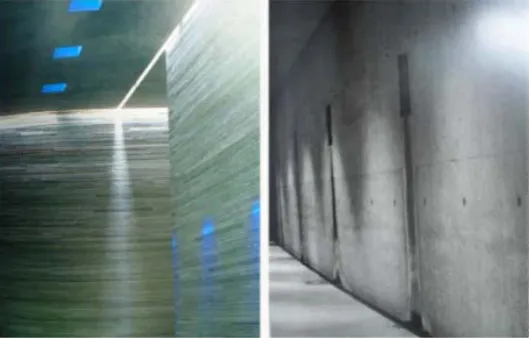
[image:13.595.93.541.521.694.2]DOI: 10.4236/adr.2019.74016 200 Art and Design Review structure and local materials, the most significant experience and psychological responses are from the light, including natural light and artificial light. Natural light consists fissure-light in the ceiling and light from windows. A network of six centimetres glass fissures in the stone ceiling brings light to the baths and adds to the sense of fluidity of overall space; these straight light lines indicate the direction in narrow spaces and illuminate the material (Figure 14); the shadows on the stone walls are somewhat like the marks left by the spring water (Figure 15).
According to the functions and different sizes, some windows bring light and beautiful landscape into the building to provide a bright space for activities; the others restrict the input of light to create a semidarkness environment for relax-ing (Figure 16).
Artificial light include different colours. For example, the orange light means the route of circulation; the blue light indicates the places next to the water
(Figure 17).
6.3. Behaviours Control in Thermal Bath
[image:14.595.302.445.352.504.2]Peter Zumthor made a space with stones to create a dynamic, maze-like space
Figure 14. Fissure-light in the ceiling.
[image:14.595.242.507.536.705.2]DOI: 10.4236/adr.2019.74016 201 Art and Design Review
Figure 16. Big windows and small windows.
Figure 17. Orange light and blue light.
which evokes curiosity in cavern spaces; meanwhile, he used stones walls, block structures, even the ways of lighting to control the access to self-behaviours.
According to the spaces and functions, the plan of the building utilizes two contrasting space types: inside or outside the structural blocks (Figure 18). In-side the blocks, we can see from Figure 19, they are all private places which in-clude changing rooms, make-up rooms, shower rooms, special baths, and ther-apy rooms. However, the spaces outside the blocks are public places: the mean-der serves the central space for circulation, permitting the access of the baths and other private places; one of baths is interior and the other is exterior; the terraces provide the places for rest. These approximate circle-shaped public spaces around the private blocks promote movements in the building.
Moreover, what we have talked about is there is a light-differing line, from the entrance to terraces or to exterior bath. With more and more natural light is in-troduced, the degree of privacy is weakened.
[image:15.595.241.511.251.424.2]DOI: 10.4236/adr.2019.74016 202 Art and Design Review
Figure 18. Structure blocks, bathing level.
Figure 19. Floor plan, bathing level.
7. An Approach for Architectural Design
7.1. Design and Planning for Senses
In the book Sensory Design written by Joy Monice Malnar and Frank Vodvarka
(2004: p. 151, p. 152), it is said that, “the real world is complex, sending out
mil-lions of information signals, we can only be aware of a small portion of them. This information is experienced and recorded as differentials of colour, heat,
motion, sound, pressure, direction, and whatever else is present and within the range of senses.” (Figure 20). Thus, for strengthening the feeling of the real world, especially the feelings of buildings we talk about, we have to create sen-sory components, forms and places to induce activities such as touch, smell, and hearing and encourage people to sending themselves into the activities, then en-hance the information-communicating with nature and built environment, as well as enrich the senses experience.
7.2. Design and Planning for Experiences
[image:16.595.193.540.227.430.2]DOI: 10.4236/adr.2019.74016 203 Art and Design Review
Figure 20. Ranges of senses (Malnar & Vodvarka, 2004).
and experiences. If these factors cannot match the individuals’ needs or re-quirements, they may cause detrimental influences on human emotion, work performance, even mental health. Thus, we have to understand the meaning of every element of the space, and use them in combination with clients’ require-ments properly. Too much or too less employment of the architectural elerequire-ments are unbefitting: too much use may cause stress and discomfort; too little may not take effect. Although at times it is intelligible that some architects, for preventing negative consequences, may just use the simplest architectural forms to shape a building, however, particular buildings, such as temples, cathedrals, and other religious or memorable constructions, need to be enhanced by the specified building elements. For example, particular types of light can create a sense of mystery and awe; and vertical architectural form suggests an overpowering gran-deur which can enhance human experience and behaviour in religious spaces.
7.3. Design and Planning for Behaviours
DOI: 10.4236/adr.2019.74016 204 Art and Design Review significant approach is “control of access to the self” (Cassidy, 1997: p. 178). It is strange but evident that everybody has two faces: one face is people want to be in participation of social interactions to seek opportunities of communication and social support; the other is, sometimes, people need to withdraw the busy and noisy conditions and enjoy a quiet place belonging to themselves solely to be certain of they are holding their personal space, territory, and privacy. Thus, the most importance of control of access to the self is to provide a place in which people can control over the choices of being alone or participating in social communication. This method of choosing-control is more useful in crowded building environment, such as prisons, offices and dealing with communities and neighbourhoods in residential complexes.
8. Conclusion
As has been discussed, the fact is that besides the Architectural History, Theory, Structure and Technology, the studies on psychological impacts from tural forms have been considered as an integral and mandatory part of architec-tural design. Also it is one of the dynamics of formatting architecarchitec-tural forms.
The primary focus in this paper is the interaction between architectural form and psychological effects on human, which consists of three aspects; the first one is the effects from the cognitive and affective senses on the built environment conditions; the second one is the influences from specified architectural form; and the third one is the individual psychological requirements. The relationships between architecture and human have been explored through a series of theo-retical studies in investigating architectural psychological behaviours and illus-trating cases. With the help of the case study of Thermal Bath from Peter Zum-thor, a design and planning approach for reflecting human senses, experiences and behaviours in the realm of environmental psychology has been summarised.
The whole case-study strategy provides multiple source of architectural form. The illustrating cases and case studies in this paper are drawn from famous ar-chitects, whose architectures, Pallasmaa (2005a) describes, clearly favour sight and incorporate strong tactile experiences in the forceful presence of materiality and weight. It helps to analyse the concrete and complex situations, and the benefit of using the case study is more clear and straightforward. However, the collected case studies and related pictures are from different architectural types, and the coherence and connectivity between theories and those case studies are difficult to be consistent. More cases are needed for future research development.
Acknowledgements
This work is supported by “the Fundamental Research Funds for the Central Universities” (DUT19RW113).
Conflicts of Interest
DOI: 10.4236/adr.2019.74016 205 Art and Design Review
References
Arnheim, R. (1977). The Dynamics of Architectural Form. Berkeley, CA: University of California Press.
Bell, P. A., Green, T. C., Fisher, J. D., & Baum, A. (2001). Environmental Psychology (5th ed.). Belmont, MA: Wadsworth Group/Thomson Learning.
Bristol, K. G. (1991). The Pruitt-Igoe Myth. Journal of Architectural Education, 44, 163-171. https://doi.org/10.1080/10464883.1991.11102687
Cassidy, T. (1997). Environmental Psychology: Behaviour and Experience in Context. Hove: Psychology Press.
Frampton, K. (1995). Studies in Tectonic Culture: The Poetics of Construction in Nine-teenth and Twentieth Century Architecture. London: MIT Press.
Gifford, R. (2002). Environmental Psychology: Principles and Practices (2nd ed.). Boston, MA: Pearson Custom Publishing.
Hall, E. (1969). The Hidden Dimension. New York: Doubleday.
Hauser, S., & Zumthor, P. (2007). Peter Zumthor: Therme Vals. Zurich: Verlag Scheidegger and Spiess.
Holl, S. (1994). Questions of Perception: Phenomenology of Architecture. New York: Princeton Architectural Press.
Jarmusch, A. (2003). Mind-Set: Research Project Will Study Architecture’s Impact on Brain.http://biology.ucsd.edu/about/news/article_050503.html
Judd, D. (1994). Some Aspects of Colour in General and Red and Black in Particular. New York: Artforum International Magazine.
Lau, B. (2007). The Poetics of Sacred Light: An Investigation of the Luminous Environ-ment in the Monastery of La Tourette. In The 24th Conference on Passive and Low Energy Architecture. PLEA Conference Paper No. 0532.
Malnar, J. M., & Vodvarka, F. (2004). Sensory Design. Minneapolis, MN: The University of Minnesota Press.
Norberg-Schulz, C. (1963). Intentions in Architecture. Cambridge, MA: MIT.
Pallasmaa, J. (2005a). The Eyes of the Skin: Architecture and the Senses. Chichester: John Wiley & Sons.
Pallasmaa, J. (2005b). Touching the World—Architecture, Hapticity and the Emancipa-tion of the Eye. In The 8th Meeting of Heads of European Schools of Architecture (pp. 34-41). Chania, Greece: European Association for Architectural Education.
http://www.eaae.be/wp-content/uploads/2017/04/20051073.pdf
Weston, R. (2003). Materials, Form and Architecture. London: Laurence King. Zumthor, P. (1998). Peter Zumthor = Pītā Zuntō. Tokyo: A + U Publishing.
Zumthor, P. (1999). Peter Zumthor Works: Buildings and Projects 1979-1997. Basel: Birkh.user.