
Reframing, Realignment and Relationships
Interim evaluation of the first place-‐based programmes
for Systems Leadership: Local Vision
May 2015
Bristol Leadership Centre
Bristol Business School
Evaluation team
This evaluation has been conducted by a multi-‐disciplinary team, led by Professor Richard Bolden and Anita Gulati at the University of the West of England, with contributions from Dr Yusuf Ahmad, Professor John Burgoyne, Nick Chapman, Dr Gareth Edwards, Elizabeth Green, David Owen, Dr Ian Smith and Michelle Spirit.
Acknowledgements
Contents
1. Executive Summary ... 4
1.1. Programme overview ... 4
1.2. Evaluation brief and approach ... 4
1.3. Systems leadership in context ... 5
1.4. Interim findings ... 5
1.5. Conclusions and next steps ... 7
2. Introduction ... 8
2.1. Systems Leadership: Local Vision ... 8
2.2. Evaluation brief and approach ... 9
2.3. Structure of this report ... 9
3. Systems Leadership in Context ... 11
3.1. What is systems leadership and why does it matter? ... 11
3.2. What kind(s) of problem(s) does systems leadership address? ... 12
3.3. Implementing and evaluating systems leadership and service transformation ... 13
3.4. National political, fiscal and regulatory environment ... 14
3.4.1. Politics and Policy ... 14
3.4.2. Fiscal and regulatory environment ... 15
4. Local Vision Programme Commissioning and Design ... 19
4.1. Framing and approach ... 19
4.2. Aims and objectives ... 20
5. Interim Findings ... 23
5.1. Emerging themes ... 23
5.2. Process ... 23
5.2.1. Enabler role and approach ... 23
5.2.2. Problem framing and analysis ... 25
5.2.3. Timing ... 26
5.3. Context ... 27
5.3.1. Organisational structures and priorities ... 27
5.3.2. Networks and relationships ... 28
5.3.3. Political and organisational support ... 29
5.4. Change ... 31
5.4.1. Mindset ... 31
5.4.2. Culture ... 33
5.4.3. Behaviours ... 35
6. Summary and Conclusions ... 38
7. References ... 41
1.
Executive Summary
1.1.
Programme overview
• Systems Leadership: Local Vision was born out of the collective vision of the
Leadership Centre and the Systems Leadership Steering Group, comprising of representatives from key agencies across local and national government, the NHS, social care, public health, the voluntary sector and the private sector. The context of this ambitious programme is set amidst the biggest recession since the 1930s coupled with a government policy of austerity and a spotlight on public service performance.
• Systems Leadership: Local Vision sets out to promote and facilitate radically
different ways of leading transformation in public service to address complex social issues, such as alcohol abuse, dementia, food poverty, and service integration. The core aim of this initiative is to develop shared leadership capability to generate solutions to ‘wicked’ (complex and intractable) issues that are not in the gift of individual organisations or service sectors to solve.
• The commissioning of Local Vision was deliberate in its intention to explore the
impact of systems leadership development in-‐situ, predicated on the principle of learning by doing, working with stakeholders, facilitated by a skilled and experienced ‘Enabler’.
• The first phase of Local Vision, initiated in 2013, selected 25 localities. Successful
initiatives were awarded up to £27,000 to fund an experienced systems leadership development ‘Enabler’ through the life of the programme. Successful applicants also received access to a variety of learning events and networks hosted by partners.
1.2.
Evaluation brief and approach
• In autumn 2014 the Bristol Leadership Centre at the University of the West of
England Business School was commissioned to undertake evaluation of the Local Vision programme. The evaluation’s primary purpose is to support learning and development of the Local Vision approach, illuminating impact (or progress towards impact) and areas for development/improvement.
• The evaluation is designed in two stages. This interim reports sets out our
findings for Phase 1, with a primary focus on exploring key criteria that may shape efficacy. This will inform the developing evaluation framework, collective ‘sense making’ and deeper exploration of efficacy planned for Phase 2 with a final report to be published in autumn 2015.
• As a systems-‐based evaluation we take the wider national context into account
1.3.
Systems leadership in context
• The concept of ‘systems leadership’ has gained increasing momentum in recent
times as a potential response to the unprecedented challenges facing public services, with declining funding and resource set against increasing demand. The move towards integration of health and social care services in particular has been a major priority in the government’s agenda in the run up to, and following, the General Election in May 2015.
• Many argue that a paradigm shift is required in how public services are organised
and delivered. These factors present a need to re-‐evaluate established approaches to the provision of local services and shape the environment in which Systems Leadership: Local Vision is implemented.
• The conceptual framework underpinning Systems Leadership: Local Vision
emerges from a growing body of theory, practice and development stemming from a recognition that traditional hierarchical approaches to tackling complex interconnected problems do not work. Systems leadership recognises complexity is adaptive, and crosses organisational and civic boundaries, enabling people to go beyond their roles in order to harness collective capability for the common good.
1.4.
Interim findings
• Interim analysis reveals a number of important factors that impact on the
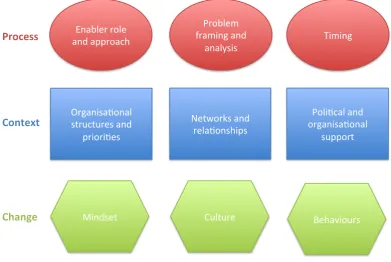
processes and outcomes of the Local Vision programme. Nine key themes are explored, grouped into three interconnected clusters (process, context and change) as summarised below.
• Process:
At its core, Local Vision is based on the assumption that systems leadership can be mobilised through the appointment of an ‘Enabler’ to work alongside partners to address a specific, shared problem/issue. The majority of project partners were very positive about the contribution of the Enabler, suggesting that their professionalism and support brought new energy and momentum to the partnership and helped people work through the challenges and uncertainties of the change process. Whilst the enabler role and approach may vary between projects key skills and tasks include:
(i) building safe space, relationships and trust; (ii) surfacing hidden themes and patterns;
(iii) fostering recognition and ownership of what needs to change;
(iv) creating shared purpose and collective connection;
(v) exploration and fostering recognition of the nature of systems leadership; and
(vi) brokerage/acting as independent arbiter; encouraging reflection and learning.
relationships and trust amongst partners. The timing of projects can also be important in terms of aligning with organisational priorities and the engagement of important stakeholders. Local Vision projects often build on from pre-‐existing initiatives and more or less established partnerships, with start-‐up conditions having a significant impact on how the project develops.
• Context:
According to the Local Vision documentation and discussion with programme leads there are a number of key criteria for engaging localities and Enablers for the Local Vision initiative. Localities are juggling a range of priorities, funding streams and initiatives. Where the Local Vision project was not closely aligned to existing organisational structures and priorities, there was often difficulty maintaining momentum and managing a range of competing commitments. There was widespread agreement amongst key stakeholders of the importance of developing strong networks and relationships between partners, founded on trust and a shared sense of purpose. Whilst systems change requires active engagement from a wide range of stakeholders, significant value can be gained from having people with dedicated time allocated to supporting and leading the project. Perhaps the most widely cited barrier to Local Vision projects was insufficient political and organisational support for the project. There was a sense that whilst some senior leaders played lip service to a systems leadership approach, improvements are difficult to sustain without consistent, long-‐term support. Enablers frequently observed that whilst junior staff were quick to understand systems leadership and enthusiastic to get involved, without positional authority they struggled to be heard. In some cases there may also be a tension between organisational and political leaders – with the potential for elected members to override shared system approaches/objectives in favour of singular objectives.
• Change:
There is evidence to suggest that Local Vision projects have facilitated a shift in
their involvement in localities without the project coming to an end. These are issues that will be explored further in Phase 2 of the evaluation.
1.5.
Conclusions and next steps
• This evaluation suggests that systems leadership begins with a shift in mindset or
perspective rather than requiring fundamental change in structures or resources. This is both its main power and limitation as the potential to sustain and replicate success is also dependent on embedding new practices, processes and structures.
• In Phase Two of the evaluation we will explore in greater detail the similarities
and differences between Local Vision projects in different localities in order to gain a better understanding of how local context both enables and/or constrains the potential for sustainable change.
• At present, our analysis notes the limited use of data in measuring progress for
Local Vision, although some localities are considering the role of data as part of a wider integration agenda.
• Local Vision does not take place within a vacuum and it would be misleading to
attribute success or failure without a clearer understanding of the relationship between this initiative and its wider context. In Phase 2 we will therefore also endeavour to explore the part that Local Vision plays within the wider regional and national context of health and social care reform.
• Systems leadership calls for a fundamental reframing of the nature and purpose
of leadership in order to address complex, ambiguous, boundary-‐spanning, ‘wicked’ issues such as the integration of health and social care. Whether or not this is achievable in practice, will depend to a large extent on the ability of key stakeholders to reframe, realign and harness the collective synergy of relationship.
2.
Introduction
2.1.
Systems Leadership: Local Vision
The Systems Leadership: Local Vision programme sets out to promote and facilitate radically different ways of leading transformation in public service to address complex social issues, such as alcohol abuse, dementia, food poverty, and service integration. The context of this ambitious initiative is set amidst the biggest recession since the 1930s, coupled with a government policy of austerity and a spotlight on public service performance.
The core principle underlying Local Vision is to develop shared leadership capability -‐ a capacity and desire to collaborate across organisational boundaries and systems to generate solutions to ‘wicked’1 issues that are not in the gift of individual organisations, or service sectors, to solve. The development of systems leadership capability within the Local Vision programme is predicated on the principle of learning by doing, focused on a collective problem, facilitated by a skilled and experienced ‘Enabler’.
Local Vision was born out of the collective visionary experimentation of the Leadership Centre2 and the Systems Leadership Steering Group, comprising representatives from across local and national government, the NHS, social care, public health, the voluntary sector, the private sector and leadership development. To date the group has pooled its resources to jointly commission research into what works in systems leadership, and to develop leadership programmes based on this intelligence across sectors3.
All too aware of the unprecedented challenges facing public service, and recognising that a paradigm shift was needed, the commissioners focused on a creating a programme that would move away from the traditional model of leadership development focusing on investment in individual talent and understanding during a residential programme. The commissioning of Local Vision was deliberate in its intention to explore the impact of systems leadership development in-‐situ, building on existing relationships and collaborations with the support of a skilled ‘Enabler’ as a facilitator and catalyst for change through action learning.
The stated aims of Local Vision are as follows4:
• To assist in the development of local solutions to a local ‘wicked’ / intractable
issue through leadership development;
• To ensure that the leadership learning is left in place to allow it to be used for
other issues;
• To draw together lessons and learning about leadership behaviours and
development that will help resolve future wicked issues.
1 A ‘wicked’ problem is complex and intractable, with no obvious solution – see Section 3.2. 2 Formerly the Leadership Centre for Local Government -‐ http://www.localleadership.gov.uk 3 See http://leadershipforchange.org.uk for more information.
2.2.
Evaluation brief and approach
In Autumn 2014 Bristol Leadership Centre at the University of the West of England was commissioned to undertake evaluation of the Local Vision programme.
The evaluation is designed in two phases. This interim report sets out our findings for Phase 1, with a primary focus on identifying and exploring key criteria that may shape efficacy and impact. This will inform the developing evaluation framework, collective ‘sense making’ and deeper exploration of programme outcomes planned for Phase 2 of the evaluation, with a final report to be published in autumn 2015. Across the two phases, the evaluation aims to:
1. Examine how Local Vision has raised awareness of systems leadership in individual places, and among stakeholders, including service users
2. Identify criteria for success and perceived benefits, anticipated value and impact from differing stakeholder perspectives
3. Gather evidence through a variety of routes to identify and map impacts (anticipated or not) and to gauge sustainability of any service transformation at a local systems level, through to service users
4. Identify any emerging patterns to help inform understanding of the ingredients of effective systems leadership interventions.
The evaluation’s primary purpose is to support learning and development of the
Local Vision approach, illuminating impact (or progress towards impact) and areas for development/improvement. In this interim evaluation we have employed a mixed methods approach, comprising a range of data sources including:
• analysis of academic literature and applied research
• qualitative in-‐depth exploratory interviews with Local Vision steering group
members, enablers, and local stakeholders
• analyses of key documentation, such as contracting with enablers and
localities and national policy documents
• survey data from the last 3 years.
As a systems-‐based evaluation we take the wider national context into account together with a thematic approach to the analysis and exploring the role of factors shaping outcomes at national as well as local level. In Phase 2 of the evaluation we will elaborate further on learning and outcomes within individual localities.
2.3.
Structure of this report
Following this introductory chapter, the report is structured as follows:
• Systems leadership in context: a review of the wider context of the Systems
Leadership: Local Vision programme in terms of theory, policy and practice. This section is informed by a review of scholarly, practitioner and policy literature and background documentation on the Local Vision programme.
• Programme commissioning and design: an outline of how systems
• Interim findings: this chapter presents emerging findings from the evaluation
to date. Nine key themes are explored, grouped into three broad clusters (process, context and change). This section is informed by interview and survey data, along with observation of key meetings and events.
• Summary and conclusions: an integrative summary of interim findings and
their implications for Phase Two of the evaluation.
3.
Systems Leadership in Context
3.1.
What is systems leadership and why does it matter?
The conceptual framework that underpins the Systems Leadership: Local Vision programme emerges from a growing body of theory and research on systems change and leadership. A review commissioned by the Virtual Staff College in 2013 suggested that ‘systems leadership’ has two key characteristics: (a) ‘it is a collective form of leadership…’ concerned with ‘the concerted effort of many people working together at different places in the system and at different levels’, and (b) it ‘crosses boundaries, both physical and virtual, existing simultaneously in multiple dimensions’5.
According to Marshall Ganz, a Harvard academic and advisor to the Obama administration, “leadership is accepting responsibility to create conditions that enable others to achieve shared purpose in the face of uncertainty’ and suggests that ‘leaders accept responsibility not only for their individual “part” of the work, but also for the collective “whole”’6. Ganz’s work frames leadership as social movement and identifies four key dimensions -‐ building relationships, telling the story, devising strategy and catalysing action – which, taken together, permit leaders and groups to exert influence without authority.
Such perspectives challenge dominant theory and practice, which tends to focus on individuals in formal organisational leadership roles, and suggests that systems leadership is a ‘mindset’ rather than a set of individual skills or competencies that one either possesses or not.
The concept of systems leadership has gained increasing momentum in recent years as a potential response to the question of ‘what would it take to create more effective leadership of the whole governmental and public service system?’7. However, whilst these broad questions have been with us for the past half-‐century , the context that generates them has changed significantly over time. Whilst policy makers and practitioners throughout the 1970s and 80s were mainly concerned with coordination of services and shared standards for the provision care, since the turn of the century we have seen an increasing focus on whole systems working, people-‐ centred design and integration of services.
The backdrop for current changes in the funding and organisation of the UK public sector is far from rosy. Public services are facing a generational challenge of declining funding and resources, against increasing demand, and ‘leaders’ navigating these challenges are challenged to think and act in new ways. Many argue that a paradigm shift is required in how public services are organised and delivered8. Systems leadership has been heralded as a way to develop leadership capacities in current times, bringing together a number of strands of thought in a new way, in order to respond to the unprecedented challenges of public service transformation in an age of austerity.
5 Ghate, D., Lewis, J. and Welbourn, D. (2013), p6. 6 Gantz, M. (2010), p527
3.2.
What kind(s) of problem(s) does systems leadership address?
Traditional approaches to leadership development work on the assumption that a key responsibility of leaders is to solve problems and make decisions on behalf of groups and/or organisations. Whilst a systems leadership approach does not deny the potential value of these activities, it suggests that different kinds of problems call for different kinds of response. Systems leadership is concerned with the mobilisation of people to tackle challenges, creating the conditions under which groups and systems solve problems through collective learning, experimentation, and transformation – an approach predicated on the centrality of effective relationships built on trust, rather than role, hierarchy or title.In the UK, the work of Professor Keith Grint has been highly influential in shaping the conceptual understanding and framing of problem solving in systems leadership. Grint’s9 adaptation of Rittel and Weber’s10 typology of ‘tame’ and ‘wicked’ problems has helped theoretically and practically in recognition of the complex nature of many of the decisions and problems that leaders and managers are ostensibly tasked with ‘solving’.
A ‘tame’ problem is something that we’ve either seen before or can apply a specific logic to resolve. Grint suggests that the response to such problems is largely a case of organising a process to address the issue – effectively calling for ‘management’. A ‘wicked’ problem on the other hand is complex and intractable, with no obvious solution. Such a situation, Grint suggests, calls for ‘leadership’ and is largely about asking questions and mobilising collective expertise to determine the real nature of the problem and weighing up the options. Such problems may appear ‘messy’ and solutions are often ‘clumsy’ as people navigate their way through a complex, ambiguous and changing landscape11.
Grint, however, reminds us that problems are not necessarily ‘wicked’ or ‘tame’ in of themselves but are ‘socially constructed’ as such through processes of narrative and sense-‐making. An illustration of this can be seen in the differing approaches of George W Bush and John Kerry in the 2004 US presidential election12. A decisive feature of this campaign was how the two candidates presented their approach to responding to the threat to US national security posed by the September 11th attacks of 2001 and the subsequent ‘War on Terror’. Bush presented this as a ‘critical’ problem and himself as the commander-‐in-‐chief whilst Kerry suggested that it was a ‘wicked’ problem requiring a shared understanding of the underlying issues and collective debate on potential ways forward. Both candidates engaged in attempts to create a compelling narrative that voters would engage with and follow through the casting of their votes. The outcome of the election was incredibly close -‐ 50.7% to 48.3% -‐ yet the approach of the two candidates was in stark contrast to one another.
Professor Ralph Stacey adds weight to the importance of whether and how complexity is perceived and understood in his application of the science of complexity and adaptive systems to leadership. He too emphasizes the importance
9 Grint, K. (2005) 'Problems, problems, problems: The social construction of ‘leadership’' 10 Rittel and Weber, 1977.
of social and indeed psychological construction of problematizing, problem solving, managing paradox and uncertainty, suggesting that “there is a major contradiction between the organisational reality of uncertainty and the beliefs that we have about the capacity of executives to know what is going on and be in control.” 13
Local Vision has deliberately used language and framed its intervention to target ‘wicked’ issues that are contested, ambiguous and complex. This evaluation raises perhaps an additional question to consider, in respect of the degree to which recognition and tolerance of ambiguity in complex problem-‐solving is acknowledged in the initiatives’ localities?
One of the striking features of Local Vision is how the intellectual concept of systems leadership has been championed and developed by the Systems Leadership Steering Group that commissioned it. The Steering Group is made up of a broad consortium of highly experienced leaders representing a wide range of public service organisations that continues to build on and learn from the legacy of earlier interventions. Certainly the Steering Groups play a significant role in shaping the discourse and narrative of systems leadership at a strategic level and indeed could be considered as modelling systems leadership in action.
A further evaluation question for Local Vision then might consider exploration of the extent and way in which discourse and narrative of systems leadership are being shaped more widely at national level, and in the localities as a consequence of this initiative.
3.3.
Implementing and evaluating systems leadership and service
transformation
There are a number of influential ‘think tank’ organisations in the UK (such as Demos, the RSA, NESTA and the King’s Fund) that play a significant role in articulating and indeed pioneering new ways of conceiving, leading and delivering public services.
All produce thought-‐provoking and evidence-‐backed publications that illuminate challenges and opportunities within the current global, political, policy and fiscal landscape for transformative innovation.
The RSA’s recent publication ‘Managing Demand: Building Future Public Services’14 articulates the notion of a new social contract or shift in relationship between the general public, state and public services focused towards the root causes of demand for services and centred around the holistic needs for citizens. Many of the pioneering examples cited, such as tackling complex and multiple needs of chronically excluded adults, point to the need for imaginative solutions to complex problems and the role that (systems) leadership can play through focusing on building community leadership and citizenship, rather than solely on delivering service.
The power of data analytics and ‘customer insight’ are underlined as central to what is termed a ‘new science’ of using data to understand the needs and behaviour of
13 Stacey, R. (2012) ‘Tools and techniques of leadership and management: Meeting the challenge of
complexity’.
citizens in a holistic way and impact on efficacy over time. The UK government for example established a behavioural insights team to look at how behavioural change theory can be applied to meet current policy challenges. Drawing heavily on data and on ethnographical research the team seeks to create new ways of delivering enhanced and tailored services and products and open up new possibilities for innovation. It has been variously applied to reframe the relationship between citizens and the state, for example in order to reduce crime, tackle obesity and reduce littering15.
Many of these practice and policy reports point to the inadequacies posed by the traditional bureaucracies of public service and indeed of our current political process. We are living through an era of significant uncertainty and restructuring in which globalisation, technology, social enterprise and volunteers outside of statutory provision, and indeed citizens are shaping new relationships with statutory services and ways of delivery (as they are in our social, cultural and business worlds). There are a myriad of radical innovations happening in these spheres, such as through the work of In Control, Participle, New Key, and Shared Lives16.
These new ways of working thrive on the creative abilities of leadership without the constraints of political accountability, position or bureaucracy. Some are small-‐scale, whilst others have had national or international impact. Our review of the literature suggests that there is scope for the evaluation of Local Vision to pose the question of what can be learnt from innovation of services outside of statutory provision and beyond usual sectorial confines. For example, what can be learnt about systems leadership and service innovation from addressing economic poverty amongst women in rural India?17 Or from organisations looking to utilise systems leadership approaches in helping governments and NGOs tackle food security issues18.
Of course we need to consider the role of context. For example, is it possible to transfer learning from the developing world to the UK? Or from one sector in the UK to another? We begin here at least in a more focused way with an exploration of the UK landscape in relation to public service transformation.
3.4.
National political, fiscal and regulatory environment
3.4.1. Politics and Policy
Both the evaluation and leadership literature underline the significance of understanding the role that context plays in shaping efficacy. Our analysis of the national political, policy and fiscal landscape highlights significant changes in interpretation over the last three decades of the relationship between the citizen and the state, and the role of public services. The political interpretation of this relationship through policy and fiscal choices plays a fundamental role in shaping the environment in which leadership is enacted.
15 Cabinet Office (2010). See http://bit.ly/1lOptJw for further information
16 See for example: In Control (http://www.in-‐control.org.uk/), Participle (http://www.participle.net/),
New Key (http://www.newkey.org.uk/), and Shared Lives (http://www.sharedlivesplus.org.uk/) 17 Nesta (2015) Building social enterprise ecosystems in India, lessons from Sankalp
(http://bit.ly/1Fr11U7)
Our analysis shows that ‘neoliberalism’, with its expression through emphasis on market forces and the view of the citizen as a customer of services, is a paradigm that has shaped the approach of the last three successive governments, representing a major shift from the post-‐war settlement with the creation of the NHS and other public services. The tension of collaboration and partnership, together with inclusion instigated during Blair’s platform of the Third Way, sits uneasily alongside the belief in the value of competition.
The underlying principles of the modernisation agenda made explicit the need to devise policy across sectoral boundaries and so alongside this developed a focus on integration of services and new forms of delivery with the role of the State positioned as enabler and regulator. The role of management and increasingly the discourse of leadership gained new visibility19.
The current government’s platform of Big Society argued that citizens and communities should take further responsibilities and powers with a reducing State provision facilitated through the fiscal agenda. The vision of power being devolved to to communities has been translated through renewed focus on the role of the third sector, alongside a focus on facilitating individual control of health and social care budgets and emphasis on customer choice.
The policy context has shown increasing recognition of the inter-‐connectedness of health and social care. Examples of initiatives to facilitate greater integration include joint inspection of health and social care providers; extending incentive payments to providers to encourage and reward joint working; and developing integrated mental health services across health and social care. Currently the Department of Health is funding integration (as outlined in the following section), as is the Department for Communities and Local Government through its Public Service Transformation Network20 and plans for more collaborative leadership.
These developments are occurring in a context that puts service user interest at the centre of policy and practice, creating the possibilities of new forms of citizen engagement and public leadership.
The evaluation of Systems Leadership: Local Vision takes place at a significant moment in political history, with the first phase coinciding with a coalition government fighting for survival, political parties other than the dominant two sharing a media platform for the first time in political debate, and the NHS at the heart of much of the public campaign21.
3.4.2. Fiscal and regulatory environment
Local leaders in the NHS, Local Authorities, Public Health and social care continue to face the challenge of providing public services where demand is growing but resources are flat or diminishing. All governments, local politicians and health and social care organisations will continue to have to grapple with this ‘wicked’ issue for many years to come.
19 For an elaboration of this argument see Brookes and Grint, 2010 20 http://publicservicetransformation.org
21 Since this interim report was written the Conservative party won a majority in the General Election
NHS England’s 5-‐Year Forward View sets out a view of the choices that are available to the next Government, with stark recognition of the fiscal shortfall:
“In order to provide the comprehensive and high quality care the people of England clearly want, Monitor, NHS England and independent analysts have previously calculated that a combination of growing demand if met by no further annual efficiencies and flat real terms funding would produce a mismatch between resources and patient needs of nearly £30 billion a year by 2020/21. So to sustain a comprehensive high-‐quality NHS, action will be needed on all three fronts – demand, efficiency and funding. Less impact on any one of them will require compensating action on the other two.”22
In simple terms if the current settlement remains unchanged, over the next five years a gap of 30% will grow between resources needed and resources available to sustain a comprehensive tax-‐funded NHS.
This reality may provide a burning platform of opportunity for some partner agencies to reach outwards to collaborate effectively with others in their locality, or they may be driven by regulation and internal pressures to concentrate on their own organisational agenda. This leads the evaluation to consider the role of finance and regulation in hindering or enabling systems leadership for Local Vision: will the tensions inherent in fighting for resources pull local organisations apart, or bring them together to optimise the use of local resources?
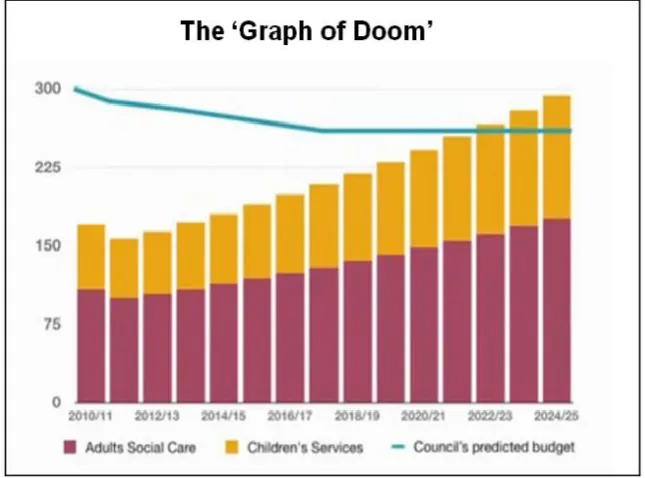
The position of Local Authorities is arguably even more challenging. The Barnet “Graph of Doom” (see Figure 1) is a graphic illustration of the financial prospects for Local Authority services over the next few years. In fewer words than the NHS England 5-‐Year Forward View, it poses a real and unanswered question as to what the future may hold for Local Authority services.
Figure 1 -‐ ‘The Barnet Graph of Doom’23
22 NHS England (2014). For report see: www.england.nhs.uk
[image:16.595.133.456.474.713.2]In recent years, the obvious downward pressure on social service provision, and the immediate and direct impact of this on increasing the hospital stays of vulnerable elderly patients, has led to national initiatives to transfer NHS financial resources for use in the social care sector.
Over the past three years a rising proportion of the NHS budget has been earmarked at a national level from local NHS Commissioner budgets to be spent on the provision of social care in their localities. In 2015/16 £5.3bn from the NHS budget has been set-‐aside for the “Better Care Fund” (formerly known as the Integration Transformation Fund). This is designed to create a single pooled budget across the NHS and Local Government to “work more closely together around people, placing their well-‐being as the focus of health and care services.” Arguably, the most tangible measure of the success of the fund will be the extent to which it can reduce demand on the acute hospital sector.
Another highly significant move is the push towards greater devolution to cities and regions, exemplified in the recent agreement reached between the Department of Health and Greater Manchester Combined Authority that proposes to give the latter the responsibility of running its own health and social care budget, worth £6bn24. The hope is that it will enable better ways of meeting the needs for long term support (arising out the rising number of older people with complex health and social care needs), ending the health and social care divide that is now recognised universally as wasteful and ineffective. Other localities are following suit.
The transfer of such a sizeable financial resource to be spent on provision previously the responsibility of Local Authority Social Services Departments brings with it some real local tensions and risks.
If the objectives of the Better Care Fund are not met in a particular locality, what will the implications be for local co-‐operation? Of course, it can equally be argued that the Better Care Fund is a significant driver for integrated delivery and systems leadership as suggested in the preliminary evaluation report for Local Vision25.
However, when all sectors of a local system are under great financial and service strain, the need for the Better Care Fund to deliver is likely to become an imperative which will more than likely create substantial inter-‐organisational tensions unless strong local partnership relations are already in place. In order to transfer NHS funds to the social care sector, NHS providers have been required to find up-‐front efficiency gains. NHS England is clear on its analysis of the necessary conditions, which include integration across systems and focus on prevention to underpin this. A substantial proportion of NHS Foundation Trusts and NHS Trusts are reporting financial deficits and projecting deficits into the coming year. Many providers are now not meeting the nationally mandated targets. Failure to meet these puts Boards in jeopardy. The aforementioned 5-‐Year Forward View identified potential gains from “innovation through the creation of new organisational forms in the provider landscape”, variously combining GPs, primary, community care and acute hospital organisations26. The implications for radical organisational and systems change alongside the need for leadership beyond organisation are substantial. Against this
24 http://www.bbc.co.uk/news/uk-‐england-‐manchester-‐31615218 25 Vise, R. (2014) The Revolution will be Improvised.
4.
Local Vision Programme Commissioning and Design
4.1.
Framing and approach
The first phase of Local Vision, initiated in 2013, invited proposals from across the UK generating some 40 responses. Of these 25 place-‐based projects were selected focusing on a wicked issue of the localities’ choosing, and involving a range of partners accordingly.
The criteria for selection included:
• The extent to which the project related to a ‘breakthrough’ issue across a
locality that involved a range of sectors and stakeholders
• Ability to demonstrate new ways of working in support of delivering
integrated services
• Evidence of seeking to achieve measurable achievements in health, care and
wellbeing.
• Commitment to applying what they learned about Systems Leadership to
other issues, and to sharing their learning so that other areas could benefit
• Senior-‐level political support and a funding commitment of £10,000 from
their local Health and Wellbeing Board.
Successful initiatives were awarded up to £27,000 to fund an experienced systems leadership development ‘Enabler’ through the life of the programme. Those selected also received access to a variety of learning events and networks hosted by the Kings Fund and other partners, including contributions of consultancy expertise from the private sector27.
The stated aims of Local Vision provide an obvious starting point for exploring explicit and implicit assumptions around the model of change for the initiative within the political and fiscal landscape as outlined in Section 3.4. This supposition can be summed up as:
• Skilled facilitation and development of systems leadership capability in a
locality, where there is engagement through focusing on a difficult relevant issue, will lead to different leadership behaviours
• The investment in collective systems leadership capability will lead to
transferable learning and skills to address similarly complex issues, thereby ensuring sustainability and informing future learning.
• That enhanced collected leadership capability is necessary to drive more
effective service provision for service users against a backdrop of increasing financial austerity.
This supposition has been ‘translated’ into action through the commissioning of
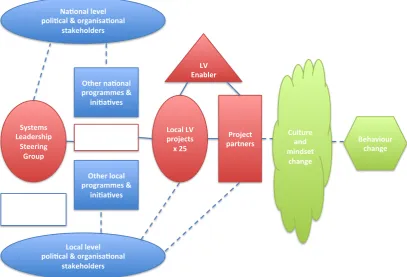
Local Vision (amongst other programmes and initiatives, such as the NHS Integrated Care Pioneers) with the engagement of localities and identification of a difficult shared problem coupled with recruitment of highly skilled and experienced ‘Enablers’, as summarised in Figure 2.
Figure 2 – Preliminary mapping of the Systems Leadership: Local Vision landscape
4.2.
Aims and objectives
Interviews and notes from Steering Group meetings, alongside the design team at the Leadership Centre, highlight a strategic focus on an experimental approach to systems leadership development, with Local Vision positioned as a break from traditional models of delivery and with an emphasis on learning through action. However, as several members of the Steering Group explained, there were varying views across the board on the significance of taking an inherently difficult issue (e.g. the integration of health and social care services) and adopting a systems leadership approach.
There is shared and palpable sense of financial urgency and impetus across members of the Steering Group of the need for change among some leaders and repositioning of the relationship with citizens and service – towards co production and shared responsibility.
The messiness, and recognition of the nature of tackling a difficult shared problem was highlighted -‐ in particular the challenges of addressing ‘wicked’ issues with no clear solution:
“You can make progress on the issues but they cannot be resolved, and everything you do is likely to have knock-‐on effects, some of which will be intended, but some of which would have been unseen and unintended.” [SL Steering Group Member]
A number of Steering Group members commented on the significance of the integration agenda for service transformation for better outcomes and on the significance of delivering a ‘place-‐based’ programme of systems leadership ‘in-‐situ’.
Na#onal'level' poli#cal'&'organisa#onal'
stakeholders'
Systems' Leadership'
Steering' Group'
Local'Vision' Other'na#onal' programmes'&' ini#a#ves'
Other'local' programmes'&'
ini#a#ves'
Local'level' poli#cal'&'organisa#onal'
stakeholders'
Local'LV' projects' x'25'
LV' Enabler'
Project' partners'
Culture' and' mindset'
change'
Behaviour' change'
[image:20.595.97.505.93.370.2]For some members, the role of place is about providing psychological safety for experimentation, and ownership in building on the value of the relationships in the locality to create change:
“You have to choose some artificial certainty e.g. place, which is not hermetically sealed but it fixes a point, because people are more able to tolerate an experiential relational approach and so building that as a vehicle for change” [SL Steering Group Member]
The role of the Enabler as a skilled facilitator of learning for systems leadership through action is seen as central to the LV approach:
“One part of our approach was providing really good experienced facilitators to work with people who wanted to work in a new way. We have a system where the people want to work together but perhaps aren’t quite sure how to do it, or it needs to be accelerated; this is where the facilitation comes in.” [SL Steering Group Member]
Taking care in matching Enablers to place and recognising that the role cannot be prescribed as a one-‐size fits all is a key aspect of the Steering Group’s understanding:
“…part of the dark art of who goes to work where, is getting somebody who pitches at the right level for the place because all the Enablers, all of us have got different things that we’re good at. There’s no formula really.” [LV Programme Team]
There is also recognition that whilst the Enablers are critical in facilitating top-‐level engagement and learning, pre-‐conditions may be important and the role carries the obvious danger of heroism and dependency:
“Whilst I think good facilitation is a pre-‐requisite unless you’ve already got a very well-‐functioning system, it would definitely be worth probing whether any (localities) have abdicated to the facilitator.” [SL Steering Group Member]
“And you know there’s a number of places I think who hire the Enablers afterwards because they value what they do. However, there has rarely if ever been a case of a place carry on doing it without the support of the Enabler. That’s the thing working for me.” [SL Steering Group Member] The Steering Group also highlight leadership behaviours that they believe are critical to the success of Local Vision and anticipate seeing evidence of as a result of the initiative. These include:
• focusing on outcomes and results rather than processes • basing the work on strong but honest relationships
• putting service users and carers at the centre of those relationships • allowing for experimentation – and therefore allowing for risk • being willing to genuinely listen to others and see their point of view
• being able to adapt, going with ‘good enough’ solutions and building on them
rather than waiting until you have the perfect service/solution.
“Part of our role has been spreading the message that behaviours have to change, and that old style behaviours just won’t work any more.” [SL Steering Group Member]
“If we could sow a way of working that was much more adaptive, particularly into the mindset of public service leaders therefore organisations, that thing would be successful and I don’t see why we shouldn’t.” [SL Steering Group Member]
The preliminary Local Vision evaluation report28 identified a number of key factors for collaborative success -‐ the majority of which involve mindset or are behavioural. The focus on shaping behaviour and mindset chimes with the system’s leadership literature as a distinguishing feature but does not take into account the real contextual ‘systems’ tensions and complexity experienced in enacting leadership as outlined earlier in this report.
A question that stems then for the evaluation’s articulation of the model of change for Local Vision, and for further exploration, is to what extent does context matter and how might this be taken into consideration? This theme is explored further in the next section of this report.
Figure
Outline
Related documents
