The Difference that Makes the Difference
Final evaluation of the first place-‐based programmes
for Systems Leadership: Local Vision
October 2015
Bristol Leadership Centre
Bristol Business School
Evaluation team
This evaluation has been conducted by a multi-‐disciplinary team, led by Professor Richard Bolden and Anita Gulati at the University of the West of England, with contributions from Yusuf Ahmad, Professor John Burgoyne, Nick Chapman, Dr Gareth Edwards, Elizabeth Green, David Owen, Dr Ian Smith and Michelle Spirit.
Acknowledgements
Contents
1.
Executive summary ... 4
2.
Introduction ... 6
3.
Evaluation process ... 7
3.1.
Aims and objectives ... 7
3.2.
Methodology ... 7
3.3.
Analysis and interpretation ... 8
4.
To what extent has Local Vision raised awareness of systems leadership amongst stakeholders in different localities? ... 10
4.1.
Thinking systemically ... 10
4.2.
Working collaboratively ... 11
4.3.
Engaging with service users ... 12
4.4.
Fostering shared leadership ... 13
5.
What are the criteria for success, perceived benefits, anticipated value and impact from different stakeholder perspectives? ... 16
5.1.
Influencing strategy ... 16
5.2.
Generating income and opportunities ... 17
5.3.
Engaging professionals ... 18
5.4.
Improving services and client outcomes ... 20
6.
What are the longer-‐term impacts of Local Vision and how sustainable are changes over time? ... 21
6.1.
Catalysing change ... 21
6.2.
Developing new ways of working ... 21
6.3.
Building commitment and momentum ... 23
6.4.
Monitoring performance ... 23
7.
Are there any emerging patterns to help inform understanding of the ingredients of effective systems leadership interventions? ... 25
7.1.
Start-‐up conditions ... 25
7.2.
Local context ... 26
7.3.
Process ... 27
7.4.
Planning for sustainability ... 30
8.
What role can data analytics play in making sense of projects and their impacts? ... 32
9.
Conclusions ... 34
10.
Glossary of terms and abbreviations ... 37
11.
References and further reading ... 38
12.
Appendix 1 – Summary of findings from previous Local Vision evaluations ... 40
12.1.
Building Blocks for Success ... 40
12.2.
Summary and Conclusions from Phase 1 Evaluation ... 41
13.
Appendix 2 – Local Vision Projects and Case Studies ... 42
13.1.
Map of Cohort 1 Projects ... 42
13.2.
Summary of Phase 2 evaluation case studies ... 43
14.
Appendix 3-‐ Qualitative data used for this evaluation ... 44
15.
Appendix 4 -‐ Local Vision Data Profiles ... 45
15.1.
Local Vision “substantive problems” to be tackled ... 48
1.
Executive summary
1. This report outlines findings from Phase 2 of the evaluation of Systems Leadership: Local Vision, conducted by Bristol Leadership Centre on behalf of the Systems Leadership Centre Steering Group. It is the third in a series of reports capturing the learning and outcomes of the first cohort of Local Vision projects.
2. In this report we focus on the outcomes and effects of Local Vision projects in different localities and consider how local context enables or constrains the potential for sustainable change. This analysis is based on case studies, interviews and secondary data.
3. Overall, the findings suggest that Local Vision has had a positive impact within each of the areas investigated, complementing existing initiatives and catalysing change and engagement amongst partners and communities.
4. There is good evidence of Local Vision projects raising awareness of systems leadership amongst stakeholders in different localities – in particular in relation to thinking systemically, working collaboratively, engaging with service users, and fostering shared leadership.
5. Likewise, there is good evidence that Local Vision has been regarded as a success in most localities, producing benefits and value for a diversity of stakeholders, such as influencing strategy, generating income and opportunities, engaging professionals, and improving services and client outcomes.
6. Whilst, in many cases it is still a little too early to determine the legacy and any lasting change arising from Local Vision, there is good evidence of its ability to catalyse change, influence new ways of working, and build commitment and momentum in relation to ‘wicked’ issues.
7. The case studies conducted during this phase of the evaluation enable the identification of a number of trends across projects that suggest some important ingredients of effective systems leadership interventions. These include start-‐up conditions (including the nature of the problem/challenge, level of intervention, prior experience of systems working, and imperative for change); local context (including alignment with other initiatives, project ownership, dedicated project support, and senior-‐level organisational and political engagement); process (including choice of Enabler, engagement with local communities, memorandum of understanding, King’s Fund learning network, and scale and timing of projects); and planning for sustainability (including project leadership, Enabler exit conditions, roll-‐out, and evaluating outcomes).
8. Alongside the collection and analysis of evidence from Local Vision project partners and Enablers, the evaluation also collated and analysed a wide range of independent metrics on localities and the nature and scale of the ‘wicked’ issues that projects were tackling. Whilst these analyses did not reveal many insights into the Local Vision projects themselves, they do illuminate the challenges of benchmarking complex change interventions, and highlight the potential value of data as a leadership tool for galvanising action in complex and contested environments.
supported by skilled ‘Enablers’, Local Vision has successfully catalysed collaboration between multiple stakeholders to address shared challenges.
10. The evaluation findings prove testament to the skill and tenacity of the Local Vision Enablers, project partners and the Leadership Centre (who coordinated and supported the initiative on behalf of the Systems Leadership Steering Group) in brokering relationships, facilitating difficult conversations and (re)connecting diverse communities to a shared sense of purpose. In most localities, there are now people committed to thinking systemically, working collaboratively, engaging with service users, and fostering shared leadership that will continue to have an impact for many years to come.
2.
Introduction
This report outlines findings from Phase 2 of the evaluation of Systems Leadership: Local Vision, conducted by Bristol Leadership Centre (BLC)1 on behalf of the Systems Leadership
Steering Group2. It is the third in a series of reports capturing the learning and outcomes of
the first cohort of Local Vision projects3. Previous reports include:
• The Revolution will be Improvised, Vize 2014 – http://tiny.cc/LV1
• Reframing, Realignment & Relationships, BLC, 2015 -‐ http://tiny.cc/LVinterim
Each of these reports gives important insights into the processes, context and outcomes of Local Vision (LV), as summarised in Appendix 1.
In this report we focus on the outcomes and effects of Local Vision projects4 in different
localities and consider how local context enables or constrains the potential for sustainable change. This analysis is based on case studies, interviews and secondary data, as explained in the next section.
The specified aims of Local Vision were as follows5:
1. To assist in the development of local solutions to a local ‘wicked’/intractable issue through leadership development;
2. To ensure that the leadership learning is left in place to allow it to be used for other issues;
3. To draw together lessons and learning about leadership behaviours and development that will help resolve future wicked issues.
Overall the findings suggest that Local Vision has had a positive impact within each of the areas investigated, complementing existing initiatives and catalysing change and engagement amongst partners and communities. There is good evidence of the Local Vision process supporting the development of local solutions to ‘wicked’6 issues, assisting in the
processes of problem identification, diagnosis and framing, partnership building and leadership development. Likewise, there is good evidence that Local Vision has triggered important learning in each area (particularly around systems thinking and shared leadership) that has been embraced by key partners and applied to other issues. Furthermore there is emerging evidence in several locations that Local Vision has positively impacted upon leadership practices and behaviours, which in turn is beginning to impact positively on service provision and client outcomes.
This report focuses on project findings and their implications for future cohorts of Local Vision. The next chapter gives an outline of the evaluation process and is followed by a series of five findings chapters each reporting on certain aspects of the evaluation. The final chapter presents conclusions and a summary of key findings. For more on the concept of systems leadership and the Local Vision approach please refer to the other reports in this series.
1 A glossary of abbreviations and key terms is given in Section 10.
2 A consortium of local and national government, NHS, social care, public health, voluntary sector and
private sector members who support the development of systems leadership in UK public services.
3 A further report, that captures the outcomes of a workshop on 3rd June 2015 has also been compiled
but is not reported here as it did not focus on evaluation of the LV programme per se.
4 Please note that whilst we refer to these as ‘projects’ most should be considered as ongoing
initiatives, without a clearly defined start or end point.
3.
Evaluation process
3.1.
Aims and objectives
In November 2014 Bristol Leadership Centre at the University of the West of England was commissioned by the Leadership Centre7 (on behalf of the Systems Leadership Steering
Group) to conduct an independent evaluation of the first cohort of Systems Leadership: Local Vision8.
The primary purpose of the evaluation was to support learning and development of the Local Vision approach, illuminating impact (or progress towards impact) and areas for development/improvement.
The project aims were as follows:
1. Examine how Local Vision has raised awareness of systems leadership in individual places, and among stakeholders, including service users;
2. Identify criteria for success and perceived benefits, anticipated value and impact from differing stakeholder perspectives;
3. Gather evidence through a variety of routes to identify and map impacts (anticipated or not) and to gauge sustainability of any service transformation at a local systems level, through to service users;
4. Identify any emerging patterns to help inform understanding of the ingredients of effective systems leadership interventions.
The evaluation was designed in two phases, as outlined below. This report sets out findings for Phase 2 and explores programme outcomes in specific localities.
3.2.
Methodology
This evaluation used a mixed methods approach, split into two phases as follows.
Phase 1 (November 2014 – April 2015)
Phase 1 involved getting a broad overview of the Local Vision programme, its approach and preliminary findings -‐ data sources included:
• analysis of academic literature and applied research;
• qualitative in-‐depth exploratory interviews with members of the Systems Leadership
Steering Group, Enablers, and local stakeholders;
• analyses of key documentation, such as contracting with Enablers and localities and
national policy documents;
• survey data from the last 3 years.
Findings from this Phase informed the development of a framework to test and explore the processes and impacts of Local Vision (see Section 3.3) and are presented in the Interim evaluation report -‐ http://tiny.cc/LVinterim.
Phase 2 (May – September 2015)
Phase 2 involved compiling case studies of Local Vision projects in different localities in order to explore programme impacts from a range of stakeholder perspectives. 10 cohort 1 projects and two cohort 2 projects were selected for follow-‐up case studies, as indicated below9:
• In-‐depth case studies: Bournemouth, Dorset & Poole (BDP); Plymouth; Wiltshire;
Solihull (cohort 2)
• Mid-‐level case studies: Gloucestershire, Hackney and Dudley
• Mini-‐case studies: Birmingham; Kent; West Cheshire; Wirral; Blackpool (cohort 2)
Cases were chosen to include a range of geographical locations, project type/focus and LV Enabler. Selection of cases was done in close consultation with the Leadership Centre. In each case a variety of sources were used, including:
• Interviews with key stakeholders: 5 or more for in-‐depth cases, 3-‐4 for mid-‐level
cases, and primarily the LV Enabler for level 1 cases
• Online survey: questionnaire responses from project partners collected by the
Leadership Centre as part of its monitoring process
• Online survey: questionnaire responses from project partners and Enablers collected
between January and July 2015 by the UWE evaluation team
• Memorandum of understanding (MOU): developed with the LV Enabler after initial
project scoping and outlining project aims and key outcomes
• Project reports/documents: reports on project progress compiled by Enablers
and/or project partners (where available)
• Project updates: verbal updates at King’s Fund events, Enabler workshops and
partnership board meetings (where available)
• Area statistics: data collected for each area to shed light on key metrics (where
available and applicable)
In total, 23 MOUs, 62 interviews, 4 site-‐visits and 49 surveys were analysed for this phase of the research. For a detailed breakdown of the data see Appendix 310.
3.3.
Analysis and interpretation
As a systems-‐based evaluation we have endeavoured to take the wider context into account, along with a thematic approach to the analysis, exploring the role of factors shaping outcomes at national as well as local level. To this end we explored the potential of descriptive statistics to indicate any pattern or factors that might inform our interpretation of the narrative case findings. Further details on this approach are provided in Chapter 8 and Appendix 4.
Narrative cases were constructed from available evidence to give a sense of how projects developed and evolved, including start up conditions, organisational and political context, key partners and stakeholders, the role played by LV Enablers, project outcomes and
9 Appendix 2 gives a summary of Local Vision locations and projects.
10 We greatly appreciate the participation of LV Enablers and local stakeholders in this evaluation. In
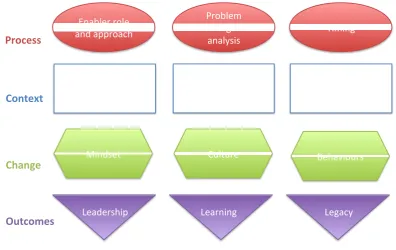
experiences, data and metrics. In addition, summary templates were created for each case, based on an extended version of the framework developed for the Interim Report, as illustrated in Figure 3.1 below.
Figure 3.1 – Data analysis framework for case studies (adapted from BLC, 2015)
Overall, an inductive approach was taken to the analysis in which members of the research team immersed themselves in the available evidence in order to identify patterns and trends that were then developed through an iterative process of engaging with the data, refining of categories and verifying interpretations and findings with the wider evaluation group. The following chapters present findings, organised in relation to the four key evaluation questions as outlined in section 3.1. A fifth question, ‘what role can data analytics play in making sense of projects and their impacts’ is also considered.
Organisa(onal+ structures+and+
priori(es+
Poli(cal+and+ organisa(onal+
support+ Networks+and+
rela(onships+ Context'
Enabler+role+ and+approach+
Problem+ framing+and+
analysis+ Timing+
Process'
Mindset+ Culture+ Behaviours+
Change'
[image:9.595.101.498.150.400.2]4.
To what extent has Local Vision raised awareness of
systems leadership amongst stakeholders in different
localities?
Local Vision was positioned as an opportunity for people in localities to learn about systems leadership and to apply this learning to a specific ‘wicked’ issue. Evidence of both incremental and transformative learning and development was captured in interviews with key stakeholders in each locality and clearly continues to have an enduring effect on how many participants go about their work.
4.1.
Thinking systemically
A foundational aspect of systems leadership is the ability to think systemically – of taking a broader view on issues that enables recognition of the interconnections between services, providers and outcomes. In each case site there was strong evidence of the Local Vision project facilitating a shift in awareness of partners that gave them a deeper appreciation of the systemic nature of challenges and the need for a collaborative response, as illustrated in the vignette below.
Case Vignette: Wirral
The Wirral Local Vision project sought to enhance the local food system in order to create a ‘healthier, fairer, happier Wirral’. It was initiated by the Public Health team at Wirral Council and brought together a broad partnership of residents, food businesses, community organisations, local government and health institutions. A systems perspective is essential to tackling such complex issues and the support provided by the LV Enabler has been incredibly valuable in developing an understanding of, and commitment to, systems thinking amongst key partners.
“Our Enabler has talked often about this being about connecting little bonfires into a beacon. This insight has made me think about the challenge not just as a problem for us to solve but as enabling the system to solve the problem itself.”
“People are really engaging with the different way of doing things. Systems leadership has already been identified as an approach the locality would like to take towards crime and health.”
For further details see: http://tiny.cc/BetterFoodWirral
Whilst, in theory, systems thinking may be rather straight forward, in practice it can be very challenging. Partners greatly valued the support of the Enabler in helping to bring together key partners in order to develop a shared understanding of issues, as illustrated below.
“It’s a real struggle for public health people to get our heads around [a systems] approach as it seems so opposite to what we do. Having [the Enabler] explain it really helped us to understand it properly.” LV Project Partner, Hackney
“[The Enabler] helped us understand the system better and therefore begin to appreciate why it wasn’t as we wanted. This insight allowed us to make suggestions/ recommendations to the safeguarding board.” LV Project Partner, Hackney
“Systems leadership wasn’t rocket science. What it did through the external support of an ‘LV Enabler’ was give us time to reflect and learn; to challenge the ‘way we do it’ and to try some different ways of thinking, being and acting while in a safe space.”
In several cases, participants also commented on the value added by the King’s Fund learning network days and the ability this gave to go deeper into the theory and practice of systems leadership. As a direct consequence, participants from at least one locality have gone on to further study in this area.
An important finding of the Phase 2 evaluation is evidence of how a systems approach has been cascaded amongst partners in some localities. In Plymouth, for example, a systems approach has been adopted by senior leaders and applied across the board; in Gloucestershire it has been applied to areas including diabetes and dementia and in the Wirral it has been applied to areas including crime and health. This demonstrates the potential systemic effect of Local Vision and the ability to transfer learning and behaviours to a range of ‘wicked’ issues.
4.2.
Working collaboratively
The development of a systems perspective has encouraged participants to work more collaboratively with partners from other organisations and sectors in order to address shared problems and challenges, as illustrated below.
“We are engaging with organisations that we have not had a relationship with before. The richness of these relationships has also improved as has the reach.” LV Project Partner, Wirral
“We’ve reflected on how important the relationships are and this makes a difference at every level and are the key to success.” LV Project Partner, BDP
“We have a strong history of partnership working in West Cheshire as demonstrated through our involvement in the whole place community budget programme. I believe that this programme has extended these principles by allowing us to work with important third sector providers such as Age UK to address these issues in
partnership with important providers.” LV Project Partner, West Cheshire
In many cases the LV Enabler played a key role in fostering collaboration through bringing together key stakeholders, many of whom rarely met or engaged with one another beforehand, and facilitating difficult conversations where necessary.
“The Enabler was able to point out the behaviours we were demonstrating and the language we were using which was really helpful, for example saying ‘what I am observing at this point is this…’” LV Project Partner, Dudley
Many LV participants made reference to the changing nature of conversations and the development of a broader shared narrative that multiple stakeholders could engage with, as indicated below.
“[Local Vision] helped us have honest discussions and created a safe environment for us to negotiate.” LV Project Partner, Dudley
“[Local Vision] helped to begin to shape a shared narrative about FGM [female genital mutilation] locally that hadn’t existed as individual agencies appeared to have their own.” LV Project Partner, Hackney
An important outcome of Local Vision in many locations, linked to the theme of working collaboratively, was the development of trust and mutual understanding between partners, as illustrated in the following quote and vignette.
“I got more understanding of the pressures other people, in other organisations, were under and what this means in terms of their actions and why they can’t deliver on things. Before if they did not deliver, I thought it was about disinterest. But now there is better trust and understanding.” LV Project Partner, Wiltshire
Case Vignette: Bournemouth, Dorset & Poole (1)
In Bournemouth, Dorset & Poole (BDP) the Local Vision project was used to support the integration of health and social care across three local authorities. This was a complex, high-‐ level strategic initiative that involved bringing together a diverse range of stakeholders, many of whom saw themselves as competitors in other areas of service provision and funding. Whilst Local Vision was only a small part of the overall initiative, the support provided by the Enabler played a key role in building a sense of cohesion across projects and of building mutual awareness and appreciation of the challenges facing different partners.
“Local Vision got everyone into the room and pushed people into honest conversations and at the end there was some kind of consensus around what needed to be done. Not everyone was whole hearted. But it is in everyone’s interests to see what they can get, personal and organisational towards a common goal.”
“We have learned about each other’s organisations and pressures which has helped identify ways of working together. We realise we need more focus on outcomes now. It is difficult to hold ourselves to account, both individual and collective and we need to capitalize on that now alongside making greater use of evidence and real working together.”
For further details see: https://www.dorsetforyou.com/better-‐together
4.3.
Engaging with service users
Although not all of the Local Vision projects focussed on increasing user engagement in the development and provision of services, in most cases the idea of co-‐production and community engagement was introduced and had an important impact on engaging partners across boundaries.
“[The Enabler] has brought perspective, really putting the patient at the centre.” LV Project Partner, Dudley
“We used the ‘PRUB’ model, to help validate whether what we do (Projects) and the
Results they achieve (typically the services we offer) are Used by people in a way that
delivers the Benefits (or outcomes) we are hoping for. Along with the case studies
developed by one of our teams, these were a really engaging and powerful way of getting leaders to think about why we are all here and for keeping a strong user focus.” LV Project Partner, Wiltshire
Whilst it was not possible to speak directly with service users during the evaluation, there was strong evidence in several localities of Local Vision partners building close associations with community-‐based organisations in order to better engage with service users, as illustrated in the following vignette from Hackney.
Case Vignette: Hackney
During the Hackney Local Vision project a local charity, the Hawa Trust, which provides support to victims of FGM (female genital mutilation) in the area was identified and engaged. The charity founder, an FGM survivor and local citizen herself, had been working for several years with little or no organisational or financial support. Through involvement in the LV partnership the Hawa Trust has grown in size and now organises regular coffee mornings, school visits, parent evenings, and educates primary school teachers and parents on the dangers of FGM. In June 2015 it was awarded a Public Health Community Grant of £7910 by Hackney Council to further raise awareness of the physical, emotional and legal issues around FGM, involving parents, girls, women, men and community leaders such as imams and pastors.
“While FGM’s a national issue, it’s in these individual households where there’s a real taboo about discussing it… The more Hawa is talking about it, the more other people are talking about it or facing up to the fact that they don’t want to talk about it… The Hawa Trust is putting FGM on the diaspora agenda in Hackney.” Kristine Wellington, Head of Safeguarding, Children and Families at Hackney CVS (cited in Hackney Citizen, 9 January, 2015)
For further details see: http://bit.ly/1suprev
Community engagement formed an important part of the Local Vision intervention in a number of areas, including Hackney, Gloucestershire, Cornwall, Dudley and Wirral was cited as having a transformative impact upon partners. Several people spoke of ‘light bulb’ moments when they recognised the value of taking a user perspective on issues and the importance of engaging local communities in the co-‐production of services.
“The light bulb moment was when all the players realised they were not doing anything collectively to prevent the risk to girls of being subject to FGM. It has been this holding up of the mirror and asking partners why they care; what they are doing; what they think others are doing; what they think they could do. And once they realise the number of girls at risk and that they thought everyone else was doing something there is no going back and people genuinely want to do something.” LV Enabler
“It is about collaborating with equal partners for the benefits of our population. It is also about trying to trigger that intrinsic drive in people to motivate themselves rather than being done by services. It is rewarding to work with like-‐minded people.”
LV Project Partner, Gloucestershire
“I thought that I was the system, but now I realise that I am only part of a much wider system. We need to learn to work much better together and then listen to
what communities want from us so that we can deliver together.” LV Project Partner,
Gloucestershire
4.4.
Fostering shared leadership
Underpinning all of the outcomes outlined above is the development of a shared, inclusive approach to leadership in which people at all levels are encouraged and empowered to lead from where they are in the system. In Wiltshire, for example, Local Vision was used to develop leadership capacity within the system to assist in implementation of the Better Care Plan, as illustrated in the following vignette.
Case Vignette: Wiltshire
The Better Care Plan (BCP), financed by the Better Care Fund (BCF), sets out a strategy for the implementation of an integrated approach to health and social care to better meet the needs of patients and communities. Local Vision was used to support the system leadership provided by individuals and leadership groups, including the Joint Commissioning Board (JCB) and the Health and Wellbeing Board (HWBB).
Much of the Enabler time was spent facilitating learning and discussion amongst partners around systems thinking and leadership. When engaging with clinicians this was often linked to practical challenges such as reducing the number of Delayed Transfers of Care and preparing for 24/7 service provision. Concepts such as ‘wicked issues’ and ‘emergent learning’ were introduced to help provide a shared language for stakeholders across the system and to develop a shared sense of purpose. The ‘100 Days Challenge’ was framed as an opportunity for experimentation and shared learning in a ‘safe fail’ environment.
“Local Vision supported us in thinking through Systems Leadership implications throughout our work. It helped us in trying to unpick the differences between project management approaches, more direct management styles against people who have tendencies to work through relationships and partnerships. The two approaches can sometimes seem polarised, but we have learnt that some approaches are better suited to different circumstances.”
“There are good examples of people of all levels being involved e.g. in development of integrated teams, homefirst pathways, and the discharge process change. The commissioning of ‘cohorted’ intermediate care beds to 9 nursing homes and the subsequent engagement of those homes together with intermediate care services is another excellent example.”
“ The 100 day challenge busted the myths and proved change can happen quickly.”
The recruitment of a dedicated team to support the integration agenda, headed up by a senior-‐level director jointly appointed by the CCG and Council, added credibility, influence and a systemic-‐perspective. Evidence indicates a growing willingness and ability of partners to engage in systems leadership and a second cohort LV project was funded to help build on this success and to deepen the learning and impact by working with the voluntary care sector in local communities.
For further details see: http://www.wiltshire.gov.uk/socialcare-‐better-‐care-‐plan.pdf
Associated with this opening up of leadership, there is evidence of individuals in many locations developing an enhanced sense of commitment and responsibility to actively influencing and shaping projects and outcomes within their locality. In Plymouth, for example, the City Council has relinquished some of its control over budgets and their allocations to enable the development of joint commissioning from shared budgets between the council and Clinical Commissioning Group (CCG), and have started a move towards cooperative commissioning with community partners.
The shift towards more inclusive and democratic forms of leadership, however, is not without its challenges. People in both local authorities and health providers spoke of it being ‘counter-‐cultural’ and appreciated the support of Enablers in aiding the transition.
“I think one of the biggest impacts they've had [Enablers] was in a couple of workshops they ran with the operational managers and team leaders in making them understand that they had to change and why they had to change. I was not on those two workshops, but I've heard from lots of people that you could actually see the penny dropping and light bulb moments. [One Enabler] in particular was challenging people when they were saying 'Well this is what we do anyway' and that approach was actually being challenged, and people started to get what it was we were trying to do. I think it might not have happened without them… the biggest change has been people understanding why we want to change…” LV Project Partner, Solihull
“The six sessions with the Enabler were worthwhile and needed given the challenges. There’s been a development of the relationships here. We want to move forward but we have to make sure we are in it together. We are now in the process of re-‐ establishing the partnership. There’s a common goal and we support working together. As a partner, I just want the system to work! In retrospect Local Vision was good value for money. We wouldn’t be revisiting the work of the partnership otherwise. There was good momentum as a result.” LV Project Partner, BDP
As a consequence of developing a more inclusive view of leadership, partners in a number of areas commented on how this has empowered people to take greater responsibility and ownership for their contribution and enhanced ownership and buy-‐in from others who play a key role in supporting and sustaining action.
“People have been given confidence to act outside of their normal roles, identified others they could be working with on different things they didn’t know before, shown people possibilities.” LV Enabler
“The real outcome of Local Vision was about taking collective responsibility and accountability for our progress.” LV Project Partner, BDP
5.
What are the criteria for success, perceived benefits,
anticipated value and impact from different stakeholder
perspectives?
Many of the points in the previous section also apply to this question. Here we will focus specifically on how Local Vision has led to tangible changes and improvements within localities. In most cases, however, Local Vision did not operate alone and outcomes were the consequence of concerted effort across a number of initiatives. We will consider the role of LV Enablers in ‘knitting’ together opportunities and, where possible, identify the distinctive contribution that Local Vision made to projects.
5.1.
Influencing strategy
All of the Local Vision projects studied during this evaluation were focussed on addressing an issue of strategic significance within localities. The nature of these challenges ranged from addressing specific issues, such as obesity, alcohol abuse, FGM or dementia, to supporting the integration of health and social care budgets and provision.
The Plymouth project is a good example of where Local Vision supported the implementation of a strategic initiative that brought together a wide range of partners to address a shared issue, as outlined in the vignette below.
Case Vignette: Plymouth (1)
In Plymouth the Local Vision project supported the implementation of the city’s Strategic Alcohol Plan. This was a wicked issue that had been recognised as a priority for some time, but where previous attempts had failed to have a lasting impact.
Initially, the LV Enabler supported the Health and Well Being Board (HWBB) as a whole, and also worked with individuals on a one-‐to-‐one basis. She encouraged partners to examine how they worked together and to debate what they really wanted to achieve from this work. She supported individuals involved with implementation of the plan and helped establish ‘peer consulting groups’ to represent the different levels within the City.
Plymouth’s Strategic Alcohol Plan was published in July 2013 and set out a clear direction in each of four domains (Treat, Protect, Prevent, and Enforce and Control), plus a number of cross-‐cutting themes. It also set out the outcomes expected from implementation of the strategy, including: reduced alcohol-‐related hospital admissions, reduced levels of harmful drinking, reduced alcohol-‐related violence, reduced alcohol-‐related anti-‐social behaviour, and reduced numbers of children affected by parental alcohol misuse.
In the two years since the publication of the plan, leads for each of its domains have been identified and are now members of the Alcohol Programme Board, chaired by the new Director of Public Health (DPH). The City regularly monitors specific data indicators to assess the success of the Alcohol Plan in achieving its outcomes. Although it is probably too early to expect positive movement in many of the indicators, there are some early signs of success.
It is clear that the degree of personal priority that the new DPH has given to the strategy is an element in its success. However, there are other signs that the work of the Alcohol Programme Board and the emphasis on system leadership and a whole system approach has had significant and positive impacts.
Bournemouth, Dorset & Poole, Kent and Wiltshire are also examples of projects that brought together stakeholders at a strategic level to support the integration of health and social care. In each case, projects engaged with both senior organisational and political leaders to influence strategic outcomes.
Whilst strategic outcomes are hard to measure, both Plymouth and Bournemouth, Dorset & Poole provide convincing evidence of having a significant positive impact on local policy and strategy.
5.2.
Generating income and opportunities
For most localities Local Vision is just one of a number of inter-‐related initiatives linked to strategic development and transformation. There is strong evidence from around half of the in-‐depth case studies of Local Vision being used to leverage additional funding and development opportunities within the locality.
“Going through the process, the discussions around the Better Care Fund, creating the positive relationships that we have has laid the foundations that have meant we were able to make a successful bid for Vanguard funding…this will help reinforce the vision and direction.” LV Project Partner, Dudley
“We also used our local findings and learning to inform our approach under our successful BrightLife Programme to tackle social isolation. This programme has
drawn down £5.2m to address social isolation from 2015-‐2020.” LV Project Partner,
West Cheshire
The Bournemouth, Dorset & Poole project offered an opportunity to support the leadership and relationship-‐building aspects of a major strategic initiative supported through the Better Care Fund and Transformation funding, as illustrated in the following vignette.
Case Vignette: Bournemouth, Dorset & Poole (2)
In Bournemouth, Dorset & Poole Local Vision was used to support a number of large strategic projects around the integration of health and social care across three local authorities, including the Transformation Challenge Fund and Better Care Fund. Local Vision offered an alternative platform for engaging partners and, in particular, developing a sense of shared purpose and leadership.
Local Vision funding of £27k was agreed in November 2013 through to spring of 2014 to address group leadership development and to support tackling of the challenges the newly formed partnership was facing. Local Vision, despite representing a very small proportion of the total funding available to the partnership, occurred at a timely moment, just as eight CEOs had arrived together in the room with a highly challenging agenda and the appointment of a skilled systems leader as Programme Director.
The memorandum of understanding (MOU) agreed for Local Vision stipulated that systems leadership would be demonstrated through the ability of the Sponsor Board to “make high level decisions with respect to the vision, the guiding principles, ensuring operational activity and with demonstrable behaviours to support the core values or openness, honesty, ability to listen, empathise and ability to think and express differently, build authentic relationships and form guiding coalitions”.
ordination.
The package of support from Local Vision included one to one coaching for partner members, as well as cross partnership activity to develop new styles and ways of working in business meetings. The linkage with the King’s Fund was also recognised as useful in co-‐ ordinating a shared policy direction with the involvement of Acute Hospital leaders.
“We’ve done more in the last 6 months than in 6 years! All of the changes going on are about bringing systems together. We’ve succeeded in bringing in cash. Locality teams are moving into place and we are pulling together IT through Dorset Digital. It’s a glass half full. How many of us could have named each other round the table and have a discussion rather than a row in picking up the phone?! You’re either in for the long haul or the short wins. It has built some pretty good foundations in moving forward.”
“The partnership was successful with the highest allocation of £750k and then levered in matched funding of £1m for commissioners to oversee the Better Together Programme. The Better Care Fund came along and in one way it was a help, but in other ways it constrained. In total though, the partnership achieved a pooled budget of £60m. There were 4 areas that got pooled budgets including Manchester. We came in the next tranche. From a leadership point of view the question is what do we want to achieve together? Our partner principles are agreed: its customer before agency! It’s easy to say and difficult to do. As a Chief Operating Officer with accountabilities that’s a real tension. But it has allowed us to move forward and do some difficult things. The Leadership aspect (Local Vision) has been one of the most important strands.”
For further details see: https://www.dorsetforyou.com/article/411954/About-‐Better-‐ Together
As the Bournemouth, Dorset & Poole vignette shows, despite the obvious benefits of securing additional funding and resource, on occasion this can cause complications and distract from project aims. This has particularly been the case for Local Vision projects associated with the Better Care Fund (BCF), which has extensive metrics and reporting requirements.
“We’ve been distracted by national form filling and templates with the Better Care Fund and complex funding mechanisms of national government.” LV Project Partner, BDP
“The Better Care Fund is a pain in the neck. In reality will that do the transformation work? No. Joint investment is key and we need to work out what we need to do. Joint commissioning has met twice and we are just starting.” LV Project Partner, BDP
5.3.
Engaging professionals
“One of the light bulb moments for example was the nurse teams came together as they did not spend the time on getting to know each other and building relationship. Some of those skills to be able to think about the importance of team building of giving people time to get to know each other, this is something that we have pulled out from this. Planning stuff, giving time for change.” LV Project Partner, Solihull
Case Vignette: Gloucestershire
The Gloucestershire LV project focussed on tackling intergenerational obesity in three local communities. Rather than commissioning an external agency to conduct a user needs analysis, the Enablers encouraged partners from the Health and Well Being Board and Clinical Commissioning Group to pair up with local representatives and spend a day visiting a least one community. For several people this was a wake-‐up call that enabled a far better understanding of the causes of obesity and of the need to engage local partners in developing sustainable solutions, such as improving the availability of healthy food and developing transport routes that encourage exercise. A GP participating in this project said “it was humbling to go into communities and see the problem from their perspective – It opened my mind” and has since applied this learning to both his clinical work, and role on bodies such as the Clinical Commissioning Group, to issues including dementia and diabetes.
“I bring this to everything I do.” LV Project Partner, Gloucestershire
For further details see: http://bit.ly/1JSBjgI
All of the Local Vision projects we researched required at least some engagement with clinical partners yet, in most cases, these were under-‐represented in comparison to other groups such as management, local authority and third sector. In some cases, however, good progress was made in terms of engaging clinicians that are likely to have a lasting impact beyond the project.
“The changing role of GPs and clinical leadership is important in the 5 Year Forward review. Where does that take us? I’m not sure we’ve understood the implications for leadership…a lot of people don’t understand the concept of what giving up control means.” LV Project Partner, BDP
“Collaborative leadership built on trust that we all want to deliver on a shared vision. I think all professionals working across health and social care are going to need to think very differently in the new world and systems leadership does provide an insight about how we all need to work together.” LV Project Partner, Gloucestershire
One of the outcomes of the collaborative, systems leadership approach advocated by Local Vision has been the development of multi-‐disciplinary teams and improved working relationships between partners, as illustrated in the Dudley vignette below.
Case Vignette: Dudley
Following Local Vision, Dudley now has in place GP led Multi-‐Disciplinary Teams (MDTs) comprising the GP (Key Coordinator of care), community nurses, mental health link workers, a practice based pharmacist and a social care link worker. Following a proposal made by Dudley Council for Voluntary Service (CVS) to join this team in each of the 5 localities and to deliver a service that would enable them to play a more active role in integrated care, they now deliver “Integrated Plus”, commissioned by the Clinical Commissioning Group.
5.4.
Improving services and client outcomes
All Local Vision projects were focussed on complex, wicked issues where changes are likely to take time and are difficult to attribute to a single intervention. Furthermore, for those aimed at high-‐level integration initiatives it is unlikely that this will lead to measurable changes in services in the short term.
Despite this, a number of sites have identified changes and have metrics in place, as illustrated in the Plymouth vignette below.
Case Vignette: Plymouth (2)
In Plymouth measurable impacts include reduction in alcohol-‐related hospital admissions, reduce the strength campaign, resolving internal policy conflicts, alliance of providers for complex needs, increase in resources for alcohol services, and joint commissioning for complex needs (City Council and Devon CCG). Whilst these outcomes cannot be attributed solely to Local Vision, it is likely to have played a part.
“We have been able to reduce the numbers of children going into foster care as a result of parents having alcohol problems. We have been able to identify the numbers of children who would otherwise have been taken into care because of their parents’ alcohol consumption. We worked with those p