Evaluation Metrics For End-to-End Coreference Resolution Systems
Jie Cai and Michael Strube
Heidelberg Institute for Theoretical Studies gGmbH Schloß-Wolfsbrunnenweg 35
69118 Heidelberg, Germany (jie.cai|michael.strube)@h-its.org
Abstract
Commonly used coreference resolution evaluation metrics can only be applied to key mentions, i.e. already annotated men-tions. We here propose two variants of the B3and CEAF coreference resolution eval-uation algorithms which can be applied to coreference resolution systems dealing with system mentions, i.e. automatically
determined mentions. Our experiments
show that our variants lead to intuitive and reliable results.
1 Introduction
The coreference resolution problem can be di-vided into two steps: (1) determining mentions, i.e., whether an expression is referential and can take part in a coreferential relationship, and (2) deciding whether mentions are coreferent or
not. Most recent research on coreference
res-olution simplifies the resres-olution task by provid-ing the system with key mentions, i.e. already an-notated mentions (Luo et al. (2004), Denis & Baldridge (2007), Culotta et al. (2007), Haghighi & Klein (2007), inter alia; see also the task de-scription of the recent SemEval task on
coref-erence resolution at http://stel.ub.edu/
semeval2010-coref), or ignores an impor-tant part of the problem by evaluating on key men-tions only (Ponzetto & Strube, 2006; Bengtson & Roth, 2008, inter alia). We follow here Stoyanov et al. (2009, p.657) in arguing that such evalua-tions are “an unrealistic surrogate for the original problem” and ask researchers to evaluate end-to-end coreference resolution systems.
However, the evaluation of end-to-end coref-erence resolution systems has been inconsistent making it impossible to compare the results. Nico-lae & NicoNico-lae (2006) evaluate using the MUC score (Vilain et al., 1995) and the CEAF algorithm
(Luo, 2005) without modifications. Yang et al. (2008) use only the MUC score. Bengtson & Roth (2008) and Stoyanov et al. (2009) derive variants from the B3 algorithm (Bagga & Baldwin, 1998). Rahman & Ng (2009) propose their own variants of B3 and CEAF. Unfortunately, some of the met-rics’ descriptions are so concise that they leave too much room for interpretation. Also, some of the metrics proposed are too lenient or are more sen-sitive to mention detection than to coreference res-olution. Hence, though standard corpora are used, the results are not comparable.
This paper attempts to fill that desideratum by analysing several variants of the B3 and CEAF al-gorithms. We propose two new variants, namely B3sys and CEAFsys, and provide algorithmic de-tails in Section 2. We describe two experiments in Section 3 showing that B3sys and CEAFsys lead to intuitive and reliable results. Implementations of B3sysand CEAFsysare available open source along with extended examples1.
2 Coreference Evaluation Metrics
We discuss the problems which arise when apply-ing the most prevalent coreference resolution eval-uation metrics to end-to-end systems and propose our variants which overcome those problems. We provide detailed analyses of illustrative examples.
2.1 MUC
The MUC score (Vilain et al., 1995) counts the minimum number of links between mentions to be inserted or deleted when mapping a
sys-tem response to a gold standard key set.
Al-though pairwise links capture the information in a set, they cannot represent singleton en-tities, i.e. enen-tities, which are mentioned only once. Therefore, the MUC score is not suitable
for the ACE data (http://www.itl.nist.
gov/iad/mig/tests/ace/), which includes singleton entities in the keys. Moreover, the MUC score does not give credit for separating singleton entities from other chains. This becomes problem-atic in a realistic system setup, when mentions are extracted automatically.
2.2 B3
The B3algorithm (Bagga & Baldwin, 1998) over-comes the shortcomings of the MUC score. In-stead of looking at the links, B3 computes preci-sion and recall for all mentions in the document, which are then combined to produce the final pre-cision and recall numbers for the entire output.
For each mention, the B3algorithm computes a precision and recall score using equations 1 and 2:
P recision(mi) =|Rmi∩Kmi|
|Rmi|
(1)
Recall(mi) = |Rmi∩Kmi|
|Kmi| (2)
whereRmi is the response chain (i.e. the system
output) which includes the mentionmi, andKmi
is the key chain (manually annotated gold stan-dard) withmi. The overall precision and recall are computed by averaging them over all mentions.
Since B3’s calculations are based on mentions,
singletons are taken into account. However, a
problematic issue arises when system mentions have to be dealt with: B3 assumes the mentions in the key and in the response to be identical. Hence, B3 has to be extended to deal with system men-tions which are not in the key and key menmen-tions not extracted by the system, so called twinless mentions (Stoyanov et al., 2009).
2.2.1 Existing B3variants
A few variants of the B3algorithm for dealing with system mentions have been introduced recently. Stoyanov et al. (2009) suggest two variants of the B3algorithm to deal with system mentions, B30and
B3all2. For example, a key and a response are pro-vided as below:
Key :{a b c}
Response:{a b d}
B30 discards all twinless system mentions (i.e.
mention d) and penalizes recall by setting
recallmi = 0 for all twinless key mentions (i.e.
mention c). The B30 precision, recall and F-score
2Our discussion of B3
0and B3allis based on the analysis
of the source code available athttp://www.cs.utah.
edu/nlp/reconcile/.
Set 1
System 1 key {a b c}
response {a b d}
P R F
B30 1.0 0.444 0.615
B3all 0.556 0.556 0.556
B3r&n 0.556 0.556 0.556
B3sys 0.667 0.556 0.606
CEAFsys 0.5 0.667 0.572
System 2 key {a b c}
response {a b d e}
P R F
B30 1.0 0.444 0.615
B3all 0.375 0.556 0.448
B3r&n 0.375 0.556 0.448
B3sys 0.5 0.556 0.527
[image:2.595.320.508.60.248.2]CEAFsys 0.4 0.667 0.500
Table 1: Problems of B30
(i.e. F = 2· P recision·Recall
P recision+Recall) for the example are calculated as:
P rB3 0=
1 2(
2 2 +
2 2) = 1.0
RecB3 0=
1 3(
2 3 +
2 3 + 0)
.
= 0.444
FB3 0 = 2×
1.0×0.444 1.0+0.444
.
= 0.615
B3all retains twinless system mentions. It assigns
1/|Rmi|to a twinless system mention as its
preci-sion and similarly1/|Kmi|to a twinless key
men-tion as its recall. For the same example above, the B3all precision, recall and F-score are given by:
P rB3
all= 1 3(
2 3+
2 3+
1 3)
.
= 0.556
RecB3
all= 1 3(
2 3+
2 3+
1 3)
.
= 0.556
FB3
all = 2×
0.556×0.556 0.556+0.444
.
= 0.556
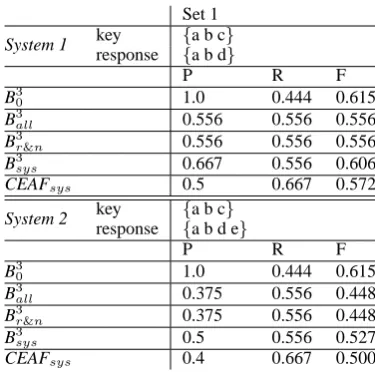
Tables 1, 2 and 3 illustrate the problems with B30
and B3all. The rows labeled System give the origi-nal keys and system responses while the rows la-beled B30, B3alland B
3
sysshow the performance gen-erated by Stoyanov et al.’s variants and the one we introduce in this paper, B3sys (the row labeled CEAFsysis discussed in Subsection 2.3).
In Table 1, there are two system outputs (i.e. System 1 and System 2). Mentions d and e are the twinless system mentions erroneously resolved and c a twinless key mention. System 1 is sup-posed to be slightly better with respect to preci-sion, because System 2 produces one more spu-rious resolution (i.e. for mention e ). However, B30 computes exactly the same numbers for both
systems. Hence, there is no penalty for erroneous coreference relations in B30, if the mentions do not
appear in the key, e.g. putting mentions d or e in
Set 1 does not count as precision errors. — B30
Set 1 Singletons
System 1 key {a b c}
response {a b d}
P R F
B3all 0.556 0.556 0.556
B3r&n 0.556 0.556 0.556
B3sys 0.667 0.556 0.606
CEAFsys 0.5 0.667 0.572
System 2 key {a b c}
response {a b d} {c}
P R F
B3all 0.667 0.556 0.606
B3r&n 0.667 0.556 0.606
B3sys 0.667 0.556 0.606
[image:3.595.76.274.59.228.2]CEAFsys 0.5 0.667 0.572
Table 2: Problems of B3all (1)
Set 1 Singletons
System 1 key {a b}
response {a b d}
P R F
B3all 0.556 1.0 0.715
B3r&n 0.556 1.0 0.715
B3sys 0.556 1.0 0.715
CEAFsys 0.667 1.0 0.800
System 2 key {a b}
response {a b d} {i} {j} {k}
P R F
B3all 0.778 1.0 0.875
B3r&n 0.556 1.0 0.715
B3sys 0.556 1.0 0.715
[image:3.595.309.511.59.232.2]CEAFsys 0.667 1.0 0.800
Table 3: Problems of B3all (2)
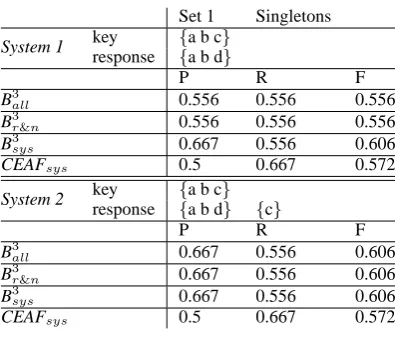
B3all deals well with the problem illustrated in Table 1, the figures reported correspond to in-tuition. However, B3all can output different re-sults for identical coreference resolutions when exposed to different mention taggers as shown in Tables 2 and 3. B3all manages to penalize erro-neous resolutions for twinless system mentions, however, it ignores twinless key mentions when measuring precision. In Table 2, System 1 and Sys-tem 2 generate the same outputs, except that the mention tagger in System 2 also extracts mention c. Intuitively, the same numbers are expected for both systems. However, B3all gives a higher preci-sion to System 2, which results in a higher F-score.
B3allretains all twinless system mentions, as can be seen in Table 3. System 2’s mention tagger tags more mentions (i.e. the mentions i, j and k), while both System 1 and System 2 have identical coref-erence resolution performance. Still, B3all outputs quite different results for precision and thus for F-score. This is due to the credit B3alltakes from un-resolved singleton twinless system mentions (i.e. mention i, j, k in System 2). Since the metric is ex-pected to evaluate the end-to-end coreference sys-tem performance rather than the mention tagging quality, it is not satisfying to observe that B3all’s numbers actually fluctuate when the system is ex-posed to different mention taggers.
Rahman & Ng (2009) apply another variant, de-noted here as B3r&n. They remove only those twin-less system mentions that are singletons before ap-plying the B3 algorithm. So, a system would not be rewarded by the the spurious mentions which are correctly identified as singletons during reso-lution (as has been the case with B3all’s higher pre-cision for System 2 as can be seen in Table 3).
We assume that Rahman & Ng apply a strategy similar to B3all after the removing step (this is not clear in Rahman & Ng (2009)). While it avoids the problem with singleton twinless system mentions, B3r&n still suffers from the problem dealing with twinless key mentions, as illustrated in Table 2.
2.2.2 B3sys
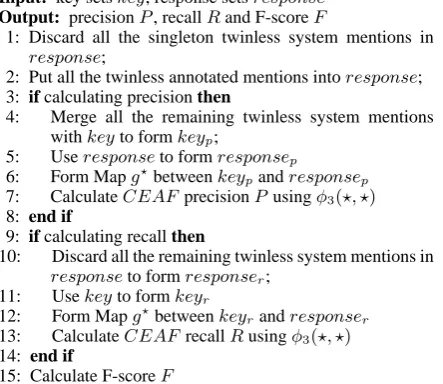
We here propose a coreference resolution evalua-tion metric, B3sys, which deals with system men-tions more adequately (see the rows labeled B3sys in Tables 1, 2, 3, 4 and 5). We put all twinless key mentions into the response as singletons which en-ables B3systo penalize non-resolved coreferent key mentions without penalizing non-resolved single-ton key mentions, and also avoids the problem B3all and B3r&nhave as shown in Table 2. All twinless system mentions which were deemed not coref-erent (hence being singletons) are discarded. To calculate B3sysprecision, all twinless system men-tions which were mistakenly resolved are put into the key since they are spurious resolutions (equiv-alent to the assignment operations in B3all), which should be penalized by precision. Unlike B3all, B3sys does not benefit from unresolved twinless system mentions (i.e. the twinless singleton sys-tem mentions). For recall, the algorithm only goes through the original key sets, similar to B3all and B3r&n. Details are given in Algorithm 1.
For example, a coreference resolution system has the following key and response:
Key :{a b c}
Response:{a b d} {i j}
To calculate the precision of B3sys, the key and re-sponse are altered to:
Keyp:{a b c} {d} {i} {j}
Algorithm 1B3
sys
Input: key setskey, response setsresponse Output: precisionP, recallRand F-scoreF
1: Discard all the singleton twinless system mentions in
response;
2: Put all the twinless annotated mentions intoresponse;
3: if calculating precision then
4: Merge all the remaining twinless system mentions
withkeyto formkeyp;
5: Useresponseto formresponsep
6: Throughkeypandresponsep;
7: CalculateB3
precisionP.
8: end if
9: if calculating recall then
10: Discard all the remaining twinless system mentions in
responseto fromresponser;
11: Usekeyto formkeyr
12: Throughkeyrandresponser;
13: CalculateB3recallR
14: end if
15: Calculate F-scoreF
So, the precision of B3sysis given by:
P rB3
sys= 1 6(
2 3+
2 3+
1 3 +
1 2 +
1 2 + 1)
.
= 0.611
The modified key and response for recall are:
Keyr:{a b c}
Responser:{a b} {c}
The resulting recall of B3sys is:
RecB3
sys= 1 3(
2 3+
2 3+
1 3)
.
= 0.556
Thus the F-score number is calculated as:
FB3
sys= 2×
0.611×0.556 0.611+0.556
.
= 0.582
B3sysindicates more adequately the performance of end-to-end coreference resolution systems. It is not easily tricked by different mention taggers3.
2.3 CEAF
Luo (2005) criticizes the B3 algorithm for using entities more than one time, because B3computes precision and recall of mentions by comparing en-tities containing that mention. Hence Luo pro-poses the CEAF algorithm which aligns entities in key and response. CEAF applies a similarity met-ric (which could be either mention based or entity based) for each pair of entities (i.e. a set of men-tions) to measure the goodness of each possible alignment. The best mapping is used for calculat-ing CEAF precision, recall and F-measure.
Luo proposes two entity based similarity met-rics (Equation 3 and 4) for an entity pair(Ki, Rj) originating from key,Ki, and response,Rj.
φ3(Ki, Rj) =|Ki∩Rj| (3)
φ4(Ki, Rj) =
2|Ki∩Rj|
|Ki|+|Rj|
(4)
3Further example analyses can be found in Appendix A.
The CEAF precision and recall are derived from the alignment which has the best total similarity (denoted asΦ(g∗)), shown in Equations 5 and 6.
P recision= Φ(g ∗)
P
iφ(Ri, Ri)
(5)
Recall= Φ(g ∗)
P
iφ(Ki, Ki)
(6)
If not specified otherwise, we apply Luo’sφ3(⋆, ⋆)
in the example illustrations. We denote the origi-nal CEAF algorithm as CEAForig.
Detailed calculations are illustrated below:
Key :{a b c}
Response:{a b d}
The CEAForigφ3(⋆, ⋆)are given by: φ3(K1, R1) = 2 (K1:{abc};R1 :{abd})
φ3(K1, K1) = 3
φ3(R1, R1) = 3
So the CEAForigevaluation numbers are:
P rCEAForig=2
3 = 0.667
RecCEAForig=2
3 = 0.667
FCEAForig = 2×
0.667×0.667
0.667+0.667 = 0.667
2.3.1 Problems of CEAForig
CEAForigwas intended to deal with key mentions. Its adaptation to system mentions has not been ad-dressed explicitly. Although CEAForig theoreti-cally does not require to have the same number of mentions in key and response, it still cannot be di-rectly applied to end-to-end systems, because the entity alignments are based on mention mappings.
As can be seen from Table 4, CEAForig fails
to produce intuitive results for system mentions. System 2 outputs one more spurious entity (con-taining mention i and j) than System 1 does, how-ever, achieves a same CEAForig precision. Since twinless system mentions do not have mappings in key, they contribute nothing to the mapping simi-larity. So, resolution mistakes for system mentions are not calculated, and moreover, the precision is easily skewed by the number of output entities. CEAForig reports very low precision for system mentions (see also Stoyanov et al. (2009)).
2.3.2 Existing CEAF variants
Rahman & Ng (2009) briefly introduce their
CEAF variant, which is denoted as CEAFr&n
here. They use φ3(⋆, ⋆), which results in equal
Set 1 Set 2 Singletons
System 1 key {a b c}
response {a b} {c} {i} {j}
P R F
CEAForig 0.4 0.667 0.500
B3sys 1.0 0.556 0.715
CEAFsys 0.667 0.667 0.667
System 2 key {a b c}
response {a b} {i j} {c}
P R F
CEAForig 0.4 0.667 0.500
B3sys 0.8 0.556 0.656
[image:5.595.75.530.62.202.2]CEAFsys 0.6 0.667 0.632
Table 4: Problems of CEAForig
Set 1 Set 2 Set 3 Singletons
System 1 key {a b c}
response {a b} {i j} {k l} {c}
P R F
CEAFr&n 0.286 0.667 0.400
B3sys 0.714 0.556 0.625
CEAFsys 0.571 0.667 0.615
System 2 key {a b c}
response {a b} {i j k l} {c}
P R F
CEAFr&n 0.286 0.667 0.400
B3
sys 0.571 0.556 0.563
[image:5.595.73.295.568.760.2]CEAFsys 0.429 0.667 0.522
Table 5: Problems of CEAFr&n
twinless singleton system mentions, they do not put any twinless mentions into the other set. In the example in Table 5, CEAFr&n does not penalize adequately the incorrectly resolved entities con-sisting of twinless sytem mentions. So CEAFr&n does not tell the difference between System 1 and System 2. It can be concluded from the examples that the same number of mentions in key and re-sponse is needed for computing the CEAF score.
2.3.3 CEAFsys
We propose to adjust CEAF in the same way as we did for B3sys, resulting in CEAFsys. We put all twinless key mentions into the response as sin-gletons. All singleton twinless system mentions are discarded. For calculating CEAFsys precision, all twinless system mentions which were mistak-enly resolved are put into the key. For computing CEAFsysrecall, only the original key sets are con-sidered. That way CEAFsysdeals adequately with system mentions (see Algorithm 2 for details).
Algorithm 2CEAFsys
Input: key setskey, response setsresponse Output: precisionP, recallRand F-scoreF
1: Discard all the singleton twinless system mentions in
response;
2: Put all the twinless annotated mentions intoresponse;
3: if calculating precision then
4: Merge all the remaining twinless system mentions
withkeyto formkeyp;
5: Useresponseto formresponsep
6: Form Mapg⋆betweenkeypandresponsep
7: CalculateCEAFprecisionPusingφ3(⋆, ⋆)
8: end if
9: if calculating recall then
10: Discard all the remaining twinless system mentions in
responseto formresponser;
11: Usekeyto formkeyr
12: Form Mapg⋆betweenkeyrandresponser
13: CalculateCEAFrecallRusingφ3(⋆, ⋆)
14: end if
15: Calculate F-scoreF
Taking System 2 in Table 4 as an example, key and response are altered for precision:
Keyp:{a b c} {i} {j}
Responsep:{a b d} {i j} {c}
So theφ3(⋆, ⋆)are as below, only listing the best
mappings:
φ3(K1, R1) = 2 (K1:{abc};R1 :{abd})
φ3(K2, R2) = 1 (K2:{i};R2:{ij})
φ3(∅, R3) = 0 (R3:{c})
φ3(R1, R1) = 3
φ3(R2, R2) = 2
φ3(R3, R3) = 1
The precision is thus give by:
P rCEAFsys= 2+1+0 3+2+1 = 0.6
The key and response for recall are:
Keyr:{a b c}
Responser:{a b} {c}
The resultingφ3(⋆, ⋆)are:
φ3(K1, R1) = 2(K1:{abc};R1:{ab})
φ3(∅, R2) = 0(R2:{c})
φ3(K1, K1) = 3
φ3(R1, R1) = 2
φ3(R2, R2) = 1
The recall and F-score are thus calculated as:
RecCEAFsys= 2
3 = 0.667
FCEAFsys = 2×0.6×0.667
0.6+0.667 = 0.632
However, one additional complication arises with regard to the similarity metrics used by
CEAF. It turns out that only φ3(⋆, ⋆) is suitable
for dealing with system mentions while φ4(⋆, ⋆)
produces uninituitive results (see Table 6).
φ4(⋆, ⋆) computes a normalized similarity for
each entity pair using the summed number of men-tions in the key and the response. CEAF precision then distributes that similarity evenly over the re-sponse set. Spurious system entities, such as the one with mention i and j in Table 6, are not pe-nalized. φ3(⋆, ⋆)calculates unnormalized
Set 1 Singletons
System 1 key {a b c}
response {a b} {c} {i} {j}
P R F
φ4(⋆, ⋆) 0.4 0.8 0.533
φ3(⋆, ⋆) 0.667 0.667 0.667
System 2 key {a b c}
response {a b} {i j} {c}
P R F
φ4(⋆, ⋆) 0.489 0.8 0.607
[image:6.595.317.512.60.155.2]φ3(⋆, ⋆) 0.6 0.667 0.632
Table 6: Problems ofφ4(⋆, ⋆)
When normalizing the similarities by the num-ber of entities or mentions in the key (for recall) and the response (for precision), the CEAF al-gorithm considers all entities or mentions to be equally important. Hence CEAF tends to compute quite low precision for system mentions which does not represent the system performance ade-quately. Here, we do not address this issue.
2.4 BLANC
Recently, a new coreference resolution evalua-tion algorithm, BLANC, has been introduced (Re-casens & Hovy, 2010). This measure implements the Rand index (Rand, 1971) which has been orig-inally developed to evaluate clustering methods. The BLANC algorithm deals correctly with sin-gleton entities and rewards correct entities accord-ing to the number of mentions. However, a ba-sic assumption behind BLANC is, that the sum of all coreferential and non-coreferential links is con-stant for a given set of mentions. This implies that BLANC assumes identical mentions in key and re-sponse. It is not clear how to adapt BLANC to sys-tem mentions. We do not address this issue here.
3 Experiments
While Section 2 used toy examples to motivate our metricsB3
sys and CEAFsys, we here report results on two larger experiments using ACE2004 data.
3.1 Data and Mention Taggers
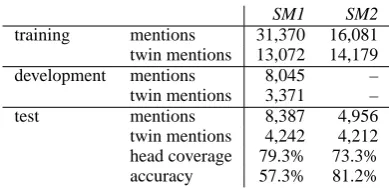
We use the ACE2004 (Mitchell et al., 2004) En-glish training data which we split into three sets following Bengtson & Roth (2008): Train (268 docs), Dev (76), and Test (107). We use two in-house mention taggers. The first (SM1) imple-ments a heuristic aiming at high recall. The second (SM2) uses the J48 decision tree classifier (Wit-ten & Frank, 2005). The number of detected men-tions, head coverage, and accuracy on testing data
SM1 SM2
training mentions 31,370 16,081
twin mentions 13,072 14,179
development mentions 8,045 –
twin mentions 3,371 –
test mentions 8,387 4,956
twin mentions 4,242 4,212
head coverage 79.3% 73.3%
[image:6.595.75.287.62.180.2]accuracy 57.3% 81.2%
Table 7: Mention Taggers on ACE2004 Data
are shown in Table 7.
3.2 Artificial Setting
For the artificial setting we report results on the development data using the SM1 tagger. To illus-trate the stability of the evaluation metrics with respect to different mention taggers, we reduce the number of twinless system mentions in inter-vals of 10%, while correct (non-twinless) ones are kept untouched. The coreference resolution sys-tem used is the BART (Versley et al., 2008) reim-plementation of Soon et al. (2001). The results are plotted in Figures 1 and 2.
0.55 0.6 0.65 0.7 0.75 0.8 0.85
0 0.2
0.4 0.6
0.8 1
F-score for ACE04 Development Data
Proportion of twinless system mentions used in the experiment MUC BCubedsys BCubed0 BCubedall BCubedng
Figure 1: Artificial Setting B3Variants
0.4 0.45 0.5 0.55 0.6 0.65 0.7 0.75 0.8
0 0.2
0.4 0.6
0.8 1
F-score for ACE04 Development Data
Proportion of twinless system mentions used in the experiment MUC CEAFsys CEAForig CEAFng
[image:6.595.311.522.384.536.2] [image:6.595.311.521.585.739.2]MUC
R Pr F
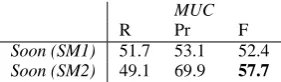
Soon (SM1) 51.7 53.1 52.4
[image:7.595.111.252.62.103.2]Soon (SM2) 49.1 69.9 57.7
Table 8: Realistic Setting MUC
Omitting twinless system mentions from the training data while keeping the number of cor-rect mentions constant should improve the corefer-ence resolution performance, because a more pre-cise coreference resolution model is obtained. As can be seen from Figures 1 and 2, the MUC-score,
B3sysand CEAFsysfollow this intuition.
B03is almost constant. It does not take twinless
mentions into account. B3
all’s curve, also, has a lower slope in comparison to B3sys and MUC (i.e. B3allcomputes similar numbers for worse models). This shows that the B3
all score can be tricked by using a high recall mention tagger, e.g. in cases with the worse models (i.e. ones on the left side of the figures) which have much more twinless system mentions. The original CEAF algorithm, CEAForig, is too sensitive to the input system mentions making it less reliable. CEAFsys is par-allel to B3sys. Thus both of our metrics exhibit the same intuition.
3.3 Realistic Setting
3.3.1 Experiment 1
For the realistic setting we compare SM1 and SM2 as preprocessing components for the BART (Ver-sley et al., 2008) reimplementation of Soon et al. (2001). The coreference resolution system with the SM2 tagger performs better, because a better coreference model is achieved from system men-tions with higher accuracy.
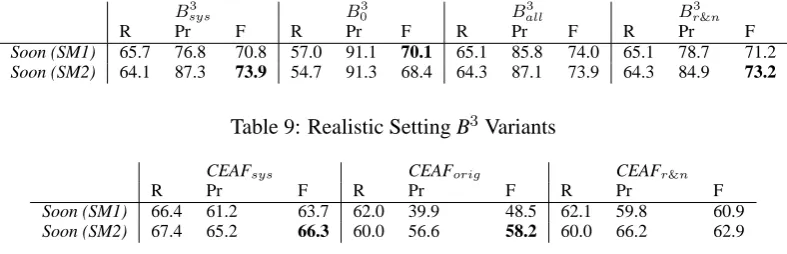
The MUC, B3sys and CEAFsys metrics have the same tendency when applied to systems with dif-ferent mention taggers (Table 8, 9 and 10 and the bold numbers are higher with a p-value of 0.05, by a paired-t test). Since the MUC scorer does not evaluate singleton entities, it produces too low numbers which are not informative any more.
As shown in Table 9, B3all reports counter-intuitive results when a system is fed with system mentions generated by different mention taggers.
B3
allcannot be used to evaluate two different end-to-end coreference resolution systems, because the mention tagger is likely to have bigger impact than the coreference resolution system. B30fails to
gen-erate the right comparison too, because it is too
B3sys B03
R Pr F R Pr F
Soon (SM2) 64.1 87.3 73.9 54.7 91.3 68.4
[image:7.595.306.534.63.108.2]Bengtson 66.1 81.9 73.1 69.5 74.7 72.0
Table 11: Realistic Setting
lenient by ignoring all twinless mentions.
The CEAForignumbers in Table 10 illustrate the big influence the system mentions have on preci-sion (e.g. the very low precipreci-sion number for Soon (SM1)). The big improvement for Soon (SM2) is largely due to the system mentions it uses, rather than to different coreference models.
Both B3r&nand CEAFr&nshow no serious prob-lems in the experimental results. However, as dis-cussed before, they fail to penalize the spurious entities with twinless system mentions adequately.
3.3.2 Experiment 2
We compare results of Bengtson & Roth’s (2008) system with our Soon (SM2) system. Bengtson & Roth’s embedded mention tagger aims at high pre-cision, generating half of the mentions SM1 gen-erates (explicit statistics are not available to us).
Bengtson & Roth report a B3 F-score for sys-tem mentions, which is very close to the one for true mentions. TheirB3-variant does not impute
errors of twinless mentions and is assumed to be quite similar to the B30 strategy.
We integrate both the B30 and B3sys variants into their system and show results in Table 11 (we can-not report significance, because we do can-not have ac-cess to results for single documents in Bengtson & Roth’s system). It can be seen that, when different variants of evaluation metrics are applied, the per-formance of the systems vary wildly.
4 Conclusions
In this paper, we address problems of commonly used evaluation metrics for coreference resolution and suggest two variants forB3and CEAF, called
B3
re-B3
sys B03 B3all Br3&n
R Pr F R Pr F R Pr F R Pr F
Soon (SM1) 65.7 76.8 70.8 57.0 91.1 70.1 65.1 85.8 74.0 65.1 78.7 71.2
[image:8.595.102.496.62.189.2]Soon (SM2) 64.1 87.3 73.9 54.7 91.3 68.4 64.3 87.1 73.9 64.3 84.9 73.2
Table 9: Realistic Setting B3Variants
CEAFsys CEAForig CEAFr&n
R Pr F R Pr F R Pr F
Soon (SM1) 66.4 61.2 63.7 62.0 39.9 48.5 62.1 59.8 60.9
Soon (SM2) 67.4 65.2 66.3 60.0 56.6 58.2 60.0 66.2 62.9
Table 10: Realistic Setting CEAF Variants
liabe comparison of end-to-end coreference reso-lution systems.
Acknowledgements. This work has been funded by the Klaus Tschira Foundation,
Hei-delberg, Germany. The first author has been
supported by a HITS PhD. scholarship. We
would like to thank ´Eva M´ujdricza-Maydt for implementing the mention taggers.
References
Bagga, Amit & Breck Baldwin (1998). Algorithms for scor-ing coreference chains. In Proceedscor-ings of the 1st Inter-national Conference on Language Resources and Evalua-tion, Granada, Spain, 28–30 May 1998, pp. 563–566. Bengtson, Eric & Dan Roth (2008). Understanding the value
of features for coreference resolution. In Proceedings of the 2008 Conference on Empirical Methods in Natural Language Processing, Waikiki, Honolulu, Hawaii, 25-27 October 2008, pp. 294–303.
Culotta, Aron, Michael Wick & Andrew McCallum (2007). First-order probabilistic models for coreference resolu-tion. In Proceedings of Human Language Technologies 2007: The Conference of the North American Chapter of the Association for Computational Linguistics, Rochester, N.Y., 22–27 April 2007, pp. 81–88.
Denis, Pascal & Jason Baldridge (2007). Joint determination of anaphoricity and coreference resolution using integer programming. In Proceedings of Human Language Tech-nologies 2007: The Conference of the North American Chapter of the Association for Computational Linguistics, Rochester, N.Y., 22–27 April 2007, pp. 236–243. Haghighi, Aria & Dan Klein (2007). Unsupervised
coref-erence resolution in a nonparametric Bayesian model. In Proceedings of the 45th Annual Meeting of the Association for Computational Linguistics, Prague, Czech Republic, 23–30 June 2007, pp. 848–855.
Luo, Xiaoqiang (2005). On coreference resolution perfor-mance metrics. In Proceedings of the Human Language Technology Conference and the 2005 Conference on Em-pirical Methods in Natural Language Processing, Vancou-ver, B.C., Canada, 6–8 October 2005, pp. 25–32. Luo, Xiaoqiang, Abe Ittycheriah, Hongyan Jing, Nanda
Kambhatla & Salim Roukos (2004). A
mention-synchronous coreference resolution algorithm based on the Bell Tree. In Proceedings of the 42nd Annual Meet-ing of the Association for Computational LMeet-inguistics, Barcelona, Spain, 21–26 July 2004, pp. 136–143. Mitchell, Alexis, Stephanie Strassel, Shudong Huang &
Ramez Zakhary (2004). ACE 2004 Multilingual Training
Corpus. LDC2005T09, Philadelphia, Penn.: Linguistic Data Consortium.
Nicolae, Cristina & Gabriel Nicolae (2006). BestCut: A
graph algorithm for coreference resolution. In Proceed-ings of the 2006 Conference on Empirical Methods in Nat-ural Language Processing, Sydney, Australia, 22–23 July 2006, pp. 275–283.
Ponzetto, Simone Paolo & Michael Strube (2006). Exploiting semantic role labeling, WordNet and Wikipedia for coref-erence resolution. In Proceedings of the Human Language Technology Conference of the North American Chapter of the Association for Computational Linguistics, New York, N.Y., 4–9 June 2006, pp. 192–199.
Rahman, Altaf & Vincent Ng (2009). Supervised models for coreference resolution. In Proceedings of the 2009 Con-ference on Empirical Methods in Natural Language Pro-cessing, Singapore, 6-7 August 2009, pp. 968–977. Rand, William R. (1971). Objective criteria for the evaluation
of clustering methods. Journal of the American Statistical Association, 66(336):846–850.
Recasens, Marta & Eduard Hovy (2010). BLANC: Imple-menting the Rand index for coreference evaluation. Sub-mitted.
Soon, Wee Meng, Hwee Tou Ng & Daniel Chung Yong Lim (2001). A machine learning approach to coreference resolution of noun phrases. Computational Linguistics, 27(4):521–544.
Stoyanov, Veselin, Nathan Gilbert, Claire Cardie & Ellen Riloff (2009). Conundrums in noun phrase coreference resolution: Making sense of the state-of-the-art. In Pro-ceedings of the Joint Conference of the 47th Annual Meet-ing of the Association for Computational LMeet-inguistics and the 4th International Joint Conference on Natural Lan-guage Processing, Singapore, 2–7 August 2009, pp. 656– 664.
Versley, Yannick, Simone Paolo Ponzetto, Massimo Poesio, Vladimir Eidelman, Alan Jern, Jason Smith, Xiaofeng Yang & Alessandro Moschitti (2008). BART: A modular toolkit for coreference resolution. In Companion Volume to the Proceedings of the 46th Annual Meeting of the As-sociation for Computational Linguistics, Columbus, Ohio, 15–20 June 2008, pp. 9–12.
Vilain, Marc, John Burger, John Aberdeen, Dennis Connolly & Lynette Hirschman (1995). A model-theoretic corefer-ence scoring scheme. In Proceedings of the 6th Message Understanding Conference (MUC-6), pp. 45–52. San Ma-teo, Cal.: Morgan Kaufmann.
Witten, Ian H. & Eibe Frank (2005). Data Mining: Practical Machine Learning Tools and Techniques (2nd ed.). San Francisco, Cal.: Morgan Kaufmann.
A B3
sys Example Output
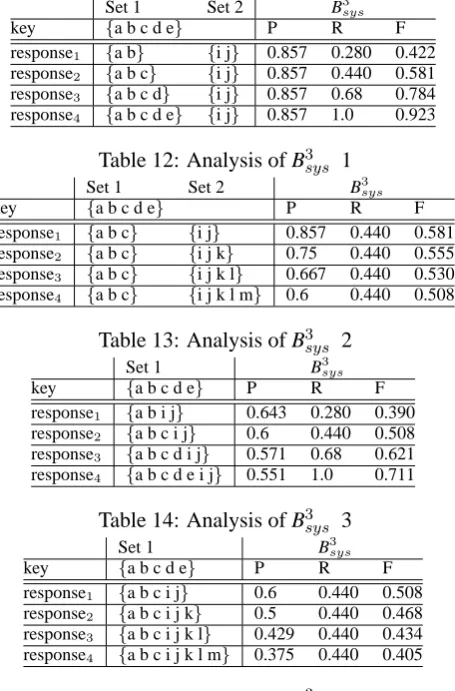
Here, we provide additional examples for analyzing the behavior of B3syswhere we systematically vary system outputs. Since we proposed B3sysfor dealing with end-to-end systems, we consider only examples also containing twinless mentions. The systems in Table 12 and 14 generate different twinless key mentions while keeping the twinless system mentions untouched. In Table 13 and 15, the number of twinless system mentions changes through different responses and the number of twinless key mentions is fixed.
In Table 12, B3sys recall goes up when more key mentions are resolved into the correct set. And the precision stays the same, because there is no change in the number of the erroneous resolutoins (i.e. the spurious cluster with mentions i and j). For the examples in Tables 13 and 15, B3sysgives worse precision to the outputs with more spurious resolutions, and the same recall if the systems resolve key mentions in the same way. Since the set of key mentions intersects with the set of twinless system mentions in Table 14, we do not have an intuitive explanation for the decrease in precision from response1 to response4.
However, both the F-score and the recall still show the right tendency.
Set 1 Set 2 B3sys
key {a b c d e} P R F
response1 {a b} {i j} 0.857 0.280 0.422
response2 {a b c} {i j} 0.857 0.440 0.581
response3 {a b c d} {i j} 0.857 0.68 0.784
response4 {a b c d e} {i j} 0.857 1.0 0.923
Table 12: Analysis of B3sys 1
Set 1 Set 2 B3sys
key {a b c d e} P R F
response1 {a b c} {i j} 0.857 0.440 0.581
response2 {a b c} {i j k} 0.75 0.440 0.555
response3 {a b c} {i j k l} 0.667 0.440 0.530
response4 {a b c} {i j k l m} 0.6 0.440 0.508
Table 13: Analysis of B3sys 2
Set 1 B3sys
key {a b c d e} P R F
response1 {a b i j} 0.643 0.280 0.390
response2 {a b c i j} 0.6 0.440 0.508
response3 {a b c d i j} 0.571 0.68 0.621
response4 {a b c d e i j} 0.551 1.0 0.711
Table 14: Analysis of B3sys 3
Set 1 B3sys
key {a b c d e} P R F
response1 {a b c i j} 0.6 0.440 0.508
response2 {a b c i j k} 0.5 0.440 0.468
response3 {a b c i j k l} 0.429 0.440 0.434
[image:9.595.186.414.274.620.2]response4 {a b c i j k l m} 0.375 0.440 0.405