Extractive Summarization and Dialogue Act Modeling on Email
Threads: An Integrated Probabilistic Approach
Tatsuro Oya and Giuseppe Carenini
Department of Computer Science
University of British Columbia
Vancouver, B.C. Canada
{toya, carenini}@cs.ubc.ca
Abstract
In this paper, we present a novel supervised approach to the problem of summarizing email conversations and modeling dialogue acts. We assume that there is a relationship between dialogue acts and important sen-tences. Based on this assumption, we intro-duce a sequential graphical model approach which simultaneously summarizes email conversation and models dialogue acts. We compare our model with sequential and non-sequential models, which independent-ly conduct the tasks of extractive summari-zation and dialogue act modeling. An empirical evaluation shows that our ap-proach significantly outperforms all base-lines in classifying correct summary sentences without losing performance on dialogue act modeling task.
1
Introduction
Nowadays, an overwhelming amount of text in-formation can be found on the web. Most of this information is redundant and thus the task of document summarization has attracted much at-tention. Since emails in particular are used for a wide variety of purposes, the process of automat-ically summarizing emails might be of great benefit in dealing with this excessive amount of information. Much work has already been con-ducted on email summarization. The first re-search on this topic was conducted by Rambow et al. (2004), who took a supervised learning ap-proach to extracting important sentences. A study on the supervised summarization of email threads was also performed by Ulrich et al. (2009). This study used the regression-based method for classification. There have been stud-ies on unsupervised summarization of email threads as well. Zhou et al. (2007, 2008)
pro-posed a graph-based unsupervised approach to email conversation summarization using clue words, i.e., recurring words contained in replies.
In addition, the task of labeling sentences with dialogue acts has become important and has been employed in many conversation analysis systems. For example, applications such as meet-ing summarization and collaborative task learn-ing agents use dialogue acts as their underlylearn-ing structure (Allen et al., 2007; Murray et al., 2010). In a previous work, Cohen et al. (2004) defined a set of “email acts” and employed text classification methods to detect these acts in emails. Later, Carvalho et al. (2006) employed a combination of n-gram sequences as features and then used a supervised machine learning method to improve the accuracy of this email act classifi-cation. In addition, Shafiq et al. (2011) presented unsupervised dialogue act labeling methods. In their work, they introduced a graph-based meth-od and two probabilistic sequence-labeling methods for modeling dialogue acts.
However, little work has been done on dis-covering the relationship between dialogue acts and extractive summaries. If there is a relation-ship between them, combining these approaches so as to model both simultaneously will yield better results. In this paper, we investigate this hypothesis by introducing a new sequential graphical model approach that performs dialogue act modeling and extractive summarization joint-ly on email threads.
2
Related Work
While email summarization and dialogue act modeling have been effectively studied, in most previous work, these tasks were studied inde-pendently. This section provides related work for each task separately.
2.1
Extractive Summarization
Rambow et al. (2004) introduced sentence ex-traction techniques that work for email threads. In their work, they introduced email-specific fea-tures and used a machine learning method to classify whether or not a sentence should be in-corporated into a summary. Their experiments demonstrated that their features were highly ef-fective for email summarization.
Ulrich et al. (2009) proposed a regression-based machine learning approaches to email thread summarization. They compared regres-sion-based classifiers to binary classifiers and showed that their approach significantly im-proves the summarization accuracy. They em-ployed the feature set introduced by Rambow et al. (2004) as their baseline and introduced new features that are also effective for email summa-rization. Some of their features refer to dialogue acts but the assumption is that they are computed before the summarization task is performed. Our work is aimed at a much closer integration of the two tasks by modeling them simultaneously.
Carenini et al. (2007) developed a fragment quotation graph that can capture a fine-grain conversation structure in email threads, which we will describe in detail in Section 3. They then introduced a ClueWordSummarizer (CWS), a graph-based unsupervised summarization ap-proach based on the concept of clue words, which are recurring words found in email replies. Their experiment showed that the CWS performs better than the email summarization approach in Rambow et al. (2004).
Extractive summarization using a sequential labeling technique has also been studied. While this is not an email summarization, Shen et al. (2007) proposed a linear-chain Conditional Ran-dom Field (CRF) based approach for extractive document summarization. In their work, they treated the summarization task as a sequence la-beling problem to take advantage of interaction relationships between sentences; their approach showed significant improvement when compared with non-sequential classifiers.
2.2
Dialogue Act Modeling
The first studies on the dialogue act modeling in emails were performed by Cohen et al. (2004). They defined “email speech acts” (e.g., Request, Deliver, Propose, and Commit) and used ma-chine learning methods to classify emails accord-ing to the intent of the sender.
Carvalho et al. (2006) further developed this initial proposal by using contextual information such as combinations of n-gram sequences in emails as their features for a supervised learning approach. The experiment showed that their ap-proach reduced classification error rates by 26.4%. Shafiq et al. (2011) proposed unsuper-vised dialogue act modeling in email threads and on forums. They introduced a graph-based and two probabilistic unsupervised approaches for modeling dialogue acts. By comparing those ap-proaches, they demonstrated that the probabilis-tic approaches were quite effective and performed better than the graph-based one.
While the following work is not done on the email domain, Kim et al. (2010) introduced a dialogue act classification on one-on-one online chat forums. To be able to capture sequential dialogue act dependency on chats, they applied a CRF model. They demonstrated that, compared with other classifiers, their CRF model per-formed the best. In their later work (Kim et al., 2012), they extended the domain to multi-party live chats and proposed new features for that domain.
3
Capturing Conversation Structure in
Email Threads
In this section, we describe how to build a frag-ment quotation graph which captures the conver-sation structure of any email thread at finer granularity. This graph was developed and shown to be effective by Carenini et al. (2011). A key assumption of this approach is that in or-der to effectively perform summarization and dialogue act modeling, a fine graph representa-tion of the underlying conversarepresenta-tion structure is needed.
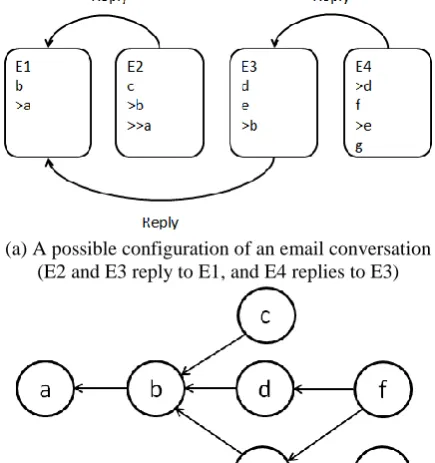
Here, we start with the sample email conver-sation shown in Figure 1 (a). For convenience, the content of the emails is represented as a se-quence of fragments.
First, we identify all new and quoted frag-ments. For example, email E1 is composed of one new fragment, ‘b’, and one quoted fragment, ‘a’. As for email E3, since we do not yet know whether or not ‘d’ and ‘e’ are different frag-ments, we consider E3 as being composed of one new fragment, ‘de’ and one quoted fragment, ‘b’.
split into ‘d’ and ‘e’ after being compared with fragments in E4 and the duplicates are removed. By applying this process to all of the emails, seven distinct fragments, a, b ..., and, g remain in this example.
In the third step, edges which represent the replying relationships among the fragments are created. These edges are determined based on the assumption that any fragment is a reply to neigh-boring quotations (the quoted fragments immedi-ately preceding or following the current one). For example, the neighboring nodes of ‘f’ in E4 are ‘d’ and ‘e’. Thus, we create two edges from node ‘f’ in E4 to node ‘d’ and ‘e’ in E3. In the same way, we see that the neighboring node of ‘g’ in E4 is ‘e’. Hence, there is one edge from node ‘g’ to ‘e’. If no quotation is contained in a reply email, we connect the fragments in the email to fragments in emails to which it reply.
In email threads, there are cases in which the original email with its quotations is missing from the user’s folder, as in the case of ‘a’ in Figure 1 (a). These types of emails are called hidden emails. Carenini et al. (2005) studied in detail how these email types might be treated and their influence on email summarization.
Figure 1 (b) shows the completed fragment quotation graph of the email thread shown in Figure 1 (a). In the fragment quotation graph structure, all paths (e.g., a-b-c, a-b-d-f, a-b-e-f, and a-b-e-g in Figure 1 (b)) capture the adjacent relationships between email fragments. Hence, we use every path that can be derived from the graph as our dataset. However, in this case, when we run the labeling task on these paths, we ob-tain multiple labels for some of the sentences because the sentences in fragments such as ‘a’, ‘b’, and ‘f’ in Figure 1 (b) are shared among multiple paths. Therefore, to assign a label to one of these sentences, we take the label more fre-quently assigned to that sentence when all its paths are considered (i.e., the majority vote).
4
Features
For both dialogue act modeling and extractive summarization, many effective sentence features have been discovered so far. Interestingly, some common features are shown to be effective in both tasks. This section explains the features used in our model. We begin with the features for extractive summarization and then describe how we derive the features for dialogue act mod-eling. All the features explained in this section, whether they belong to extractive summarization
or dialogue act modeling, are included in our model.
(a) A possible configuration of an email conversation (E2 and E3 reply to E1, and E4 replies to E3)
[image:3.595.307.525.98.221.2](b) An example of a fragment quotation graph Figure 1: A fragment quotation graph derived from a
possible configuration of an email conversation
4.1
Extractive Summarization Features
The features we use for extractive summarization are mostly from Carenini et al. (2008) and Ram-bow et al. (2004) and have proven to be effective on conversational data. Details of these features are described below. Note that all sentences in an email thread are ordered based on paths derived from a fragment quotation graph.
Length Feature: The number of words in each sentence.
Relative Position Feature: The number of sentences preceding the current divided by the total number of sentences in one path.
Thread Name Overlaps Feature: The num-ber of overlaps of the content words between the email thread title and a sentence.
Subject Name Overlaps Feature: The num-ber of overlaps of the content words between the subject of the email and a sentence.
Question Feature: A binary feature that in-dicates whether or not a sentence has a ques-tion mark.
[image:3.595.306.524.105.337.2]Participation Dominance Feature: The number of utterances each person makes in one path.
Finally, we also include a simplified version of the ClueWordScore (CWS) developed by Carenini et al. (2007), which is listed below.
Simplified CWS Feature: The number of overlaps of the content words that occur in both the current and adjacent sentences in the path, ignoring stopwords.
4.2
Dialogue Act Features
The relative positions and length features have proven to be beneficial to both tasks (Jeong et al., 2009; Carenini et al., 2008). Hence, these are categorized as both dialogue acts and extractive summarization features. In addition, we use word and POS n-grams as our features for dialogue act modeling. These features are extracted by the following process explained in Carvalho et al. (2006). However, we extend the original ap-proach in order to further abstract n-gram fea-tures to avoid making them too sparse to be effective. In this section, we describe the deriva-tion process in detail.
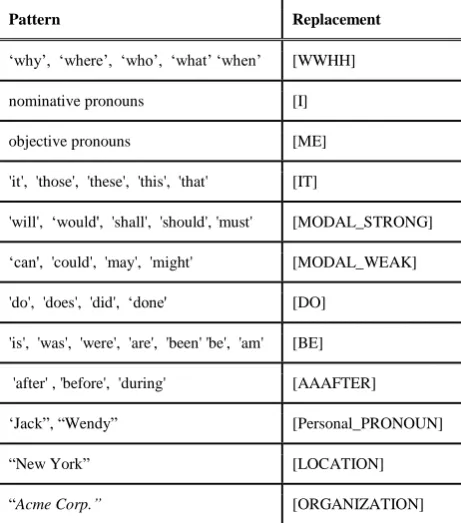
A multi-step approach is used to generate word n-gram features. First, all words are tagged with the named entity using the Stanford Named Entity Recognizer (Finkel et al., 2005), and are then replaced with these tags. Second, a se-quence of word-replacement tasks is applied to all email messages. Initially, some types of punc-tuation marks (e.g., <>()[];:. and ,) and extra spaces are removed. Then, shortened phrases such as “I’m” and “We’ll” are substituted for more formal versions such as “I am” and “We will”. Next, other replacement tasks are per-formed. Some of them are described in Table1. In the third step, unigrams and bigrams are ex-tracted. In this paper, unigrams and bigrams refer to all possible sequences of length one and two terms. After extracting all unigrams and bigrams for each dialogue act, we then compute Infor-mation Gain Score (Forman, 2003) and select the n-grams whose scores are in the top five greatest on the training set. In this way, we can automati-cally detect features that represent the character-istics of each dialogue act. In addition to word n-grams, we also include POS n-grams in our fea-tures. In a similar way, we first tag each word in sentences with POS using the Stanford POS tag-ger (Toutanova et al., 2003). Then, for each dia-logue act, we extract bigrams and trigrams, all of
which are scored by the Information Gain. Based on their scores, we select the POS bigram and trigram features whose scores are within the top five greatest. One example of word n-gram fea-tures for a Question dialogue act selected by this derivation method is shown in Table 2.
Pattern Replacement
‘why’, ‘where’, ‘who’, ‘what’ ‘when’ [WWHH]
nominative pronouns [I]
objective pronouns [ME]
'it', 'those', 'these', 'this', 'that' [IT]
'will', ‘would', 'shall', 'should', 'must' [MODAL_STRONG]
‘can', 'could', 'may', 'might' [MODAL_WEAK]
'do', 'does', 'did', ‘done' [DO]
'is', 'was', 'were', 'are', 'been' 'be', 'am' [BE]
'after' , 'before', 'during' [AAAFTER]
‘Jack”, “Wendy” [Personal_PRONOUN]
“New York” [LOCATION]
[image:4.595.300.531.161.423.2]“Acme Corp.” [ORGANIZATION]
Table 1: Some Preprocessing Replacement Pattern
Word Unigram Word Bigram
? [MODAL_STRONG] [I]
anyone [IT] ?
WWHH [DO] anyone
deny [WWHH] [BE]
[Personal _PRONOUN] [BE] [IT]
Table 2: Sample word n-grams selected as the fea-tures for Question dialogue act
5
The Sequential Labeling Task
Our DCRF uses the graph structure shown in Figure 2 with one chain (the top X nodes) model-ing extractive summary and the other (the middle Y nodes) modeling dialogue acts. Each node in the observation sequence (the bottom Z nodes) corresponds to each sentence in a path of the fragment quotation graph of the email thread. As shown in Figure 2, the graph structure captures the relationship between extractive summaries and dialogue acts by connecting their nodes. We use Mallet1 (McCallum, 2002) to implement our DCRF model. It uses l2-based regularization to avoid overfitting, and a limited BFGS fitting algorithm to learn the DCRF model parameters. Also, it uses tree-based reparameterization (Wainwright et al., 2002) to compute the poste-rior marginal, or inference.
Figure 2: The DCRF model used to create extractive summaries and model dialogue acts
6
Empirical Evaluations
6.1
Dataset Setup
In our experiment, the publically available BC3 corpus2 (Ulrich et al., 2008) is used for training and evaluation purposes. The corpus contains email threads from the World Wide Web Con-sortium (W3C) mailing list. It consists of 40 threads with an average of five emails per thread. The corpus provides extractive summaries of each email thread, all of which were annotated by three annotators. Hence, we use sentences that are selected by more than one annotator as the gold standard summary for each conversation.
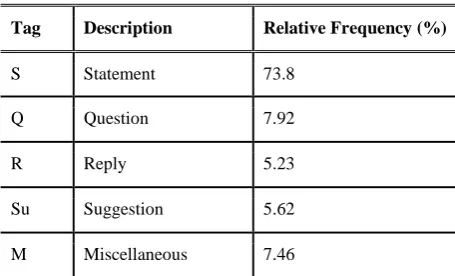
In addition, all sentences in the 39 out of 40 threads are annotated for dialogue act tags. The tagset consists of five general and 12 specific tags. All of these tags are based on Jeong et al. (2009). For our experiment, considering that our data is relatively small, we decide to use the coarser five tag set. The details are shown in Ta-ble 3.
1
http://mallet.cs.umass.edu
2
http://www.cs.ubc.ca/nest/lci/bc3.html
Tag Description Relative Frequency (%)
S Statement 73.8
Q Question 7.92
R Reply 5.23
Su Suggestion 5.62
M Miscellaneous 7.46
Table 3: Dialogue act tag categories and their relative frequency in the BC3 corpus
After removing quoted sentences and redundant information such as senders and addresses, 1300 distinct sentences remain in the 39 email threads. The detailed content of the corpus is summarized in Table 4.
Total Dataset
No. of Threads 39
No. of Sentences 1300
No. of Extractive Summary Sentences 521
No. of S Sentences 959
No. of Q Sentences 103
No. of R Sentences 68
No. of Su Sentences 73
[image:5.595.311.516.318.535.2]No. of M Sentences 97
Table 4: Detailed content of the BC3 corpus
6.2
Evaluation Metrics
Here, we introduce evaluation metrics for our joint model of extractive summarization and dia-logue act recognition.
com-pare our system with a non-sequential classifier, a support vector machine (SVM), with the same settings as those described above. For these im-plementations, we use Mallet and SVM-light package3 (Joachims, 1999).
In our experiment, we first measure separate-ly the performance of extractive summarization and dialogue act modeling. The performance of extractive summarization is measured by its av-eraged precision, recall, and F-measure. For dia-logue acts, we report the averaged-micro and macro accuracies as well as the averaged accura-cies of each dialogue act.
Second, we evaluate the combined perfor-mance of extractive summarization and dialogue act modeling tasks. In general, we are interested in the dialogue acts in summary sentences be-cause they can be later used as input for other natural language processing applications such as automatic abstractive summarization (Murray et al., 2010). Therefore, we measure the perfor-mance of our model with the following modified precision (Pre’), recall (Rec’), and F-measure (F’):
{ }{ } (1)
{ { } } (2)
(3)
where a correctly classified sentence refers to a true summary sentence that is classified as such and whose dialogue acts are also correctly classi-fied.
6.3
Experiment Procedure
For all cases, we run five sets of 10-fold cross validation to train and test the classifiers on a shuffled dataset and calculate the average of the results. For each cross validation run, we extract all features following the process described in Section 4 on the training set. When comparing these two baselines with our model, we report p-values obtained from a student paired t-test on the results to determine their significance.
3
http://www.cs.cornell.edu/people/tj/svm_light
6.4
Results
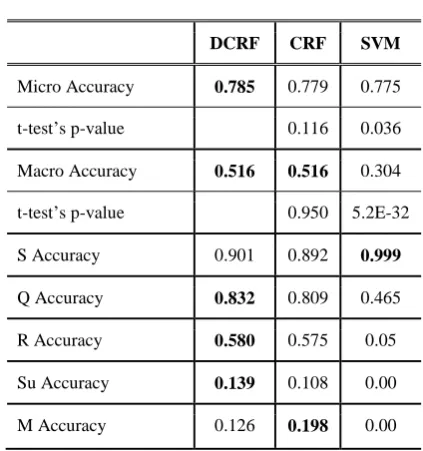
The performances of extractive summarization and dialogue act modeling using the three meth-ods are summarized in Table 5 and 6, respective-ly.
DCRF CRF SVM
F-measure 0.485 0.428 0.397
t-test’s p-value 0.00046 2.5E-07
Precision 0.562 0.591 0.675
[image:6.595.309.519.154.273.2]Recall 0.457 0.370 0.308
Table 5: A comparison of the extractive summariza-tion performance of our DCRF model and the two baselines based on precision, recall, and F-measure
DCRF CRF SVM
Micro Accuracy 0.785 0.779 0.775
t-test’s p-value 0.116 0.036
Macro Accuracy 0.516 0.516 0.304
t-test’s p-value 0.950 5.2E-32
S Accuracy 0.901 0.892 0.999
Q Accuracy 0.832 0.809 0.465
R Accuracy 0.580 0.575 0.05
Su Accuracy 0.139 0.108 0.00
M Accuracy 0.126 0.198 0.00
Table 6: A comparison of the dialogue act modeling performance of our DCRF model and the two
base-lines based on averaged accuracies
From Table 5, we observe that, in terms of extractive summarization results, our DCRF model significantly outperforms the two base-lines. Noticeable improvements can be seen for the recall and F-measure. In terms of F-measure, compared with the CRF and SVM, our model improves by 5.7% and 8.8% respectively. The p-values obtained from the t-test indicate that our results are statistically significantly different (p < 0.05) from those of the two baselines.
[image:6.595.308.520.307.533.2]accura-cy. Both our model and the CRF consider the sequential structure of the conversation, which is not captured in the SVM model. Clearly, this indicates that the sequential models are effective in modeling dialogue acts due to their ability to capture the inter-utterance relations of conversa-tions.
Compared with the CRF, our DCRF model outperforms it in most cases except in classifying the ‘M’ dialogue act. However these improve-ments are not significant as t-test of both macro and micro-averaged accuracies indicate that the differences are not statistically significant (p > 0.05).
Another item to be mentioned here is that the accuracies of classifying ‘R’, ‘Su’ and ‘M’ dia-logue acts are relatively low. This issue applies to all classifiers and is plausibly due to the small dataset. There are only 68, 73 and 97 sentences, respectively, out of 1300 that are labeled as ‘R’, ‘Su’ and ‘M’ in the BC3 corpus. Since our dia-logue act classifiers rely heavily on n-gram fea-tures, were the data small, these features would be too sparse to effectively represent the charac-teristics of the dialogue acts. However, compared with the SVM results, our joint model and the CRF perform significantly better in classifying these dialogue acts. This also explains why the sequential model is preferable in dialogue act modeling.
Note that despite the small dataset, all the classifiers are relatively accurate in classifying ‘Q’. This is because n-gram features selected for ‘Q’ such as ‘?’ and ‘WWHH’ are very specific to this dialogue act, which makes the task of ‘Q’ classification easier compared to those of others.
[image:7.595.76.285.592.706.2]Next, we discuss the result of t
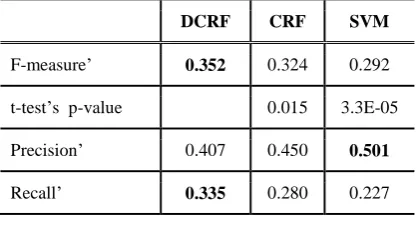
he com-bined performance. The performances of our model and the two baselines are summarized in Table 7.DCRF CRF SVM
F-measure’ 0.352 0.324 0.292
t-test’s p-value 0.015 3.3E-05
Precision’ 0.407 0.450 0.501
Recall’ 0.335 0.280 0.227
Table 7: A comparison of the overall performance of our DCRF model and the two baselines based on
modified precision, recall and F-measure
We see that our DCRF model significantly outperforms the two baselines. While our model yields the lowest Pre’ of all, its Rec’ is much greater than the other two baselines and this leads to its achieving the highest F’. Compared with the CRF and SVM, the F’ obtained from our system improves by 2.8% and 6% respec-tively. In addition, the p-values show that the results of our model are statistically significant (p < 0.05) compared with those of the two base-lines.
Overall, these experiments clearly indicate that our model is effective in classifying both dialogue acts and summary sentences.
7
Conclusions and Future Work
In this work, we have explored a new automated approach for extractive summarization and dia-logue act modeling on email threads. In particu-lar, we have presented a statistical approach for jointly modeling dialogue acts and extractive summarization in a single DCRF. The empirical results demonstrate that our approach outper-forms the two baselines on the summarization task without loss of performance on the dialogue act modeling one. In the future, we would like to extend our approach by exploiting more effective features. We also plan to apply our approach to different domains possessing large dataset.
Acknowledgements
We are grateful to Yashar Mehdad, Raimond Ng, Maryam Tavafi and Shafiq Joty for their com-ments and UBC LCI group and ICICS for finan-cial support.
References
J. Allen, N. Chambers, G. Ferguson, L. Galescu, H. Jung, and W. Taysom. Plow: A collaborative task learning agent. In AAAI-07, pages 22–26, 2007. Giuseppe Carenini, Gabriel Murray, and Raymond
Ng. 2011. Methods for Mining and Summarizing Text Conversations. Morgan Claypool.
Giuseppe Carenini, Raymond Ng, and Xiaodong Zhou. 2005. Scalable discovery of hidden emails from large folders. In ACM SIGKDD’05, pages 544–549.
Giuseppe Carenini, Raymond Ng, and Xiaodong Zhou. 2007. Summarizing email conversations with clue words. 16th International World Wide Web Conference (ACM WWW’07).
Vitor R. Carvalho and William W. Cohen. 2006. Im-proving ”email speech acts” analysis via n-gram selection. In Proceedings of the HLT-NAACL 2006 Workshop on Analyzing Conversations in Text and
Speech, ACTS ’09, pages 35–41, Stroudsburg, PA,
USA. Association for Computational Linguistics. William W. Cohen, Vitor R. Carvalho, and Tom M.
Mitchell. 2004. Learning to classify email into “speech acts”. In Proceedings of Empirical Meth-ods in Natural Language Processing, pages 309– 316, Barcelona, Spain, July.
Jenny Rose Finkel, Trond Grenager, and Christopher Manning. 2005. Incorporating Non-local Infor-mation into InforInfor-mation Extraction Systems by Gibbs Sampling. In Proceedings of the 43nd An-nual Meeting of the Association for Computational Linguistics (ACL 2005), pp. 363-370.
George Forman. 2003. An extensive empirical study of feature selection metrics for text classification. The Journal of Machine Learning Research, 3:1289–1305.
Minwoo Jeong, Chin-Yew Lin, and Gary Geunbae Lee. 2009. Semi-supervised speech act recognition in emails and forums. In Proceedings of the 2009 Conference on Empirical Methods in Natural Lan-guage Processing.
Thorsten Joachims. 1999 Making large-Scale SVM Learning Practical. Advances in Kernel Methods - Support Vector Learning, B. Schölkopf and C. Burges and A. Smola (ed.), MIT-Press, 1999. Shafiq Joty, Giuseppe Carenini, and Lin, Chin-Yew
Lin. 2011. Unsupervised Modeling of Dialog Acts in Asynchronous Conversations. In Proceedings of the twenty second International Joint Conference on Artificial Intelligence (IJCAI) 2011. Barcelona, Spain.
Shafiq Joty, Giuseppe Carenini, Gabriel Murray, and Raymond Ng. 2009 Finding Topics in Emails: Is LDA enough? NIPS-2009 workshop on applica-tions for topic models: text and beyond. Whistler, Canada.
McCallum, A. Kachites, 2002. MALLET: A Machine Learning for Language Toolkit. http://mallet.cs.umass.edu.
Su Nam Kim, Lawrence Cavedon, and Timothy Baldwin. 2010a. Classifying dialogue acts in 1-to-1 live chats. In Proceedings of the 2010 Conference on Empirical Methods in Natural Language Pro-cessing (EMNLP 2010), pages 862–871, Boston, USA.
Su Nam Kim, Lawrence Cavedon and Timothy Bald-win (2012) Classifying Dialogue Acts in Multi-party Live Chats, In Proceedings of the 26th Pacif-ic Asia Conference on Language, Information and Computation (PACLIC 26), Bali, Indonesia, pp. 463—472.
Gabriel Murray and Giuseppe Carenini. 2008. Sum-marizing Spoken and Written Conversations. Em-pirical Methods in NLP (EMNLP 2008), Waikiki, Hawaii, 2008.
Gabriel Murray and Giuseppe Carenini. 2010. Sum-marizing Spoken and Written Conversations. Gen-erating and Validating Abstracts of Meeting
Conversations: a User study (INLG 2010), Dublin,
Ireland, 2010.
Gabriel Murray, Renals Steve, and Carletta Jean. 2005a. Extrative summarization of meeting record-ings. In Proceeding of Interspeech 2005, Lisbon, Portugal, pages 593-596.
Owen Rambow, Lokesh Shrestha, John Chen, and Chirsty Lauridsen. 2004. Summarizing email threads. In Proceedings of HLTNAACL 2004. Dou Shen, Jian-Tao Sun, Hua Li, Qiang Yang, and
Zheng Chen. 2007. Document summarization us-ing conditional random fields. In Proc. of IJCAI, volume 7, 2862–2867.
Charles Sutton, Khashayar Rohanimanesh, and An-drew McCallum. 2004. Dynamic conditional random fields: Factorized probabilistic models for labeling and segmenting sequence data. In Proc. ICML.
Maryam Tavafi, Yashar Mehdad, Shafiq Joty, Giuseppe Carenini and Raymond Ng. 2013. Dia-logue Act Recognition in Synchronous and Asyn-chronous Conversations. In Proceedings of the
SIGDIAL 2013 Conference, pages 117–121, Metz,
France. Association for Computational Linguistics. Kristina Toutanova, Dan Klein, Christopher Manning, and Yoram Singer. 2003. Feature-Rich Part-of-Speech Tagging with a Cyclic Dependency Net-work. In Proceedings of HLT-NAACL 2003, pp. 252-259.
Jan Ulrich,Giuseppe Carenini,Gabriel Murray, andRaymond T. Ng: Regression-Based Summari-zation of Email Conversations. ICWSM 2009 Jan Ulrich, Gabriel Murray, and Giuseppe Carenini.
2008. A publicly available annotated corpus for supervised email summarization. AAAI-2008 EMAIL Workshop.