Linguistic Profiling based on General–purpose Features and Native
Language Identification
Andrea Cimino, Felice Dell’Orletta, Giulia Venturi and Simonetta Montemagni
Istituto di Linguistica Computazionale “Antonio Zampolli” (ILC–CNR) ItaliaNLP Lab -
www.italianlp.it
via G. Moruzzi, 1 – Pisa (Italy)
{name.surname}@ilc.cnr.it
Abstract
In this paper, we describe our approach to na-tive language identification and discuss the re-sults we submitted as participants to the First NLI Shared Task. By resorting to a wide set of general–purpose features qualifying the lexi-cal and grammatilexi-cal structure of a text, rather than to ad hoc features specifically selected for the NLI task, we achieved encouraging re-sults, which show that the proposed approach is general–purpose and portable across differ-ent tasks, domains and languages.
1 Introduction
Since the seminal work by Koppel et al. (2005), within the Computational Linguistics community there has been a growing interest in the NLP–based Native Language Identification (henceforth, NLI) task. However, so far, due to the unavailability of balanced and wide–coverage benchmark corpora and the lack of evaluation standards it has been dif-ficult to compare the results achieved for this task with different methods and techniques (Tetreault et al., 2013). The First Shared Task on Native Lan-guage Identification (Tetreault et al., 2013) can be seen as an answer to the above mentioned problems. In this paper, we describe our approach to na-tive language identification and discuss the results we submitted as participants to the First NLI Shared Task. Following the guidelines by the Shared Task Organizers based on the previous literature on this topic, Native Language Identification is tackled as a text classification task combining NLP–enabled feature extraction and machine learning: see e.g.
Tetreault et al. (2013) and Brooke and Hirst (2012). Interestingly, the same methodological paradigm is shared by other tasks like e.g. author recognition and verification (see e.g. van Halteren (2004), author-ship attribution (see Juola (2008) for a survey), genre identification (Mehler et al., 2011) as well as read-ability assessment (see Dell’Orletta et al. (2011a) for an updated survey), all relying on feature extraction from automatically parsed texts and state–of–the–art machine learning algorithms. Besides obvious dif-ferences at the level of the typology of selected lin-guistic features and of learning techniques, these dif-ferent tasks share a common approach to the prob-lems they tackle: i.e. they succeed in determining the language variety, the author, the text genre or the level of readability of a text by exploiting the distri-bution of different types of linguistic features auto-matically extracted from texts.
Our approach to NLI relies on multi–level lin-guistic analysis, covering morpho–syntactic tagging and dependency parsing. In the NLI literature, the range of features used is wide and includes char-acteristics of the linguistic structure underlying the L2 text, encoded in terms of sequences of charac-ters, words, grammatical categories or of syntac-tic constructions, as well as of the document struc-ture: note however that, in most part of the cases, the exploited features are task–specific. In our ap-proach, we decided to resort to a wide set of fea-tures ranging across different levels of linguistic de-scription (i.e. lexical, morpho–syntactic and syntac-tic) without any a priori selection: the same set of features was successfully exploited in NLI–related tasks, i.e. focusing on the linguistic form rather than
the content of texts, such as readability assessment (Dell’Orletta et al., 2011a) or the classification of textual genres (Dell’Orletta et al., 2012).
The exploitation of general features qualifying the lexical and grammatical structure of a text, rather than ad hoc features specifically selected for the task at hand, is not the only peculiarity of our approach to NLI. Following Biber (1993), we start from the assumption that “linguistic features from all levels function together as underlying dimensions of vari-ation”. This choice stems from studies on linguis-tic variation, in parlinguis-ticular from Biber and Conrad (2009) who claim that linguistic varieties – called “registers” from a functional perspective – differ “in their characteristic distributions of pervasive linguis-tic features, not the single occurrence of an indi-vidual feature”. This is to say that by carrying out the linguistic analysis of collections of essays each written by different L1 native speakers, we need to quantify the extent to which a given feature occurs in each collection, in order to reconstruct the lin-guistic profile underlying each L1 collection: dif-ferences lie at the level of the distribution of linguis-tic features, which can be common and pervasive in some L1 collections but comparatively rare in oth-ers. This approach is the basis of so–called “linguis-tic profiling” of texts, within which “the occurrences of a large number of linguistic features in a text, ei-ther individual items or combinations of items, are counted” (van Halteren, 2004) with the final aim of reconstructing the profile of a text.
We carried out native language identification in two steps. The first step consisted of the identifi-cation of the set of linguistic features characteriz-ing the essays written by different L1 native speak-ers, i.e. the linguistic profiling of the different sec-tions of TOEFL11 corpus (Blanchard et al., 2013) distributed as training and development data. In the second step, the features which turned out to have highly discriminative power were used for the classification of essays written by different L1 na-tive speakers. Essay classification has been carried out by experimenting with different approaches: i.e. a single–classifier method and two different multi– model ensemble approaches.
The paper is organised as follows: after introduc-ing the set of used lintroduc-inguistic features (Section 2), Section 3 illustrates a selection of the linguistic
profiling results obtained with respect to the train-ing section of the TOEFL11 corpus; Section 4 de-scribes the different classification approaches we followed and the feature selection process; in Sec-tion 5 achieved results are reported and discussed.
2 Features
In this study, we focused on a wide set of features ranging across different levels of linguistic descrip-tion. Differing from previous work on NLI, no a priori selection of features was carried out. Instead of focusing on particular classes of errors or on dif-ferent types of stylistic idiosyncrasies, we took into account a wide range of features which are typically used in studies focusing on the “form” of a text, e.g. on issues of genre, style, authorship or read-ability. As previously pointed out, this represents a peculiarity of our approach. This choice makes the selected features language–independent, domain– independent and reusable across different types of tasks, as empirically demonstrated in Dell’Orletta et al. (2011a) where the same set of features has been successfully exploited for readability assess-ment, and in Dell’Orletta et al. (2012) where the fea-tures have been used for the classification of differ-ent types of textual genre. Note that in both cases the language dealt with was Italian: for the NLI Shared Task we had to specialize the feature extraction pro-cess with respect to the English language as well as to the annotation scheme used to represent the un-derlying linguistic structure.
The whole set of features we started with is de-scribed below, organised into four main categories: namely, raw text and lexical features as well as morpho-syntactic and syntactic features. This pro-posed four–fold partition closely follows the differ-ent levels of linguistic analysis automatically car-ried out on the text being evaluated, i.e. tokeniza-tion, lemmatizatokeniza-tion, morpho-syntactic tagging and dependency parsing.
2.1 Raw and Lexical Text Features
Sentence Length, calculated as the average number of words per sentence.
Word Length, calculated as the average number of characters per word.
of words per document.
Character bigrams.
Word n-grams, including both unigrams and bi-grams.
Type/Token Ratio: the Type/Token Ratio (TTR) is a measure of vocabulary variation which has shown to be a helpful measure of lexical variety within a text as well as style marker in an authorship at-tribution scenario: a text characterized by a low type/token ratio will contain a great deal of repeti-tion whereas a high type/token ratio reflects vocabu-lary richness and variation. Due to its sensitivity to sample size, TTR has been computed for text sam-ples of equivalent length (the first 50 tokens).
2.2 Morpho–syntactic Features
Coarse grained Part-Of-Speech n-grams: distri-bution of unigrams and bigrams of coarse–grained PoS, corresponding to the main grammatical cate-gories (e.g. noun, verb, adjective, etc.).
Fine grained Part-Of-Speech n-grams: distribu-tion of unigrams and bigrams of fine–grained PoS, which represent subdivisions of the coarse–grained tags (e.g. the class of nouns is subdivided into proper vs common nouns, verbs into main verbs, gerund forms, past particles, etc.).
Verbal chunks: distribution of sequences of verbal PoS (also including adverbs). This feature can be seen as a proxy to capture different aspects of verbal predication, with particular attention to idiosyncratic usages of verbal mood, tense, person and adverbial modification.
Lexical density: ratio of content words (verbs, nouns, adjectives and adverbs) to the total number of lexical tokens in a text.
2.3 Syntactic Features
Dependency types n-grams: distribution of uni-grams and biuni-grams of dependency types calculated with respect toi)the hierarchical parse tree structure andii)the surface linear ordering of words.
Dependency triples: distribution of triplets repre-senting a dependency relation consisting of a syn-tactic head (h), the dependency relation type (t) and the dependent (d). Two different variants of this fea-ture are distinguished, based on the fact that either the coarse–grained PoS or the word–form ofhandd
is considered: we will refer to the former asCoarse
grained Part-Of-Speech dependency triples and to the latter as Lexical dependency triples. In both cases, the relative ordering ofhandd, i.e. whetherh
precedes or followsdat the level of the linear order-ing of words within the sentence, is also considered.
Dependency Subtrees: distribution of dependency subtrees consisting of a dependency relation (repre-sented as the dependency triple{h,t,d}), the head father and the dependency relation linking the two. As in the previous case, two different variants of this feature are distinguished, based on the fact that ei-ther the coarse grained PoS or the word–forms of the nodes in the dependency subtree are considered.
Parse tree depth features: this set of features is meant to capture different aspects of the parse tree depth and includes: a)the depth of the whole parse tree, calculated in terms of the longest path from the root of the dependency tree to some leaf; b) the average depth of embedded complement ‘chains’ governed by a nominal head and including either prepositional complements or nominal and adjecti-val modifiers;c)the probability distribution of em-bedded complement ‘chains’ by depth. These fea-tures represent reliable indicators of sentence com-plexity, as stated by, among others, Yngve (1960), Frazier (1985) and Gibson (1998), and they can thus allow capturing specific difficulties of L2 learners.
Coarse grained Part-Of-Speech of sentence root: this feature refers to coarse grained POS of the syn-tactic root of a sentence.
Arity of verbal predicates: this feature refers to the number of dependencies (corresponding to either subcategorized arguments or modifiers) governed by the same verbal head. In the NLI context, it can al-low capturing improper verbal usage by L2 learners due to language transfer (e.g. with pro–drop lan-guages as L1).
Subordination features: this set of features is meant to capture different aspects of the use of sub-ordination and includes: a)the distribution of sub-ordinate vs main clauses; b) the average depth of ‘chains’ of embedded subordinate clauses and c) the probability distribution of embedded subordinate clauses ‘chains’ by depth. Similarly to parse tree depth, this set of features can be taken to reflect the structural complexity of sentences and can thus be indicative of specific difficulties of L2 learners.
of the words occurring between the syntactic head and the dependent. This is another feature which reflects the syntactic complexity of sentences (Lin, 1996; Gibson, 1998) and which can be successfully exploited to capture syntactic idiosyncracies of L2 learners due to L1 interferences.
2.4 Other features
Two further features have been considered for NLI purposes, which were included in the distributed datasets. For each document, we have also consid-ered i) the English language proficiency level (high, medium, or low) based on human assessment by lan-guage specialists, and ii) the topic of the essays.
3 Linguistic Profiling of TOEFL11 Corpus
In this section, we illustrate the results of linguis-tic profiling carried out on the training and devel-opment sets extracted from the TOEFL11 corpus. This corpus, described in Blanchard et al. (2013), contains 1,100 essays per 11 languages (for a to-tal of 12,100 essays) sampled as evenly as possi-ble from 8 prompts (i.e., topics) along with score levels (low/medium/high) for each essay. The con-sidered L1s are: Arabic, Chinese, French, German, Hindi, Italian, Japanese, Korean, Spanish, Telugu, and Turkish. For the specific purposes of the NLI Shared Task, a total of 9,900 essays has been dis-tributed as training data (900 essays per L1), 1,100 as development data (100 per L1) and the remaining 1,100 essays have been used as test data.
We started from the automatic linguistic annota-tion of training and development data whose output has been searched for with respect to the features il-lustrated in Section 2.
3.1 Linguistic Pre–processing
Both training and development data were au-tomatically morpho-syntactically tagged by the POS tagger described in Dell’Orletta (2009) and dependency–parsed by the DeSR parser using Multi–Layer Perceptron as learning algorithm (At-tardi et al., 2009), a state–of–the–art linear–time Shift–Reduce dependency parser. Feature extraction is carried out against the output of the multi–level automatic linguistic analysis carried out during the pre–processing stage: lexical and grammatical pat-terns corresponding to the wide typology of selected
features are looked for within each annotation layer and quantified.
3.2 Linguistic Profiling
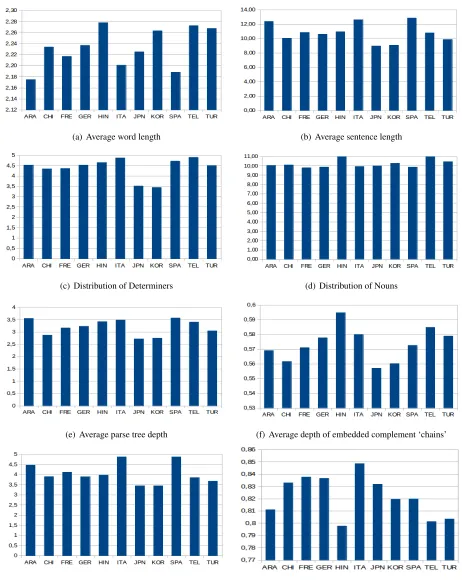
Generally speaking, linguistic profiling makes it possible to identify (groups of) texts which are sim-ilar, at least with respect to the “profiled” features (van Halteren, 2004). In what follows we report the results of linguistic profiling obtained with re-spect to the 11 L1 sub–corpora considered in this study. Figure 1 shows the results obtained with re-spect to a selection of the features described in Sec-tion 2. These results refer to the combined training and development data sets: note, however, that we also calculated the values of these features in the two datasets separately and it turned out that they do not vary significantly between the two sets. This fact can be taken as a proof both of the reliability of our approach to linguistic profiling and of the relevance of these features for NLI purposes.
Starting from raw textual features (Figures 1(a) and 1(b)), both average sentence length and aver-age word length vary significantly across L1s. In particular, if on the one hand the essays written by Arabic and Spanish L1 speakers contain the shortest words and the longest sentences, on the other hand the Hindi and Telugu L1 essays are characterized by the longest words; the L1 Japanese and Korean cor-pora contain the shortest sentences.
Let us focus now on the distribution of unigrams of coarse grained Parts–Of–Speech. If we consider the distributions of determiners and nouns, two fea-tures typically used for NLI purposes (Wong and Dras, 2009) which also represent stylistic markers associated with different linguistic varieties (Biber and Conrad, 2009), it can be noticed (see Fig-ures 1(c) and 1(d)) that for Japanese and Korean the essays show the lowest percentage of determiners, while for Hindi and Telugu they are characterized by the highest percentage of nouns.
Ara-(a) Average word length (b) Average sentence length
(c) Distribution of Determiners (d) Distribution of Nouns
(e) Average parse tree depth (f) Average depth of embedded complement ‘chains’
[image:5.612.72.534.65.645.2](g) Average length of the longest dependency link (h) Arity of verbal predicates
bic speakers contain the deepest parse trees, for Ital-ian and Spanish we observe the longest dependency links and for Hindi and Telugu the longest sequences of embedded complements. Moreover, while the essays by Italians are characterised by the highest value of arity of verbal predicates, for Hindi, Telugu and Korean essays much lower values are recorded. Interestingly, these linguistic profiling results show similar trends across the 11 languages at dif-ferent levels of linguistic analysis. For instance, it can be noted that Japanese and Korean or Italian and Spanish, which belong to two different language families, show similar distributions of features. Sim-ilarities have also been recorded in the sub–corpora by Hindi and Telugu speakers, even if these lan-guages do not belong to the same family; we can hypothesize that this might originate from language contact phenomena.
4 System Description
4.1 Machine Learning Classifier
Our approach to Native Language Identification has been implemented in a software prototype, i.e. a classifier operating on mopho–syntactically tagged and dependency parsed texts which assigns to each document a score expressing its probability of be-longing to a given L1 class. The highest score rep-resents to the most probable class. Given a set of features and a training corpus, the classifier creates a statistical model using the feature statistics extracted from the training corpus. This model is used in the classification of unseen documents. The set of fea-tures and the machine learning algorithm can be pa-rameterized through a configuration file.
For each feature, we have implemented three dif-ferent variants, depending on whether the feature value is encoded in terms of: i ) presence/absence of the feature (binary variant), ii ) the normalized frequency (normalized frequency variant), and iii ) the normalizedtf*idf value (normalized tf*idf vari-ant). Since the binary feature variant outperformed the other two, in all the experiments carried out on the development set reported in Section 5 we illus-trate the results obtained using this variant only. This is in line with the results obtained by Brooke and Hirst (2012) and Tetreault et al. (2013). According to (Brooke and Hirst, 2012), a possible explanation
is that “in these relatively short texts, there is high variability in normalized frequencies, and a simpler metric, by having less variability, is easier for the classifier to leverage”. Support Vector Machines (SVM) using LIBSVM (Chang and Lin, 2001) and Maximum Entropy (ME) using MaxEnt1have been used as machine learning algorithms.
We experimented two classification approaches: a single classifier method and two ensemble systems, combining the output of several classifiers.
The single classifier uses the set of features re-sulting from the feature selection process described in Section 4.2 and the SVM using linear kernel as machine learning algorithm. This choice is due to the fact that in all the experiments the linear SVM outperformed the SVM using polynomial kernel. There are two possible explanations for this fact, namely: a) the number of features is much higher than the number of training instances, accordingly it might not be necessary to map data to a higher dimensional space, therefore the nonlinear mapping does not improve the performance; b) Weston et al. (2000) showed that SVMs can indeed suffer in high dimensional spaces where many features are irrele-vant. Note that in Section 5, we report the results of this classifier using different sets of features corre-sponding to the lexical, morpho–syntactic and syn-tactic levels of linguistic analysis.
The two ensemble systems combine the outputs of the component classifiers following two different strategies. The first one is based on the majority vot-ing method (henceforth,VoteComb ): the combina-tion strategy is seen as a classical voting problem where for each essay is assigned the L1 class that has been selected from the majority of classifiers. In case of ties, the L1 class predicted from the best indi-vidual model (as resulting from the experiments car-ried out on the development set) is selected. The sec-ond strategy combines the outputs of the component classifiers via another classifier (henceforth referred to asmeta–classifier): we will refer to this second strategy asClassComb. The meta–classifier uses as a feature the probability score predicted from each component classifier for each L1 class. Differently from the component classifiers, the meta–classifier is based on polynomial kernel SVM. In both
en-1
semble systems, the component classifiers use linear SVM and ME as machine learning algorithms and exploit different sets of features among the ones re-sulting from the feature selection process described below.
4.2 Features Selection Process
Since our approach to NLI relies on a wide num-ber of general–purpose features, a feature selection process was necessary in order to prune irrelevant and redundant features which could negatively af-fect the classification results. The selection process starts taking into account all thenfeatures described in Section 2. In each iteration, for each featurefiwe generate a configuration ci such thatfi is disabled and all the other features are enabled. When an it-eration finishes, we obtain for eachci a correspond-ing accuracy scorescore(ci)which is computed as the average of the accuracy obtained by the classi-fier on the development set (ad) and on an internal development set (ai), corresponding to the 10% of the training set, used in order to reduce the overfit-ting risk. Beingcb the best configuration among all theciconfigurations, ifscore(cb)≤of the accuracy scores resulting from the previous iterations the pro-cess stops. Otherwise:
1. store inF the pairhfb, disabledi;
2. for each configurationci, ifscore(ci)≤of the accuracy scores resulting from the previous it-erations, we store inFthe pairhfi, enabledi;
3. setC=hcb, score(cb)i
where F is a map containing elements
f eature → {disabled, enabled} and C is a
pair that contains the current best configuration cb and the corresponding score score(cb). In each iteration, we consider only the features which do not occur inF. At the initialization stepF is empty and C contains the configuration where all the considered features are enabled.
In spite of the fact that the described selection process does not guarantee to obtain the global opti-mum, it however permitted us to obtain an improve-ment of about 8% with respect to the starting model indiscriminately using all features.
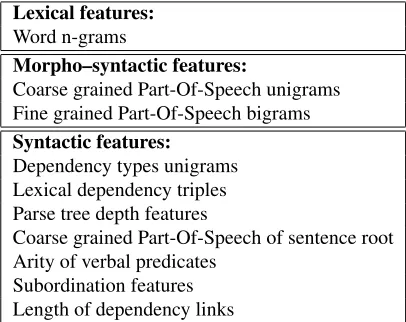
Table 1 lists the features resulting from the fea-ture selection process. It can be noted that some
Lexical features:
Word n-grams
Morpho–syntactic features:
Coarse grained Part-Of-Speech unigrams Fine grained Part-Of-Speech bigrams
Syntactic features:
Dependency types unigrams Lexical dependency triples Parse tree depth features
Coarse grained Part-Of-Speech of sentence root Arity of verbal predicates
[image:7.612.325.528.52.213.2]Subordination features Length of dependency links
Table 1: Features resulting from the feature selection pro-cess.
of them coincide with those typically used for NLI purposes: this is the case of n–grams of words, Parts-Of-Speech and syntactic dependencies. Inter-estingly, to our knowledge, other features such as ar-ity of verbal predicates, length of dependency links as well as subordination and parse tree depth fea-tures have not been used for NLI so far, in spite of their being widely exploited in the syntactic com-plexity literature (as discussed in Section 2).
5 Results
Table 2 reports the overall Accuracy achieved with the different classifier models in the NLI classifi-cation task on the official test set as well as the F-measure score recorded for each L1 class. The first two lines show the accuracies of the two com-bination models, while the last three report the re-sults obtained by the single classifier using i) the set of features resulting by the features selection pro-cess (Best Single), ii) the selected lexical features only (see Table 1) (Lexical ) and iii) the lexical and morpho–syntactic features (Lex+Morph ).
develop-Accuracy ARA CHI FRE GER HIN ITA JAP KOR SPA TEL TUR
ClassComb 77,9 73,8 77,5 83,2 87,3 71,1 86,0 78,8 74,2 70,8 76,2 78,0
VoteComb 77,2 74,3 77,0 80,0 87,0 72,8 81,6 79,6 73,8 67,7 77,6 77,6
Best Single 76,6 71,9 77,6 75,8 85,7 73,2 82,0 80,0 74,0 69,0 76,9 76,5
Lex+Morph 76,4 77,2 76,2 78,6 85,9 72,1 80,4 76,8 71,9 68,0 76,4 76,4
[image:8.612.82.536.52.131.2]Lexical 76,2 71,1 76,5 79,0 87,6 74,5 80,8 77,7 70,8 66,7 79,2 73,4
Table 2: Classification results of different classifiers on official test data.
ment test set.
Let us consider now the results obtained by the single model classifiers. In all cases theBest Single outperforms the other two models demonstrating the reliability of the features selection process and that a combination of lexical, morpho–syntactic and syn-tactic features leads to better results.
Although the best performing model is the Class-Comb, this is not true for all the 11 languages. In Table 2, the best results for each L1 are bolded. In-terestingly, even thoughLexical is the worst model, it is the best performing one for three L1s while the best model, i.e.ClassComb, for five only.
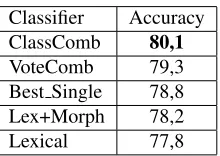
It can be noted that with respect to the devel-opment data set the syntactic features used by the Best Single model allow an increment of +1% as opposed to the Lexical model: this represents a much higher increase if compared with the result obtained on the test data, which is +0,4%. This is an unexpected result since the feature selection de-scribed in Section 4.2 was carried out on an internal development set in order to prevent the risk of over-fitting on the distributed development data.
Classifier Accuracy
ClassComb 80,1
VoteComb 79,3
Best Single 78,8
Lex+Morph 78,2
[image:8.612.132.242.492.570.2]Lexical 77,8
Table 3: Classification results of different classifiers on distributed development data.
6 Conclusion
In this paper, we reported our participation results to the First Native Language Identification Shared Task. By resorting to a wide set of general– purpose features qualifying the lexical and
grammat-ical structure of a text, rather than to ad hoc fea-tures specifically selected for the task at hand, we achieved encouraging results. After a feature se-lection process, new features which to our knowl-edge have never been exploited so far for NLI pur-poses turned out to contribute significantly to the task. Interestingly, the same set of features we started from has been previously successfully ex-ploited in other related tasks, such as readability assessment and genre classification, operating on the Italian language. The obtained results suggest that our approach is general–purpose and portable across different domains and languages. Further di-rections of research currently include: i) comparison of results obtained with general purpose features and with NLI–specific features (e.g. typical errors or dif-ferent types of stylistic idiosyncrasies specific to L2 learners), with a view to combining them to achieve better results; ii) design and development of new en-semble classification methods as well as new fea-ture selection methods considering not only classes of features but also individual features; iii) testing our approach to NLI on different L2s (e.g. Italian) .
References
Giuseppe Attardi, Felice Dell’Orletta, Maria Simi and Joseph Turian. 2009. Accurate dependency parsing with a stacked multilayer perceptron. InProceedings of EVALITA, Evaluation of NLP and Speech Tools for Italian, Reggio Emilia, Italy.
Douglas Biber. 1993. Using Register–diversified Cor-pora for General Language Studies. Computational Linguistics Journal, 19(2): 219–241.
Douglas Biber and Susan Conrad. 2009. Genre, Register, Style. Cambridge: CUP.
Julian Brooke and Graeme Hirst. 2012. Robust, Lexical-ized Native Language Identification. InProceedings of COLING 2012, Mumbai, India, 391–408.
Chih-Chung Chang and Chih-Jen Lin. 2001. LIBSVM: a library for support vector machines. Software avail-able at http://www.csie.ntu.edu.tw/ cjlin/libsvm Walter Daelemans. 2012. Explanation in Computational
Stylometry. In A. Gelbukh (ed.)CICLing 2012, Part II, LNCS 7817, Springer–Verlag, 451–462.
Felice Dell’Orletta. 2009. Ensemble system for Part-of-Speech tagging. InProceedings of Evalita’09, Eval-uation of NLP and Speech Tools for Italian, Reggio Emilia, December.
Felice Dell’Orletta, Simonetta Montemagni and Giulia Venturi. 2011a. READ-IT: Assessing Readability of Italian Texts with a View to Text Simplification. In Proceedings of the Workshop on “Speech and Lan-guage Processing for Assistive Technologies” (SLPAT 2011), Edinburgh, July 30, 73–83.
Felice Dell’Orletta, Simonetta Montemagni and Giulia Venturi. 2012. Genre–oriented Readability Assess-ment: a Case Study. InProceedings of the Workshop on Speech and Language Processing Tools in Educa-tion (SLP-TED), 91–98.
Lyn Frazier. 1985. Syntactic complexity. In D.R. Dowty, L. Karttunen and A.M. Zwicky (eds.),Natural Language Parsing, Cambridge University Press, Cam-bridge, UK.
Edward Gibson. 1998. Linguistic complexity: Locality of syntactic dependencies. InCognition, 68(1), pp. 1– 76.
Patrick Juola. 2008. Authorship Attribution. Now Pub-lishers Inc.
Moshe Koppel, Jonathan Schler and Kfir Zigdon. 2005. Automatically determining an anonymous author’s na-tive language. InIntelligence and Security Informat-ics, vol. 3495, LNCS, Springer–Verlag, 209–217. Dekan Lin. 1996. On the structural complexity of natural
language sentences. InProceedings of COLING 1996, pp. 729–733.
Ryan McDonald and Joakim Nivre. 2007. Character-izing the Errors of Data-Driven Dependency Parsing Models. In Proceedings of EMNLP-CoNLL, 2007, 122–131.
Alexander Mehler, Serge Sharoff and Marina Santini (Eds.). 2011. Genres on the Web. Computational Models and Empirical Studies. Springer Series: Text, Speech and Language Technology.
Sze–Meng Jojo Wong and Mark Dras. 2009. Contrastive Analysis and Native Language Identification. In Pro-ceedings of the Australasian Language Technology As-sociation Workshop.
Hans van Halteren. 2004. Linguistic profiling for author recognition and verification. In Proceedings of the Association for Computational Linguistics (ACL04), 200–207.
Joel Tetreault, Daniel Blanchard, Aoife Cahill and Mar-tin Chodorow. 2012. Native Tongues, Lost and Found: Resources and Empirical Evaluations in Na-tive Language Identification. InProceedings of COL-ING 2012, Mumbai, India, 2585–2602.
Joel Tetreault, Daniel Blanchard and Aoife Cahill. 2013. Summary Report on the First Shared Task on Native Language Identification. InProceedings of the Eighth Workshop on Building Educational Applications Us-ing NL, Atlanta, GA, USA.
Victor H.A. Yngve. 1960. A model and an hypothesis for language structure. In Proceedings of the American Philosophical Society, 444–466.