Transforming Controlled Natural Language Biomedical Queries
into Answer Set Programs
Esra Erdem and Reyyan Yeniterzi Faculty of Engineering and Natural Sciences
Sabancı University
Orhanlı, Tuzla 34956 Istanbul, Turkey
Abstract
We introduce a controlled natural language for biomedical queries, called BIOQUERYCNL, and present an algorithm to convert a biomed-ical query in this language into a program in answer set programming (ASP)—a for-mal framework to automate reasoning about knowledge. BIOQUERYCNL allows users to express complex queries (possibly containing nested relative clauses and cardinality con-straints) over biomedical ontologies; and such a transformation of BIOQUERYCNL queries into ASP programs is useful for automat-ing reasonautomat-ing about biomedical ontologies by means of ASP solvers. We precisely describe the grammar of BIOQUERYCNL, implement our transformation algorithm, and illustrate its applicability to biomedical queries by some examples.
1 Introduction
The rapid increase in the popularity and usage of Web leads researchers to store data and make it pub-licly available in many ways. In particular, to facili-tate access to its desired parts, it is stored in a struc-tured form, like ontologies. These ontologies can be queried with an SQL-like formal query language. However, since these ontologies have been devel-oped for and widely used by people that lacks the necessary knowledge in a formal query language, a simpler and more commonly known language is needed to represent queries. A natural language is the perfect answer, but ambiguities in its grammar and vocabulary make it difficult to automate reason-ing about queries in natural language. Therefore, to
represent queries, we consider a middle ground be-tween these two options: a Controlled Natural Lan-guage (CNL).
A CNL is a subset of a natural language, with a re-stricted grammar and vocabulary, that overcomes the ambiguity of natural languages. Since we consider queries in a specific domain, namely biomedicine, and over specific sources of information, namely biomedical ontologies, a CNL designed and devel-oped for reasoning about biomedical ontologies is sufficient to represent biomedical queries. Essen-tially, a CNL is a formal language but with a look of a natural language. Therefore, compared to a natural language, a CNL can be easily converted to some other formalisms. This allows us to use au-tomated reasoners, specifically developed for such formalisms, to find answers to queries expressed in a CNL.
One such formalism is Answer Set Programming (ASP) (Baral, 2003). ASP is a new knowledge rep-resentation and reasoning paradigm which supports representation of defaults, constraints, preferences, aggregates, etc., and provides technologies that al-low us to automate reasoning with incomplete in-formation, and to integrate other technologies, like description logics reasoners and Semantic Web tech-nologies. For instance, in (Bodenreider et al., 2008), the authors illustrate the applicability and effective-ness of using ASP to represent a rule layer that inte-grates relevant parts of some biomedical ontologies in RDF(S)/OWL, and to compute answers to some complex biomedical queries over these ontologies.
Although CNLs are appropriate for expressing biomedical queries, and methods and technologies
Figure 1: Architecture of the Overall System
of ASP are appropriate for automated reasoning about biomedical ontologies, there is no algorithm to convert a CNL biomedical query into a program. In (Bodenreider et al., 2008), biomedical queries are represented as programs in ASP; however, these pro-grams are constructed manually. However, manually constructing ASP programs to represent biomedi-cal queries is not only time consuming but also requires expertise in ASP. This prevents automat-ing the whole process of computautomat-ing an answer to a query, once it is given in a CNL.
In this paper, we design and develop a CNL (called BIOQUERYCNL) for expressing biomedical queries over some ontologies, and introduce an al-gorithm to convert a biomedical query expressed in this CNL into a program in ASP. The idea is to au-tomatically compute an answer to the query using methods of (Bodenreider et al., 2008), once the user types the query. This idea is illustrated in Figure 1.
Similar approaches of using a CNL for querying ontologies have been investigated in various stud-ies. For instance, (Bernstein et al., 2005) consid-ers queries in the controlled natural language, At-tempto Controlled English (ACE) (AtAt-tempto, 2008), and transforms them into queries in PQL(Klein and Bernstein, 2004) to be evaluated by a query engine. (Bernstein et al., 2006) presents a system that guides the user to write a query in ACE, and translates the query into SPARQLto be evaluated by the reasoner of JENA (Jena, 2008). On the other hand, (Kauf-mann et al., 2006) transforms a given natural lan-guage query to a SPARQL query (using the
Stan-ford Parser and WORDNET) to be evaluated by a reasoner like that of JENA. Our work is different from these studies in two ways: we consider queries over biomedical ontologies (thus different forms of queries, and vocabulary), and we transform a query into an ASP program to automate reasoning over a rule layer presented in ASP.
Transformations of natural language sentences into ASP has been studied in (Baral et al., 2008) and (Baral et al., 2007). In (Baral et al., 2008), the au-thors introduce methods to transform some simple forms of sentences into ASP using Lambda Calcu-lus. In (Baral et al., 2007), the authors use C&C tools (CC, 2009) to parse the some forms of natu-ral language input, and perform a semantic analysis over the parser output using BOXER(Boxer, 2009), to do reasoning in ASP. Our work is different in that we consider a CNL to express queries, and intro-duce a different method for converting CNL to a pro-gram in ASP, via Discourse Representation Struc-tures (DRS) (Kamp, 1981).
In the rest of the paper, first we briefly discuss ASP with some examples (Section 2). Then we de-fine the grammatical structure of BIOQUERYCNL and give some examples (Section 3). Next, we introduce our algorithm for transforming a BIO -QUERYCNL query into an ASP program and ex-plain it by an example (Section 4). We conclude with a discussion of challenges related to the im-plementation of our algorithm (Section 5) and other related problems that we are working on (Section 6).
2 Answer Set Programming
Answer Set Programming (ASP) (Lifschitz, 1999; Marek and Truszczy´nski, 1999; Niemel¨a, 1999; Baral, 2003) is a new knowledge representation and reasoning paradigm which supports representa-tion of defaults, constraints, preferences, aggregates, etc., and provides technologies that allow us to auto-mate reasoning with incomplete information, and to integrate other technologies, like description logics reasoners and Semantic Web technologies.
(DLV, 2009). Consider for instance the program: gene_gene(‘‘ADRB1’’,‘‘CHRM5’’).
gene_gene(‘‘CHRM1’’,‘‘CHRM5’’).
chain(X,Y) :- gene_gene(X,Y). chain(X,Y) :- gene_gene(Y,X).
chain(X,Y) :- gene_gene(X,Z), chain(Z,Y). The first rule expresses that the gene ADRB1 inter-acts with the gene CHRM5. The second rule ex-presses that the gene CHRM1 interacts with the gene CHRM5. The third, the fourth, and the fifth rules express a chain of such interactions. In a rule con-taining:-, the left-hand-side of:-is called thehead of the rule, the right-hand-side is called thebodyof the rule. Such a rulep :- q, r. is read as “pifq andr”. Here the head atom isp, and the body atoms are q and r. The answer set for this program de-scribes that there is a chain of interactions between CHRM1 and CHRM5, ADRB1 and CHRM5, and ADRB1 and CHRM1.
As mentioned above, the language of ASP is ex-pressive enough to represent defaults, constraints, preferences, aggregates, etc.. For instance, the rule treats_2diseases(R)
:-#count{D:treats(R,D)}>=2, drug(R). describes drugsRthat treat at least 2 diseases.
3 A Controlled Natural Language for Biomedical Queries
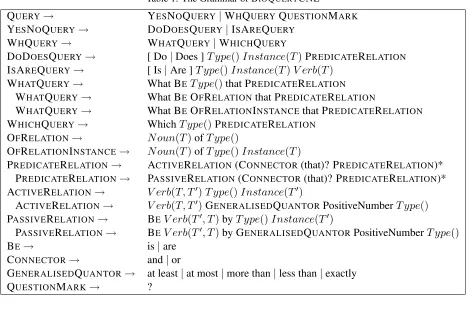
We introduce a controlled natural language, called BIOQUERYCNL, to express biomedical queries, whose grammar is shown in Table 1. This gram-mar should be considered in connection with the given biomedical ontologies. The italic words in the grammar, for instance, represent the information ex-tracted from the related ontologies. We call these italic words ontology functions; the detailed descrip-tion of these funcdescrip-tions are given in Table 2.
With BIOQUERYCNL, the users can ask simple queries, queries with nested relative clauses (with any number of conjunctions and disjunctions), and queries with cardinalities. Some sample queries are given below.
(Q1) Which symptoms are alleviated by the drug Epinephrine?
(Q2) What are the side-effects of the drugs that treat the disease Asthma?
(Q3) What are the genes that are related to the disease Asthma and are targeted by the drug Epinephrine?
(Q4) What are the symptoms of the diseases that are related to the gene ADRB1 or that are treated by the drug Epinephrine?
(Q5) Which genes are targeted by at least 2 drugs and are related to at most 3 diseases?
BIOQUERYCNL is a subset of Attempto Con-trolled English (ACE) (Attempto, 2008), which can represent a wide range of queries (Fuchs et al., 2008), specialized for biomedical ontologies.
4 Converting Controlled Natural Language Queries to Programs
We have implemented an algorithm, QUERY, pre-sented in Algorithm 1, that obtains an ASP rule Head ← Bodyfrom a query Qexpressed in BIO -QUERYCNL, via transformingQ into a DRS. We will explain the main steps of the QUERY algorithm by an example, considering query (Q4).
Algorithm 1QUERY(Q)
Input: A queryQ
Output: An ASP ruleHead ←Body
1: D:=Find the DRS ofQ 2: Head:=HEAD(D) 3: Body0 :=BODY(D)
4: Body:=POSTPROCESSING(Body0) 5: returnHead ←Body
4.1 Transforming a CNL Query into DRS
Table 1: The Grammar of BIOQUERYCNL
QUERY→ YESNOQUERY|WHQUERY QUESTIONMARK YESNOQUERY→ DODOESQUERY|ISAREQUERY
WHQUERY→ WHATQUERY|WHICHQUERY
DODOESQUERY→ [ Do|Does ]T ype()Instance(T)PREDICATERELATION ISAREQUERY→ [ Is|Are ]T ype()Instance(T)V erb(T)
WHATQUERY→ What BET ype()that PREDICATERELATION WHATQUERY→ What BEOFRELATIONthat PREDICATERELATION
WHATQUERY→ What BEOFRELATIONINSTANCEthat PREDICATERELATION WHICHQUERY→ WhichT ype()PREDICATERELATION
OFRELATION→ N oun(T)ofT ype()
OFRELATIONINSTANCE→ N oun(T)ofT ype()Instance(T)
PREDICATERELATION→ ACTIVERELATION(CONNECTOR(that)? PREDICATERELATION)* PREDICATERELATION→ PASSIVERELATION(CONNECTOR(that)? PREDICATERELATION)* ACTIVERELATION→ V erb(T, T0)T ype()Instance(T0)
ACTIVERELATION→ V erb(T, T0)GENERALISEDQUANTORPositiveNumberT ype() PASSIVERELATION→ BEV erb(T0, T)byT ype()Instance(T0)
PASSIVERELATION→ BEV erb(T0, T)by GENERALISEDQUANTORPositiveNumberT ype()
BE→ is|are
CONNECTOR→ and|or
GENERALISEDQUANTOR→ at least|at most|more than|less than|exactly
QUESTIONMARK→ ?
Table 2: The Ontology Functions
T ype() returns the type information the ontologies keep, ex. gene, disease, drug Instance(T) returns instances of the typeT, ex. Asthma for type disease
V erb(T) returns the verbs related to the typeT, ex. approve for type drug
V erb(T, T0) returns the verbs where typeT is the subject and typeT0is the object, ex. drug treat disease N oun(T) returns the nouns that are related to the typeT, ex. symptom for type disease
[A,B,C,D] query(A,what)-1 predicate(B,be,A,C)-1 relation(C,of,D)-1
object(C,symptoms,countable,na,eq,1)-1 [E,F,G]
modifier_pp(F,to,E)-1 property(G,related,pos)-1 predicate(F,be,D,G)-1
object(E,gene_ADRB1,countable,na,eq,1)-1 v
[H,I]
predicate(I,treated,H,D)-1 object(H,drug_Epinephrine, countable,na,eq,1)-1
object(D,diseases,countable,na,geq,2)-1
Note that the DRS consists of two kinds of expres-sions. The lines with a list of uppercase letters, like [E,F,G], describe the domain of the DRS; each up-percase letter is a referent. The rest of the DRS de-scribe the conditions about the domain.
The DRS above contains some predefined pred-icates, such as object, property, predicate, query, etc.. All the nouns, adjectives, verbs, mod-ifiers, etc. are represented with one of them. For instance,
• object describes objects and the relevant forms of nouns denoting them (like “diseases”)
pro-duced by different forms of verbs (like “treated”),
• relationdescribes relations that are produced by of-constructions (like “symptoms of dis-ease”),
• querydescribes the form of the query and the objects that the query is referring to.
Ontologies represent relations between concepts. A rule layer over ontologies introduce further con-cepts integrating them. ASP takes into account relevant concepts and relations to answer a given query about these ontologies. In the biomedical queries we consider, the concepts and instances are represented withobject and the relations between these concepts are represented withpredicateand relation. Thequeryis also important in terms of the type of information the user asks for.
4.2 Constructing the Head and the Body Atoms
Once the corresponding DRS is obtained from a given BIOQUERYCNL query, the head and the body atoms are constructed by analyzing the conditions in the DRS, as described in Algorithms 2 and 3.
The HEAD algorithm is about the query pred-icate, which refers to objects or relations that are asked for in the given query. By following the referents, starting from the one mentioned in query, the algorithm finds out the type of the information that is asked for in the given query. Consider, for instance, query (Q4). The referent mentioned in query(A,what) is A. It is mentioned in predicate(B,be,A,C)-1, and here it denotes an object with referent C. Now let’s find where C is mentioned: in object(C,symptoms,countable,na,eq,1)-1 to denote symptoms. Therefore, the query asks for symptoms. Based on this information, Algorithm 2 returns the head of the ASP rules as follows: what_be_symptoms(SYM1)
The BODYalgorithm analyzes thepredicateand therelationpredicates. These two predicates de-scribe relations between objects dede-scribed by the object predicates. The algorithm starts from the predicateand the relationpredicates, and then, by following the referents, it returns the body atoms
of the ASP rule. For instance, Algorithm 3 returns the following body atoms for query (Q4):
symptoms_of_diseases(symptom_SYM1, disease_DIS1)
diseases_be_related_to_gene(disease_DIS1, gene_‘‘ADRB1’’) drug_treated_diseases(drug_‘‘Epinephrine’’,
disease_DIS1)
These body atoms are given to POSTPROCESSING step, to produce bodies of the ASP rules.
4.3 Constructing the ASP Rules
POSTPROCESSING is the last step of the QUERY algorithm. At this step, first the number of rules is determined, and then the body atoms are placed in the bodies of these rules. In ASP, a conjunc-tive query can be represented by a rule. However, disjunctive queries are represented by several rules with same head but different bodies. For instance, query (Q4) is a disjunctive query (a disjunction of two queries), so there will be two rules representing this query:
what_be_symptoms(SYM1)
:-symptoms_of_diseases(symptom_SYM1, disease_DIS1), diseases_be_related_to_gene(disease_DIS1,
gene_‘‘ADRB1’’).
what_be_symptoms(SYM1)
:-drug_treated_diseases(drug_‘‘Epinephrine’’, disease_DIS1),
symptoms_of_diseases(symptom_SYM1, disease_DIS1). Next, the predicate names in the bodies of these rules are matched with the names of the already de-fined predicates in ontologies or in the rule layer over these ontologies. After matching the predicate names, the parameters of the predicates may have to be reordered.
The matching of the predicates very much de-pends on the user interface (UI). If UI enforces users to use a specific grammar and lexicon while form-ing the query, then the matchform-ing can be done with an easy table look-up method. If the UI allows more flexibility of constructing a query, then the match-ing algorithm should use some basic Natural Lan-guage Processing methods and similarity metrics to find the most probable matching.
Algorithm 2HEAD(D) Input: A DRS
Output: Head of an ASP rule
1: query(Ref,QuestionWord) // e.g.,query(A,which)for “Which drug ...” 2: ifRef is an objectthen
3: Object:=REFERSTO(Ref) // e.g.,Arefers to a “drug”DRG1
4: Head :=CONCAT(QuestionWord,Object,Ref) // e.g.,which drug(DRG1)
5: else ifRef is a subject of a predicatethen //query(A,what)for “What are the genes ...” 6: Object:=REFERSTO(Ref) // e.g.,Arefers to “genes”GEN E1
7: Head :=CONCAT(QuestionWord,Predicate,Object,Ref) // e.g.,what be genes(GEN E1) 8: end if
9: return Head
returns the body predicates with the parameters. In these parameters, the type and the instance names are kept together. Thus, ordering of those parame-ters are done just by using the type information. Af-ter the ordering is done, the type information part is removed from the parameters.
For instance, after matching the predicates, we get the following ASP rule for query (Q4).
what_be_symptoms(SYM1) :-disease_symptom(DIS1,SYM1), disease_gene(DIS1,‘‘ADRB1’’).
what_be_symptoms(SYM1)
:-treats_disease(‘‘Epinephrine’’,DIS1), disease_symptom(DIS1,SYM1).
With an ASP rule layer over ontologies, and this ASP program, an ASP solver, like DLVHEX (DLVHEX, 2009), returns an answer to query (Q4). For instance, consider the ASP rule layer, and the gene, disease, drug ontologies of (Bodenreider et al., 2008). The ontologies of (Bodenreider et al., 2008) are obtained from the ontologies PHAR -MGKB (PharmGKB, 2008), UNIPROT (UniProt, 2008), GENE ONTOLOGY (GO) (GeneOntology, 2008), GENENETWORK database (GeneNetwork, 2008), DRUGBANK (DrugBank, 2008), and the Medical Symptoms and Signs of Disease web page (MedicalSymptomsSignsDisease, 2008). With this rule layer and the ontologies, and the ASP program above, the following is a part of the answerDLVHEX finds to the query above:
noisy breathing faster breathing shortness of breath coughing
chest tightness wheezing
4.4 Another Example
The algorithm discussed above returns the following ASP program for query (Q5):
which_genes(GN1)
:-2<=#count{DRG1:drug_gene(DRG1,GN1)}, #count{DIS1:disease_gene(DIS1,GN1)}<=3.
Since query (Q5) contains cardinality constraints, the ASP program uses the aggregate#count.
More examples of biomedical queries, and the ASP programs generated by our program can be seen athttp://people.sabanciuniv.edu/ esraerdem/bioquery-asp/bionlp09/.
5 Implementational Issues
We have implemented the algorithms explained above in PERL. We have used Attempto Parsing Engine APE to convert a given BIOQUERYCNL query into a DRS. Since BIOQUERYCNL is about biomedical ontologies, we provided APE some in-formation about biomedical concepts, such as gene, drug, and words that represent relations between these concepts such as treat, target etc..
Algorithm 3BODY(D) Input: A DRS
Output: Body of an ASP rule 1: Body:=empty string 2: foreach predicatePdo
3: //P can be of the formpredicate(Ref,Verb,SubRef), likepredicate(H,targeted, A) 4: Subject:=REFERSTO(SubRef) // e.g.,Arefers to “genes”GEN E1
5: ifP has a verb phrase modifierthen
6: hModifier,Objecti:=REFERSTO(Ref) // e.g.,Hrefers toh“by”, “drug”DRG1i 7: end if
8: ifP has an objectthen //P can be of the formpredicate(Ref,Verb,SubRef,ObjRef) 9: Object:=REFERSTO(ObjRef)
10: end if
11: Body:= CONCAT(Body,Subject,Verb,Modifier,Object) 12: // e.g.,genes targeted by drugs(GEN E1, DRG1) 13: end for
14: foreach relationRdo
15: //Rcan be of the formrelation(Ref1,of,Ref2), likerelation(C,of, D) 16: Object1:=REFERSTO(Ref1) // e.g.,Crefers to “symptoms”SY M1 17: Object2:=REFERSTO(Ref2) // e.g.,Drefers to “diseases”DIS1 18: Body:= CONCAT(Body,Object1,”‘of”’,Object2)
19: // e.g.,symptoms of diseases(SY M1, DIS1) 20: end for
21: return Body
the concept name just before the instance (like “the drug Epinephrine”) in the query. This is how we deal with instance names, in the current version of our implementations. However, such BIOQUERYCNL queries are not in the language of APE; so, with some preprocessing, we rewrite these queries in the correct syntax for APE.
6 Conclusion
We have designed and developed a Controlled Nat-ural Language (CNL), called BIOQUERYCNL, to represent biomedical queries over some ontologies, and provided a precise description of its grammati-cal structure.
We have introduced an algorithm to convert queries in BIOQUERYCNL to a program in Answer Set Programming (ASP). The idea is to compute an-swers to these queries automatically, by means of automated reasoners in ASP, over biomedical on-tologies in RDF(S)/OWL and a rule layer in ASP integrating these ontologies. Our algorithm can handle various forms of simple/complex
disjunc-tive/conjunctive queries that may contain (nested) relative clauses and cardinality constraints.
We have implemented this algorithm in PERL, and tried it with the ASP rule layer, and the ontolo-gies of (Bodenreider et al., 2008).
One essential part of the overall system is an in-telligent user interface that allows a user to enter biomedical queries in BIOQUERYCNL. Design and implementation of such a user-interface is a part of our ongoing work.
Acknowledgments
Thanks to Tobias Kuhn for his help with ACE. This work is supported by the Scientific and Technolog-ical Research Council of Turkey (TUBITAK) grant 108E229.
References
Chitta Baral, Juraj Dzifcak, and Luis Tari. 2007. To-wards overcoming the knowledge acquisition bottle-neck in answer set prolog applications: Embracing natural language inputs. InProc. of ICLP, pages 1– 21.
Chitta Baral, Juraj Dzifcak, and Tran Cao Son. 2008. Using answer set programming and lambda calculus to characterize natural language sentences with nor-matives and exceptions. InProc. of AAAI, pages 818– 823.
Chitta Baral. 2003. Knowledge Representation, Rea-soning and Declarative Problem Solving. Cambridge University Press.
Abraham Bernstein, Esther Kaufmann, Anne G¨ohring, and Christoph Kiefer. 2005. Querying ontologies: A controlled english interface for end-users. InProc. of ISWC, pages 112–126.
Abraham Bernstein, Esther Kaufmann, Christian Kaiser, and Christoph Kiefer. 2006. Ginseng: A guided in-put natural language search engine for querying on-tologies. InJena User Conference.
Patrick Blackburn and Johan Bos. 2005. Representation and Inference for Natural Language. A First Course in Computational Semantics. CSLI.
Olivier Bodenreider, Zeynep Hande C¸oban, Mahir Can Do˘ganay, Esra Erdem, and Hilal Kos¸ucu. 2008. A preliminary report on answering complex queries re-lated to drug discovery using answer set programming. InProc. of ALPSWS.
Boxer. 2009. http://svn.ask.it.usyd.edu. au/trac/candc/wiki/boxer.
CC. 2009. http://svn.ask.it.usyd.edu.au/ trac/candc/wiki.
DLV. 2009. http://www.dbai.tuwien.ac.at/ proj/dlv.
DLVHEX. 2009. http://con.fusion.at/ dlvhex/.
DrugBank. 2008. http://redpoll.pharmacy. ualberta.ca/drugbank/.
Norbert E. Fuchs, Kaarel Kaljurand, and Tobias Kuhn. 2008. Discourse representation structures for ace 6.0. Technical Report IFI-2008.02, Department of Infor-matics, University of Zurich.
Michael Gelfond and Vladimir Lifschitz. 1988. The stable model semantics for logic programming. In Robert Kowalski and Kenneth Bowen, editors,Logic Programming: Proceedings of the Fifth International Conference and Symposium.
GeneNetwork. 2008. http://humgen.med.uu. nl/˜lude/genenetwork.
GeneOntology. 2008. http://www. geneontology.org.
Jena. 2008. http://jena.sourceforge.net/.
Hans Kamp. 1981. A theory of truth and semantic rep-resentation. In J. A. G. Groenendijk, T. M. V. Janssen, and M. B. J. Stokhof, editors,Formal Methods in the Study of Language, volume 1, pages 277–322. Esther Kaufmann, Abraham Bernstein, and Renato
Zum-stein. 2006. Querix: A natural language interface to query ontologies based on clarification dialogs. In Proc. of ISWC.
Mark Klein and Abraham Bernstein. 2004. Toward high-precision service retrieval. IEEE Internet Computing, 8(1):30–36.
Vladimir Lifschitz. 1999. Action languages, answer sets and planning. InThe Logic Programming Paradigm: a 25-Year Perspective. Springer.
Victor Marek and Mirosław Truszczy´nski. 1999. Sta-ble models and an alternative logic programming paradigm. InThe Logic Programming Paradigm: a 25-Year Perspective. Springer.
MedicalSymptomsSignsDisease. 2008. http: //www.medicinenet.com/symptoms_and_ signs/article.htm.
Ilkka Niemel¨a. 1999. Logic programs with stable model semantics as a constraint programming paradigm. An-nals of Mathematics and Artificial Intelligence, 25. PharmGKB. 2008.http://www.pharmgkb.org. UniProt. 2008. http://www.ebi.uniprot.org/