Statistical Script Learning with Recurrent Neural Networks
Karl Pichotta and Raymond J. Mooney Department of Computer Science The University of Texas at Austin
{pichotta,mooney}@cs.utexas.edu
Abstract
We describe some of our recent efforts in learning statistical models of co-occurring events from large text corpora using Recurrent Neural Networks.
1 Introduction
Natural language scripts are structured models of stereotypical sequences of events used for document understanding. For example, a script model may en-code the information that fromSmith landed in Bei-jing, one may presumably inferSmith flew in an air-plane to Beijing,Smith got off the plane at the Bei-jing airport, etc. The world knowledge encoded in such event co-occurrence models is intuitively use-ful for a number of semantic tasks, including Ques-tion Answering, Coreference ResoluQues-tion, Discourse Parsing, and Semantic Role Labeling.
Script learning and inference date back to AI research from the 1970s, in particular the semi-nal work of Schank and Abelson (1977). In this work, events are formalized as quite complex hand-encoded structures, and the structures encoding event co-occurrence are non-statistical and hand-crafted based on appeals to the intuitions of the knowledge engineer. Mooney and DeJong (1985) give an early non-statistical method of automatically inducing models of co-occurring events from docu-ments, but their methods are non-statistical.
There is a growing body of more recent work investigating methods of learning statistical mod-els of event sequences from large corpora of raw text. These methods admit scaling models up to be
much larger than hand-engineered ones, while being more robust to noise than automatically learned non-statistical models. Chambers and Jurafsky (2008) describe a statistical co-occurrence model of (verb, dependency) pair events that is trained on a large corpus of documents and can be used to infer im-plicit events from text. A number of other sys-tems following similar paradigm have also been pro-posed (Chambers and Jurafsky, 2009; Jans et al., 2012; Rudinger et al., 2015). These approaches achieve generalizability and computational tractabil-ity on large corpora, but do so at the expense of de-creased representational complexity: in place of the rich event structures found in Schank and Abelson (1977), these systems model and infer structurally simpler events.
In this extended abstract, we will briefly sum-marize a number of statistical script-related systems we have described in previous publications (Pichotta and Mooney, 2016a; Pichotta and Mooney, 2016b), place them within the broader context of related re-search, and remark on future directions for research.
2 Methods and results
In Pichotta and Mooney (2016a), we present a sys-tem that uses Long Short-Term Memory (LSTM) Recurrent Neural Nets (RNNs) (Hochreiter and Schmidhuber, 1997) to model sequences of events. In this work, events are defined to be verbs with in-formation about their syntactic arguments (either the noun identity of the head of an NP phrase relating to the verb, the entity identity according to a corefer-ence resolution engine, or both). For example, the sentenceSmith got off the plane at the Beijing
portwould be represented as (get off, smith, plane, (at, airport)). This event representation was investi-gated in Pichotta and Mooney (2014) in the context of count-based co-occurrence models. Balasubra-manian et al. (2013), Modi and Titov (2014), and Granroth-Wilding and Clark (2016) describe sys-tems for related tasks with similar event formula-tions.
In Pichotta and Mooney (2016a), we train an RNN sequence model by inputting one component of an event tuple at each timestep, representing se-quences of events as sese-quences of event compo-nents. Standard methods for learning RNN sequence models are applied to learning statistical models of sequences of event components. To infer probable unobserved events from documents, we input ob-served document events in sequence, one event ponent per timestep, and then search over the com-ponents of a next event to be inferred using a beam search. That is, the structured prediction problem of event inference is reduced to searching over proba-ble RNN output sequences. This is similar in spirit to a number of recent systems using RNN models for structured prediction (Vinyals et al., 2015; Luong et al., 2016; Dong and Lapata, 2016).
While the count-based event co-occurrence sys-tem we investigated in Pichotta and Mooney (2014) treats events as atomic—for example,the plane flew
and the plane flew over land are unrelated events with completely independent statistics—this method decomposes events into components, and the two occurrences of the verb flew in the above exam-ples have the same representation. Further, a low-dimensional embedding is learned for every event component, soflewandsoared can get similar rep-resentations, allowing for generalization beyond the lexical level. Given the combinatorial number of event types,1 decomposing structured events into
components, rather than treating them as atomic, is crucial to scaling up the number of events a script system is capable of inferring. In fact, the system presented in Pichotta and Mooney (2014) does not use noun information about event arguments for this reason, instead using only coreference-based entity
1With a vocabulary of V verb types, N noun types, P preposition types, and event tuples of arityk, there are about V P Nk−1 event types. ForV = N = 10000,P = 50, and
k= 4, this is5×1017.
information.
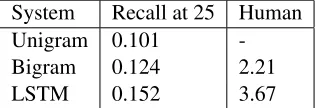
[image:2.612.347.505.86.140.2]System Recall at 25 Human Unigram 0.101 -Bigram 0.124 2.21 LSTM 0.152 3.67
Table 1:Next event prediction results in Pichotta and Mooney (2016a). Partial credit is out of 1, and human evaluations are out of 5 (higher is better for both). More results can be found in the paper.
Table 1 gives results comparing a naive baseline (“Unigram,” which always deterministically guesses the most common events), a co-occurrence based baseline (“Bigram,” similar to the system of Pichotta and Mooney (2014)) and the LSTM system. The metric “Recall at 25” holds an event out from a test document and judges a system by its recall of the gold-standard event in its list of top 25 inferences. The “Human” metric is average crowdsourced judg-ments of inferences on a scale from 0 to 5, with some post hoc quality-control filtering applied. The LSTM system outperforms the other systems. More results and details can be found in Pichotta and Mooney (2016a).
These results indicate that RNN sequence mod-els can be fruitfully applied to the task of predicting held-out events from text, by modeling and inferring events comprising a subset of the document’s syn-tactic dependency structure. This naturally raises the question of to what extent, within the current regime of event-inferring systems trained on doc-uments, explicit syntactic dependencies are neces-sary as a mediating representation. In Pichotta and Mooney (2016b), we compare event RNN models, of the sort described above, with RNN models that operate at the raw text level. In particular, we inves-tigate the performance of a text-level sentence en-coder/decoder similar to the skip-thought system of Kiros et al. (2015) on the task. In this setup, dur-ing inference, instead of encoddur-ing events and de-coding events, we encode raw text, decode raw text, and then parse inferred text to get its dependency structure.2 This system does not obviously encode
event co-occurrence structure in the way that the
previous one does, but can still in principle infer im-plicit events from text, and does not require a parser (and can be therefore be used for low-resource lan-guages).
[image:3.612.88.289.127.195.2]System Accuracy BLEU 1G P Unigram 0.002 - -Copy/paste - 1.88 22.6 Event LSTM 0.023 0.34 19.9 Text LSTM 0.020 5.20 30.9
Table 2: Prediction results in Pichotta and Mooney (2016b). More results can be found in the paper.
Table 2 gives a subset of results from Pichotta and Mooney (2016b), comparing an event LSTM with a text LSTM. The “Copy/paste” baseline determin-istically predicts a sentence as its own successor. The “Accuracy” metric measures what percentage of argmax inferences were equal to the gold-standard held-out event. The “BLEU” column gives BLEU scores (Papineni et al., 2002) for raw text inferred by systems (either directly, or via an intermediate text-generation step in the case of the Event LSTM output). The “1G P” column gives unigram preci-sion against the gold standard, which is one of the components of BLEU. Figure 1, reproduced from Pichotta and Mooney (2016b), gives some example next-sentence predictions. Despite the fact that it is very difficult to predict the next sentence in natural text, the text-level encoder/decoder system is capa-ble of learning learning some aspects of event co-occurrence structure in documents.
These results indicate that modeling text directly does not appear to appreciably harm the ability to infer held-out events, and greatly helps in inferring held-out text describing those events.
3 Related Work
There are a number of related lines of research inves-tigating different approaches to statistically model-ing event co-occurrence. There is, first of all, a body of work investigating systems which infer events from text (including the above work). Chambers and Jurafsky (2008) give a method of modeling and in-ferring simple (verb, dependency) pair-events. Jans et al. (2012) describe a model of the same sorts of events which gives superior performance on the task
of held-out event prediction; Rudinger et al. (2015) follow this line of inquiry, concluding that the task of inferring held-out (verb, dependency) pairs from documents is best handled as a language modeling task.
Second, there is a body of work focusing on au-tomatically inducing structured collections of events (Chambers, 2013; Cheung et al., 2013; Nguyen et al., 2015; Ferraro and Van Durme, 2016), typically motivated by Information Extraction tasks.
Third, there is a body of work investigating high-precision models of situations as they occur in the world (as opposed to how they are described in text) from smaller corpora of event sequences (Regneri et al., 2010; Li et al., 2012; Frermann et al., 2014; Orr et al., 2014).
Fourth, there is a recent body of work investi-gating the automatic induction of event structure in different modalities. Kim and Xing (2014) give a method of modeling sequences of images from or-dered photo collections on the web, allowing them to perform, among other things, sequential image pre-diction. Huang et al. (2016) describe a new dataset of photos in temporal sequence scraped from web albums, along with crowdsourced story-like descrip-tions of the sequences (and methods for automati-cally generating the latter from the former). Bosse-lut et al. (2016) describe a system which learns a model of prototypical event co-occurrence from on-line photo albums with their natural language cap-tions. Incorporating learned event co-occurrence structure from large-scale natural datasets of differ-ent modalities could be an exciting line of future re-search.
Input: As of October 1 , 2008 ,hOOVichanged its company name to Panasonic Corporation.
Gold: hOOViproducts that were branded “National” in Japan are currently marketed under the “Panasonic” brand.
Predicted: The company’s name is nowhOOVi.
Input: White died two days after Curly Bill shot him.
Gold: Before dying, White testified that he thought the pistol had accidentally discharged and that he did not believe that Curly Bill shot him on purpose.
Predicted: He was buried athOOViCemetery.
Input: The foundation stone was laid in 1867.
Gold: The members of the predominantly Irish working class parish managed to save£700 towards construction, a large sum at the time.
Predicted: ThehOOViwas founded in the early 20th century.
Input: Soldiers arrive to tell him thathOOVi has been seen in camp and they call for his capture and death.
Gold: hOOViagrees .
Predicted: hOOViis killed by thehOOVi.
Figure 1: Examples of next-sentence text predictions, reproduced from Pichotta and Mooney (2016b). hOOViis the out-of-vocabulary pseudo-token, which frequently replaces proper names.
alternative evaluation for script systems.
4 Future Work and Conclusion
The methods described above were motivated by the utility of event inferences based on world knowl-edge, but, in order to leverage large text corpora, actually model documents rather than scenarios in the world per se. That is, this work operates un-der the assumption that modeling event sequences in documents is a useful proxy for modeling event sequences in the world. As mentioned in Section 3, incorporating information from multiple modalities is one possible approach to bridging this gap. In-corporating learned script systems into other useful extrinsic evaluations, for example coreference reso-lution or question-answering, is another.
For the task of inferring verbs and arguments ex-plicitly present in documents, as presented above, we have described some evidence that, in the con-text of standard RNN training setups, modeling raw text yields fairly comparable performance to explic-itly modeling syntactically mediated events. The ex-tent to which this is true for other extrinsic tasks is an empirical issue that we are currently explor-ing. Further, the extent to which representations of more complex event properties (such as those hand-encoded in Schank and Abelson (1977)) can be learned automatically (or happen to be encoded in the learned embeddings and dynamics of neural script models) is an open question.
Acknowledgments
This research was supported in part by the DARPA DEFT program under AFRL grant FA8750-13-2-0026.
References
Niranjan Balasubramanian, Stephen Soderland, Mausam, and Oren Etzioni. 2013. Generating coherent event schemas at scale. InProceedings of the 2013 Confer-ence on Empirical Methods in Natural Language Pro-cessing (EMNLP-2013).
Antoine Bosselut, Jianfu Chen, David Warren, Hannaneh Hajishirzi, and Yejin Choi. 2016. Learning prototyp-ical event structure from photo albums. In Proceed-ings of the 54th Annual Meeting of the Association for Computational Linguistics (ACL-16).
Nathanael Chambers and Daniel Jurafsky. 2008. Un-supervised learning of narrative event chains. In Pro-ceedings of the 46th Annual Meeting of the Association for Computational Linguistics (ACL-08), pages 789– 797.
Nathanael Chambers and Dan Jurafsky. 2009. Unsuper-vised learning of narrative schemas and their partici-pants. InProceedings of the 47th Annual Meeting of the Association for Computational Linguistics (ACL-09), pages 602–610.
Jackie Chi Kit Cheung, Hoifung Poon, and Lucy Vander-wende. 2013. Probabilistic frame induction. In Pro-ceedings of the 2013 Conference of the North Amer-ican Chapter of the Association for Computational Linguistics: Human Language Technologies (NAACL-13).
Li Dong and Mirella Lapata. 2016. Language to logical form with neural attention. InProceedings of the 54th Annual Meeting of the Association for Computational Linguistics (ACL-16).
Francis Ferraro and Benjamin Van Durme. 2016. A uni-fied Bayesian model of scripts, frames and language. InProceedings of the 30th AAAI Conference on Artifi-cial Intelligence (AAAI-16).
Lea Frermann, Ivan Titov, and Manfred Pinkal. 2014. A hierarchical Bayesian model for unsupervised induc-tion of script knowledge. InProceedings of the 14th Conference of the European Chapter of the Associa-tion for ComputaAssocia-tional Linguistics (EACL-14), pages 49–57.
Mark Granroth-Wilding and Stephen Clark. 2016. What happens next? Event prediction using a compositional neural network model. In Proceedings of the 30th AAAI Conference on Artificial Intelligence (AAAI-16). Sepp Hochreiter and J¨urgen Schmidhuber. 1997. Long short-term memory. Neural Computation, 9(8):1735– 1780.
Ting-Hao K. Huang, Francis Ferraro, Nasrin Mostafazadeh, Ishan Misra, Jacob Devlin, Aishwarya Agrawal, Ross Girshick, Xiaodong He, Pushmeet Kohli, Dhruv Batra, Larry Zitnick, Devi Parikh, Lucy Vanderwende, Michel Galley, and Margaret Mitchell. 2016. Visual storytelling. InProceedings of the 15th Annual Conference of the North American Chapter of the Association for Computational Linguistics (NAACL-16).
Bram Jans, Steven Bethard, Ivan Vuli´c, and Marie Francine Moens. 2012. Skip n-grams and ranking functions for predicting script events. In Proceedings of the 13th Conference of the Euro-pean Chapter of the Association for Computational Linguistics (EACL-12), pages 336–344.
Gunhee Kim and Eric P. Xing. 2014. Reconstructing storyline graphs for image recommendation from web community photos. InProceedings of the 2014 IEEE Conference on Computer Vision and Pattern Recogni-tion (CVPR-14).
Ryan Kiros, Yukun Zhu, Ruslan Salakhutdinov, Richard S. Zemel, Antonio Torralba, Raquel Urtasun, and Sanja Fidler. 2015. Skip-thought vectors. In
Proceedings of the 29th Annual Conference on Neural Information Processing Systems (NIPS-15).
Boyang Li, Stephen Lee-Urban, Darren Scott Appling, and Mark O Riedl. 2012. Crowdsourcing narrative intelligence.Advances in Cognitive Systems, 2:25–42. Minh-Thang Luong, Quoc V. Le, Ilya Sutskever, Oriol Vinyals, and Lukasz Kaiser. 2016. Multi-task se-quence to sese-quence learning. InProceedings of the 4th International Conference on Learning Represen-tations (ICLR-16).
Ashutosh Modi and Ivan Titov. 2014. Inducing neu-ral models of script knowledge. In Proceedings of the Eighteenth Conference on Computational Natural Language Learning (CoNLL-2014), Baltimore, MD, USA.
Raymond J. Mooney and Gerald F. DeJong. 1985. Learning schemata for natural language processing. In
Proceedings of the Ninth International Joint Confer-ence on Artificial IntelligConfer-ence (IJCAI-85), pages 681– 687.
Nasrin Mostafazadeh, Nathanael Chambers, Xiaodong He, Devi Parikh, Dhruv Batra, Lucy Vanderwende, Pushmeet Kohli, and James Allen. 2016. A corpus and cloze evaluation for deeper understanding of com-monsense stories. InProceedings of the 2016 Confer-ence of the North American Chapter of the Associa-tion for ComputaAssocia-tional Linguistics: Human Language Technologies (NAACL-16).
Kiem-Hieu Nguyen, Xavier Tannier, Olivier Ferret, and Romaric Besanc¸on. 2015. Generative event schema induction with entity disambiguation. In Proceed-ings of the 53rd Annual Meeting of the Association for Computational Linguistics (ACL-15).
J Walker Orr, Prasad Tadepalli, Janardhan Rao Doppa, Xiaoli Fern, and Thomas G Dietterich. 2014. Learn-ing scripts as Hidden Markov Models. InProceedings of the 28th AAAI Conference on Artificial Intelligence (AAAI-14).
Kishore Papineni, Salim Roukos, Todd Ward, and Wei-Jing Zhu. 2002. BLEU: a method for automatic eval-uation of machine translation. InProceedings of the 40th Annual Meeting of the Association for Computa-tional Linguistics (ACL-02), pages 311–318.
Karl Pichotta and Raymond J. Mooney. 2014. Statis-tical script learning with multi-argument events. In
Proceedings of the 14th Conference of the European Chapter of the Association for Computational Linguis-tics (EACL 2014), pages 220–229.
Karl Pichotta and Raymond J. Mooney. 2016a. Learn-ing statistical scripts with LSTM recurrent neural net-works. InProceedings of the 30th AAAI Conference on Artificial Intelligence (AAAI-16).
the Association for Computational Linguistics (ACL-16), Berlin, Germany.
Altaf Rahman and Vincent Ng. 2012. Resolving com-plex cases of definite pronouns: the Winograd schema challenge. In Proceedings of the 2012 Conference on Empirical Methods in Natural Language Process-ing and Computational Natural Language LearnProcess-ing (EMNLP-CoNLL-12), pages 777–789.
Michaela Regneri, Alexander Koller, and Manfred Pinkal. 2010. Learning script knowledge with web experiments. InProceedings of the 48th Annual Meet-ing of the Association for Computational LMeet-inguistics (ACL-10), Uppsala, Sweden, July.
Rachel Rudinger, Pushpendre Rastogi, Francis Ferraro, and Benjamin Van Durme. 2015. Script induction as language modeling. InProceedings of the 2015 Con-ference on Empirical Methods in Natural Language Processing (EMNLP-15).
Roger C. Schank and Robert P. Abelson. 1977. Scripts, Plans, Goals and Understanding: An Inquiry into Hu-man Knowledge Structures. Lawrence Erlbaum and Associates.
Richard Socher, John Bauer, Christopher D. Manning, and Andrew Y. Ng. 2013. Parsing with compositional vector grammars. InProceedings of the 51st Annual Meeting of the Association for Computational Linguis-tics (ACL-13).