Discriminant Analysis for Human Arm Motion Prediction
and Classifying
Mohammed Z. Al-Faiz, Sarmad H. Ahmed
Department of Computer Engineering, Al-Nahrain University, Baghdad, Iraq Email: [email protected], [email protected]
Received September 22, 2012; revised October 22, 2012; accepted October 30, 2012
ABSTRACT
The EMG signal which is generated by the muscles activity diffuses to the skin surface of human body. This paper pre- sents a pattern recognition system based on Linear Discriminant Analysis (LDA) algorithm for the classification of up- per arm motions; where this algorithm was mainly used in face recognition and voice recognition. Also a comparison between the Linear Discriminant Analysis (LDA) and k-Nearest Neighbor (k-NN) algorithm is made for the classifica- tion of upper arm motions. The obtained results demonstrate superior performance of LDA to k-NN. The classification results give very accurate classification with very small classification errors. This paper is organized as follows: Muscle Anatomy, Data Classification Methods, Theory of Linear Discriminant Analysis, k-Nearest Neighbor (kNN) Algorithm, Modeling of EMG Pattern Recognition, EMG Data Generator, Electromyography Feature Extraction, Implemented System Results and Discussions, and finally, Conclusions. The proposed structure is simulated using MATLAB.
Keywords: Linear Discriminant Analysis (LDA); k-Nearest Neighbor (k-NN)
1. Introduction
EMG signals, which are measured at the skin surface, are the electrical manifestations of the activity of muscles. It provides an important access to the human neuromuscu- lar system. EMG has been well recognized as an effec- tive tool to generate control commands for prosthetic de- vices and human-assisting manipulators. Information ex- tracted from EMG signals, represented in a feature vector, is chosen to minimize the control error. In order to achieve this, a feature set must be chosen which maximally sepa- rates the desired output classes. The extraction of accu- rate features from the EMG signals is the main kernel of classification systems and is essential to the motion com- mand identification [1].
Early attempts using pattern matching algorithms for prosthesis control have been proposed by Finely [2].
In today’s literature on EMG classification the signal processing chain is often broken down to three algorith- mic components: the feature extraction, the dimensional- ity reduction and the pattern classification. In the feature extraction step attributes are extracted omitting redun- dancy. In the second step the amount of data is further re- duced by selecting or projecting features for more robust and accurate classification. In the last step pattern match- ing algorithms are applied to detect the category of the input data. The complete processing queue has to be carefully balanced-especially the combination of the pat-
tern matching algorithm and the selected feature contrib- utes significantly to the classification accuracy.
EMG classification is one of the most difficult pattern recognition problems because there are large variations in EMG features. Especially, it is difficult to extract use- ful features from the residual muscle of an amputee. So far, many researches proposed many kinds of EMG fea- ture to classify posture and they showed good perform- ance. However, how to select a feature subset with the best discrimination ability from those features is still an issue for classifying EMG signals [3].
2. Muscle Anatomy
arm. The flexor carpi radialis flexes and abducts the wrist, while the flexor carpi ulnaris flexes and adducts. The ex- tensor carpi radialis produces extension and abduction of the wrist, while the extensor carpi ulnaris produces ex- tension and abduction [5].
3. Data Classification Methods
The most commonly used techniques for data classifica- tion is the Linear Discriminant Analysis. This method ma- ximizes the ratio of between-class variance to the with- in-class variance in any particular data set thereby guar- anteeing maximal separability. The use of Linear Discri- minant Analysis for data classification is applied to clas- sification problems and recognition. This method also helps to better understand the distribution of the feature data [6].
The Linear discriminant analysis (LDA) is a classical statistical approach for supervised classification. LDA computes an optimal transformation (projection) by mini- mizing the within-class distance and maximizing the be- tween-class distance simultaneously, thus achieving maxi- mum class discrimination. Hence LDA will be used in this paper as the classification method due its ability in class discrimination. In the case of the classification of the upper arm motion; these motions are similar to each other in signal shape. Therefore, the obtained results in this paper demonstrated that this method of classification can provide accurate classification result with minimum classification error in the classification of the upper arm motions.
4. Theory of Linear Discriminant Analysis
[6]
Consider a data set that consists of n samples
i, i
1 ni
x y ,
where denotes the d-dimensional input,
i the corresponding class label, n is the
sample size, and k is the number of classes. Let d
i
x
1, 2, ,
y k
1, ,2
X x x ,xn d n (1)
be the data matrix and X d n j
G
j be the data matrix of
the j-th class, where nj is the sample size of the j-th class, and that maps xi in the d-dimensional space to a vector
d
L i
x in the -dimentional space as follows:
T ,
d L
i i
x x G d
In LDA, three scatter matrices, called the within-class, between-class and total scatter matrices are defined as follows:
Ti j
c xc
1
1
j
k
w
j x X
S x
n
(2) 1 1 k b j j S n n
i
i
Tc c c c (3)
T 11 k
t i i
j
S x c x c n
i
c
(4)
where is the centroid of the j-th class, and c is the global centroid. It can be verified from the definitions that St= Sb + Sw. Define three matrices Hw, Hb, and Ht as follows:
1
1 T
T 11 , , k k
w K
H X c e X c e
n
(5)
1
1
1 , , k
b k
H n c c n c c
n
(6)
T
1 t
H X ce
n
j
e
T, T, T.
w w w b b b t t t
S H H S H H S H H
(7)
where and e are vectors of all ones of length nj and n, respectively. Then the above three scatter matrices can be expressed as
It follows from the properties of the matrix trace that
2 2 1 1 trace j k j w
j x X
S x c
n
(8) 2 2 1 1 trace w kj
S x c n
T , T , T .
L L L
w w b b t t
S G S G S G S G S G S G
(9)
Thus trace (Sw) measures the distance between the data points and their corresponding class centroid, and trace (Sb) captures the distance between the class centroids and the global centroid.
In the lower-dimensional space resulting from the lin- ear transformation G, the scatter matrices become
An optimal transformation G would maximize trace
Lb and minimize trace
S
wL simultaneously, whichis equivalent to maximizing trace
S
L bS and minimizing
trace
Lt simultaneously, since L
S S SLSL
LDA
G
t w b . The
optimal transformation, , of LDA is computed by solving the following optimization
1
LDA arg max trace L L b t
G S S
b t
S x S x
It is known that the optimal solution to the optimiza- tion problem in above equation can be obtained by solv- ing the following generalized eigenvalue problem:
1
t b
S S x x
d1 i i
1 d
When St is singular, this is known as the singularity or undersampled problem in LDA. When St is singular, the classical LDA formulation discussed above cannot be ap- plied directly.
The unified framework consists of four steps described below:
1) Compute the eigenvalues,
of St and the cor-
responding eigenvectors
ui id1 , with t i
Φ:
Φ i
.
Then T.
i iui
1
d
S u
2) Given a transfer function , let
T
1
d
i i i
t i
S u u
1
q
i S St b
S St
1, ,
for all i. Construct .
3) Compute the eigenvectors,
of cor-
i
responding to the nonzero eigenvalues, where q = rank (Sb), t denotes the pseudo-inverse of . Construct the matrix G as G q.
5. k-Nearest Neighbor (kNN) Algorithm
The k-nearest neighbor (kNN) classification rule is well- known and widely used nonparametric pattern classifica- tion method. It was originally suggested by Cover and Hart [7]. Its simplicity and effectiveness have led it to be widely used in a large number of classification problems. When there is little or no prior knowledge about the dis- tribution of the data, the kNN method should be one of the first choices for classification. It is a powerful non- parametric classification system which bypasses the pro- blem of probability densities completely. The class as- signed to a pattern is the class of the nearest pattern known to the system, measured in terms of a distance de- fined on the feature (attribute) space. On this space, each pattern defines a region (called its Voronoi region). When distance is the classical Euclidean distance, Voronoi re- gions are delimited by linear borders. To improve the classification, more than one neighbor may be used to determine the class of a pattern or distances other than the Euclidean distances that may be used [8]. The kNN rule classifies assigning it the label most frequently rep- resented among the k nearest samples; this means that, a decision is made by examining the labels on the k-near- est neighbors and taking a vote. kNN classification was developed from the need to perform discriminant analy- sis when reliable parametric estimates of probability den- sities are unknown or difficult to determine [8].
6. Modeling of EMG Pattern Recognition
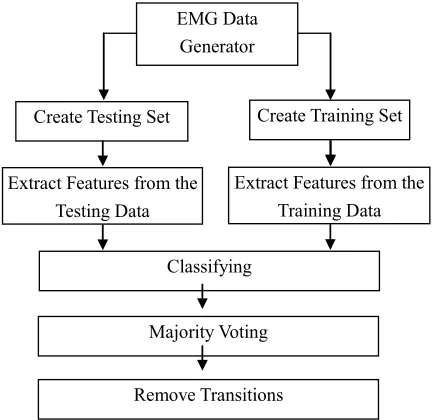
The structure of the implemented system is shown in Fi-
gure 1, which will form a common baseline measure-
ment against other algorithms for comparison.
The process of pattern recognition can be broken down into two main phases: feature extraction and classifica- tion.
Feature extraction refers to the transformation of the input signal into a set of representative signal features. Number of features that are now commonly used for EMG classification; in this paper features that are used are the root mean square and autoregressive coefficients.
Classification maps feature vectors into specific classes, with the mapping function determined using training data. This classification procedure is implemented using LDA classifier, and kNN classifier.
7. EMG Data Generator
The data used in this paper are generated using EMG Si- mulator [9]. These data were simulated from simulation of seven sites on the forearm and one site on the bicep.
Signals are generated using a model constructed to closely resemble the physiology and morphology of ske- letal muscle, combined with line source models of com- monly used needle electrodes positioned in a way consis- tent with clinical studies. The validity of the simulation routines is demonstrated by comparing values of statis- tics calculated from simulated signals with those from clinical EMG studies of normal subjects. The simulated EMG signals are used to explore the relationships be- tween muscle structure and activation and clinically ac- quired EMG signals.
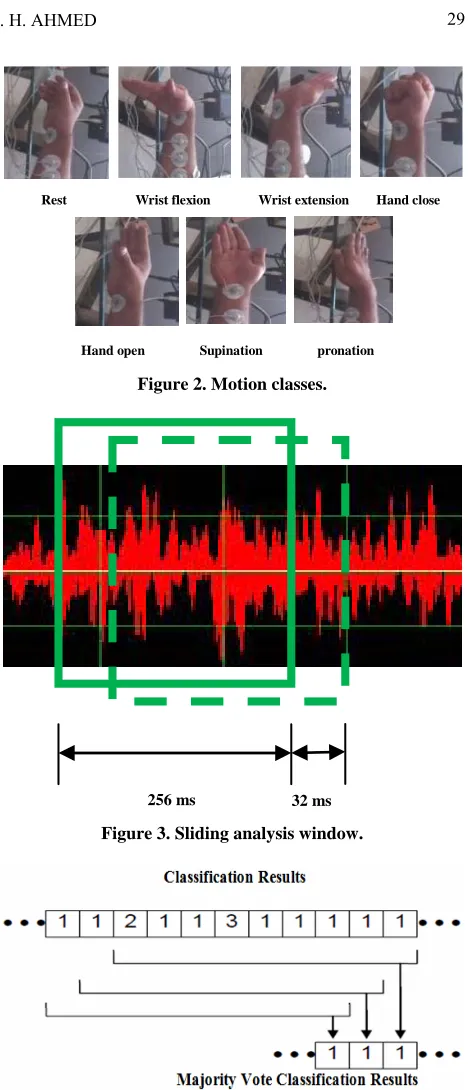
EMG data were simulated as the subject underwent seven distinct limb motions: hand open, hand close, supi- nation, pronation, wrist flexion, wrist extension, and rest, as shown in Figure 2. These data are used to create test-
EMG Data Generator
Create Training Set Create Testing Set
Extract Features from the Training Data Extract Features from the
Testing Data
Classifying
Majority Voting
[image:3.595.315.531.510.720.2]Remove Transitions
ing set and training set.
8. Electromyography Feature Extraction
The first four autoregressive coefficients and the root mean square value were used as the feature vector. The analysis window size was 256 ms, which were spaced 128 ms apart for training data and 32 ms apart for testing data. Data that were 256 ms before or after a change in limb motion were removed from the training set to avoid transitional data.
Rest Wrist flexion Wrist extension Hand close
Hand open Supination pronation
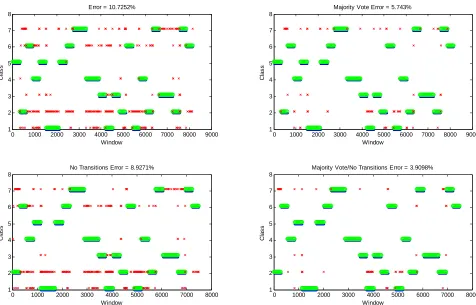
Features are computed from the EMG signals using a sliding analysis window. In this paper the sliding window is depicted in Figure 3, with analysis windows of 256 ms in length, spaced 32 ms apart. A single feature vector is produced from each analysis window.
9. Implemented System Results and
Discussions
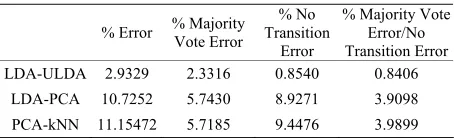
The classification error from the testing data was 2.9329% (with no feature reduction). To improve classification ac- curacy, majority vote post-processing can be employed. The majority vote uses the current classification result, along with the previous classification results (with an analysis window spacing of 32 ms, this corresponds to the classification results within the last 256 ms) and makes a classification decision based on the class that appears most often (Figure 4).
The resulting effect is a smooth operation that removes spurious misclassification. The classification error re- duces to 2.3316% after majority vote post processing.
The errors that are present occur during transitional periods, which are expected as the system is in an unde- termined state between contractions.
If we removed the analysis windows that are 256 ms before and after the transition, the classification error is 0.85402% (i.e. no transitions).
If we combine majority vote post processing with no transition error; the classification error will be 0.84067%. The classification errors from the testing data (with Lin- ear Discriminant Classifier and ULDA Feature Reduc- tion) are shown in Figure 5.
Also the classification errors from the testing data (with Linear Discriminant Classifier and PCA Feature Reduction) are shown in Figure 6.
While the classification errors from the testing data (with k-Nearest Neighbor Classifier and PCA Feature Reduction) are shown in Figure 7.
The classification errors from the testing data are sum- marized in Table 1.
10. Conclusions
[image:4.595.307.541.52.597.2]Results in this paper demonstrate that a relatively simple pattern classification system can achieve high classifica-
Figure 2. Motion classes.
256 ms 32 ms
Figure 3. Sliding analysis window.
Figure 4. Majority vote post-processing.
0 1000 2000 3000 4000 5000 6000 7000 8000 9000 1
2 3 4 5 6 7 8
Window
Cl
as
s
Error = 2.9329%
0 1000 2000 3000 4000 5000 6000 7000 8000 9000 1
2 3 4 5 6 7 8
Window
Cl
as
s
Majority Vote Error = 2.3316%
0 1000 2000 3000 4000 5000 6000 7000 8000 1
2 3 4 5 6 7 8
Window
Cl
as
s
No Transitions Error = 0.85402%
0 1000 2000 3000 4000 5000 6000 7000 8000 1
2 3 4 5 6 7 8
Window
Cl
as
s
[image:5.595.61.539.83.385.2]Majority Vote/No Transitions Error = 0.84067%
Figure 5. Classification errors from the testing data (with Linear Discriminant Classifier and ULDA Feature Reduction).
0 1000 2000 3000 4000 5000 6000 7000 8000 9000
1 2 3 4 5 6 7 8
Window
Cl
a
s
s
Error = 10.7252%
0 1000 2000 3000 4000 5000 6000 7000 8000 9000
1 2 3 4 5 6 7 8
Window
Cl
a
s
s
Majority Vote Error = 5.743%
0 1000 2000 3000 4000 5000 6000 7000 8000
1 2 3 4 5 6 7 8
Window
Cl
a
s
s
No Transitions Error = 8.9271%
0 1000 2000 3000 4000 5000 6000 7000 8000
1 2 3 4 5 6 7 8
Window
Cl
a
s
s
Majority Vote/No Transitions Error = 3.9098%
[image:5.595.59.535.412.717.2]0 5000 10000 0
2 4 6 8
Window
Cl
a
s
s
Error = 11.1547%
0 5000 10000 0
2 4 6 8
Window
Cl
a
s
s
Majority Vote Error = 5.7185%
0 2000 4000 6000 8000 0
2 4 6 8
Window
Cl
a
s
s
No Transitions Error = 9.4476%
0 2000 4000 6000 8000 0
2 4 6 8
Window
Cl
a
s
s
[image:6.595.56.289.84.265.2]Majority Vote/No Transitions Error = 3.9899%
Figure 7. Classification errors from the testing data (with kNN Classifier and PCA Feature Reduction).
Table 1. The classification errors.
% Error % Majority Vote Error
% No Transition
Error
% Majority Vote Error/No Transition Error
LDA-ULDA 2.9329 2.3316 0.8540 0.8406
LDA-PCA 10.7252 5.7430 8.9271 3.9098
PCA-kNN 11.15472 5.7185 9.4476 3.9899
tion (e.g. computation load, power requirements, system robustness).
REFERENCES
[1] M. Z. Al-Faiz, A. A. Miry and A. H. Ali, “A k-Nearest
Neighbor Based Algorithm for Human Arm Movements Recognition Using EMG Signals,” IEEE Proceedings of the 1st International Conference on Energy, Power and
Control (EPC-IQ), Basrah, 30 November-2 December
2010, pp. 159-167.
[2] R. R. Finley and R. W. Wirta, “Myocoder Studies of Mul- tiple Myocoder Response,” Archives of Physical Medi- cine and Rehabilitation, Vol. 48, 1967, pp. 599-601. [3] O. Fukuda, T. Tsuji, M. Kaneko and A. Otsuka, “A Hu-
man-Assisting Manipulator Teleoperated by EMG Sig- nals and Arm Motions,” IEEE Transactions on Robotics and Automation, Vol. 19, No. 2, 2000, pp. 210-222. doi:10.1109/TRA.2003.808873
[4] N. Bu, M. Okamoto and T, Tsuji, “A Hybrid Motion Classification Approach for EMG-Based Human-Robot Interfaces Using Bayesian and Neural Networks,” IEEE Transactions on Robot, Vol. 23, No. 3, 2009, pp. 502-
511.
[5] S. Park and S. Lee, “EMG Pattern Recognition Based on Artificial Intelligence Techniques,” IEEE Transactions on Rehabilitation Engineering, Vol. 6, No. 4, 1998, pp. 400-
405. doi:10.1109/86.736154
[6] K. Fukunaga, “Introduction to Statistical Pattern Recog- nition,” 2nd Edition, Academic Press Professional, Inc., San Diego, 1990.
[7] T. M. Cover and P. E. Hart, “Nearest Neighbor Pattern Classification,” IEEE Transactions on Information The- ory, Vol. IT-13, No. 1, 1967, pp. 21-26.
doi:10.1109/TIT.1967.1053964
[8] A. Cervantes, I. Galvan and P. Isasi, “AMPSO: A New Particle Swarm Method for Nearest Neighborhood Clas- sification,” IEEE Transactions on System, Man and Cy- bernetics, Vol. 39, No. 5, 2009, pp. 1082-1091.
doi:10.1109/TSMCB.2008.2011816
[9] A. Hamilton-Wright and D. W. Stashuk, “Physiologically Based Simulation of Clinical EMG Signals,” IEEE Tran- sactions on Biomedical Engineering, Vol. 52, No. 2, 2005,
[image:6.595.59.286.325.394.2]