
Fast Secure Multiparty ECDSA with Practical
Distributed Key Generation and Applications to
Cryptocurrency Custody
∗Yehuda Lindell† Ariel Nof† Samuel Ranellucci‡
October 14, 2018
Abstract
ECDSA is a standardized signing algorithm that is widely used in TLS, code signing, cryp-tocurrency and more. Due to its importance, the problem of securely computing ECDSA in a distributed manner (known as threshold signing) has received considerable interest. However, despite this interest, there is still no full threshold solution for more than 2 parties (meaning that anyt-out-of-nparties can sign, security is preserved for anyt−1 or fewer corrupted parties, andt ≤ncan be any value thus supporting an honest minority) that haspractical key distri-bution. This is due to the fact that all previous solutions for this utilize Paillier homomorphic encryption, and efficient distributed Paillier key generation for more than two parties is not known.
In this paper, we present the first truly practical full threshold ECDSA signing protocol that has both fast signing and fast key distribution. This solves a years-old open problem, and opens the door to practical uses of threshold ECDSA signing that are in demand today. One of these applications is the construction of secure cryptocurrency wallets (where key shares are spread over multiple devices and so are hard to steal) and cryptocurrency custody solu-tions (where large sums of invested cryptocurrency are strongly protected by splitting the key between a bank/financial institution, the customer who owns the currency, and possibly a third-party trustee, in multiple shares at each). There is growing practical interest in such solutions, but prior to our work these could not be deployed today due to the need for distributed key generation.
1
Introduction
1.1 Background and Prior Work
In the late 1980s and the 1990s, a large body of research emerged around the problem of threshold cryptography; cf. [3,9,11,12,17,34,33,29]. In its most general form, this problem considers the
∗
An extended abstract of this work (by the first two authors) appeared at ACM CCS 2018. This paper includes the full proofs of security, as well as a performance improvement to the Paillier-based private multiplication.
†
Dept. of Computer Science, Bar-Ilan University, Israel. [email protected], [email protected]. Some of this work was carried out for Unbound Tech Ltd. This work was also supported by the European Research Council under the ERC consolidators grant agreement n. 615172 (HIPS), by the BIU Center for Research in Applied Cryptography and Cyber Security in conjunction with the Israel National Cyber Directorate in the Prime Minister’s Office, and by the Alter Family Foundation.
‡
setting of a private key shared betweennparties with the property that any subset oftparties may be able to decrypt or sign, but any set of less thantparties can do nothing. This is a specific example of secure multiparty computation, where the functionality being computed is either decryption or signing. Note that trivial solutions like secret sharing the private key and reconstructing to decrypt or sign do not work since once the key is reconstructed, any single party can decrypt or sign by itself from that point on. Rather, the requirement is that a subset of t parties is needed for every
private-key operation.
Threshold cryptography can be used in applications where multiple signers are needed to gen-erate a signature, and likewise where highly confidential documents should only be decrypted and viewed by a quorum. Furthermore, threshold cryptography can be used to provide a high level of key protection. This is achieved by sharing the key on multiple devices (or between multiple users) and carrying out private-key operations via a secure protocol that reveals nothing but the output. This provides key protection since an adversary needs to breach multiple devices in order to obtain the key. After intensive research on the topic in the 1990s and early 2000s, threshold cryptography received considerably less interest in the past decade. However, interest has recently been renewed. This can be seen by the fact that a number of startup companies are now deploying threshold cryptography for the purpose of key protection [35,36,37]. Another reason is due to the fact that ECDSA signing is used in Bitcoin and other cryptocurrencies, and the theft of a signing key can immediately be translated into concrete financial loss. Bitcoin has a multisignature solution built in, which is based on using multiple distinct signing keys rather than a threshold signing scheme. However, the flexibility of the Bitcoin multisig is limited, not supporting arbitrary and complex ac-cess structures. In addition, plain multisig solutions introduce anonymity and scalability problems (as discussed in [18, Section 6.3]), and do not support revoking a party’s share, which can be a crucial feature in some applications. Thus, a more general solution may be obtained via threshold cryptography.
remains open:
Is it possible to construct a full-threshold protocol for multiparty ECDSA, with practical distributed key generation and signing?
We answer this question in the affirmative.
1.2 Our Results
In this paper, we present the first full threshold ECDSA signing protocol that has practical dis-tributed key generation and fast signing. We achieve this breakthrough by replacing the Paillier additively homomorphic encryption with ElGamal in-the-exponent that also supports additive ho-momorphism. This enables us to compute an encrypted signature in a similar way to that of [18], except that upon decryption the parties are only able to receive s·G (where G is the generator point of the Elliptic curve group) and not sitself, where sis the desired portion of the signature. This is due to the fact that we use ElGamal “in the exponent” and so we only obtain the result “in the exponent”.1 We overcome this by computing the signature value sin parallel using a method that guarantees privacy but not correctness. The combination of the above yields a secure solution since the encrypted signature is verified and so s-in-the-clear is only revealed once equality with the encrypted signature is validated.
The above method has many significant advantages over using Paillier. First, we do not need distributed key generation of Paillier keys which is hard, but just distributed key generation of ElGamal keys which is very easy. Second, Elliptic curve operations themselves are far more efficient than Paillier operations. Third, zero-knowledge proofs that are very expensive in Paillier are far more efficient in the Elliptic curve group (it is well known that zero-knowledge is easier in known-order groups). Fourth, by working in the same Elliptic curve group as the signature, all homomorphic operations are automatically modulo the required group order q. This removes many of the difficulties in using Paillier, that required adding randomness to enable effectively working over the integers, and then proving in zero-knowledge that the “correct amount” was added. Another issue that arises when securely computing ECDSA is how to force the parties to use the correctk−1. We use a similar method as that of [18] which is to multiplicative maskkwith a random valueρ, and then to revealk·ρ. This enables each party to locally invert and obtaink−1·ρ−1 which can be used in generating the signature. Once again, by working within ElGamal and not Paillier, we can achieve this far more efficiently than [18] and without the expensive Paillier-based zero-knowledge proofs that they require.
We remark that our entire protocol works over any group, and thus can be used to securely compute DSA in exactly the same way.
1.3 Cryptocurrency Wallets and Custody
As mentioned above, one important application of our protocol in practice today is in the protection of cryptocurrency. Although there are differing opinions on the benefit of existing cryptocurrencies
1
to society, it is well accepted that honest investors should be protected from mass theft that we are already seeing in this space. On the end user side, a secure cryptocurrency wallet should enable the user to split their signing key amongst multiple devices, and require all (or a subset) in order to transfer money. On the financial institution side, there is real interest in banks and other institutions to offer full cryptocurrency custody solutions to large customers. Such a solution is intended for use by investors who wish to protect very large amounts of cryptocurrency (even in the billions) as part of their investment portfolio. Due to the high amount of funds involved, it is not possible to enable any single party to have access to the signing key. Furthermore, neither the bank nor the customer should have the ability to singlehandedly transfer funds (the bank cannot due to liability, and the customer cannot due to the fact that its systems are typically less secure than the bank). Thus, a natural solution is to split the signing key into multiple parts, both in the bank and the customer (and potentially an additional third trustee) and then require some threshold in each entity to sign.2 A full-blown solution for this will typically have different roles both at the bank and the customer (one set of parties would authorize the signature itself as being requested from the customer, another would verify that the transfer meets the agreed-upon policy, and so on). Thus, such solutions require complex access structures for signing. We discuss this in more detail in Section5.4and show that our protocol fully supports these requirements. Thus, our protocol provides the first real solution for this problem that is of very practical relevance today.
1.4 Concurrent Work
Concurrently to this work, [19] also present a multiparty ECDSA protocol with practical key gen-eration. The protocols have some similarity, but the methods used to prevent adversarial behavior are very different. One significant difference between the two results is the hardness assumption and security model. We prove that our protocol is secure under simulation-based definitions, show-ing that it securely computes a standard ideal functionality for ECDSA. In addition, we prove the security of our protocol under the standard assumptions that the DDH problem is hard and that Paillier encryption is indistinguishable. In contrast, [19] prove the security of their protocol under a game-based definition, and require DDH as well as an ad-hoc but plausible assumption called Paillier-EC (first introduced in [28]).
2
Preliminaries
We denote the security parameter by κ and the number of parties by n. We denote by [n] the set
{1, . . . , n}.
2.1 The ECDSA Signing Algorithm
The ECDSA signing algorithm is defined as follows. Let G be an Elliptic curve group of order q
with base point (generator) G. The private key is a random value x ← Zq and the public key is Q=x·G. ECDSA signing on a message m∈ {0,1}∗ is defined as follows:
1. Compute m0 to be the|q|leftmost bits of SHA256(m), where |q|is the bit-length ofq. Denote this operation by Hq(m).
2
2. Choose a random k←Z∗
q
3. Compute R←k·G. LetR= (rx, ry).
4. Compute r=rxmodq ands←k−1·(m0+r·x) modq.
5. Output (r, s)
It is a well-known fact that for every valid signature (r, s), the pair (r,−s) is also a valid signature. In order to make (r, s) unique (which will help in formalizing security), we mandate that the “smaller” of {s,−s} is always output (where the smaller is the value between 0 and q−12 ). We denote (r, s)←Sign(x, m) to be the signing algorithm, andVerify(Q, m,(r, s)) to be the verification procedure (that outputs 0 for “invalid” and 1 for “valid”).
2.2 ElGamal in the Exponent
Let Gdenote a group of orderq where the DDH assumption is assumed to be hard, and let Gbe
a generator of the group. We will use addition as the group operation, upper-case characters for group elements, and lower-case characters for scalars in Zq. This is consistent with Elliptic curve notation, although all of our protocols work equivalently in finite field groups.
We utilize ElGamal decryption “in the exponent”. An encryption of a valuem∈Zqwith public key P ∈Gis denoted EGexpEncP(m), and is formally defined by
EGexpEncP(m) = (A, B) = (r·G, r· P+m·G),
wherer←Zqis random. When we wish to specify the randomness in the encryption, we denote the above byEGexpEncP(m;r). Note thatm isnot actually in the exponent here, but this is the name used since when using multiplicative group notation (as in finite fields), a ciphertext is (gr, hr·gm), in which case mis in the exponent.
Observe that this encryption is additively homomorphic. Specifically, two ciphertexts (A, B) and (C, D) can be added by computing (A+C, B+D). If (A, B) = (r·G, r·P+m·G) and (C, D) = (s·G, s·P+m0·G) then (A+C, B+D) = ((r+s)·G,(r+s)·P+(m+m0)·G) =EGexpEncP(m+m0). In addition, multiplication of a ciphertext (A, B) = (r·G, r· P+m·G) by a scalarc is computed by (c·A, c·B) = ((c·r)·G,(c·r)· P+ (c·m)·G) =EGexpEnc(c·m). This can be combined with rerandomization by computing (c·A+s·G, c·B+s·P) = ((c·r+s)·G,(c·r+s)· P+ (c·m0)·G), which is a “fresh” random encryption of c·m0. We stress that ElGamal in-the-exponent is not a valid encryption scheme since decryption requires solving the discrete log problem. In particular, given dwhere P =d·Gand EGexpEncP(m), it is possible to efficiently compute m·G. The next step of computingm requires solving the discrete log, and so can only be achieved ifmis relatively small.
2.3 Private Multiplication
Our protocol for secure multiplication utilizes a subprotocol πmultpriv that computes the product of additive shares withprivacy butnot correctness. Specifically, we consider the multiplication func-tionality defined by f((a1, b1), . . . ,(an, bn)) = (c1, . . . , cn), where the output values c1, . . . , cn are random under the constraint that Pn
adversaries; this means that the adversary cannot learn anything more than allowed, but correct-ness is not guaranteed. This is actually problematic to define, since the adversary receives output, and thus saying that it learns nothing more than allowed would typically require an ideal-model type of definition. However, since the outputs of the parties are random inZq under the constraint, nothing is revealed unless the shares are reconstructed. We therefore require the following two properties (let I ⊆ [n] denote the set of corrupted parties and let J = [n]\I denote the set of honest parties):
1. Privacy: For any probabilistic polynomial-time adversary malicious A running the protocol, and any two sets of inputs {(aj, bj)}j∈J and {(a0j, b0j)}j∈J for the honest parties, the view of A (including its input, randomness, message transcript and output shares{ci}i∈I) when executing the protocol with honest parties using inputs {(aj, bj)}j∈J is computationally indistinguishable from its view when executing the protocol with honest parties using inputs{(a0j, b0j)}j∈J.
2. Input indistinguishability: Define an implicit-input function on the views of all parties in the execution; this function outputs the implicit inputs of the adversary so that the output of the protocol is the function being computed applied to these implicit adversary inputs and the honest parties’ inputs. Then, input indistinguishability requires that for any probabilistic polynomial-time adversary malicious Arunning the protocol, and any two sets of inputs {(aj, bj)}j∈J and
{(a0j, b0j)}j∈J for the honest parties, if the output of the function applied toA’s implicit inputs and
{(aj, bj)}j∈J equals the output of the function applied to A’s implicit inputs and{(a0j, b0j)}j∈J, thenA’s view is indistinguishable even givenc1, . . . , cn. This notion was formally defined in [30] in order to achieve concurrent security, but can also be applied to other settings.
Observe that the first property mandates privacy irrespective of what inputs are used by the parties and irrespective ofA’s strategy. However, this only holds as long as the shares are not reconstructed to obtainPn
`=1c`, since indistinguishability is trivially impossible in such a case. Thus, the second property guarantees that if two sets of inputs result in the same output, then the views of A
even given Pn
`=1c` are indistinguishable. Thus, as long as the output is only reconstructed when the output is correct, the protocol guarantees full privacy. Our protocol for secure multiplication (used to compute ECDSA) will ensure this exact property; the output of the private multiplication is securely verified against encrypted and validated values, and the result is only revealed if it is correct. We stress that we require input indistinguishability of multiplication for the result of the multiplicationmoduloq.
We show how private multiplication can be instantiated in Section 6. One instantiation is based on oblivious transfer and has low computation cost but higher bandwidth, while our second instantiation is based on Paillier encryption and has higher computation cost but much lower bandwidth.
3
Definition of Security
3.1 The ECDSA Ideal Functionality
FUNCTIONALITY 3.1 (The ECDSA FunctionalityFecdsa)
FunctionalityFecdsaworks with partiesP1, . . . , Pn, as follows:
• Upon receivingKeyGen(G, G, q) from all partiesP1, . . . , Pn, whereGis an Elliptic-curve group
of orderqwith generatorG:
1. Generate an ECDSA key pair (Q, x) by choosing a random x ← Z∗
q and computing
Q=x·G. Then, store (G, G, q, x).
2. SendQto allP1, . . . , Pn.
3. Ignore future calls toKeyGen.
• Upon receivingSign(sid, m) from all P1, . . . , Pn, ifKeyGen was already called andsidhas not been previously used, compute an ECDSA signature (r, s) onm, and send it to allP1, . . . , Pn. (Specifically, choose a random k ← Z∗q, compute (rx, ry) = k·G, r = rxmodq, and s0 ←
k−1(Hq(m) +r·x). Then, set s = min{s0, q −s0} so that the signature (r, s) always has
s < q/2.)
We definedFecdsausing Elliptic curve (additive) group notation, although all of our protocols work forany prime-order group.
3.2 Security Model
Security in the presence of malicious adversaries. We prove security according to the stan-dard simulation paradigm with the real/ideal model [5,23], in the presence ofmalicious adversaries
andstatic corruptions. As is standard for the case of no honest majority, we consider security with abort meaning that a corrupted party can learn output while the honest party does not. In our definition of functionalities, we describe the instructions of the trusted party. Since we consider se-curity with abort, the ideal-model adversary receives output first and then sends either (continue, j) or (abort, j) to the trusted party, for every j ∈ [n] to instruct the trusted party to either deliver the output to partyPj (in case of continue) or to send abortto party Pj. This means that honest parties either receive the correct output or abort, but some honest parties may receive output while others abort. This was termednon-unanimous abort in [24]. As described in Section5(after Protocol5.1), in this case of secure signing, it is easy to transform the protocol so that all parties receive output if any single honest party received output.
We remark that when all of the zero-knowledge proofs are UC secure [6], then our protocol can also be proven secure in this framework.
3.3 Ideal Functionalities
As in [28] and [13], we prove the security of our protocol using the ideal zero-knowledge functionality, denotedFzk, and an ideal commit-and-prove functionality, denotedFcom-zk. In practice, these proofs are instantiated using Fiat-Shamir on highly efficient Sigma protocols. In this section, we define these ideal functionalities, and the relations for the zero-knowledge proofs.
The ideal commitment functionality Fcom. In order to realize Fcom-zk defined below, we use an ideal commitment functionality Fcom, formally defined in Functionality 3.2. Any UC-secure commitment scheme fulfills Fcom; e.g., [27, 1, 16]. In the random-oracle model, Fcom can be trivially realized with static security by simply defining Com(x) = H(x, r) where r ← {0,1}κ is random, and sending Com(x) to all parties. Since Fcom is defined so that all parties receive the same commitment, the value Com(x) needs to be broadcasted. However, as shown in [24], a simple echo-broadcast suffices here for the case of non-unanimous abort (this takes two rounds of communication). In order to ensure this, the parties send a hash of all the commitments that they received in the round after the commitments were sent. If any two parties received different commitments, then they notify all parties to abort and then halt. This adds very little complexity and ensures the same view for any committed values.
FUNCTIONALITY 3.2 (The Commitment Functionality Fcom)
FunctionalityFcom works with partiesP1, . . . , Pn, as follows:
• Upon receiving (commit, sid, i, x) from party Pi (for i ∈ [n]), record (sid, i, x) and send (receipt, sid, i) to allP1, . . . , Pn. If some (commit, sid, i,∗) is already stored, then ignore the message.
• Upon receiving (decommit, sid, i) from party Pi, if (sid, i, x) is recorded then send (decommit, sid, i, x) to partyP1, . . . , Pn.
The ideal zero knowledge functionalityFzk. We use the standard ideal zero-knowledge func-tionality defined by ((x, w), λ)→(λ,(x, R(x, w))), whereλdenotes the empty string. For a relation R, the functionality is denoted byFR
zk. Note that any zero-knowledge proof of knowledge fulfills the
Fzk functionality [25, Section 6.5.3]; non-interactive versions can be achieved in the random-oracle model via the Fiat-Shamir paradigm; see Functionality3.3 for the formal definition.
FUNCTIONALITY 3.3 (The Zero-Knowledge Functionality FR
zk for Relation R)
Upon receiving (prove, sid, i, x, w) from a partyPi (fori∈ [n]): ifsid has been previously used then ignore the message. Otherwise, send (proof, sid, i, x, R(x, w)) to all partiesP1, . . . , Pn, where
R(x, w) = 1 iff (x, w)∈R.
1. Knowledge of the discrete log of an Elliptic-curve point: Define the relation
RDL ={(G, G, q,P, w)| P =w·G}
of discrete log values (relative to the given group). We use the standard Schnorr proof for this [32]. The cost of this proof is one exponentiation for the prover and two for the verifier, and communication cost of two elements of Zq.
2. Diffie-Hellman tuple of Elliptic-curve points: Define the relation
RDH ={(G, G, q,(A, B, C), w)|B =w·G ∧ C =w·A}
of Diffie-Hellman tuples (relative to the given group). We use the well-known proof that is an extension of Schnorr’s proof for discrete log. The cost of this proof is two exponentiations for the prover and four for the verifier, and communication cost of two elements of Zq.
3. Rerandomization of tuple: Define the rerandomization relation
RRE ={(G, G, q,(P, A, B, A0, B0),(r, s))|A0 =r·G+s·A ∧ B0 =r· P+s·B}.
Observe that if (G,P, A, B) is a Diffie-Hellman tuple, then (G,P, A0, B0) is a uniformly dis-tributed and independent Diffie-Hellman tuple (with the sameG,P). In contrast, if (G,P, A, B)
is not a Diffie-Hellman tuple, thenA0, B0 are uniform and independent random group elements. See Eq. Eq. (1) in the proof of Theorem B.1 for a proof of this fact. The Sigma protocol for this relation is described in Appendix A.1; the cost of this proof is four exponentiations for the prover and six for the verifier, and communication cost of three elements ofZq.
4. Knowledge of x in EGexpEncP(x): we define the relation
REG={((G, G, q,P, A, B),(x;r))|(A, B) =EGexpEncP(x;r)}
of the encrypted value in an ElGamal encryption-in-the-exponent ciphertext. Note that this is very different from knowing a regular ElGamal plaintext since herex is “in the exponent”, and the knowledge extractor must be able to extractxitself (and not justx·G). The Sigma protocol for this relation is described in AppendixA.2; the cost of the proof is three exponentiations for the prover and five for the verifier, and communication cost of three elements of Zq.
5. Scalar product with encrypted values: we define the relation
Rprod={((G, G, q,P, A, B, C, D, E, F),(t, r, y))|
(C, D) =EGexpEncP(y;t) ∧ E =y·A+r·G ∧ F =y·B+r· P}
which means that (E, F) is generated by multiplying (A, B) by the scalarywhich is encrypted-in-the-exponent in (C, D), and then rerandomizing the result. The Sigma protocol for this relation is described in Appendix A.3; the cost of this proof is eleven exponentiations for the prover and twelve for the verifier, and communication cost of six elements of Zq.
For clarity, we remove the (G, G, q) part from the input to the zero-knowledge proofs below, with
The committed non-interactive zero knowledge functionalityFcom-zk. In our protocol, we will have parties send commitments to a statement together with a non-interactive zero-knowledge proof of the statement. As in [28], we model this formally via a commit-zk functionality, denoted
Fcom-zk, defined in Functionality 3.4. Given non-interactive zero-knowledge proofs of knowledge, this functionality is securely realized by just having the prover commit to the statement together with its proof, using the ideal commitment functionalityFcom. As inFcom, consistency of views is validated by all parties sending a hash of the commitments that they received.
FUNCTIONALITY 3.4 (The Committed NIZK Functionality FR
com-zk for RelationR)
FunctionalityFcom-zk works with partiesP1, . . . , Pn, as follows:
• Upon receiving (ComProve, sid, i, x, w) from a partyPi (fori∈[n]): ifsidhas been previously used then ignore the message. Otherwise, store (sid, i, x) and send (ProofReceipt, sid, i) to
P1, . . . , Pn.
• Upon receiving (DecomProof, sid) from a party Pi (fori ∈ [n]): if (sid, i, x) has been stored then send (DecomProof, sid, i, x, R(x, w)) toP1, . . . , Pn.
4
Secure Multiplication –
F
mult4.1 Functionality Definition
A basic multiplication functionality (from additive shares) can be defined by having each partyPi provide ai and bi for input, and then returning ci to partyPi, where c1, . . . , cn are random under the constraint that Pn
`=1c`= (
Pn
`=1a`)·(
Pn
`=1b`) modq
We will actually need an extended version of this multiplication functionality, where the value a·G is also returned to the parties, where a = Pn
`=1a` ((G, G, q) denotes the description of a group of orderq, with generator G). Although this looks “out of place”, this additional value can be computed efficiently while computing Fmult. For this reason, we combine them together. In addition, in our protocol, we need to enable multiplication with the same value more than once. This is achieved by having an “input” command, and then enabling multiplications between inputs. Finally, we define the functionality for random input shares only for the honest parties, whereas corrupted parties can choose their own shares.3 This is needed in our proof of security (see Game 2 in the proof of Theorem B.1) and is anyway the way the functionality is used in order to securely compute ECDSA. Finally, we add a local affine transformation on an encrypted/shared input, that is needed for computing ECDSA. This is a local operation only, and so is formalized by the honest parties providing these values. See Functionality 4.1 for the specification of Fmult that we use in our protocol.
Observe that Fmult as described here is not a “standard” multiplication functionality and is tailored to what we need for securely computing Fecdsa. Arguably, as such, one should call it an ECDSA helper functionality. However, since it’s main operation (and most difficult one) is multiplications, we call itextended multiplication.
3As such, the functionality is “corruption aware”, meaning that it behaves differently for honest parties and
FUNCTIONALITY 4.1 (The Extended Multiplication Functionality Fmult)
The functionality Fmult is given the set of indices of corrupted parties C ⊆[n], and works with
partiesP1, . . . , Pn as follows:
• Upon receiving (init,G, G, q) from all parties, Fmult stores (G, G, q). If some (G, G, q) has
already been stored, then ignore the message.
• Upon receiving (input, sid, ai) from a partyPi withi∈ C, if no value (sid, i,·) value is stored, thenFmult stores (sid, i, ai). Else, the message is ignored.
• Upon receiving (input, sid) from a partyPiwithi /∈ C, if no value (sid, i,·) value is stored, then
Fmult chooses a randomai ←Zq, returns (input, sid, ai) toPi, and stores (sid, i, ai). Else, the message is ignored.
• If some (sid, i, ai) has been stored for alli∈[n] thenFmultcomputesa=P
n
`=1a`modq, stores (sid, a) and sends (input, sid) to all parties.
• Upon receiving (mult, sid1, sid2) from all parties,Fmult checks that some (sid1, a) and (sid2, b)
values have been stored. If yes, thenFmultsetsc=a·bmodqand sends (mult-out, sid1, sid2, c)
to all parties.
• Upon receiving (affine, sid1, sid2, x, y) from the honest parties with x, y ∈ Zq, functionality
Fmult checks that some (sid1, a) has been stored. If yes, Fmult computesb=a·x+ymodq,
stores (sid2, b), and sends (affine, sid1, sid2, x, y) toA.
• Upon receiving (element-out, sid) from all parties, functionalityFmult checks that some (sid, a)
has been stored. If yes,FmultcomputesA=a·Gand sends (element-out, sid, A) to all parties.
In addition,FmultsendsA1, . . . , Anto the ideal adversary, whereAi=ai·G(withaias received ininputforsid).
4.2 Checking Diffie-Hellman Tuples
In order to securely compute Fmult, one step involves the parties securely checking that a tuple (G,P, U, V) is a Diffie-Hellman tuple or not. As part of the initialization of Fmult, each party has a share di such that P = d·G, with d = Pn`=1d`. Thus, (G,P, U, V) is a Diffie-Hellman tuple if and only if V = d·U. This can be verified by the parties each sending Ui = di ·U to each other, and then all parties simply check that V =Pn
`=1Ui. However, this will not be secure since we require that nothing be learned if the input is not a Diffie-Hellman tuple, and Pn
`=1Ui reveals the value T such that (G,P, U, V −T) is a Diffie-Hellman tuple. Thus, the parties first each rerandomize the tuple and then continue as above. This is rather standard, and the full specification is therefore deferred to Section7. We remark that as part of the protocol, the parties need to verify values usingP1, . . . ,Pn such thatPi =di·Gfor everyi∈[n]. (In our multiplication protocol, these values are learned in the initialization phase.) We define the ideal functionality
FUNCTIONALITY 4.2 (FcheckDH - Check DH Tuple)
FcheckDHruns with partiesP1, . . . , Pn, as follows:
1. Upon receiving (init, i,Pi, di) from partyPi,FcheckDH verifies thatPi=di·G. If not, it sends abortto all parties. Otherwise, it stores{P1, . . . ,Pn} and sends{P1, . . . ,Pn}to all parties.
2. Upon receiving (check, i, U, V, di) from partyPi for everyi∈[n], FcheckDH verifies that Pi=
di·Gfor all i ∈ [n] and that V = d·U where d= P n
`=1d`modq. If all conditions were satisfied,FcheckDH sendsacceptto all the parties. Otherwise, it sendsreject to all parties.
4.3 Securely Computing Fmult
We describe separate subprotocols for init,input,element-out,affineand mult. We remark thatinit
must be called first, and all other calls toFmultare ignored untilinitis completed. In our description of the protocol, each round is structured as follows: (a) each party receives the messages sent by the other parties and/or ideal functionalities in the previous round,(b)each party carries out local computation, and (c) each party sends the messages from this round to other parties and/or to ideal functionalities.
Init: Theinitprocedure is used to generate an ElGamal (in-the-exponent) public keyP, with each party holding shares d1, . . . , dn of the private key (meaning that Pn`=1d` = d where P = d·G). In addition to each party storing its share di of the private key, and the public key P, the parties also store all values P1, . . . ,Pn where Pi =di·G. These latter values are used inside the protocol forFcheckDH in order to enforce the parties to use their correct value di. Specifically, if a party is supposed to compute Y =di·X for some value X, then it can prove that it behaved honestly by proving that (G, X,Pi, Y) is a Diffie-Hellman tuple (sincePi =di·G and Y =di·X). Thus, the parties need to have stored Pi.
The protocol for init is basically a type of simulatable coin tossing. In the first round, each party generates a value Pi =di·G and prepares a zero-knowledge proof of knowledge of di, and commits to the value and proof. Then, in the second round, the parties decommit. Finally,P is set to be the sum of allPi. This is simulatable in the ideal commitment hybrid model using standard simulation techniques. See Protocol4.3 for a full specification.
Input: The input procedure is used to generate an ElGamal in-the-exponent encryption of a=
Pn
PROTOCOL 4.3 (Initialization Subprotocol of Fmult)
Upon joint input (init,G, G, q), number of partiesn, and a unique session identifiersid, the parties run any initialization steps needed forπprivmult(e.g., base oblivious transfers). In parallel, each party
Pi works as follows:
1. Round 1: Party Pi chooses a random di ← Zq, and computes Pi =di·G. Then, Pi sends (ComProve, init, i,Pi, di) toFcomRDL-zk(i.e.,Pisends a commitment toPiand a POK of its discrete log).
2. Round 2: Upon receiving (ProofReceipt, init, j) fromFRDL
com-zk for everyj ∈[n], party Pi sends (DecomProof, init, i) toFRDL
com-zk. In addition,Pi sends (init, i,Pi, di) toFcheckDH.
3. Output: Pireceives (DecomProof, init, j,Pj, βj) fromFcomRDL-zk for every j∈[n], and receives (P1, . . . ,Pn) from FcheckDH. If some βj = 0 (meaning that a proof is not valid), or the
Pj values received from FcomRDL-zk do not match thePj values received from FcheckDH then it
aborts. Otherwise, Pi locally computes the ElGamal public-key P =Pn`=1P` and stores (di,P,{P`}n`=1).
PROTOCOL 4.4 (Input Subprotocol of Fmult)
Upon input (input, sid, ai) toPi for alli∈[n], each partyPi works as follows:
1. Round 1: Pi chooses a randomsi←Zq and computes (Ui, Vi) =EGexpEncP(ai;si). Then,Pi sends (proof, sid, i,(P, Ui, Vi),(ai, si)) toFzkREG.
2. Output: Pi receives (proof, sid, j,(P, Uj, Vj), βj) from FzkREG, for everyj ∈[n]\{i}. If some βj = 0, thenPi aborts. Otherwise,Pi computesU =P
n
`=1U`andV =P n
`=1V` and stores (sid,(U, V), ai, si,{(U`, V`)}n`=1).
Pi outputs (input, sid).
In the point-to-point model, it is necessary for the parties to ensure that they all received the same input. This is achieved by sending hashes of all received ciphertexts (U1, V1), . . . ,(Un, Vn) after receiving output. This can be done in parallel to the continuation of the protocol, and we therefore do not add it as a separate round.
PROTOCOL 4.5 (Element-Out Subprotocol of Fmult)
Upon input (element-out, sid), ifPi has some (sid,(U, V), ai, si,{(U`, V`)}n`=1) stored, then it
pro-ceeds as follows (otherwise it ignores the input):
1. Round 1: Pi computes Ai = ai ·G, and sends Ai to Pj for all j ∈ [n]\ {i}, and sends (proof, sid, i,(G,P, Ui, Vi−Ai), si) toFzkRDH.
2. Output: Pireceives (proof, sid, j,(G,P, Uj, Vj−Aj), βj) fromFzkRDH, for allj∈[n]\{i}. If some βj = 0, then Pi aborts. Otherwise, Pi computesA =P
n
`=1A`. Then, Pi outputs (element-out, sid, A).
Affine: Theaffineprocedure merely involves scalar multiplication and scalar addition to a given ciphertext. Since ElGamal in-the-exponent is additively homomorphic, these operations can be easily carried out on any value that was input. We remark that since the parties store their local shares and randomness in all input values, and the encryptions of all the parties’ shares, these must also be adjusted. However, this is also straightforward using the same homomorphic operations. See Protocol4.6 for a full specification.
PROTOCOL 4.6 (Affine Subprotocol of Fmult)
Upon input (affine, sid1, sid2, x, y), if Pi has some (sid1,(U, V), ai, si,{(U`, V`)}n`=1) stored and sid2has not yet been used, then it proceeds as follows (otherwise it ignores the input):
1. Pi locally computesU0=x·U andV0 =x·V +y·G, for all`∈[n] it computesU`0 =x·U` andV`0=x·V`+yn·G. Then,Pi stores sid2,(U0, V0), ai·x+ny, x·si,{(U`0, V`0)}n`=1
.
private information of the honest parties. This therefore requires a method of verifying equality without revealing anything.
PROTOCOL 4.7 (Mult Subprotocol of Fmult)
Upon input (mult, sid1, sid2), if Pi has some (sid1,(U, V), ai, si,{(U`, V`)}n`=1) and some
(sid2,(X, Y), bi, ti,{(X`, Y`)}n`=1) stored, then it definessid=sid1ksid2 and proceeds as follows
(otherwise it ignores the input):
0. In parallel to the below, the parties run a private multiplication protocolπprivmult. PartyPiinputs (ai, bi); denote Pi’s output byci. (In fact, this can even be run in parallel to (input, sid1, ai) and/or (input, sid2, bi).)
1. Round 1:
(a) Pi chooses a randoms0i and computes
(Ei, Fi) = (ai·X+si0·G, ai·Y +s0i· P).
(b) Pi sends(proof, sid, i,(P, X, Y, Ui, Vi, Ei, Fi),(si, s0i, ai))to F
Rprod
zk , and sends (Ei, Fi) to all parties.
2. Round 2:
(a) Pi receives (proof, sid, j,(P, X, Y, Uj, Vj, Ej, Fj), βj) from F Rprod
zk , for all j ∈[n]\{i}. If someβj= 0 (meaning that a proof is not valid), then it aborts.
(b) Pi sets (E, F) = (P n
`=1E`,P n `=1F`).
(c) Pi chooses a random ˆsi←Zq and computes (Ai, Bi) =EGexpEncP(ci; ˆsi), whereci is its output fromπmultpriv.
(d) Pi sends (proof, sid, i,(P, Ai, Bi),(ci,sˆi)) toFzkREG, and sends (Ai, Bi) to all parties.
3. Round 3:
(a) Pi receives (proof, sid, j,(P, Aj, Bj), βj0) from F REG
zk , and (Aj, Bj) from Pj, for every
j∈[n]\{i}. If some βj0 = 0, thenPiaborts.
(b) Pi computesA=E−P n
`=1A` andB=F−P n `=1B`. (c) Pi sends (check, i, A, B, di) toFcheckDH.
4. Round 4:
(a) If Pi receivesrejectfrom FcheckDH, then it aborts.
(b) Pi sends (proof, sid, i,(P, Ai, Bi−ci·G),sˆi) toFzkRDH, and sends ci to all parties.
5. Output: Pireceives (proof, sid, j,(P, Aj, Bj−cj·G), β00j) fromF RDH
zk , andcj fromPj, for every
j∈[n]\{i}. If some βj00= 0 (wherePi verifies the proof using thecj value received here, and
Aj, Bj from Step3a), thenPiaborts. Otherwise,Picomputesc=Pn`=1c`modqand outputs
c.
tuple. Thus, the parties run a subprotocol that checks if a tuple is a Diffie-Hellman tuple without revealinganything else. Informally, this is achieved by each party rerandomizing the tuple so that if it is a Diffie-Hellman then it remains one, but if it is not then it becomes purely random. This subprotocol is formalized in the FcheckDH functionality and presented in Section 7. Finally, if the check passes, then the parties can sendcito each other, sum the result and output it. Of course, this last step must also be verified, but this is easy to do since the parties already provided encryptions ofci in order to check the result, and they can therefore prove that theci provided is the one that they previously encrypted.
The full proof of security of Protocols 4.3–4.7 is presented in Appendix B and follows the intuition given above.
5
Securely Computing ECDSA
In this section, we present our protocol for distributed ECDSA signing. We separately describe the key generation phase (which is run once) and the signing phase (which is run multiple times). In the description of the protocol, we denote byPi the party carrying out the instructions, by Pj the other parties, and we use` as a running index from 1 ton.
5.1 The Protocol for Fecdsa
GivenFmult, it is very easy to construct a protocol for securely computingFecdsa. In particular,
Fmult provides the ability to securely multiply values together. Thus, it is possible for the parties to choose random xi, ki values (to define x =Pn`=1xi and k= Pn`=1ki) and use Fmult to obtain R=k·G(using element-out), to computeH(m) +r·xmodq using affine, and finally to multiply this withkto obtain k·(H(m) +r·x) modq. (Note that all operations are modulo q already and so all computations are correct.) However, this is not the computation needed! Rather, ECDSA signing requires computing k−1·(H(m) +r·x), with k-inverse. Note that Fmult does not enable securely inverting an element that was input, and this is not an operation that is typically efficient in MPC. We overcome this problem by having the parties input an addition random masking
element ρ and then use mult to reveal τ = ρ·k. Given this value in the clear, each party can locally compute τ−1 =ρ−1·k−1. In addition, the parties can use mult a second time to compute β =ρ·(H(m) +r·x). The key observation is that the product of these values β and τ−1 (which party can locally compute) is exactlyρ−1·k−1·ρ·(H(m) +r·x) =k−1·(H(m) +r·x) which is the s-part of a valid signature. By using Fmult, all of the above operations are guaranteed to be correct, and so the adversary cannot cheat. In addition, sinceρis random, the valuesτ andβreveal nothing more than the signature; as we will show, they are random values under the constraint that βτ equals the valid signature. This can therefore be simulated.
We remark that key generation here merely involves running init forFmultand input for values x1, . . . , xnin order to define a randomxthat is the ECDSA private key. By callingelement-out, the parties also obtainQ=x·Gwhich is the ECDSA public key. As such, distributed key generation is very efficient, and scales easily to a large number of parties.
PROTOCOL 5.1 (Securely ComputingFecdsa)
Auxiliary input: Each party has the description (G, G, q) of a group, and the number of parties
n.
Key generation: Upon inputKeyGen(G, G, q), each partyPi works as follows:
1. Pi sends (init,G, G, q) toFmultto run the initialization phase.
2. Pi sends (input, sidgen) to Fmult, and receives back (input, sidgen, xi). (Denote x =P n `=1x` andQ=x·G.)
3. Pi waits to receive (input,0) toFmult.
4. Pi sends (element-out,0) toFmult.
5. Pi receives (element-out,0, Q) fromFmult.
6. Output: Pilocally storesQas the ECDSA public-key.
Signing: Upon inputSign(sid, m), wheresidis a unique session idsid, each partyPi works as follows:
1. Pi sends (input, sidk1) and (input, sidk2) to Fmult, and receives back (input, sidk1, ki) and (input, sidk2, ρi). (Denotek=P
n
`=1k` andρ=P n `=1ρ`.)
2. After receiving (input, sidk1) and (input, sidk2) from Fmult, Pi sends (mult, sidk1, sidk2) and (element-out, sidk1) toFmult.
3. Pireceives (mult-out, sidk1, sidk2, τ) and (element-out, sidk1, R) fromFmult(note thatτ=k·ρ
andR=k·G).
4. Pi computesR= (rx, ry) andr=rxmodq.
5. Pi sends (affine,0, sidk3, r, m0) to Fmult (recall that identifier 0 is associated with the
private-keyx, and thussidk3 will be associated withm0+x·rmodq).
6. Pi sends (mult, sidk2, sidk3) toFmult.
7. Pi receives (mult-out, sidk2, sidk3, β) fromFmult (note thatβ =ρ·(m0+x·r) modq).
8. Pi computess0=τ−1·βmodqands= min{s, q−s}.
9. Output: Pioutputs (r, s).
Output to all parties. As we have described above, our protocol as described is not secure with unanimous abort, since some honest parties may abort while others receive output. However, in this case of ECDSA signing, it is easy to transform the protocol so that if one honest party receives output then so do all. This is achieved by having any party who receives (r, s) as output send it to all other parties. Then, if a party who otherwise aborted receives (r, s), it can check that (r, s) is a valid signature on m and output it if yes.
Correctness. In order to validate correctness, observe that τ is the product of k=Pn
`=1ki and ρ =Pn
`=1ρi, and thatβ is the product of the same ρ with α=Pn`=1αi. Furthermore,R =k·G for the same k as above. Given the above, and noting that αi = m
0
n +xi ·r, it follows that s0 =τ−1·β = k−1·ρ−1·ρ·α =k−1·(m0+x·r), where r =rxmodq for R =k·G = (rx, ry). Thus, (r, s) is a valid ECDSA signature with private-key x=Pn
Security. SinceFmultis used for all the operations, the adversary cannot deviate from the protocol at all. Thus, all that is required is to show that the τ and β values revealed leak no information beyond the signature itself. This follows from the fact thatρ is random. We show this formally in the proof of security in Section5.3.
Assumptions. As pointed out in [13], requiring Paillier as an additional assumption for ECDSA signing can be viewed as a disadvantage. If this is a concern, then the private multiplication protocol πmultpriv in Protocol4.7can be instantiated with the OT-based protocol of Section6.1with the result that the only assumption required is DDH (since oblivious transfer can also be instantiated under this assumption). Although this is not strictly a minimal assumption (since ECDSA does not strictly require DDH), it is a much closer assumption than Paillier.
5.2 Efficiency and Experimental Results
In this section, we analyze the theoretical complexity of our protocol, and describe its concrete running time based on our implementation. For the cost, we count the number of exponentiations and communication of group elements (we don’t count the cost of commitments since this involves only computing a hash function, and sending small bandwidth; we count the cost of sending an element ofZq as the same as a group element even though it’s less).
5.2.1 Theoretical Complexity
The Fmult protocol is comprised of subprotocols for init, input, element-out and mult (affine is a local computation only). In addition, it includes a call to FcheckDH and to πmultpriv. Recall that we have two instantiations of πmultpriv, one based on OT and the other on Paillier; see Section 6. The costs of each of these subprotocols is summarized in Table1(where multofFmult includes the cost of FcheckDH and πprivmult; note that πprivmult is run in parallel to the rest and so does not add rounds). We also remark that the base OT computations for πprivmult based on OT are run in the ECDSA key generation phase, as is the Paillier key-generation and proof of correctness of the key for the Paillier-based protocol. We count these underinit ofFmult. For this, we use the OT protocol of [8] that costs 3 exponentiations for the sender and 2 for the receiver (and sending 4 group elements), and use the OT extension of [26] that requires κ base OTs for security parameter κ (this is the same as used in [13]). We therefore count 2.5×128 = 320 exponentiations between each pair of parties (averaging that each party is sender half the time and receiver the other half).
The protocol for computing Fecdsa is comprised of KeyGen and Sign. The KeyGen phase consists of one call of each of init, input and element-out of Fmult. The overall cost appears in Table1 (obtained by summing the costs from Fmult); note that these must be called sequentially, and thus the round complexity is also summed. The Sign phase consists of two parallel calls to
input of Fmult, followed by a parallel call toelement-outand mult, and an additional call to mult. Note that the second call tomultcan begin as soon as the result ofelement-outis received, thereby reducing the round complexity. Note also that when using πmultpriv based on Paillier, the second multiplication requires only 2 Pailler exponentiations and sending a single Paillier ciphertext; this is explained in Section6.2.
key generation phase, the OT extensions used in the actual signing have almost zero cost and are not noticeable relative to the rest of the protocol. In contrast, the Paillier-based protocol requires 7(n−1) additional large-integer exponentiations (which are much more expensive than the Elliptic curve operations). In Section5.2.2, we show the actual running-time of the variant of our protocol that uses Paillier-based private multiplication.
Protocol EC Mult. Paillier Exp. Communic. Rounds
FcheckDH 11 + 10n 0 8EC 3
init ofπprivmult (OT) 320n 0 40KiB 2
mult ofπmultpriv (OT) 0 0 97KiB 2
init ofπprivmult (Paillier) 0 11 + 11n 11N 1
mult ofπmultpriv (Paillier) 0 14n 16N 2
initof Fmult (OT) 2 + 322n 0 3EC + 40KiB 2
initof Fmult (Paillier) 2 + 2n 11 + 11n 3EC + 11N 2
inputof Fmult 6 + 5n 0 5EC 1
element-outof Fmult 3 + 4n 0 3EC 1
multof Fmult (OT) 34 + 32n 0 23EC + 97KiB 6
multof Fmult (Paillier) 34 + 32n 14n 23EC + 16N 6
Totals – OT
KeyGenofFecdsa 11 + 331n 0 11EC + 40KiB 5
SignofFecdsa (OT) 83 + 78n 0 59EC + 194KiB 8 Totals – Paillier
KeyGenofFecdsa 11 + 11n 11 + 11n 11EC + 11N 5
SignofFecdsa 83 + 78n 21n 59EC + 24N 8
Table 1: Theoretical counts of all costs in our protocols; the communication cost given is ingroup elements (denoted EC) and elements ofZN (denoted N) thateach party sends toeach other party. The cost of πmultpriv for OT is taken from [13, Sec. VI-D]; these concrete numbers are based on computational security parameter
κ= 128 and statistical security parameter 80. The key generation for the Paillier variant includes additional costs not counted here (like local Paillier key generation, and verification of the zero-knowledge proof of correctness of the Paillier key).
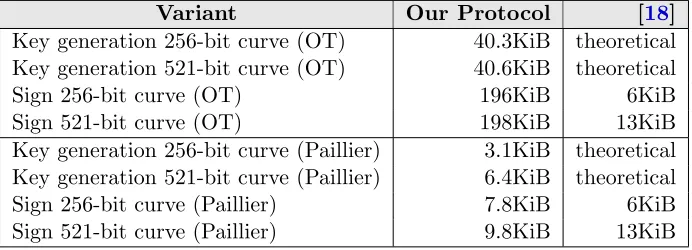
Variant Our Protocol [18]
Key generation 256-bit curve (OT) 40.3KiB theoretical Key generation 521-bit curve (OT) 40.6KiB theoretical
Sign 256-bit curve (OT) 196KiB 6KiB
Sign 521-bit curve (OT) 198KiB 13KiB
Key generation 256-bit curve (Paillier) 3.1KiB theoretical Key generation 521-bit curve (Paillier) 6.4KiB theoretical Sign 256-bit curve (Paillier) 7.8KiB 6KiB Sign 521-bit curve (Paillier) 9.8KiB 13KiB
Table 2: Concrete bandwidth for our protocol and [18], for different curve sizes, inkilobytes. The communi-cation is how mucheach party sends toeach other party. In all cases, we use a 2048-bit modulus for Paillier.
approxi-mately the same communication of [18] for a 521-bit curve.
5.2.2 Experimental Results
We implemented our protocol in C++, and ran it on AWS with all machines of type Intel(R) Xeon(R) CPU E5-2676 v3 @ 2.40GHz with 1 GB RAM (RedHat 7.2) and a 1Gb per second network card. We ran experiments from 2 to 20 parties (all in the same region); each execution was run 16 times and we took the average. The results can be seen in the graph in Figure 1, and in Table 3. We implemented the version with the Paillier-based private multiplication of Section6.2(although the OT version has much faster computation, its significantly higher communication makes it less attractive for most real-world scenarios). As is clearly seen, the signing time is practical (especially for cryptocurrency applications): from 304ms for 2 parties to about 3sec for 10 parties and about 5sec for 20 parties. We stress that the implementation issingle threaded, and the running time can be significantly reduced by using multiple threads on multicore machines.
0 5000 10000 15000 20000 25000 30000
2 3 4 5 6 7 8 9 10 11 12 13 14 15 16 17 18 19 20
Figure 1: The running times in milliseconds for key generation (top line in blue) and signing (bottom line in red) for 2-20 parties, for the Pailler variant of the protocol.
As we have stressed, the primary contribution of this paper is to achieve practical signing and key generation. Indeed, as shown in Figure1, key generation takes 11sec for 2 parties, 17sec for 10 parties and 28 seconds for 20 parties. This is not very fast, but is clearly practical, especially since key generation need only be run once.
comparison, our signing phase including communication is 2–5 times slower than [18] (depending on the number of parties). Since our goal is multiparty ECDSA with practical key generation and signing, this demonstrates that our goal is achieved.
Number of GGN16 [18] Our protocol – Sign Parties (local comp. only) (including communication)
2 205 304
3 256 575
4 312 840
5 369 1112
6 418 1395
7 453 1648
8 505 1929
9 557 2196
10 609 3267
11 661 2774
12 714 3011
13 765 3284
14 818 3572
15 876 3852
16 949 4144
17 977 4385
18 1029 4636
19 1083 5061
20 1136 5194
Table 3: Comparison of signing times (in milliseconds) between [18] and our protocol. The times for [18] are oflocal computation only (without communication), whereas the times for our protocol are in AWS with real communication.
5.3 Proof of Security of Protocol 5.1
Theorem 5.2 Protocol5.1securely computesFecdsawith abort in theFmult-hybrid model, in the presence of a malicious adversary corrupting any t < nparties, with point-to-point channels.
Proof: We have already provided the intuition regarding the security of the protocol in Section5.1, and so proceed directly with the formal proof.
LetAbe an adversary and letI ⊆[n] be the set of corrupted parties. If all parties are corrupted, then the simulation is trivial. We therefore consider I ⊂[n] (with|I|< n) and we denote the set of honest parties by J = [n]\I. Throughout the proof, we denote corrupted parties by Pi (i.e., i∈I), honest parties by Pj (i.e., j∈J), and a running index over [n] by `.
We construct a simulator S who invokes A internally and simulates an execution of the real protocol, while interacting withFecdsa in the ideal model.
Key generation: For the key generation, S instructs all Pi with i∈I to send KeyGen(G, G, q)
toFecdsa. Upon receiving backQ fromFecdsa, simulator S works as follows:
2. S receives the messages (input, sidgen, xi) that Asends to Fmult, for everyi∈I.
3. S simulates Fmult sending (input, sidgen) to Pi, for everyi∈I.
4. S receives the messages (element-out,0) thatA sends to Fmult, for everyi∈I.
5. S simulates Fmult sending (element-out,0, Q) to Pi, for every i∈ I, where Q is the public-key received by S from Fecdsa. In addition S computes Qi =xi·G for every i∈ I, and chooses random {Qj}j∈J under the constraint that
Pn
`=1Q` = Q. Then, S simulates Fmult sending Q1, . . . , Qn toA.
6. S stores all of the values{xi}i∈I, as well asQ.
This completes the simulation of the key generation phase.
Signing: For the signing phase, upon inputSign(sid, m), ifsidhas not been used previously, then
S instructs all Pi with i ∈ I to send Sign(sid, m) to Fecdsa. Upon receiving back a signature (r, s), simulator S works as follows:
1. S runs the ECDSA verify procedure on signature (r, s) and public keyQ, and obtains the group elementR such that R= (rx, ry) andr =rxmodq.
2. S receives (input, sidk1, ki) and (input, sidk1, ρi) that A instructs Pi to send to Fmult, for all i∈I.
3. S simulatesFmult sending (input, sidk1) and (input, sidk2) toPi, for all i∈I.
4. S receives messages (mult, sidk1, sidk2) and (element-out, sidk1) that Ainstructs Pi to send to
Fmult, for all i∈I.
5. S chooses a random τ ∈Zq and simulates Fmult sending (mult-out, sidk1, sidk2, τ) to Pi for all i∈I.
6. S simulatesFmult sending (element-out, sidk1, R) to Pi for all i∈I, where R is as computed in Step1 above. In additionS computes Ri =ki·Gfor everyi∈I, and chooses random{Rj}j∈J under the constraint thatPn
`=1R`=R. Then,S simulates Fmult sendingR1, . . . , Rn toA. 7. S simulatesFmult sending (affine,0, sidk3, r, m0) to A.
8. S receives messages (mult, sidk2, sidk3) that Ainstructs Pi to send toFmult, for alli∈I.
9. S setss0 =swith probability 1/2, and otherwises0 =q−s.
10. S computesβ =τ ·s0modq.
11. S simulatesFmult sending (mult-out, sidk2, sidk3, β) to Pi, for all i∈I.
We now show that the simulation byS in the ideal model results in a distribution that is identical to that of an execution of Protocol 5.1 in the Fmult-hybrid model. Observe that the only actual values received by the corrupted parties during the execution are Q (in the key generation), R (as the output of element-out) and values τ and β. The distribution over these values in a real execution are
Q=x·G, R=k·G, τ =ρ·k, β=ρ·(m0+x·r)
where k, ρ ∈ G are random, and r = rxmodq where R = (rx, ry). (Note that x is also random, but it is fixed in the key generation phase, and the same in all signing executions.) In contrast, the distribution over these values in the simulated execution are
Q=x·G, R=k·G, τ, β=τ·s0
where k, τ ∈ Gare random, and s0 =k−1·(m+x·r). (Observe that S does not knowx and k,
but this is the distribution since it is derived from the output received fromFecdsa.) In the real execution, since ρ is random, we have thatτ andβ arerandom under the constraint that
β τ =
ρ·(m0+x·r) ρ·k =k
−1·
(m0+x·r) =s0.
Similarly, in the simulated execution, since τ is random, we have thatτ and β are random under the constraint that
β τ =
τ ·s0 s0 =s
0 .
Thus, these distributions are identical.
The only issue that we have ignored is the distribution over s0 being less than or greater than q/2. Specifically, Fecdsa always takes s in the signature to be less than q/2 (by defining s= min{s0, q−s0}). The parties in the protocol do the same. However, the distribution over s0 in the simulation is such that s0 < q/2 with probability 1/2 and s0 > q/2 with probability 1/2 (see Step 9 in the simulation description). We therefore have to show that this is also the same in a real execution. Nevertheless, this follows immediately from the fact that for everyk∈Zq resulting ins0=k−1·(m0+r·x) it follows that−k results ins0 =−k−1·(m+r·x) =q−k−1·(m+r·x); in both cases r is the same since if k·G= (rx, ry) then−k·G= (rx,−ry). This implies that the probability of receiving s0 < q/2 is 1/2 and equal to the probability of receiving s0 > q/2. This completes the proof.
5.4 Extending the Protocol to Threshold (and General) Access Structures
βi of β, but this is achieved by including the Lagrange coefficients) Of course, it is also necessary to generate a Shamir sharing of d (as in the init phase of Fmult), to enable computing FcheckDH, which requires shares of the private ElGamal key associated with P.
The above requires a modification to the key generation phase in order to generate these shares. Fortunately, it is not difficult to generatet-out-of-nshares in a robust way for ECDSA, as described in [13] (although their signing protocol only works for 2-out-of-n). We sketch this now, using the Fmult functionality. The idea is for the parties to generate a sharing of a random degree-(t−1) polynomial p(·) where the ECDSA private key is x = p(0). Denote p(z) = Pt−1
`=0c`·z`; note that x = p(0) = c0. This polynomial is generated by the parties calling (input, sidk`) for ` = 0, . . . , t−1, to define the coefficients (c` is the coefficient with identifier sidk`). Next, the parties call (element-out, sidk0) to obtain the ECDSA public key Q = c0 ·G = x·G. Finally, each party Pi needs to obtain its Shamir share p(i) of the private key. This can be achieved by a variant of the affine operation, for the parties to compute ElGamal encryptions and shares ofp(i) for i= 1, . . . , n; this is just computing a local linear combination of the shares of the coefficients and the appropriate valuei0, i1, i2, . . . , it−1. Once the parties hold these shares and the associated ElGamal encryptions, they can run a variant of element-out that provides the value to only one party, in order for each Pi to receive p(i)·G. Finally, the parties can all send their shares ofp(i) to Pi, who sums them and verifies that the result is correct by multiplying G by the sum and comparing the result to the value received inelement-out. This prevents any party from providing an incorrect share. In order to ensure that Pi learns nothing but the sum, each Pj can randomly mask its share and send shares of the mask to all other parties.
The above can be generalized to any linear secret sharing scheme forany access structure, as long as such a scheme has an efficient method of robustly sharingx (and obtaining Q).
An important access structure. One specific access structure that is of practical interest for cryptocurrency custody is the following. Define ` sets of users A1, . . . , A` of sizes n1, . . . , n`, respectively, and define authorized thresholds t1, . . . , t` for each set. Then, define the access structure to be any combination of AND/OR over these sets. For example, one could define (A1∨A2)∧(A3∨A4)∧A5, which means that in order to sign, an appropriate threshold is needed in A1 or A2, and in A3 or A4 and in A5. To be concrete, A5 could denote a set of servers at a trustee (that rely on automatic authorization and not human verification),A3 andA4 could be two sets of shift workers at the financial institution offering the custody solution, andA1 andA2 could be analogous workers at the customer who owns the cryptocurrency. Each of the sets may have its own threshold which trades off security and the difficulty of contacting a large enough set when funds need to be transferred. Our protocol easily supports such an access structure by using the well-known method of traversing the circuit from the output to the input, and additively sharing the key at an AND gate while replicating the key at an OR gate. Finally, Shamir sharing is used to split the key shares at each node amongst the defined subset with the defined threshold.
6
Private Multiplication Instantiations
6.1 Private Multiplication Using OT
receiver’s inputs, as was recently shown in [13] also in the context of ECDSA. When running this protocol with oblivious transfer that is secure in the presence of malicious adversaries, the corrupted parties’ inputs to the oblivious are actually explicitly defined (and can be extracted). Thus, when correct inputs are used, this protocol can be simulated, implying input indistinguishability. In contrast, if the adversary inputs incorrect values to the OTs that do not defineany real input (i.e., are inconsistent between the OTs), then the result will not be the valid c= Pn
`=1c` except with negligible probability. Thus, in such a case, we merely need the first privacy requirement.
Complexity. When using OT extension [26], private multiplication requires the parties to carry out a setup step, where a public key is established which is used to compute seeds for the sender and receiver. Then, these seeds are expanded by a PRG (pseudo-random generator) to generate random correlated pads to mask the transmitted messages. The setup step involves each party sending 40KiB and carrying out 320 elliptic-curve multiplications. (We have 320 multiplications since [26] requires runningκ base OTs, that cost 3 multiplications for the sender and 2 for the receiver, and thus 2.5 on average. In practice, we take κ = 128, thereby requiring 320 multiplications.) The extension part is cheap in terms of computation but requires each party to transmit 97KiB to each of the other parties for each multiplication.
6.2 Private Multiplication Using Paillier
6.2.1 The Multiplication Protocol
We now present an alternative method of achieving private multiplication which has much lower communication complexity but higher computation (but still very reasonable). This protocol is based on the folklore multiplication protocol based on additively homomorphic encryption, with additional zero-knowledge proofs to prevent malicious parties from cheating. In particular, one of the main problems that we face in this protocol is that we wish to multiply insideZq, but are using Paillier with message spaceZN. This opens the door to multiple attacks, that we discuss below.
Each party Pi works as follows:
1. Setup (run during key generation): Party Pi generates a Paillier public/private key pair [31], denoted (pki, ski), and sends pki to all parties. We denote the Paillier encryption of x using randomness r and public-key pk by Encpk(x;r). We stress that each party generates its own Paillier keylocally, and no distributed generation is needed. In addition, each party generates a non-interactive proof thatpki was generated correctly (more exactly, that gcd(N, φ(N) = 1 and so the scheme is indeed additively homomorphic); see Section 6.2.3.
In addition, each party sets parameters s=t= 128 and`= 80 (the parameterst, ` are utilized in the zero-knowledge proofs in Sections6.2.6and 6.2.7), whereass is used to ensure thatδj→i sent in Step 2 is large enough to hidePj’s private input.
2. Multiplication: each partyPiholds inputsxi, yi and the aim is for the parties to obtainz1, . . . , zn such thatPn
i=1zi = (Pni=1xi)·(Pni=1yi) modq. The protocol is as follows:
(a) Step 1 (message 1): Pi computes ci = Encpki(xi), where pki is its own public-key. In
t, ` security parameters as defined in Section6.2.6(the proof requires a modulus from the verifier, and thus is different for each Pj). For every j∈[n]\{i},Pi sends (ci, πi1→j) to Pj. (b) Step 2 (message 2): For everyj∈[n]\{i}, partyPi receivescj =Encpkj(xj) andπj→i from
Pj. Party Pi verifies the proof πj→i and then uses the homomorphic operations—where
,⊕are homomorphic multiplication and addition, respectively—to generate
ci→j = (cj⊕2t+`·q)yi⊕δi→j =Encpkj(xj·yi+ 2
t+`·q·y
j+δi→j)
for a randomly chosenδi→j ∈Zq2·2t+`+s. In addition, Pi generates a non-interactive
zero-knowledge proof of zero-knowledge πi2→j of the pair of values (yj, δj→i) such that ci→j = ((cj⊕ 2t+`·q)yj)⊕δj→i with yj ∈Zq and δj→i ∈ Zq2·2t+`+s (with soundness as long as yj ∈
(−2t+`·q,2t+`·q) and δj→i ∈(−q2·22t+2`+s, q2·22t+2`+s)). See Section6.2.7for the proof specification. Pi sends (ci→j, πi2→j) toPj.
(c) Step 3 (output): Pi receives all cj→i =Encpki(xi·yj+ 2
t+`·q·y
j +δj→i) and πj2→i values fromPj for everyj∈[n]\{i}. Then, for eachcj→i,Pi verifies the proofπ2j→i, decryptscj→i and adds (xi+ 2t+`·q)·2t+`·q+2t+`·q2·2t+`+smodN. Finally,Pi sums the results, adds xi·yi and subtracts all itsδi→j values, and reduces the result moduloq. The result isPi’s output zi.
Before proceeding, we explain some of the ideas behind the above protocol. First, we explain why Pi and Pj add the 2t+` ·q values. Note that the soundness of the zero-knowledge proof provided by Pi only guarantees that xi ∈ (−2t+`·q,2t+`·q). Thus, Pj first adds 2t+` ·q to the ciphertext ci before proceeding, ensuring that it encrypts a value that is greater than 0 (and less than 2·2t+`·q). Likewise, the proof provided byPj only guarantees thatb∈(−2t+`·q,2t+`·q) and ∆∈(−2t+`·q2·2t+`+s,2t+`·q2·2t+`+s). Thus,Pi adds (xi+ 2t+`·q)·2t+`·qmodN, converting the multiplication by b to a multiplication byb+ 2t+`·q, ensuring that even if −2t+`·q < b < 0 then the result is multiplication by a positive value in the range [0,2·2t+`·q). Furthermore, Pi adds 2t+`·q2·2t+`+s modN so that if−2t+`·q2·2t+`+s<∆<0 then the result is as if a positive value in the range [0,2·2t+`·q2·2t+`+s) was added. Note that these operations are moduloN since this is the domain of the Paillier encryption.
Next, we explain the choice of δj→i ∈ Zq2·2t+`+s. In our use of this protocol, all xi, yi ∈ Zq.
In order to ensure that cj→i reveals nothing about yj, the value δj→i needs to be longer than xi·yj+ 2t+`·q·yj (this is because no modulo reduction takes place and soPi receives the integer value). Now, as stated above, the zero-knowledge proof regardingxi only guarantees that it is less thanq·2t+` and soxi·yj < q2·2t+`. We therefore chooseδj→i ∈Zq2·2t+`+s, making its-bits longer
thanxi·yj+ 2t+`·q·yj and so making the statistical distance betweenxi·yj+ 2t+`·q·yj+δj→i and a random element r∈Zq2·2t+`+s be at most 2−s.
Correctness: The protocol is correct as long as there is no reduction modulo N. In order to see this, note that
xi·yj + 2t+`·q·yj+δj→i+ (xi+ 2t+`·q)·2t+`·q+ 2t+`·q2·2t+`+s=xi·yj+δj→i modq.
Thus, by each partyPi subtracting the δi→j values they chose, the overall sum equals x·y. Now, we have that no reduction moduloN takes place in the Paillier encryption as long as
Now, since xi, yj ∈Zq and δj→i ∈Zq2·2t+`+s, we have that the above is upper bound by
q2+ 2t+`·q2+q2·2t+`+s+ 22t+2`·q2+ 2t+`·q2·2t+`+s<2·q2·22t+2`+s.
Taking s = ` = 80 (which suffices for statistical distance) and t = 128, we have that as long as N > q2·2497 there is no reduction moduloN in the computation. This implies that for q <775 (which includes all typically used curves), it suffices to useN of length 2048 (which is the minimum reasonable size for Paillier in any case).
On the necessity of the zero-knowledge proofs. We first prove why it is necessary to have the parties prove that the values they used in the homomorphic encryption are within certain ranges. Consider a corrupted party Pi who sends an encryption ci = Encpki(µ·q
ν +x
i) for some µ, ν ∈ N with the property that if yj is small then (µ·qν +xi)·yj < Ni and if yj is large then (µ·qν +xi)·yj ≥Ni. In the former case, the protocol will proceed with everything correct (since µ·qν ·y
j +xi ·yj =xi·yj modq), whereas in the latter case the overall protocol will fail (since [µ·qν ·yj modNi] +xi·yj 6=xi·yj modq). This will reveal one bit of information about yj that should not be revealed, and enables an adversary to carry out a binary search on private values. In a similar way, a corrupted Pj can also use yj +µ·qν and achieve the same effect. In order to prevent this attack, we have both parties prove that their values are in range in zero-knowledge. Since N is much larger than q, we are able to use range proofs that have a lot of slack regarding soundness. This is important since tight range proofs are much more expensive.
In addition, recall thatPj proves that it computedcj→i by multiplying by someband adding ∆ (within range). This part of the proof is needed due to the following. Assume that the encryption scheme used (Paillier) is actuallyfully homomorphicand not just additively homomorphic. Then,Pj could generate the ciphertextcj→i by computing a circuit that says: if the value encrypted modulo q is less than q/2 then output the correct value; else output an incorrect value. This would leak information about Pi’s private value, as discussed above. Thus, in order to prove security without the zero-knowledge proof, one would need to assume that Paillier isnot fully homomorphic, which would be a non-standard assumption on Paillier. We stress that it may be possible to prove the ECDSA protocol secure under a game-based definition without making this assumption (although we do not know if this is the case). Nevertheless, our aim is to achieve simulation-based security which seems to require this stronger property.
Multiple multiplications. In our use of multiplication in our ECDSA protocol, the parties need to carry out two multiplications, where one of the values is the same. Letxi be the input ofPi and let yj, yj0 be the inputs of Pj. Then, Pi sends a single first message, and Pj computes its second message once with yj and δj→i and a second time with y0j and a different randomδj0→i. Thus, the second multiplication requires only a single round of communication, and only a single ciphertext. Note that this second multiplication can also be run later and does not need to be run at the same time as the first.

![Table 3: Comparison of signing times (in milliseconds) between [18] and our protocol. The timesfor [18] are of local computation only (without communication), whereas the times for our protocolare in AWS with real communication.](https://thumb-us.123doks.com/thumbv2/123dok_us/7971293.1321896/21.612.164.452.122.390/comparison-milliseconds-protocol-timesfor-computation-communication-protocolare-communication.webp)
