DNA sequence variability at the
rplX
locus of
Bacillus subtilis
PAUL
M.
SHARP,*
NIAMH
C. NOLAN,
NIAMH
NICHOLMAIN
and
KEVIN
M.
DEVINE
Department of Genetics, Trinity College, Dublin 2, Ireland
(Received 4 July 1991 ; revised 12 September 1991 ; accepted 20 September 1991)
~
The pattern and extent of
DNA
sequence variability at the rplXlocus (encoding r i b m a l proteinL24)
has beeninvestigated in nine strains of Bacillus subtilis. Overall, there is a very low level of nucleotide diversity, even at silent
sites, which is probably due to selection among synonymous codons. By analogy with Escherichia coli, there may
also be some effect of the relative proximity of rplX to the chromosomal origin of replication. The small number of
nucleotide substitutions are non-randomly distributed: all of the synonymous changes are in valine codons. From
the sequence differences the strains can be divided into two groups, which are not coincident with their previous
classification; this observation is consistent with recombination among strains.
Introduction
An understanding of the population structure and diversity of bacterial species is of obvious medical, economic and environmental relevance, but so far prokaryotes (and microbes in general) have received much less attention than animal and plant species. Multilocus enzyme electrophoresis (MLEE) has been applied to a number of bacteria, with the results generally suggesting that prokaryotes have clonal popu- lation structures (Selander et al., 1985, 1987; Piffaretti et al., 1989). Studies of the extent and pattern of DNA sequence diversity have been fewer in number, but have suggested that genetic exchange is more prevalent than the MLEE results might indicate (DuBose et al., 1988; Dowson et al., 1989). Thus, the most fundamental question concerns the extent of recombination among prokaryotes (Maynard Smith et al., 1991), which raises the question as to whether it is meaningful to discuss bacterial ‘species’. If ‘species’ do exist, how much DNA sequence variability is there among different isolates?
Not surprisingly, the most extensively studied species has been Escherichia coli. MLEE results have been interpreted as indicating a largely clonal pattern of divergence (Selander & Levin, 1980; Ochman & Selander, 1984; Selander et al., 1987)
.
However, DNA sequence analyses of the phoA locus (DuBose et al., 1988) and the *Author for correspondence. e-mail : PSHARP@VAXl . TCD. IE .Abbreciarions : CAI, codon adaptation index ; Fop, frequency of optimal codons; K , number of synonymous substitutions per site.
The nucleotide sequence data reported in this paper have been submitted to GenBank/EMBL and have been assigned the accession numbers M81748 and M81749.
trp region (Milkman & Stoltzfus, 1988; Milkman & Bridges, 1990) have revealed recombination of short DNA segments among closely related strains; thus it has been suggested that E. coli does comply with the traditional species concept. The extent of DNA sequence diversity among strains of E. coli varies among the small number of different loci examined, and it is not clear to what extent this is determined by natural selection. Of course, the prokaryotic kingdom is so diverse that there is no reason to believe that this (as yet incomplete) picture of E. coli will be applicable to other bacteria.
40 P . M . Sharp and others
genetic recombination has occurred among wild isolates of B. subtilis. In this study, we examine DNA sequence divergence at the rplX locus (encoding ribosomal protein L24) in nine B. subtilis strains of diverse origins.
Methods
Bacterial strains. E. coli TG 1 [K 12A (lac-pro) supE thi hsdR F’traD-
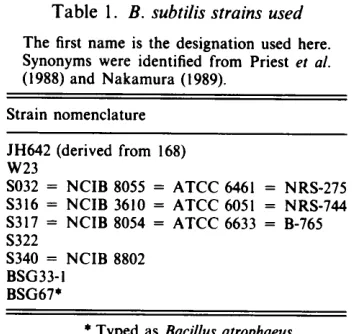
36 proAB lael lac2 AM 151 was obtained from Amersham. The nine isolates of Bacillus subtilis investigated in this study are outlined in Table 1, and were collected as follows. Five previously characterized strains (S032, S3 16, S3 17, S322, S340) were obtained from F. G. Priest (Heriot-Watt University, Edinburgh, UK), and the identification of each of these strains in different culture collections is indicated in Table
1 ; references to these strains can be found in Priest et al. (1988). Two strains from the Chinese National Culture Collection (BSG33-1 , BSG67), originally isolated from the Gobi Desert, were obtained from
T. Trautner (Max-Planck-Institut fur Molekular Genetik, Berlin, Germany). These two strains were typed at the National Collections of Industrial and Marine Bacteria (Aberdeen), where one (BSG67) was identified as belonging to the recently defined species B. atrophaeus
(Nakamura, 1989). JH642, a derivative of 168, wasobtained from J. A. Hoch (Scripps Clinic and Research Foundation, La Jolla, Calif., USA). W23 was obtained from the Bacillus Genetic Stock Center (Ohio State University, Columbus, Ohio, USA).
DNA manipulations. Chromosomal DNA was isolated from each strain according to Rodriguez & Tait (1983). Using the published sequence of the B. subtilis 168 spc ribosomal protein operon (Henkin et
al., 1989), two oligonucleotides, 5’-CTAGCTCCAGAAGTTATC- TAA-3‘ and 5’-CTTTTCTTTAAGGCGGTTCAT-3’, were selected from the 3’-end of rplN and the complementary strand of the 5’-end of
rplE, the genes preceding and following rplX, respectively. These oligonucleotides were synthesized on an Applied Biosystems 39 1 PCRMate DNA synthesizer and were used as primers for a polymerase chain reaction (PCR). Each PCR contained: 100 ng chromosomal DNA, a 10 VM concentration of each primer, 2-7 mM-MgC12, 100 mM- Tris/HCl, pH 9, 500mM-KC1, 1% (v/v) Triton X-100, 0.1% (w/v) gelatin, 200 pM-dNTP mix and 2.5 U of Taq polymerase. The ends of the amplified DNA fragments were made blunt using the Klenow fragment of DNA polymerase. The DNA fragments were then ligated to pGEM5Zf (Promega Corp.), which had previously been linearized with EcoRV, and the ligation mix was transformed into E. coli TGI. Insert-containing plasmid DNA was prepared by the method of Birnboim & Doly (1979). The DNA sequence of the insert was determined with the Promega T7 Sequencing Kit, using universal forward and reverse, SP6, T7 and appropriate synthetic oligonucleo- tides as sequencing primers. Double-stranded template plasmid DNA was sequenced as outlined in the Promega Protocols and Applications Guide. Except where otherwise specified, all molecular biological methods were carried out according to Maniatis et al. (1982).
Results and Discussion
Nucleotide sequence diversity
The rplX region of the chromosome has been cloned and sequenced from nine strains of B. subtilis (Fig. 1). The sequence of strain JH642 is identical to the 168 sequence already published (Henkin et al., 1989), except at one nucleotide in the putative ribosome-binding site 5’ to
Table 1. B. subtilis strains used The first name is the designation used here. Synonyms were identified from Priest et al.
(1 988) and Nakamura ( I 989). Strain nomenclature
JH642 (derived from 168) W 23
SO32 = NCIB 8055 = ATCC 6461 = NRS-275 S316 = NCIB 3610 = ATCC 6051 = NRS-744 S317 = NCIB 8054 = ATCC 6633 = B-765 S322
S340 = NCIB 8802 BSG67*
BSG33-1
* Typed as Bacillus atrophaeus
rplX. The RBS for 168 was reported as GGTGG, whereas the same region is GGAGG in JH642 and all other strains examined here. Bearing in mind that JH642 was derived from 168, it seems probable that the substitution of A by T in 168 is an artefact. Among the other eight strains investigated there are only five different sequences : strains JH642, S3 16, S322 and BSG33-1 are identical, as are S340 and BSG67. For one of the strains showing most divergence from JH642 (S3 17, with six differences) two separate PCR-generated clones were sequenced. These two sequences were identical, suggesting that errors produced by Tag polymerase do not contribute significantly to the variation observed.
Six of the 103 codons of the rplX gene vary among the strains. In the non-coding region between rplN and rplX
(5’ to rplX) one of 37 nucleotides is variable, and there is one insertion/deletion event; the latter is probably an insertion in the ancestor of the 168, S316, S322, BSG33-1 clade (see below). There is no variation in the non-coding region 3’ to rplX (5’ to rplE).
Two of the differences among the rplX sequences occur at second codon positions, and thus cause amino acid replacements (Fig. 1). This protein is quite highly conserved, as judged by the 47% amino acid identity between B. subtilis and E. coli. The Ile+Thr replacement at residue 12 is less conservative than the Ile+Leu replacement seen between the Gram-positive and Gram- negative species. The Lys-Arg replacement at residue
103 would be considered a conservative change, but this residue is conserved as Lys in E. coli. Thus both of these replacements may be at least slightly deleterious; we note that each change is found in one strain only.
[image:2.576.327.504.91.258.2]Gly Thr Ile Leu Ala Ala Phe Pro Lys Lys Asp Arg Val Leu Val Glu Gly Val Asn Met
GGA ACA ATC CTT GCT GCT TTC CCT AAA AAG GAC CGC GTT TTA GTT GAA GGT GTT AAC ATG
Ala Pro Ile His Val Ser Asn Val Met Pro Leu Asp Pro Lys Thr Gly Glu Val Thr Arg
GCG CCA ATT CAT GTA TCA AAC GTT ATG CCG CTC GAT CCT
--_
---
--- ---
AAA ACA GGT GAA GTG ACT CGC--- ---
---
---
---
---
---
---
--- ---
---
---
---
--- ---
---
Val Gly Tyr Lys Val Glu Asp Gly Lys Lys Val Arg Val Ala Lys Lys Ser Gly Gln Val
GTA GGA TAC AAA GTG GAA GAT GGC AAA AAA GTT CGT GTA GCA AAA AAA TCT GGG CAA GTT
--- --- ---
--- --- ---
---
---
--- ---
___
--- ---
---
--- ---
---
---
--- ---
42 P. M . Sharp and others
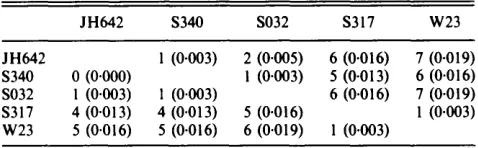
Table 2. Nucleotide divergence of rplX among strains
Values are the number of base substitutions (and divergence per site in brackets); values (below diagonal) for rplXcoding sequence only, and (above diagonal) for the entire region sequenced (see Fig. 1). Strains S316, $322 and BSG33-1 are identical to JH642; BSG67 is identical to S340.
JH642 s340 SO32 S317 W23
JH642 1 (0.003) 2 (0.005) 6 (0.016) 7 (0.019) S340 0 (0.000) 1 (0.003) 5 (0.013) 6 (0.016) SO32 1 (0.003) 1 (0.003) 6 (0.016) 7 (0.019) S317 4 (0.013) 4 (0.013) 5 (0.016) 1 (0.003) W23 5 (0.016) 5 (0.016) 6 (0.019) 1 (0.003)
presented in Table 2; the insertion/deletion event is weighted equally with a nucleotide substitution. The greatest divergence is a little under 2%, and is found between strain W23 and other strains (except S3 17). The average nucleotide diversity among the five sequences (or among all nine strains) is 0.010 (or 0.006) in the rplX gene (values for the whole sequence are similar). The extent of divergence obviously depends on the strains chosen, and on the loci examined (see below), and a realistic estimate of nucleotide diversity within the species B. subtilis awaits further investigation.
The majority of the nucleotide changes occur at silent sites, as almost universally seen in both intra- and interspecific comparisons, and as expected if the majority of sequence polymorphisms and evolutionary changes occur at the less constrained sites, a view now widely held in the light of the neutral mutation theory (Kimura, 1983). Unexpectedly, all four silent nucleotide changes occur in Val codons. There are 15 Val residues in ribosomal protein L24, constituting 14.6% of the protein, which is more than twice the average among a wide range of proteins (Collins & Coulson, 1990), but this fact alone is not sufficient to explain the distribution of variability. In the rplX gene there are 52 4-fold degenerate sites (i.e. positions where any substitution is silent; see Table 3), and the presence of all four differences among the 15 codons for one amino acid is unusual. The probability that all four changes occur at (different) Val codons is approximately 15/52 x 14/5 1 x 13/50 x 12/49 = 0.0050. However, we would have been interested if all changes had involved any amino acid (not just Val), and so similar probabilities should be calculated for each, and summed : the probability becomes 0.0064. This test is conservative, because it ignores the lack of variability at 48 2-fold degenerate sites in rplX. To include the 2-fold degenerate sites, they could each be considered as 1/3 of a fully (dfold) degenerate site, since one of the three possible nucleotide substitutions is synonymous (Li et al., 1985; for simpli-
Table 3. Codon usage in B. subtilis 168 rplX
‘Optimal’ codons are underlined, ‘non-optimal’ codons are indicated by an asterisk (*).
~~ ~
Phe UUU 0 Ser UCU 4 Tyr UAU 0 CysUGU 0
uuc
1 u c c * 0 UAC 1 UGC 0 Leu UUA 1 UCA 1 ter UAA 0 ter UGA 0 UUG 0 UCG*O UAG 1 TrpUGG 0 Leu CUU 1 Pro= 3 His CAU 2 ArgCGU 1CUC 1 c c c * 0 CAC 1 CGC 2 CUA 1 CCA 2 G l n w 5 CGA* 0 CUG 0 CCG 1 CAG 0 CGG* 0 Ile AUU 2 T h r w 2 AsnAAU I Ser AGU 0 AUC 2 ACC’O AAC 3 AGC 0 AUA* 0 ACA 2 Lys T A 16 ArgAGA 0 MetAUG 4 ACG 0 A A G 2 AGG* 0 Val GUU 8 AlaGCU 3 AspGAU 5 GlyGGU 4 GUC 0 GCC* 0 GAC 1 GGC 4 GUA 5 GCA 1 GluGAA 3 GGA 2 GUG 2 GCG 1 GAG 1 GGG* 1
city, the third positions of Ile codons are classified as 2- fold degenerate); then the rplX gene contains 68 4-fold degenerate site ‘equivalents’. Thus, the clustering of changes in Val codons seems highly significant. How- ever, it is difficult to gauge the real significance of this observation, because the particular hypothesis being tested has been suggested by the data.
A potential explanation of non-random changes at silent sites is that they are constrained by natural selection. Selection among synonymous codons has been inferred to occur in B. subtilis (Shields & Sharp, 1987), and indeed other ribosomal protein genes have highly biased codon usage. The Codon Adaptation Index (CAI) was developed as a measure of the codon bias in a gene (Sharp & Li, 1987a), in terms of the relative ‘fitness’ of each of its constituent codons; this relative fitness is assessed from the frequency of each codon in a reference set of genes expressed at very high levels. The CAI for rplX is 0.72, placing it among the most highly biased genes in B. subtilis (Sharp et al., 1990a). To consider the effect of codon selection on rplX sequences it is simpler to consider the occurrence of ‘optimal’ codons (defined in Sharp et al., 19906). Codon usage in the 168 rplX gene is shown in Table 3. The frequency of optimal codons, Fop, is 0.69, confirming that this is one of the most highly biased genes known in this species; only five out of 186 B. subtilis genes considered by Sharp et al. (1 990 b) have Fop values higher than 0.70.
[image:4.576.37.276.160.234.2]possible that the Val codons form some sort of mutational hotspot. The four Val codon changes are of three different types (A:T e, T:A, A:T e, G :C and G :C *--) T : A; bearing in mind that it is not known
whether the primary mutational event involved the sense or complementary DNA strand). Mutation patterns can be influenced by nearest neighbour nucleotides, and there is some evidence that this affects codon usage in lowly expressed genes in B. subtilis (Shields & Sharp, 1987). In DNA, the third position of a Val codon has a T to the 5' side: none of the nine other synonymous positions with a 5' T (in Phe, Leu and Ile codons) in rplX are variable. The four variable sites
are
interesting in that they are among seven Val codons followed by a 3' A; none of the Phe, Leu or Ile codons are followed by an A. Thus, it is silent sites occurring in the context T-X-A which are variable at rplX. However, since a similar pattern of variability is not seen at other loci (see below), it is difficult at this stage to know how to interpret this observation.Relative degree of divergence at rplX
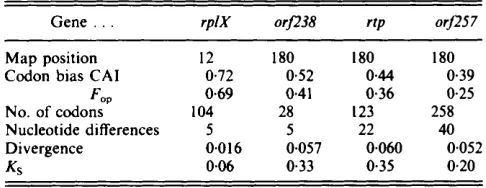
It is possible to make some assessment of the divergence of the rplX gene relative to other loci sequenced in different strains of B. subtilis. A region at the chromoso- mal replication terminus has been sequenced in both 168 (Carrigan et al., 1987; Ahn & Wake, 1991) and W23 (Lewis & Wake, 1989; Ahn & Wake, 1991). Two genes located at terC can be compared in their entirety between these two strains (Ahn & Wake, 1991): rtp, encoding a DN A-binding protein, and or-57, encoding a protein with strong similarity to the pyrroline karboxylate reductases of E. coli and Pseudomonas aeruginosa. A short 3' fragment of another gene, designated or-38, and encoding a protein with some similarity to the product of the Rhizobium meliloti nodG gene, can also be compared. The three genes at terC have similar levels of nucleotide divergence between 168 and W23 (Table 4), and are each 3-4 times more divergent than rplX. Of course, nucleo- tide divergence can occur at non-synonymous and synonymous (silent) sites; the increased divergence in orf257 is partly due to less constraint on the protein sequence of its product, but in rtp and o r - 3 8 all of the changes are synonymous. To quantify the divergence at silent sites, we have calculated K,, the number of synonymous substitutions per site, by the method of Li et al. (1989, which includes a statistical correction for multiple hits. The values of Ks for the terC genes are again at least 3 times that for rplX (Table 4). Unlike rplX, there is no evidence of an excess of nucleotide differences at Val codons in the terC genes.
By analogy with E. coli, two factors may contribute to the lower divergence at rplX than at terC. First, codon
Table 4. Divergence between B. subtilis strains 168 and W23
Codon usage bias is estimated by two indices: CAI, Codon Adaptation Index, and Fop, Frequency of optimal codons - in each case values are the average for the two strains. Divergence is presented as the nucleotide divergence, and as Ks, the estimated number of synonymous substitutions per site.
Gene . . . rplX orf238 rtp orf257
Map position 12 180 I80 180 Codon bias CAI 0.72 0-52 0.44 0.39
F O P 0-69 0.41 0.36 0.25
No. of codons 104 28 123 258 Nucleotide differences 5 5 22 40 Divergence 0.016 0.057 0.060 0.052
KS 0.06 0.33 0.35 0.20
usage bias in these genes, assessed by either the CAI or Fop, is much lower than in rplX (Table 4). Thus, the difference in degree of divergence may be attributable to differential constraint on synonymous codon usage, as seen in comparisons between E. coli and Salmonella typhimurium (Sharp & Li, 1987 b). Second, rplX is located at 12" on the B. subtilis chromosome (Piggot et al., 1990), quite close to the origin of replication; the extent of silent site divergence between E. coli and S . typhimurium is greatly reduced near oriC (Shaqp et al., 1989).
The bglC gene encoding encb$-1,4-glucanase has been investigated in four different strains of B. subtilis [see Cantwell et al. (1988) and references therein]. These sequences are highly divergent : average nucleotide diversity among the four strains is 0.100. One of the strains examined was designated as AT'CC 6633, which has been classified as being the same as S317 (Table 1). The ATCC 6633 sequence is not complete, but is clearly the most divergent among the four strains, with a nucleotide divergence of around 0.145 from each of the other three strains. The average nucleotide diversity among the other three strains investigated (DLG, IF03034 and PAP115) is 0.056. Thus, while the relationships of these three strains to each other (and to the strains examined here) are unknown, nevertheless the bglC gene appears to be far more divergent than rplX. The map location of bglC is unknown, but codon usage in bglC (CAI = 0-43, Fop = 0.30) is much less biased than in rplX, and this alone could account for the greater variability at bglC. There is no sign of hypervariability at Val codons in bglC.
[image:5.576.297.540.175.269.2]44 P . M . Sharp and others
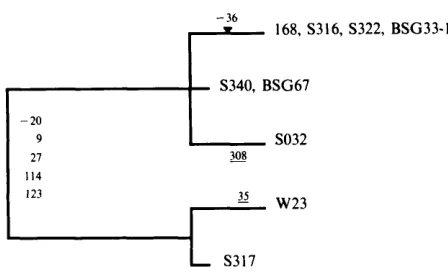
168, S316, S322, BSG33-1
f-
S340, BSG67 - 209
27 114 I23
F-
w23L
S317Fig. 2. Relationship among the rplX genes of the nine B. subtilis strains examined. Strain designations appear at the right end of branches. Horizontal branch lengths are approximately proportional to the number of differences (the insertion is weighted equally with a substitution). Numbers on branches indicate the nucleotide sites at which nucleotide changes have occurred, with those involving an amino acid replacement underlined, and the single nucleotide insertion indicated as a triangle (the first base of the rplX start codon is taken as position 1). Changes at the five sites near the root of the tree may have occurred on either branch leading from the common ancestor.
ma1 segments shared a common ancestor. In fact, there is some indication that recombination has occurred among B. subtilis strains (see below). However, the 168-W23 comparison is the most divergent among the rplX sequences examined here, and yet it is lower than all divergence values for terC or bglC; this suggests that there has indeed been stronger constraint on divergence at rplX.
Relationships among strains of B. subtilis
The nucleotide differences at rplX can be used to investigate the evolutionary relationships among these strains - at least for the rplX locus. This proviso arises because it is not clear how prevalent recombination is in different species of bacteria (Maynard Smith et al., 1991). Using the maximum parsimony principle (Fitch, 1977), the strains of B. subtilis examined here fall into two groups (Fig. 2), one including 168 (and six other strains), the other including W23 (and S317). We may consider just four (representative) strains (168, S032, W23 and 53 17) and ask whether the phylogenetically informative sequence variations (i.e. excluding differences which are found in only one of the sequences examined) significant- ly support the grouping in Fig. 2. There are three possible (unrooted) relationships among four strains, yet all five informative sites support the grouping of 168 with S032, and W23 with S317; following Li & Gouy (1990), the probability that this grouping is incorrect is approxima- tely P = 0.01.
The relationships inferred for the rplX sequences (Fig. 2) are different from those which might be expected.
First, diversity does not appear to be related to geographical origin, since strains BSG33- 1 and BSG67, isolated from the Gobi Desert in Central Asia, are identical to 168 at rplX. Second, Nakamura (1989) has examined 52 strains of B. subtilis by DNA hybridization, reflecting overall DNA relatedness. He found a major subdivision among the strains, with one group being quite distinct from the others; he reclassified these strains as B. atrophaeus. All of the B. atrophaeus strains, and only those strains, exuded a brownish-black pig- ment, suggesting that the latter is a diagnostic character for this species. Among the strains examined here, BSG67 exudes a pigment, and was typed as B. atrophaeus (see Methods). However, the rplX gene of BSG67 falls within the 168 cluster (Fig. 2). In contrast, W23 and S317 (neither of which exude pigment) are distinct from 168 at rplX. Additionally, strains S316 and S317, by their similarity to NRS-744 and B-765, respectively (see Table I), both fall within Nakamura’s group 3 of B. subtilis, and are expected to be distinct from SO32 (similar to NRS- 275, and thus in group 2). Yet S316 and SO32 lie within the 168 group, while S317 is with W23. Thus the pigment production trait seems to be completely concordant with overall DNA relatedness (Nakamura, 1989), but the rplX gene is not, indicating that different regions of the chromosome have undergone recombination. This might be anticipated, since B. subtilis is naturally competent. Duncan et al. (1989) have reported exchange between wild isolates of B. subtilis and B. licheniformis in soil cultures, although the stability and fitness of the recombinants was questionable. Indeed, Duncan et al. (1989) point out that the observed dichotomy between these two sympatric species would be hard to explain if extensive successful recombination occurred.
In conclusion, the rplX genes show low divergence among strains of B. subtilis isolated from around the world. The degree of divergence is lower than observed for other genes, which is consistent with selection among synonymous codons constraining divergence in highly expressed genes. Even though the number of variable sites is small, they are sufficient to suggest that the relationships among these rplX sequences are different from those inferred from other characteristics (pigment production and DNA hybridization), suggesting that recombination has occurred among strains of B. subtilis.
We would like to thank Fergus Priest and Tom Trautner for generously providing bacterial strains, and Peter Young and Michael Bulmer for statistical advice. This study was supported by EOLAS grant SC/151/89 to P.M.S. and K.M.D.
References
A m , K . S . & WAKE, R.G.(1991). Variationsandcodingfeaturesofthe
[image:6.576.43.267.86.222.2]BIRNBOIM, H. C. & DOLY, J. (1979). A rapid alkaline extraction procedure for screening recombinant plasmid DNA. Nucleic Acids Research 7 , 15 1 3- 1523.
CANTWELL, B. A., SHARP, P. M., GORMLEY, E. & MCCONNELL, D. J. ( 1988). Molecular cloning of Bacillus beta-glucanases. In Biochemis- tryandGeneticsofCellulose Degradation, pp. 181-201. Edited by J.-P. Aubert, P. Beguin & J. Millet. London: Academic Press. CARRIGAN, C. M., HAARSMA, J. A., SMITH, M. T. & WAKE, R. G .
(1987). Sequence features of the replication terminus of the Bacillus subtilis chromosome. Nucleic Acids Research 15, 850 1-8509.
COLLINS, J. F. & COULSON, A. F. W. (1990). Significance of protein sequence similarities. Methods in Enzymology 183, 474-487.
DOWSON, C. G., HUTCHISON, A., BRANNIGAN, J. A., GEORGE, R. C., HANSMAN, D., LINARES, J., TOMASZ. A., MAYNARD SMITH, J. & SPRATT, B. G. ( 1989). Horizontal transfer of penicillin-binding protein genes in penicillin-resistant clinical isolates of Streptococcus pneumoniae. Proceedings of the National Academy of Sciences yf the
United States yf America 86, 8842-8846.
DUBNAU, D. (1989). The competence regulon of Bacillus subtilis. In
Regulation of' Prokaryotic Dei*elopment, pp. 147- 166. Edited by I.
Smith, R. A. Slepecky & P. Setlow. Washington, DC: American Society for Microbiology.
DUBOSE, R. F., DYKHUIZEN, D. E. & HARTL, D. L. (1988). Genetic exchange among natural isolates of bacteria : recombination within the phoA gene of Escherichia coli. Proceedings of the National Academy
sf' Sciences yf the United States yf America 85, 7036-7040.
DUNCAN, K . E., ISTOCK, C. A., GRAHAM, J. B. & FERGUSON, N. (1989).
Genetic exchange between Bacillus subtilis and Bacillus Iichenifbrmis : variable hybrid sterility and the nature of bacterial species. Evolution
FITCH. W. M. (1977). On the problem of discovering the most parsimonious tree. American Naiuralist 11 1, 223-257.
HENKIN, T. M., MOON, S. H., MATWEAKIS, L. C. & NOMURA, M.
(1989). Cloning and analysis of the spc ribosomal operon of Bacillus subtilis: comparison with the spc operon of Escherichia coli. Nucleic Acids Research 17, 7469-7486.
KIMURA, M. (1983). The Neutral Theory y f Molecular Ecolurion.
Cambridge: Cambridge University Press.
LEWIS, P. J. & WAKE, R. G . (1989). DNA and protein sequence conservation at the replication terminus in Bacillus subtilis I68 and
W23. Journul of Bacteriology 171. 1402-1408.
LI, W.-H. & Gouv, M. (1990). Statistical tests of molecular phylogenies. Methods in Enzymologjv 183, 645-659.
LI, W.-H., Wu, C.-I. & Luo, C.-C. (1985). A new method for estimating synonymous and nonsynonymous rates of nucleotide substitution considering the relative likelihood of nucleotide and codon changes. Molecular Biology and Evolution 2, 150- 174.
MANIATIS, T., FRITSCH, E. F. & SAMBROOK. J. (1982). Molecular Cloning: a Loboratory Manual. Cold Spring Harbor, NY: Cold
Spring Harbor Laboratory.
MAYNARDSMITH, J., DOWSON, C. G. &SPRATT, B. G . (1991). Localized sex in bacteria. Nature, London 349, 29-31.
MILKMAN, R. & BRIDGES, M. M. (1990). Molecular evolution of the
Escherichia coli chromosome. 111. Clonal frames. Genetics 126, 505-
51 7.
MILKMAN, R. & STOLTZFUS, A. (1988). Molecular evolution of the
43, 1585- 1609.
Escherichia coli chromosome. 11. Clonal segments. Genetics 120,359- 366.
N AKAMURA, L. K. (1 989). Taxonomic relationships of black-pigmented
Bacillus subtilis strains and a proposal for Bacillus atrophaeus sp. nov. International Journal of Systematic Bacteriology 39, 295-300.
OCHMAN, H. & SELANDER, R. K. (1 984). Evidence for clonal population structure in Escherichia coli. Proceedings of the National Academy of
Sciences of' the United States of America 81, 198-201.
PIFFARETTI, J.-C., KRESSBUCH, H., AESCHBACHER, M., BILLE, J., BANNERMAN, E., MUSSER, J. M., SELANDER, R. K. & ROCOURT, J.
(1989). Genetic characterization of clones of the bacterium Listeria monocytogenes causing epidemic disease. Proceedings of the National Academy oj'sciences of'the United States of America 86, 38 18-3822.
PIGGOT, P. J., AMJAD, M.. Wu, J.-J., SANDOVAL, H. & CASTRO, J.
(1990). Genetic and physical maps of Bacillus subtilis 168. In
Molecular Biological Methods for Bacillus, pp. 557-569. Edited by C. R. Harwood & S. M. Cutting. Chichester: John Wiley. PRIEST, F. G., GOODFELLOW, M. & TODD, C. (1988). A numerical
classification of the genus Bacillus. Journal of General Microbiology
RODRIGUEZ, R. L. & TAIT, R. C. (1983). Recombinant DNA Techniques: An Introduction. Reading, MA : Addison-Wesley.
SELANDER, R. K. & LEVIN, B. R. (1980). Genetic diversity and structure in Escherichia coli populations. Science 210, 545-547.
SELANDER, R. K., MCKINNEY, R. M., WHITTAM, T. S., BIBB, W. F.,
BRENNER, D. J., NOLTE, F. S. & PATTISON, P. E. (1985). Genetic structure of populations of kgionella pneumophila. Journal of Bacteriology 163, 1021-1037.
SELANDER, R. K . , CAUGANT. D. A. & WHITTAM, T. S. (1987). Genetic structure and variation in natural populations of Escherichia coli. In
Escherichia coli and Salmonella typhimurium : Cellular and Molecular Biology, pp. 1625-1648. Edited by F. C. Neidhardt, J. L. Ingraham,
K. B. Low, B. Magasanik, M. Schaechter & H. E. Umbarger. Washington, DC : American Society for Microbiology.
SHARP, P. M. & LI, W.-H. (1987a). The Codon Adaptation Index - a
measure of directional synonymous codon usage bias, and its potential applications. Nucleic Acids Research 15, 1281-1295.
SHARP, P. M. & LI. W.-H. (19876). The rate of synonymous substitution in enterobacterial genes is inversely related to codon usage bias.
Molecular Biology and Evolution 4, 222-230.
SHARP, P. M., SHIELDS, D. C.. WOLFE, K. H. & LI, W.-H. (1989).
Chromosomal location and evolutionary rate variation in Enterobac- terial genes. Science 246, 808-8 10.
SHARP, P. M., HIGGINS, D. G., SHIELDS, D. C. & DEVINE, K. M.
(l990a). Protein-coding genes: DNA sequence database and codon usage. In Molecular Biological Methods jor Bacillus, pp. 557-569.
Edited by C. R. Harwood & S. M. Cutting. Chichester: John Wiley. SHARP, P. M., HIGGINS. D. G., SHIELDS, D. C., DEVINE, K. M. & HOCH,
I . A. (1990b). Bacillus suhtilis gene sequences. In Genetics and Biotechnologj*yf Bacilli, vol 3, pp. 89-98. Edited by M. M. Zukowski, A. T. Ganesan & J. A. Hoch. San Diego: Academic Press. SHIELDS, D. C. & SHARP, P. M. (1987). Synonymous codon usage in
Bacillus subiilis reflects both translational selection and mutational biases. Nucleic A c i h Research 15, 8023-8040.
WOESE, C. R. (1987). Bacterial evolution. Microbiological Reviews 51, 134, 1847-1882.