2014
Improving customer equity through value creation
and value appropriation
Youngsu Lee
Iowa State University
Follow this and additional works at:https://lib.dr.iastate.edu/etd
Part of theAdvertising and Promotion Management Commons, and theMarketing Commons
This Dissertation is brought to you for free and open access by the Iowa State University Capstones, Theses and Dissertations at Iowa State University Digital Repository. It has been accepted for inclusion in Graduate Theses and Dissertations by an authorized administrator of Iowa State University Digital Repository. For more information, please [email protected].
Recommended Citation
Lee, Youngsu, "Improving customer equity through value creation and value appropriation" (2014).Graduate Theses and Dissertations. 14028.
Improving customer equity through value creation and value appropriation
by
Youngsu Lee
A dissertation submitted to the graduate faculty
in partial fulfillment of the requirements for the degree of
DOCTOR OF PHILOSOPHY
Major: Business and Technology (Marketing)
Program of Study Committee: Sridhar N. Ramaswami, Major Professor
Terry L. Childers Stephen K. Kim Douglas M. Walker
Qing Hu
Iowa State University
Ames, Iowa
2014
Then you will know the truth, and the truth will set you free (John 8:28).
I’m so grateful to God who gives me strength when I am weak.
This work is dedicated to my family who has always supported my endeavor to pursue a PhD degree.
TABLE OF CONTENTS
Page
LIST OF FIGURES ... iv
LIST OF TABLES ... v
NOMENCLATURE ... vi
ACKNOWLEDGEMENTS ... vii
ABSTRACT………. ... viii
CHAPTER 1 INTRODUCTION ... 1
CHAPTER 2 CONCEPTUAL FRAMEWORK ... 10
Customer Equity ... 10
Value Creation and Value Appropriation ... 13
Value Creation Processes and Outcomes ... 26
Value Appropriation Processes and Outcomes ... 37
VC and VA Efficiency and Customer Equity ... 47
CHAPTER 3 METHOD ... 51
Empirical Context and Data Collection ... 51
Measure Development ... 53
Measure Validation ... 56
Hypothesis Tests and Results ... 59
CHAPTER 5 DISCUSSION AND CONCLUSION ... 69
Summary and Contribution ... 69
Managerial Implications ... 71
Limitations and Further Research ... 73
LIST OF FIGURES
Page
Figure 1 Conceptual Model of the Study ... 83
Figure 2 Research model ... 83
LIST OF TABLES
Page
Table 1 Value Creation and Value Appropriation Processes ... 74
Table 2 Confirmatory Factor Analysis for VC and VA Processes ... 75
Table 3 Confirmatory Factor Analysis for VC and VA Outcomes ... 77
Table 4 Confirmatory Factor Analysis for CE and Control Variables ... 78
Table 5 Descriptive Statistics and Correlation Matrix ... 79
Table 6 Results of Tobit Type 2 (Heckman) Regressions ... 80
Table 7 Seemingly Unrelated Regression Parameter Estimates (A nested model only with main effect terms) ... 81
NOMENCLATURE
CE Customer Equity
VE Value Equity
RE Relationship Equity
BE Brand Equity
VC Value Creation
VA Value Appropriation
VCE Value Creation Efficiency
VAE Value Appropriation Efficiency
DEA Data Envelopment Analysis
ACKNOWLEDGEMENTS
I would like to give my special thanks to my committee chair, Dr. Sridhar
Ramaswami, who not only imparted knowledge, but also shared his precious lifetime
experience. I would like to thank my committee members, Dr. Stephen Kim who became my
role model as an academic researcher, Dr. Terry Childers who inspired me to think deeply,
Dr. Doug Walker who always encouraged me, and Dr. Qing Hu who helped me transition,
for their guidance and support throughout the course of this research.
In addition, I would also like to thank my coursework professors for brightening my
ignorance and imparting knowledge, and the department faculty and staff for making my
time at Iowa State University a wonderful experience.
Finally, I want to also offer my appreciation to friends, especially members of Ames
KUMC (Ames Korean Methodist United Church) who became my family while in Ames
during the Ph.D. program.
ABSTRACT
Customer equity is increasingly being considered as a market-based asset that can
improve financial performance and market valuation of firms. There has been a trend
therefore within organizations to design internal processes which can facilitate maximal
achievement of customer equity. From a managerial perspective, it is important to know how
such processes come together to influence equity perceptions of the firm’s customers. Value
theory categorizes processes into two components: value creating and value appropriating. In
this dissertation, I evaluate how marketing-related VC and VA processes interact in shaping
customer equity of a firm. I develop a framework that identifies several VC and VA
organizational processes based on the work of Srivastava and his colleagues (1999) and other
relevant extant research. I also propose outcomes to measure effectiveness of VC and VA
processes. Using data collected from B2B firms in India, I estimate the efficiency of firms in
converting VC and VA inputs into VC and VA outcomes. I call these efficiencies as value
creation efficiency (VCE) and value appropriation efficiency (VAE). I then test how VCE
and VAE work together to affect CE outcomes. The floodlight analysis of interaction effects
between VCE and VAE show that the effect of VC processes on value and relationship
equity assessment by customers depends on VA processes being moderately efficient. On the
other hand, the effect of VC processes on brand equity assessment by customers depends on
the presence of high level of VA efficiency. The overall message is that unless a firm is
efficient in transforming VA processes into VA outcomes, it may not gain equity benefits
CHAPTER 1
INTRODUCTION
Customer equity, defined as the total of the discounted lifetime values of the firm’s
customers, has gained the interest of both academicians and practitioners (Blattberg and
Deighton 1996; Lemon, Rust, and Zeithaml 2001; Rust, Zeithaml, and Lemon 2000).
Customer equity (CE hereafter) highlights the value a firm derives from its market-based
assets, i.e., its customers (Gupta, Hanssens, Hardie, Kahn, Kumar, Lin, Ravishanker, and
Sriram 2006; Srivastava, Shervani, and Fahey 1998). The primary emphases of extant
literature in CE so far has been to develop various approaches to estimate customers’ lifetime
value (CLV hereafter) based on information and assumption about customers’ purchasing
pattern, probability of future purchase behavior, marketing programs to acquire and retain
customers, and so forth (Gupta et al. 2006; Reinartz, Krafft, and Hoyer 2004; Reinartz,
Thomas, and Kumar 2005; Venkatesan and Kumar 2004). Many firms like IBM, Capital
One, and LL Bean are adopting customer equity concept and using CLV as a tool to manage
their business and marketing plans (Gupta et al. 2006). In addition, academic researchers
have shown empirical evidence that management of customer equity based on CLV
positively influences performance of the firm. They even go further, arguing that customer
equity can be used as a firm’s performance metric along with other financial metrics like
stock prices and aggregate profit of the firm (Gupta et al. 2006; Kumar and Shah 2009).
CE and CLV offer a lot of benefits to marketing managers who feel the pressure to
quantify performance of marketing programs. Thanks to the development of information
massive historical transaction data and various probability estimation functions (see review
by Gupta et al. 2006; Kumar and George 2007).
Despite theoretical and practical developments of customer equity, however, studies
and measures of CLV have been criticized for difficulty of application and omission of
variables. First, calculation of CLV is complicated and may be beyond the skill levels
available in most firms. Some CLV estimation methods require assumptions based on
probability distribution of customers’ behavior (Gupta et al. 2006). Furthermore, estimation
methods are so diverse that there is much confusion even among academicians (Kumar and
George 2007). Although estimation methods have been developed, lack of applicable data of
the firm constrains use of CLV estimation for many firms. Second, developed metrics neglect
activities that may affect CE elements such as relationship and brand at macro levels.
Because customer equity was originally defined and measured using specific activities of the
firm, research seems to have primarily focused on identification of specific marketing
programs such as customer contact, customer prioritization, and so forth that drive CLV
formation. In addition, although there exist some research on customer relationship
management (Kumar, Venkatesan, and Reinartz 2008; Melancon, Noble, and Noble 2011;
Ulaga and Eggert 2006), little is known about the effect of brand-relevant processes on
customer equity. Especially in a B2B context where management of relationship with
customers is critical, research is very scarce.
An alternative approach to CLV has been suggested as well, focusing on content of
three dimensions of CE: value, relationship and brand equity (Rust et al. 2000, 2004; Lemon
et al. 2001). Value equity refers to “the customer’s objective assessment of the utility of a
Brand equity refers to “the customer’s subjective and intangible assessment of the brand,
above and beyond its objectively perceived value” (Lemon et al. 2001). Relationship equity
refers to “the tendency of the customer to stick with the brand, above and beyond the
customer’s objective and subjective assessments of the brand” (Lemon et al. 2001). The
semantic difference of the three equity dimensions from previous studies that are based on
customer behaviors is that it enables a complete specification and capture of the domain of
the customer equity concept. Indeed, there are several attempts to measure customer equity
using subjective scales based on managerial perceptions (Vogel et al. 2008; Matsuno et al.
2014).
Despite different approaches to estimate CE and CLV, one question requiring
attention is how to enhance customer equity. Given that customer equity is a function of
organizational processes, understanding how organizational processes enhance customer
equity is a critical area of study. Especially, if one accepts customer equity as a firm’s
performance metric, a strategic approach to increase the firm’s performance is needed along
with micro-level perspectives focusing on individual marketing programs. We will adopt a
process view of the firm to disentangle the firm’s processes which can enhance customer
equity. A process perspective is important to take since processes help open the black box of
CE formation and provide new managerial insights (Garvin 1998).
Interestingly, there are only a handful of studies that examine organizational
processes which affect CLV or customer equity. Some researchers highlight the role of
marketing mix processes to increase customer equity. For example, Bolton et al. (2004)
suggest that a firm’s marketing decision making may influence the firm’s relationship
including marketing mix management, customer segmentation management prior to customer
acquisition and customer contact management could increase customer value and equity. In
addition, other researchers underscore processes focused on customer management such as
selection and retention of existing customers (Blattberg and Deighton 1996; Hanssens,
Thorpe, and Finkbeiner 2008) and customer contact of high-value customers after acquisition
of customers (Kumar et al. 2008). However, these studies have used marketing processes
merely as instruments to induce more monetary return from customers, and neglect their
strategic roles. Further, they study the relationship between processes and each dimension of
customer equity individually, but few research has examined processes for customer equity
collectively despite the importance of the topic.
Given the paucity of research and gaps of the previous research, the purpose of this
study is to examine the following;
What organizational process capabilities are relevant for improvingcustomerequity
inB2Bcontexts?
Whatistherelationshiporthepotentialinterplayamongorganizationalprocess
capabilities toimprovecustomerequity?
The first research question responds to haphazard treatment of organizational processes for
CE, and we will be providing a structure to identify relevant processes in this thesis. The
second research question shows the structural relationship among the processes.
To address these research questions, we define customer equity from a customer
customers’ assessment of the firm’s products/services, brands and relationship with
customers. This definition is important for two reasons. First, there still is no consensus on
how CLV (a metric of customer equity) should be measured. Second, value is determined not
only by the firm which provides, but also by customers who consume its products/services.
This thesis contributes to the customer equity literature and marketing capability
literature. First, regarding finding specific processes of the firm, we adopt categorization of
the firm’s activities suggested by Srivastava et al. (1999) and Ramaswami et al. (2009).
Based on market-based asset concept, they classify organizational processes into three core
processes: product development management, supply chain management, and customer
relationship management processes. We divide customer relationship management process
into ex ante and ex post customer relationship management processes, which we call
customer and communication processes respectively. As a consequence, we propose four
organizational processes: customer, product, supply chain, and communication processes.
Second, we propose that a firm’s processes may not have an identical influence on
customer equity, but may play different roles. According to recent development of
value-based theory and strategy of the firm, a firm’s processes can be delineated into either a value
creation role or a value appropriation role (Brandenburger and Stuart Jr. 1996; Lepak, Smith,
and Taylor 2007; Mizik and Jacobson 2003; Priem 2007; Woodruff 1997). Value creation
(VC hereafter) refers to “the firm’s activity that provides a greater level of novel and
appropriate benefits than target users or customers currently possess (Lepak et al. 2007).”
One of the examples of VC is R&D, which is involved in building patents and making new
products (Mizik and Jacobson 2003). On the other hand, value appropriation (VA hereafter)
(Priem 2007). One of the examples of VA is advertising (Mizik and Jacobson 2003). In this
study, we will try to identify specific value creation and value appropriation processes, and
examine the interplay among them.
We use the VC and VA framework to identify organizational processes that shape
customer equity for several reasons. First, raisond’être of both marketing function and
customer equity coincide with value and value-oriented activities of the firm. According to
the American Marketing Association’s (AMA) definition of marketing, a firm’s marketing
activities focus on creating and delivering valueforcustomers, or more broadly,
stakeholders. One the other hand, customer equity is also focused on delivering valuefor and
deriving valuefromcustomers. Likewise, both views consent that core activities of the firm
lies in value, and therefore understanding value-oriented processes are critical to utilizing the
firm’s internal processes to improve value assessed by its customers.
Second, investigation of a firm’s processes from VC and VA perspectives gives the
firm insights on how to achieve competitive advantage, and ultimately illuminates ways to
improve performance of the firm. As Woodruff (1997) puts it, “customer value is the next
source of competitive marketing.” Therefore, analysis of the firm’s processes for customer
equity will answer what is the source of competitive advantage and how to create it.
Third, with regard to the relationship of VC and VA on CE, we propose that VC’s
influence on CE depend on the level of VA. From resource allocation perspective, VC and
VA has been seen as imperfect substitutes for each other or seen as tradeoffs, and therefore if
a firm makes more strategic emphasis on the one side, then the other side gains less attention
(Mizik and Jacobson 2003). However, from behavioral and procedural perspective, the two
performance of the firm (Jaworski and Kohli 1993; Kohli and Jaworski 1990; Narver and
Slater 1990). Furthermore, improvement of customer equity demands cross-functional
cooperation with all areas of the company (Hogan, Lemon, and Rust 2002). Hence, we
suggest that neither of them is sufficient, but both VC and VA are necessary to increase
performance of the firm.
Last but not least, we will examine the relationship between VC and VA with dyadic
data collected between a firm and a customer in a B2B context in one of the emerging
economies, India. Considering that management of customer equity is equally important in
B2B contexts as in B2C contexts, it is worthwhile studying factors to improve customer
equity in B2B contexts. Test of synergistic relationship between VC and VA in an emerging
market will provide a new perspective on the theory (Wright, Filatotchev, Hoskisson, and
Peng 2005). Furthermore, study of customer equity in a dyadic B2B contextual setting is very
sparse.
To investigate proposed research questions, we adopt a very unique analytical
approach combining non-parametric and parametric methods. Instead of formulating VC and
VA relationship directly, we use a non-parametric method (i.e., Data Envelopment Analysis,
DEA hereafter) to estimate a firm’s efficiency in converting VC and VA inputs into relevant
customer outputs. Then, we test the interaction of VC and VA efficiency scores on CE using
a parametric estimation method (i.e., Seemingly Unrelated Regression, SUR). Overall, we
find synergistic relationships between VC and VA, and more specifically we find interaction
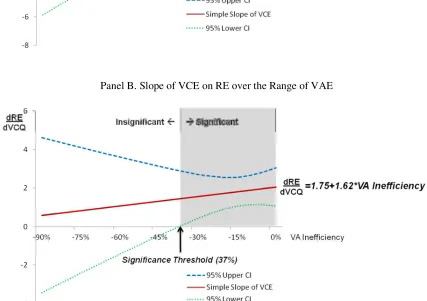
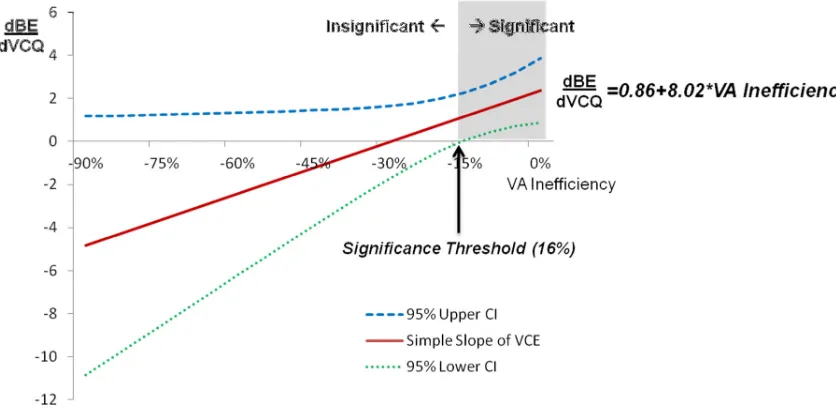
effects of VA on VC-VE link and VC-BE link, but not on VC-RE link. Floodlight analyses
of the two interaction effects provide an exciting opportunity to advance our knowledge of
when they achieve a modest level of VA efficiency, but it can acquire synergy from VA on
VC-BE only when it achieves a high level of VA efficiency. Given that customer equity
dimensions (value, relationship, and brand equity) ultimately influence the firm performance
altogether, the results imply that firms should capitalize on its value extracting activities such
as relational marketing, decision on product launch timing, marketing mixes for customers to
enhance performance, especially performance assessed by customers.
We believe that the current study offers numerous theoretical and managerial
contributions. First, we aim to analyze a firm’s processes comprehensively and collectively.
Research to date has examined individual marketing processes and marketing capabilities,
and their effects on the firm’s performance separately. Related to this notion, Morgan (2012)
recently showed concerns about the current marketing research practice, stating “most work
in marketing area focuses on a firm’s overall marketing capabilities and fails to identify the
specific capabilities that make up the overall capability.” To the best of our knowledge, few
pieces of research consider marketing activities extensively except for a conceptual study by
Srivastava et al. (1999) and an empirical study by Ramaswami et al. (2009). Second, from a
theoretical point of view, we suggest that VC and VA complement each other (Lepak et al.
2007; Teece 1986), contrary to the recent view that emphasis on either VC or VA substitute
each other because of limited resources (Mizik and Jacobson 2003). Our view is important
because it suggests that the firm should balance value creation and value appropriation to
derive maximum output despite the pressure of resource limitations.
This paper first gives a brief overview of CE. Second, it will then go on to discussion
and comparison of VC and VA of the firm. We will compare three perspectives about the
effects argument. The third part will review management and marketing literature on VC and
VA, and literature on marketing capabilities in relation with VC and VAto identify a firm’s
processes. Fourth, we explore how interaction between VC and VA processes influences
customer equity and introduce our methodology and analyses to verify our conceptual
framework. Finally, the study concludes with a discussion of the implication of the findings
CHAPTER 2
CONCEPTUAL FRAMEWORK
Customer Equity
As the focus of a firm’s activities shifts from products to customers, the value of a
firm’s customers and the area of customer management have been gaining increasing
attention from academia and practice (Hogan et al. 2002). At the same time, practitioners and
academic researchers found surprising anecdotal evidences that quality products and strong
brands may not always enjoy market success. Answering to changes of economy and firms’
interests, researchers have proposed the concept of customer equity which suggests that a
firm derives value not only from its products, but also from its customers (Rust et al. 2000).
Identification of customers as one of the valuable resources of the firm corresponds with
market-based asset argument of Srivastava and his colleagues (1998).
Building upon research on value of customers (Blattberg and Deighton 1996;
Schmittlein, Morrison, and Colombo 1987), Lemon et al. (2001) formally define customer
equity as the total of the discounted lifetime values of the firm’s customers. They argue that a
firm’s customer value is quantifiable in a metric form, and propose an estimation method
(Rust et al. 2004). Since it was developed when marketers and researchers felt responsible
for accounting for the effectiveness of marketing spending, the customer equity concept has
been welcomed by practitioners and academicians alike. Origination of the concept is
and some firms both in B2C and B2B have adopted CLV to evaluate and manage their
marketing activities, and assess value of customers they possess1.
Researchers have developed various mathematical modeling approaches for CLV
estimation. CLV estimation methods are overall divided into two groups: disaggregate-level
approach and aggregate-level approach. While the former focuses on calculation of
individual-level CLV, the latter focuses on calculation of firm-level or average CLV (Kumar
and George 2007). In addition to devising estimation methods, researchers attempt to
associate CLV to the value of the firm. For example, Kumar and Shah (2009) empirically
show that CLV can be a good predictor of the firm’s market capitalization measured by the
stock price of the firm. Wiesel, Skiera and Villanueva (2008) see CLV metric as one of the
asset measures of the firm and attempt to integrate it into financial reporting.
However, even if aggregate-level approach considers firm-level variables to affect
customer equity, the focus so far has been restricted to marketing mix or sales activity levers.
For example, a review paper by Kumar and George (2007) shows that estimation models
commonly include a firm’s promotional expenses, marketing cost, number of customer
contact, and so forth. Since CLV estimation requires complex assumptions about customers’
future behavior using probability distribution and historical transaction data, application of
methods may not be feasible to all firms (Bolton and Tarasi 2006; Persson and Ryals 2010).
As an alternative to quantification of CLV, Rust et al. (2000, 2004) and Lemon et al. (2001)
propose a different approach, which focuses on customers’ subjective assessment of three
dimensions of CE: value, relationship and brand equity. Since the CE framework
conceptually posits that a firm’s value derives from customers, and customers are actual
1
evaluators of different dimensions of CE, customers’ subjective assessment has been
accepted as a measure of CE. For example, Vogel et al. (2008) show that customers’ positive
evaluation of the three dimensions would predict customers’ future purchase intention and
behavior. Since these dimensions rely on customers’ subjective assessment, one can
indirectly estimate the firm’s CE based on those assessments. Similarly, Matsuno et al.
(2014) use perceptual measures of customer equity in terms of customer satisfaction,
retention, and acquisition. Extending research based on subjective measures, Persson and
Ryals (2010) propose CE scorecard which consists of subjective evaluation of CE’s three
dimensions from survey and actual customer behavior from database. Given that research in
marketing still relies on customer survey data to calculate customer value (Vogel et al. 2008),
use of subjective assessment of customer equity as our dependent variable for this study can
be supported.
In spite of development of estimation of CLV and subjective measures of CE, the
question of how to increase customer equity has been barely researched. Even though some
suggestions are made to investigate marketing activity levers (Lemon et al. 2001; Rust et al.
2000), those levers are restricted to micro-level variables and specific marketing mixes, but
few attempts are made to examine a firm’s marketing processes at a strategic level. Lack of
research would run counter to Rust et al.’s (2000) argument that “figuring out how to drive
customer equity is central to the decision making of any firm.” To make good use of CE
framework for strategic decision making purposes, it is imperative to investigate processes
which can enhance CE from a managerial and strategic perspective. To address this issue, we
Value Creation and Value Appropriation
One of the core concepts and widely discussed topics in marketing is value.
Marketing is defined as “the activity, set of institutions, and processes for creating,
communicating, delivering, and exchanging offerings that have value for customers, clients,
partners, and society at large (AMA 2007).” From a firm’s perspective, a main objective of
marketing activities, more broadly a firm’s activities, is to deliver a product/service that has
potential value to stakeholders.
On the other hand, some scholars focus on customers’ perspective on value.
Woodruff (1997) defines customer value as “a customer’s perceived preference for and
evaluation of those products’ attributes, attribute performances, and consequences arising
from use that facilitate (or block) achieving the customer’s goals and purposes in use
situations.” Customer’s view of value corresponds with the notion that value is determined
exogenously (Bowman and Ambrosini 2001). One thing that should be noted here is that
value concept includes not only assessment of products or services that are main objects of
consumption, but also relationships and even brands.
The first definition above underscores the functions of the firm as value provider
while the latter definition emphasizes the assessment by customers as value consumers.
When the firm’s activities regarding value are associated with the customer’s assessment, the
firm’s performance including perceptual and financial performance is likely to increase. In
this study, we examine whether value-oriented activities of the firm influence value
assessment of customers, especially for three dimensions of customer equity. Among many
diverse activities of the firm centered on value, theories in business have been paying
Creation is associated with generating intrinsic value for customers while appropriation is
associated with harvesting value or return from customers in the market.
Creation and appropriation2 concepts have deep roots in economics and management
disciplines and been discussed in the context of a firm’s roles and functions. The main roles
of firms are to create economic rent3 and to distribute or appropriate the created rent among
stakeholders. Economics literature suggests several approaches to create rent such as
individual firm’s profit maximization, industrial structure (e.g., monopoly rent) and
innovation (e.g., Ricardian rent), to name a few (Makadok 2001). Extant research in
management literature so far has been good at discussing and establishing the sources of
value creation and value appropriation, suggesting selection of resources (i.e., resource-based
theory) and deployment of resources (i.e., dynamic capability theory) (Makadok 2001).
However, a major problem with these approaches is that they emphasize the firm’s
perspective to create and appropriate value. Considering that value is determined not only by
producers (i.e., firms) who invest resources and efforts and build capabilities, but also by
beholders (i.e., customers) who actually purchase and consume their products and services,
those views on value creation and appropriation seem to shine only one side of the coin.
Recent theoretical development proposes a new perspective which integrates the
diverse viewpoints of the firm and its customers. According to this new perspective, value
creation refers to the firm’s activity that “provides a greater level of novel and appropriate
benefits than target users or customers currently possess, and that they are willing to pay for
2
Appropriation, extraction, and capture are interchangeably used in economics and management literature, and this study also uses those terms interchangeably.
3
(Lepak et al. 2007).” This definition is important because it suggests that value creation
involves not only the firm’s activities to create, but also customers’ assessment and
purchasing intention. Priem (2007) also refers to value creation as “involving innovation that
establishes or increases the consumer’s valuation of the benefits of consumption (i.e., use
value).” This notion implies that value lies inherently in the eyes of beholders. It should be
noted that use value concept is not limited to original usage benefits that the product is
intended for, but is extended to other benefits that customers will get out of usage. For
example, in a B2B context, an engineering company uses a customized component in place
of a standardized component despite high cost since it eventually alleviates workload of
engineers who design facilities, and reduces cost of construction. Value creation processes of
the firm include innovation activities such as R&D for new product and new technology
development, innovative production process, and exploring sources of new supplies (Mizik
and Jacobson 2003). In addition, according to knowledge-based resource theory of the firm,
knowledge, more specifically customer knowledge and competitor knowledge codified into
the firm and the firm’s members is an inimitable resource for value creation (Kang, Morris,
and Snell 2007). In this regard, a firm’s activities to create knowledge through market
learning about customers and competitors can be considered as value creation process as well
(Felin and Hesterly 2007). As shown in the definition, novelty and appropriateness are
considered as attributes of outcomes of value creation processes such as innovative
technology and new product development (Im and Workman 2004; Moorman 1995).
On the other hand, value appropriation refers to the firm’s activity that “captures or
retains consumers’ payment over competition (Priem 2007).” This definition highlights the
or price that customers actually pay for (Priem 2007). From the customer’s perspective, value
appropriation accentuates consumers’ selection of the product from among a consideration
set and actual payment for it (Priem 2007). When the number of competitors increases in the
market, the amount of value captured by the firm will decrease because players need to share
the total value created and extracted from the market (Lepak et al. 2007). There are three
fundamental ways for a firm to increase extracted value: increasing market share, marking
premium prices given the same cost structure with competitors, and reducing costs given the
same price on the product. Many marketing activities such as communicating including
advertising and pricing can be considered as being responsible for the first two value
appropriation processes (Mizik and Jacobson 2003) along with the last manufacturing
efficiency to reduce costs. Similarly, Teece (1986) calls a firm’s processes to capture value
from innovation as “complementary assets”, exemplifying marketing, competitive
manufacturing, and after-sales support.
Marketing activities are involved both in value creation and appropriation for the
firm. Previous research suggests capabilities and processes such as R&D capability
(Krasnikov and Jayachandran 2008), information processing capability (Hillebrand, Nijholt,
and Nijssen 2011; Jayachandran, Sharma, Kaufman, and Raman 2005; Selnes and Sallis
2003), new product development and product management (Morgan 2012), customer
responsiveness (Jayachandran, Hewett, and Kaufman 2004) and co-creating value with
customers (Payne, Storbacka, and Frow 2008; Vargo and Lusch 2004) for creations aspect
that increases intrinsic use value. Additionally, specialized marketing capability (Vorhies,
Morgan, and Autry 2009) in association with marketing mix (Vorhies and Morgan 2005),
Fang, and Palmatier 2011) are suggested as appropriation processes that increase exchange
value. Extant marketing research has proposed these creation and appropriation processes are
related to customer equity and performance of the firm independently or interdependently.
Previous research, however, deals with a firm’s processes and capabilities either
separately or collectively, and accordingly fails to provide a comprehensive picture of the
firm’s marketing processes with regard to value creation and appropriation. Following
Moorman’s (2012) request, one purpose of this thesis is to provide an integrative structure of
marketing processes of the firm with regard to value creation and value appropriation.
Yet, the distinction between VC and VA may not be so overt for some processes. For
example, previous literature proposes that customer responsiveness should be a creation
process since it highlights the importance of collecting customer information on customers’
needs, and applying such knowledge to creating new products (Homburg, Grozdanovic, and
Klarmann 2007; Sok and O'Cass 2011). That notion underscore the marketing’s role for
information acquisition, transmission and utilization processes (Moorman 1995). Contrarily,
some other research narrowly sees responsiveness pertaining to appropriation because they
focus on frontline functions’ capability that retains customers by resolving customers’
imminent problems (Ramani and Kumar 2008).
To address confusion, we classify marketing functions and capabilities into VC and
VA in the following manner. First, VC involves generating inherent use value of products
and services for customers through innovation and invention activities (Priem 2007).
Therefore, an activity “that is involved in providing a higher level of novel and appropriate
benefits than target users or customers currently possess” can be considered as a VC process.
related to a VC process. For example, since a firm’s market learning activity to produce
customer and competitor knowledge can be a source for product development, it can be
considered as a creation process. Likewise, a firm’s attempt to build a relationship with a
supplier for new products can belong to creation process such that it emphasizes provision of
creative or new value to customers.
On the other hand, Lepak et al. (2007) suggest two operating mechanisms for VA:
competition and isolating mechanisms. As appropriation relates to division of created value
among stakeholders, the increasing number of competitors in marketplace precludes the
ability for a firm to set higher exchange value/price and maintain higher revenue
(Brandenburger and Stuart Jr. 1996). On the other hand, isolating mechanisms such as
resources and capabilities that are so ambiguous that competitors cannot imitate allow the
firm to achieve increased customer pool, premium price of products and services, and
decreased production cost, and ultimately increased sum of exchange value that the firm
would get (Barney 1991). A firm’s marketing processes such as decision making of product
launch timing, marketing mixes, etc. are often embedded and routinized, and therefore
competitors hardly replicate (Powell and Dent-Micallef 1997; Zahra and George 2002).
Additional examples of isolating mechanisms are reputation, economies of scale, relationship
with customers, and so forth (Barney 1991). In short, a firm’s processes to operate as
isolating mechanisms to restrict competition will be classified as VA process.
Relationship between VC and VA
Then, what is the relationship between VC and VA? This question is managerially
or balance between VC and VA, and how to increase value of the firm (i.e., customer equity)
and ultimately performance of the firm. Unfortunately, in spite of calls made to evaluate the
relationship between VC and VA (Lepak et al. 2007), we do not seem to know much about
the relationship between creation and appropriation. In the following discussion, based on
marketing and management literature, we will unfold and compare three major perspectives
about the relationship between VC and VA.
First, value chain analysis (VCA) that partitions the firm into diverse functions hints
that the primary activities of a firm can be divided into VC and VA activities (Porter 1985).
According to VCA, operations that are involved in manufacturing a product with support of
inbound logistics constitute the first part of primary activities of the firm. Since those
activities involve actual manufacturing processes of a product that consumers use, those
activities manifest value creation processes. Next, marketing and sales activities supported by
outbound logistics constitute the second part of the primary functions, and they are
responsible for communicating and delivering the created product to customers. In addition,
since customer service functions help solve customers’ problems on the spot and keep
customers engaged in the relationship with the firm, they represent a value appropriation
process. When value chain is augmented to vertical value chain of the industry, the
subsequent relationship from VC and VA applies to inter-organizational relationship. For
example, Brandenburger and Stuart (1996) define created value as the ultimate buyer’s
willingness-to-pay subtracted from the initial supplier’s opportunity cost, and each player in
the chain share some portion of value according to their bargaining power. To sum, value
VA, and therefore VA mediates the relationship between VC and customer equity of the
firm, and subsequently, the firm performance.
Second, another research stream advocates incompatible roles between VC and VA.
An early study on the relationship between VC and VA proposed that incongruence in their
goals would give rise to tension (Ruekert and Walker 1987). For example, R&D department
that is more involved in technology feasibility and marketing department that is more
involved in understanding and meeting customers’ preference often collide although their
ultimate goal is to develop a new product. Extending this perspective, studies investigate
cause of conflicts based on resource allocation or strategic emphasis between the two.
Resource allocation perspective presumes that since the firm’s resources are limited, the firm
needs to determine whether to emphasize either VC or VA, depending on the firm’s situation,
and therefore VC and VA are considered as trade-offs. For example, Mizik and Jacobson
(2003) view R&D as VC and advertising as VA, and empirically compare the effect of
strategic emphasis of one over the other process on stock performance. They demonstrate
that when the management team of the firm strategically emphasizes VC, VA receives less
attention and therefore its role becomes restricted. With regard to performance, they
empirically showed that emphasis on VA increases financial performance of the firm
measured by stock return while emphasis on VC under financial difficulties would improve
the firm’s performance. Their research indicates that VC and VA potentially substitute for
each other even though they did not offer an explicit test of the conflicting relationship.
Third, from a synergistic effect perspective, VA should complement VC to increase
the firm’s performance. As we see in value chain and resource allocation perspective, a
but a variety of processes of the firm involving different functional departments can complete
VC and VA for customers. Although VC is involved in producing benefits or use value for
customers, VA should be involved in translating and communicating created benefits to
customers (Ruekert and Walker 1987). Therefore, it is critical to achieve inter-functional
collaboration to create and deliver value for customers, and capture value from the product
and customers (Jaworski and Kohli 1993; Kohli and Jaworski 1990; Li and Calantone 1998;
Narver and Slater 1990; Vorhies et al. 2009).
If more than two departments compete over the limited resource of the firm, neither
VC nor VA may be executed well. Value can be captured by the firm only when customers
have access to and pay for the product. VA activities such as marketing communication
provide information about the product/service to customers, and therefore it eases customers’
information access. Without the firm’s communication of the product with customers, access
would be very limited to a small number of customers. Effective VA such as advertising and
distribution helps customer access information, and ultimately induces their payments for the
product. In addition, effective marketing communication helps customers have emotional
attachment to the product or brand, and therefore it increases emotional utility and ultimately
claims premium price in the market. These facilitating roles of VA can occur in almost every
marketing function in a firm such as pricing, channel management, selling, marketing
planning and implementation, etc. In this sense, as Lepak et al. (2007) suggested, value
appropriation may complement value creation. Additional support is provided by Aspara and
Tikkanen (2013) who suggest that firms that emphasizes both VC and VA would have better
performance. However, they fail to show empirical evidence of a moderating effect between
Although we acknowledge that VC and VA may compete for resources and that there
are tradeoffs between the two (Mizik and Jacobson 2003), we follow prior research and argue
that VC and VA can be pursued simultaneously at the organizational level (e.g., Lepak et al.
2007; Aspara and Tikkanen 2013). More specifically, following the nuance of a synergistic
perspective of VC and VA, we argue that VC depends on the level of VA to increase
customer equity. It is true that there exist some conflicts among different departmental
functions in the organization, for example, between R&D and marketing (Ruekert and
Walker 1987). Especially when it comes to allocating finite budget to different functions of
the firm, tensions may be elevated among departments. However, according to behavioral
and procedural perspectives about role of marketing such as market orientation, a firm’s
processes are interconnected and collaborate with each other to improve performance of the
firm (Jaworski and Kohli 1993; Kohli and Jaworski 1990; Narver and Slater 1990).
Furthermore, VC processes of the firm can only enhance potential of economic or monetary
value, and the potential is not realized and transformed into economic value until the firm
interacts with markets and competes against other firms to extract customers’ payments
(Moran and Ghoshal 1999). A firm’s commercialization capabilities are needed to exploit
financial return from the firm’s assets such as technology (Lin, Lee, and Hung 2006; Teece
1986). In conclusion, we propose the moderation relationship between VC and VA such that
VA complements VC on CE. Formally put, we posit the following proposition:
Creation and Appropriation Processes in Marketing
Since our fundamental conceptual framework is based on VC and VA, we will
examine organizational processes in marketing to increase performance of the firm (i.e.,
customer equity in this study). Business process refers to a set of activities to design and
execute work practices in order to acquire and retain customers by providing value to them
(Li and Calantone 1998; Srivastava, Shervani, and Fahey 1999). Given that one of the
organizational goals is to achieve competitive advantage, the notion of business process
conforms to that of (dynamic) capabilities (Day 1994). According to dynamic capabilities of
the firm, the firm’s processes along with positions and paths determine competitive
advantage, which ultimately leads to the firm’s performance and value – CE in this study
(Teece, Pisano, and Shuen 1997). Morgan (2012) also provides resemblance between
processes and capabilities, defining marketing capabilities as “the specialized, architectural,
cross-functional, and dynamic processes by which marketing resources are acquired,
combined, and transformed into value offerings for target market(s).” Consequently, building
upon Morgan (2012)’s notion, we encompass both business processes and capabilities in
literature review with regard to VC and VA.
To locate organizational processes and capabilities relevant to marketing function, we
systematically review the literature. We used creation and appropriation as main keywords
for search, and we also included similar concepts from literature. For example, we use value
creation, value appropriation and value capture for value aspect, relationship creation and
relationship appropriation for relationship aspect, and finally we used brand management,
brand creation, and brand value creation for brand aspect. We limited journal sources to
Knowledge as the database source. For marketing journals, we selected JM (Journal of
Marketing), JMR (Journal of Marketing Research) and JAMS (Journal of The Academy of
Marketing Science). In addition, we included JA (Journal of Advertising) and JBR (Journal
of Business Research) for finding related to customer relationship and brand equity drivers
for customer equity. For management journals, we selected AMJ (Academy Of Management
Journal), SMJ (Strategic Management Journal), JOM (Journal of Management) and MS
(Management Science). As a caveat, it should be noted that our literature review may not be
exhaustive, but summarize the broadly examined marketing processes and capabilities.
After reviewing literature and identifying various processes and capabilities regarding
VC and VA, we develop a scheme to organize processes. Borrowing from the classification
by Srivastava et al. (1999), we organize marketing-related tasks into four broad processes:
customer, product, supply chain and communication processes. These processes have been
empirically validated to significantly affect the creation of customer value, and ultimately the
performance of the firm (Ramaswami, Srivastava, and Bhargava 2009). Porter (1985) also
points out these processes as primary functions of the firm to create value for customers. Yet,
unlike Srivastava et al. (1999) who suggest CRM (customer relationship management) as an
encircling concept including customer learning and building relationship, we isolate CRM
into customer-oriented process to identify customers’ needs, and communication-oriented
process to communicate the product with customers. We do so since we believe that
organizational learning and information dissemination within the firm are more relevant to
customer relationship for product development while product and information provision are
As we proposed, a firm’s processes may not make identical influence on customer
equity, but play different roles. Some processes contribute to creating inherent value of a
product/service while other processes contribute to realizing monetary value in the
marketplace. Therefore, we split each process into two dimensions according to their
contributions to either VC or VA. As aforementioned, VC pertains to a firm’s activities to
provide novel and meaningful solutions for customers, and it determines intrinsic value of a
product/service. On the other hand, VA relates to isolating mechanisms to detain competitors
and incur more exchange value from customers, and it determines extrinsic value of a
product in relation to competition. Among others, processes such as human resources,
accounting and finance are excluded since they are not directly related to VC or VA, but they
are supporting activities for VC and VA (Porter 1985). In the meantime, we do not consider
communication VC process. Since communication process does not create a product per se,
but involves in ex post production process, we presume that communication is associated
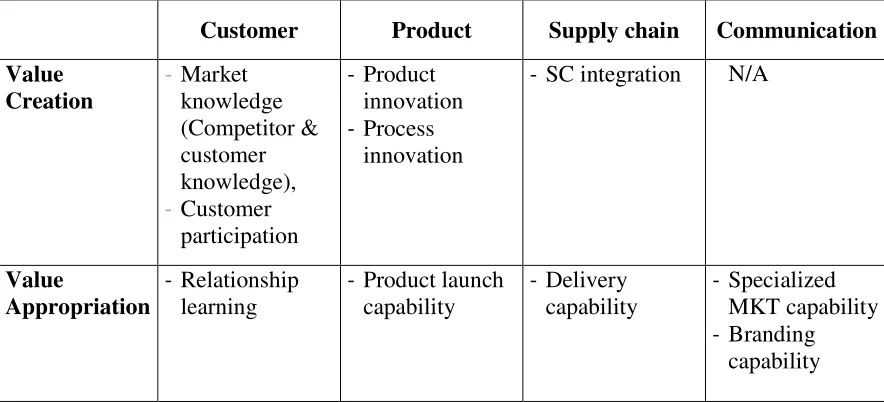
only with VA. As a consequence, we populate seven cells of Table 1 with processes that have
been discussed in extant literature.
First, customer-oriented process highlights importance of customer information and
interacting with customers (Ramani and Kumar 2008). We consider market learning about
customers and competitors and customer participation as customer-oriented VC since
knowledge of customers and competitors and customer participation at new product
development stage help to create knowledge and provide foundation for ideas of novel and
meaningful use value. We assign relationship learning as customer VA because it contributes
to acquiring and retaining customers at the firm-customer interface. Second, product-oriented
identify product and process innovation as product VC since they are regarded as core
processes of creation. We also classify product launch capability as product VA since it
determines success of a product in a competitive market. Third, supply chain process
manifests secured acquisition of physical or informational inputs for creating goods and
services and delivery of produced products to customer. We classify supply chain integration
as supply chain VC because it helps the firm generate creative products with the aid of
suppliers. On the other hand, proper delivery of produced goods at promised time can secure
customers’ payment and long-term relationship, and therefore delivery capability is classified
as supply chain VA. Finally, communication process plays a significant role to attract more
customers and make them stick to the product and the firm, and finally induce customers’
payment for products and services. We categorize specialized marketing capability and
branding capability as communication VA.
Integrating overarching VC and VA framework and respective organizational
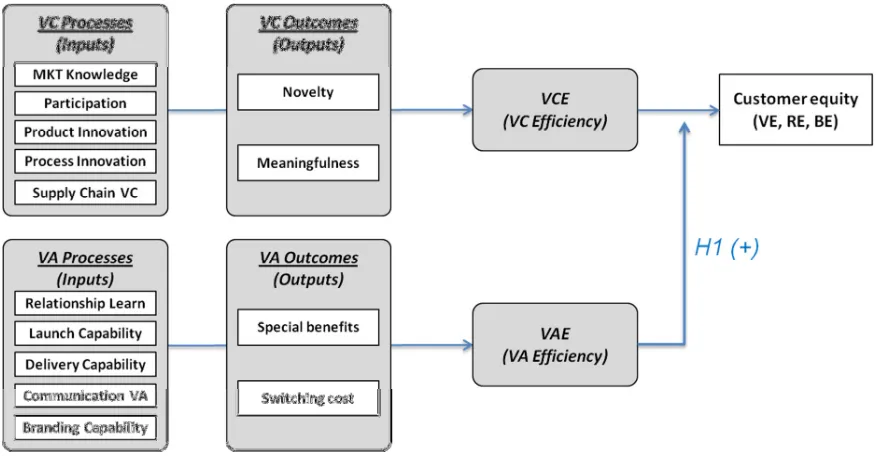
processes together, I depict the conceptual model of the study in Figure 1.
The following section discusses how individual VC and VA processes contribute to customer
equity.
Value Creation Processes and Outcomes
Customer Value Creation
Customer value creation process involves understanding customers’ expressed or
organizational memory. It encompasses all activities pertaining to organizational creation of
knowledge about customers’ needs and competitors’ products and strategy. Although
extensive research has been carried out on learning and using customer/market knowledge,
marketing discipline rarely distinguishes between learning and using. It is likely that
marketing’s overemphasis of application of market information to new product development
and customer service leads to equivocality between learning and use. For example, Luo and
his colleagues (2006) define market learning as stock of knowledge about developing new
products, building brand image, and establishing channel partner relationships. However,
organizational learning theory apparently delineates between learning and using. Behavioral
perspective of market orientation also points out that learning separates from using such that
intelligence generation and dissemination indicate learning aspect while responsiveness
implies use aspect (Kohli and Jaworski 1990). Similarly, Moorman (1995) suggests
differentiation between learning and utilization, categorizing market information processes
into information acquisition, information transmission, information utilization which is again
divided into conceptual utilization and instrumental utilization. Additional support is
provided by Sinkula (1994) who argues that organizational learning is composed of
knowledge acquisition, information distribution, information interpretation, and
organizational memory, but both information use and relevant decision making do not
necessarily constitute organizational learning.
With respect to specific roles of learning, customer knowledge creation process does
not yield a product perse. Rather, it produces knowledge about customers and markets, and
builds a foundation for segmenting customers, targeting a specific customer segment, and
organizational learning can be a significant source to create customer value (Slater and
Narver 1995). Li and Calantone (1998) also define market knowledge competence as “the
processes that generate and integrate market knowledge,” and divide it into customer
knowledge process and competitor knowledge process. The purpose of the former process is
to discover customers’ inherent needs, and the latter is to find competitors’ ability and
strategy. Similarly, Jayachandran et al. (2004) stress the role of customer knowledge and
relevant processes, and conceptualizes customer knowledge process, which refers to presence
of firm processes to identify customer needs. Building upon market orientation, Morgan and
his colleagues (2003) refer to customer and competitor knowledge processes as architectural
marketing capability as opposed to special marketing capabilities that we discuss in VA
section (Morgan, Vorhies, and Mason 2009). Taken together, these processes allow the firm
to formulate differentiation strategy which makes products and services unique from
competitors and relevant to customers. Once those knowledge processes are established in
the firm, the firm is likely to earn benefits from it through information use, which occurs
during the product value creation process.
No matter how proactive a firm becomes, learning from customers poses challenge to
the firm. Learning is performed by organizational members, and therefore some valuable
information can be filtered out either during the codification process or when the information
is disseminated across the organization. Furthermore, since customers’ needs are dynamic
and constantly changing, but stored knowledge is static, it may therefore not reflect
customers’ current needs. Use of outdated information could result in product failures in the
market. As a consequence, the firm needs not only stationary knowledge from learning
knowledge by customers. To cope with such challenges, today’s firms try to have customers
participate in the firm’s product development process.
Customer participation refers to “the extent to which the customer is involved in the
firm’s new product development process” (Fang 2008). Participating customers provide or
share information, make suggestions, and become involved in decision making during the
product creation and delivery process (Chan, Yim, and Lam 2010). Some firms organize
panels of customers who share their opinions about their products and competing products,
and even ask them to propose ideas for a new product. For example, 3M relies on groups of
experts – called leadusers – who are from seemingly unrelated areas, but possess expertise
in various fields (von Hippel 1986). The firm often holds workshops for lead users to
generate radically new ideas for a new product. In addition to customer participation, some
firms empower customers and get them involved in choosing a design and specifications for
a new product to be manufactured among prototypes (Fuchs and Schreier 2011; O'Cass and
Ngo 2011; Ramani and Kumar 2008).
Research to date has looked at two roles of customer participation according to the
level of customers’ involvement in the firm’s internal process. The first role is customer
participation as a source of information, and the second role is customer participation as a
co-developer. Regarding the first view, Bonner (2010) suggests that customer interactivity
enhances better understanding of customer needs, which ultimately affects better
performance of the new product. Extending this, Fang (2008) classifies customer
participation into customer participation as a codeveloper (CPC) in comparison with
customer participation as an information resource (CPI), and emphasizes customer
not only collect hands-on knowledge for immediate use, but also to enhance firm-customer
interactions and customer-customer interactions (Ramani and Kumar 2008), which
eventually enhances assessment of the firm’s relationship with customers.
Customer participation is more common in business-to-business contexts than in
business-to-customer contexts since industrial products require more customization.
Customer participation in business-to-business contexts has many forms from face-to-face
interactions, group discussions, working meetings, etc (Bonner 2010). Customer participation
would increase customers’ assessment of value of products and services, and ultimately
enhance customer satisfaction (Chan et al. 2010). They also suggest three mechanisms for
better assessment of economic value, which are better product quality, customized product,
and increased control. Customer participation gives not only economic benefits, but also
psychological benefits for a supplier and a customer (Chan et al. 2010). Cooperation at
product development process can reduce unnecessary transaction cost, and mitigate tension
between suppliers and customers due to disagreement with specification of prototypes. As a
result, customers often become satisfied with the customized product and maintain cordial
relationships.
Product Value Creation
Since the goal of new product development process is to create and enhance intrinsic
use value of the product, it is one of the significant value creation processes. However, since
the exchange value of the product is not determined and realized until it reaches the
marketplace and is purchased by customers, the new product developmentprocess itself is
Previous studies indicate two types of innovation activities within the new product
development process: product innovation and process innovation (Crossan and Apaydin
2010; Damanpour and Gopalakrishnan 2001; Utterback and Abernathy 1975).Product
innovation refers to the extent to which products and services a firm produces are new and
creative for customers’ need (Damanpour and Gopalakrishnan 2001). Processinnovation
refers to the degree to which the processes used by a firm to manufacture and deliver
products are creative (Crossan and Apaydin 2010).
First, product innovation directly involves enhancing benefits and use value for
customers as a firm’s offerings. Therefore, it is considered as a key component for the
success of the product (Henard and Szymanski 2001). For a product to deliver benefits to
customers, it should reflect customers’ needs and wants. The product also needs to deliver
advantageous or distinguished benefits to customers since it also ultimately competes with
other products. For these reasons, it is often said that product innovation is externally focused
(Damanpour and Gopalakrishnan 2001).
The firm needs two types of competences to achieve product innovation:
technological competence and customer competence (Danneels 2002). Sources of
technological competence vary from internal departments to external sources. Internal
technology competence can be achieved through R&D activities of the firm. Research also
pays attention to external sources for technology competence such as supply chain, which we
will discuss in the section of supply chain value creation. Regarding the second competence,
the firm often collects ideas for a new product based on formal meetings, informal
development process. I presume that customer participation and product innovation are
interconnected as inputs for value creation processes.
Second, process innovation includes “new production methods, new management
approaches, and new technology that can be used to improve production and management
processes” (Crossan and Apaydin 2010). In other words, process innovation focuses on
creating new value through internal improvement (Damanpour and Gopalakrishnan 2001).
Transferring benefits earned from process innovation to customers may depend on
competitiveness of the industry. For example, when a firm develops a cost effective
manufacturing process, the firm can enjoy higher income from reduced costs. As competition
becomes intense, the firm can use cost effectiveness as cost competitive advantage to
maintain their market share and revenue level by reducing prices. However, from a firm’s
perspective, both product and process innovation potentially breed high benefits despite
initial high costs due to their newness. From a customer’s perspective, innovative products
directly lead to increased customers’ use value, and creative processes results in increased
customers’ benefits when they are applied and projected to products.
One may suggest that product-process innovation is more common than a
process-product innovation pattern. However, Damanpour and Gopalakrishnan (2001) indicate that
concurrent innovation both in product and process would lead to better performance of the
firm. Product innovation leads to radically increased use value and process innovation
provides incrementally increased use value in support of product innovation. In view of the
previous study, we consider product innovation and process innovation as components for
Supply Chain Value Creation
The next creation process is upstream supply chain integration that connects the firm
and its suppliers. The need for supply chain is that no single firm today manufactures a
product within its own boundary, and hence needs to be connected with diverse suppliers that
provide products and services. However, division of functions across the firms incurs
transaction costs which come from intention to safeguard the assets, to monitor behavior and
outcome of the business partners, and to adapt to environmental change (Rindfleisch and
Heide 1997). Scholars suggest that supply chain integration can solve these cost issues to a
large degree. A well-managed supply chain allows the integration of business processes from
end-user through suppliers of products, services, and information (Alvarado and Kotzab
2001).
Specific benefits to be earned from the integration for supply chain creation process
can be seen from four perspectives: knowledge transfer, creative product differentiation,
inventory cost reduction, and transaction cost reduction. First, supply chain integration helps
the firm be in the know of raw materials and components, and customers and market
conditions that channel members serve. The firm which plans on developing an innovative
product needs to search for suppliers that would satisfy the requirements for the new product.
Since suppliers often have more knowledge about raw materials, components, and
technology for components, integrated relationship with suppliers can enhance the firm’s
ability to determine feasibility of developing a new product. For example, when a company
plans to develop a commercial signage with high resolution screen, it has to do research
price. Once the firm identifies a proper supplier, it also has to examine whether the supplier’s
capacity can meet the focal firm’s manufacturing schedule.
Second, related to the first point, integration helps the firm to differentiate its product
from those of competitors (Srivastava et al. 1999). Stable relationships allow supply firms to
reach economies of scale, and allow the firm to achieve competitive advantage in cost and
price. Competitive advantage, in turn, enables the suppliers to enjoy resource slack since it
secures sales and proper margin regardless of competition. Such resource slack can lead to
the supplier investing in R&D and innovation activities. On the other hand, the focal firm can
develop innovative products with the help of their suppliers. For example, Japanese
manufacturers of car components often keep secure and long-term relationship, and they
have been providing innovative products such as CVT (continuously variable transmission)
and battery pack for hybrid cars. Those benefits help car manufacturers produce competitive
products in terms of functionality as well as quality and price. In addition, close relationship
with customers allows the firm to produce customized products for consumers based on the
information that customers provide.
Third, the information from downstream supply chain can be the source to reduce
cost relevant to delivering products to customers. When the firm knows sales and inventory
level on customer’s side, it can manage manufacturing schedule and their inventory of raw
materials. Ultimately, knowledge from customers helps the firm reduce unnecessary costs.
From a transaction cost perspective, the integrated relationship also decreases costs for
negotiation, safeguards, and coordination. Thereby, the firm can reduce the total cost of