other industrial waters, and strong alkali solutions. It is possible to automate fully the preconcentration and separation/analysis procedure. In an example of this trace levels of Mg2#, Ca2#and transition metals in biological and environmental samples are preconcen-trated on two iminodiacetic acid-type chelating ion exchanger and one strong acid cation exchanger con-nected in series. The preconcentrated metal ions are then removed from the three columns and the concen-trated metal ion mixture is separated on an analytical Ion Pac CS5 column by an elution programme that takes into account pH, ammonia/ammonium ion buf-fer concentration and PDCA concentration. Detec-tion is by absorpDetec-tion after postcolumn reacDetec-tion of the metal ions with PAR.
See also: II/Chromatography: Liquid: Mechanisms: Ion Chromatography. Extraction: Analytical Inorganic Extrac-tions. Ion Exchange: Theory of Ion Exchange. III /Ion Analysis: Liquid Chromatography.
Further Reading
Barkley DJ, Blanchette M, Cassidy RM and Elchuk S (1986) Dynamic chromatographic systems for the de-termination of rare earths and thorium in samples from uranium ore reRning processes. Analytical Chemistry 58: 2222}2226.
Cagniant D (1992) Complexation Chromatography. New York: Dekker.
Elchuk S and Cassidy RM (1979) Separation of the lanthan-ides on high-efRciency bonded phases and
conven-tional ion-exchange resins. Analytical Chemistry 5: 1434}1438.
Haddad PR and Jackson PE (1990)Ion Chromatography Principles and Applications, p. 232. Amsterdam: Elsevier.
Hilton DF and Haddad PR (1986) Determination of metal-cyano complexes by reversed phase ion-interaction high performance liquid chromatography and its application to the analysis of precious metals in gold process-ing solutions. Journal of Chromatography 361: 141}150.
InczeHdy J (1966) Analytical Applications of Ion Ex-changers. Oxford: Pergamon Press.
Kraus KA and Moore GE (1953) Anion exchange studies. VI. The divalent transition elements manganese to zinc in hydrochloric acid.Journal of the American Chemical Society74: 1460}1462.
Pietrzyk DJ (1989) Macroporous polymers. In Brown PR and Hartwick RA (eds) High Performance Liquid Chromatography, p. 244, New York: Wiley-Interscience. Siriraks A, Kingston HM and Riviello JM (1990) Chelation ion chromatography as a method for trace elemental analysis in complex environmental and biological samples.Analytical Chemistry62: 1185}1193. Timberbaev AR and Bonn GK (1993) Complexation in ion
chromatography} an overview of developments and trends in metal analysis. Journal of Chromatography 640: 195}206.
Weiss J (1995)Ion Chromatography, 2nd edn, Weinheim: VCH.
Wilkins DH (1959) The separation and determination of nickel, chromium, cobalt, iron, titanium, tungsten, mol-ybdenum, niobium, and tantalum in a high temperature alloy by anion exchange.Talanta2: 355}360.
Use in Gas Separation
See III / GAS SEPARATION BY METAL COMPLEXES: MEMBRANE SEPARATIONS
METAL MEMBRANES: MEMBRANE
SEPARATIONS
Y. S. Lin and R. E. Buxbaum, University of Cincinnati, Cincinnati, OH, USA
Copyright^ 2000 Academic Press
Introduction
Figure 1 Hydrogen solubility of several transition metals at dif-ferent temperatures (PH2"1 atm). (Copyright REB Research &Consulting with permission.)
amount of hydrogen. Graham went on to show that palladium and palladium}silver membranes permeate only hydrogen, paving the way for the use of metal membranes for hydrogen extraction and puriRcation. Much of the earlier knowledge in metal membranes is summarized in three reference books published in 1967}1968 (see Further Reading). Recent academic research is reviewed in seversl monographs on inor-ganic membranes and review articles. This article gives an overview of the general properties of metal membranes, followed with a description of methods that have been developed for membrane fabrication. Applications of the metal membranes in separation and chemical reaction processes and design of the metal membrane separation processes are descibed later in the article.
General Properties of Metallic
Membranes
A surprising amount of hydrogen can be absorbed reversibly by palladium alloys and by many transition metals over a large temperature range. The absorp-tion proceeds via interstitial incorporaabsorp-tion in the metal, generally leaving the crystalline structure intact. Thus, for example, face-centered cubic palladium retains its structure to the metal hydride phase, with the hydrogen progressively occupying tetrahedral and octahedral sites. The nature of the chemical bonding is still not well understood, but a widely used model assumes that the hydride is an alloy (in the usual metallic sense) of hydrogen and the host metal. Electrons from the hydrogen progressively occupy the d-bands of the transition metal, and the hydrogen exists essentially as slightly shielded protons in the host lattice. The other model is based on a predominantly covalent bond between the metal and hydrogen. In this model molecular hydrogen is dissociated to become atomic hydrogen, which subsequently forms chemical-type bonds to the host metal.
Figure 1 shows hydrogen solubility relationships for several transition metals at different temper-atures. At constant pressure, the hydrogen solubility of some metals increases with increasing temperature, while for some other metals it decreases. Figure 2 shows typical relationships of hydrogen solubility (presented in the atomic ratio of hydrogen to metal) versus hydrogen partial pressures at dif-ferent temperatures. The dashed curve in Figure 2 encloses the two-phase region of the palladium hy-dride system with-phase to its left and-phase to its right. For all metals below their hydride phase transition, the solubility increases with hydrogen pressure. The most common relationship for this is
the Sievert’s relation:
C"KsP
1
2 [1]
That is to say that the hydrogen concentration, ex-pressed as the ratio of hydrogen : metal or as the volume of hydrogen per gram of metal, is propor-tional to a temperature dependent constant (Ks) times
the hydrogen pressure to the power1
2. The power12in
eqn [1] comes from the entropic effect of every molecule of hydrogen dissociating into two hydrogen atoms in the metal.
Aside from solubility, the most important qualities of a metal for use in metallic membranes are the hydrogen diffusivity in metal and the rates of dissociation and recombination reactions on the membrane surfaces. At the upstream membrane sur-face the sursur-face reaction step consists of adsorption of H2, dissociation of this adsorbed H2into two
Figure 2 Hydrogen solubility of palladium at different hydrogen pressures and temperatures (3C) (From Lewis FA (1967)The Palladium Hydrogen System. Fig. 2.3, p. 17. New York: Academic Press.)
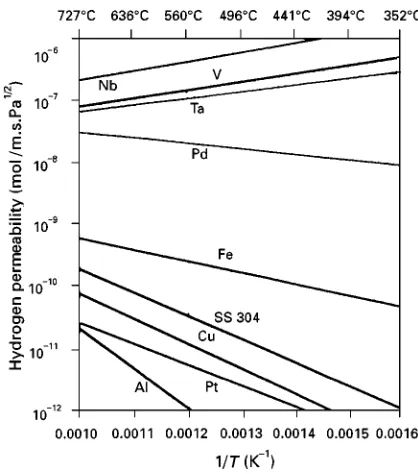
Figure 3 Hydrogen permeability of various transition metals at different temperatures. (Copyright REB Research&Consulting with permission.)
Based on the Mass Action Law, the following simpli-Red equations can be obtained to describe the com-bined effects on hydrogen permeationSux:
J"KR(PUH!PI) [2]
J"(DKs/2L) (P
1 2
I!P
1 2
II) [3]
J"KR(PII!PDH) [4]
wherePUHis the upstream hydrogen pressure,PDHis
the downstream hydrogen pressure,PI is the
imagi-nary pressure in equilibrium with the upstream sur-face of the metal, andPIIis the imaginary presure in
equilibrium with the downstream surface. KR is
a lumped rate constant for the surface reaction step. In eqn [3], DKs is the product diffusivity and
Sievert’s constant in the bulk metal membrane and L is the membrane thickness. Often DKs/2 is
called the hydrogen permeability and is plotted in Figure 3 for several metals. It should be noted that
metal membranes are practically impermeable to other gases such as helium or nitrogen due to their low solubility and diffusivity in the metals. Al-though for all the metals of interest to separation applications, the hydrogen diffusivity increases and solubility decreases with increasing temperature, weRnd for some metals (e.g. palladium) the permeab-ility increases with temperature, while for others (e.g. tantalum, niobium) it decreases. The determining fac-tor is the relative temperature dependency of dif-fusivity and solubility. Because of slow reaction steps (eqn [2] and eqn [4]), permeation membranes of Nb, V and Ta must be coated with palladium to be used for separation applications.
For most metal membranes, bulk diffusion is rate-limiting. That is, (DKs/2L) is typically smaller
thanKR. For such membranes eqn [3] describes the
Sux withPIIandPIreplaced byPUHandPDH. In this
case, the hydrogen permeance is inversely propor-tional to the membrane thickness with permeation Sux exhibiting aP12
H2dependence. This relationship is
referred to as the Richardson’s law. If the surface steps are rate-limiting, i.e. (DKs/2L) much larger
than KR, the hydrogen permeation Sux is
propor-tional to the transmembrane pressure drop. When resistances of both surface and bulk steps are equally important, the above equations are sometimes approximated with P0.7
H2 dependencies or similar
[image:3.568.298.507.437.674.2]Another critical behaviour for any metallic mem-brane is durability. Figure 2 shows that below a criti-cal temperature (3103C) palladium hydride can exist either in the-phase or-phase, depending on hydro-gen pressure and temperature. Above the critical tem-perature, palladium hydride remains in the -phase regardless of the hydrogen partial pressure. Both the -phase and -phase have the same face-centered cubic lattice structure, but the lattice constant of the latter is as much as 3% larger than the former. Thus, a hydrogen pressure swing below the critical temper-ature or a tempertemper-ature swing (above the critical pres-sure) will cause large mechanical strains during phase transformation of the palladium hydride between the two phases. These lattice strains would destroy the mechanical integrity of a membrane made of palladium alone. This phenomenon is referred to as ‘hydrogen embrittlement’. For practical application this is avoided by alloying the palladium and by lowering the hydrogen pressure sharply before the membrane cools to room temperature. The same problems and solutions are also applicable to Pd-coated transition metals.
Alloying palladium with silver results in a phase diagram with a decreased critical temperature and pressure. If we accept the metallic alloy model for metal}hydride systems, the role of silver can be ex-plained as an electron-donating behaviour where electrons from silver and hydrogen atoms compete for Rlling the 4d-band of palladium. Since 4d-band Rlling is associated with -phase formation, 40% silver prevents -phase formation entirely although most common alloys do not employ quite so much silver. Once the 4d-band isRlled, electrons from fur-ther hydrogen absorption contributes to 5s-bandR ll-ing and the net effect is decrease in both critical temperature and pressure in the phase diagram. Com-mon palladium}silver (23}25% silver) membranes and palladium}copper membranes can be operated at much lower temperatures than pure palladium mem-branes without signiRcant hydrogen-embrittlement problems. This is especially true if care is taken at start-up and shutdown to avoid exposure of the membranes to high-pressure hydrogen at room temperature.
Metal membranes are susceptible to surface pois-oning. Prolonged exposure of many metal mem-branes to sulfur or even carbon containing gases un-der some conditions could deactivate the membrane surface or change the bulk structure of thin metal membrane, affecting adversely the membrane permeation and separation properties. The current approach is to avoid this problem by removing pois-oning impurities from the gas stream prior to the contact with the membrane surface. ModiRcation of
the metal surface to improve its resistance to surface poisoning may provide an inherent solution to this problem. Research efforts in Rnding a suitable modiRcation method have been limited, but are ex-pected to increase in the future.
Fabrication of Metal Membranes
Casting/rolling is the current method for commercial production of palladium-based metal membranes. This method involves several steps. Membrane raw materials are melted at a high temperature to form ingots which go subsequently through hot or cold forging or pressing to produce tube or sheet. TheRnal membrane has a thickness typically in the range of 50 to 75m (0.002}0.003 in). The metal membranes prepared by this method are polycrystalline with large grains (submicron or micron size). Furthermore, cold rolling often generates lattice dislocation and it can enhance hydrogen solubility in palladium and some of its alloys due to the accumulation of hydro-gen around the dislocation. As a result, these poly-crystalline metal membranes have very high hydrogen solubility.
Based on the Richardson equation (eqn [3]), thin metal membranes are more desired than thick ones in terms of hydrogen permeance and metal cost savings. The problem has been in forming such membranes and keeping them stable during temperature and pressure cycling. To improve the durability, thin metal membranes have been formed by coating on porous metallic or ceramic support. Several methods have emerged in the past decade for this including liquid-phase electroless plating and chemical vapour deposition (CVD).
Electroless plating involves autocatalysed de-composition of a selected metastable metal presursor such as Pd(NH3)4X2where X can be NO3, Cl or Br in
alkaline aqueous solution at around 503C. To avoid autodecomposition of the metal precursors a stabi-lizer such as ethylenediaminetetraacetic acid (EDTA) is often added. For nonmetallic supports, the surface (substrate) should be activated, e.g. by SnCl2/PdCl,
prior to electroless plating. Palladium or pallad-ium}silver Rlms with a thickness ranging from 5 to 30m have been prepared by this method on sup-ports of porous alumina and stainless steel and on non-porous niobium, tantalum or vanadium alloy.
Thin metal membranes can also be prepared by CVD of metal salts and metal organic compounds, such as PdCl2and Pd(O2C5H7)2and can also be
Reduction of the precursor occurs directly or by countercurrent exposure to the reducing agent at 200}4003C. PalladiumRlms as thin as 0.5m have been deposited on or inside porous alumina support this way. For sputter deposition a metal target of desired composition is placed apart from the substra-te in a sputsubstra-tering chamberRlled with a working gas (argon) at low pressure (about 10\3torr). A DC or
radiofrequency AC electric-Reld gradient plasma is generated in the working gas and bombards the tar-get. Fine metal particles or atoms dislodged from the target move towards the substrate and subsequently deposit. Thin palladium and palladium}silver mem-branes have been coated on porous -alumina and dense polymer substrates by this method.
Metal membranes prepared by the vapour methods are usually nanocrystalline with grain size in the range of a few tens of nanometers. Electroless-plated metal membranes appear to be more coarse-grained. For palladium on substrate membranes, the bulk dif-fusion step in the substrate is generally the rate-limiting step. Furthermore, Rne-grained thin metal membranes appear to have a lower hydrogen per-meability than coarse-grained thick metal mem-branes. Thus, while the metal cost for Pd-coated ceramics is typically much lower than for symmetric metal membranes, the Sux is usually fairly similar and can even be lower than traditional metal mem-branes, and is typically proportional to the pressure dependence and not to P12
H2 as in eqn [3]. Similar
membrances prepared by different methods can exhibit different dependency, and speciRc rela-tionships should be obtained in order to design separ-ation and reaction processes involving these metal membranes.
Metal Membrane Applications
The major large-scale application for metal mem-branes today is hydrogen puriRcation, with most of that hydrogen used for interated circuit manufac-ture. Different circuit technologies differ in the purity of hydrogen they require, and the current needs are between 5 nines (99.999%) and 8 nines (99.999999%) hydrogen, or 0.01 to 10 ppm impu-rities. The largest user, silicon-based semiconductor manufacture requires the lower levels of purity, and gallium arsenide the highest. These purity levels are expected to increase over time as transistor densities rise, doubling approximately every two years. Silicon applications should thus need 7 nines and gallium arsenide applications 9 nines hydrogen by 2005.
Metal membrane puriRcation competes with ad-sorption technology for the market in electronic com-ponent manufacturing. The metal membrane market
is valued at only$10 millions/year, but the ultrapure hydrogen delivery market is at least 100 times bigger suggesting signiRcant room for growth in puriRer sales. For electronic component manufacturing using cylinder hydrogen (the only choice in much of the Far East) there is no real alternative to membrane puriR -cation using tubular membranes of palladium}silver alloy (23}25% silver). The leading companies in this market are Johnson Matthey (75% market share) and Japan Pionics (25% market share.) Cylinder hydro-gen is so impure that competing getter technology is not cost effective. Competing getter technology is often preferred with liquid hydrogen sources (avali-able in the USA and Europe) because the pressure drop is lower and since the delivered hydrogen is purer, the cost is lower as well. Even here, membranes are often used for high value-added parts since getters tend to release small amounts of oxide dust as they saturate with impurities. This oxide can interfere with semiconductors manufacture and presents a safety hazard, e.g. released vanadium oxide dust is highly toxic with an exposure limit of 0.05 mg m\3.
Membranes are also safety favourites since the main getter alloys areSammable in contact with air at operating temperatures as high as 6003C.
A second major application for metal membrane puriRed hydrogen is as a carrier gas for gas chromatography. This is true particularly in Europe and the Far East where helium is scarce, but also in the USA for fast-response, high-sensitivity applica-tions. The purity need here could be met by ultrapure cylinders, especially backed by a getter trap, but it is cost effective to use a membrane. An ‘A-size’ cylinder, containing 65 ft3 (STP) (1900 L (STP)) of
ultrapure zero-grade hydrogen costs approximately $220 currently. Continuous use as a carrier and refer-ence gas consumes about 150 cm3 (STP) min\1,
emptying the cylinder in slightly over a week, and costing the customer$10 000 annually. A membrane puriRer of very modest size will allow the customer to use a much cheaper, lower grade of hydrogen, return-ing the purchase cost in six months or less.
Palladium membranes are also used for isotope enrichment providing a separation factor of about 1.4 for protium over deuterium, and about 1.7 for pro-tium over tripro-tium. While the hydrogen volume need for this application is small, the low separation factor ensures that quite a lot of membrane is needed.
Figure 4 Schematic diagram of a metal membrane hydrogen purifier process. (Courtesy of Johnson Matthey, plc.)
product (hydrogen) as it is formed. As a result mem-brane reactors drive the reaction towards completion and achieve advantages of enhanced catalyst use, higher feed space velocity and fewer side products.
Another beneRt of membrane reactors, particularly for fuel cell applications that require high-purity hydrogen from source gases like methanol or gaso-line, is that a membrane changes the way pressure affects extent of reaction and product recovery. Without the membrane in the reactor, a reforming reaction of this type would require low pressure op-eration to achieve high conversion, and would require a difRcult hydrogen puriRcation for the intended use. A membrane reactor allows the reaction to be driven by high pressures, greatly increasing the ease of hydrogen product recovery. At present, several membrane reactors are in trial and one at the pilot-plant scale for the production of hydrogen. Typical pressures of operation are at 17 atm, with operation temperatures dictated by the catalyst and material of construction. The size of the fuel cell market is currently small, but is believed to be rising fast.
Designs of Metal Membrane
Separation Processes
Figure 4shows the basic design of a hydrogen puriR -er. Prominently shown is a heat exchanger set be-tween the input hydrogen feed and the puriRed hydro-gen product. Heat recovery of this type is critical because the membranes typically operate at 350}4003C in an environment where the source gas and product application are near room temperature. Heat exchange cools the output gas and reduces the electric heating costs. Heat exchange also promotes temperature uniformity within the puriRer; this is an important consideration since for most of the hydro-gen permeable alloys a 1003C temperature gradient in
the membrane would mean that part of the mem-brane would have to operate at signiRcantly below their optimal temperature for Sux, and part of the membrane would operate at signiRcantly above the optimal temperature for long life.
Figure 4 also shows a bleed valve to control the removal of impurities from the puriRer, and a system to provide inert gas (nitogen) Sushing. Setting these systems is something of an art, since with too little bleed, impurities would build up in the puriRer reducing the hydrogen output. Too much bleed, by contrast, results in a loss of heat and pressure result-ing in a similar reduction in output. Most larger puriRers provide a nitrogen purge system as shown, to help extend the life of the membrane by reducing hydrogen embrittlement of the palladium alloys. This purge system can also be a source of problems as purging can result in hydrogen being sucked back into the puriRer. If the sucked back hydrogen is con-taminated with other electronic gases (particularly arsine) this will result in an irreversibly poisoned membrane.
There are basically two types of tubular membrane based commercial puriRer designs: pressure-outside and pressure-inside. Until recently, large-scale hydro-gen puriRcation ('100 L (STP) min\1) was limited to
pressure-outside design.Figure 5shows schematic of a pressure-outside design. The inletSow ofSuid con-taining a mixed gas includes hydrogenSows over the outer surface of the metal membrane tubes housed inside a pressure vessel. The metal membrane tubes are operatively connected at one end to a header and the other end of the tubes are either capped or can be operatively attached to a Soating head. Hydrogen permeates from outside into the inside of the metal membrane tubes, and leaves the membrane module through the outlet port. Pressure-outside designs (Johnson Matthey, Japan Pionics, and REB Research & Consulting) have longer life than the pressure-inside designs since the former do not require a braze seal at both ends of the membrane tube.
Figure 5 Schematic diagram of a pressure-outside design of metal membrane module: 1. Feed gas inlet. 2. Feed gas outlet. 3. Pressure vessel. 4. Metal membrane tubes. 5. Header. 6. Pure hydrogen outlet. (From US Patent 5,931,987, 1999.)
cause of fatigue failure in pressure-inside designs, as is burnthrough. Burnthrough is believed to be a bigger problem with pressure-inside designs since metals are inherently more stable in compression than in ten-sion. That is a tube in compression will Sow some-what to heal a thin spot, but willSow away in tension turning a thin spot into a hole.
A third type of puriRer usingSat plates of Pd}Cu was recently demonstrated by Northwest Power. As Sat plates can be made thinner than metal tubes the outputSux with these membrane is exceptional. Un-fortunately welded seals are much less reliable in this conRguration than with tubes and instead graphite seals are used. The degree of puriRcation from these devices is unacceptable for integrated circuit manu-facture, but appears to be acceptable for use with fuel cells.
Almost all commercial metal membrane separation systems use the symmetric solid metal membranes fabricated by the conventional casting/rolling method. The only commercial attempt at using por-ous substrate supported metal membranes was in the 1950s and 1960s by Union Carbide who applied a thin layer of palladium}silver alloy on a porous ceramic substrate. By choosing the pore size and
thickness appropriately, metal cost per unit area could be decreased signiRcantly while Sux could be increased somewhat. The early membranes did not prove durable though, and had to be removed from service. Results with all of these alternatives is en-couraging but it is fair to say that the commercial metal membrane market is still dominated by unsup-ported palladium alloys. The main reason is purity and durability: both the Pd-coated refractory metals and the Pd coated porous substrates have shown less cycling durability than typically associated with the solid Pd alloys, and the purity of hydrogen puriRed through the newer membranes has still to reach the very high levels of solid membrane puriRers. This latter is particularly signiRcant for the high value added applications that dominate the metal mem-brane market currently.
Concluding Remarks
Metal membranes are the most hydrogen perm-selec-tive inorganic membranes in the temperature range of 200}5003C. They are expected to remain so in the near future. Much progress has been made in under-standing metal membrane properties and develop-ment of various methods for metal membrane fabrications. However, applications of metal mem-branes have been limited to hydrogen puriRcation. In addition to the structural stability and cost problems, another major problem for metal membranes is their susceptibility to surface poisoning. This problem has to be solved in order for the metal membranes to gain wider acceptance in processes for separation of hy-drogen containing gases of industrial importance.
Further Reading
Armor JN (1998) Applications of catalytic inorganic membrane reactors to reRnery products. Journal of Membrane Science147: 217}233.
Bhave RR (1991)Inorganic Membranes.Synthesis, Charac-teristics and Applications. New York: van Nostrand Reinhold.
Burggraf AJ and Cot L (eds) (1995)Fundamentals of Inor-ganic Membrane Science and Technology. Amsterdam: Elsevier.
Buxbaum RE (1999) Membrane reactor advantages for methanol reforming and similar reactions.Separation Science and Technology34: 2113}2123.
Buxbaum RE (1999) US Patent 5,888,273.High Temper-ature Gas PuriTcation System. March 30.
Buxbaum RE and Kinney AB (1996) Hydrogen transport through tubular membranes of palladium-coated tanta-lum and niobium.I&EC Research35: 530}537. Hsieh HP (1996)Inorganic Membranes for Separation and
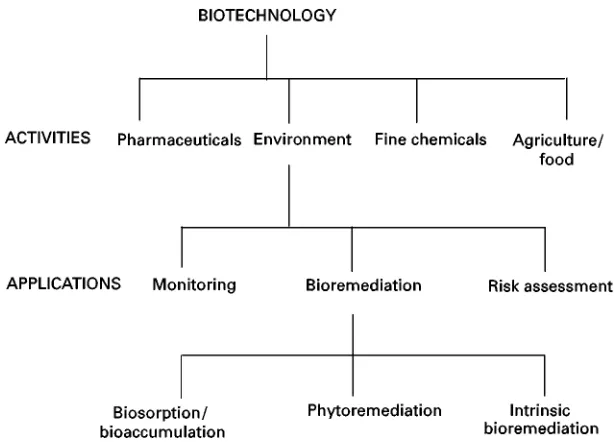
Figure 1 Biotechnology activities and applications. (This is an original developed by H Eccles.) Hwang ST and Kammermeyer K (1984) Membranes in
Separation. Malabar, Florida: Rorbert E. Krieger. Lewis FA (1967) The Palladium Hydrogen System.
London: Academic Press.
Mueller WM, Blackledge JP and Libowitz GG (1968)Metal Hydrides. New York: Academic Press.
Shu J, Grandjean BPA, Van Neste, A and Kaliaguine S (1991) Catalytic palladium-based membrane reactors.
A review.Canadian Journal of Chemical Engineering 69: 1036}1060.
Uemiya U (1999) State-of-the-art of supported metal mem-branes for gas separation.Separation and PuriTcation Methods28: 51}85.
Wise EM (1968)Palladium Recovery, Properties and Uses. London: Academic Press.
METAL UPTAKE ON MICROORGANISMS
AND BIOMATERIALS: ION EXCHANGE
H. Eccles, British Nuclear Fuels, Preston, UK
Copyright^ 2000 Academic Press
Introduction
Microorganisms and biomaterials can be used for the removal/recovery of metals from process liquors and liquid wastes. The mechanisms involved in capturing metals from solution by microorganisms and related materials are now commonly referred to as biosorp-tion. Biosorption has been deRned as the removal of metals or metalloid species, compounds and partic-ulates from solution by biological material. It is one of theRelds in environmental biotechnology, which is itself a small, but growing, component of the biotech-nology industry (Figure 1).
The use of microorganisms to treat waste liquors on a commercial scale dates back to the end of the nineteenth century when theRrst communal sewage plants in Berlin, Hamburg, Munich, Paris and other major cities came into operation. In the intervening 100 years the use of microorganisms and plants to protect the environment has developed into a multi-billion dollar (US$) industry. However, the founda-tions of this environmental biotechnology industry are still with the treatment of municipal/domestic efSuents.