ISSN Print: 2327-5219
DOI: 10.4236/jcc.2018.67005 Jul. 30, 2018 41 Journal of Computer and Communications
Application of Improved Deep Auto-Encoder
Network in Rolling Bearing Fault Diagnosis
Jian Di, Leilei Wang
School of Control and Computer Engineering, North China Electric Power University, Baoding, China
Abstract
Since the effectiveness of extracting fault features is not high under traditional bearing fault diagnosis method, a bearing fault diagnosis method based on Deep Auto-encoder Network (DAEN) optimized by Cloud Adaptive Particle Swarm Optimization (CAPSO) was proposed. On the basis of analyzing CAPSO and DAEN, the CAPSO-DAEN fault diagnosis model is built. The model uses the randomness and stability of CAPSO algorithm to optimize the connection weight of DAEN, to reduce the constraints on the weights and extract fault features adaptively. Finally, efficient and accurate fault diagnosis can be implemented with the Softmax classifier. The results of test show that the proposed method has higher diagnostic accuracy and more stable diagno-sis results than those based on the DAEN, Support Vector Machine (SVM) and the Back Propagation algorithm (BP) under appropriate parameters.
Keywords
Fault Diagnosis, Rolling Bearing, Deep Auto-Encoder Network, CAPSO Algorithm, Feature Extraction
1. Introduction
With the wide application of rolling bearings in various mechanical equipment, the problem of mechanical equipment damage caused by faults has become in-creasingly prominent, which affects the safety of equipment and personnel se-riously [1]. Therefore, research on the fault diagnosis of rolling bearings is cru-cial for the stable operation of mechanical equipment. Vibration analysis is the most widely used method for detecting the health of mechanical equipment [2].
At present, there have been many studies on the diagnosis methods of bearing faults [3] [4] [5]. The analysis methods based on vibration signals mainly include noise method, oil sample analysis method, and vibration method. Hao et al. [6]
How to cite this paper: Di, J. and Wang, L.L. (2018) Application of Improved Deep Auto-Encoder Network in Rolling Bearing Fault Diagnosis. Journal of Computer and Communications, 6, 41-53.
https://doi.org/10.4236/jcc.2018.67005
Received: June 30, 2018 Accepted: July 27, 2018 Published: July 30, 2018
Copyright © 2018 by authors and Scientific Research Publishing Inc. This work is licensed under the Creative Commons Attribution International License (CC BY 4.0).
http://creativecommons.org/licenses/by/4.0/
DOI: 10.4236/jcc.2018.67005 42 Journal of Computer and Communications
proposed a multi-layer over-limit learning machine method to learn the fault vi-bration time domain signal and diagnose the fault of the rolling bearing. Liu et al.[7] proposed a method for extracting fault characteristics of rolling bearings based on fault characteristic trend line template. According to the fault characte-ristic trend line, the method finds the bearing fault charactecharacte-ristics and avoids the shortcomings in the order tracking process. A rolling bearing fault feature ex-traction method based on adaptive noise-based complete empirical mode de-composition (CEEMDAN) combined with IMF sample entropy is used to adap-tively decompose the vibration signal [8]. In order to extract the fault characte-ristics of rolling bearings accurately and stably, Liu et al. [9] proposed a feature extraction method based on variational mode decomposition and singular value decomposition. However, the K value in this method needs to be given in ad-vance, and the determination or range of other parameters is still lack of theo-retical basis. The most critical part of the data-driven fault diagnosis method is the extraction of bearing fault characteristics [10]. Due to the increasing number of bearing equipment, the frequency of collecting samples is getting higher and higher, which makes bearing faults fall into massive data problems. The method adopted above requires a large amount of prior knowledge, rich theoretical knowledge of signal processing and practical experience as a support in the process of feature extraction. Moreover, the number of samples selected by the fault feature is small, which cannot adequately reflect the potential information of the bearing fault data, and reduces the accuracy of fault diagnosis. Therefore, it is especially important to choose a suitable method for fault diagnosis of roll-ing bearroll-ings.
DOI: 10.4236/jcc.2018.67005 43 Journal of Computer and Communications
the adaptive and stability of CAPSO algorithm search. It can optimize the con-nection weight of DAEN, reduce the constraint on the weight, and extract the fault characteristics automatically. The results show that the proposed method has higher accuracy and stable diagnosis results relatively.
2. The Basic Theory of DAEN
Deep Auto-Encoder Network (DAEN) is a neural network consisting of a mul-ti-layer auto-encoder AE [16]. The output of the hidden layer of the above-mentioned AE is used as the input of the next level, layer by layer train-ing. The feature representation in the original space is transformed into another feature space, and the potential information between the data is depicted, which can be applied to multi-layer network training and solve multi-classification problems. The training of the entire deep self-encoding network is divided into two stages: pre-training and fine-tuning [17].
2.1. Pre-Training
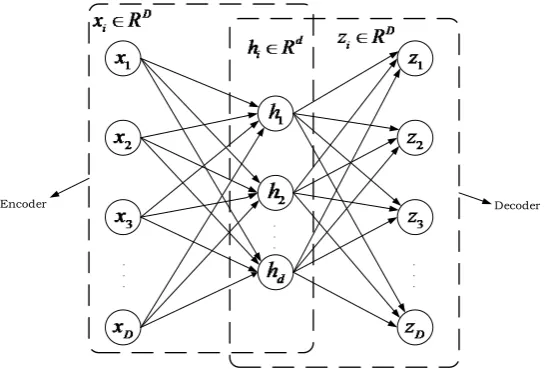
Auto-Encoder (AE) is a three-layer neural network model [18], which is com-posed of two parts: encoder and decoder. Its structure is shown in Figure 1.
Given the training samples x=
{
x x1, ,...,2 xN}
, (for each sample xi ,[
1, ,..,2]
T
i D
x = x x x ). The output vector set of the hidden layer is h=
{
h h1, ,...2 hN}
,(for each sample hi,
[
1, ,...,2]
Ti d
h = h h h ).
( ) ( )
(
1 1)
f
h s W x b= + (1)
( )
1 1(
t)
f
s t = +e− (2)
where x and h are D-dimensional vectors, W( )1 is a weight matrix that connects
the input layer to the hidden layer, b( )1 is the offset matrix between the input
layer and the hidden layer, sf is the activation function of the encoder. This
[image:3.595.238.516.516.703.2]paper uses the sigmoid activation function, which is used widely and has good
Figure 1. The structure of an autoencoder.
Encoder Decoder
. . .
. . . .
DOI: 10.4236/jcc.2018.67005 44 Journal of Computer and Communications
experimental results. Where t represents the input vector corresponding to each neuron [19].
The decoder is the inverse of the encoder, the original input vector is recon-structed using the hidden layer output vector obtained by the encoder. Output variable is z=
{
z z1, ,...,2 zN}
, (for each sample zi,[
1, ,...,2]
T
i D
z = z z z ) by
de-coders as follows
( ) ( )
(
2 2)
f
z s W h b= + (3)
where z is a D-dimensional vector. W( )2 is a weight matrix that connects the
hidden layer to the output layer. b( )2 is the offset matrix between the hidden
layer and the input layer,
The goal of AE training is to optimal set of parameters θ =
(
W b W( )1, ( )1, ( )2 ,b( )1)
,so that the error between the output data and the input data is as small as possi-ble [20]. AE usually uses MSE as the loss function of the standard autoencoder, the loss function expression is as follows
( )
(
)
2MSE MSE
1 1
1 , 1 1
2
m m
i i i i
i i
J L x z Pz x P
m m
θ
= =
= = −
∑
∑
(4)2.2. Fine-Tuning
It can be known from the above pre-training process that when training the AE parameters of each layer, the other layer parameters are fixed and remain un-changed. Therefore, if you want better results, you can use the tagged data set to adjust all layer parameters of the entire depth self-encoding network to achieve global optimality by BP algorithm after the pre-training is completed. This process becomes fine-tuned. The fine-tuning after the pre-training is completed will directly use the BP algorithm to train the effect on the initial weight of the randomization, because the latter tends to fall into the local optimum [21].
3. Bearing Fault Diagnosis Model Based on CAPSO-DAEN
The input layer of the AE has the same number of nodes as the output layer. The process of encoding and decoding can be regarded as compressing the input da-ta, and representing the high-dimensional original data with a low-dimensional vector, so that the compressed low-dimensional vector can be retained.
3.1. CAPSO-DAEN Training Algorithm
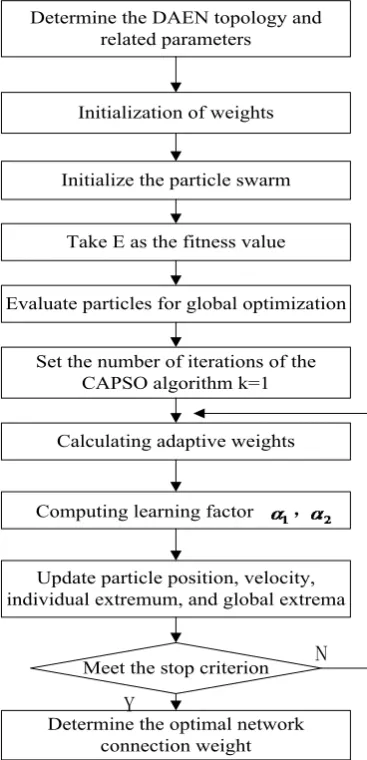
In this paper, the CAPSO algorithm is used to optimize the connection weight between each hidden layer and output layer in DAEN. It can find the optimal solution adaptively, reduce the dependence on the weight and improve the con-vergence speed of the algorithm. The input data for this model is the original time domain signal of the bearing vibration signal.
DOI: 10.4236/jcc.2018.67005 45 Journal of Computer and Communications
layer and output layer in DAEN is mapped into the particles in the CAPSO algo-rithm, the speed and position of the particle are adjusted continuously, the fit-ness value is updated, and the global optimal solution is finally output. Accord-ing to the expression of the loss function in Equation (4), the trainAccord-ing error function E in the automatic encoder is the fitness function in the CAPSO algo-rithm, and the expression is as follows:
2 1
1 2
m
i i i
E Pz x P
=
= −
∑
(5)where xi is the ith training sample of the AE encoder; zi is the ith output
vector of the AE encoder.
The specific steps for optimizing the weight between the hidden layer and the output layer in DAEN with CAPSO are as follows, as shown in Figure 2.
[image:5.595.282.466.318.699.2]Step 1: Determining the network topology of the DAEN, determining the number of cells in each layer in the automatic encoder and initializing related parameters.
Figure 2. CAPSO-DAEN training algorithm flow chart. Determine the DAEN topology and
related parameters
Initialization of weights
Initialize the particle swarm
Take E as the fitness value
Evaluate particles for global optimization
Set the number of iterations of the CAPSO algorithm k=1
Calculating adaptive weights
Computing learning factor
,
Update particle position, velocity, individual extremum, and global extrema
Meet the stop criterion
Determine the optimal network connection weight
Y
DOI: 10.4236/jcc.2018.67005 46 Journal of Computer and Communications
Step 2: Initialize the population in the CAPSO algorithm, Set the parameter vector X = {ω, θ} of DAEN as the position k
i
x of particle i in the kth iteration. Initialize the control coefficients α1, α2 in the CAPSO, the total number N of
particle groups, the maximum number of iterations, and the initial value of the convergence angle γmin.
Step 3: The weights between the hidden layer and the output layer in the DAEN are mapped into particle groups in the CAPSO, the position and velocity of the particle group are initialized. Then, the initialized samples are input into the DAEN for adaptive training learning. According to the mode, the fitness function in the middle, constantly updating the fitness value f of the particle ite-ration position.
Step 4: The particle individual optimal solution and the global optimal solu-tion are updated to determine whether the end condisolu-tion of the loop is satisfied. If the current number of iterations is the maximum number of iterations or the current error is the minimum error. The optimal network connection weight, is output. If the condition is not met, re-update the position and speed of the par-ticle and execute Step3.
3.2. Fault Diagnosis Model for Rolling Bearings
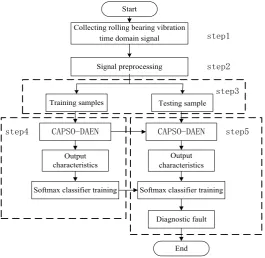
The intelligent fault diagnosis model of rolling bearing based on CAPSO-DAEN is divided into the following steps, as shown in Figure 3, the steps are as follows:
Step 1: This model uses the original vibration time domain signal of the bearing as input data.
[image:6.595.240.506.448.706.2]Step 2: The input data of the model is preprocessed. The vibration time domain
Figure 3. Bearing Fault Diagnosis Flow Chart Based on CAPSO-DAEN.
Start
Collecting rolling bearing vibration time domain signal
Signal preprocessing
Training samples Testing sample
CAPSO-DAEN CAPSO-DAEN
Output
characteristics characteristicsOutput
Softmax classifier training Softmax classifier training
Diagnostic fault
End
step1
step2
step3
DOI: 10.4236/jcc.2018.67005 47 Journal of Computer and Communications
signal is obtained by normalizing the original vibration time domain data. If the vibration time domain signal has a data length of m, then there is
min
max min
ˆ i
i x x x
x x
− =
− (6)
where xi is the ith data point of the bearing vibration time domain signal x1, min
x is the minimum data point of the bearing vibration time domain signal
1
x, xmin is the maximum data point of the bearing vibration time domain
sig-nal x1, xˆi is the ith data point of the vibration time domain signal x2, i = 1, 2,
3, ..., m.
Step 3: The samples are divided into training samples and test samples. They are used to train and test CAPSO-DAEN respectively. Among them, the test samples are used to evaluate the effectiveness of CAPSO-DAEN extraction fea-tures, and test the accuracy of the model's fault diagnosis.
Step4: Aiming at the fault types of rolling bearings, the fault states of rolling bearings are coded. In the training sample stage. The CAPSO-DAEN training algorithm in Figure 3 is used to training and set some basic parameters used in CAPSO-DAEN. Because CAPSO-DAEN does not have the classification func-tion, the Softmax classifier is used to train the output features. The training con-centration label samples are used to fine tune the network and retain the training data for testing.
Step5: Sample testing stage. The CAPSO-DAEN trained in step 5 is used in the test work. The test samples are input into the trained CAPSO-DAEN to output the characteristics, and then the characteristics are input to the Softmax classifier. Lastly output the probability value of 7 faults. The state of the maxi-mum probability value is the final fault diagnosis result, and then the classifica-tion results are judged. And evaluaclassifica-tion of the accuracy of the model.
4. Simulation and Analysis
4.1. Experimental Data
Sample model of data should endeavor to include all bearing fault characteris-tics. Vibration signal contains complicated bearing information, thus time do-main data of vibration signal are the inputs of network. The experimental data is based on the rolling bearing fault vibration data released by the Case Data Cen-ter of Case WesCen-tern Reserve University. The CAPSO-DAEN method is used to learn the time domain signal of the rolling bearing vibration. In experiment, dif-ferent degrees of single point damage were produced in the bearing outer ring, rolling body and inner ring by EDM technology.
DOI: 10.4236/jcc.2018.67005 48 Journal of Computer and Communications
simultaneously collected at a sampling rate of 48,000 Hz.
In order to test the validity and accuracy of the algorithm, the sample set is di-vided into training samples and test samples, and 150 sample sets are randomly selected to test the CAPSO-DAEN algorithm, and the remaining sample set is used to train the CAPSO-DAEN algorithm.
4.2. State Encoding
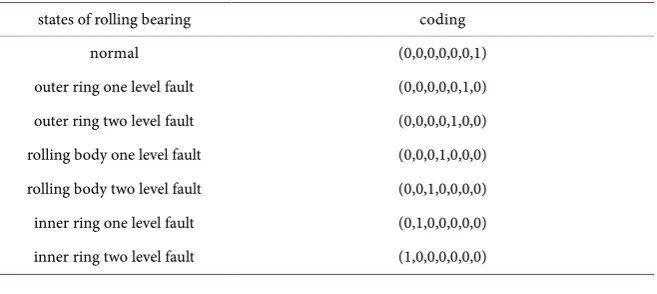
The fault diagnosis method of rolling bearing based on CAPSO-DAEN is to solve the problem of multiple classification of faults. It is necessary to diagnose 7 kinds of fault problems of rolling bearings. The diagnosis results can be divided into 7 types, which are normal, outer ring one level fault, outer ring two level fault, rolling body one level fault, rolling body two level fault, inner ring one lev-el fault and inner ring two levlev-el fault. As shown in Table 1, the fault states of rolling bearings are coded.
4.3. Analysis of Result
1) Research on fault diagnosis results of different AE layers
The average accuracy of fault diagnosis was tested when the number of AE layers was 0 - 15. The results are shown in Figure 4. As can be seen from Figure 4, when the number of AE layers is 4, the average accuracy of fault diagnosis is already high, and then the correct rate increases slowly as the number of AE lay-ers increases. In actual training, as the number of AE laylay-ers increases, the train-ing time increases linearly. Taktrain-ing into account the two factors of fault diagnosis and training time, the number of AE layers selected in the following test is 4 lay-ers.
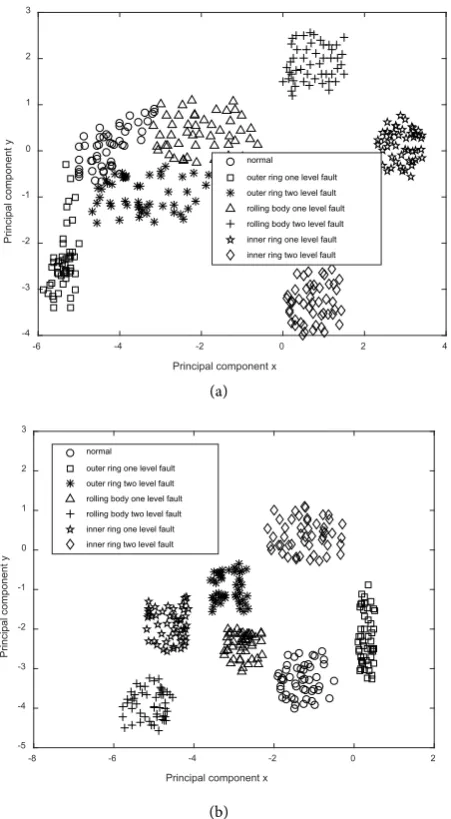
In order to further verify the extraction capability of the improved depth self coded network, two important components of the fourth layer features of the CAPSO-DAEN algorithm and the DAEN algorithm are analyzed, as shown in
Figure 5.
2) Research on fault diagnosis results under different methods.
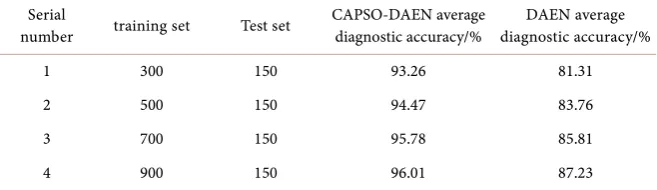
[image:8.595.211.540.584.731.2]The fault diagnosis situation of training set is 300, 500, 700, 900, respectively. The results of CAPSO-DAEN and DAEN are shown in Table 2. Compared with
Table 1. Status coding of rolling bearings.
DOI: 10.4236/jcc.2018.67005 49 Journal of Computer and Communications
Figure 4. Fault diagnosis results when different AE layers.
(a)
(b)
Figure 5. Characteristic scatter plot of two algorithms.(a) DAEN; (b) CAPSO-DAEN.
0 5 10 15
AE
60 65 70 75 80 85 90 95
Accuracy/%
-6 -4 -2 0 2 4
Principal component x
-4 -3 -2 -1 0 1 2 3
Principal component y
normal outer ring one level fault outer ring two level fault rolling body one level fault rolling body two level fault inner ring one level fault inner ring two level fault
-8 -6 -4 -2 0 2
Principal component x
-5 -4 -3 -2 -1 0 1 2 3
Principal component y
[image:9.595.263.489.296.706.2]DOI: 10.4236/jcc.2018.67005 50 Journal of Computer and Communications
Table 2. Fault diagnosis results for different training sets. Serial
number training set Test set CAPSO-DAEN average diagnostic accuracy/% diagnostic accuracy/% DAEN average
1 300 150 93.26 81.31
2 500 150 94.47 83.76
3 700 150 95.78 85.81
4 900 150 96.01 87.23
a few training samples, the more training samples, the better the diagnostic per-formance. Because more samples contain enough fault feature information, it can depict potential information between data, which is more conducive to ex-tract fault characteristics. With the increasing number of training samples, the average accuracy of the two methods of CAPSO-DAEN and DAEN is also in-creasing. However, the average diagnostic accuracy of DAEN is significantly lower than that of CAPSO-DAEN, and the diagnostic accuracy of CAPSO-DAEN is higher. When the training set reaches 900, the average diagnostic accuracy of CAPSO-DAEN is 96.01%, and the effect is better. Therefore, determining the number of training samples plays a key role in improving the accuracy of fault diagnosis.
In order to further verify the effectiveness of the CAPSO-DAEN algorithm, we compare it with traditional algorithms such as SVM and BP. The initial values of these parameters are determined through extensive experiments. SVM uses the most widely used radial basis kernel (RBF), in which the two most important parameters are the penalty factor and the radius of the kernel function, which are set to 20 and 0.082 respectively. The initial learning rate of BP algorithm is 0.1, and the maximum training iteration number is 500. The above 2 methods use the same vibration signal for training and testing, and the accuracy of the fault diagnosis is shown in Table 3.
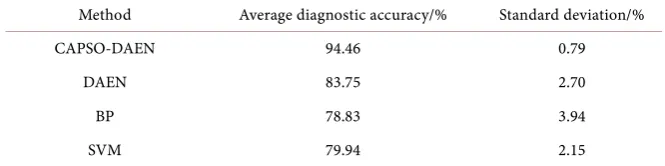
From Table 2 and Table 3, we can see that the rolling bearing fault diagnosis method based on CAPSO-DAEN has higher fault diagnosis accuracy than the other 3 methods. In the test stage, the fault diagnosis method of rolling bearing based on CAPSO-DAEN and DAEN algorithm increases with the increase of training samples, but the accuracy rate of fault diagnosis is increasing, but CAPSO-DAEN has high accuracy. The fault diagnosis method of rolling bearing fault diagnosis based on BP and SVM algorithm increases with the increase of training samples and the accuracy rate of fault diagnosis. It is also increasing. However, when the training sample is 250, the growth rate is slow, and it is only suitable for small sample training.
DOI: 10.4236/jcc.2018.67005 51 Journal of Computer and Communications
Table 3. Fault diagnosis results of BP and SVM in different training sets.
training set Test set The BP method diagnoses the average correct rate/% The SVM method diagnoses the average correct rate/%
100 150 55.89 57.70
150 150 60.51 62.11
200 150 73.73 71.25
250 150 78.14 79.32
Table 4. Test results for 15 times.
Method Average diagnostic accuracy/% Standard deviation/%
CAPSO-DAEN 94.46 0.79
DAEN 83.75 2.70
BP 78.83 3.94
SVM 79.94 2.15
than the accuracy of the other 3 methods. In the standard deviation, the stan-dard deviation of the CAPSO-DAEN method was significantly lower than the other two methods, 0.79%, and the standard deviation of DAEN, BP and SVM were 2.70%, 3.94%, 2.15% respectively. Therefore, the CAPSO-DAEN method has a higher diagnostic accuracy than the DAEN method and the traditional BP and SVM methods, and the stability of the fault diagnosis is higher.
5. Conclusions
In this paper, an improved deep autoencoder network method is proposed for rotating machinery fault diagnosis. Firstly, the utility model can learn the vibra-tion time domain signal of the rolling bearing directly, which can extract the fault feature automatically and effectively. Therefore, it overcome the problems existing in the traditional method in extracting the fault feature and does not need to manually extract the feature, thereby improving the effectiveness of the fault diagnosis. Secondly, the improved deep autoencoder network algorithm optimizes the connection weight by using the randomness and stability of the CAPSO algorithm search, reduces the constraint on the weight, and improves the learning efficiency of the algorithm.
The proposed method is applied to the fault diagnosis of rolling bearing. The results confirm that the proposed method has higher diagnostic accuracy and more stable diagnosis results than other methods. Besides, the proposed deep autoencoder network method has better classification performance than deep autoencoder network method.
Conflicts of Interest
[image:11.595.207.540.221.304.2]DOI: 10.4236/jcc.2018.67005 52 Journal of Computer and Communications
References
[1] Henriquez, P., Alonso, J.B., Ferrer, M.A. and Travieso, C.M. (2014) Review of Au-tomatic Fault Diagnosis Systems Using Audio and Vibration Signals. IEEE Transac-tions on Systems, Man, and Cybernetics: Systems, 44, 642-652.
https://doi.org/10.1109/TSMCC.2013.2257752
[2] Lei, Y., He, Z. and Zi, Y. (2009) Application of an Intelligent Classification Method to Mechanical Fault Diagnosis. Expert Systems with Applications, 36, 9941-9948. https://doi.org/10.1016/j.eswa.2009.01.065
[3] Amar, M., Gondal, I. and Wilson, C. (2015) Vibration Spectrum Imaging: A Novel Bearing Fault Classification Approach. IEEE Transactions on Industrial Electronics, 62, 494-502. https://doi.org/10.1109/TIE.2014.2327555
[4] Grasso, M., Chatterton, S., Pennacchi, P. and Colosimo, B.M. (2016) A Data-Driven Method to Enhance Vibration Signal Decomposition for Rolling Bearing Fault Analysis. Mechanical Systems and Signal Processing, 81, 126-147.
https://doi.org/10.1016/j.ymssp.2016.02.067
[5] Chen, K., Gu, S. and Zheng, H. (2018) Research on Real-Time Intelligent Fault Di-agnosis Algorithm for Rolling Bearing. Journal of Electronic Measurement & In-strumentation, 32, 66-72.
[6] Hao, L.N., Wang, F.L. and Cao, R.M. (2017) Multi-Layer Extreme Learning Ma-chine Methods Based Fault Diagnosis of Rolling Bearing. Science Technology & En-gineering, 17, 86-91.
[7] Liu, D. (2017) Bearing Fault Diagnosis Based on Fault Characteristic Trend Tem-plate. Journal of Mechanical Engineering, 53, 083.
https://doi.org/10.3901/JME.2017.09.083
[8] Zhao, L., Xia, J., Zehua, L.I., et al. (2017) Fault Diagnosis of Rolling Bearing Based on VMD Sample Entropy and LS-SVM. Journal of Military Transportation Univer-sity, No. 3, 96-100.
[9] Liu, C., Wu, Y.J. and Zhen, C. (2015) Rolling Bearing Fault Diagnosis Based on Variational Mode Decomposition and Fuzzy C Means Clustering. Proceedings of the Csee, 35, 3358-3365.
[10] Thirukovalluru, R., Dixit, S., Sevakula, R.K., Verma, N.K. and Salour, A. (2016) Ge-nerating Feature Sets for Fault Diagnosis Using Denoising Stacked Auto-Encoder.
Proceedings of IEEE Conference on Prognostics and Health Management, Ottawa, 20-22 June 2016, 1-7.
[11] Hinton, G.E. and Salakhutdinov, R.R. (2006) Reducing the Dimensionality of Data with Neural Networks. Science, 313, 504-507.
https://doi.org/10.1126/science.1127647
[12] Jing, L., Zhao, M., Li, P., et al. (2017) A Convolutional Neural Network Based Fea-ture Learning and Fault Diagnosis Method for the Condition Monitoring of Gear-box. Measurement, 111, 1-10. https://doi.org/10.1016/j.measurement.2017.07.017 [13] Xin, S., Zhu, Y., Ning, X., et al. (2016) Transformer Fault Diagnosis Based on Deep
Auto-Encoder Network. Electric Power Automation Equipment, 36, 122-126. [14] Su, S., Liu, Z., Xu, S., et al. (2015) Sparse Auto-Encoder Based Feature Learning for
Human Body Detection in Depth Image. Signal Processing, 112, 43-52. https://doi.org/10.1016/j.sigpro.2014.11.003
DOI: 10.4236/jcc.2018.67005 53 Journal of Computer and Communications [16] Liu, K., Lin, J., Zheng, L., et al. (2018) Slow Moving Target Detection Based on Deep
Self-Coding Network. Computer Engineering, 44, 129-134.
[17] Zabalza, J., Ren, J., Zheng, J., et al. (2016) Novel Segmented Stacked Autoencoder for Effective Dimensionality Reduction and Feature Extraction in Hyperspectral Imaging. Neurocomputing, 185, 1-10.https://doi.org/10.1016/j.neucom.2015.11.044 [18] Shao, H., Jiang, H., Zhao, H., et al. (2017) A Novel Deep Autoencoder Feature
Learning Method for Rotating Machinery Fault Diagnosis. Mechanical Systems and Signal Processing, 95, 187-204.
[19] Dong, H.B., Dong-Jin, L.I. and Zhang, X.P. (2018) Particle Swarm Optimization Algorithm with Dynamically Adjusting Inertia Weight. Computer Science, 45, 98-102+139.
[20] Janssens, O., Slavkovikj, V., Vervisch, B., Stockman, K., Loccufier, M., Verstockt, S., Van de Walle, R. and Van Hoecke, S. (2016) Convolutional Neural Network Based Fault Detection for Rotating Machinery. Journal of Sound and Vibration, 377, 331-345. https://doi.org/10.1016/j.jsv.2016.05.027