A STUDY TO ASSESS THE KNOWLEDGE OF MOTHERS’ REGARDING DEVELOPMENTAL
MILESTONES OF INFANTS
*Deepika David, Mrs. Khushlata J.
Assistant Professor, College of Nursing
ARTICLE INFO ABSTRACT
The infant is a dynamic, ever
neuro developmental and physical growth. This sequence is influenced continuously by intrinsic and extrinsic forces that produce individual variation and make each infant’s developmental path unique. Parents need to understand growth and development in order to
delays or abnormalities in development. By monitoring child and family the nurse can observe the inter-relationship of physical growth and cognitive, motor and emotional development. Therefore a descriptive study to as
selected hospital of Ludhiana Punjab was undertaken with the objectives: to assess the knowledge of mothers regarding developmental milestones of infant and to ascertain the rel
of mothers with selected demographic variables.
conducted in various child care areas of selected hospital Ludhiana, Punjab. The study sample consisted of total 100 mothers of infants from ch
statistics and presented through tables and figures.
mothers (53%) had good knowledge score regarding developmental milestones of infants. Mean percentage and rank o
lowest in the area of social development (21% and rank 6
status, occupation, monthly family income, source of information, place of livin children were found to be non significant.
Copyright © 2014 Deepika David et al. This is an open access article distributed under the Creative Commons Attribution License, which permits unrestricted use, distribution, and reproduction in any medium, provided the original work is properly cited.
INTRODUCTION
Developmental milestone are a set of functional skills or specific tasks that most children can do at a certain age range. Child development refers to how a child becomes able to do more complex things as they get older. Development is different than growth. Growth refers to the child's development: Although each milestone has an age level, the actual age when a normally developing child reaches that milestone can vary quite a bit. Every child is unique (S. Neil). Over the past decade there has been a growing recognition of the involvement of the home in several public health and hygienic issues. Perhaps the best understood of these issues is the role of mother in preventing the delay in growth of infant Child development is one of the crucial issues of the twentieth century. Among the reasons for this interest is that child development affects the society at large. Consequently the manner in which the parents bring up their children has become the concern of the state and society. If the state does not make this concern, maladjusted children of today may become the anti-social elements of tomorrow
*Corresponding author: Deepika David,
Assistant Professor, College of Nursing, Mohan Dai Oswal Cancer Hospital Ludhiana, Punjab 141008, India.
ISSN: 0975-833X
International Journal of Current Research
Vol.
Article History:
Received 25th
April, 2014 Received in revised form
14th
May, 2014
Accepted 08th
June, 2014
Published online 20th
July,2014 Key words: Developmental Milestones, Infants, Knowledge, Mothers.
RESEARCH ARTICLE
A STUDY TO ASSESS THE KNOWLEDGE OF MOTHERS’ REGARDING DEVELOPMENTAL
MILESTONES OF INFANTS
Mrs. Khushlata J. Toppo and Mrs. Kamla Saini
Nursing, Mohan Dai Oswal Cancer Hospital Ludhiana, Punjab
ABSTRACT
The infant is a dynamic, ever-changing being who undergoes an orderly and predictable sequence of developmental and physical growth. This sequence is influenced continuously by intrinsic and extrinsic forces that produce individual variation and make each infant’s developmental path unique. Parents need to understand growth and development in order to monitor child’s progress, to identify delays or abnormalities in development. By monitoring child and family the nurse can observe the relationship of physical growth and cognitive, motor and emotional development. Therefore a descriptive study to assess the knowledge of mothers regarding developmental milestones of infants in selected hospital of Ludhiana Punjab was undertaken with the objectives: to assess the knowledge of mothers regarding developmental milestones of infant and to ascertain the rel
of mothers with selected demographic variables. A non-experimental, descriptive study was conducted in various child care areas of selected hospital Ludhiana, Punjab. The study sample consisted of total 100 mothers of infants from child care areas. Data was analyzed by inferential statistics and presented through tables and figures. Findings revealed that maximum number of mothers (53%) had good knowledge score regarding developmental milestones of infants. Mean percentage and rank order of knowledge score was highest in introduction (63% and rank 1 lowest in the area of social development (21% and rank 6th). Variables i.e. age, parity, educational status, occupation, monthly family income, source of information, place of livin
children were found to be non significant.
is an open access article distributed under the Creative Commons Attribution License, which permits unrestricted use, any medium, provided the original work is properly cited.
Developmental milestone are a set of functional skills or age-specific tasks that most children can do at a certain age range. Child development refers to how a child becomes able to do more complex things as they get older. Development is different than growth. Growth refers to the child's each milestone has an age level, the actual age when a normally developing child reaches that ry quite a bit. Every child is unique (S. Neil). Over the past decade there has been a growing recognition of
al public health and hygienic issues. Perhaps the best understood of these issues is
the role of mother in preventing the delay in growth of infant3.
Child development is one of the crucial issues of the twentieth st is that child development affects the society at large. Consequently the manner in which the parents bring up their children has become the concern of the state and society. If the state does not make this concern, maladjusted children of today may
Assistant Professor, College of Nursing, Mohan Dai Oswal Cancer
(Breckenbridge et al., 1973). Assessing child's development is a team effort, family plays an important role. Mother can identify the milestone development of infant by observations. Mothers can tell about the infant's doctor about any worries or concerns she may have. Pediatri
developmental screening. Screening involves a series of questions and observations that gets at your child's ability to perform certain age-appropriate tasks using developmental milestones as a guide can helps to identify infants who may at risk for developmental delay (S. Neil).
life till one year of age. At no other time in life are physical changes and developmental as dramatic as during infancy (Whaley and Wong 1993). The child has always occupied an important position in the society since the origin of mankind. Children have always been the centre of hope, dedication and future of the nation. For achieving the enjoyment of the highest attainable standard of life and society it is necessary that all aspects of child’s health and welfare be considered rather than the care of the sick child alone. Development monitoring is an operational strategy for the promotion of health, which enables mother to visualize growth and development pattern of their children (Kapil
mothers play an important role in the life of children. Infants are usually seen at health care facilities for health maintenance International Journal of Current Research
Vol. 6, Issue, 07, pp.7524-7528, July,2014
OF CURRENT RESEARCH
A STUDY TO ASSESS THE KNOWLEDGE OF MOTHERS’ REGARDING DEVELOPMENTAL
Mrs. Kamla Saini
Punjab 141008, India
changing being who undergoes an orderly and predictable sequence of developmental and physical growth. This sequence is influenced continuously by intrinsic and extrinsic forces that produce individual variation and make each infant’s developmental path unique. monitor child’s progress, to identify delays or abnormalities in development. By monitoring child and family the nurse can observe the relationship of physical growth and cognitive, motor and emotional development. Therefore a sess the knowledge of mothers regarding developmental milestones of infants in selected hospital of Ludhiana Punjab was undertaken with the objectives: to assess the knowledge of mothers regarding developmental milestones of infant and to ascertain the relationship of knowledge experimental, descriptive study was conducted in various child care areas of selected hospital Ludhiana, Punjab. The study sample ild care areas. Data was analyzed by inferential Findings revealed that maximum number of mothers (53%) had good knowledge score regarding developmental milestones of infants. Mean rder of knowledge score was highest in introduction (63% and rank 1st) and
). Variables i.e. age, parity, educational status, occupation, monthly family income, source of information, place of living and number of
is an open access article distributed under the Creative Commons Attribution License, which permits unrestricted use,
at least six times during the first year. Anticipatory guidance offered at these visits can help parents prepare for the rapid changes that mark the first year of life (Adele Pillitteri 1999). Childcare in a right perspective is very important, as children are our future generation. Care implies not only providing children with proper food and shelter but also their growth, psychological, emotional and social development. This sort of upbringing helps in developing a physically, psychologically, emotionally and socially fit personality. It involves mothers and health workers in a meaningful and reinforcing way, aiming at action before overt malnutrition occurs. Growth monitoring is best initiated from birth rather than when the child is already 2 to 3 years (Chidananda Murthy 2000). Infant mortality rate in India was 53 in the year 2009. In India the goal was set at 60/1000 live births by the year 2000 AD. Many low cost measures can be adopted for saving life of millions of children. Immunization, breast-feeding, birth spacing, growth monitoring, improved weaning and oral dehydration are those measures, which are very important factors to achieve this target (Park 2007).
A study conducted on Racial and ethnic disparities in the quality of primary health care for children and concluded that Non-White racial groups scored lower than Whites on Knowledge of child developmental ability at ages 3 months and 1 year. A potential explanation for a lack of knowledge of developmental ability may be due to fewer interactions with the child’s pediatrician and, therefore, less provision of anticipatory guidance. Research has shown that Non-White families tend to have less continuous care and poorer interpersonal relationships with their provider (Stevens 2002). Among the indisputable rights of children is the right to health. Without respecting this right and providing the necessary resources to secure it, one cannot hope to achieve any of the major development goals (Onis D. Mercedes et al., 2004). The Late Prime Minister Jawaharlal Nehru once said, “Children are the wealth of tomorrow- takes care of them. If you wish to have a strong India, ever ready to meet various challenges”. During 1979 on International Children’s year the United Nations has recommended efforts to intensify the growth monitoring, informal education, supplementary nutrition and referral services (Suraj Gupte 2004). A study was conducted on 440 Korean Mothers of 4 Month old Infants to assess the Knowledge about Child Development and Child-Rearing Practices concluded that the knowledge level of child development and child-rearing was generally low. On Average, parents got about 50 percent of the answers right (50.6%) in child development theory’s category, in developmental norms category the mean score was 47.3% and that of discipline and rearing was 35.8% and parent-child interaction was 38.7%. Another study was conducted in southern state to assess the maternal knowledge of child development (N=406) revealed that 65% women correctly answered the knowledge questions. Mothers lacked the most knowledge about infant sleep patterns and developmental ability of 6-month-old infant. Maternal education, race, number of children, and assistance with child care were significantly related to maternal knowledge (Lee, Keunyoung Chang-Song 2006, Stephanie Reich 2005). A study was conducted to see the relationship between physical growth and motor development in the WHO Child Growth Standards
observed that significant associations were there between gross motor development and some physical growth indicators. Statistically significant associations were noted between various milestones achievement ages and growth when 3 or 6 months and birth length-for-age (WHO 2006). Parents need to understand growth and development in order to monitor child’s progress, to identify delays or abnormalities in development. By monitoring child and family the nurse can observe the interrelationship of physical growth and cognitive, motor and emotional development. The young are often among the most valuable groups and thus their needs require special attention (Richard Behrma 2007). A study was done on
Capacity building of mothers on promoting infant
development. Two major forces which influence child growth and development are hereditary and environment stimulation.
The most important environment is an appropriate and effective nurturing from parents especially the mother. Every family wishes their children grow up to be a good and healthy people and have these desirable characteristics: satisfy physical health and appropriate growth for age, good mental health, social well-being with proper life skills, appropriate cognitive development, good discipline and responsibility. It is generally accepted that a good start at the beginning of life makes a child to be an efficient person of the society because the first five-years is a crucial period of child’s growth and development especially the growth of the brain. Hence, mother who is usually the master of child rearing should have adequate and current knowledge about child development, interact with the child regularly and set up proper home environment (Isaranurug 2005). The best pediatric slogan of today is “Not many but healthy children”. If we are keen on having a happy nation, the time to act is now. Today, yes right away. For as the poet Gabriela Mistral, puts it, we are guilty of many errors and many faults; but our worst crime is abandoning the children, neglecting the foundation of life (Parameshwari. S. 2006). Infancy is traditionally designated as the period from birth to one year of age. Infants become children and children become adolescents, passing through their parents’ lives and disappearing into adulthood; full-fledge persons with lives and future of their own. This year is known for its rapid growth and development with tripling birth weight and increasing length of 50%. Without proper stimulation and nurturing care by consistent caregivers, the infant may not develop a healthy interest in life or a feeling of security essential for future development. Growth refers to the increase in the physical size of the body, and development to the increase in skills and function (Park 2007).
When we talk about developing skills like, Gross motor, using large group of muscles to sit, stand, walk, run etc., keeping balance and changing positions. Fine motor, using hands to be able to eat, draw, dress, play, write and do many other things. Language, speaking, using body language and gestures, communicating and understanding what others say. Cognitive, thinking skills, including learning understanding, problem solving, reasoning and remembering. Social, interacting with others, having relationship with family, friends and teachers, co-operating and responding to the feeling of others. 0-3 years these milestone for how child develop and role that mothers
play at different stages(Parthasarathy 2009). Developmental
delay occurs when a child exhibits a significant delay in the acquisition of milestones or skills, in one or more domains of development (i.e., gross motor, fine motor, language, cognitive, social or activities of daily living). A significant delay has been traditionally defined as discrepancy of 25 percent or more from the expected rate, or a discrepancy of 1.5 to 2 standard deviation from the normal. Global developmental delay is defined as a delay in two or more developmental domains. In addition to delays in development, health professionals should also recognize deviations in development. A deviation occurs when a child develops milestones or skills outside of the typical acquisition sequence. An example of this can be seen in conditions such as cerebral palsy, in which the infant rolls over early secondary to increased extensor tone. Developmental dissociations may also occur. Dissociations arise when a child has widely differing rates of development in different developmental domains. For example, children with autism often have typical gross motor development but
significantly delayed language development, therefore
language development has dissociated from gross motor development (Poon 2010).
MATERIALS AND METHODS
Research Approach: A Descriptive research approach was used to assess the knowledge of mothers regarding Developmental Milestones of Infants.
Research Design: Non-experimental research design was utilized to achieve the objectives.
Independent and Dependent Variables
a) Independent Variables:- Age, Parity, Educational Status,
Occupation, Monthly family income, Type of family, Source of information, Place of living, Number of Children.
b) Dependent Variables: - Knowledge of mothers regarding
the developmental milestones of infants.
Selection and Description of Field for the Study
The present study was conducted in Sehat Hospital, Urban estate Jamalpur Ludhiana. It is one of the best Advanced Newborn care centre of the city providing advanced facilities to the sick Children.
Population
The target population of the study was the mothers of infants in the child care areas
Sample and Sampling technique
Total sample was 100 mothers of infants selected from child care areas. Selection was done on the basis of Purposive Sampling.
Development and Description of Tool
A structured questionnaire was used to assess the knowledge of mothers’ regarding developmental milestones of infants. An
intensive review of literature, experts’ opinion, suggestions of the research panel, researcher’s professional experience and informal interview with the mothers of infants provided the basis for the construction of questionnaire. To accomplish the objectives of the study the questionnaire was constructed in the following parts:
The tool consists of following 2 parts
Part I: Sample Characteristics
This part consists of 9 items for obtaining personal information i.e. Age, parity, educational status, occupation, monthly family income, type of family, source of information, place of living and number of children.
Part II: structured Questionnaire
This part consists of Structured multiple choice questions regarding different aspects of maternal knowledge regarding Growth and Development of infants. This questionnaire consists of 40 multiple choice items, each item consist of one correct answer among the four choices and each correct answer carries one mark.
The questions were related to the following aspects
Area Items
Introduction 05
Physical growth 14 Development:
Gross motor 09
Fine motor 04
Language 04
Social 04
Total Items =40
Maximum score =40
Minimum score =0
Criterion Measure
The criterion measure used in the study was knowledge score on developmental milestones. The knowledge score refers to the total obtained score on knowledge items in structured multiple choice questionnaire by mothers.
Level of knowledge Score Percentage
a. Excellent ≥26 ≥65%
b. Good 20-25 51-64%
c. Average 14-19 36-50%
d. Below Average ≤13 ≤35%
Content Validity of the tool
Ethical Consideration
With the view of ethical consideration the researcher discussed the type and purpose of the study with the Pediatrician of Sehat Hospital Ludhiana and written permission was obtained thereafter. Mothers were explained about the purpose of study. An informed verbal consent from mothers of infants was taken. Mothers were ensured that the information given by them will be kept confidential and will be used purely for research purpose.
Reliability of the Tool
Reliability was computed by split half method i.e. by calculating coefficient of correlation first and then by applying Spearman’s Brown Prophecy formula. The reliability of the Questionnaire was rʹ was 0.77. Hence the tool was reliable.
Plan of Analysis
Analysis of the data was done in accordance with the objectives. It was done by using the descriptive and inferential statistics such as calculating the percentage, mean, mean percentage, standard deviation and ANOVA and‘t’-test with selected variables. Bar diagrams were used to depict the findings. The level of significance chosen was p<0.05.
RESULTS
Findings related to the knowledge of Mothers.
[image:4.612.312.565.185.270.2]To assess the knowledge of mothers regarding the growth and development of infants.
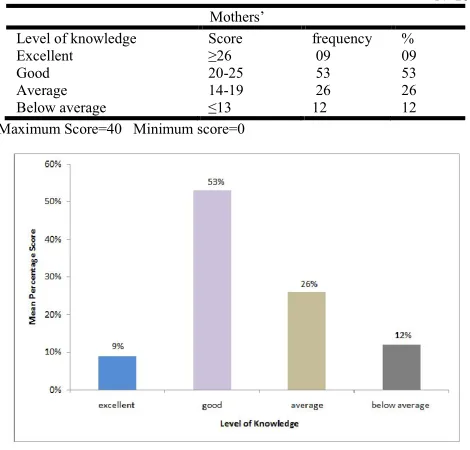
Table 1. Frequency and Percentage Distribution of Mothers’ Level of Knowledge Regarding Growth & Development of Infants
N=100 Mothers’
Level of knowledge Score frequency %
Excellent ≥26 09 09
Good 20-25 53 53
Average 14-19 26 26
Below average ≤13 12 12 Maximum Score=40 Minimum score=0 Fig. 1. Mean Knowledge Score of Mothers Regarding Developmental Milestones of Infants According to Level of Knowledge Table-1 and Fig. 1 depicts that maximum (53%) mothers had good knowledge followed by (26%) average, (12%) below average score and least (9%) had excellent knowledge. Thus it can be concluded that maximum mothers had good knowledge regarding growth and development of infants. To assess the deficit areas of knowledge Table 2. Mean, Mean Percentage and Rank Order of Knowledge Score of Mothers Regarding Growth and Development of Infants According to Areas of Knowledge N=100 Knowledge Score Areas of Knowledge Max score Mean score Mean % Rank Order Introduction 05 3.15 63.00 1
Physical growth 14 7.45 53.21 3
Gross motor 09 4.38 48.66 4
Fine motor Development 04 1.84 46.00 5
Language Development 04 2.23 55.75 2
Social Development 04 0.84 2.00 6
TOTAL 40 19.89 49.72
Maximum score=40 Minimum Score=0
[image:4.612.317.551.378.529.2]Table 2 and Fig. 2 indicates that according to areas of knowledge of mothers regarding growth and development of infants, mean percentage of knowledge score was highest (63%) in introduction followed by (55.7%) in language development, (53.2%) in physical growth, (48.6%) in gross motor development, 46% in fine motor development and least (21%) in social development respectively.
Fig. 2. Mean Percentage of Knowledge Score of Mothers Regarding Developmental Milestones of Infants According to Areas of Knowledge
It can be concluded that mothers had highest knowledge in the area of introduction rank 1 followed by language development rank 2, physical growth rank 3, gross motor development rank 4 and fine motor development rank 5. Mothers least knowledge score in the area of social development is rank 6. Hence it can be inferred that there is need for enhancement of knowledge of mothers regarding gross motor, fine motor and social development.
DISCUSSION
Based on the findings from the analysis of the data and review of literature discussion is done according to the objectives written below: To assess the knowledge of mothers regarding
[image:4.612.61.296.450.675.2]developmental milestones of infants. Findings of the present study revealed that maximum (53%) of mothers had good knowledge score followed by (26%) average, (12%) below average score and least (9%) had excellent knowledge regarding developmental milestones of infants. The mean percentage of knowledge score was highest (63%) in introduction followed by (55.7%) in language development, (53.2%) in physical growth, (48.6%) in gross motor development, 46% in fine motor development and least (21%) in social development respectively. The findings of present study were related with the study conducted by Shivani Rikhy (2009) on gauging knowledge of developmental milestones among Albertan adults. Maximum number i.e. (63%) of respondents answered physical development questions correctly followed by (15%) of respondents answered
cognitive development questions correctly, (7%) of
respondents answered questions regarding social development correctly and (2%) of respondents answered emotional development correctly. Parents were most likely to use doctors/pediatricians, books and nurses as resources. The findings of the present study were also related to the findings of the study conducted by Mare H. Bornstein (2004) on immigrant mothers’ knowledge of parenting and children’s development. Less than half of the immigrant mothers were aware about the onset of babbling and at the age at which infant can respond to his/her name. Less than (50%) of the mothers were having the knowledge regarding age of head lifting while lying on stomach.
Acknowledgement
I acknowledge the expertise and diligent guidance contributed by Prof. (Mrs.) K.J. Toppo, Supervisor, for her enlightening guidance, keep personal interest and consistent encouragement throughout the course of the study. She has been so helpful in each and every step when things seem to be confronting and problems beyond salvage. With profound gratitude I express my heartfelt indebtedness to my Co-supervisor, Prof. (Mrs.) Kamla Saini. for her expert guidance and support in my endeavor. Her invaluable guidance has enabled me to persue this research study with all its intricacies and challenges. My sincere thanks go to Dr. (Mrs.) Rajinder Kaur Mahal, Principal, MD Oswal College of Nursing, Ludhiana for her keen interest and clarify queries at each step of this study. I deeply appreciate her untiring and outstanding contribution, encouraging words and eveready help at all stages of work. Without her support this research project would not have seen the light of the day. Her analytical approach has made this research project presentable.
I owe sincere thanks to the panel of experts, Principal Dr. (Mrs.) Rajinder Kaur Mahal, Vice-principal Prof. (Mrs.) K.J. Toppo, Mrs. Suraj Mathew (Reader), Mrs. Mandeep Kaur, Mrs. Prabhjot Kaur, Mrs. Neelam Dass Ms. Riya Sood, Ms. Rubia Sapra, Ms. Manpreet Kaur and all nursing faculty members of MD Oswal College of Nursing for their valuable suggestions. I am thankful to Dr. Davinder Singh Bath,
Paediatrician, Sehat Hospital, Ludhiana for granting
permission to conduct the research study in child care areas of the hospital. I wish to extend my sincere gratitude to 100 mothers without whose cooperation I could not have undertaken and successfully completed this study. I am deeply indebted to Dr. R.S Sibia, Head of Paediatrics, MD Oswal Hospital, Ludhiana for their guidance and valuable suggestions.
REFERENCES
Adele Pillitteri. Child Health Nursing, care of the child and family. Lippincott Company, 1999, 174-190.
Breckenbridge Maraian, Vincent E. Child Development, 4th
Ed. W.B. Saunders Co. Philadelphia (1973) P 8-10. Chidananda Murthy, Childcare. Nisargopchar Varta 2000
May; 11:5.
De Onis M, Garza C, Victora CG, Norman KR, WHO Multicentre growth reference study (MGRS): Rational, planning and implementation. Food Nutrition Bulletin. 2004; 25 (1): S1-89.
Kapil et al. Utility of growth monitoring: its relevance in the promotion of child health. Indian Pediatrics. (1994) 31:239-244.
Lee, Keunyoung. The Study on Korean Mothers’ Knowledge about Child Development and Child-Rearing, Japan, 2006, Jun 19.
Neil Salkind - child development - 6th edition – Philadelphia Rinchart and Winston Inc., page No. 204.
Park. K. Text Book of Preventive and Social Medicine. 20th
ed., Banarsidas Bhanot publishers; 2007. 367-368. Stephanie Reich. Maternal knowledge of child development.
Infant mental health journal [serial online] 2005 mar 8 [cited 2008 Aug 20]; 26(2): [143-56]. Available from: URL: http://www.interscience.wiley.com
Stevens and Shi, L. Racial and ethnic disparities in the quality of primary care for children. Journal of Family Practice, 2002, 51(6), 573-578.
Suraj Gupte, The Short Text book of Pediatrics. 10th ed.,
Jaypee Brothers, 2004:1-7.
Whaley and Wong. Essentials of pediatric nursing. 5th ed. St.
Louis: Mosby; 1993, 288-89.