LOW TEMPERATURE MAGNETIC AND ELECTRICAL PROPERTIES OF
1
Ramanna, R.,
1,*Sankarappa
1
Department of Physics, Gulbarga University, Gulbarga, Karnataka, India
2
Shridevi Institute of Engineering and
ARTICLE INFO ABSTRACT
Magnetic multilayers, vacuum conditions. X
Atomic force microscope (AFM) has been employed to study surface structure and grain sizes. The magnetization as a function of field at temperatures 150K, 200K and 300K has been measured using the MPMS SQUID
field, saturation magnetization, remanent magnetization and determined. The existence of
been established for both the films. The low temperature electrical resistivity in the range from 5 K to 300 K has been measured and fo
(Co/Al
properties and data analyzed thoroughly.
Copyright © 2014 Ramanna et al. This is an open access article distributed under the Creative Commons Att distribution, and reproduction in any medium, provided the original work is properly cited.
INTRODUCTION
Study of magnetic interactions between the ferromagnetic (FM) layers in multilayered to discovery number of fascinating phenomena and generated lot of interest in the scientific community from both theoretical and experimental points of view (Hartmann et al., 1999; Volkerts, 2011
Soft magnetic multilayers small thicknesses have the potential to be useful as magnetic sensors (Dieny, 1992
Structural, magnetic and giant magnetoresistance were studied in Ag-Co multilayers (Angelakeris et al., 2003
consisting of ferromagnetic metals and nonmagnetic metals were investigated for structure, magnetic and electrical studies (Hutchings et al., 1999; Srivastava et al., 2004
nonmagnetic spacer in tuning the interlayer exchange coupling (IEC) between two neighboring magnetic layers has been first reported by Grunberg (Partha Pratim Pal and Ranjit Pati 2008). In some multilayers, chromium (Cr) spacer was used and investigated interface roughness (Kumar Dileep
Ajay, 2005; Kholin et al., 2006), magnetic and electronic structures (Botana et al., 2008). An anomalous behavior of low temperature resistivity has been observed in the films, Co/M/Co (M = Cr or Cr/Ag or Ag/Cr) (Aliev
Structural and magnetic properties were probed in Fe/Cu multilayers for varied Fe layer thickness (El Khiraouia 2008). Interlayer diffusion of nonmagnetic metals
*Corresponding author: Sankarappa, T.
Department of Physics, Gulbarga University, Gulbarga, Karnataka, India
ISSN: 0975-833X
Vol. 6, Issue,
Article History:
Received 15th September, 2014 Received in revised form 26th October, 2014
Accepted 19th November, 2014
Published online 27th December,2014
Key words:
Multilayered films, Surface roughness, Coercive field, Resistivity.
RESEARCH ARTICLE
LOW TEMPERATURE MAGNETIC AND ELECTRICAL PROPERTIES OF (CO/AL
Sankarappa, T.,
1Ashwajeet, J. S.,
1Sujatha, T. and Sadashivaiah
Department of Physics, Gulbarga University, Gulbarga, Karnataka, India
Shridevi Institute of Engineering and Technology, Tumkur, Karnataka, India
ABSTRACT
Magnetic multilayers, (Co(50nm)/Al(10nm))n; n =2 and 5 were deposited at 473K, under high
vacuum conditions. X- ray diffraction (GIXRD) studies indicated amorphous nature of the films. Atomic force microscope (AFM) has been employed to study surface structure and grain sizes. The magnetization as a function of field at temperatures 150K, 200K and 300K has been measured using the MPMS SQUID - vibrating sample magnetometer (VSM). From the hysteresis loops, coercive field, saturation magnetization, remanent magnetization and
determined. The existence of ant ferromagnetic interaction between Co layers through Al layer has been established for both the films. The low temperature electrical resistivity in the range from 5 K to 300 K has been measured and found metallic behavior in both the films. This is for the first time that Co/Al) multilayers were investigated for structural and low temperature magnetic and electrical properties and data analyzed thoroughly.
open access article distributed under the Creative Commons Attribution License, which distribution, and reproduction in any medium, provided the original work is properly cited.
Study of magnetic interactions between the ferromagnetic (FM) layers in multilayered to discovery number of fascinating phenomena and generated lot of interest in the scientific community from both theoretical and experimental points of 2011; Spaldin, 2011). oft magnetic multilayers small thicknesses have the potential 1992; Parkin, 1992). Structural, magnetic and giant magnetoresistance were studied 2003). Multilayers consisting of ferromagnetic metals and nonmagnetic metals were investigated for structure, magnetic and electrical studies 2004). The role of nonmagnetic spacer in tuning the interlayer exchange coupling (IEC) between two neighboring magnetic layers has been first Partha Pratim Pal and Ranjit Pati, In some multilayers, chromium (Cr) spacer was used Kumar Dileep and Gupta magnetic and electronic . An anomalous behavior of low temperature resistivity has been observed in the films, Aliev et al., 1998). Structural and magnetic properties were probed in Fe/Cu El Khiraouia et al.,
Interlayer diffusion of nonmagnetic metals C, Cr, Pt
Department of Physics, Gulbarga University, Gulbarga, Karnataka, India.
(Ding et al., 2005; Shima et al.,
and Cu into the magnetic layers has been studied
et al., 2007). It is known that the interlayer coupling depends
on the thickness of spacer layer
micrographs show that the sputtered films result in a qu smooth Co and Ta films and the Ta buffer layer decreases the surface roughness of Co. The thickness of Co layers affects the magnetic properties, both Hc and
et al., 2009). Based on the molecular dynamics simulation, the
multilayer system of Co/CoAl/Co was simulated and the corresponding quantitative atomic and structural analyses were performed (Kim et al., 2006). NMR, magnetoresistance, and magnetization studies show that the magnetic behavior of Co/Ag (111) multilayers depends strongly on the nominal thickness of the Co layers, which determines the microstructure of the Co layers (van Alphen and de Jonge
Here, we report on structural and low temperature magnetic and electrical properties of multilayered films, (Co(50nm)/Al(10nm))n (where n= 2 and 5 represent number of
repeats) labeled as CAC1 and CAC2. For the first time detailed studies of structural and low temperature magnetic and electrical properties of (Co/Al)
are reported.
MATERIALS AND METHODS
The (Co/Al) n; n= 2 and 5 films were developed using electron
beam gun evaporation method at a temperature of 473K. Sigma Available online at http://www.journalcra.com
International Journal of Current Research
Vol. 6, Issue, 12, pp.10537-10541, December, 2014
INTERNATIONAL
z
CO/AL) MULTILAYERS
and Sadashivaiah, P. J.
Department of Physics, Gulbarga University, Gulbarga, Karnataka, India
, Tumkur, Karnataka, India
; n =2 and 5 were deposited at 473K, under high ray diffraction (GIXRD) studies indicated amorphous nature of the films. Atomic force microscope (AFM) has been employed to study surface structure and grain sizes. The magnetization as a function of field at temperatures 150K, 200K and 300K has been measured using vibrating sample magnetometer (VSM). From the hysteresis loops, coercive field, saturation magnetization, remanent magnetization and ant ferromagnetic coupling were interaction between Co layers through Al layer has been established for both the films. The low temperature electrical resistivity in the range from 5 K to und metallic behavior in both the films. This is for the first time that multilayers were investigated for structural and low temperature magnetic and electrical
ribution License, which permits unrestricted use,
et al., 2003), Ag (Xu et al., 2007), Al
and Cu into the magnetic layers has been studied (Yan Peng
t is known that the interlayer coupling depends
on the thickness of spacer layer (Hirayama et al., 1993). AFM
micrographs show that the sputtered films result in a quite smooth Co and Ta films and the Ta buffer layer decreases the surface roughness of Co. The thickness of Co layers affects the and Ms, dramatically (Vahaplar
. Based on the molecular dynamics simulation, the multilayer system of Co/CoAl/Co was simulated and the corresponding quantitative atomic and structural analyses were . NMR, magnetoresistance, and magnetization studies show that the magnetic behavior of depends strongly on the nominal thickness of the Co layers, which determines the microstructure
van Alphen and de Jonge 1995).
Here, we report on structural and low temperature magnetic and electrical properties of multilayered films, (where n= 2 and 5 represent number of repeats) labeled as CAC1 and CAC2. For the first time detailed studies of structural and low temperature magnetic and ) multilayers of present thickness
MATERIALS AND METHODS
; n= 2 and 5 films were developed using electron beam gun evaporation method at a temperature of 473K. Sigma
Aldrich make Co and Al were used here. X- ray diffraction (GIXRD) studies were carried out in Brucker-D8 advance diffractometer with Cu-Kα radiation of 1.5406 Å wavelength. Surface morphology has been investigated by Atomic force microscope (AFM). Magnetic hysteresis studies were carried out in an MPMS SQUID – vibrating sample magnetometer (VSM) at three different temperatures 150K, 200K and 300K. The resistivity measurements were carried out by following a four point method in the temperature range from 5 K to 300K in an Oxford Instrument make instrumentation.
RESULTS AND DISCUSSION
Grazing incidence X-ray diffraction (GIXRD) studies
Fig. 1 Shows the XRD pattern of CAC1 film. No peak is observed in the pattern indicating amorphous nature. Similar pattern was observed for CAC2 film. It is reported that the films deposited by the electron beam evaporation technique below a certain critical layer thickness show amorphous nature (Kharmouche et al., 2004). Present result is in agreement with
that reported in (Sharma et al., 2009; Archna Jaiswal
et al., 2007).
Fig.1. GIXRD spectra for CAC1 film
AFM
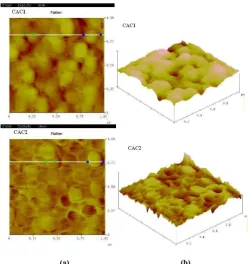
AFM images in contact mode with a scan area of 1 μm x 1 μm have been recorded. The AFM images in 2D and 3D for the present films are shown in Fig. 2. The height verses distance profiles were sketched (Sasi and Gopchandran, 2007). And from that, average grain size, D (pair of blue dots) and average surface roughness, h (pair of green dots in Fig. (2a)) were determined. It is noted that D increase and h decease with increase of t (Table 1).
Table 1. AFM parameters of CAC sample
Sample Surface roughness, h (nm) Average particle size, D (nm)
CAC1 2.35 247
CAC2 1.40 309
[image:2.595.307.557.51.316.2](a) (b)
Fig.2. AFM image of CAC1 and CAC2 films in (a) 2D and (b) 3D
Magnetization
The magnetization, M, as a function of applied field, H, was measured at three different temperatures of 150K, 200K and 300K for the fields applied parallel to the surface of the films. The recorded hysteresis (M-H) loops for the present films are shown in Fig. 3. Both the films exhibited ferromagnetism at these three temperatures. Coercive field, Hc, saturation
magnetization, Ms, remanent magnetization, Mr, were
determined from the hysteresis loops and they are tabulated in Table 2. Hc is found to be decreasing with increase of
temperature. It means that both the films become magnetically softened with temperature (Ying-Ta Shih et al., 2014). Saturation magnetization Ms and remenant magnetization Mr
decreased with increasing temperature. The M–Hloops are not changed with temperature, which is a typical behavior observed in many soft magnetic materials (Akhilesh K Singh
et al., 2013; Herndon et al., 2008; Huang et al., 2001;
[image:2.595.57.272.354.532.2]Brajpuriya, 2010; Ryoichi Nakatani et al., 2004; Li-Feng Liu 2008).
Table 2. Parameters derived from the M-H loops at 150K, 200K and 300K for CAC Samples
Samp
le
Tempera
tu
re
, K
Coerci
v
e fiel
d,
H
c
(T)
x10
-3
Satu
ration
magne
tiza
tion,
M
s
(A
m
-1)
Re
ma
nen
t
magne
tiza
tion,
M
r
(A
m
-1)
Square
n
ess
(Mr/
Ms),
S
AF
c
ou
pl
ing (
1
-S)
CAC1 150 3.089 7.123 2.401 0.337 0.662 200 2.88 7.129 2.322 0.325 0.674 300 2.04 7.049 1.862 0.264 0.735 CAC2 150 2.563 12.8 12.183 0.951 0.048 200 2.562 12.8 12.236 0.955 0.044 300 2.554 12.675 12.17 0.96 0.039
20 30 40 50 60
0 1 2 3 4 5 6 7 8
Int
ensity
(a
. u
.)
2Degree
[image:2.595.308.559.596.757.2]The size of the saturation magnetization measured in the present films is very small and that is expected for when the films are grown on the glass substrates (Takeuchi et al., 1990).
The finite values of (1-S) obtained for both the films confirm the existence of antiferromagnetic type of interaction between
Co layers similar to what has been observed in (Sadashivaiah
et al., 2010; Ramanna et al., 2013). Antiferromagnetic
coupling is appreciable in CAC1 and somewhat weak in CAC2. The strength of antiferromagnetic coupling decreased in CAC1 and increased in CAC2 with increasing temperature (Parkin et al., 1990).
Fig.3. Plots of magnetization versus magnetic field for CAC1 and CAC2 films for different
-0.08 -0.04 0.00 0.04 0.08 -10
-8 -6 -4 -2 0 2 4 6 8 10
Magnetic field H, (T)
M
a
gneti
za
tio
n
M,
(Am
-1 )
CAC-1 150K
-0.08 -0.04 0.00 0.04 0.08 -10
-8 -6 -4 -2 0 2 4 6 8 10
Magnetic field H, (T)
M
agne
tizat
ion
M,
(
Am
-1 )
CAC-1 200K
-0.08 -0.04 0.00 0.04 0.08 -10
-8 -6 -4 -2 0 2 4 6 8 10
Magnetic field H, (T)
M
ag
netizat
ion
M, (Am
-1 )
CAC-1 300K
-0.08 -0.04 0.00 0.04 0.08 -20
-16 -12 -8 -4 0 4 8 12 16 20
Magnetic field H, (T)
Ma
g
n
etizatio
n M,
(A
m
-1 )
CAC-2 150K
-0.08 -0.04 0.00 0.04 0.08 -20
-16 -12 -8 -4 0 4 8 12 16 20
Magnetic field H, (T)
Magnetiz
at
ion M
, (Am
-1 )
CAC-2 200K
-0.08 -0.04 0.00 0.04 0.08 -20
-16 -12 -8 -4 0 4 8 12 16 20
Magnetic field H, (T)
Mag
netization
M
, (Am
-1 )
CAC-2 300K
Resistivity Studies
[image:4.595.63.266.131.287.2]The measured variation of ρ with temperature for CAC1 is displayed in Fig.4. The resistivity increased with increase of t indicating metallic behavior.
Fig. 4. A plot of resistivity, ρ, versus temperature, T, for CAC1
Similar behavior is observed for CAC2. A careful observation of variation of ρ with T revealed that there exists two different power laws for the measured temperature range as shown in Fig.5 (a-b) for CAC1 and CAC2 films. Hence, the following expressions were fit to the data for different temperature ranges.
ρ(T) = ρ(0) + a1 Tk for 5K≤ T ≤ 100K
ρ(T) =A+BTn for 100K ≤ T ≤ 300K
Where, ρ(0) is the residual resistivity which is taken to be equal to the measured value at 5K in the two films.
By regressional analysis, the coefficient a1, exponents k, n and
constants A and B were extracted. The fit parameters thus obtained are tabulated in Table 3. Both the films produced exponent n to be near unity. For pure nonmagnetic metals, the linearity between resistivity and temperature is expected at high temperature (Taylor et al., 1968).
Table 3. The fit parameters of the CAC films
Sample
ρ (0K)
(Ωm)
x10
-8
ρ (300K) (Ωm)
x
1
0
-8
a1
(
ΩmK
-k)
x
1
0
-14
k
A x 1
0
-8
B x
1
0
-1
1 n
CAC1 7.211 9.447 5.563 2.5 6.882 8.845 0.999 CAC2 1.54 2.018 1.188 2.5 1.47 1.89 0.999
0 50 100 150 200 250 300
7.0x10⁻⁸
7.5x10⁻⁸
8.0x10⁻⁸
8.5x10⁻⁸
9.0x10⁻⁸
9.5x10⁻⁸
Resis
ti
v
ity
(
m
)
T (K)
CAC-1
[image:4.595.58.523.403.774.2](a) (b)
Fig.5. Plots of resistivity, ρ versus temperature, T for CAC1 and CAC2 film for (a) 5K to 100K and (b) 100K to 300K. The continuous curve passing through the data points are fits to the data
0 20 40 60 80 100
7.20x10⁻⁸ 7.30x10⁻⁸ 7.40x10⁻⁸ 7.50x10⁻⁸ 7.60x10⁻⁸ 7.70x10⁻⁸ 7.80x10⁻⁸
Res
ist
ivity
(
m
)
T (K)
CAC1
100 150 200 250 300
7.80x10⁻⁸ 8.10x10⁻⁸ 8.40x10⁻⁸ 8.70x10⁻⁸ 9.00x10⁻⁸ 9.30x10⁻⁸ 9.60x10⁻⁸
Resistivity
(
m
)
T (K)
CAC-1
0 20 40 60 80 100
1.52x10⁻⁸ 1.54x10⁻⁸ 1.56x10⁻⁸ 1.58x10⁻⁸ 1.60x10⁻⁸ 1.62x10⁻⁸ 1.64x10⁻⁸ 1.66x10⁻⁸
Resis
ti
vi
ty
(
m
)
T (K) CAC2
100 150 200 250 300
1.65x10⁻⁸ 1.70x10⁻⁸ 1.75x10⁻⁸ 1.80x10⁻⁸ 1.85x10⁻⁸ 1.90x10⁻⁸ 1.95x10⁻⁸ 2.00x10⁻⁸ 2.05x10⁻⁸
Resistivity
(
m
)
T (K)
For the present films, in the temperature range, 5K ≤ T ≤ 100K, the exponent, k is found to be 2.5 respectively and that is in agreement with the results on a magnetic layer (Aliev et al.,
1998). In this range of temperature, electron-phonon s-d scattering dominates over electron-magnon scattering which is expected to be dominant below 20K (Sadashivaiah et al.,
2010). It is concluded that in these films, electron-electron and electron-defect scatterings are predominant below 100K and, electron-phonon and electron-magnon scatterings are predominant above 100K (Ramanna et al., 2013).
Conclusion
(i) The Multilayered films, (Co(50nm)/Al(10nm))n; n = 2 and 5
were deposited. The structure and surface roughness were probed by grazing incidence X-ray diffraction (GIXRD and atomic force microscope (AFM).
(ii) At Three different temperatures of 150K, 200K and 300K magnetic hysteresis loops were recorded in a MPMS SQUID – vibrating sample magnetometer (VSM). At these three temperatures, coercive field, saturation magnetization, remanent magnetization and antiferromagnetic coupling were determined. Antiferromagnetic coupling increased with increase in temperature for CAC1 and decreased with increase in temperature for CAC2.
(iii) Electrical resistivity as a function of temperature in the range from 5K to 300K has been measured by four point method. Both the films exhibited metallic behavior. Relations between resistivity and temperature have been established.
Acknowledgement
Authors acknowledge the financial help received from University Grants Commission, New Delhi, India in the form of a Research Project. Also, authors acknowledge the UGC-CSR, Indore for extending experimental facilities of GIXRD, AFM, magnetic and resistivity measurements.
REFERENCES
Akhilesh K. Singh, Srijani Mallik, Subhankar Bedanta, A Perumal, 2013. J. Phys. D: Appl. Phys., 46, 445005. Aliev, F.G., V.V. Moshchalkov, Y. Bruynseraede 1998. Phys
Rev.B 58, 7.
Angelakeris, M. et al. 2003. Sensors and Actuators A 106, 91. Archna Jaiswal, Sanjay Rai, M. K. Tiwari, V. R. Reddy, G. S.
Lodha, R. V. Nandedkar, 2007. J. Phys. Condens. Matter,
19, 016001.
Botana, J., M. Pereiro, D. Baldomir, H. Kobayashi, J.E. Arias, 2008. Thin Solid Films, 516, 5144.
Brajpuriya, R, 2010. J. Appl. Phys., 107, 083914. Dieny, B. 1992. Europhys. Lett., 17, 261,
Ding, Y. F., J. S. Chen, and E. Liu, 2005. Surf. Coat. Technol., 198, 270.
El Khiraouia, S., M. Sajieddinea, M. Hehnb, S.Robertb, O.Lenobleb, C. Bellouardb, et al. 2008. Physica B, 403,2509.
Hartmann, U., Magnetic Multilayers and Giant Magnetoresistance 1999. Fundamentals and Industrial Applications (New York: Springer).
Herndon, N. B, S. H. Oh, J. T. Abiade, D. Pai, J. Sankar, S. J. Pennycook, Kumar, D. 2008. J. Appl. Phys., 103, 07D515
Hirayama Y., T. Takeuchi, and M. 1993. Futamoto Journal of
Applied Physics, 73, 6441.
Huang M-Q, Hsu Y N, McHenry E and Laughlin D E, 2001.
IEEE Trans. Magn., 37, 2239.
Hutchings, J .A., K. Newstead, M. F. Thomas, G. Sinclair, E.E. Joyce, and P.J. Grundy, 1999. J.Phys. Condens. Matter, 11, 3449.
Kharmouche A., S.M. Cherif, G. Schmerber, 2004. J. Phys.
Appl. Phys., 37, 2583.
Kholin, D. I, A. B. Drovosekov, S. O. Demokritov, M. Rickart, N.M. Kreines, 2006. Phys Metals Metallography, 101, S67.
Kim, S.P. et al. 2006. Materials Science and Engineering, B, 135, 25.
Kumar Dileep, Gupta Ajay 2005. Hyperfine Interactions. 160, 165.
Li-Feng Liu, Wei-Y, Zhou, Si-Shen Xie, Ole Albrecht, Kornelius Nielsch, 2008. Chemical Physics Letters, 466, 165.
Parkin S. S. P., N. More, and K. P. Roche, 1990. Phys. Rev.
Lett., 64, 2304.
Parkin, S. S. P. 1992. Appl. Phys. Lett., 60, 512.
Partha Pratim Pal and Ranjit Pati, 2008. Physical Review, B 77, 144430.
Ramanna R., P.J. Sadashivaiah, T. Sankarappa et al. 2013.
Electrical Engineering Research, 1, 4, 96.
Ryoichi Nakatani, Hideo Hoshiyama, Hirotaka Yakame, Yasushi Endo, Masahiko Yamamoto, 2004. Science and
Technology of Advanced Materials, 5, 69.
Sadashivaiah, P. J, T. Sankrappa, T. T. Sujatha et al. 2010. Vacuum. 85,466.
Sasi B., K.G. Gopchandran, 2007. Nanotechnology, 18, 115613.
Sharma A., S. Tripathi, N. Lakshmib, P. Sachdev, T. Shripathi, 2009. Solid State Communications 149, 1033.
Shima T., K. T. akanashi, Y. K. Takahashi, K. Hono, G. Q. Li, and S. Ishio, 2003. J. Magn. Magn. Mater., 266, 171, Spaldin, N. A. 2011. Magnetic Materials: Fundamental and
Applications (New York: Cambridge University Press) Srivastava, S. K., Ravikumar, A. Gupta. R. S. Patel, A.K.
Majumdar, D. K. Avasthi, 2004. Nuclear Instruments and
Methods in Physics Research, B 243, 304.
Takeuchi T., Y. Hirayama and M. Futamoto 1990. Journal of
Applied Physics 67, 4465.
Taylor G.R., A. Isin, R. E. Coleman, 1986. Phys. Rev., 165, 621.
Vahaplar, K., S. Tari, H. Toku, S. Okur, J. 2009. Vacuum Sci.
and Tech., B 27, 2112.
van Alphen, E. A. M. and W. J. M. de Jonge, 1995. Physical
Review, B, 51, 13, 8182.
Volkerts, J. P. 2011. Magnetic Thin Films: Properties, Performance, and Applications (New York: NovaScience
Pub Incorporated).
Xu, X. H., T. Jin, H. S. Wu, F. Wang, X. L. Li, and F. X. Jiang. 2007. The Solid films 515, 5471.
Yan Peng, Yan-ying Hu, Yao-peng Li, Hui-yuan Sun, 2007.
Chinese Journal of Chemical Physics, Vol. 20, 6.
Ying-Ta Shih, Chien-Yu Su, Chung-Wei Tsai, Wei Pan, 2014. AIP Advances 4, 027117.