On Scenario Aggregation to Approximate
Robust Combinatorial Optimization
Problems
Andr´
e Chassein
1and Marc Goerigk
21Fachbereich Mathematik, University of Kaiserslautern, Germany 2Department of Management Science, Lancaster University, United Kingdom
Abstract
As most robust combinatorial min-max and min-max regret problems with dis-crete uncertainty sets are NP-hard, research in approximation algorithm and approx-imability bounds has been a fruitful area of recent work. A simple and well-known approximation algorithm is the midpoint method, where one takes the average over all scenarios, and solves a problem of nominal type. Despite its simplicity, this method still gives the best-known bound on a wide range of problems, such as ro-bust shortest path or roro-bust assignment problems.
In this paper, we present a simple extension of the midpoint method based on scenario aggregation, which improves the current best K-approximation result to an (εK)-approximation for any desired ε >0. Our method can be applied to min-max as well as min-min-max regret problems.
Keywords: robust combinatorial optimization; approximation algorithms; scenario aggregation; min-max optimization; min-max regret optimization
1 Introduction
We consider uncertain combinatorial optimization problems of the form
min
ctx:x∈ X ⊆ {0,1}n (P)
where X is the set of feasible solutions, and c is an uncertain objective function that comes from some uncertainty set U. Two frequently studied approaches to reformulate such an uncertain problem to a robust counterpart are min-max optimization
min x∈Xmaxc∈U c
FPTAS
Problem LB UB for fixedK
Min-Max
Shortest Path Ω(log1−εK) K ![KZ07] Spanning Tree Ω(log1−εK) O(log2K) ! [ABV07]
s-t Cut Ω(log1−εK) K
Assignment Ω(log1−εK) K
Selection Ω(1) O(log loglogKK) ![KZ07]
Knapsack Ω(1) - ! [ABV07]
Regret
Shortest Path Ω(log1−εK) K ![KZ07] Spanning Tree Ω(log1−εK) K ! [ABV07]
s-t Cut Ω(log1−εK) K
Assignment Ω(log1−εK) K
Selection Ω(1) K ![KZ07]
[image:2.595.133.464.79.286.2]Knapsack not approx. not approx.
Table 1: Current best known approximation guarantees (UB) for unbounded number of scenariosK, and best known inapproximability results (LB) (see [KZ16]).
and min-max regret optimization
min x∈Xmaxc∈U c
tx−opt(c)
where opt(c) = miny∈Xcty is used as an additional normalization term. Both types
of problems have received significant attention in the research literature, see, e.g., the surveys [KY97,ABV09,KZ16] on this topic. In this paper we focus on the case of discrete uncertainty, i.e., the uncertainty set is of the formU ={c1, . . . , cK} ⊂Rn.
For most combinatorial problems where the deterministic version can be solved in polynomial time (e.g., shortest path, spanning tree, selection), both robust counterparts turn out to be NP-hard. Therefore, the approximability of such problems has been analyzed (see, e.g., [ABV07]).
A popular approximation algorithm due to its generality and simplicity is the midpoint method (see, e.g., [CG15]). The idea is to define a new scenario ˆc:= K1 P
i∈[K]ci, which
is the average of all scenarios in the uncertainty set, and to solve a nominal problem with respect to these costs. This method is known to be a K-approximation algorithm for both min-max and min-max regret optimization. In the case of interval uncertainty, this approach even gives a 2-approximation [KZ06, Con12]. Quite surprisingly, this is still the best known approximation guarantee for several problems, see Table 1. In col-umn ”FPTAS for fixed K”, we denote if a fully polynomial-time approximation scheme (FPTAS) is known for the problem with fixed number of scenariosK.
for any constant ε >0. With a slight modification, this also holds for min-max regret. This result hence improves all entries of Table 1 where the best-known approximation is
K and the column ”FPTAS for fixedK” is checked. Interestingly, this also leads to the first-ever approximation algorithm for min-max knapsack problems with unboundedK. Note that this method is not a PTAS. While a PTAS exists for most problems when
K is fixed, it has exponential runtime in K. Our approach remains polynomial in K, but does not give a constant approximation guarantee.
The remainder of this paper is structured as follows. In Section 2 we present our improved approximation algorithm in the case of min-max robustness, and discuss its application to min-max regret in Section 3. We describe two computational experi-ments for the proposed aggregation scheme in Section 4 before we conclude the paper in Section 5.
2 Min-Max Approximation
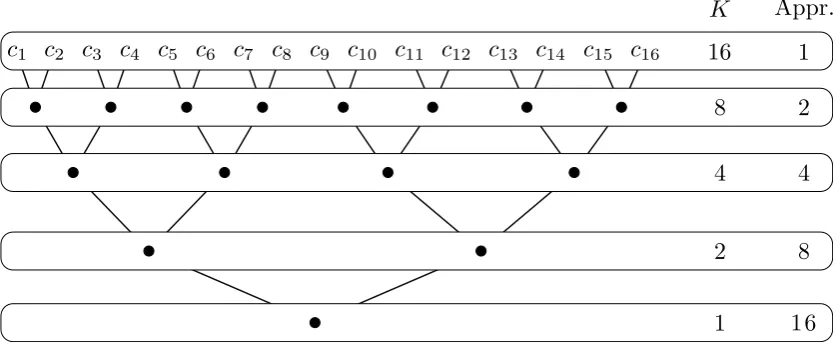
[image:3.595.89.508.400.573.2]In this section, we show how to improve theK-approximation algorithm for the min-max problem to aεK-approximation algorithm for any constantε >0, if a 2-approximation is available for a fixed number of scenarios. The basic idea is the following. Let us assume we have K = 16 scenarios. Solving the robust problem with all 16 scenarios would yield a 1-approximation (i.e., an optimal solution). Solving the problem with only one aggregated scenario gives a 16-approximation. We show that intermediate scenario aggregations also yield intermediate approximation guarantees (see Figure 1).
Figure 1: Basic aggregation scheme.
2-approximation. In total, this method then yields a 2·K/4 =K/2-approximation. In the following, we explain the details of this procedure.
For simplicity, we assume K= 2k here, but our results readily extend to anyK. IfK
is not equal to 2k for some integerk, we setk0=dlog2Keand create an uncertainty set
U0 with 2k0 scenarios by copying any scenarios fromU until the required size is reached. Note that |U0| ≤ 2|U |, and this does not change the corresponding robust optimization problem. We then apply our analysis to the uncertainty set U0.
Let any partition of [K] into sets Sj,j∈[K/2], with cardinality 2 be given. For each
Sj ={j1, j2}, setcj = 12(cj1 +cj2), i.e., cj is the midpoint scenario of scenario setSj.
Lemma 1. Let x be an optimal solution for the min-max problem with scenario set
U ={c1, . . . , cK/2}. Then,xis a 2-approximation for the min-max problem with scenario
setU.
Proof. Let x be an optimal solution for U, and x∗ an optimal solution for U. Let
i∗= argmaxi∈[K]ct
ix be the index of the worst-case scenario inU with respect tox, and choose j∗ such thati∗ ∈Sj∗ ={j∗
1, j2∗}. Then
max i∈[K]c
t
ix=cti∗x≤ctj∗
1x+c
t j∗
2x≤2 maxj∈[K/2]
cj1 +cj2
2 t
x
= 2 max j∈[K/2]c
t
jx≤2 max j∈[K/2]c
t
jx∗ ≤2 max i∈[K]c
t ix∗
We repeatedly apply Lemma 1 to reduce the number of scenarios. Denote byU(k) the original scenario set U containing all scenarios. After the first level of aggregation we end up with scenario setU(k−1) containing 2k−1 scenarios. Repeating the aggregation process we create setsU(`) for `from k to 0.
Corollary 2. Applying Lemma 1 repeatedly, we get a scenario setU(`) with 2`
scenar-ios such that solving the min-max problem with respect to U(`) gives a 2k−` = K/2`
-approximation for the min-max problem with scenario set U.
s t e1
e1
e1
e2
e3
e3
e3
e4
e5
e5
e5
e6
e7
e7
e7
[image:5.595.163.435.84.167.2]e8
Figure 2: An instance of the min-max shortest path problem with 8 scenarios. An edge with vectoreihas cost 1 in theithscenario and 0 in all other scenarios. For this instance the approximation guarantee of Corollary 2 is tight if we aggregate to 4 scenarios.
the aggregated problem may consist of the top instead of the bottom path. This leads to a gap of 2k−` =K/2`. In Figure 2, we present this worst case instance for K= 8 and
`= 2.
Lemma 3. A solution that is anα-approximation forU(`)is also an(αK/2`)-approximation
for U.
Proof. Analogously to the proof of Lemma 1.
We can now state the main result of this section.
Theorem 4. Let a constant 0< ε≤1 be given, and letK be unbounded. If there exists a 2-approximation algorithm for the min-max problem with a fixed number of scenarios,
there exists a polynomial-time algorithm that gives an(εK)-approximation for the
min-max problem.
Proof. Let ε ≤ 1 be constant. We choose `0 := dlog1ε + 1e. As K is unbounded, we
can assume that K ≥`0. According to Corollary 2 we construct the set U(`0) with 2`0 scenarios. Using the 2-approximation algorithm for the min-max problem with a fixed number of scenarios, we find a 2-approximation forU(`0). Using Lemma 1, we conclude that the solution is a 2·2k−`0 = 2K/2dlog1ε+1e≤K/1
ε =εK-approximation. Note that the running time of this procedure is polynomial since the value ofand, therefore, also
`0, is fixed.
Corollary 5. Let a constant 0< ε≤1 be given, and let K be unbounded. Then there
exists a polynomial-time (εK)-approximation algorithm for the min-max shortest path,
spanning tree, selection, and knapsack problem.
As examples, let us consider the min-max selection and shortest path problems. For both problems we need a 2-approximation algorithm for the min-max problem with a fixed number of scenarios.
• For selection, there exists an FPTAS that finds for a fixed number of scenarios ˜
K a (1 + ˜ε)-approximation with running time OpK˜n
˜
εK˜−1
using Theorem 4, an (εK)-approximation is possible in Op4εn
by aggregating
to ˜K = 2dlog1ε+1escenarios, and approximating the resulting problem with a factor
of 2, i.e., choosing ˜ε= 1.
• For shortest path, there exists an FPTAS that finds for a fixed number of
sce-narios ˜K a (1 + ˜ε)-approximation with running time in OmnK˜
˜
εK˜−1
, which makes
it possible to find an (εK)-approximation in time Omn4ε
by aggregating to
˜
K = 2dlog1ε+1e scenarios, and approximating the resulting problem with a factor
of 2, i.e. choosing ˜ε= 1.
3 Min-Max Regret Approximation
To translate the results obtained for min-max to min-max regret problems we need to modify the aggregation procedure, as the following example shows.
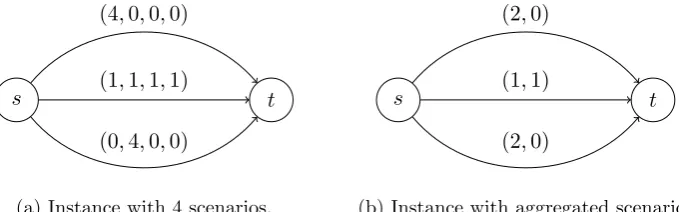
Example 6. Consider the min-max regret shortest path instance shown in Figure 3a. There are four scenarios. An optimal solution is to take the path in the middle with a
regret of 1. If we aggregate the first two and the last two scenarios, we arrive at the
instance shown in Figure 3b. Here, all three paths are optimal with a perceived regret
of 1 (the top and bottom part have a regret of 1 in the first scenario, while the middle
path has a regret of 1 in the second scenario). Without loss of generality we can hence
assume that an optimization algorithm will return the top path, but its true regret is 4.
Hence, in this example, we obtain only a 4-approximation and not a 2-approximation as
in the case of the min-max objective function.
s t
(4,0,0,0)
(0,4,0,0) (1,1,1,1)
(a) Instance with 4 scenarios.
s t
(2,0)
(2,0) (1,1)
[image:6.595.130.470.446.552.2](b) Instance with aggregated scenarios
Figure 3: An example instance where aggregating from four to two scenarios leads to a 4-approximation for min-max regret.
Instead of simply aggregating pairs Sj ={j1, j2} of scenarios and solving a min-max
regret problem on this new scenario set, we consider the following problem
min
x∈Xj∈max[K/2]c
t jx−
1
2opt(cj1)−
1
Note that we do not use the objectivectj−opt(cj), as would be usual for min-max regret. Further generalizing, we call a problem
min x∈Xmaxi∈[K]c
t
ix−d(ci)
with arbitrary da generalized min-max regret problem.
Lemma 7. Solving the generalized min-max regret problem (*) on U = {c1, . . . , cK/2}
is a 2-approximation for U.
Proof. Let x be optimal for problem (*), and x∗ optimal for the original problem with
uncertainty set U. Again, denote by i∗ = argmaxi∈[K]ctix−opt(ci) and choose j∗ such thati∗ ∈Sj∗ ={j∗
1, j2∗}. Then
max i∈[K] c
t
ix−opt(ci)
=cti∗x−opt(ci∗)
≤ctj∗
1x−opt(cj
∗
1) +c
t j∗
2x−opt(cj
∗
2)
≤ max
j∈[K/2] (cj1 +cj2)
tx−opt(c
j1)−opt(cj2)
= 2 max j∈[K/2]
ctjx−1
2opt(cj1)−
1
2opt(cj2)
≤2 max j∈[K/2]
ctjx∗−1
2opt(cj1)−
1
2opt(cj2)
= max j∈[K/2] c
t j1x
∗−
opt(cj1) +c
t j2x
∗−
opt(cj2)
≤2 max i∈[K] c
t
ix∗−opt(ci)
Note that the arguments used in the proof of Lemma 7 can be generalized to the case where scenarios are aggregated repeatedly, i.e., we aggregate to sets Sj with more than two elements. Similar to Corollary 2 we obtain:
Corollary 8. Given an aggregated scenario set U(`) where each of the 2` scenarios is
given as cj := 2k1−`
P
s∈Sjcs. The optimal solution of the generalized min-max regret
problem
min
x∈Xjmax∈[2`]cjx−
1 2k−`
X
s∈Sj
opt(ck)
yields an (K/2`)-approximation of the min-max regret problem with scenario set U.
Theorem 9. Let a constant 0 < ε ≤ 1 be given, and let K be unbounded. If there exists a 2-approximation algorithm for the generalized min-max regret problem with a fixed number of scenarios, then there exists a polynomial-time algorithm that gives an
(εK)-approximation for the min-max regret problem.
Note that in our construction of the generalized problem, we have d(ci) ≤ opt(ci). Hence, we can use the same proof as in [ABV07] using the FPTAS for multi-objective spanning tree to show that there is an FPTAS for our generalized min-max regret span-ning tree problem. The same approach applies to the min-max regret selection problem. Furthermore, we can modify any generalized min-max regret shortest path problem by adding an edge from s to t with costs d(ci) in scenario i. We create an additional scenario where the costs of each edge is 0, and the costs of the new edge is a sufficiently large valueM. Asd(ci)≤opt(ci), we can then solve a classic min-max regret problem on this instance, giving the same objective value as before. Hence, the FPTAS for min-max regret shortest path (see [ABV07]) can also be applied to our generalized problem.
Corollary 10. Let a constant 0< ε≤1 be given, and letK be unbounded. Then there
exists a polynomial-time (εK)-approximation algorithm for the min-max regret shortest
path, spanning tree, and selection problem.
4 Computational Experiments
In this section, we present two experiments to test the proposed aggregation method. In both experiments the underlying problem is a robust shortest path problem with a discrete uncertainty set. The underlying graph of the shortest path problem is a complete layered graph with 10 layers and width 4. The scenario set consists of randomly generated scenarios. The cost of each edge is chosen uniformly in [0,1] for each scenario.
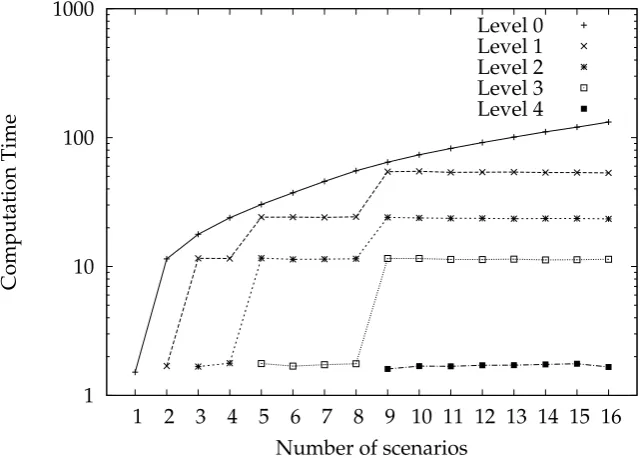
In the first experiment, we investigate the influence of the aggregation scheme on so-lution quality and computation time. We start by solving the robust problem exactly using an IP formulation which contains one additional constraint per scenario. In the next step, we aggregate two consecutive scenarios. This reduces the number of con-straints in the IP formulation. We solve the reduced IP formulation and repeat the aggregation process until we end up with a single scenario. To make the aggregation scheme work properly we have to ensure at the beginning of the aggregation that the number of scenarios is a power of two. This is done by duplicating some of the scenar-ios. For example the scenario set{c1, c2, c3, c4, c5}is replaced with the scenario multiset
{c1, c1, c2, c2, c3, c3, c4, c5}. We evaluate each computed solution using the original set
0.95 1.00 1.05 1.10 1.15 1.20 1.25 1.30
1 2 3 4 5 6 7 8 9 10 11 12 13 14 15 16
Relative worst case performance
Number of scenarios
[image:9.595.138.455.86.322.2]Level 0 Level 1 Level 2 Level 3 Level 4
Figure 4: The horizontal axis gives the number of scenarios. The relative worst case performance of the different solutions for the different levels of aggregation is shown on the vertical axis.
1 10 100 1000
1 2 3 4 5 6 7 8 9 10 11 12 13 14 15 16
Computation Time
Number of scenarios
Level 0 Level 1 Level 2 Level 3 Level 4
[image:9.595.135.457.392.621.2]But each additional aggregation level has a smaller impact. Note also that the relative performance of the aggregated solutions is far below the theoretical performance guaran-tee. The solution time depends only on the number of scenarios which remains after the aggregation. Recall the duplication of scenarios which increases the number of scenarios to the next power of two.
In the proposed aggregation scheme (see Figure 1) always two consecutive scenarios are aggregated. This rule is arbitrary. In the second experiment, we test if a more so-phisticated aggregation rule can lead to an improved solution quality. For the improved aggregation scheme we aggregate similar scenarios. To this end, we computed a mini-mal cost perfect matching between the different scenarios. We set the cost of matching scenario i with scenario j to the Euclidean distance of scenario i and j. The optimal matching produces a list of pairs of scenarios. We sort this list with respect to the Euclidean distance between the scenarios of the pair. We then iteratively aggregate the matched pairs of scenarios, beginning with the pair which has the smallest Euclidean dis-tance, until all matched pairs are aggregated. Then we recompute the perfect matching and repeat the aggregation process. This is repeated until all scenarios are aggregated to a single scenario. To model the naive approach we iteratively aggregate two consecutive scenarios until we have halved the number of scenarios. Then we repeat the aggregation process from the beginning, until we end up with a single scenario. For the experiment we used a robust shortest path problem with 16 scenarios. The results of the experiment, averaged over 10,000 instances, are shown in Figure 6.
It can be seen that the more involved aggregation rule based on scenario similarity gives indeed better results for intermediate aggregation levels. For full or no aggregation, the used aggregation rule is of course irrelevant.
5 Conclusions
The midpoint method is a central approximation algorithm in robust optimization. De-spite its simplicity, it has been the best-known method for several classic combinatorial problems. In this paper, we presented a simple variant of the method, where the un-certainty set is not aggregated to a single scenario, but to a sufficiently small set of scenarios instead. This reduced scenario set is then approximated using, e.g., an FPTAS for discrete uncertainty of constant size. Our approach can be used to find polynomial time (εK)-approximations for any constant ε∈(0,1], thus improving several currently known best approximability results.
Our results hold for any aggregation scheme. However, for practical purposes, aggre-gating similar scenarios is reasonable, so as to preserve the structure of the uncertainty set as far as possible. To quantify this effect we considered a computational experiment using random shortest path instances. Our results indicate that approximation guar-antees are considerably smaller on these instances than the theoretical bounds suggest, and that aggregating similar scenarios does indeed improve the quality of solutions.
1.00 1.02 1.04 1.06 1.08 1.10 1.12 1.14 1.16 1.18
1 2 3 4 5 6 7 8 9 10 11 12 13 14 15 16
Relative worst case performance
[image:11.595.135.456.81.318.2]Number of aggregated scenarios
Figure 6: The horizontal axis gives the number of scenarios that remain after each ag-gregation. The relative worst case performance of the different solutions for the different levels of aggregation is shown on the vertical axis. The straight line shows the performance when aggregating similar scenarios and the dashed line shows the performance of the consecutive aggregation scheme.
(ci1, . . . , cin) and cj = (cj1, . . . , cjn) are aggregated, the resulting scenario is given as
c= (max{ci1, cj1}, . . . ,max{cin, cjn}). With an analogous analysis as in Section 2, one can also show that the same aggregation approach can be used in this setting.
References
[ABV07] H. Aissi, C. Bazgan, and D. Vanderpooten. Approximation of min–max and min–max regret versions of some combinatorial optimization problems.
Euro-pean Journal of Operational Research, 179(2):281 – 290, 2007.
[ABV09] H. Aissi, C. Bazgan, and D. Vanderpooten. Min–max and min–max regret versions of combinatorial optimization problems: A survey. European Journal
of Operational Research, 197(2):427 – 438, 2009.
[CG15] A. Chassein and M. Goerigk. A new bound for the midpoint solution in minmax regret optimization with an application to the robust shortest path problem.
European Journal of Operational Research, 244(3):739–747, 2015.
using a symmetry point scenario. European Journal of Operational Research, 219(2):452–457, 2012.
[KY97] P. Kouvelis and G. Yu. Robust Discrete Optimization and Its Applications. Kluwer Academic Publishers, 1997.
[KZ06] A. Kasperski and P. Zieli´nski. An approximation algorithm for interval data minmax regret combinatorial optimization problems. Information Processing
Letters, 97(5):177–180, 2006.
[KZ07] A. Kasperski and P. Zieli´nski. Approximation of min-max (regret) combina-torial optimization problems under discrete scenario representation. Technical report, Institute of Mathematics and Computer Science, Wroclaw University of Science and Technology, PRE 7, 2007.
[KZ16] A. Kasperski and P. Zieli´nski. Robust discrete optimization under discrete and interval uncertainty: A survey. In Robustness Analysis in Decision Aiding,
![Table 1: Current best known approximation guarantees (UB) for unbounded number ofscenarios K, and best known inapproximability results (LB) (see [KZ16]).](https://thumb-us.123doks.com/thumbv2/123dok_us/9321192.433980/2.595.133.464.79.286/table-current-approximation-guarantees-unbounded-ofscenarios-inapproximability-results.webp)