'
computers
and people
formerly
Computers and Automation
.\1
SCIENCE &
TECHN
.
LOG'
,
March,
1974
Vol.
23,
NO.3
TRANSIT
EXPRESSWAY
ALSO
People-Moving With
New Technology
- P. E. Norton
IN THIS ISSUE:
Computerizing Production
Data Increases Plant's
Efficiency
- Edward F. Sylvain
Privacy and Security in
Data Systems
- Ruth M. Davis
The Assassination of Martin
Luther King, Jr " Part 2
ttWHO'S WHO IN COMPUTERS
AND DATA PROCESSING"
EDITION 5.3 = 5th EDITION
+
3 SUPPLEMENTS ALREADY ISSUEDTHE
MOST ESSENTIAL
AND
DATA
COMPONENTS
PROCESSING
IN
ARE
COMPUTERS
PEOPLE
Who are they?
Consult
What do they do?
Where do they do it?
"Who's Who in Computers and Data Processing" has been changed to a periodic subscription basis as follows:
1. The latest Cumulative Edition (the 5th edition
published 1971, containing over 15,000 cap-sule biographies, over 1,000 pages long, 3 volumes, hardbound) PLUS
2. Three Updating Supplements per period totaling over .3.,000 entries
Both for $34.50 in any period when a cumulative edition is supplied ... and $15.00 per period when a cumulative edition is not supplied.
BASED ON continual data gathering from computer
pro-fessionals carried out by
Computers and People
(formerly
Computers and Automation).
This reference is particularly useful for:
Personnel managers Libraries
Conference planners
Directors of computer installations Suppliers to the computer industry Executive search organizations Prospective authors
Prospective speakers ...
anyone who needs to keep up with the important people in the field.
Each computer professional has a capsule biography
detailing: last name; first name and middle initial (if
any); occupation; year of birth; university education and degrees; year entered the computer field; main interests; job title; organization and its address; pub· lications, honors and memberships; home address.
2
nWho's Who In Computers
And Data Processing"
jointly published by Computers and People (Berkeley
Enter-prises, Inc.) and Quadrangle / New York Times Book Co.
We are confident that you will find the subscription will repay you many times over. In fact, one day when this wealth of material gives you the inside track with someone important to you, you'll find the information
PRICELESS: the most essential component in EDP is
CAPABLE PEOPLE.
RETURNABLE IN 10 DAYS FOR FULL REFUND (if not satisfactory)
r - - - (may be copied on any piece of paper) -I WHO'S WHO IN COMPUTERS AND DATA PROCESSING
I 815 Washington St., Newtonville, Mass. 02160
YES, please enroll me as a subscriber to Who's 'Who in Computers and Data Processing at the
follow-ing rate:
$34.50 including the last cumulative edition
OR
$15.00 since I already have access to the last cum-ulative edition
I understand that for each period of subscription I shall receive three updating supplements, totaling over 3,000 entries.
) Payment enclosed ) Please bill me. ( ) Please bill my organization
RETURNABLE IN 10 DAYS FOR FULL REFUND
Name Title Organization Address City
Your Signature
(if not satisfactory)
State & Zip
10,
IF YOU COULD PREVENT
JUST ONE IMPORTANT MISTAKE
BEFORE IT HAPPENED. • •
HOW MUCH
WOULD THAT BE WORTH TO YOU - $100? - $1000? more?
Our considered estimate is that 10 to 20% or more of the cost of operation of most businesses is the cost of mistakes. (Just one foreseeable mistake that "Computers and Automation" made in 1970 has cost us $4000.)
WOULDN'T YOU AGREE
THAT SENSE, COMMON AND UNCOMMON,
OUGHT TO BE THE KEY TO PREVENTING MISTAKES?
In a number of the issues of "The Notebook on Common Sense, Elementary and Advanced", we examine systematically the prevention of mistakes, such as:
No. 15:
No. 23:
No. 38:
No. 41:
No. 49:
No. 63:
Preventing Mistakes from Failure to Understand
Preventing Mistakes from Forgetting )
- Volume 1, first
subscription. year
The Concepts of Feedback and Feedback Control )
Preventing Mistakes from Unforeseen Hazards - Volume 2, second
Preventing Mistakes from Placidity subscription year
Preventing Mistakes from Camouflage and Deception
and we are planning at least 20 more issues in Volumes 3 to 5 under this general heading.
WHY NOT TRY THE NOTEBOOK ON COMMON SENSE?
GUARANTEE:
(1) You may return (in 7 days) the first batch of issues we send you, for FULLREFUND, if not satisfactory. (2) Thereafter, you
may cancel at any time, and you will receive a refund for the unmailed portion of your sub-scription.
PAST ISSUES:
As a new subscriber, you do not miss past issues. Every subscriber's subscription starts at Vol. 1, No.1, and he eventually receives all issues. The past issues are sent to him usually four at a time, every week or two, until he has caught up, and thus he does not miss important and interesting issues that never go out of date.HOW CAN YOU LOSE?
(may be copied on any piece of paper)
-To: BERKELEY ENTERPRISES, INC.
815 Washington St., Newtonville, Mass. 02160
( ) YES, please enter my subscription to the Notebook on Common Sense at $12 a year,
24 issues (newsletter style), and extras.
( ) Please send me (as FREE premiums for subscribing) the first six issues:
1. Right Answers - A Short Guide to Obtaining Them 4. Strategy in Chess
2. The Empty Column 5. The Barrels and the Elephant 3. TIle Golden Trumpets of Yap Yap 6. The Argument of the Beard
( ) I enclose $ ) Please bill my organization
Returnable in 7 days for full refund if not satisfactory.
NAME _______________________________________________ TITLE ________________________________ _
ORGANIZATION ____________________________________________________________________________ __
ADDRESS ________________________________________________________________________________ ___
SIGNATURE ________________________________________ ___ Purchase Order No " ______________________ _
Editor
Assistant Editors
Art Director
Software Editor
Advertising Director
Contributing Editors
Advisory
Vol.
23,
No. 3
March, 1974
Edmund C. Berkeley Barbara L. Chaffee Linda Ladd Lovett Neil D. Macdonald Grace C. Hertlein Stewart B. Nelson
Edmund C. Berkeley
John Bennett Moses M. Berlin Andrew D. Booth John W. Carr III Ned Chapin Ted Schoeters Richard E. Sprague Ed Burnett
Committee James J. Cryan Bernard Quint
Editorial Berkeley Enterprises, Inc.
Offices 815 Washington St. Newtonville, MA 02160 617-332-5453
Advertising The Publisher
Contact Berkeley Enterprises, Inc. 815 Washington St. Newtonville, MA 02160 617-332-5453
"Computers and People," formerly "Computers and Automation," is published monthly, 12 issues per year, at 815 Washing-ton St., NewWashing-tonville, MA 02160, by Berkeley Enterprises, Inc. Printed in U.S.A. Second Class Postage paid at Boston, MA, and addi-tional mailing points.
Subscription rates: United States, $11.50 for one year, $22.00 for two years. Canada: add $1 a year; foreign, add $6 a year.
NOTE: The above rates do not include our publication "The Computer Directory and Buyers' Guide". If you elect to re-ceive "The Computer Directory and Buyers' Guide," please add $12.00 per year to your subscription rate in U.S. and Canada, and $15.00 per year elsewhere.
Please address all mail to: Berkeley Enterprises, Inc., 815 Washington St., New-tonville, MA 02160.
Postmaster: Please send all forms 3579 to Berkeley Enterprises, Inc., 815 Washing-ton St., NewWashing-tonville, MA 02160.
© Copyright 1974, by Berkeley Enter-prises, Inc.
Change of address: If your address changes, please send us both your new address and your old address (as it ap-pears on the magazine address imprint), and allow three weeks for the change to be made.
4
computers
and people
formerly Computers and AutomationComputer Applications
8 People-Moving with New Technology [A]
by Phillip E. Norton, Westinghouse Electric Corp., Pittsburgh, Pa. Taking the highly developed technology for automatic ele-vators and applying it in the horizontal dimension - in crowded cities, airports, expositions, and so on.
13 Computerizing Production Data Increases Plant's [A]
Operation Efficiency
by Edward F. Sylvain, I BM Corporation, San Jose, Calif. How a new system for data information for manufacturing determines production requirements, machine performance, inventory control, and control of parts.
Computers and Society
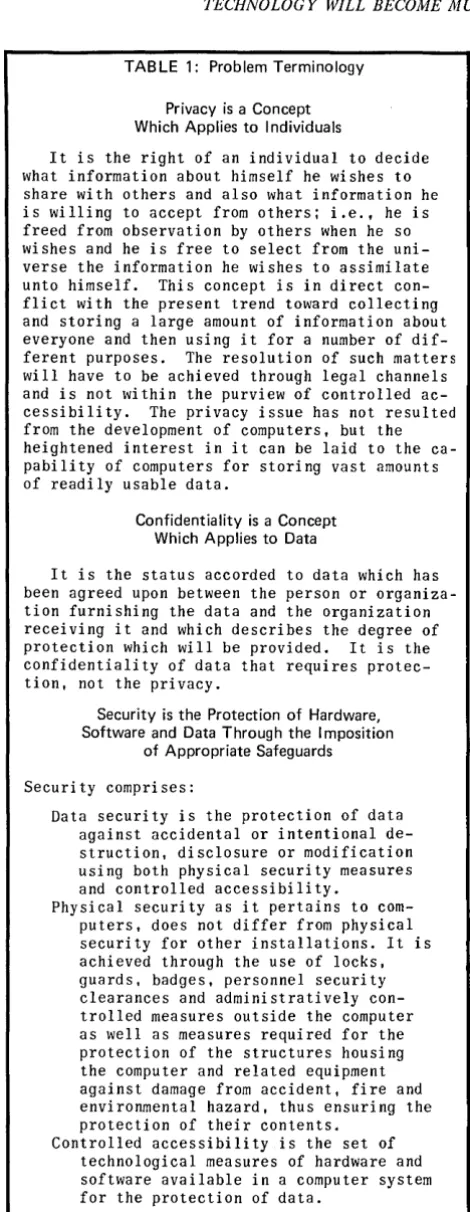
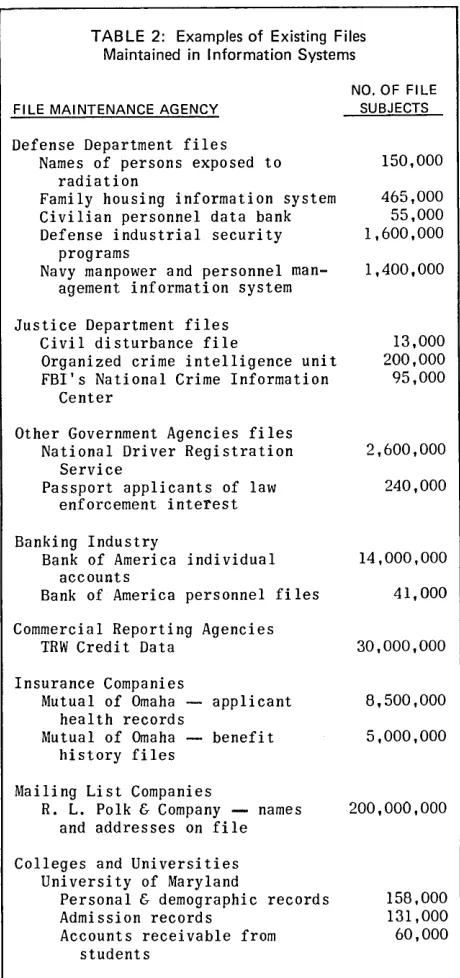
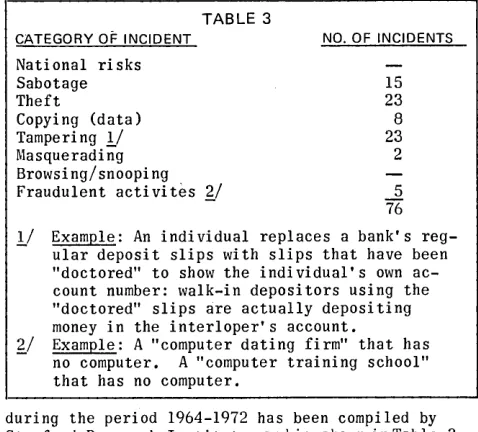
20 Privacy and Security in Data Systems [A]
by Ruth M. Davis, Director, I nstitute for Computer Sciences and Technology, National Bureau of Standards, Bethesda, Md.
How the problem of privacy has introduced serious stresses between society and technology; and how present and future tensions can be reduced if the government, the courts, ser-vice industries, and legislative bodies, visibly take on ap-propriate responsibilities.
Computer Programming
16 Effective Program Design [A]
by David W. Packer, Digital Equipment Corp., Maynard, Mass. The concept of the design of good programs as a discipline in itself, needs to be accepted, taught, and developed.
The Profession of Information Engineer and the Pursuit of Truth
5 Unsettling, Disturbing, Critical [F)
Statement of policy by Computers and People
28 The Assassination of the Reverend Martin Luther King, Jr., [A]
and Possible Links with the Kennedy Murders - Part 2 by Wayne Chastain, Jr., Reporter, Memphis, Tenn.
The report of a diligent study into the details and circum-stances of the assassination of the Reverend Martin Luther
King, Jr., on April 4, 1968, and related events, and the con-siderable evidence of a conspiracy.
Computers, Games, and Puzzles
6 Computers, Puzzles, and Games [E)
by Edmund C. Berkeley, Editor, Computers and People
It is fun to use one's mind - and it is fun to use the artificial mind of the computer.
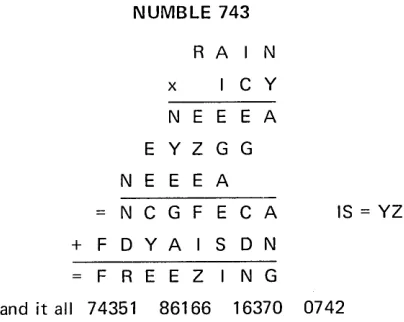
33 Number Puzzles for Nimble Minds - and Computers [C)
NUMB LES - Deciphering unknown digits in order to read
a message.
NAYMANDIJ - Finding system among randomness.
by Neil Macdonald, Assistant Editor
The magazine of the design, applications, and implications of
information processing systems - and the pursuit of truth in
input, output, and processing, for the benefit of people.
Computers, Games, and Puzzles (continued)
7 Word Puzzles for Nimble Minds - and Computers [C] WUNSI LLABO - Converting into words of one-syllable.
SIXWORDO - Converting into sentences of not more than six words.
by Edmund C. Berkeley, Editor
Unsettling, Disturbing, Critical . .
Computers and People (formerly Computers and Automation),
believes that the profession of information engineer includes not only competence in handling information using computers and other means, but also a broad responsibility, in a professional and engineer-ing sense, for: the reliability and social significance of pertinent in-put data; the social value and truth of the outin-put results. In the same way, a bridge engineer takes a professional responsibility for the reliability and significance of the data he uses, and the safety and efficiency of the bridge he builds, for human beings to risk their lives on.
Accordingly, Computers and People publishes from time to time
articles and other information related to socially useful input and output of data systems in a broad sense. To this end we seek to publish what is unsettling, disturbing, critical - but productive of thought and an improved and safer planet in which our children and later generations may have a future, instead of facing extinction.
The professional information engineer needs to relate his engi-neering to the most important and most serious problems in the world today: war, nuclear weapons, pollution, the population explo-sion, and many more.
CORRECTIONS
In the February, 1974, issue of Computers and People:
Page 5, left column, line 19, replace "opponet" by "opponent". Page 18, line 1 (title), replace "Social and" by "Social
Force and".
Page 20, left column, last section heading, replace "Euth-ansi a" by "Euthanasia".
Page 36, left column, line 5, replace "Phildo-Ford" by "Philco-Ford".
Page 37, right column, line 16 from bottom, replace "Brooks Roberst" by "Brooks Roberts".
We much regret these stupid mistakes, and have altered our procedure to make such mistakes less likely in the future.
COMPUTERS and PEOPLE for March, 1974
Front Cover Picture
This two-mile Transit Expressway in South Park, near Pittsburgh, Pa., is one example of the development of new systems and new equip-ment to ease the burden on the commuting public. For more about moving people with new technol-ogy, see the lead article, page 8.
Departments
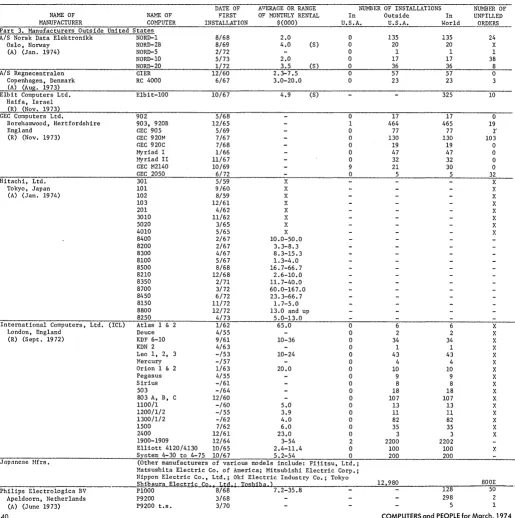
34
Across the Editor's Desk -Computing and Data Processing Newsletter42
Advertising Index42
Calendar of Coming Events 40 Monthly Computer Census38
39
Key
[A] [C]
[E] [F]
New Contracts New Installations
Article
Monthly Column Editorial
Forum
NOTICE
*D ON YOUR ADDRESS IMPRINT MEANS THAT YOUR SUBSCRIP-TION INCLUDES THE COMPUTER DIRECTORY. *N MEANS THAT YOUR PRESENT SUBSCRIPTION DOES NOT INCLUDE THE COM-PUTER DIRECTORY.
EDITORIAL
Computers, Puzzles, and Games
It is fun to use one's mind.
One of the subjects that we continually cover in Com-puters and People is the material that challenges people's
minds; and an important way to lead a person who has little knowledge of a computer into the comfortable under-standing of it, is for him to play games with the computer
- and to solve puzzles with the computer at his elbow helping him.
New machines make possible new ways of playing. On one occasion more than 40 years ago, I was assigned the use of a desk calculator possessing automatic long division, and I found a little time to just play with it. So, with all the work of long division vanished, I did a little experi-menting with recurring decimal fractions. I found out that the prime number 11111 was exactly divisible by 41 and by 271 (both prime numbers) and so each of 1/41 and 1/271 was a recurring decimal that repeated in periods of five digits:
1/41
=
.024390243902439 ... .1/271 = .003690036900369 ... .
Some new games or puzzles related to computer game playing and computer puzzle solving that have been de-scribed and published in Computers and People (formerly Computers and Automation) are:
- Numbles, played with letters and digits - a series of puzzles published since 1968; - Zingo, played with 21 dice - see the February
1972 issue of Computers and Automation;
Naymandij, played with a series of 200 digits -see the January 1974 issue of Computers and People.
We have also embarked on some games, puzzles, and exercises related to some of the great tasks that still lie in front of computer programmers. One of these is teaching a computer to understand free and unconstrained natural language.
In this area, we have published:
- "Computer Programming Using Natural Language" - three articles in the June, July, and August
6
1973 issues of Computers and Automation
(re-prints available);
- "'Do What I Mean' (DWIM): the Programmer's Assistant" - an article by Warren Teitelman in the April 1972 issue of Computers and Automa-tion;
- Wunsillabo and Sixwordo, puzzles played with words - published for the first time in this issue of Computers and Peopie.
We expect to expand our coverage of games, puzzles, and exercises that can be played with or aided by a com-puter, especially an interactive computer - because the computer has many virtues as a partner in games and puzzles:
l. It can be very patient.
2. It never gets angry but always stays calm.
3. It never gets tired or weary.
4. It can be unfailingly polite and courteous.
5. It can be adaptable, friendly, even sympathetic.
6. It can crack jokes.
7. It can read, look up, report, sketch, draw, calcu-late, reason, analyze, learn, remember, forget, and act randomly.
8. It can ask questions, accept answers, supply answers, accept many kinds of commands, and respond to many kinds of commands.
9. It can play the roles of: teacher, drill sergeant, dictionary, table of figures, library, tutor, col-league, calculating prodigy, file of records, score-keeper, timer, umpire, guide, philosopher, play-mate, and friend.
It is fun to use the artificial mind of a computer.
~c.~
Edmund C. Berkeley Editor
WORD PUZZLES FOR NIMBLE MINDS - AND COMPUTERS
Edmund C. Berkeley EditorWUNSILLABO
The day is sure to come when words will be under-standable by computers not only in limited contexts but much more widely. In the meantime, it will be good to practice with several kinds of exercises. One kind of exer-cise is getting computers to understand sequences of words in natural language but in limited contexts. See for ex-ample in the August 1973 issue of Computers and Auto-mation (in Appendix 1 in the article "Computer
Program-ming Using Natural Language, Part 3") the 65 examples there given of plain ordinary free natural English trans-lated by a computer program (GENIE) into a programming language acceptable to a computer. Another kind of exer-cise is getting people to translate from more difficult Eng-lish linguistic expressions into easier expressions, for there is a great deal of English written and spoken which only a few people understand.
This second kind of exercise finds one expression in the following kind of word puzzle or word game (which we here and now name WUNSILLABO), the problem of taking passages in ordinary natural English and converting them entirely into one-syllable words, the meaning to be just the same. The requirement of one syllable has some ex-ceptions: (1) additional syllables produced by one of the endings "s, es, d, ed, ing" are allowed; (2) figures in digits and symbols such as $25 are allowed. Example:
Problem: Jones intends to suppress all varieties of
worship in this religious edifice.
A satisfactory answer (though perhaps not the best and perhaps not completely accurate) is as follows:
One Proposed Answer: Jones aims to put a stop to al1
forms of praying in this church.
Note that the concept of religious edifice in the original sentence includes the concept of mosque, while the para-phrase does not; but this is probably a quite unimportant objection.
WUNSILLABO PUZZLE 743
1. I mistrust the governmental system of monarchy, and always have.
2. In his monotonous harangue there were many mis-conceptions.
3. Brown is transmitting to Smith a consignment of condiments.
4. Smith reported that the earth tremors in Maine were serious and Ubiquitous.
5. These old Scotch manufacturers have a hereditary mono-poly in many varieties of excellent marmalade. 6. The icy precipice in the great valley glacier
consti-tuted such a tremendous obstacle for Clark that he could not overcome it and proceed on his journey.
COMPUTERS and PEOPLE for March, 1974
7. Your invoice indicates that your company has a credit of $179. Please transmit this amount to us at your earliest opportunity so as to settle the accounts between us.
8. Please indicate to me if you are interested in exam-ining the incoming letters for any particular kinds of correspondence, and as soon as the incoming mail is opened, I shall be happy to inspect it promptly, and refer to you any correspondence that you are perhaps interested in.
SIXWORDO
Another way to make difficult English linguistic expres-sions easier is to make sentences shorter. Short sentences can usually be understood more easily than long ones, both by persons and by computers. Hence we have two questions:
Is it possible to express any desired meaning as a sequence of short sentences, each no longer than
x
words? What is the best value of x for a computer? for a person?
Some exploration of these questions is contained in the following puzzle or game (which we here and now name SIXWORDO). The puzzle is to paraphrase a passage (a set of sentences), making every new sentence no longer than six words, the meaning to be just the same. Example:
Problem: This is the problem of making every sentence
no longer than six words.
One Proposed Answer: This problem is the following.
Make every sentence short. "Short" means six words or less.
SIXWORDO PUZZLE 743
(1) It was a fascinating place to work. (2) There was the graceful old hacienda, now falling into picturesque disrepair. (3) There was the immense volcanic cone of Popocatepetl, close at hand, dominating the western sky line. (4) In the orchard, really a series of orchards, there were old avocados in long straight rows. (5) The Rodiles family had been interested in avocados through several gen-erations. (6) For years they made it a practice to bring home the best ones from the local markets, and to sprout the seeds and plant the seedlings in their orchard. (7) The resulting collection is a botany professor's paradise, literal-ly several thousands of avocados, grown to maturity, no two of them exactly alike. (8) If one wants to study var-iation in avocados, this is it.
(From page 103 of Plants, Man and Life by Edgar Anderson)
For these puzzles, we invite our readers to send us solu-tions together with human programs or computer programs which will produce the solutions. A proposed solution (there is no such thing as "the" solution) will be published in the next issue.
"All major city transit agencies building new systems or modernizing existing ones are turning to automation . . . automated rail systems are able to do a better job of competing with the automobile and of bringing relief from traffic congestion on streets and higfiiNays. N
PEOPLE-MOVING With New Technology
Phillip E. Norton Manager, Public Relations Westinghouse Electric Corp.
Pittsburgh, Pa. 15222
Every day, in cities throughout the world, thous-ands of commuters travel part of their way to work on
a nearly ideal mass transit system quiet, safe,
direct, inexpensive and dependable in all kinds of weather.
The system, of course, is the elevator. Its only
real drawback is that it goes only up and down. And
those same commuters find that moving horizontally in a city during a morning or evening rush hour is a much more frustrating challenge than vertical travel.
In the U.S. alone, planning experts have calcu-lated that about 45 urban transit systems costing nearly 11 billion dollars should be built by 1980. This crisis in urban mobility has brought industry and government together in the development of new systems and new equipment to ease the burden on the commuting public.
One example of industry's involvement in mass transportation is the work of Westinghouse Electric
Corporation. Westinghouse has been supplying
trans-portation equipment for more than 80 years. Today its products range from total urban transit systems to motors for subway cars.
Transit Expressway
One achievement in this field was the development of "Transit Expressway", an innovative system of transportation designed specifically for medium-den-sity cities.
Thi s system features lightweight rubber-tired ve-hicles operating under computer control on their own
guideways. The electrically propelled cars are
quiet, give off no fumes, and can offer commuters virtually continuous service at all hours, in all seasons.
More than 300,000 people rode a two-mile Transit Expressway demonstration loop in South Park, near Pittsburgh. The loop was opened in 1965 as part of a development program conducted by Westinghouse for the Port Authority of Allegheny County.
Although developed by Westinghouse, Transit Ex-pressway is not a proprietary system. The demonstra-tion project was financed by funds from Westinghouse and other industries as well as Federal, state and county governments.
Instead of having an operator, Transit Express-way vehicles are controlled by an electronic system
linked to a central computer. The computer
super-vises the entire system, while wayside controls see to it that the vehicles operate at the proper speed, maintain the specified intervals, and stop and start
8
as programmed. Doors open and close automatically,
as on an elevator.
Two 60-horsepower motors propel each car. The ve-hicles are locked to the roadway by rubber-tired wheels positioned along the side of an I-shaped center guidebeam.
Transit Expressway can operate at ground level, underground, or elevated. It can climb grades as steep as 10 per cent, compared to a maximum of about four per cent for steel wheel-steel rail systems. The vehicles also have a much smaller turning radius than the typical steel-wheel car.
At South Park, each Transit Expressway vehicle weighs 18,000 pounds, or less than one-third the weight of a typical subway car. Thus, it requires a much smaller, lighter, supporting structure than the old-fashioned "els".
Because of its quiet, pollution-free operation, Transit Expressway can be used unobtrusively even in residential neighborhoods.
The Port Authority of Allegheny County has begun construction of a 10.5 mile Transit Expressway sys-tem from downtown Pittsburgh to the South Hills
sub-urbs. Other independent engineering consultants
have recommended the same technology for a 45-mile transit system serving the Greater Miami area and for an eight-mile system linking downtown Honolulu with the airport.
Besides medium-density cities, the Transit Ex-pressway technology can be designed to serve spread-out college campuses, large shopping-office complexes and other activity centers. To date, however, the most important application has been for the coun-try's new and expanding airports.
Taking the Walking Out of Flying
In 1971, the Hillsborough County Aviation Author-ity in Florida opened a $60-million terminal complex at the new Tampa International Airport. The airport features a new design concept: a central Landside terminal surrounded by four satellite Airside ter-minals.
Linking the main terminal with each of the satel-lites is a Westinghouse passenger transfer system designed to take the walking out of flying. The sys-tem is the first commercial application of Transit Expressway technology.
To eliminate an aggravating facet of modern air travel -- the long, tiring, time-consuming terminal trek from car to boarding gate -- the designers of the Tampa Airport included the shuttle as an integ-ral part of the terminal.
TAMPA AI RPORT SHUTTLE
Travelers at Tampa never need walk more than 700
feet from car to plane. From the main terminal
--where baggage is checked, cars are parked, and tickets are issued -- a traveler takes a short, comfortaole ride on an automated, air-conditioned vehicle and steps into one of the four airside terminals.
The system includes two cars on each of the four legs. Four additional cars will serve two future airside buildings, making a total of 12 vehicles on two-and-one-fourth miles of elevated roadway.
The cars shuttle back and fourth between the sat-ellites and main terminal, reaching speeds of 30 mi les an hour on the 40-second ride. Wi th a 30-second dwell time at each stop, cars are available for boarding every 70 seconds.
Because the ride is brief, no seats are needed. Each car can comfortably carry 100 passengers, giv-ing the shuttle the capacity to move 3360 passengers
every ten minutes. Making over 1000 trips a day,
each car travels about 50,000 miles a year -- more than a New York subway vehicle.
Another airport designed for the era of the great Jets is the new Sea-Tac (Seattle-Tacoma) International
Airport. There, a computer-controlled transit
sys-tem links the main terminal with two satellite
ter-minals. (See "People Mover Automatic System at
Se-attle-Tacoma International Airport", by J. N. Dra-villas, Computers and Automation, April, 1973.)
The most recent airport to adopt a similar pas-senger shuttle system is Miami International. In July 1973, the Dade County Port Authority selected this system to link the main terminal with a new satellite international complex that will begin operation in mid-1975.
The system will consist of two trains, each with two rubber-tired cars, operating on a quarter-mile
COMPUTERS and PEOPLE for March, 1974
aerial roadway. Since each train will comfortably
carry 128 passengers, the system will be able to handle 3000 passengers every hour. Traveling at about 30 miles an hour, the air-conditioned cars will make the run between terminals in less than a minute -- and passenger waiting time will seldom be more than 38 seconds.
The Miami Airport installation will be specially designed to make international travel as painless as possible. For instance, the lobby areas in both the main and satellite terminals are divided into zones -- "free" zones for departing passengers, airport employees and other nontravelers and "sterile" zones for those passengers arriving from overseas who must go through customs.
By having two cars connected, a train can stop at each station with one car in the free zone and the other in the sterile zone -- saving passengers, their guests, and airport workers a lot of time and inconvenience.
The Tampa, Sea-Tac and Miami Airports give strong indication of the growing acceptance of driverless, computer-controlled transit systems to move passen-gers more efficiently throughout today's expanding air-travel complexes. But in Williamsburg, Va., another important application of Transit Expressway technology will soon be evidenced.
Busch Gardens Family Entertainment Complex
In Williamsburg, a passenger transfer system will carry visitors between the new $30 million Busch Gardens and the Anheuser-Busch Hospitality Center when the huge family entertainment complex opens in the spring of 1975. The electronically controlled system will be capable of handling 2000 passengers
an hour along 7000 feet of concrete guideway. At a
top speed of 30 mi les an hour, a complete loop on the miJe-and-a-half track will take five minutes in-cluding stops. Half the loop is elevated on steel
superstructures with concrete columns. The other
half is at ground level.
The system is a convenience feature of the 300-acre site that includes the Busch Gardens Bird Cir-cus, the noted Anheuser-Busch Clydesdale horses, trained animal shows, and a 60-acre lake, in addi tion to rides, shops and eating facilities.
Such transit expressways will help ease the bur-den of "footwork" in medium-bur-density cities, airports and entertainment complexes. But larger metropoli-tan areas require a somewhat different approach to handle the greater number of passengers.
Automated Rail Systems For Metropolitan Areas
All major city transit agencies building new sys-tems or modernizing existing ones are turning to automation -- including New York, Washington, Balti-more, Boston, Montreal, Sao Paulo and Atlanta. The
reason for this trend is obvious. Automation helps
modern transit systems provide passengers with a level of service never before possible; service that is not only safer, but also faster, more convenient, more comfortable, and more economical than that pro-vided by any of the tradi tional, mnnually operated tnnsi t systems.
With this level of service, automated rail systems are able to do a better job of competing with the automobile and of bringing relief from traffic
con-gestion on streets and highways. A major activity
in this field centers on the Bay Area Rapid Transit
BART TRAIN
rtf
(BART) District system in San Francisco-Oakland and the Sao Paulo Metro system in Brazil.
Bay Area Rapid Transit District
The new 75-mile BART network, the first in the world to be fully computerized and automated, also is the first completely new metropolitan rapid transi t system in the nation in 60 years. Built as an integral part of the total transportation facilities of the San Francisco Bay Area, the system serves San Francisco, Alameda and Contra Costa counties.
The communications and control equipment includes a central processing uni t installed at the BART head-quarters building in Oakland; secondary control fa-cilities at each of the 33 BART passenger stations; wayside communications and data transmission equip-ment; and control units for the 150 lead cars on the trains.
The control system makes it possible to operate trains safely only 90 seconds apart at speeds of 80
miles an hour. The average speed of the trains is
50 miles an hour, including 20-second station stops.
The central computer for BART is a Westinghouse Prodac 250 system which supervises train scheduling
and routing. If a train is delayed for any reason,
the computer automatically adjusts other trains so that they maintain safe intervals and yet keep de-lays to a minimum.
What the Computer Does
The basic function of the computer is to
"opti-mize" the system - and to help trains get back on
schedule if for some reason they are delayed, and to determine how to cope with unexpected situations that affect scheduled service. The computer cannot override local station, wayside and train-carried
equipment on questions of safety. I t can make
"sug-gestions" on how service can be improved. If the
local equipment determines that the suggestion can be carried out safely, it will act accordingly.
The computer has a number of other major
func-tions in the automated BART system. It dispatches
trains from the yards and,working through station and wayside equipment, aligns var-ious switches so the trains can be routed safely to their proper destinations. The computer also operates a large display board in the BART central control room. The board has a graphic representation of the various routes of the transit system. The computer lights various portions of the board to indicate the progress of all the trains in operation. The computer-operated board also displays the condi-tion of the system's electrificacondi-tion equipment, as well as that of auxiliary
equipment such as fans and pumps. All of
these functions can be carried out by com-puter faster, more reliably, and more eco-nomically than would be possible manually.
BART also features the most advanced propulsion system of any transit network in the world. Four ISO-horsepower drive motors propel each car. The propulsion equi pment features a solid-state "chopper" system, an assembly of electronic equip-ment that takes power from the 1000-volt third rail and feeds it to the traction motors.
COMPUTERS and PEOPLE for March, 1974
The equipment can accelerate a 700-foot-long train from stand-still to 50 miles an hour in 20 seconds and decelerate from 80 miles an hour to a
stop in 40 seconds - with a smoothness approaching
that of a modern high-speed elevator. As many as 105 BART trains will be in operation during peak hours, some containing as many as 10 72-passenger cars.
Three of the four lines that make up the BART
system are already carrying passengers. These are
all on the East Bay section of the Bay Area. Service to San Francisco through a tube beneath the Bay will begin this year.
120-Mile Sao Paulo Metro System
In South America, the first leg of what will eventually be a 120-mile network is being constructed in Sao Paulo, the world's eleventh largest city. Scheduled to begin initial service this year, the 1O.5-mile section will run north to south through the city. The North-South line will have 20 passenger stations and the capacity to move one million per-sons a day. Right now, it takes two hours to travel the North-South line by car. Total metro transit
time - about 40 minutes.
The trains will operate automatically at 90-second
intervals and speeds up to 62 miles an hour. Each
stainless-steel car will hold up to 333 passengers. Such speed and efficiency is a result of coordina-tion of the Metro trains by an automated transit con~rol system which ensures optimal scheduling. The traIn control system includes a central control com-plex, local uni ts at each station, and the train yard, wayside equipment, car-mounted control pack-ages, and the communications equipment needed to link the system together.
The automatic train control system provides three general functions: train protection, train operation, and line supervision. The Automatic Train Protection (ATP) is the safety system centered around each sta-tion or stasta-tion control zone and involves only the trains within the area. The ATP detects trains within its zone and maintains safe separation of trains, preventing them from exceeding civil and
o
,
BART CENTRAL DISPLAY BOARD
traffic speed limits. It also controls track inter-sections so that trains move through them safely. The ATP system is fail-safe, and cannot be overruled by either the train operation or the line supervision functions.
Automatic Train Operation (ATO) is also a local control function which operates the trains from start to stop within the safety envelope provided by the train protection system. ATO closes the doors, accelerates the trains at the appropriate programmed rate, controls their speed based on sched-ule performance, decelerates the trains to a precise station stop, opens the doors, controls the train's dwell time at the station and, at predetermined points, reverses the train's direction.
SAO PAULO CAR
The Automatic Line Supervision (ALS) function is subdivided into local and central supervision. Local line supervision, located at stations, in-cludes train identification decoding, route request, route designation, passenger station sign control,
and dwell control. All of these functi ons are
automatic.
Central line supervlslon, as the name implies, is
located at the central control complex. It monitors
the position and adjusts the performance of all trains. The train schedule is stored in a computer that controls and supervises a number of functions, including train routing, station dwell times, train performance adjustments, train dispatching, and cor-rective strategies.
Although central line supervision provides re-corders, visual displays, and manual input devices for use by central operations personnel, many of the functions are programmed to function automatically without human intervention. The design is such that any degradation in service is detected while it is still a minor deviation from the schedule and not a complete breakdown in performance.
System Optimization
Probably the most important and valuable function of the Metro central computer control is its unique ability to supervise operation of the network to see that daily train schedules are maintained as closely as possible.
The control strategy that performs these optimiz-ing functions describes the real-life system. It in-cludes a model, which is essentially a tabular rep-resentation of the Metro system corresponding to the discrete locations where information for control is obtained and where control adjustments can be made. The simulation program can be used to test proposed changes in the system, especially as passenger load demands change in the future.
o
12
STYLE OF ENTRY FORM
WHO'S WHO IN COMPUTERS
AND DATA PROCESSING
Who's Who in Computers and Data Processing is
pub-lished jointly by Quadrangle/The New York Times Book Co. and Computers and People (formerly Computers and Automation). The Fifth Edition (hard cover, three
vol-umes, over 1000 pages) containing over 15,000 capsule biographies was published in the Spring, 1971. Three sup-plements, together containing over 3000 entries, have b~en
published, bringing updating through 1973.
If you entered the field of computers and data proces-sing in 1967 or earlier and wish to be considered for in-clusion in the Who's Who in Computers and Data Proc-essing - or if you have already been included and your biography should be updated - please complete the fol-lowing form (which may be copied or extended on any piece of paper).
WHO'S WHO ENTRY FORM
(may be copied on any piece of paper)
1. Name (Please print) _ _ _ _ _ _ _ _ _ _ _ _ _ _ 2. Home Address (with Zip) _ _ _ _ _ _ _ _ _ _ _
3. Organization _ _ _ _ _ _ _ _ _ _ _ _ _ _ _ _ _ _
4. Its Address (with Zip) _ _ _ _ _ _ _ _ _ _ _ _ 5. Your Title _ _ _ _ _ _ _ _ _ _ _ _ _ _ _ _ _ _
6. Your Main Interests:
Applications Business Construction Design Logic Management
Mathematics Programming Sales Systems Other
(please specify)
7. Year of Birth _ _ _ _ _ _ _ _ _ _ _ _ _ _ _ _ 8. Education and Degrees _ _ _ _ _ _ _ _ _ _ _ _ _ _
9. Year Entered Computer Field _ _ _ _ _ _ _ _ _ _ 10. Your Present Occupation _ _ _ _ _ _ _ _ _ _ _ _ _
11. Publications, Honors, Memberships, and other
Distinctions: _ _ _ _ _ _ _ _ _ _ _ _ _ _ _ _ _ 12. Do you have access to a computer? ) Yes ) No a. If yes, what kind: Manufacturer? _ _ _ _ _ _ _ _ _
Model?
b. Where is it installed: Organization? _ _ _ _ _ Address? _ _ _ _ _ _ _ _ _ _ _ _ _ _ _ _ _ _ _
c. Is your access: Batch ( Other (
Time-Shared
Please explain _ _ _ _ _
13. Do you subscribe: - to Computers and People (formerly Computers and Automation): ( ) Yes ( ) No - to The New York Times: ( ) Yes ( ) No 14. Associates or colleagues who should be sent Who's Who
entry forms (name and address)
(attach paper if needed)
When completed, please send promptly to:
Who's Who Editor, Who's Who in Computers and Data Processing, R FD 1, No. Grosvenordale, CT 06255
COMPUTERS and PEOPLE for March, 1974
Edward F. Sylvain General Products Division IBM Corporation
Computerizing Production Data
Increases Plant's Operation Efficiency
San Jose, Calif. 95114
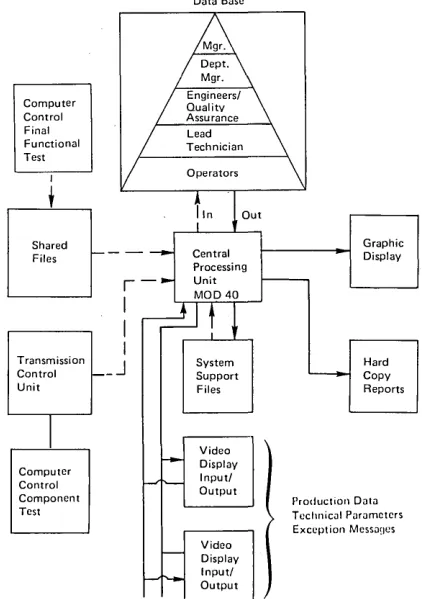
'THE CENTRAL DATA BASE IS STRUCTURED LIKE A PYRAMID."
Production control and operational economy are significantly increased by a real-time batch-oriented system at IBM's plant in San Jose,
Cali-fornia. The Data Information and Manufacturing
Sys-tem (DIMS) computes production requirements, reports machine and operation performance and provides for inventory control and control of parts movement through manufacturing phases in the production of
magnetic disk packs. DIMS handles over 2,000
ter-minal inquiries and some 40,000 testing transactions a day.
Direct manufacturing personnel -- engineers and managers -- can readily retrieve data using any of
the system's 32 video display terminals or a graphic
display terminal. Each user retrieves only
infor-mation suited to his particular needs, as defined by DIMS' internal hierarchi?l security structure.
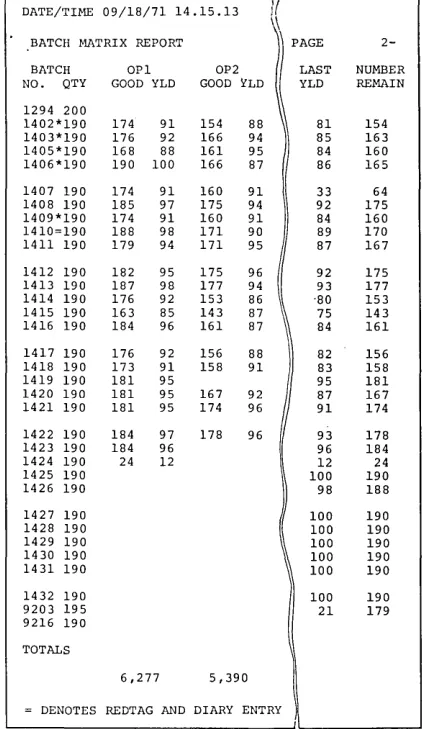
DIMS also turns out several hard-copy reports, such as a Batch Matrix report that lists all batch yields and quantities against operations and a Pro-duction Scheduler report that notes the required
E. F. Sylvain is Manager of Circuit Technology Engineering Admini stration at the IBM San Jose
Gen-eral Products Division plant. He was previously
Manager of Manufacturing Engineering. Mr. Sylvain has also held several key posi tions at IBM related to storage product file development, and been as-sociated wi th test methods in manufacturing over the past decade. He has a BSEE 1949 and MSEE 1950 from Montana State College, Bozeman, Montana.
COMPUTERS and PEOPLE for March. 1974
starts and operations based on current yields, schedules, and inventories.
System Configuration
The DIMS hardware configuration (Figure 1) in-cludes an IBM System/360 Model 40 computer serv-icing video display stations. The stations are used for process data input and for results and perform-ance output. The stations are strategically located throughout the manufacturing process and in engineer-ing and administrative areas. Testengineer-ing operations in the process are monitored by special control units. Data gathered by these testers is transmitted to the computer for inclusion in the central data base via a transmission control unit.
Additional hardware includes remote printer/key-board units for label output and exception
report-Computer Control Final Functional Test
Shared Files
Transmission Control Unit
1
Computer Control Component Testf
I
-Data Base
Central Processing
System Support Files
Graphic Display
Hard Copy Reports
Production Data Technical Puramctcrs Exception Messa~les
Figure 1. 01 MS Data Configuration and Flow
[image:13.613.337.548.424.724.2]PRODUCTION & DEFECT CLAIM
TOTAL CLAIM
=
100BATCH = QV51 MACH = 0200
TOTAL GOOD
=
50 TOTAL REJECT=
5010/452 20/453 20/454
Figure 2. Typical Video Display Outputs Used by Operators
ing, disk storage units for the data base, and the graphic display terminal for statistical analysis.
DIMS operating system is DOS, selected because of its low core overhead, flexibility, and relative ease with which nonstandard devices can be supported.
Included in the DIMS software is a communications simulator that allows testing of new application programs without impacting the online system. Every transaction received through the communications sys-tem is logged, enabling DIMS to maintain data base integrity through restart procedures.
Conceptually, the central data base is structured
like a pyramid, as shown in Figure 1. Raw data,
or-iented to the operator, serves as the base of the
pyramid. A greater degree of summarization of the
data takes place as the tip of the pyramid is ap-proached, until the most summarized data is
avail-able for strategic planning by management. The
search structure is such that a person at a given hierarchial level can seek out lower level detail but he cannot seek information summaries above his
leve 1.
DATE/TIME 09/18/71 14.15.13
i(
'\
BATCH MATRIX REPORT PAGE 2-BATCH OPI OP2 LAST NUMBER NO. QTY GOOD YLD GOOD 'lLD I YLD REMAIN 1294 200
1402*190 174 91 154 88 81 154 1403*190 176 92 166 94 85 163 1405*190 168 88 161 95 84 160 1406*190 190 100 166 87 86 165 1407 190 174 91 160 91 33 64 1408 190 185 97 175 94 92 175 1409*190 174 91 160 91 84 160 1410=190 188 98 171 90 89 170 1411 190 179 94 171 95 87 167 1412 190 182 95 175 96
( 92 175
1413 190 187 98 177 94 93 177 1414 190 176 92 153 86 '80 153 1415 190 163 85 143 87 75 143 1416 190 184 96 161 87 84 161 1417 190 176 92 156 88 82 156 1418 190 173 91 158 91 83 158 1419 190 181 95 95 181 1420 190 181 95 167 92 87 167 1421 190 181 95 174 96 91 174 1422 190 184 97 178 96 93 178 1423 190 184 96 96 184 1424 190 24 12 12 24 1425 190
))
100 190 1426 190 98 188 1427 190
(I
100 190 1428 190 100 190 1429 190 100 190 1430 190
~
100 190 1431 190 100 190 1432 190 100 190 9203 195 21 179 9216 190TOTALS
6,277 5,390 = DENOTES REDTAG AND DIARY ENTRY
Figure 3. Batch Matrix Report
14
Controls
The primary control or monitoring technique built into DIMS involves batching of parts. Each batch must be completely accounted for at each operation before the system allows the batch to proceed to the
next operation. Figure 2 shows a typical video
dis-play input used by the operator to account for parts
processed and defects found. The three pairs of
numbers at the bottom of the figure refer to defect
type and quantity. Another control technique
pre-vents the batch from being worked in the event Qual-ity Assurance people should place a hold on it.
BATCH 2505 AT OPERATION DEC 72 OP #1 #2 #3 #4 GOOD 130 130 130 127 YIELD 100.0 100.0 100.0 97.6 MACH 054 065 073 003,004 MO/DAY 12/10 12/10 12/19 12/26 DEFECT NONE NONE NONE 3/179 A015-00 BATCH 2505 AT OPERATION DEC 72
OP #5 #6 #7 #8 GOOD 126 126 125 121 YIELD 99.2 100.0 99.2 96.8 MACH 101 304 408 502 MO/DAY 12/27 01/05 01/08 01/20 DEFECT 1/227 NONE 1/931 4/901 A015-00 BATCH 2505 AT OPERATION DEC 72
OP #9 #10 #11 GOOD 121 115 N/C YIELD 100.00 95.0
MACH 603 702 MO/DAY 01/22 01/22 DEFECT NONE 6/501
Figure 4. Output for Batch Analysis
Still another technique involves notifying an op-erator of potential problems detected earlier in the manufacturing process by linking messages to a batch of parts.
An offshoot of batch control is scheduling and
inventory controlv based upon the operator's batch
inputs to the system. Inventory control also
en-compasses the various other materials making up the finished product.
Collection of variable data about key parameters provides yet another means of monitoring
manufac-turing operations. An operator keys in variable
process readings. If any exceed one of a number of control limits (fixed or statistical), the system alerts the operator and instructs him as to the proper action to take. The data base also includes variable data which is linked to production data for convenient engineering analysis of problems re-lated to costs or production efficiency.
Cost information, perhaps the most sophisticated of all DIMS reports, draws together nearly every piece of information in the data base to arrive at where and what cost deviations and fluctuations are occurring.
The computer control testers automatically input raw data to the data bank for such uses as feedback information to operations, preventive analysis, and correlation studies. Study results are used to op-timize specification and operation limits.
The controls provided by DIMS usually require human involvement, in that information from the data base alerts someone to take some appropriate action.
Human involvement is important. When, for instance,
an operator receives feedback from a manager or an engineer, he realizes that someone is indeed looking at the data he entered and taking appropriate ac-This in turn prompts him to make more valid inputs.
COMPUTERS and PEOPLE for March. 1974
[image:14.613.49.287.52.116.2] [image:14.613.331.531.150.353.2] [image:14.613.60.271.367.732.2]e
5
s,
y
I,
Applications
Examples of how DIMS is used follow:
1. At the beginning of each work day, manufacturing lead technicians receive a Batch Matrix Report
(Figure 3) which shows all the active batches in
a matrix form. This enables the technician to
maintain a smooth flow of his batches through the process, picking up stragglers and tracking "hot" batches. If the technician notes any batches that are out of place or are "unusual,"
he may immediately obtain
a
complete analysis ofthat batch (Figure 4) by going to the nearest
video display terminal.
2. A daily Production Scheduler Report (Figure 5)
shows what has taken place and where bottlenecks are appearing. The report tells manufacturing
PRODUCT TYPE 231 CENTER NEW PRODUCTION SCHEDULER 09/29/71 12.48
COMPUTATIONS BASED ON LAST 3000 UNITS
DESCRIPTION OPI OP2 OP3 015 035 045 OPERATION YIELD 100.0 100.0 98.5 TARGET YIELD 98.0 100.0 98.0 . CUMULATIVE YIELD 100.0 100.0 98.5 START FACTOR 18.80 18.80 18.80 AVG. LEAD TIME
ACTIVE 14 13 12 FINAL ASSEMBLY SCHEDULE
PER DAY FOR
NEXT DAY 49 49 49 NEXT WEEK 49 49 49 NEXT MONTH 45 45 45 AVERAGE STARTS PER
DAY FOR
NEXT DAY 921 921 921 NEXT WEEK 921 921 921 NEXT MONTH 846 846 846 DESIRED OUTPUT INVENTORY 00 00 2,500 ACTUAL OUTPUT INVENTORY 00 2,280 570 *REDTAGGED OUTPUT INVENTORY 00 00 00 OPTIMAL UNIT STARTS -1,068 -1,068 1,211 ACTUAL UNIT STARTED 1,140 1,140 00 FIRST RUN DAILY YIELDS 100.0 100.0 00.0 REWORK DAILY YIELDS 00.0 00.0 00.0
Figure 5. Sample Page from Production Schedule Report
OPERATION +tIl PERFORMANCE WK 1/19
PERIOD 30 DAY DEFECT +t % MACH
WKD 3,298 10,969 TYPE 900 400 84% 01,03
YLD 85.6 78 TYPE 400 27 06 01,03
TGT YLD 90 TYPE 600 18 04 03,02
TYPE 300 II 02 03,02
BATCH REJ/TOT YLD MACH +t/DEF CODE
2552 35/110
68
01
32/900 2/4002514 32/114 72 03 29/900 1/450
2506 29/113 74 01 23/900 3/400
2528 27/109 75 01 23/900 4/200
Figure 6. Performance by Operation
COMPUTERS and PEOPLE for March, 1974
how many parts are scheduled to be started, based on current yields and inventories. Actual, sched-uled, and projected disk starts are compared, showing management what the process has been do-ing and whether it looks like the process can handle the advancing schedules.
3. Each operation in the process is sum~arized at
the end of the shift, enabling an engineer to as-sess the performance of the specific operation he is responsible for by simply going to a terminal.
The display (Figure 6) lists the throughput,
yields, a breakdown of the most significant re-jects and a list of the poorest performing
batches. Information is stored to allow the user
to look at not only the shift, but the current day, week, and month, as well as historically by day, week, and month with equal ease.
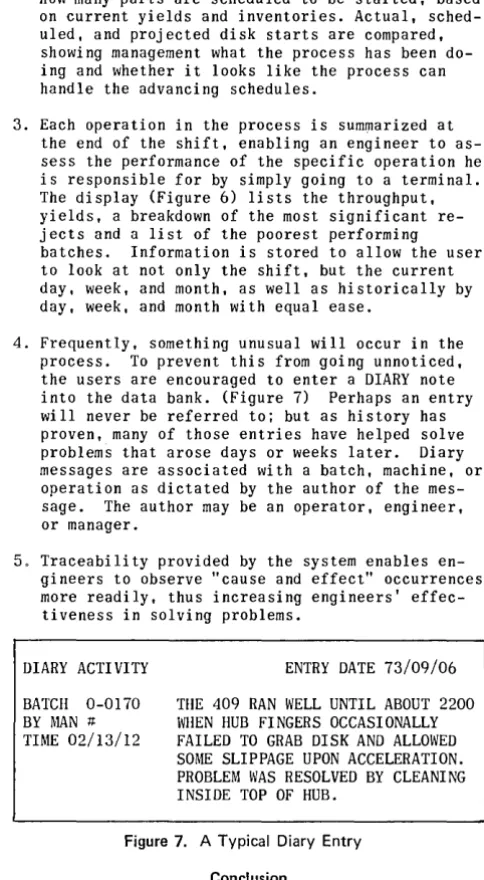
4. Frequently, something unusual will occur in the process. To prevent this from going unnoticed, the users are encouraged to enter a DIARY note
into the data bank. (Figure 7) Perhaps an entry
will never be referred to; but as history has proven, many of those entries have helped solve problems that arose days or weeks later. Diary messages are associated with a batch, machine, or operation as dictated by the author of the mes-sage. The author may be an operator, engineer, or manager.
50 Traceability provided by the system enables en-gineers to observe "cause and effect" occurrences more readily, thus increasing engineers'
effec-tiveness in solving problems.
DIARY ACTI VITY
BATCH 0-0170
BY MAN +t
TIME 02/13/12
ENTRY DATE 73/09/06
THE 409 RAN WELL UNTIL ABOUT 2200
WHEN HUB FINGERS OCCASIONALLY FAILED TO GRAB DISK AND ALLOWED SOME SLIPPAGE UPON ACCELERATION. PROBLEM WAS RESOLVED BY CLEANING INSIDE TOP OF HUB.
Figure 7. A Typical Diary Entry
Conclusion
In designing DIMS, highest priority was given to making the system responsive to the needs of diverse users; and, very important, DIMS is sufficiently flexible to meet changing requirements.
DIMS provides instantaneous access to information concerning a batch process, thereby eliminating hours of paper work for lead technicians. It allows engineering people to track specific batches of in-terest. It assures operators that their batches
have been properly accounted for. And Quality
As-surance has rigid control of any batches they put on hold, thus providing QA with permanent records of actions that were applied.
DIMS has enabled Manufacturing to maintain better inventory levels at the various operations. Produc-tion requirements are accurately computed based on
current real process performances. Operation
sum-maries allow management and engineering personnel to more carefully assess the performance of the various operations and machines.
The net result is an improved process performance
now and the necessary control to maintain i~proved
performance in the future.
o
[image:15.615.331.573.56.496.2] [image:15.615.56.306.79.574.2] [image:15.615.72.313.596.723.2]EFFective Program Design
*
David W. Packer Digital Equipment Corp. 146 Main Street Maynard, Mass. 01754
"The tendency of many programmers is to just start drawing a de-tailed flowchart, solving each problem as it occurs. This is anal-ogous to building a house without a plan - one brick at a time. The result in either case is likely to be the creation of a monster. "
This discussion of computer program design promotes the idea that the success and ultimately the cost of any computer program i£ critically related to its design; that is, that the design, is, by far, the most critical aspect of program development. The EDP community often talks of design and the concepts of modularity, generality, flexi-bility, and maintainability; yet many programs are not well designed, and others are not designed at all, but simply
written. It is my belief that the design of a program is much
different from its coding, and is a creative task involving many - if not all - of the same elements as systems design.
Good Program Design Results in Good Systems Design
A further extension of this view is that one who learns to design programs well gains valuable training in systems designing as well. The only basic difference between the program and the system is that the program is a smaller unit, and consequently there is less risk from bad design of it. A system is nothing more or less than a set of programs
16
David W. Packer is Manager of Information Systems and Data Processing at Digital Equipment Corporation. He joined DEC in 1964 and has most recently been responsible for developing and building its systems and data processing function. Prior to this, he was a Rese?rch Associate at M.I.T.'s Sloan School, working on simulation of industrial enterprises. He has authored material on management of the EDP function, corporate growth dynamics, and management science techniques. He received a B.S. in both electrical engineering and humanities in 1960 and an M.S. in industrial management in 1963, all from M.I.T.
with logical and physical inter-connections, in much the same way as a program is a set of routines with the same sort of connections. I believe that program design is, over the long run, a most essential ingredient of an effective systems job, for well-designed programs are fairly insensi-tive to the inadequacies of the particular coding techniques used and tend to make the system flexible and easy to modify.
The lip-service paid to program design manifests itself in a number of misconceptions about what constitutes good design. This, coupled with the fact that the computer can do "anything" (i.e., that even the most poorly designed program can be made to work), detracts from the im-portance of program design today. Why should programs be
designed well - or maybe more practically, why should
programs be designed at all and not just coded?
I think it is clear to anybody who has worked with large numbers of programs that have existed for a long time that well-designed programs are easier to write, to document, to review, to control, to understand, to debug, to test, and to maintain.
Today, many programmers are being thrust into their jobs with only a brief indoctrination into programming techniques (a course that more often than not has nothing or little to do with design), with a manual that answers only the technical questions of the specific language being used. Very little education or emphasis has been or is being given to effective design of computer programs. Thus, the devel-opment of programmers' creative skills (which in turn would provide a solid base for future systems work) is being minimized.
Another important consideration IS that EDP
installa-tions are operating at an unnecessarily high cost level, and they are often unresponsive to users' needs because of the time required to change, revise, and write new programs. The EDP business today is characterized by a tremendous shortage of programming and technical talent so it is highly desirable to educate the available talent in an organized way and to develop at the earliest time the creative and technical requisites for high productivity, fast response, and advancement in the organization for people currently m programming jobs.
It is my mtention in this article to discuss program
design, to show concrete examples of what constitutes good - and poor - design, and to show how fundamental the design process is to the whole programming job, and in effect to the whole systems job. My commen ts derive from COBOL-oriented business-data-processing operations; but I do not believe they are restricted to COBOL users nor to business applications programmers. The following sections
COMPUTERS and PEOPLE for March. 1974
o