Original citation:
Morrison, Natasha, Noel, Jonathan A. and Scott, Alex (2017) Saturation in the hypercube and bootstrap percolation. Combinatorics, Probability and Computing, 26 (1). pp. 78-98.
doi:10.1017/S0963548316000122
Permanent WRAP URL:
http://wrap.warwick.ac.uk/104266
Copyright and reuse:
The Warwick Research Archive Portal (WRAP) makes this work by researchers of the University of Warwick available open access under the following conditions. Copyright © and all moral rights to the version of the paper presented here belong to the individual author(s) and/or other copyright owners. To the extent reasonable and practicable the material made available in WRAP has been checked for eligibility before being made available.
Copies of full items can be used for personal research or study, educational, or not-for profit purposes without prior permission or charge. Provided that the authors, title and full bibliographic details are credited, a hyperlink and/or URL is given for the original metadata page and the content is not changed in any way.
Publisher’s statement:
This article has been published in a revised form in Combinatorics, Probability and
Computing, http://dx.doi.org/10.1017/S0963548316000122 This version is free to view and download for private research and study only. Not for re-distribution, re-sale or use in derivative works. © Cambridge University Press 2016
A note on versions:
The version presented here may differ from the published version or, version of record, if you wish to cite this item you are advised to consult the publisher’s version. Please see the ‘permanent WRAP URL’ above for details on accessing the published version and note that access may require a subscription
Saturation in the Hypercube and Bootstrap Percolation
Natasha Morrison, Jonathan A. Noel, and Alex Scott
Mathematical Institute, University of Oxford, Woodstock Road, Oxford OX2 6GG, UK.
{morrison,noel,scott}@maths.ox.ac.uk
August 27, 2014
Abstract
Let Qd denote the hypercube of dimension d. Given d≥m, a spanning subgraph
Gof Qd is said to be (Qd, Qm)-saturated if it does not contain Qm as a subgraph but
adding any edge of E(Qd)\E(G) creates a copy ofQm inG. Answering a question of
Johnson and Pinto [27], we show that for every fixedm ≥2 the minimum number of edges in a (Qd, Qm)-saturated graph is Θ(2d).
We also study weak saturation, which is a form of bootstrap percolation. Given graphs F and H, a spanning subgraphGof F is said to be weakly(F, H)-saturated if the edges ofE(F)\E(G) can be added toGone at a time so that each additional edge creates a new copy of H. Answering another question of Johnson and Pinto [27], we determine the minimum number of edges in a weakly (Qd, Qm)-saturated graph for all
d≥m≥1. More generally, we determine the minimum number of edges in a subgraph of the d-dimensional grid Pkd which is weakly saturated with respect to ‘axis aligned’ copies of a smaller grid Prm. We also study weak saturation of cycles in the grid.
1
Introduction
graph is known as the weak saturation number and denoted wsat(F, H). Note that every (F, H)-saturated graph is also weakly (F, H)-saturated and so
wsat(F, H)≤sat(F, H). (1.1)
For additional background on minimum saturation in graphs, see [21]. Given k ≥ 2 and d ≥ 1, the k-grid of dimension d is the graph Pd
k with vertex set
{0,1, . . . , k −1}d where two vertices are adjacent if they differ by one in some coordinate
and are equal in the other d− 1 coordinates. In particular, Pd
2 is known the hypercube
of dimension d and denoted Qd. In this paper, we are interested in saturation and weak
saturation problems in hypercubes and grids.
With regards to sat (Qd, Qm), the special casem= 2 was studied by Choi and Guan [14]
who constructed a (Qd, Q2)-saturated graph with at most 14 +o(1)
|E(Qd)| edges.
San-tolupo (see [21]) conjectured that this construction is best possible. In their recent paper [27], Johnson and Pinto disproved this conjecture (in a strong sense) by showing that, for every fixedm, there exists a (Qd, Qm)-saturated graph witho(|E(Qd)|) edges. More precisely, they
proved the following.
Theorem 1.2 (Johnson and Pinto [27]). For every fixed m ≥ 2, there exists 0 < εm < 1 such that sat(Qd, Qm)≤O d(1−εm)2d
.
In the case m= 2, Johnson and Pinto [27] obtained a stronger bound; namely,
sat(Qd, Q2)<10·2d. (1.3)
That is, for every d, there exists a (Qd, Q2)-saturated graph with bounded average degree.
Motivated by this result, they asked the following: for which fixed values of m is
sat(Qd, Qm) = O 2d
?
We show that this is the case for every m ≥2.
Theorem 1.4. For every fixed m≥2, sat (Qd, Qm)≤(1 +o(1))72m22d.
In the case of weak saturation, Johnson and Pinto [27] proved
wsat(Qd, Q2) = 2d−1 (1.5)
for all d≥ 2 by exhibiting a spanning tree of Qd which is weakly (Qd, Q2)-saturated. They
asked about the value of wsat(Qd, Qm) for general d≥m≥1. We answer this question.
Theorem 1.6. For d≥m≥1,
wsat (Qd, Qm) = (m−1)2d− m−2
X
j=0
(m−1−j)
d j
We remark that, previously, the best known lower bound on sat(Qd, Qm) was (m+ 1−
o(1))2d−1, due to Johnson and Pinto [27]. By combining Theorem 1.6 with (1.1), we can
improve this to (m−1−o(1))2d. In particular, for fixed m, Theorem 1.4 is tight up to a (constant) factor of O(m).
In fact, Theorem 1.6 is a special case of a more general result. Given k ≥ r ≥ 2 and
d≥m≥1, say that a copy of Prm inPkd isaxis aligned if it is induced by a set of vertices of the formI1× · · · ×Idwhere exactlymof the sets Ii are intervals of lengthr in{0, . . . , k−1}
and the rest are singletons. Let wsat∗ Pd k, Prm
be the minimum number of edges in a spanning subgraph G of Pkd such that the edges of E Pkd\E(G) can be added to G, one edge at a time, such that every added edge creates an axis aligned copy of Prm. We prove the following.
Theorem 1.7. For k ≥r≥2 and d≥m ≥1,
wsat∗ Pkd, Prm=
d X
j=0
d−j X
i=0
(m−1 +i)
d j
d−j
i
(k−r+ 1)j(r−2)i
−
m−2
X
j=0
d−j X
i=0
(m−1−j)
d j
d−j
i
(k−r+ 1)j(r−2)i,
where, by convention, 00 = 1.
We remark that if r = 2 ord =m, then every copy ofPm
r inPkd is axis aligned. Thus, in
these cases, wsat∗ Pd k, Pmr
= wsat Pd k, Pmr
. In particular, Theorem 1.6 is implied by the case k =r= 2 of Theorem 1.7.
We also consider an extension of (1.5) to general even cycles in the grid, proving the following.
Theorem 1.8. For k ≥2 and d≥`≥2, wsat Pkd, C2`
=kd−1.
The rest of the paper is structured as follows. At the beginning of Section 2, we review some fundamental properties of hypercubes which will be used in the proof of Theorem 1.4. Then, we prove Theorem 1.4 by giving an explicit construction of a (Qd, Qm)-saturated graph
with bounded average degree. In Section 3, we turn our attention to weak saturation and prove Theorems 1.6, 1.7 and 1.8. We conclude in Section 4 by mentioning a number of open problems.
2
Minimum Saturation in the Hypercube
2.1
Preliminaries
Letej denote the jth standard basis vector inFd2; ie., the vector in which thejth coordinate
sum of its coordinates. A basic fact about hypercubes is that, for d ≥ m, every copy Q of
Qm in Qd is induced by a set of vertices of the form n
v+P
j∈J0ej :J0 ⊆J o
where v is a
fixed vertex and J ⊆[d] has cardinality m. We say that the coordinates ofJ and [d]\J are
variable and fixed underQ, respectively.
We will need a standard result from Coding Theory, due to Hamming [26] (for another reference, see [30, 31]). This result was also used by Johnson and Pinto [27] (and we use some ideas from [27] in our proof).
Theorem 2.1 (Hamming [26]). There is an independent set C⊆V (Q2t−1) such that every vertex of V (Q2t−1)\C has a unique neighbour in C.
A setC as in Theorem 2.1 is often referred to as aHamming code. We remark that, since every vertex ofQ2t−1 has exactly 2t−1 neighbours,
|C|= 2
2t−1
(2t−1) + 1 = 2
2t−t−1
. (2.2)
Another ingredient of our proof of Theorem 1.4 is the following result of Conder [16].
Theorem 2.3 (Conder [16]). For every s ≥ 1, there is a 3-colouring of the edges of Qs in which there is no monochromatic cycle of length 4 or 6.
2.2
Definitions and Proof Outline
In this section, we will use Theorems 2.1 and 2.3 to construct a spanning subgraph Gof Qd
which contains no copy of Qm and which can be extended to a graphG0 which is (Qd, Qm
)-saturated and satisfies the bound in Theorem 1.4.
Throughout the proof, let m ≥2 be fixed and let d be an integer which we may choose to be sufficiently large. Lett and s be the unique integers such that
d= 6m(2t−1) +s and 0≤s <6m2t. (2.4)
We view the set [d] as a union of m intervals of length 6(2t−1) indexed by the elements of [m] followed by one interval of length s. Given v ∈ V(Qd) and 1 ≤ i ≤ m, let v(i)
denote the vertex of V(Q6(2t−1)) obtained by restricting v to the coordinates of the interval
corresponding to i, and we let v(m + 1) be the vertex of V(Qs) obtained by restricting
v to its last s coordinates. Each of the first m intervals of [d] is further divided into 6 subintervals of length (2t−1) indexed by the pairs (r, γ) where r∈ {0,1} and γ ∈ {0,1,2}.
For (i, r, γ) ∈ [m]× {0,1} × {0,1,2}, let v(i, r, γ) be the vertex of V(Q2t−1) obtained by
restricting v(i) to the subinterval corresponding to (r, γ).
Let C be a subset of V (Q2t−1) as in Theorem 2.1. We will treat the vertices v ∈
V (Qd) differently depending on which of the triples (i, r, γ)∈[m]× {0,1} × {0,1,2} satisfy
v(i, r, γ)∈C. For starters, let X denote the set of all vertices v for which there exists some
G and will not play a large role in the construction. Now, divide the vertices ofV (Qd)\X
into setsA0, . . . , Am whereAj is defined to be the set of all vertices of V (Qd)\X for which
there are exactly j triples (i, r, γ) such that v(i, r, γ) ∈ C. We remark that, by (2.2) and (2.4),
|V (Qd)\A0|=O 2d/d
(2.5)
Our goal is to construct a graph G which does not contain Qm as a subgraph and does
not contain any edge uv of Qd where u, v ∈ A0 such that, for any such edge, the graph
G+uv contains a copy ofQm. Given such a graphG, let G0 be a graph obtained by adding a
maximal set of edges toGwithout creating a copy ofQm. ThenG0 is (Qd, Qm)-saturated and
every edge ofG0 has at least one endpoint inV (Qd)\A0. By (2.5), the total number of edges
incident toV (Qd)\A0 is at most O 2d
and so we obtain sat(Qd, Qm)≤ |E(G0)|=O 2d
, as desired.
The difficulty of the proof is to ensure that G+e contains a copy of Qm for every edgee
of Qd joining two vertices ofA0 while simultaneously maintaining the property that Gdoes
not contain a copy ofQm. For the latter, we will apply Theorem 2.3 and a parity argument.
In what follows, letφ1 :E Q6(2t−1)
→ {0,1,2} andφ2 :E(Qs)→ {0,1,2}be colourings as
in Theorem 2.3, and let φ:E Q6(2t−1)∪E(Qs)→ {0,1,2} be the mapping which is equal
toφ1 onE Q6(2t−1) and equal to φ2 on E(Qs).
2.3
The Construction
We describe our construction.
Step 1. Add to G every edge of Qd which joins a vertex of Aj to a vertex of Aj+1 for
0≤j ≤m−2.
Step 2. Suppose that uv is an edge of Qd such that u, v ∈Aj for some 1≤ j ≤ m−1. Let
k be the unique element of [m+ 1] such that u(k)=6 v(k). We add the edge uv to G if
(i) eitherk=m+1 or there does not exist (r0, γ0)∈ {0,1}×{0,1,2}such thatu(k, r0, γ0) =
v(k, r0, γ0)∈C,
and for every (i, r, γ)∈[m]× {0,1} × {0,1,2} such that i6=k and v(i, r, γ)∈C we have
(ii) γ =φ(u(k)v(k)), and
(iii) |v|+|v(k)|+|v(i)|+j−1≡r mod 2.
Note that (iii) is well defined since u and v differ only on a coordinate of the interval corresponding to k and so for every i6=k we have
|v|+|v(k)|+|v(i)| ≡ |u|+|u(k)|+|u(i)| mod 2.
Before moving on we make a few observations, each of which can be verified by looking carefully at Steps 1 and 2.
Observation 2.7. A0 is an independent set ofG.
Observation 2.8. Ifuv is an edge ofGsuch thatu(i, r, γ) =v(i, r, γ)∈C, thenu(i, r0, γ0) =
v(i, r0, γ0) for every pair (r0, γ0)∈ {0,1} × {0,1,2}.
Observation 2.9. If uv is an edge of G such that u(m+ 1)6=v(m+ 1), then u, v ∈Aj for
some 1≤j ≤m−1.
The next observation follows from the fact that C is an independent set inQ2t−1.
Observation 2.10. If uv is an edge of G such that u(i, r, γ) 6=v(i, r, γ), then at most one
of u(i, r, γ) or v(i, r, γ) is in C.
To complete the proof of Theorem 1.4, it suffices to establish the following two claims. We state these claims now and show that they imply Theorem 1.4 before proving the claims themselves.
Claim 2.11. For every edge uv of Qd such that u, v ∈A0, the graph G+uv contains a copy
of Qm.
Claim 2.12. G does not contain Qm as a subgraph.
Proof of Theorem 1.4. IfG is not (Qd, Qm)-saturated, then by Claim 2.12 we can extend G
to a (Qd, Qm)-saturated graph G0 by adding a maximal set of edges which do not create a
copy of Qm. By Claim 2.11 none of these additional edges are between vertices in A0 and
so, by Observation 2.7, A0 is an independent set in G0. Thus, every edge of G0 has at least
one endpoint in (Sm
k=1Ak)∪X. The total number of edges incident to vertices of this set is
at most d m [ k=1 Ak ! ∪X
=d|A1|+d
m [ k=2 Ak ! ∪X
Note that|(Sm
k=2Ak)∪X|=O |C|22d−2(2 t−1)
, which isO 2d/d2
by (2.2) and (2.4). There-fore the second term of the above expression is o 2d and it suffices to bound d|A1|. We
have
d|A1|=d
6m|C|2d−(2t−1)=d6m22t−t−12d−(2t−1)= 6md2d−t
= 6m 6m(2t−1) +s2d−t<72m22d by (2.4). The result follows.
Remark 2.13. Note that if d is of the form 6m(2t−1) for some t, then we obtain a better
bound: sat(Qd, Qm)≤(1 +o(1))36m22d.
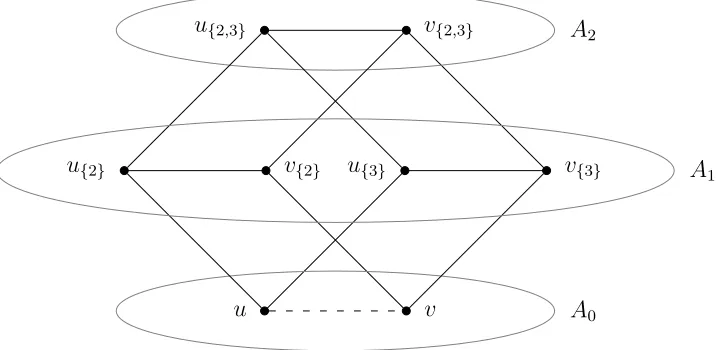
Proof of Claim 2.11. Let uv be an edge of Qd where u, v ∈ A0 and let k be the unique
element of [m+ 1] for which u(k)=6 v(k). Define γ :=φ(u(k)v(k)) and let I ⊆[m]\ {k} be a set of size m−1. For i∈I, pickri ∈ {0,1}so that
|v|+|v(k)|+|v(i)| ≡ri mod 2.
For each i∈I, letci be the unique neighbour ofv(i, ri, γ) inQ2t−1 contained inC. Given
I0 ⊆ I, we let vI0 and uI0 be the vertices of Qd such that uI0(i, ri, γ) = vI0(i, ri, γ) = ci for
all i ∈ I0 and, on all other coordinates, uI0 and vI0 agree with u and v, respectively. In
particular, v∅ =v and u∅ =u. If I0 =6 I, then for any i0 ∈ I\I0 we see that vI0 is adjacent
tovI0∪{i0} and uI0 is adjacent touI0∪{i0} inG via edges added in Step 1. Also, for I0 ⊆I, we
havevI0, uI0 ∈A|I0| and, if I0 6=∅, then for each i∈I0,
|vI0|+|vI0(k)|+|vI0(i)| ≡ri+|I0| −1 mod 2.
Thus, for I0 6=∅, vI0 is adjacent to uI0 via an edge of G added in Step 2. This implies that
{vI0 :I0 ⊆I} ∪ {uI0 :I0 ⊆I}induces a copy ofQm inG+uv, which completes the proof.
u{2,3} v{2,3} A2
v{3}
u{3}
u v A0
v{2}
[image:8.612.127.486.336.511.2]u{2} A1
Figure 1: An illustration of the proof of Claim 2.11 in the case thatm = 3 and u(1) 6=v(1).
Proof of Claim 2.12. Suppose, to the contrary, that Gcontains a copyQofQm. LetJ ⊆[d]
be the set of coordinates which are variable under Q. For eachi ∈ [m+ 1], let J(i) be the set of coordinates of J which are in the interval of [d] corresponding to i. Moreover, given
(i, r, γ)∈[m]× {0,1} × {0,1,2}, let J(i, r, γ) be the set of coordinates of J which are in the
interval of [d] corresponding to (i, r, γ).
Subclaim 2.14. For each i ∈ [m] there is a pair (ri, γi) ∈ {0,1} × {0,1,2} such that
Proof. Suppose to the contrary that there exists (r, γ)6= (r0, γ0) such that bothJ(i, r, γ) and
J(i, r0, γ0) are non-empty.
First, suppose that there exists a vertex v ∈ V(Q) with v(i, r, γ) ∈ C. Let u be a neighbour of v in Q obtained by changing a coordinate in J(i, r0, γ0). By Observation 2.8, the edge uv is not contained in G, which is a contradiction. Thus, v(i, r, γ), v(i, r0, γ0) ∈/ C
for all v ∈V(Q).
Now, let Q0 be a copy of Q2 inQobtained by starting with an arbitrary vertex ofQ and
varying one coordinate of J(i, r, γ) and one coordinate of J(i, r0, γ0). By the result of the previous paragraph, we see thatV(Q0)⊆Aj for somej and so every edge ofQ0 was added in
Step 2. By taking the edges ofQ0 and restricting them to the interval of [d] corresponding to
i, we see that all of the resulting edges must receive the same colour underφ. This contradicts the fact that there is no copy ofQ2 which is monochromatic underφand completes the proof
of the subclaim.
Subclaim 2.15. Suppose that |J(i)| ≥ 2 for some i ∈ [m] and let Q0 be a copy of Q2 in
Q obtained by starting with an arbitrary vertex and varying two coordinates of J(i). Then there is a unique vertex v ∈V(Q0) with v(i, ri, γi)∈C.
Proof. By Subclaim 2.14 we have J(i) = J(i, ri, γi). By Observation 2.10, if uv is an edge
of Q0, then we cannot have u(i, ri, γi), v(i, ri, γi)∈C. Thus, if there are two vertices u, v of
Q0 for whichu(i, ri, γi), v(i, ri, γi)∈C, then they must be non-adjacent. So, in this case, the
vertices of Q0 alternate between Aj and Aj+1 for some j and every edge of Q0 was added
in Step 1. However, this implies that for w ∈ V(Q0) such that w(i, ri, γi) ∈/ C, the vertex
w(i, ri, γi) ofQ2t−1 must have two distinct neighbours in C, which is a contradiction.
Now we assume that every vertex v of Q0 satisfies v(i, ri, γi)∈/ C. However, in this case,
we see that every edge of Q0 was added in Step 2. As before, we obtain a copy of Q2 in
Q6(2t−1) which is monochromatic under φ, a contradiction.
Subclaim 2.16. |J(i)| ≤2 for every i∈[m].
Proof. Suppose not. Let Q0 be a copy of Q3 in Q obtained by starting with an arbitrary
vertex and varying three coordinates ofJ(i). If we vary any pair of these coordinates, leaving the third one fixed, we obtain a copy ofQ2inQ0which must obey Subclaim 2.15. This implies
that there are precisely two vertices x, y ∈ V(Q0) such that x(i, ri, γi), y(i, ri, γi) ∈ C and
they are at distance 3 inQ0. However, now we get that the vertices of V(Q0)\ {x, y}induce a copy F of C6 in Q, where every edge of F was added in Step 2. Taking the edges of F
and restricting them to the interval of [d] corresponding toi, we see that all such edges must receive the same colour underφ. This contradicts the fact that there is no copy ofC6 which
is monochromatic under φ and completes the proof of the subclaim.
Subclaim 2.17. |J(m+ 1)| ≤1.
Proof. If not, then let Q0 be a copy of Q2 inQ obtained by starting at an arbitrary vertex
coordinates, we obtain a copy of Q2 inQswhich is monochromatic under φ, a contradiction.
Subclaim 2.18. Suppose that uv andvw are distinct edges ofQwhere u, v, w ∈Aj for some
j. Then there is some k ∈[m] such that u(k)6=v(k) and v(k)6=w(k).
Proof. We show that there cannot exist distinct integersk, k0 ∈[m+1] such thatu(k)6=v(k) andv(k0)6=w(k0). This is sufficient to prove the subclaim since, by Subclaim 2.17, we cannot haveu(m+ 1)6=v(m+ 1) and v(m+ 1) 6=w(m+ 1).
Suppose that such integersk, k0 exist, and let x be the unique vertex of Qd distinct from
v which is joined to both uandw inQd. Note that both of the edgesxuand wxare present
in Q. Also, x ∈ Aj and so all of the edges uv, vw, wx, xu were added to G in Step 2. This
implies that j ≥1 and that there is a triple (i, r, γ) withi /∈ {k, k0} such that
u(i, r, γ) =v(i, r, γ) =w(i, r, γ) = x(i, r, γ)∈C.
However, one can easily check that the parity of |v|+|v(k)|+|v(i)| is different from the parity of|x|+|x(k)|+|x(i)| modulo 2 and so only one can be equivalent to r. By definition of Step 2, only one of the edgesuv and xwcan exist inG. This contradiction completes the proof.
Subclaim 2.19. If |J(m+ 1)|= 1, then |J(i)| ≤1 for all i∈[m].
Proof. If not, let Q0 be a copy of Q3 in Q obtained by starting at an arbitrary vertex and
varying one coordinate of J(m+ 1) and two of J(i). Then, by Subclaim 2.15, there is an edge uv ∈ E(Q0) such that u(i) 6= v(i) and u, v ∈ Aj for some j (in fact, there are many
such edges). Now, let w be the neighbour of v in Q0 obtained by changing the coordinate of J(m+ 1). By Observation 2.9, we have that w ∈ Aj as well. However, this contradicts
Subclaim 2.18.
Subclaim 2.20. There is at most one i∈[m] for which |J(i)|= 2.
Proof. If not, leti, i0 ∈[m] such that|J(i)|=|J(i0)|= 2 and let Q0 be a copy of Q4 obtained
by starting at an arbitrary vertex and varying two coordinates of J(i) and two coordinates of J(i0). By Subclaim 2.15, we see that there must exist edges uv, vw ∈ E(Q0) such that
u(i) 6= v(i), v(i0) 6= w(i0) and u, v, w ∈ Aj for some j. This contradicts Subclaim 2.18 and
completes the proof.
Now, let us complete the proof of the claim. Throughout, for each i∈[m], we let (ri, γi)
be a pair such that J(i) =J(i, ri, γi), which exists by Subclaim 2.14. In what follows, we let
j∗ be the minimum integer j such that V(Q)∩Aj 6=∅ and let v∗ ∈ V(Q)∩Aj∗. Note that
for everyi∈[m] such that J(i)6=∅ we must havev∗(i, ri, γi)∈/ C. If not, then starting with
v∗ and changing a coordinate of J(i) yields a vertex of V(Q)∩Aj∗−1 by Observations 2.8
and 2.10, contradicting our choice of j∗. By Subclaims 2.19 and 2.20, there is at most one
i∈[m] such that J(i) =∅. This implies that
where j∗ must equal zero if no such i exists. We divide the proof into cases.
Case 1: |J(i)|= 1 for everyi∈[m].
In this case, we must havej∗ = 0 and sov∗ ∈A0. However, if we start withv and change
the coordinate of J(i) for any i, then we obtain a vertex u with u(i, ri, γi)∈C by
Observa-tion 2.7. Thus, changing allmof these coordinates yields a vertexwsuch thatw(i, ri, γi)∈C
for all i ∈ [m]; that is, w ∈ Am. This is a contradiction since, by Observation 2.6, w is an
isolated vertex and therefore cannot belong to Q.
Case 2: |J(m+ 1)|= 1.
Let u be the neighbour of v∗ in Q obtained by changing the coordinate in J(m + 1). We must have u, v∗ ∈ A1 by (2.21) and Observation 2.9. This implies that there is some
i∈ [m] such that J(i) =∅ and v∗(i, ri, γi)∈ C. Also, by Subclaim 2.19 and the Pigeonhole
Principle, we must have |J(i0)|= 1 for every i0 ∈[m]\ {i}.
Now, for each i0 ∈[m]\ {i}, letwi0 be the neighbour ofv∗ inQobtained by changing the
coordinate inJ(i0). By Subclaim 2.18 and the fact thatu, v∗ ∈A1, we cannot havewi0 ∈A1.
So, by our choice of j∗, we must have wi0(i0, ri0, γi0) ∈ C. As in the proof of Case 1, if we
start with v∗ and change the coordinate ofJ(i0) for every i0 ∈[m]\ {i}, we obtain a vertex of Am contained inQ, contradicting Observation 2.6. This completes the proof in this case.
Case 3: |J(i)|= 2 for some i∈[m].
By Subclaim 2.15, there is a neighbouruofv∗ inQobtained by changing a coordinate in
J(i) such thatu∈Aj∗. This immediately implies thatj∗ = 1 by (2.21) and Observation 2.7.
Now, for each i0 ∈[m] for which|J(i0)|= 1, let wi0 be the neighbour of v∗ inQ obtained
by changing the coordinate in J(i0). By Subclaim 2.18 and the fact thatu, v∗ ∈A1, we must
have wi0(i0, ri0, γi0) ∈ C. Thus, if we let x be the vertex obtained from v∗ by changing the
coordinate of J(i0) for every suchi0, then x∈Am−1.
LetQ0 be the copy ofQ2inQobtained by starting atxand varying the two coordinates of
J(i). Then, by Subclaim 2.15, there must be some vertexyofV(Q0) such thaty(i, ri, γi)∈C.
However, this implies thaty∈Am, contradicting Observation 2.6. This completes the proof
of Claim 2.12 and of Theorem 1.4.
3
Weak Saturation
3.1
Hypercubes and Grids
In this section, we discuss weak saturation in cubes and more generally in grids. We will prove Theorem 1.7, which immediately implies Theorem 1.6.
Weak saturation is part of a more general theory, known as bootstrap percolation. In the
graph bootstrap process, we start with an initial set S0 of ‘infected’ vertices in a graph F
and, at the ith step of the process, a vertex v ∈V(F)\Si−1 j=0Sj
added toSi if there is a copy ofH inF h
Si−1
j=0Sj
∪ {v}i containingv. A natural extremal problem is to determine the size of the smallest initial set S0 for which, after some step of
the process, every vertex of F is infected; such a set is said to be (F, H)-percolating. It is easily seen that weak saturation corresponds to a bootstrap process on the edges of a graph, rather than its vertices (i.e. a bootstrap process on the line graph). For an introduction to the literature on bootstrap percolation, see for instance [3, 4, 5] and the references therein.
Here we are interested in the ‘edge version’ of the problem for cubes and grids. The ‘vertex version’ of the problem was solved by Balogh, Bollob´as, Morris and Riordan [6], who determined the minimum size of a subset of V Pd
k
which is percolating with respect to (the vertex sets of) axis aligned copies of Pm
r , and also the minimum size of a (Kkd, Krm
)-percolating set, for all k ≥ r ≥ 2 and d ≥ m ≥ 1 (here Kkd is the graph with vertex
set {0, . . . , k −1}d and two vertices are adjacent if they differ in exactly one coordinate).
Somewhat surprisingly, the two quantities are the same.
We will use the following simple linear algebraic lemma from [6]. Given a graph F and a set H of subgraphs of F, let wsat (F,H) be the minimum number of edges in a graph G
such that the edges of E(F)\E(G) can be added to G, one edge at a time, in such a way that each added edge increases the number of graphs of H contained in G; such a graph is said to be weakly (F,H)-saturated. In this language, wsat∗ Pd
k, Prm
= wsat Pd k,H
where
H contains all axis aligned copies of Pm
r inPkd.
Lemma 3.1 (Balogh, Bollob´as, Morris and Riordan [6]). Let F be a graph, let H be a collection of subgraphs of F, and let W be a vector space. Suppose that there exists a set
{fe:e∈E(F)} ⊆W such that for every H ∈ H there are non-zero scalars {ce:e∈E(H)} such that P
e∈E(H)cefe= 0. Then
wsat(F,H)≥dim (span{fe:e∈E(F)}).
Proof. Let G be a weakly (F,H)-saturated graph. Define G0 := G and label the edges
of E(F) \E(G) by e1, . . . , ek such that for 1 ≤ i ≤ k there is a subgraph Hi ∈ H of
Gi :=Gi−1+ei such that Hi contains ei. Thus, by hypothesis, fei can be written as a linear
combination of the vectors in {fe :e ∈E(Hi)\ {ei}}. This implies that
span{fe :e∈E(G0)}= span{fe:e∈E(G1)}=· · ·= span{fe :e ∈E(Gk)}.
Since G= G0 and F = Gk, it must be the case that |E(G)| ≥ dim (span{fe :e∈E(F)}).
Since G was an arbitrary weakly (F,H)-saturated graph, this completes the proof.
To handle the vertex version of the question, Balogh, Bollob´as, Morris and Riordan gave a clever construction of a suitable vector space and then proved that it has the same dimension as a suitable percolating set. The result then follows by Lemma 3.1. Our proof of Theorem 1.7 uses the same approach, but requires a different construction. For other examples of this type of strategy, see Kalai [29] and Pikhurko [34, 35].
Given a vertex v ofPd
the sum of the coordinates of v. Given i ∈ [d], a line L in direction i is a path of length
k−1 in Pd
k in which any two vertices ofL differ on the ith coordinate. Proof of Theorem 1.7. LetG be a spanning subgraph of Pd
k in which, for each vertex v,
• we add every edge uv of Pd
k such that |u| = |v| −1 and u and v differ on a small
coordinate of v, and
• we add min{L(v), m−1} edges uv of Pd
k such that |u|=|v| −1 and uand v differ on
a large coordinate of v.
Some elementary counting gives us
E(G) =
d X
j=0
d−j X
i=0
(m−1 +i)
d j
d−j
i
(k−r+ 1)j(r−2)i
−
m−2
X
j=0
d−j X
i=0
(m−1−j)
d j
d−j
i
(k−r+ 1)j(r−2)i.
So, to prove the upper bound, we need only show that G is weakly Pkd, Prm-saturated. In order of increasing |v|, we add all missing edges of E(Pd
k)\E(G) from v to vertices u with
|u|=|v| −1 one edge at a time. By construction, for every added edge uv with|u|=|v| −1, the coordinate on which uand v differ is large inv. For any vertexx, ifL(x)≤m−1, then all edgesxywith |x|=|y| −1 are already present inG. Also, ifv is a vertex withL(v)≥m, thenG containsm−1 edges wvwith |w|=|v| −1 such that the coordinate on whichw and
v differ is large in v. Putting this together, an easy inductive argument shows that, if we add edges in this order, then each edge added from v to a vertexu with|u|=|v| −1 creates a new copy of Qm in which v is the ‘top’ vertex.
For the lower bound, we apply Lemma 3.1 whereHconsists of all axis aligned copies ofPrm
inPd
k. So, it suffices to show that there exists a vector spaceW and a set
fe:e∈E Pkd ⊆
W which satisfy the hypotheses of Lemma 3.1 such that
dim span
fe:e∈E Pkd ≥ |E(G)|. (3.2)
The spaceW that we choose is the direct sum ofkdcopies ofRm−1, one for each vertex ofPkd, and dkd−1 copies of
Rr−2, one for each line in Pkd. Given a vector w of W, a vertex x of Pkd
and a lineLofPd
k, letπx(w) denote the projection ofwonto the copy ofRm−1 corresponding
to x and let πL(w) denote the projection of w onto the copy of Rr−2 corresponding to L.
Note thatw is determined by its projections.
Let Z := {z1, . . . , zd} be a collection of d vectors of Rm−1 in general position. Also,
let Y := {y1, . . . , yk−2} be a set of k −2 vectors of Rr−2 such that y1, . . . , yr−2 are linearly
independent and, for r−1≤t ≤k−1,
yt:=−
t−1
X
j=t−r+2
Thus any consecutiver−2 vectorsyi, . . . , yi+r−2 are linearly independent and any consecutive
r−1 vectors yj, . . . , yj+r−1 sum to zero. Suppose that e =uv is an edge of Pkd such that u
and v differ on coordinate i∈[d] and let t be the maximum of theith coordinates of u and
v. Further, let L be the unique line of Pd
k containinge. We define fe to be the vector of W
such that
• πu(fe) = πv(fe) =zi and πx(fe) = 0 for every x∈V(Qd)\ {u, v}, and
• πL=yt and πL0 = 0 for every line L0 6=L.
In order to apply Lemma 3.1, we need to show that for every axis aligned copy P of Prm
in Pd
k there are non-zero scalars {ce :e∈E(P)} such that Pe∈E(P)cefe = 0. Let P be an
axis aligned copy of Pm
r inPkd and letI ⊆[d] be the set of m coordinates which vary under
P. Let{ci :i∈I} be a set of scalars such that Pi∈Icizi = 0. Note that ci 6= 0 for all i∈I
since the vectors of Z are in general position.
For each vertex v of P, let M(v) ⊆[d] be the set of indices j such that both v−ej and
v+ej are contained inP. Define the lines of P to be the paths of lengthr−1 inP obtained
by taking the intersection of a line of Pd
k with V(P). Note that |M(v)| is precisely the
number of lines ofP in whichv has degree two. For each lineLof P, define m(L) :=|M(v)|
where v is an endpoint ofL (clearly the endpoints give the same value). For eachi∈I, let
Ei be the set of all edges of P for which i is the variable coordinate. For each edgee ∈ Ei
contained in a line L of P, definede := 2m(L)ci. We claim that P
e∈E(P)defe = 0.
First, let L be a line ofP in direction i. Then, for some t≥r−1, we have
πL
X
e∈E(P)
defe
= X
e∈E(P)
deπL(fe) = X
e∈E(L)
2m(L)ciπL(fe) = 2m(L)ci t X
j=t−r+2
yj.
However, this sum is equal to zero by definition of yt.
Now, fix a vertexv ofP and for eachi∈I letLi be the line ofP in directionicontaining
v. We have
πv
X
e∈E(P)
defe
= X
e∈E(P)
deπv(fe) = X
i∈M(v)
X
e∈Ei
2m(Li)c
iπv(fe) + X
i∈I\M(v)
X
e∈Ei
2m(Li)c
iπv(fe)
which is equal to
X
i∈M(v)
2m(Li)+1ciπv(fe) + X
i∈I\M(v)
2m(Li)ciπv(fe)
by definition of M(v). We observe that, for any i ∈ M(v), we have m(Li) = |M(v)| −1
and for any i ∈ I \M(v) we have m(Li) = |M(v)|. Therefore, the above sum is equal to
2|M(v)|P
i∈Icizi which is zero by our choice of{ci :i∈I}. Combining this with the result of
the previous paragraph, we get P
e∈E(P)defe = 0, as desired.
independent. Let {ce :e∈E(G)} be any set of scalars, not all of which are zero, and let F
be the spanning subgraph of G containing all edges e∈ E(G) such that ce 6= 0. Let v be a
vertex of non-zero degree inF such that |v| is maximum.
First, consider the case that v has degree at most m−1 in F. Let J denote the set of
dF(v) coordinates such that, for each j ∈J, the edge fromv tov−ej is present in F. Then P
e∈E(G)ceπv(fe) is a linear combination of the vectors in {zj : j ∈ J} in which not all of
the coefficients are zero. Since|J| ≤m−1 and the vectors of Z are in general position, this sum is non-zero and therefore P
e∈E(G)cefe 6= 0.
Now, suppose that v has degree at least m inF. By construction of G, this implies that there is a coordinate j which is small for v such that the edge e from v to v−ej is present
in F. Let L be the unique line of Pkd containing e. Then, by maximality of |v|, every edge of L contained in F joins two vertices for which j is a small coordinate. This implies that
P
e∈E(F)ceπL(fe) is a linear combination of the vectors in {yi : 1≤i ≤r−1} in which not
all of the coefficients are zero. Thus, since the vectors y1, . . . , yr−1 are linearly independent,
this sum is non-zero and we obtain P
e∈E(G)cefe6= 0, which completes the proof.
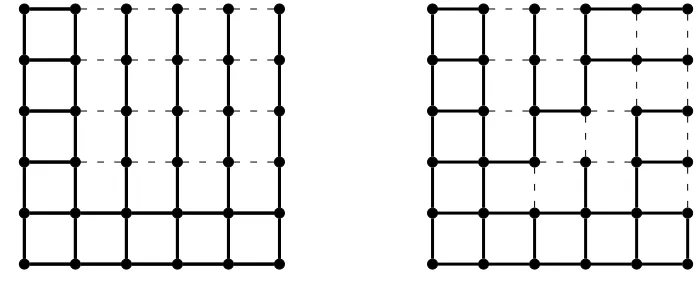
Remark 3.3. The proof of Theorem 1.7 implies that, for most values of k ≥ r ≥ 2 and
[image:15.612.128.477.340.485.2]d≥m≥1, there are many tight examples. For an example in two dimensions, see Figure 2.
Figure 2: Two non-isomorphic weakly (P62, P32)-saturated graphs with wsat (P62, P32) edges.
3.2
Cycles in the Grid
We prove Theorem 1.8 using an elementary argument.
Proof of Theorem 1.8. First, notice that wsat Pkd, C2`
≥ kd −1 holds since any weakly
Pd
k, C2`
-saturated graph must be connected. To prove the upper bound, we proceed by induction ond+k.
Consider the base case k = 2 and d=`. For 0≤t≤`, let Lt be the set of all vertices v
of Q` with |v| = t and define xt to be the vertex of Lt which consists of t ones followed by
`−t zeros. We letG be the graph such that, for 1≤t≤`, each vertexv ∈Lt is joined to a
• if t= 1 or v =xt, then v is joined to xt−1.
• if t≥2 and v 6=xt, thenv is joined to an arbitrary vertexy ∈Lt−1\ {xt−1}such that
vy∈E(Q`).
It is clear thatGis a tree and so|E(G)|= 2`−1. For each vertexv, letP
v be the unique path
inGfromv tox0. Note that, by construction, ifv /∈ {x1, . . . , x`}thenV(Pv)∩{x1, . . . , x`}=
∅.
We show that G is weakly (Q`, C2`)-saturated. First, add each edge x`v where v ∈
L`−1\ {x`−1}. Each of these edges creates a copy ofC2` by taking the pathsPx` andPv along
with the edge x`v.
Next, for each t = `−1, . . . ,2, in turn, we add every edge uv where u ∈ Lt\ {xt} and
v ∈ Lt−1 \ {xt−1}. When doing so we can assume, inductively, that for each s such that
t < s ≤ ` every edge from Ls\ {xs} to Ls−1 \ {xs−1} is present. In particular, this implies
that there is a path Ru of length `−t from u to x` which does not contain any vertex of
{x0, . . . , x`−1}. Therefore, when adding the edge uv, we obtain a copy ofC2` by taking the
paths Pv,Px`, Ru and the edgeuv.
After this, for each t=`−1, . . . ,2, in turn, we add every edgeuxt−1 whereu∈Lt\ {xt}.
In this case, let wbe a vertex of Lt\ {xt, u}such that there are paths Ru and Rw fromuto
x` and w to x`, respectively, such thatV(Ru)∩V(Rw) ={x`}. We obtain a copy of C2` by
taking the paths Ru,Rw, Pw and Pxt−1 along with the edge uxt−1.
Finally, for each t=`−1, . . . ,2, in turn, we add every edge xtv wherev ∈Lt−1\ {xt−1}.
Let j be an index on which v is zero and let P be a path from x` to x0 which contains ej
but is disjoint from {x1, . . . , x`−1}. Notice that P does not contain any vertex of Pv. We
obtain a copy of C2` by taking the paths xtxt+1. . . x`, P, and Pv along with the edge xtv.
This completes the proof of the base case.
Now, we assume that d+k > `+ 2 and that the proposition holds for smaller values of
d+k. We divide the proof into two cases.
Case 1: d > `.
Let Gd−1 be a weakly Pkd−1, C2`
-saturated graph with kd−1 −1 edges. We construct a
weakly Pd k, C2`
-saturated graph G. For each vertex v of Pd
k, let vd−1 be the restriction of
v to its first d−1 coordinates and let vd be the last coordinate of v. In constructingG, we
add every edgeuv of Pd
k such that
• ud−1vd−1 ∈E(Gd−1) andud =vd= 0, or
• ud−1 =vd−1.
It is clear that |E(G)| =kd−1. For 0 ≤ t ≤ k−1, let S
t be the set of all vertices v such
that vd=t. Note that St induces a copy of Pkd−1 in P d k.
Let us show that G is weakly Pkd, C2`
-saturated. First, add all edges uv of Pkd where
u, v ∈S0 in some order such that each added edge creates a new copy ofC2`. This is possible
vertices of St. By induction on t we can assume that all edges between vertices in St−1 are
already present. Given an edge uv where u, v ∈St, let u0, v0 ∈ St−1 where u0d−1 =ud−1 and
vd0−1 =vd−1. We obtain a copy of C2` by taking the edges u0u, uv, vv0 and a path of length
2`−3 from v0 to u0 inSt−1. This completes the proof in this case.
Case 2: k >2.
Let Gk−1 be a weakly Pkd−1, C2`
-saturated graph with (k−1)d−1 edges. For each set
S ⊆[d], let m(S) be the minimum element of S and let YS be the set of all vertices v of Pkd
such that S is precisely the set of coordinates on which v is equal to k−1. We add to G
every edge uv of Pd
k such that
• u, v ∈Y∅ and uv ∈E(Gk−1), or
• u∈YS and v ∈YS\{m(S)} for some non-empty S⊆[d].
It is clear that |E(G)|=kd−1. Let us show thatGis weakly Pd
k, C2`
-saturated. First, add all edges uv whereu, v ∈Y∅
such that each added edge creates a new copy of C2`. This is possible by definition ofGk−1.
Next, for each non-empty set S⊆[d], in order of increasing cardinality, add all edges uv
where u, v ∈YS. Inductively, we can assume that all edges between vertices of YS\{m(S)} are
already present. Note that YS\{m(S)} induces a copy of Pd
−|S\{m(S)}|
k−1 where |S \ {m(S)}| ≤
d−2. Letu0 andv0 be the unique neighbours ofuandv inYS\{m(S)}, respectively. We obtain
a copy of C2` by taking the edges u0u, uv, vv0 and a path of length 2`−3 from v0 to u0 in
YS\{m(S)}.
Finally, for each setS, in order of increasing cardinality, and elementj ofS\{m(S)}, add every edge uv where u ∈ YS and v differs from u on coordinate j. Let u0 be the neighbour
of u in YS\{m(S)} and let v0 be the neighbour of v in YS\{j,m(S)}. If ` = 2, then we obtain
a copy of C4 by taking the edges u0u, uv, vv0 and u0v0. Otherwise, let w be the vertex of
YS\{m(S)} obtained fromu0 by decreasing coordinatem(S) by one. Further, let w0 be vertex
of YS\{j,m(S)} obtained from w by decreasing coordinate j by one. We obtain a copy of C2`
by taking the edges w0w, wu0, u0u, uv, vv0 and a path of length 2`− 5 from v0 to w0 in
YS\{j,m(S)}. Note that this is possible sincew0 is adjacent to v0 and the subgraph induced by
YS\{j,m(S)} is isomorphic to P
d−|S\{j,m(S)}|
k−1 . This completes the proof.
4
Open Problems
Many interesting open problems remain, and we mention some of them here.
4.1
Minimum Saturation
Recall that we were able to prove a better upper bound on sat(Qd, Qm) whendis of the form
6m(2t−1) than for general values of d (see Remark 2.13). It is not clear whether this is
Question 4.1. For fixed m≥2, does limd→∞ sat(Q2dd,Qm) exist?
As it stands, the best known lower bound on sat(Qd, Qm) is (m −1−o(1))2d, which
follows from Theorem 1.6 and (1.1). We doubt that this bound is tight. In particular, we ask the following.
Question 4.2. For fixed m≥2, let cm := lim infd→∞sat(Qd, Qm)/2d. Does cmm → ∞?
It would also be interesting to study saturation numbers in the grid.
Question 4.3. Fix m≥2, r≥2 and k ≥max{r,3}, and let d→ ∞. Is it true that
sat∗ Pkd, Prm=o E Pkd
?
How about
sat∗ Pkd, Prm=O kd?
Here, the notation sat∗ indicates that we are considering axis aligned copies ofPrm inPkd. Moving beyond the finite case, it would also be interesting to consider grids inside the infinite square latticeZd, where vertices are adjacent if they have`
1-distance 1.
Question 4.4. For d ≥ m ≥ 2, what is the infimal density of a Qm-saturated subgraph of the d-dimensional square lattice? More generally, what about the d-dimensional lattice that is saturated with respect to axis aligned copies of Pm
r ?
Here the density is naturally defined as the lim sup of densities inside large boxes. For both of the last two questions, it would also be interesting to know what happens if we do not require our (sub)grids to be axis aligned.
Recall that Kd
k is the graph with vertex set {0, . . . , k −1}d in which two vertices are
adjacent if they differ (by any amount) in exactly one coordinate. In one of the original papers on minimum saturated graphs, Erd˝os, Hajnal and Moon [20] determined sat(Kk, Kr)
for all values ofk andr. The multidimensional version of this problem also seems interesting.
Problem 4.5. For k ≥r≥2 and d≥m ≥1, determine sat Kkd, Krm.
The problem of determining sat (Kk, C`) was raised by Bollob´as [10] and has been
ex-tensively studied. The case ` = 3 is trivial, and the cases ` = 4 and ` = 5 were solved by Ollmann [33] and Chen [12, 13], respectively. The first non-trivial bounds for general `were given by Barefoot, Clark, Entringer, Porter, Sz´ekely, and Tuza [8], who proved that there are positive constants c1 and c2 such that, for ` 6= 8,10,
(1 +c1/`)n ≤sat (Kk, C`)≤(1 +c2/`)n.
The value ofc2 was improved by Gould, Luczak and Schmitt [25]. Currently, the best general
upper and lower bounds are due to F¨uredi and Kim [22]. It is natural to ask about cycles in the hypercube.
Problem 4.6. For ` ≥2 and d≥log2(2`), determine sat(Qd, C2`).
More generally, similar questions can be asked for cycles in Pd
k or Kkd. We remark that
the related problem of determining ex (Qd, C2`) was proposed by Erd˝os [19] and is very well
4.2
Weak Saturation
Recall that Theorem 1.7 provides the explicit value of the weak saturation number of axis aligned copies ofPm
r inPkd. However, for most values ofm, d, r, k, the graph that we construct
contains several ‘bent’ copies of Pm
r . We ask about the weak saturation number of general
copies of Prm in Pkd.
Problem 4.7. For general 1≤m ≤d and 2≤r≤k, determine wsat Pd k, Prm
.
In [10], Bollob´as conjectured that wsat(Kk, Kr) = sat(Kk, Kr) for all k and r. This was
proved for r < 7 in [9] and for general r by Alon [1] and Kalai [28, 29] using methods from exterior algebra and matroid theory. A multidimensional version of this problem also seems interesting.
Problem 4.8. For general 1≤m ≤d and 2≤r≤k, determine wsat Kkd, Krm.
As was mentioned in Section 3, the ‘vertex version’ of Problem 4.8 was solved in [6]. Theorem 1.8 leaves open the problem of determining wsat Pd
k, C2`
whend < `. We ask
the following.
Question 4.9. Given k≥2 and ` > d≥2 such that Pd
k contains a cycle of length 2`, what is the value of wsat Pkd, C2`
?
4.3
Semi-saturation
Johnson and Pinto [27] also study another type of saturation problem, which is often referred to as semi-saturation [18, 22] (other terms have also been used: see [10, 28, 32, 34, 36]). Given graphs F and H, say that a spanning subgraphG of F is (F, H)-semi-saturated if for every edgee∈E(F)\E(G), the graphG+econtains more copies ofH thanGdoes. Note thatG
may contain H as a subgraph. Let ssat(F, H) denote the semi-saturation number, which is the minimum number of edges in a (F, H)-semi-saturated graph. Then it is easy to see that
wsat(F, H)≤ssat(F, H)≤sat(F, H).
Johnson and Pinto [27] proved that ssat(Qd, Qm)≤(m2+m/2) 2d. Based on this result and
(1.3), they asked whether ssat(Qd, Q2) is equal to sat(Qd, Q2) for sufficiently large d and,
if not, whether lim supd→∞
sat(Qd,Q2)
2d > lim supd→∞
ssat(Qd,Q2)
2d . Given Theorem 1.4, it now
seems natural to pose these questions more generally.
Question 4.10. For fixed m ≥ 2, is ssat(Qd, Qm) is equal to sat(Qd, Qm) for sufficiently large d? If not, is lim supd→∞
sat(Qd,Qm)
2d >lim supd→∞
ssat(Qd,Qm)
2d ?
References
[1] N. Alon, An extremal problem for sets with applications to graph theory, J. Combin. Theory Ser. A 40 (1985), no. 1, 82–89.
[2] R. Baber, Tur´an densities of hypercubes, arXiv:1201.3587v2, preprint, November 2012.
[3] P. N. Balister, B. Bollob´as, J. D. Lee, and B. P. Narayanan, Line Percolation, arXiv:1403.6851v1, preprint, March 2014.
[4] J. Balogh and B. Bollob´as, Bootstrap percolation on the hypercube, Probab. Theory Related Fields 134 (2006), no. 4, 624–648.
[5] J. Balogh, B. Bollob´as, and R. Morris,Graph bootstrap percolation, Random Structures Algorithms 41 (2012), no. 4, 413–440.
[6] J. Balogh, B. Bollob´as, R. Morris, and O. Riordan, Linear algebra and bootstrap perco-lation, J. Combin. Theory Ser. A 119 (2012), no. 6, 1328–1335.
[7] J. Balogh, P. Hu, B. Lidick´y, and H. Liu,Upper bounds on the size of 4- and 6-cycle-free subgraphs of the hypercube, European J. Combin. 35 (2014), 75–85.
[8] C. A. Barefoot, L. H. Clark, R. C. Entringer, T. D. Porter, L. A. Sz´ekely, and Zs. Tuza, Cycle-saturated graphs of minimum size, Discrete Math. 150 (1996), no. 1-3, 31–48, Selected papers in honour of Paul Erd˝os on the occasion of his 80th birthday (Keszthely, 1993).
[9] B. Bollob´as, Weakly k-saturated graphs, Beitr¨age zur Graphentheorie (Kolloquium, Manebach, 1967), Teubner, Leipzig, 1968, pp. 25–31.
[10] , Extremal graph theory, London Mathematical Society Monographs, vol. 11, Academic Press, Inc. [Harcourt Brace Jovanovich, Publishers], London-New York, 1978.
[11] P. Brass, H. Harborth, and H. Nienborg,On the maximum number of edges in a C4-free
subgraph of Qn, J. Graph Theory 19 (1995), no. 1, 17–23.
[12] Y.-C. Chen, MinimumC5-saturated graphs, J. Graph Theory61 (2009), no. 2, 111–126.
[13] ,All minimum C5-saturated graphs, J. Graph Theory 67 (2011), no. 1, 9–26.
[14] S. Choi and P. Guan,Minimum critical squarefree subgraph of a hypercube, Proceedings of the Thirty-Ninth Southeastern International Conference on Combinatorics, Graph Theory and Computing, vol. 189, 2008, pp. 57–64.
[16] M. Conder, Hexagon-free subgraphs of hypercubes, J. Graph Theory 17 (1993), no. 4, 477–479.
[17] D. Conlon,An extremal theorem in the hypercube, Electron. J. Combin.17(2010), no. 1, Research Paper 111, 7.
[18] A. N. Day, Saturated Graphs of Prescribed Minimum Degree, arXiv:1407.6664v1, preprint, July 2014.
[19] P. Erd˝os,On some problems in graph theory, combinatorial analysis and combinatorial number theory, Graph theory and combinatorics (Cambridge, 1983), Academic Press, London, 1984, pp. 1–17.
[20] P. Erd˝os, A. Hajnal, and J. W. Moon,A problem in graph theory, Amer. Math. Monthly
71 (1964), 1107–1110.
[21] J. R. Faudree, R. J. Faudree, and J. R. Schmitt, A Survey of Minimum Saturated Graphs, Electron. J. Combin. 18 (2011), Dynamic Survey 19, 36 pp. (electronic).
[22] Z. F¨uredi and Y. Kim,Cycle-saturated graphs with minimum number of edges, J. Graph Theory 73 (2013), no. 2, 203–215.
[23] Z. F¨uredi and L. ¨Ozkahya,On 14-cycle-free subgraphs of the hypercube, Combin. Probab. Comput. 18 (2009), no. 5, 725–729.
[24] , On even-cycle-free subgraphs of the hypercube, J. Combin. Theory Ser. A 118
(2011), no. 6, 1816–1819.
[25] R. Gould, T. Luczak, and J. Schmitt, Constructive upper bounds for cycle-saturated graphs of minimum size, Electron. J. Combin. 13(2006), no. 1, Research Paper 29, 19.
[26] R. W. Hamming, Error detecting and error correcting codes, Bell System Tech. J. 29
(1950), 147–160.
[27] J. R. Johnson and T. Pinto, Saturated Subgraphs of the Hypercube, arXiv:1406.1766v1, preprint, June 2014.
[28] G. Kalai, Weakly saturated graphs are rigid, Convexity and graph theory (Jerusalem, 1981), North-Holland Math. Stud., vol. 87, North-Holland, Amsterdam, 1984, pp. 189– 190.
[29] ,Hyperconnectivity of graphs, Graphs Combin. 1 (1985), no. 1, 65–79.
[31] , The theory of error-correcting codes. II, North-Holland Publishing Co., Amsterdam-New York-Oxford, 1977, North-Holland Mathematical Library, Vol. 16.
[32] N. Morrison, J. A. Noel, and A. Scott, On Saturated k-Sperner Systems, arXiv:1402.5646v2, preprint, July 2014.
[33] L. T. Ollmann, K2,2 saturated graphs with a minimal number of edges, Proceedings of
the Third Southeastern Conference on Combinatorics, Graph Theory, and Computing (Florida Atlantic Univ., Boca Raton, Fla., 1972), Florida Atlantic Univ., Boca Raton, Fla., 1972, pp. 367–392.
[34] O. Pikhurko, Extremal hypergraphs, Ph.D. thesis, University of Cambridge, October 1999, pp. i–xii and 1–150.
[35] ,Weakly saturated hypergraphs and exterior algebra, Combin. Probab. Comput.
10 (2001), no. 5, 435–451.
[36] Z. Tuza, Asymptotic growth of sparse saturated structures is locally determined, Dis-crete Math. 108 (1992), no. 1-3, 397–402, Topological, algebraical and combinatorial structures. Frol´ık’s memorial volume.