ALUMINUM: NEW ALLOYS AND HEAT TREATMENT
Optimization of Casting Process Parameters for Synthesis
of Al-Nb-B Master Alloy
SHRISTY JHA,1ANIMESH MANDAL,1 and PRAKASH SRIRANGAM2,3
1.—School of Minerals, Metallurgical and Materials Engineering, Indian Institute of Technology Bhubaneswar, Argul, Bhubaneswar 752050, India. 2.—WMG, University of Warwick, Coventry CV4 7AL, UK. 3.—e-mail: [email protected]
Al-Nb-B master alloys were synthesized using commercial pure aluminum, niobium, and KBF4salts. Two different sources of Nb (pure Nb powder and
Al-60%Nb powder) were used to prepare the master alloy. Casting process parameters such as reaction time and melt stir time interval were varied to enhance the formation of in situ intermetallic particles in the master alloys. The size, shape and distribution of intermetallic particles in these master alloys were studied using microscopy techniques. The results show that the Al-5Nb-1B master alloy prepared with Al-60%Nb powders has a uniform distribution of intermetallic particles as compared to the master alloy pre-pared with pure Nb powders. Increase in boron content from 1 wt.% to 2 wt.% in the master alloys resulted in a higher fraction of intermetallic particles. Among all the master alloys synthesized, Al-5Nb-2B was observed to have the highest number of well-distributed intermetallic particles which could act as potential grain refiners of aluminum alloys.
INTRODUCTION
Grain refinement is a prominent way of improv-ing the mechanical properties of cast aluminum alloys for automotive and aerospace applications.1 Grain refinement of aluminum alloys is usually carried out by various methods, such as inoculation, rapid cooling and the application of external fields, such as ultra-sonication, electromagnetic stirring, etc.2 Among these grain refining methods, inocula-tion of the melt, which includes the addiinocula-tion of particles by in situ reactions, is a very common method in aluminum alloys. These particles act as heterogeneous nucleation sites for the grain refine-ment of alloys.3In Al-Cu alloys, titanium along with boron or carbon were found to be very effective in the refinement of primary Al grains.4 The flux-assisted synthesis route, which involves the addi-tion of KBF4and K2TiF6salts to molten aluminum,
is considered to be the most preferred route to prepare Al-Ti-B master alloys. In flux-assisted synthesis, the particles are formed by an exothermic reaction of salts which results in enhanced wetta-bility and better microstructural stawetta-bility of the master alloy.5 Addition of 0.01 wt.% Ti in the form of a master alloy to Al-Cu melt results in the
formation of TiB2 and Al3Ti particles, which aid in
grain refinement of the alloy.6,7However, TiB2and
Al3Ti particles are found to be ineffective in grain
refining of aluminum alloys that contain high amount of Si, Li, Cr and Zr.8–11Recent studies have reported that the niobium addition which forms Al3Nb particles in the melt is found to be an
effective grain refiner of Al-Si alloys.12–15 Further, it has been observed that the addition of Nb along with B enhances the grain refinement of Al-Si alloys as compared to the refinement occurring with only Nb or boron additions. This enhanced grain refine-ment was attributed to the similarities between the Al-Nb-B and Al-Ti-B systems. It was reported that the particles formed in Al-Nb-B master alloys are NbB2 and Al3Nb, and that they are isostructural
with TiB2 and Al3Ti in Al-Ti-B alloys. Also, the
lattice mismatch parameters of NbB2 and Al3Nb
with the Al matrix is similar to that of TiB2 and
Al3Ti with the Al matrix. However, the main
been reported on the grain-refining efficiency of Al-xNb-yB master alloys on grain refinement of com-mercial Al-Si alloys.16–20Although research studies have been carried out on the grain refinement of Al-Si alloys using Al-Nb-B master alloys, very little emphasis has been laid on optimizing the casting process parameters during the synthesis of Al-Nb-B master alloys meant for grain refinement of Al-Si alloys. The aim of this publication is to study the effect of casting process parameters such as sources of Nb, reaction times, effects of stirring on synthesis and microstructures of Al-Nb-B master alloys.
EXPERIMENTAL DETAILS Synthesis of Al-Nb-B Master Alloys
The raw materials used for making the master alloys include commercially pure Al (CP Al) (>99.8% purity), pure niobium powders (99.99% pure, 200 mesh size; HiMedia, India), Al-60Nb powder (average size 400lm; Baoji Rui Hong Metal Materials, China) and KBF4 salts (98%
purity; Madras Fluorine, India). Figure1 repre-sents the SEM images of the as-received pure Nb powders (Fig.1a) and Al-60%Nb powders (Fig.1b), which are two different Nb sources.
Figure1c is a schematic of the experimental setup. Al-Nb-B master alloys with varied Nb:B
ratios were synthesized by adding Al-60%Nb or pure Nb and KBF4into the Al melt together. First,
an Al-5Nb-1B master alloy was prepared by adding Al-60%Nb powders to molten aluminum in a graphite crucible. The amount of total melt in all the cases was 300 g. The melt was kept at 800°C for 30 min for homogenization, followed by KBF4 salts
being added to the melt. The melt was stirred at regular intervals prior to casting in a split-type graphite mold. To study the effect of reaction time, three reaction times were selected: 1 h 30 min, 2 h 15 min, and 2 h 45 min. In another set of experi-ments, to check the effect of sequence of addition of raw materials, both sources of Nb and KBF4 were
mixed together and then added to the melt, rather than adding them separately as in the previous case. As the received powders and salts were preheated to 200°C prior to adding to the melt. Thereafter, the effect of stirring of the melt on the the synthesis of master alloys was studied. For comparison, one of the melts was unstirred after the addition of Nb and KBF4salts, while the other melt
was stirred every 15 min.
Also, experiments were carried out to synthesize master alloys of the same composition using differ-ent sources of Nb, i.e., pure Nb powder and Al-60Nb powder. For the master alloy preparation, molten Al was homogenized for 2 h at 800°C and then a
[image:2.594.43.542.395.702.2]heated mixture of Nb powders + KBF4salt and
Al-60Nb powders + KBF4 salt was added. The Nb or
Al-60Nb powders were wrapped in aluminum foil prior to addition to the melt. The wrapped powders were carefully plunged inside the melt and then stirred. This was done to prevent oxidation of the Nb particles. After holding at 800°C for 1 h, the temperature was raised to 850°C and held for 30 min for better dissolution of pure Nb and Nb containing particles in Al-60Nb alloy. Then, the temperature was brought down to 800°C and held for another 30 min to minimize the loss of B in the form of BF3 gas. Thus, the total holding time was
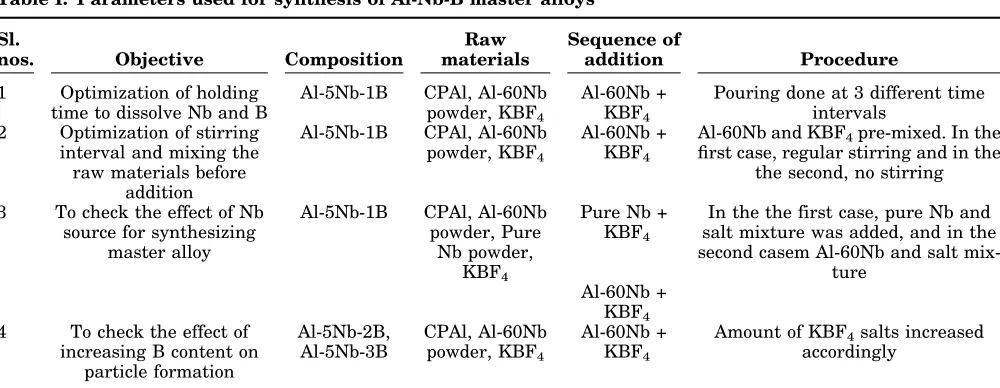
2 h. Finally, dross was removed, and the melts were cast into graphite split-type molds. In the final set of experiments, boron content in the master alloy was varied from 1 wt.% to 3 wt.%, keeping the Nb content fixed at 5 wt.%. Dissolution of KBF4 is ensured by stirring the melt at intervals of 15 min. The low melting point of the salt (530°C) and high reactivity of the salt with molten aluminum ensures that it does not remain unreacted in the the liquid aluminum at the reaction temperature of 800°C. TableI represents the parameters used in the synthesis of different Al-Nb-B master alloys.
Optical and SEM Microscopy
The cylindrical castings were sectioned at 2 cm from the bottom to prepare samples for metallog-raphy studies using standard metallographic tech-niques. The samples were etched with Keller’s reagent for 30 s to study the particles in the microstructure. The alloys were examined under an optical microscope (NIKON ECLIPSE LV150 N) and FESEM [Carl Zeiss SMT instru-ment coupled with energy dispersive x-ray spec-trometer (EDS)].
RESULTS AND DISCUSSION Optimisation of Reaction Time
for the Synthesis of Al-Nb-B Master Alloy Experiments were carried out for different total reaction times (defined as the time from the addi-tion of KBF4salt and/or Al-60Nb powder to the melt
to pouring of the master alloy into the molds) to ensure complete formation of particles by the reac-tion of KBF4 salt and Al-60Nb powder in molten
aluminum. The exothermic reaction between the KBF4 salts and the melt results in proper
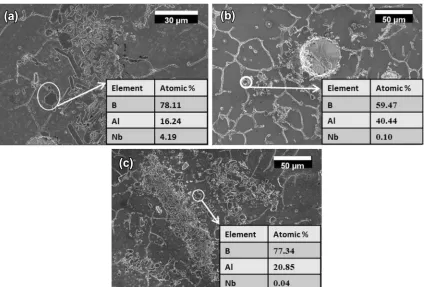
dissolu-tion of Nb and the formadissolu-tion of compounds.21 Figures2 represents FESEM micrographs of the Al-Nb-B master alloy for different reaction times. (1 h 30 min, 2 h 15 min, and 2 h 45 min, respec-tively). It is evident from the figure that the particles were formed in the master alloys for all reaction times; however, the particles were also found to be agglomerated. The agglomeration of boride particles could be due to the flux-generated reaction of KBF4 with the Al matrix and the
engulfment of the KF-AlF3 salts.22 Also, as shown
in Fig. 2, the longer the reaction time, the higher the chances for agglomeration formation which is expected, as particles have more time to react and agglomerate to reduce surface energy.23 Besides agglomeration, particle settling is also favored due to the high density of the in situ particles formed during the reaction. For example, particles such as Al3Nb and NbB2 (whose probability of forming is
[image:3.594.56.556.533.727.2]high in Al-Nb-B master alloys) have densities of 4.54 g/ml and 6.98 g/ml, respectively, as compared to 2.3 g/ml of molten aluminum at 800°C.16 Hence, the melt should be held for less than or equal to 2 h after the addition of the powders, with stirring at regular intervals to lessen the tendency to the agglomeration and settling of particles.
Table I. Parameters used for synthesis of Al-Nb-B master alloys
Sl.
nos. Objective Composition
Raw materials
Sequence of
addition Procedure
1 Optimization of holding
time to dissolve Nb and B
Al-5Nb-1B CPAl, Al-60Nb
powder, KBF4
Al-60Nb + KBF4
Pouring done at 3 different time intervals
2 Optimization of stirring
interval and mixing the raw materials before
addition
Al-5Nb-1B CPAl, Al-60Nb
powder, KBF4
Al-60Nb + KBF4
Al-60Nb and KBF4pre-mixed. In the
first case, regular stirring and in the the second, no stirring
3 To check the effect of Nb
source for synthesizing master alloy
Al-5Nb-1B CPAl, Al-60Nb
powder, Pure Nb powder,
KBF4
Pure Nb + KBF4
In the the first case, pure Nb and salt mixture was added, and in the second casem Al-60Nb and salt
mix-ture Al-60Nb +
KBF4
4 To check the effect of
increasing B content on particle formation Al-5Nb-2B, Al-5Nb-3B CPAl, Al-60Nb powder, KBF4 Al-60Nb + KBF4
Amount of KBF4salts increased
Effect of Stirring and Addition Sequence of KBF4Salt and Al-60Nb Powders
on Al-Nb-B Master Alloy
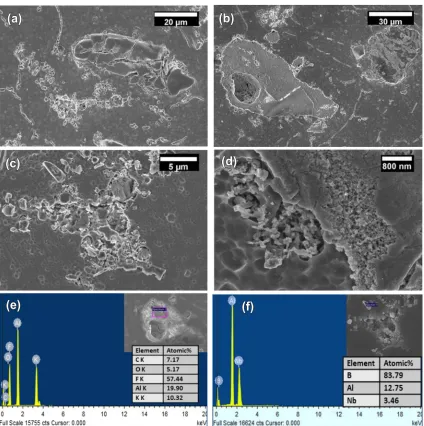
Figure3 represents the SEM images of particles formed in the Al-Nb-B master alloy for stirred and unstirred melts. Figure3a and b represents the effect of no stirring on particle formation, while Fig.3c and d represent the particles formed in the stirred condition. This stirring study was under-taken because, in one of the cases, it was reported that stirring disturbs the layer of reacted salts and the aluminum is readily oxidized on the top of the melt. As a result, the chance of entrainment of residue salts in the melt increases, which promoting agglomeration.24 Thus, with the hope of reducing agglomeration, these sets of experiments were undertaken. However, in the present case, the melt which was not stirred at regular intervals, has a few coarse unreacted particles containing Nb and some unreacted salts, as supported by the K peaks shown in EDX on the particles, in Fig. 3a, b and e. Stirring at regular intervals resulted in distinct, better-distributed and finer particles with very few or almost no unreacted salts, as represented by Fig. 3c, d and f. Thus, stirring is essential for the formation and uniform distribution of particles. This has also been substantiated in earlier reports.20
Also in the above cases (stirring and non-stirring), Al-60Nb powders and KBF4salt were mixed before
addition into the melt, unlike the previous cases
(‘‘Optimisation of reaction time for synthesis of Al-Nb-B master alloy’’ section) where they were added separately. It was observed that a higher fraction of particles formed when KBF4 salt and Al-60Nb
powders are pre-mixed and added to the melt. This could be due to higher dissolution rate of particles like Nb2Al (1940°C) and NbAl3(1680°C) present in
the Al-60Nb alloy in the melt (Al-Nb binary phase diagram represented in Fig.4f). This higher disso-lution could be because of high amounts of energy released during the exothermic reaction of KBF4
salts with the aluminum,16 which leads to sudden increases in temperature of the melt, ultimately enhancing the reaction kinetics in the melt.Iin the cases where KBF4salts were added 30 min after the
addition of Al-60Nb, dissolution of Al-60Nb would have been slower because of the initial lack of energy.
Comparison of the Master Alloys Prepared with Al-60Nb and Pure Nb Powders
Two master alloys of composition, each Al-5Nb-1B, were prepared using different sources of Nb. The first master alloy (MA1) was prepared using pure Nb powder and KBF4salt, and the the second
master alloy (MA2) was prepared using Al-60Nb powder and KBF4salt.
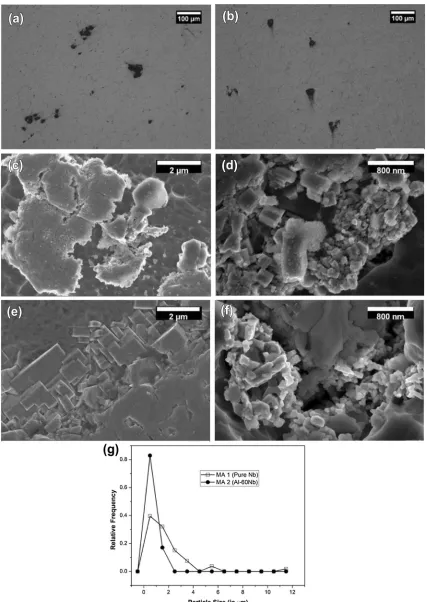
[image:4.594.79.503.64.351.2]Figure4represents optical micrographs and SEM images of particles in the the Al-5Nb-1B alloy prepared with different sources of Nb. Optical
microstructures in Fig.4a and b shows the distri-bution of particle agglomerates throughout the sample. As shown in Fig.4c and d, clusters of coarse particles were observed in the Al-5Nb-1B master alloy prepared with KBF4salts and pure Nb
powders, while, on the other hand, small clusters of fine particles were observed in the the Al-5Nb-1B master alloy prepared with KBF4salt and Al-60Nb
powder, as shown in Fig.4e and f. Also, more faceted particles were formed in the latter master alloy.
Figure4g shows the size distribution of the particles, as in Fig.4a–d in both the master alloys. For this calculation, the feret diameters of a number of particles were measured from different regions in the microstructure using an image analysis soft-ware (ImageJ). The master alloy prepared with Al-60Nb powders have comparatively finer particles
[image:5.594.95.519.63.489.2]which were higher in number as compared to the master alloy prepared with pure Nb. The average size of clusters is found to be small in the master alloy prepared with Al-60Nb powders compared to the master alloy prepared with pure Nb powders. In terms of particle formation, the fine size inter-metallics with a higher fraction of particles were observed in the alloy synthesized with Al-60Nb compared to pure Nb powders. Also, the shape of the particles was found to be of faceted morphology in the alloy synthesised with Al-60Nb powders. The above-mentioned characteristics are important, because such particles facilitate better refining, as they promote better heterogeneous nucleation.1 There are two conjectures for the reason behind the master alloy made with Al-60Nb having a higher volume fraction of particles. First, the liq-uidus temperature of the Al-60Nb alloy (1680°C) is
significantly lower than that of pure Nb (2470°C) according to the Al-Nb phase diagram.25 Hence, it could be possible that the dissolution of Al-Nb powders in the aluminum melt is faster than pure Nb. Thus, in the present study where the reaction temperature is 800°C, reaction kinetics between Al-60Nb and KBF4would be faster as compared to that
between pure Nb and KBF4. Secpmd, the Nb is
present in the form of Nb2Al and NbAl3 in the
Al-60Nb powder, hence there would be minimum loss of Nb, as their densities are less as compared to elemental Nb and thus the tendency to settle down would be comparatively less.16
Comparative Study of Al-5Nb-xB (x= 1,2,3) Master Alloys
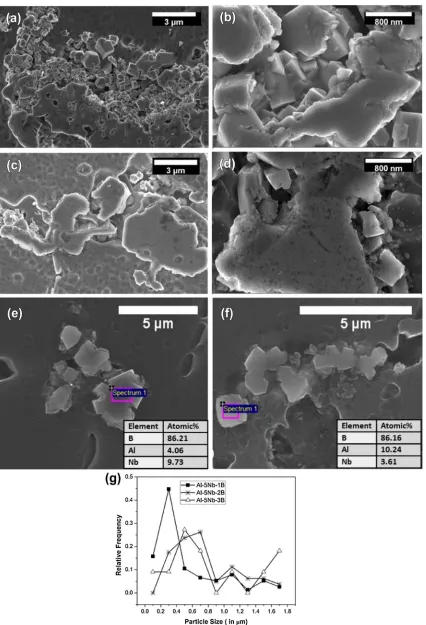
When the concentration of boron was increased from 1 wt.% to 2 wt.%, the number of particles increased, as expected. Figure5 shows the microstructure of the two master alloys, Al-5Nb-2B and Al-5Nb-3B. The particles are very well formed in Al-5Nb-2B (Fig.5a and b), while the particles in Al-5Nb-3B are relatively coarser and have fewer distinct particles, as seen in Fig.5c and d.
Figure5e and f represents the EDX analyses of particles formed in Al-5Nb-2B and Al-5Nb-3B. The nature of particles formed is similar in both cases, i.e., major elements of the particles being Al, Nb and B. With the increase in boron content, the amount of Nb in the particles has increased. This could be due to an exothermic reaction sustaining for a longer period with the increased amount of KBF4 salt.
Further, the increase in B content to 3 wt.% did not show observable increase in the volume fraction of the particles. This could be due to the high viscosity of the melt observed on the addition of higher amounts of salts, which eventually leads to sticking of the salt–melt mixture to the stirrer and walls of the crucible, which ultimately resulted in poor
recovery of B and a lower fraction of particles formed in the alloy.
Figure5g shows the size distribution of particles formed in Al-5Nb-xB (x = 1, 2, 3) master alloys. Most particles in Al-5Nb-1B were found to be in the sub-micron range (0.1–0.6lm), while in Al-5Nb-2B, the particle size distribution is much wider, ranging from 0.1lm to 1.8lm. The parti-cles in 3B lie in the same range as Al-5Nb-2B. The varied size of the particles in Al-5Nb-2B is preferred for grain refinement. Thus, Al-5Nb-2B was found to be optimum with evidently high recovery of both Nb and B and the formation of large numbers of particles.
Characterization of the In Situ Particles Formed in the Master Alloys
To understand and predict the phases formed in situ in the matrix, XRD analysis of the master alloy was carried out. Figure6 shows the XRD pattern of the Al-5Nb-2B master alloy. The diffrac-togram shows peaks of the FCC phase and the HCP phase. The FCC peaks corresponds to aluminum.26 To identify the phase with those HCP peaks, powder diffraction files of probable compound,s like Al3Nb,
NbB2, Al0.33Nb0.667B2, AlB2, were referred to. In
comparisons using standard JCPDS files, the peaks were found to be closest to Al0.33Nb0.667B2(referred
to as aluminum boron niobium), and thus can be assumed to be the same. Al0.33Nb0.667B2 is
charac-terized bya hexagonal lattice structure, with a density of 5.6 g/ml and forms a solid solution with NbB2.27 As the first two peaks of these two
com-pounds are very close to each other, there might also be a possibility of the presence of some fraction of NbB2phase.
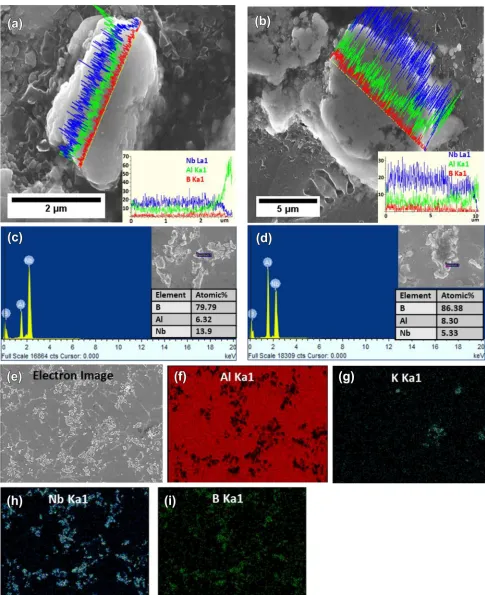
It is known that phases with a low volume fraction, typically less than 5%, cannot be detected by XRD. Hence, further analysis using SEM–EDS (Fig.7) was carried out on a few random particles in the Al-5Nb-2B alloy. Figure7a and b are line scans on two particles, representing the distribution of the elements Al, Nb and B in in situ-formed particles. From the scan, it can be observed that all three elements are present in the particles. Figure7c and d are the EDX point analysis on two different particles, showing their approximate constitution. Again, all the three elements, i.e., Al, Nb and B, are present. The EDX elemental map of a region of the Al-5Nb-2B alloy is shown in Fig.7e–i. From the microstructure, it is evident that the particles are distributed along the grain boundaries. Also, it can be inferred that the particles are rich in Nb and B. The traces of K indicate the presence of a residue of KBF4 salt. Point EDX analysis on a number of
particles indicate the presence of NbB2,
Al0.33Nb0.667B2, Al3Nb and AlB2, but, due to their
low volume fraction, it could not be detected by XRD.
[image:8.594.44.273.66.241.2]CONCLUSION
Al-Nb-B master alloys with high fractions of wel-distributed Nb-B-containing particles were devel-oped by varying the process parameters. A shorter reaction time results in an incomplete salt–metal reaction which is indicated by the presence of unre-acted salts and Nb powder in the solidified master alloy. On the other hand, longer reaction times led to gravity settling of the particles and agglomeration. Thus, the optimum reaction time was found to be 2 h 15 min at 800°C. Also, it was shown that master alloys prepared by the reaction of Al-60Nb powders with KBF4 salt results in the formation of higher
volume fractions of particles, as compared to using pure Nb powder. The experiments also demonstrated that it is not very feasible to synthesize Al-Nb-B alloys with B greater than 2 wt.% due to the higher viscosity of the melt.
In all the master alloys, agglomerates of particles are well distributed in the matrix. Methods like plastic deformation can reduce the agglomerate/par-ticle size even more, which is beyond the scope of the present work.
OPEN ACCESS
This article is distributed under the terms of the Creative Commons Attribution 4.0 International License (http://creativecommons.org/licenses/by/4.0/ ), which permits unrestricted use, distribution, and reproduction in any medium, provided you give appropriate credit to the original author(s) and the source, provide a link to the Creative Commons li-cense, and indicate if changes were made.
REFERENCES
1. B.S. Murty, S.A. Kori, and M. Chakraborty,Int. Mater. Rev. 47, 3 (2002).
2. M.A. Easton, M. Qian, A. Prasad, and D.H. Stjohn,Curr. Opin. Solid State Mater. Sci.20, 13 (2016).
3. A.L. Greer and T.E. Quested,Philos. Mag.86, 3665 (2006). 4. A. Cibula,J. Inst. Met.90, 1 (1951).
5. V. Auradi, S.L. Biradar, S.M. Suresha, and S.A. Kori,Appl. Mech. Mater.592–594, 494 (2014).
6. L. Arnberg, L. Ba¨ckerud, and H. Klang,Met. Technol.9, 7 (1982).
7. L. Arnberg, L. Ba¨ckerud, and H. Klang,Met. Technol.9, 1 (1982).
8. S.A. Kori, B.S. Murty, and M. Chakraborty, Mater. Sci. Technol.15, 986 (1999).
9. G.P. Jones and J. Pearson,Met. Trans. B7, 223 (1976). 10. D.G. McCartney,Int. Mater. Rev.34, 247 (1989).
11. C.R. Chakravorty and M. Chakraborty, Cast Met. 4, 98 (1991).
12. T.W. Clyne, A.M.M. Nazar, M. Prates, and G.J. Davies,Met. Technol.5, 302 (1978).
13. F. Wang, Z. Liu, D. Qiu, J.A. Taylor, M.A. Easton, and M.X. Zhang,Acta Mater.61, 360 (2013).
14. F. Wang, D. Qiu, Z.L. Liu, J.A. Taylor, M.A. Easton, and M.X. Zhang,J. Appl. Crystallogr.47, 770 (2014).
15. T. Wang, H. Fu, Z. Chen, J. Xu, J. Zhu, F. Cao, and T. Li,J. Alloys Compd.511, 45 (2012).
16. M. Nowak, L. Bolzoni, and N.H. Babu.Mater. Des.66, 366 (2015).
17. L. Bolzoni, M. Nowak, and N.H. Babu.Mater. Des.66, 376 (2015).
18. L. Bolzoni and N.H. Babu.JOM68, 1301 (2016).
19. M. Nowak, L. Bolzoni, and N.H. Babu.J. Alloys Compd.641, 22 (2015).
20. M. Nowak, W.K. Yeoh, L. Bolzoni, and N.H. Babu.Mater. Des.75, 40 (2015).
21. G.P. Jones and J. Pearson,Metall. Trans. B7, 223 (1976). 22. M.S. Lee and P. Grieveson, Mater. Sci. Technol.19, 769
(2003).
23. F. Gazanion, X.G. Chen, and C. Dupuis,Mater. Sci. Forum 396–402, 45 (2002).
24. Y. Birol,J. Alloys Compd.420, 71 (2006).
25. A. S. M. International, A. S. M. I. A. P. D. Committee, and A. S. M. I. H. Committee,ASM Handbook, vol 3. (ASM Inter-national, 1992).
26. E.A. Owen and E.L. Yates,Dublin Philos. Mag. J. Sci.15, 472 (1933).