ISSN Online: 2327-5227 ISSN Print: 2327-5219
DOI: 10.4236/jcc.2018.610004 Oct. 29, 2018 40 Journal of Computer and Communications
Study on the Recommended Model Based on
Personal Information System
Xiaoyu Dai
Computer Science & Statistics, Letters & Science, University of California, Berkeley, Berkeley, CA, US
Abstract
This paper classifies the scenario elements which affect the real-time infor-mation needs of mobile commerce users, and proposes a nomination model that integrates the user’s personalized context elements. In this model, the top K scenarios that have the greatest impact on each user’s instant information demands are calculated from the user’s current scenario and historical data, thereby constructing a user personalized situation and improving it as an in-put condition that existing scenario-based multi-dimensional information recommendation algorithm is used for project nomination. Result/Conclusion: The improved algorithm and other three algorithms were compared by Mov-ie lens and MBook Crossing dataset. The experimental results show that the model has higher prediction accuracy and can effectively improve user satis-faction and more effectively and solve personalized nomination issues in a mobile commerce environment.
Keywords
Personalized Model, Modern E-Commerce, Model Investigation
1. Introduction
In recent years, with the development of mobile communication technologies and the popularity of smart mobile devices, users are eager to obtain informa-tion and services that meet their individual needs from the mobile internet in a timely by convenient and efficient manner during the mobile process. However, because of the rapid development of information technology and its increasing content, and the limited ability of mobile devices to process information, it is increasingly difficult for people to obtain valuable information through mobile networks. In order to solve the problem of mobile information overloading and other issues, the mobile recommendation system, which has received extensive attention, has become an effective means to alleviate this problem.
How to cite this paper: Dai, X.Y. (2018) Study on the Recommended Model Based on Personal Information System. Journal of Computer and Communications, 6, 40-51. https://doi.org/10.4236/jcc.2018.610004
Received: September 17, 2018 Accepted: October 26, 2018 Published: October 29, 2018
Copyright © 2018 by author and Scientific Research Publishing Inc. This work is licensed under the Creative Commons Attribution International License (CC BY 4.0).
DOI: 10.4236/jcc.2018.610004 41 Journal of Computer and Communications
At present, scholars around the world have begun to research recommenda-tion quesrecommenda-tions combining with user context informarecommenda-tion in mobile environment, for the characteristics that the demand of mobile commerce users’ information has a strong situational dependence. Woemdl proposed a two-stage context movement recommendation model, first considering the comprehensive weight of the user state context, and then recommending when the weight reaches the set threshold [1]. Dao considered situational information into the recommenda-tion model and adopted the combinarecommenda-tion of genetic algorithm and collaborative filtering algorithm to improve the recommendation quality [2]. Yuan Jing and others believe that the integration of mobile business situation information into the recommendation system is conducive to improving the quality of recom-mendation, and then propose a model for learning resource recommendation by using context information [3]. In combination with the characteristics of mobile business scenarios, Lili Zhai uses the K-means algorithm to cluster the users and adopts the collaborative filtering method to recommend, which effectively im-proves the mobile business information recommendation accuracy [4]. Puxiong Zhou and others proposed LBS + AR + Three-dimensional stereotype recom-mendation method for multilevel association rules for the characteristics of scene sensitivity in mobile information services, which introduces user context analysis to improve recommendation accuracy and quality [5]. Xiaotong Deng takes context information to users clustering, and then to improve similarity calculation [6] by social network theory to analyze user relationships and im-prove similarity to further imim-proves the quality of information recommendation in the mobile commerce environment.
The above researches show that scholars at home and abroad have made cer-tain achievements based on user situational information. However, most of them ignored the impact of difference among commerce scenarios on the needs and lacks in-depth analysis of each user’s personalized situation. To this end, ac-cording to the characteristics of the mobile commerce environment, this paper classifies the scene elements to identify the main scene elements that affect the user’s instant information needs, and finds the greatest K impact on their infor-mation needs for each user through the training set method. On the basis of the scenario elements, the personalized situation recommendation model in the mo-bile e-commerce environment incorporating personalized situational elements is proposed. Finally the existing context-based multi-dimensional information recommendation algorithm is improved, and the personalized situation is used as the input condition to replace the current situation information. This model provides a new idea for improving the accuracy of mobile commerce recom-mendation and effectively improving user experience.
2. Context and Personalized Context Analysis in Mobile
E-Commerce Environment
2.1. Significance and Classification of Situation
com-DOI: 10.4236/jcc.2018.610004 42 Journal of Computer and Communications
bining with the characteristics of mobile commerce, the context is defined as in-formation about the time, location, environment and other inin-formation that af-fect the instant information needs of mobile commerce users.
According to the above definition, it is to classify the scene elements that af-fect the real-time information needs of mobile commerce users as following:
1) User context. The user context mainly refers to the user’s basic context in-formation, the behavioral state and historical preferences when using the sys-tem .Whether the user is learning or working, and he likes to exercise or stay at home during rest, these scene elements will affect distribution and selection of attention in user’s mind, which is important variables that influence the out-come of the recommendation.
2) Location context. According to the description of the location context [8], it refers to the context information related to the user’s location, such as the in-formation which about the user’s situation at school or home and around [8]. The user location information in this paper mainly includes: the user’s city, the location type (school, home, shopping mall), the status of the people around (classmates, family, colleagues).
3) Time context. The time context mainly takes the time attribute to indicate the user’s situation and its preferences, Such as the time what the user browse coupon site by IPAD (at different times of a day), the user’s different demand for information resources on holidays and workdays, including that pay attention to leisure and entertainment during the holidays, but focus on work and study in-formation in the working day.
4) Environmental context, which refers to the environmental information when the user using the recommended system, including the natural environment such as temperature and weather. The environment in which mobile commerce users are located is changeable. When designing the recommendation system, it is necessary to analyze the environmental factors to understand the real state of the use of the system, which is conducive to discovering the user’s needs and changes.
5) Equipment context. At present, mobile commerce users mostly obtain in-formation resources through mobile terminal devices (mobile phones, pads, etc.). The device information mainly includes two aspects. First, hardware device information which shows the size of the screen, affects the amount of informa-tion displayed on each page; the other includes that network informainforma-tion refer-ring to the networking ways of devices that including 2G, 3G, 4G and WiFi. Dif-ferent network methods have difDif-ferent speeds. Therefore, the recommendation system needs to capture this information in time and recommend the informa-tion to users in an appropriate manner to provide better service to users.
2.2. Personalized Context Determination
re-DOI: 10.4236/jcc.2018.610004 43 Journal of Computer and Communications
sult deviating from the user’s instant information demand to some extent. In the process of mobile commerce information recommendation, the situation infor-mation varies from person to person. Time, location, season and temperature are very important context elements for the travel recommendation system. Some users don’t think these scene elements are important but others have the opposite view, and also some users think that only time and place elements are important to them. So if we can find out the factors that affect the final selection of each user from all the situation information, which it could not only reduce the running burden of the system, but also make the prediction result more ideal
[9].
Gao and others creatively proposed the concept of “individualized context”. Zhou Puxiong and others borrowed this idea and expanded the connotation of individualized context. This paper is used for reference given by Zhou Puxiong. That is, personalized context refers to the largest K context elements that affect the instant information needs of users to be recommended [10]. This paper draws on the method of [10], which based on the user rating as a measure, firstly the training set of the user ratings matrix, and obtains the user recommendation eval-uation matrix that incorporates the context elements, and then the K-optimal rating for each user. K context elements make up the personality of the user context, in which the K value is automatically set according to the optimal rating result.
The specific process of Personalized Context determination is divided into the following steps:
Step 1: Divide the user scoring matrix into training set D and test set in a ratio of 80:20. Then D will follow the user’s current context C=
{
c c1, , ,2 ct}
isdi-vided into t subsets, namely D=
{
d d1, , ,2 ds}
.Step 2: Let PX U D( , ) be the information recommendation quality evaluation
standard, where U is the user set, D is the training set, and X is the recommend-ed algorithm usrecommend-ed for this evaluation standard. PX u d(S S, ) indicates that us is the
target user, and the algorithm X is trained on the training set ds based on the
context, and the user us scores the information recommendation quality.
Step 3: Obtain a context-based user recommendation evaluation matrix Pc:
(
)
(
)
(
)
(
)
(
)
(
)
(
)
(
)
(
)
1 1 1 2 1
2 2
1 2
, , ,
, , ,
, , ,
x x x s
x s s x s x s
C
x s x s x s s
P u d P u d P u d
P u d P u d P u d
P
P u d P u d P u d
=
(1)
Step 4: Find the context elements corresponding to the K optimal values in the corresponding row for each user through step 3, and compose the context to set
(
1, , ,2 K)
C′= C C′ ′ C′ , which is user’s personalized context.
3. Model Construction
DOI: 10.4236/jcc.2018.610004 44 Journal of Computer and Communications
analysis of each user’s personalized context. In view of this, this paper introduces user personalization based on existing context recommendation research that a personalized context recommendation model for mobile e-commerce environ-ment is constructed. The recommendation process of the model begins by gene-rating user’s personalized situation through the user’s current context and mul-ti-dimensional historical rating data, and then jointly taking rating data obtained from the multi-dimensional rating data warehouse to get a multidimensional data U (user) × I (project) × C’ (personalization context) × R (rating) based on personalized context C’ and as input to select relevant rating data condition, based on these selected rating data combined with the multi-dimensional infor-mation recommendation algorithm based on personalized situation proposed in this paper, the final recommendation list {I1, I2, I3, ∙∙∙} is obtained.
3.1. Personalized Context Analysis Module
Its main function is to find out K scene elements that have the greatest impact on users’ instant information needs, which means the user’s personalized scenes, current situation and multi-dimensional rating data warehouse are the basis for the system to generate user personalized context [11]. The user’s current context can be obtained through a mobile device with built-in sensors and RFID. The multidimensional historical rating data of the project accepted by the users of multidimensional rating data warehouse stores. Each rating data first extracts the main attributes of each dimension document of the user, project and con-text, and then combines the rating data saved by the system to form a multidi-mensional historical rating data and stores it. The multidimultidi-mensional rating data warehouse is an important basis for determining the user’s personalized context and also a key data source for multi-dimensional information recommendation.
3.2. Multidimensional Information Recommendation Module
It is the most important component of the mobile e-commerce personalized con-text recommendation model. This module first uses multi-dimensional historical rating data and user personalized contexts obtained from the personalized con-text analysis module to gain multi-dimensional data U × I × C’ × R based on personalized contexts Based on the proposed the multi-dimensional information recommendation algorithm of the particular scene, it is recommended for the project.
3.3. User and Recommendation System Interaction Module
DOI: 10.4236/jcc.2018.610004 45 Journal of Computer and Communications
instantly to the multidimensional rating data warehouse, which will update the contexts and ratings.
4. Multidimensional Information Recommendation
Algorithm Based on Personalized Contexts
4.1. Algorithm Design Idea
In this paper, the mobile user’s current personalized situation C’ is used instead of the current situation C as the filtering condition, and the rating data segment contained in the scene elements that have less influence on the user’s score is ex-cluded to select scene sufficiently similar to the current personalized situation C’, in order to score the data segment and determine if there is a certain use for this data segment which the user has different scores for the same project in dif-ferent contexts, and then make the traditional two-dimensional recommenda-tion algorithm to perform score predicrecommenda-tion. The improved algorithm [13] of the existing multi-context recommendation algorithm based on the context can not only reduce the burden of system operation, and also effectively improve the quality of the recommendation.
When the multi-dimensional data is selected to use the personalized context C’, in the actual situation, it may lead to an extremely sparse scoring matrix if in over-explicit situation. Therefore, the selection condition used in this paper is C’
∈ SC’, SC’ is the superior situation to which the personalized situation C’
be-longs, such as C’ = “girlfriend”, then SC’ = “friend”.
4.2. Algorithm Process Description
Input: MR (Multidimensional Ratings), MR = {(Uj, Ik, Cl, RUj,Ik,Cl)}; j = 1, ∙∙∙, m; k
=1, ∙∙∙, n (total of m users, n items). C1 is a historical context in multidimensional
scoring data, l = 1, ∙∙∙, q.
User’s current personalized context C’, target user U1.
Output: Target user u1 predicted rating for project I1 in the current
persona-lized context C’ are Pu1, I1, C’.
The specific process of the algorithm is divided into the following steps: Step 1: Filter the MR to filter out the rating data set MD that is sufficiently similar to the user’s current personalized context C’.
Step 2: Determine if step 1 is difficult to construct due to data sparsity the score data segment MD with the context is sufficiently similar to the current personalized context C’. If doesn’t exist, directly execute the next step. Other-wise, SC’ is used instead of C’ as the selection condition to select the score data segment, SC’ is the personality the superior situation to which context C’ be-longs.
rat-DOI: 10.4236/jcc.2018.610004 46 Journal of Computer and Communications
ing. That is :R IUj, k=AVG U I C
(
j, ,k l)
,which guarantees the user get a uniquerating value for the same item, resulting in the final score data segment MD after the personalized context filtering.
Step 4: Calculate the similarity of the MD using the traditional two-dimensional recommendation algorithm:
(
)
(
)
(
)
(
)
(
)
(
)
1 1 1 1 1 1 1 ,1 2 2
, ,
Sim , u j 's j's j
s s j
u j ' u j j'
u u U U
S I S U j
u u U U
S S U S S U
R R R R u U
R R R R
∈ ∈ ∈ − − = − −
∑
∑
∑
(2)in where, the average value of all items rating by the target user u1 in MD is represented by Ru1; The average value of all items rating by the target user Uj
took as RUj.
Step 5: Predict the items rating to be recommended
(
)
(
)
1,iC 1 1 j i, j 1,
N
u I u j U I U j
P ′ =R +k
∑
= R −R ×sim u U (3)in where
(
)
1
1 , i
U U sim j
k u U ′ ∈ = Σ .
The set of N users most similar to the recommended user u is denoted as u’. The N value is usually preset by the system.
Step 6: Rank them in descending order according to the size of the rating val-ue, and recommend TOP-N as the recommended set to target users.
5. Experimental Results and Analysis
5.1. Experimental Data Sets and Evaluation Criteria
In order to verify the prediction effect of the multi-dimensional information recommendation algorithm based on personalized contexts, the Movie lens data set [14] provided by the University of Minnesota was adopted in this paper, and the numerical experiment [15] is carried out on the basis of Book rating data provided by Book-Crossing, the real data set of MBook Crossing constructed by integrating the reasonable scenario was generated, and the rating data is ran-domly divided into training set and test set according to the ratio of 80:20, and the context-based collaborative filtering algorithm, the classic Slope One algo-rithm and the dimension-based input are selected [16], which is a comparative analysis of the contextual multidimensional information recommendation algo-rithm [17].
DOI: 10.4236/jcc.2018.610004 47 Journal of Computer and Communications
the Book-Crossing book community using a crawler 271,379 behavioral infor-mation carried out in this book. Based on the Book-Crossing data set, the data set MBook-Cross constructed by reintegrating the situational information, con-tains basic information about user ID, location, age, time (morning, noon, after-noon, evening), location (office, home, school, restaurant), environmental context information (sound environment, space), status information (entertainment, work, study), etc.
This paper uses the average absolute error widely used in the recommended quality test method MAE [19] and P(U)@N [20] are used as metrics. The MAE measures the accuracy of the recommendation results by calculating the deviation between the predicted rating and the actual rating [21], while P(U)@N represents the Top-N recommended column generated by the user. The ratio of the number of items in the table that meets their needs to N is calculated as follows:
1
MAE N
i pi qi
N
= −
=
∑
(4)( )
relevanititemin top items forP u @N n u
N
= (5)
5.2. Experimental Results and Analysis
1) Personalized Context Determination Training According to the Specific Steps in Section 1.2
The user ratings on the set are trained to obtain a context-based user recom-mendation evaluation matrix.
The context-based user recommendation evaluation matrix for the Movie lens data set is:
Gender Time … Preference
4.868 4.808 3.855
3.701 2.684 4.188
4.792 0 4.325
C P =
The context-based user recommendation evaluation matrix for the MBook Crossing data set is:
Time Position … Status
4.875 4.781 2.956
3.774 1.885 4.809
2.972 4.570 3.631
C P =
The rows in the matrix represent the individual users, and the columns represent the corresponding contexts. Each value represents the user’s rating of the information recommendation quality of the user under ct. If the system sets
DOI: 10.4236/jcc.2018.610004 48 Journal of Computer and Communications
2) Analysis of Prediction Results
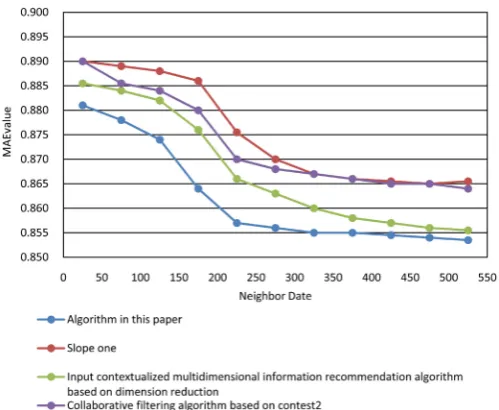
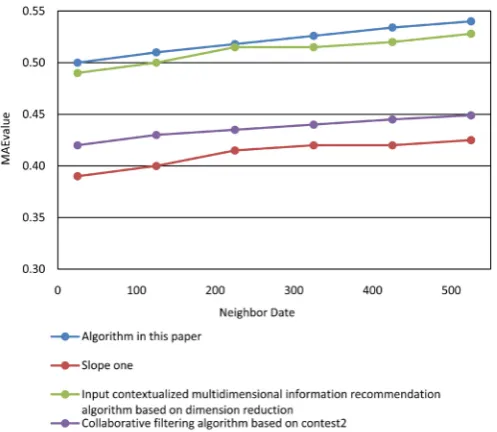
The algorithm proposed in this paper is compared with the context-based collaborative filtering algorithm, the classic Slope One and the input-contextual multidimensional information recommendation algorithm based on dimensio-nality reduction. The specific comparison results are shown in Figures 1-4.
[image:9.595.248.499.262.466.2]As shown in Figure 1, due to the lack of some external context information in the Movie lens dataset, the rating data segments with the selected contexts and the current personalized context C’ have certain sparsity, resulting in the large volatility in MAE values of the other three algorithms, and when the number of near neighbors is less than 0 - 150, the MAE values of the algorithms are large, but with the increase of the number of near neighbors, the MAE value shows a trend of decreasing and tends to be stable, less than the other three algorithms.
Figure 1. Comparison of MAE results of 4 algorithms on the Movie lens data set.
[image:9.595.249.499.496.701.2]DOI: 10.4236/jcc.2018.610004 49 Journal of Computer and Communications Figure 3. The P(U)@N comparison results of 4 algorithms on the Movie lens data set.
Figure 4. The P(U)@N comparison results of the four algorithms on the MBook crossing data set.
[image:10.595.250.499.315.531.2]DOI: 10.4236/jcc.2018.610004 50 Journal of Computer and Communications
As can be seen from Figure 3 and Figure 4, when selecting the number of dif-ferent neighbors in the P(U)@N performance comparison, the collaborative filter-ing algorithm considerfilter-ing the overall situation information and the input con-text-based recommendation algorithm based on dimensionality reduction are more accurate than the Slope One algorithm. The proposed algorithm is more effective and has a higher P(U)@N accuracy rate, indicating that the algorithm in this paper is reasonable considering individualized contexts in the case of elements. It has a higher recommendation quality and can better meet the mo-bile instant information needs of business users.
6. Conclusion
Based on context information recommendation, there is a lack of in-depth anal-ysis of user personalized contexts on the existing research. This paper proposes a personalized context recommendation model in mobile e-commerce environ-ment, and improves the multi-dimensional information recommendation algo-rithm based on context. The model calculates the personalized context of each user firstly, and then replaces the current context with each user’s personalized context for multi-dimensional information recommendation. Since this model first determines, the context elements that have the greatest impact on user rec-ommendation, it is more in line with the fact that humans have different needs in different context. Finally, experiments are carried out on the data sets of Movie lens and MBook Crossing, and the results show that the model and improved algorithm proposed in this paper have higher prediction accuracy, better recom-mendation quality, and can effectively solve the personalized recomrecom-mendation problem in the mobile commerce environment. The future research will com-bine the social network theory and long tail theory with the method in this paper to further improve the quality of algorithm recommendation.
Conflicts of Interest
The author declares no conflicts of interest regarding the publication of this pa-per.
References
[1] Woerndl, W., Vico, D.G. and Bader, R. (2016) A Study on Proactive Delivery of Restaurant Recommendations for Android Smartphones.
http://pema2011.cs.ucl.ac.uk/papers/pema2011_vico.pdf
[2] Dao, T.H., Jeong, S.R. and Ahn, H. (2012) A Novel Recommendation Model of Lo-cation-Based Advertising: Context-Aware Collaborative Filtering Using GA Ap-proach. Expert Systems with Applications, 39, 3731-3739.
https://doi.org/10.1016/j.eswa.2011.09.070
[3] Jing, Y. and Jiao, Y. (2009) Personalized Recommendation of Learning Resources Based on Context Information. Intelligence Theory and Practice, 32, 116-119. [4] Zhai, L., Xing, H. and Zhang, S. (2016) Research on Collaborative Filtering
Rec-ommendation of Mobile E-Commerce Based on Situation Clustering Optimization.
DOI: 10.4236/jcc.2018.610004 51 Journal of Computer and Communications
[5] Zhou, P. and Tao, M. (2012) Research on Situation-Sensitive Personalized Informa-tion RecommendaInforma-tion System in Mobile Network Environment. Library and In-formation Service, 56, 80-81.
[6] Deng, X., Chun, J., Han, Q., et al. (2013) Collaborative Filtering Recommendation Model Based on Situation Clustering and User Rating. Systems Engineering: Theory & Practice, 33, 2945-2946.
[7] Dey, A.K. (2001) Understanding and Using Context. Personal and Ubiquitous Computing Journal, 5, 4-7. https://doi.org/10.1007/s007790170019
[8] Zhai, L., Jing, W. and He, X. (2015) Software Industry Virtual Machine Group Co-operation Competition Mechanism. Science Press, Beijing, 182-183.
[9] Wen, G. and Wu, Z. (2009) Research on Collaborative Recommendation Based on Personalized Situation and Project. Journal of Southeast University: Natural Science Edition, 39, 29-30.
[10] Zhou, P., Xue, W. and Zhao, W. (2015) Multi-Agent Based on Personalized Situa-tion InformaSitua-tion RecommendaSitua-tion Research. Intelligence Journal, 34, 182-183. [11] Jun, Y. (2011) Research on Multi-Dimensional Information Recommendation
Based on Situational Awareness. Wuhan University, Wuhan.
[12] Jun, Y., Wang, H. and Ai, D. (2014) A New Method of Multidimensional Informa-tion RecommendaInforma-tion Based on Output SituaInforma-tionalizaInforma-tion. Information Science, 32, 126-132.
[13] Jun, Y., Zan, M. and Ai, D. (2013) Research on Input and Context Multidimension-al Information Recommendation Based on DimensionMultidimension-ality Reduction. Information Theory & Practice, 36, 64-65.
[14] Xu, H.L., Wu, X., Li, X.D., et al. (2009) Comparison Study of Internet Recommen-dation System. Journal of Software, 20, 350-362.
https://doi.org/10.3724/SP.J.1001.2009.00350
[15] Xun, H., Meng, X., Zhang, Y., et al. (2014) A Recommendation Algorithm for Fu-sion Project Features and Mobile User Trust Relationship. Journal of Software, 25, 1824-1825.
[16] Kim, J., Lee, D. and Chung, K. (2014) Item Recommendation Based on Con-text-Aware Model for Service. Multimedia Tools and Applications, 71, 855-872.
https://doi.org/10.1007/s11042-011-0920-0
[17] Cyohulyad, R. and Leray, P. (2014) A Personalized Recommender System Relational Model and Users Preferences. Procedia Computer Science, 35, 1063-1067.
[18] Xu, F.W., Meng, X.W. and Wang, L.C. (2011) Collaborative Filtering Recommen-dation Algorithm Based on Context Similarity of Mobile Users. Journal of Elec-tronics & Information Technology, 33, 2785-2788.
https://doi.org/10.3724/SP.J.1146.2011.00384
[19] Hou, S., Sun, L. and Jin, X. (2018) Method and System for Protecting Personal In-formation Based on Mobile Terminal and the Mobile Terminal. US20180053013. [20] Ju, J.Y. and Dongsim, K. (2017) A Study of Outcomes Utilizing K-MOOC Credit
Based on the Information System Success Model. Journal of Educational Studies, 48, 95-113.https://doi.org/10.15854/jes.2017.06.48.2.95