doi:10.4236/ajor.2011.13016 Published Online September 2011 (http://www.SciRP.org/journal/ajor)
Allocation of Repairable and Replaceable Components
for a System Availability Using Selective Maintenance
with Probabilistic Maintenance Time Constraints
Irfan Ali1*, Mohammed Faisal Khan2, Yashpal Singh Raghav1, Abdul Bari1 1
Department of Statistics & Operations Research, Aligarh Muslim University, Aligarh, India
2
Department of Mathematics, Integral University, Lucknow, India E-mail:*[email protected]
Received April 23, 2011; revised May 19, 2011; accepted June 8, 2011
Abstract
In this paper, we obtain optimum allocation of replaceable and repairable components in a system design. When repair and replace time are considered as random in the constraints. We convert probabilistic con-straint into an equivalent deterministic concon-straint by using chance constrained programming. We have used the selective maintenance policy to determine how many components to be replaced & repaired within the limited maintenance time interval and cost. A Numerical example is presented to illustrate the computational procedure and problem is solved by using LINGO Software.
Keywords:Selective Maintenance, Availability, Optimization and Allocation, Chance Constraints
1. Introduction
In many industrial environments, systems are required to perform a sequence of operations (or missions) with fi-nite breaks between each operation. During these breaks, it may be advantageous to perform repair and replace-ment on some of the system components. However, it may be impossible to perform all desirable maintenance activities prior to the beginning of the next mission due to limitations on maintenance resources. In this paper,
we have consider that the maintenance (i.e. repair and
replace) time in general are unknown (are of random character). For this a mathematical programming frame-work is established for assisting decision-makers in de-termining the optimal subset of maintenance activities to perform prior to beginning of the next mission. This de-cision-making process is referred to as selective mainte-nance. The selective maintenance models presented al-low the decision-maker to consider limitations on main-tenance time and budget, as well as the reliability of the system. Selective maintenance is an open research area that is consistent with the modern industrial objective of performing more intelligent and efficient maintenance.
Rice et al. [1] define a Mathematical programming
Model for solving selective maintenance problem.
Cas-sady et al. [2] extend the mathematical programming
model problem by permitting subsystems to be com-prised of non identical components in any structure, adding a second resource constraint (representing main-tenance cost), and creating two additional selective maintenance formulations that minimize resource con-sumption as the objective function and include mission
reliability as a constraint. Cassady et al. [3] extend
mathematical programming model problem in two ways. First the life distributions of system components are specified to be weibull distributions. Second, the decision maker is given multiple maintenance options: minimal repair on failed components, replacement of failed com-ponents and replacement of functioning comcom-ponents (preventive maintenance).
Cassady et al. [4] formulate a set of three optimization
models that capture the trade-off between improving availability performance and the investments required to achieve this improvement. Two of these models address the allocation of funds for availability improvement ef-forts, and the third model addresses the incorporation of availability performance considerations in the system design phase.
problem; where equivalent means that the solution of the deterministic problem is a solution of the stochastic problem. The stochastic optimizations have been used in the solution of some problems in probability and statis-tics; see Prekopa [5]. Charnes and Cooper [6], Rao [7], Prekopa [8], Uryasev and Paradolos [9], Louveaux and Birge [10] define non linear stochastic optimization for integers.
In most of the real life problems in which the decision maker would like to optimize objective function, and the values of the parameters are uncertain to enable the deci-sion maker to take the decideci-sion. If we consider the pa-rameter as random variables, the resulting problem is known as stochastic programming problem. Stochastic programming is an optimization method based on the probability theory, has been developed in several ways e.g., two stage programming problem by Dantzig [11], Chance constrained programming by Charnes and Coo-per [12] and a stochastic programming problem with probabilistic constraints by V. A. Bereznev [13]. Previ-ous research on the redundancy allocation problem for series-parallel system has focused on only deterministic
versions when components maintenance (i.e. repair and
replace) are assumed to be an exact value.
In this paper we have discussed components repairable and replaceable time as a random variable in the straint. Probabilistic constraints function is then con-verted into an equivalent deterministic non-linear pro-gramming form by using chance constrained program-ming.
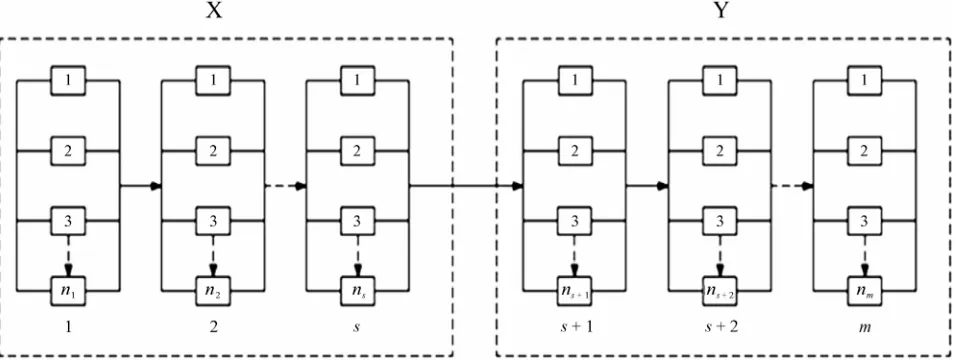
In this paper we assume that the system comprises two types of subsystem. One is the type of subsystems in which the components are very sensitive to the function-ing of the whole system and, therefore, on deterioration these should be replaced by new ones. Let these
subsys-tems range from 1 to s. The other types of subsystems
are those in which the components after deterioration can be repaired and then replaced. Let such subsystems range from s + 1 to m. In Figure 1 the group X consists of the s
subsystems with sensitive components which on failure
are replaced by new ones and Y the remaining (ms)
subsystems in which the components can be repaired. It is assumed that there is a single team for the replacing and repairing the components of group X and Y. this means that replacing and repairing of the components is various subsystems of X and Y is done in series.
2. Definition and Notations
Every industrial and engineering organization depends upon the effective performance of repairable and re-placeable components of the system. A repairable com-ponent of a system can be defined as a comcom-ponent which after deterioration can be restored to an operating condi-tion by some maintenance accondi-tion. On the other hand a replaceable component is the one which after failure is replaced by a new one. We consider a system which re-quires to perform a sequence of identical missions after every given (fixed) period. The system consists of sev-eral subsystems where each subsystem can work prop-erly if at least one of its components is operational. Thus we are working under the following two assumptions
Assumption 1: all the component states in a subsystem are independent
Assumption 2: the reliability, the cost and the weight of each component within a sub system are identical
Let i denote the probability that a component of a
subsystem i survives the mission given that the
compo-nent is functioning at the start of the mission, and let i
denote the number of components in subsystem i all in
the functioning state at the start of the mission. Since group X of the system is a series arrangement of the
a
[image:2.595.59.537.525.705.2]n
149
subsystems its availability can be defined as
1 1
1 1 i, 1, 2, ,
s
n i i
A a i
s)
(2.1)
Similarly for group Y composed of
inde-pendent subsystems (
(ms
1, ,
s m) connected in series,
the availability can be defined as
2 1
1 1 i, 1, ,
m
n i i s
A a i s
m (2.2)Since the system is a series arrangement of these two groups X and Y, the complete system availability can be defined by
2
1
, 1, 2
i i
A A i
(2.3)We will use the following notations in our formulation of the problem:
i = Total number of failed components in the
subsystem at the end of a mission.
k ith
i = Number of failed components replaced and
re-paired in subsystem prior to the next mission.
p
th
i
( ,1
i = Time units required for replacing a failed
com-ponent in the subsystem of group X.
, m)
p p p t
.
th
i
i = Expected units time required for replacing a
failed component in the subsystem of group X.
t
t
th
i
i = Time units required for repairing and then
re-placing a failed component in the subsystem of
group Y.
th
i
i
t= Expected units time required for repairing and
then replacing a failed component in the subsystem
of group Y.
th
i
i
t
= Standard deviation of repair time for replacing a
failed component in the of group subsystem of
group X.
th
i
i
t
= Standard deviation of replace time for repairing
and then replacing a failed component in the
sub-system of group Y.
th
i
1 2
T T = Total time required for replacing (repairing)
all the failed components in the system.
01 02
T T
k
= Total time available for replacing (repair-ing) the failed components in the system between two missions.
i = Cost units required for replacing a failed
com-ponent in the subsystem of group X.
c
c
th
i
i = Time units required for repairing and then
re-placing a failed component in the subsystem of
group Y.
th
i
1 2
C C = Total cost required for replacing (repairing)
all the failed components in the system.
01 02
C C = Total cost available for replacing
(repair-ing) the failed components in the system.
3. Selective Maintenance
The selective maintenance operation is an optimal deci-sion-making activity for systems consisting of several equipments under limited maintenance duration. The main objective of the selective maintenance operation is to select the most important equipment or subsystem to maintain. It also has to determine the appropriate main-tenance actions in order to minimize the sum of produc-tion losses due to machine failures and the maintenance cost during the next working time. Such kind of prob-lems can be encountered for equipments that perform sequences of tasks and can be repaired only during in-tervals of tasks. Such cases occur in military equipment production lines in which maintenance actions are car-ried out on weekends, vehicles are maintained between two deliveries and computer systems are maintained at night, etc. We have used the selective maintenance pol-icy in our system that comprises two types of subsystem groups X and Y. If ideally, all the failed components in all the subsystem of group X are replaced by new ones prior to the beginning of the next mission/ run. In a simi-lar way, ideally all the failed components in subsystem of group Y are repaired and then replaced prior to the beginning of the next mission/run. However, due to the constraints on the cost and time it may not be possible to repair and replace all the failed components in group X and Y. Further, the cost required for replacing the failed components by new ones in group X is
1 1
s i i i
C c
(3.1) and the cost required for replacing the failed components after repairs in group Y is2 1
m i i i s
C c
k (3.2)Suppose that the total maintenance cost available for replacing of failed components between two missions is
01 cost units. If 01 1
C C C , then all failed components
may not be repaired prior to beginning of the next mis-sion.
In similar way, suppose that the total maintenance cost available for repairing of failed components between two
missions is 02 cost units. If C02 2, then all failed
components may not be replaced prior to beginning of the next mission.
C C
Let us assume that component replace and repair time
i
t and ti, are independently normally distributed
0
0
p
the time required for replacing the failed components in group X is
1 1s i i i
P t k T p
(3.3)and the time required for repairing and then replacing the failed components in group Y is
2 1m i i i s
P t k T
m
(3.4)
Suppose, that the total maintenance time available for
repair of failed components between two missions is 01
time units. If T01 1, then also all failed components
cannot be repaired prior to beginning of the next mission.
T T
In similar way, suppose, the total maintenance time available for replacement of failed components between
two missions is 02 time units. If 02 2, then also all
failed components can not be replaced prior to beginning of the next mission.
T T T
In such a case, a method is needed to decide which failed components should be repaired and replaced prior to the next mission and which components should be left in a failed condition. This process is referred as Selective Maintenance.
For this let us suppose i be the number of
compo-nents in the subsystem, which can be repaired and
replaced prior to the beginning of the next mission (See Rice et al. [1]).
p
th
i
Thus under the selective maintenance the number of components available for the next mission in the subsystem will be
th
i
niki
pi i1, 2, , (3.5)4. Formulation of the Problem
Now we discuss the mathematical programming model, with stochastic maintenance time constraint. The prob-lem at hand addresses the issue of maximize the total system availability within the limited available repair and replacement (maintenance) budget and maintenance time between two missions, where repair & replace time of the component are random variable. From (2.3) and (3.5), the availability of the system to be maximized is given by
1
1
1 1
1 1
i i i
i i i
s
n k p i i
m
n k p i i s
A a
a
(4.1)
Since the total cost of replacing the failed components
should not exceed C01, we have
01 1
s i i i
c p C
(4.2)And the total cost of replacing the failed components
after repairs should not exceed C02, we have
02 1
m i i i s
c p C
(4.3)The maximum tolerable time between two missions (Spent in the maintenance of the components in various subsystems of group X and Y simultaneously by single
server/team) is given by and . Thus we have the
constraints. 01
T T02
01 0 1s i i i
P t p T p
p
,
(4.4)
02 0 1m i i i s
P t p T
(4.5)We have pi cannot be exceed ki
0 pikiand integeri1, 2, m (4.6)
The probabilistic constraints (4.4) and (4.5) converted into an equivalent deterministic non-linear programming form by using chance constrained programming. The mathematical formulation of the problem is to maximize (4.1) under the constraints (4.2) to (4.6).
5. Solution Using Chance Constrained
Programming
5.1. When Replace Time Treated to be Random Variable
The replace time ti, i1, , s in the constraint
func-tion are assumed to be independently and normally dis- tributed random variables. Let ti
t1, ,ts
and
1, ,
i s . Then the constraint function
p p p
t pi i ,will also be normally distributed random variables with
mean E t p
i i and varianceV t p
i i
. If
2 ,
i
i i t
tN
,then the joint distribution of
t1, , ts will be given by
2
22 1
1
1 exp 1
2 (2 )
1, , .
i i
s i i
i s
s i t
t i
t f t
i s
Then, the mean is obtained as follows
1 1 1
s s s
i i i i i i i i
i i i
E t p E t p p E t p
(5.1a)151
2 2
2
1 1 1 i
s s s
i i i i i i i t
i i i
V t p V t p p V t p
(5.2a)Now, we consider the probabilistic constraint (4.4) can be expressed as
i 01
0P f t T p (5.3a)
where
1
s
i i
i i
f t t
pIt can be simplified as
01 0i i i
i i
f t E f t T E f t P
V f t V f t
p (5.4a)
where
i i
i
f t E f t V f t
is a standard normal variate
with mean zero and variance one. thus the probability of
realizing less than or equal to one can be writ-
ten as
iV f t
01 01 i i iT E f t P f t T
V f t
(5.5a)
where represent the cumulative density function
of the standard normal variate evaluated at z. if
z
K
represents the value of the standard normal variate at
which
K p0, then the constraint (5.5a) can bestated as
01 i iT E f t
K
V f t
(5.6a)
the inequality will be satisfied only if
01 i iT E f t K
V f t
or equivalently,
i
i
01E f t K V f t T
01
1 1
s s
i i i i
i i
E t p K V t p T
(5.7a)substituting Equations (5.1a) and (5.2a) in Equation (5.7a), we get
2 2 01
1 1 i
s s
i i i t
i i
p K p T
(5.8a)Here, functions in the constraint (5.8a) are given in
terms of the population expected values and variance of
t pi i , which are unknown (by hypothesis), then we willuse estimators of mean E t p
i i and variance V t p
i i .The estimator of E t
ipi is
1 1
ˆ s s
i i i i i i
i i
E t p p E t p t
, say. (5.9a)and the estimator of V t p
i i
2
2 2 21 1
ˆ
i
s s
i i i i i t
i i
V t p p E t p
, say. (5.10a)where ti and
2
i
t
are the estimated mean and variance
from the sample. Thus, an equivalent deterministic con-straint to the stochastic concon-straint is given by
2 2 01
1 1 i
s s
i i i t
i i
t p K p T
(5.11a)5.2. When Repair Time Treated to be Random Variable
The repair time ti, i s 1, , m in the constraint
function are assumed to be independently and normally distributed random variables. Let ti
ts1, , tm
and
1
i s, , m . Then the constraint function
t pi ip p p ,
will also be normally distributed random variables with mean E t p
i i and variance V t p
i i
.If
, 2
i i
tN i , then the joint distribution of
ts1, , tm
will be given by
2 2 2 1 1 1 1 exp , 2 2π1, , .
i i
m
i i
i m
m i s
t t
i s
t f t
i s m
Then, the mean is obtained as follows
1 1 1
m m m
i i i i i i i i
i s i s i s
E t p E t p p E t p
(5.1b)and the variance as follows
1
2 2
1 1 i
m
i i i i i i
i s
m m
i i i t
i s i s
V t p V t p V t p
p V t p2
(5.2b)
now, we consider the probabilistic constraint (4.5) can be expressed as
i 02
0P f t T p (5.3b)
where
1
m
i i
i s i
f t t
p
It can be simplified as
02
0
i i i
i i
f t E f t T E f t P
V f t V f t
02
1 1
m m
i i i i
i s i s
E t p K V t p T
(5.7b)p
(5.4b) Substituting Equations (5.1b) and (5.2b) in Equation
(5.7b), we get
where
i i
i
f t E f t V f t
2 2 02
1 1
m m
i i i i
i s i s
p K p T
(5.8b)
is a standard normal variate
Here, functions in the constraint (5.8b) are given in terms of the population expected values and variance of
t pii , which are unknown (by hypothesis), then we willuse estimators of mean E t p
i i and variance V f t
i
.with mean zero and variance one. Thus the probability of
realizing less than or equal to one can be
written as
iV f t
The estimator of
ipi
02 02
i i
i
T E f t P f t T
V f t
(5.5b) E t
1 1
ˆ m m
i i i i i i
i s i s
E t p p E t p t
, say (5.9b)where represent the cumulative density function
of the standard normal variate evaluated at z. if
z
K
represents the value of the standard normal variate at
which
K p0, then the constraint (5.5b) can bestated as
and the estimator of V f t
i
2
2 21 1
ˆ
i
m m
i i i i i t
i s i s
V t p p E t p 2
, say (5.10b)where ti and
2
i
t
are the estimated mean and variance
from the sample. Thus, an equivalent deterministic con-straint to the stochastic concon-straint is given by
02 i
i
T E f t
K V f t
(5.6b)
2 2 02
1 1 i
m m
i i i t
i s i s
t p K p T
the inequality will be satisfied only if (5.11b)
02 i
i
T E f t K V f t
These are the deterministic non linear constraints equivalent to the original probabilistic constraints. Thus, the solution of the probabilistic programming problem can be obtained by solving the deterministic non-linear programming problem. The resulting mathematical pro-gramming formulation is given as
or equivalently,
i
i
02E f t K V f t T
s
m
i 1 i 1
01
1 1
02
1 1
01 1
1
Max 1 1 1 1 ( )
subject to
( )
( )
( )
i i i i i i
n k p n k p
i i i
s
s s
i i i i
i i
m m
i i i i
i s i s
s i i i
i i i s
A p a a
E t p K V t p T ii
E t p K V t p T iii
c p C iv
c p
02 ( )
0 and integer, 1, , ( )
m
i i
C v
p k i m vi
i
(A)
153
s
m
i 1 i 1
2 2 01
1 1
2 2 02
1 1
01 1
Max 1 1 1 1 ( )
subject to
( )
( )
( )
i i i i i i
i
i
n k p n k p
i i i
s
s s
i i i t
i i
m m
i i i t
i s i s
s i i i
i i i s
A p a a
t p K p T ii
t p K p T iii
c p C iv
c p
02 1
( )
0 and integer, 1, , ( )
m
i i
C v
p k i m vi
i
(B)
6. Numerical Illustration
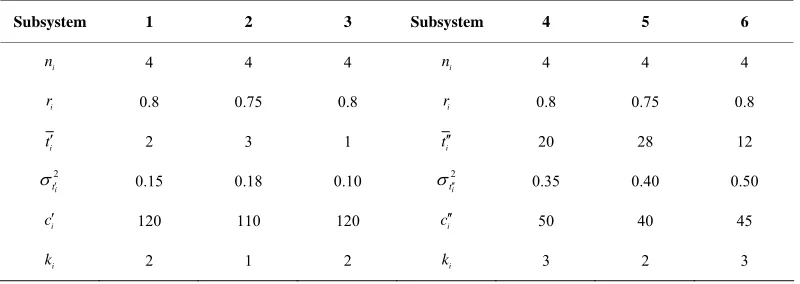
Consider a system having the group X consisting of 3 subsystems and also the group Y consisting of 3 subsys-tems. The available time between two missions for re-pairing and replacing is 80 and 8 time units. The avail-able cost of maintenance for repairing and replacing is for the next mission is 480 and 200 units. The remaining
parameters for the various subsystems are given in Table
1.
Let the chance constraint (4.4) and (4.5) be required to
be satisfied with 99% probability. Then k is such that
. The value of standard normal variate
k 0.99 K
corresponding to 99% confidence limits is 2.33 (by linear interpolation). Thus, the (non-linear programming) prob- lem (B) is obtained as:
1
3
5 6
1
2
1 2
Max 1 1 0.8 1 1 0.75
1 1 0.8 1 1 0.8
1 1 0.75 1 1 0.8
p
p
p p
A t
Subject to
2 2 2
1 2 3 1 2 3
2p 3p p 2.33 0.15p .18p 0.10p 8
4 5 6
2 2 2
4 5 6
20 28 12
2.33 0.35 0.40 0.50 80
p p p
p p p
1 2 3
120p 110p 120p 480
4 5 6
50p 40p 45p 200
1
0 p 2, 0 p21, 0 p32 and 0 p43,
5
0 p 2, 0 p63
and pi 0,i1, 2, , 6 integer
2
4 2
1
p
p
The above nonlinear programming problem repre-sented by, is solved by using LINGO computer program. The optimal Solution obtained after 347 iterations as follows.
1 1, 2 1, 3 1
p p p and p41,p51, p62 with
A t
[image:7.595.99.499.577.719.2]Max 0.9188.
Table 1. The number of failed components and the respective cost and time etc. in the various subsystems.
Subsystem 1 2 3 Subsystem 4 5 6
i
n 4 4 4 ni 4 4 4
i
r 0.8 0.75 0.8 ri 0.8 0.75 0.8
i
t 2 3 1 ti 20 28 12
2
i t
0.15 0.18 0.10 t2i 0.35 0.40 0.50
i
c 120 110 120 ci 50 40 45
i
k 2 1 2 ki 3 2 3
So in subsystem 1, 2 and 3 we replace 1, 1 and 1 components respectively while in the subsystems 4, 5 and 6 we repair and then replace 1, 1 and 2 components respectively.
7. Conclusions
This paper has provided a profound study of the selective maintenance problem for an optimum allocation of re-pairable and replaceable components in system availabil-ity as a problem of non-linear stochastic programming in which we maximize the system availability under the
upper bounds on maintenance (i.e., repair and replace)
time and cost. The maintenance time considered as a random variable and has normal distribution. An equiva-lent deterministic form of the stochastic non-linear pro-gramming problem (SNLPP) is established by using the chance constrained programming problem. Many authors have solved the allocation of repairable component problem. But to solve the above problem with probabil-istic maintenance time will be much more helpful to demonstrate the practically complicated situations related to system maintenance problem.
8. References
[1] W. F. Rice, C. R. Cassady and J. A. Nachlas, “Optimal Maintenance Plans under Limited Maintenance Time,”
Proceedings of the 7th Industrial Engineering Research Conference, Banff, 9-10 May 1998.
[2] C. R. Cassady, E. A. Pohl and W. P. Murdock, “Selective Maintenance Modeling for Industrial Systems,” Journal of Quality in Maintenance Engineering, 2001, Vol. 7, No.
2, pp. 104-117. doi:10.1108/13552510110397412 [3] C. R. Cassady, W. P. Murdock and E. A. Pohl, “Selective
Maintenance for Support Equipment Involving Multiple Maintenance Actions,” European Journal of Operational
Research, Vol. 129, No. 2, 2001, pp. 252-258. doi:10.1016/S0377-2217(00)00222-8
[4] C. R. Cassady, E. A. Pohl and J. Song, “Managing Avail-ability Improvement Efforts with Importance Measures and Optimization,” IMA Journal of Management Mathe-matics, Vol. 15, No. 2, 2004, pp. 161-174.
doi:10.1093/imaman/15.2.161
[5] A. Prekopa, “Stochastic Programming,” Series: Mathe-matics and Its Applications,Kluwer Academic Publishers,
Dordrecht, 1995.
[6] A. Charnes and W. W. Cooper, “Deterministic Equiva-lents for Optimizing and Satisfying under Chance Con-straints,” Operations Research, Vol. 11, No. 1, 1963, pp.
18-39. doi:10.1287/opre.11.1.18
[7] S. S. Rao, “Optimization Theory and Applications,” Wiley Eastern Limited, New Delhi, 1979.
[8] A. Prekopa, “The Use of Stochastic Programming for the Solution of the Some Problems in Statistics and Probabil-ity,” Technical Summary Report #1834, University of Wisconsin-Madison, Mathematical Research Center, Ma- dison, 1978.
[9] S. Uryasev and P. M. Pardalos, “Stochastic Optimization,” Kluwer Academic Publishers, Dordrecht, 2001.
[10] F. Louveaux and J. R. Birge, “Stochastic Integer Pro-gramming: Continuity Stability Rates of Convergence,” In: C. A. Floudas and P. M. Pardalos, Eds., Encyclopedia of Optimization, Vol. 5, Kluwer Academic Publishers,
Dordrecht, 2001, pp. 304-310.
[11] G. B. Dantzig, “Linear Programming under Uncertainty,”
Management Science, Vol. 1, No. 3-4, 1955, pp. 197-206. doi:10.1287/mnsc.1.3-4.197
[12] A. Charnes and W. W. Cooper, “Chance Constrained Programming,” Management Science, Vol. 6, No. 1, 1959,
pp. 73-79. doi:10.1287/mnsc.6.1.73
[13] V. A. Bereznev, “A Stochastic Programming Problem with Probabilistic Constraints,” Engineering Cybernetics,