Chemical signals are important sources of information to aquatic animals since visibility in water is often limited. In contrast to the terrestrial environment (Eisner and Meinwald, 1995), the behavioural significance of these signals in aquatic environments, with few exceptions (e.g. Dulka et al., 1987; Hardege et al., 1998), is largely unexplored (Chivers and Smith, 1998). Chemical communication involves the provision of information by the sender to a receiver and the subsequent use of that information by the receiver in deciding how to respond (Bradbury and Vehrencamp, 1998). An understanding of the information content of a signal and its specific function can be obtained by studying the behavioural context of signal exchange during natural interactions. Here, we introduce a technique for visualising chemical signals in naturally interacting animals. We used this technique to study the significance of chemical signals in dominance fights of crayfish. Crayfish are nocturnal animals with a well-developed sense of olfaction. Previous studies on a variety of crayfish species suggest that chemical signals play an important role in various aspects of their life including courtship, brood care, predator avoidance and agonistic interactions (Ameyaw-Akumfi and Hazlett, 1975; Blake and Hart, 1993; Dunham and Oh, 1992;
Little, 1975; Tierney and Dunham, 1982; Zulandt Schneider and Moore, 2000; Zulandt Schneider et al., 1999). In recent years, their agonistic behaviour has received increasing attention as a model system for the study of mechanisms underlying complex behaviours (Herberholz et al., 2001; Huber and Delago, 1998; Issa et al., 1999; Listerman et al., 2000; Yeh et al., 1997). Crayfish frequently engage in fights over resources. Factors determining fight outcome include size, sex, past experience and who initiates the fight (Bovbjerg, 1956; Guiasu and Dunham, 1997; Issa et al., 1999; Rubenstein and Hazlett, 1974; Scrivener, 1971; Sinclair, 1977). Fights between size-matched individuals are longer and escalate in aggression from simple approach to displays such as meral spreading (a threat display) and finally to potentially damaging behaviours such as claw ripping (Bruski and Dunham, 1987; Huber and Delago, 1998). Male crayfish (Procambarus clarkii,
Orconectes virilis) also show meral spreading when exposed
to tank water from male conspecifics, suggesting that chemical signals may play a role in agonistic interactions (Ameyaw-Akumfi and Hazlett, 1975; Dunham and Oh, 1992; Hazlett, 1985). However, the source of the chemical signal and its specific function remain unclear.
JEB3861
Chemical communication is a widespread phenomenon in aquatic animals but is difficult to investigate because the signals are not visible. Here, we present the results of a study into chemical communication in blindfolded fighting crayfish (Astacus leptodactylus) in which we employed a new method: visualisation of urine using the dye Fluorescein. The probability of urine release is greater during fights than during non-social activities or inactivity. The eventual winners are more likely to release urine during fights than the eventual losers. In both winners and losers, urine release is coupled to offensive behaviours, and the probability of urine release increases with increasing levels of aggression. In A. leptodactylus, urine is carried to the opponent by the forward-projecting gill currents. During spontaneous release, urine is fanned laterally with the aid of the exopodites of the maxillipeds. Aggressive behaviour is effective in intimidating
blindfolded opponents only in conjunction with urine release: receivers decrease offensive behaviour and increase defensive behaviour. Aggressive behaviour alone does not intimidate opponents. The loser of a recent fight is deterred equally well by a familiar and an unfamiliar opponent. Hence, in crayfish, individual recognition of the urine scent of a dominant individual does not appear to be significant for the maintenance of dominance hierarchies. Our results suggest that urine contains information about the fighting ability and/or aggressiveness of the signaller. The chemical signals thus far unidentified appear to be important in determining the outcome of a fight.
Key words: urine, visualisation technique, chemical signal, olfaction, dominance, fighting, Decapoda, Crustacea, Astacus leptodactylus, crayfish.
Summary
Introduction
Urine makes the difference: chemical communication in fighting crayfish made
visible
Thomas Breithaupt* and Petra Eger
Fakultät für Biologie, Universität Konstanz, Postfach 5560 (M618), D-78457 Konstanz, Germany *Present address: Department of Biological Sciences, University of Hull, Hull HU6 7RX, UK (e-mail: [email protected])
In other decapod crustaceans (lobsters, green crabs and blue crabs), the chemical signals are mostly urine-borne and elicit specific responses that are different in males and females (Atema and Cowan, 1986; Bamber and Naylor, 1997; Christofferson, 1978; Eales, 1974; Gleeson, 1991). In lobsters, catheters consisting of flexible plastic tubing attached to the nephropores were used to monitor urine release (Breithaupt et al., 1999) and demonstrated the important role of urine signals in the maintenance of dominance hierarchies (Breithaupt et al., 1999; Karavanich and Atema, 1998b). Dominance is (at least in part) based on the loser’s olfactory recognition of the individual composition of the urine of their previous winners (Karavanich and Atema, 1998a). In addition to individual signatures, lobster urine contains signal components indicating dominance status (Bushmann and Atema, 2000). In lobsters, urine signalling is limited to offensive behaviours and increases with increasing levels of aggression (Breithaupt and Atema, 2000). However, the use of catheters prevents the transmission of urine to the opponent. These studies on lobsters could not therefore reveal whether urine signals have an immediate effect on the behaviour of the receiver during the fight.
We were interested to know whether crayfish employ urine as an aggressive signal and whether urine signals elicit a response from the receiver during the fight. We were also interested in the message conveyed by urine signals. Does urine contain information about the identity of the signaller? Does it reveal the aggressive motivation of the signaller?
Crayfish aggressive interactions were studied in size-matched male Astacus leptodactylus. The animals were reversibly blindfolded to prevent responses to the visual occurrence of the dye that was used to visualise urine release.
Materials and methods
Animals
Crayfish (Procambarus clarkii, Astacus leptodactylus,
Astacus astacus, Astropotamobis torrentium, Pacifastacus leniusculus and Orconectes limosus) were obtained from local
crayfish dealers (Simon Phillipson, Ravensburg, Germany; Max Keller, Augsburg, Germany) or cultured in the laboratory (Procambarus clarkii only). They were kept in communal tanks containing approximately 30 animals with a continuous flow-through of Lake Constance water.
To study dominance interactions, we used intermoult males of Astacus leptodactylus (carapace length 40–50 mm, mass 50–90 g) with intact appendages. After marking them individually, we kept the crayfish in four 250 l tanks containing up to 20 animals. The four groups were separated for more than 2 weeks to reduce the chance of individual memory being developed between individuals from different tanks [Karavanich and Atema (1998a) showed that such memory does not last 2 weeks in lobsters]. Seventy-two hours before the fight, individual crayfish were separated and placed in 20 l aquaria at 16 °C. Prior to isolation, they were blindfolded by wrapping opaque tape around the eyestalks and rostrum and
fixing the tape to the carapace with cyanoacrylate glue. The blindfold served to exclude possible reactions to visual disturbances including those associated with the release of Fluorescein from the nephropores.
To eliminate the influence of body size on the intensity and outcome of a fight, the opponents were size-matched (carapace length differences less than 5 %, chelae length differences less than 6 %) [for the effect of size differences on lobster fights, see Scrivener (1971)]. Combatants were taken from separate communal tanks, thus ensuring that they could not remember the opponent from previous encounters (Karavanich and Atema, 1998a).
Urine visualisation technique
We tried several methods (oral application, injection into muscles and heart) of administering four dyes (Methylene Blue, Indigo Carmine, Phenol Red and sodium Fluorescein; Merck KGaA, Darmstadt, Germany). Of these, only injection of Fluorescein into the bloodstream worked reliably.
A solution of 0.1 % sodium Fluorescein dissolved in crayfish saline (Van Harrefeld and Verwey, 1936) was injected at a dose of 2–6µg g–1body mass into the heart/pericardium region of the crayfish approximately one-third of a carapace length rostral to the caudal edge of the carapace. The dye was injected using a 250µl glass syringe (Unimetrics Corp, Folsom, Germany) and 45-gauge needle (Luer-Lok 0.45 mm×13 mm; B. Braun, Melsungen, Germany). After injection, the hole in the carapace was quickly sealed with beeswax and tape to avoid loss of haemolymph. Release of dye was observed starting 30–60 min after injection (Fig. 1). Close-up video recordings of the frontal area of crayfish (Astacus leptodactylus and Procambarus clarkii) confirmed that the dye was released from the nephropore. Dye was released intermittently over the next 4–8 h. Dye release occurred after feeding, after social contact or spontaneously. The technique was successful in visualising urine in almost all individuals of the species tested: 20 Procambarus clarkii, 48 Astacus leptodactylus, two Astacus
astacus, eight Astropotamobis torrentium, two Pacifastacus leniusculus and two Orconectes limosus. Four small crayfish
(Procambarus clarkii, 9 g body mass) died after receiving a high dose (6µg g–1) of Fluorescein. Lower concentrations caused no obvious damage.
General procedure for fights
acclimation period by lifting a polyvinylchloride divider that had separated the animals. In eight cases, urine release was recorded for 60 min prior to lifting the divider. Interactions were recorded for 30 min. To discriminate between effects caused by individual or by dominance recognition, we conducted repeated fights with either familiar or unfamiliar opponents.
Fights against familiar opponents (24 fights)
Two consecutive fights were initiated between the same pairs of crayfish (24 fights). The loser of the first fight was re-matched with the winner of the previous fight after a 24 h isolation period.
Fights against unfamiliar opponent (36 fights)
The losers of initial fights (N=18) were re-matched (after 24 or 48 h of isolation) against unfamiliar dominants that had previously won one (N=12 of which seven were without Fluorescein injection) or two (N=6) fights.
Analysis of fights and of urine release during fights
The visualisation technique allowed us to analyse the probability of urine release during the fight but not the volume of urine released. During each 5 s interval, we noted whether or not stained urine was released and whether the anterior body appendages (maxillipeds and antennules) were active. During each interval, we also assigned both crayfish an agonistic level (Table 1) (see also Atema and Voigt, 1995; Breithaupt and Atema, 2000). When we detected more than one agonistic level within one time interval, we declared on overall level for that interval on the basis of the following ranking: agonistic levels 5, 4 and 3 outranked (>) levels 2, 1, 0, –1 and –2; level 5>4>3>2>1; level –2 outranked level –1, and both levels –2 and –1 outranked levels 2, 1 and 0. We analysed only sequences in which animals fought (bouts) and/or released urine including an additional 10 s before and 10 s after the episode.
To analyse the duration of repeated fights between familiar and unfamiliar opponents, we evaluated only those combats in which the first fight exceeded 1 min and contained a bout that was longer than 45 s. Similarly, to evaluate the risk and effectiveness of urine signals, we included only bouts that exceeded 30 s. These criteria excluded from analysis those fights in which the loser provided little resistance.
Lag sequential analysis
This analysis identifies non-random sequences of behaviour occurring during social interactions (Sacket, 1979; Waas, 1991b). Changes in the relative frequency of selected behaviours are quantified following a behaviour of interest (‘criterion’). We used this analysis to identify changes in the behaviour of the receiver caused by the chemical signal of the sender (‘effectiveness of the urine signal’) and in the behaviour of the sender following its signal (‘predictive value of the signal’).
Analysis of the effectiveness of the urine signal
We selected two criteria and analysed differences in the response to these criteria: (a) ‘offensive urine release’, offensive behaviour (agonistic levels 2–5) accompanied by urine release; (b) ‘offensive behaviour’, offensive behaviour
Fig. 1. Astacus leptodactylus (carapace length 45 mm) releasing a plume of urine made visible by intra-vascular injection of Fluorescein.
Table 1. Definition of agonistic levels
Agonistic
level Description Behavioural elements
−2 Fleeing Fast walking backwards, fast walking away, tail-flipping
−1 Avoidance Walking backwards slowly, walking away slowly, turning away from opponent
0 No activity Separate and no activity
A Activity Separate and walking
1 No physical contact (within 1 body length) Approaching opponent, turning towards opponent, following opponent 2 No physical contact (threat display) High on legs, meral spreading
3 Physical contact (claws not used to grasp) Antenna touching, antenna whipping, claw touching, claw pushing, claw boxing, claw tapping
4 Physical contact (claws used to grasp) Clamping of chela(e) onto opponents body 5 Unrestrained use of claws Claw snapping, claw ripping
[image:3.612.49.301.71.266.2] [image:3.612.56.560.568.712.2]without urine release. For these criteria, we determined (in a data set comprising 40 fights and 36 individuals) the frequency of the opponent’s defensive (levels –2 and –1), neutral (levels 0, A) and offensive (levels 1–5) behavioural acts in the current time intervals (lag 0) and in the time intervals preceding (lag –1) and following (lag 1, lag 2) the criteria. Differences in the relative frequency of defensive, neutral or offensive behaviour in the subsequent intervals compared with the preceding interval were used as a measure of the change in response to the opponent’s signal. For a valid application of parametric analysis to our data, relative frequencies were arcsine-transformed (Zar, 1999) to meet the assumption of normal distribution. A multivariate analysis of variance (ANOVA) was used to identify those behavioural changes in the eventual loser that were significantly affected by offensive urine release by the eventual winner compared with offensive behaviour without urine release. Since we found no effect of crayfish identity on the behavioural response, we pooled the data of all 36 animals for the analysis.
Analysis of the predictive value of urine signals
We selected four criteria and analysed changes in the behaviour of the actor following these criteria: agonistic levels 2 and 3 with urine release (criteria A and B respectively) and without urine release (criteria C and D respectively). We then compared the relative frequency of behavioural acts of higher, the same or lower agonistic level in the subsequent time interval (lag 1, lag 2) with the agonistic level of the respective criterion (lag 0). We analysed differences in the response to the two criteria using a multivariate ANOVA.
Other statistical procedures
We used parametric statistics (multi-way ANOVA, repeated-measure design) (Zar, 1999) to test for possible differences in urine release between winners and losers and also for the effect of ‘experience’ on urine release. A measure of urine output was derived for each combatant from the proportion (%) of total time of urine release in each 30 min interaction. Proportions were arcsine-transformed to meet the requirements for parametric statistics.
Logistic regression analysis of the original data set was used to analyse the dependence between urine release probability and agonistic levels (Breithaupt and Atema, 2000). Previous urine release can influence probability of current urine output. Therefore, individual data points adjacent in time are not independent of each other. For example, when urine is released from a filled bladder, the release would be expected to last longer than 5 s. To take this autocorrelation into account, we included time-lagged series of the urine release data as independent variables in the analysis. We allowed for variations among individuals by including crayfish identity. Probabilities attributing to agonistic levels (see Fig. 3) were calculated from parameter estimates of the logistic regression analysis. The logistic regression analysis also tested for significant differences of these parameter estimates from the mean overall agonistic levels.
Multivariate ANOVA (Zar, 1999) was used to test for differences in the use of the anterior body appendages (maxillipeds) between offensive and spontaneous urine release. For each 30 min interaction, we calculated (i) the proportion of time that appendage movements accompanied urine release during fights and (ii) the proportion of time that appendage movements occurred during spontaneous urine release. For the test, we used arcsine-transformed proportions. Since we found no effect of crayfish identity (i.e. no individual differences among animals) on the behavioural response, we pooled the data from all animals for the analysis.
All statistical analyses were performed with JMP 4.02 (SAS Institute). We used the standard error of the mean (S.E.M.) to indicate deviations from the mean.
Results
The agonistic context of urine release
We analysed 60 interactions between male Astacus
leptodactylus involving 43 blindfolded individuals. Blindfolding did not appear to alter the fighting behaviour of crayfish as they displayed all elements of agonistic behaviour previously described in other crayfish species, e.g. Orconectes
rusticus (Bruski and Dunham, 1987) and Astacus astacus
(Goessmann et al., 2000; Huber and Delago, 1998). During the 30 min observation period, we generally observed several bouts of interactions (Fig. 2). Bouts started with one of the two crayfish approaching the other (agonistic level 1) and ended when one of the animals (the bout loser) retreated (agonistic levels –1 or –2) and did not exceed agonistic level 2 in the subsequent 15 s. An animal was considered a loser of the fight if it retreated (level –1) or escaped (–2) at the end of a bout and did not win any following bout within the 30 min observation period.
winners and losers, the probability of urine release increased with increasing levels of offensive behaviour (levels 1–5; Fig. 4C,D). In losers, urine was rarely released during defensive behaviour (Fig. 4D). Winners, in contrast, released urine in 12 % (level –1) and 38 % (level –2) of defensive behaviours (Fig. 4D). Since winners only rarely exhibited defensive behaviour (on average only 3 s per fight at level –1 and 1.3 s at level –2; Fig. 4A) and always showed offensive behaviours thereafter, these retreats and escapes of the winner may be interpreted as tactical offensive manoeuvres (e.g. repositioning) rather than as defensive acts.
During agonistic interactions of Astacus leptodactylus, urine was directed towards the opponent, probably carried by the gill currents (Atema, 1985). The direction of urine signals changed when urine was released spontaneously. Fanning activity of the flagella of the mouthparts (the exopodites of the three maxillipeds) (Breithaupt, 2001) directed the urine stream laterally. Fanning occurred almost exclusively during spontaneous release but rarely during offensive urine release (Fig. 5). Spontaneous urine release was further accompanied by flicking and downward-pointing of the antennules (the chemosensory appendages of crustaceans) (Fig. 5). These behaviours have been interpreted as enhancing olfaction in crustaceans (Schmitt and Ache, 1979). They rarely occurred during fights (Figs 2, 5). Offensive urine release was accompanied by upward extension of the large endopodites of the third maxillipeds, which then covered the exopodites, thus inactivating and protecting the fan organs (Figs 2, 5).
Fight duration for familiar and unfamiliar combatants
Previous studies (Breithaupt and Atema, 2000; Karavanich and Atema, 1998a,b) on lobsters suggested that a subordinate animal recognising the individual urine scent of a familiar dominant individual maintains dominance and avoids escalated fights. The evidence for this interpretation was that, between
AF MX –2 –10 A1 2 3 4 5
Lift divider
10 20 30 40
UR
Loser
AD
Time (min) ADAF
MX –2 –10 A 1 2 3 4 5
UR
Winner
B
eha
vi
o
u
r
B
eha
vi
o
u
[image:5.612.202.566.74.382.2]r
Fig. 2. Time course of agonistic behaviours (levels –2 to 5; see Materials and methods), of urine release (UR) and of the activity of anterior appendages (MX, maxilliped endopodites extended upwards; AF, antennule flicking; AD, antennules pointing downwards) during a fight. Behaviour was recorded at 5 s intervals. Only intervals in which animals fought and/or released urine are shown. The ethograms of the eventual winner (upper trace) and the eventual loser (lower trace) show four bouts of interactions. Positive agonistic levels denote offensive behaviours; negative agonistic levels denote defensive behaviours (see Table 1). Level A denotes activity at some distance from the opponent. Level 0 denotes no activity. The vertical broken line indicates lifting of the divider screen that separated the animals.
First fight Second fight Third fight Spont. 0
10 20 30 40
*
**
U
ri
ne
r
el
ea
se
(%
o
f t
o
tal
ti
m
e)
Winner Loser
[image:5.612.330.556.486.626.2]familiar lobsters, but not between unfamiliar lobsters, second fights are generally shorter and less aggressive than first fights (Karavanich and Atema, 1998a). We measured fight duration in crayfish as the sum of the duration of individual bouts. Fights between familiar opponents decreased significantly in duration from 263±32.7 s in the first encounter to 135±40 s in the second encounter on another day (means ±S.E.M.; N=10;
P<0.01, paired t-test). Even if paired with an unfamiliar
opponent, the loser of a previous day’s fight gave up earlier: second fights were significantly shorter (68.5±8.2 s) than first fights (205.5±32.2 s; N=10; P<0.01, paired t-test). We found no difference in duration of either first or second fights between familiar and unfamiliar crayfish (P=0.88; two-way ANOVA). This suggests that there is no individual recognition or that recognition is not a significant factor for the avoidance of repeated fights in the crayfish Astacus leptodactylus.
The effectiveness and predictive value of urine signals
We analysed changes in the relative frequency of agonistic
behaviours of both the signaller and the receiver in response to urine release and offensive behaviours (see Lag sequential
analysis) to determine (i) the effect of offensive urine release
(i.e. offensive behaviour accompanied by urine release) on the agonistic behaviour of the opponent (effectiveness of urine signals) and (ii) whether offensive urine release had any predictive value about the next act of the signaller that could inform the receiver about the offensive intention of the signaller.
0 50 100 150 200
250
A
B
D
C
T
ime
per
f
ight
(s)
–2 –1 0 1 2 3 4 5 –2 –1 0 1 2 3 4 5
0 0.2 0.4 0.6 0.8
**
**
*
**
**
Winner Loser
U
ri
n
e
re
le
ase
pr
o
bab
il
it
y,
P
Agonistic level
**
**
**
*
**
**
Maxilliped up Exopodite fanning Antennule flick Antennule down
0 50 100
**
**
**
**
Time during urine release (%) Fight Spontaneous
[image:6.612.274.563.74.295.2]Fig. 5. Mean probability (+1 S.E.M., N=39 fights) of activities of antennules and mouthparts accompanying spontaneous urine release and urine release during fights. Activities differed between the two release conditions (**P<0.01; multivariate ANOVA).
Fig. 4. Duration of different agonistic levels per fight (A,B) and probabilities (P) of urine release at these levels (C,D) in winners (A,C) and losers (B,D). Values are means +1 S.E.M. for 39 fights. Asterisks denote significant differences with respect to the mean probability over all agonistic levels (*P<0.05, **P<0.01; logistic regression analysis). Probabilities at level 0 and 1 are generally lower, while those of levels 3–5 are higher, than the mean probability of urine release as estimated by the logistic model. At levels –2 and –1, probabilities are smaller than the mean only in losers.
–15 –10 -5 0 5 10 15
Response to offensive behaviour (O) Response to urine release (O+U)
O O+U O O+U
C
han
g
e in re
cei
v
er
’s beha
viour (
%
)
Defensive levels –2, –1
Offensive levels 1–5
**
**
O O+U
[image:6.612.63.273.559.690.2]Neutral levels 0, A
Effectiveness of offensive urine release
We compared the relative frequency of the receiver’s agonistic levels concurrent with offensive behavioural acts and urine release by the signaller with the receiver’s preceding behaviour. The frequency of defensive behavioural acts (levels –1 and –2) by the receiver increased by more than 10 % and offensive behavioural acts (levels 1–5) decreased in response to offensive behaviour by the signaller accompanied by urine release (Fig. 6, open columns). No change in offensive or defensive behaviour by the receiver was recorded in response to offensive behaviour by the signaller not accompanied by urine release (filled columns). Neutral behaviour by the receiver remained unchanged under all conditions. The response lasted for at least 15 s, as inferred from analysis including subsequent time intervals (5 s delay, 10 s delay). Hence, urine signals were effective in reducing the aggression of the opponent.
Predictive value of offensive urine release
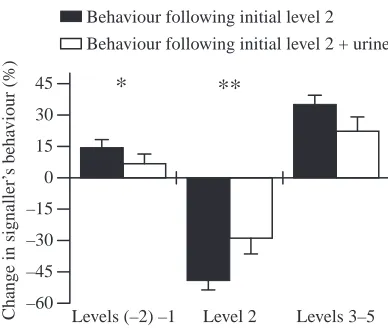
Urine release could be a threat signal if, subsequent to release, the signaller increased its aggression level, leading to an increased risk of injury for the opponent. We studied changes in the relative frequency of agonistic behaviours following an initial low-level offensive behaviour with or without urine release (initial level 2, see Fig. 7; initial level 3, data not shown). This was to investigate whether urine release in conjunction with offensive behaviour provides predictable information about the subsequent activities of the signaller and if this differed from that of offensive behaviour without urine release. We determined the relative frequency of behavioural acts of higher (levels 3, 4 or 5), the same (level 2 or 3) or lower (<level 2 or 3) agonistic level in the subsequent time intervals (lag 1, lag 2). We compared these frequencies with those of behaviours concurrent with the respective criterion (lag 0). After having performed level 2 aggression, the animals showed agonistic levels higher than the initial level more frequently than lower agonistic levels (P<0.01, contrast analysis, multivariate ANOVA, Fig. 7). Following initial level 3, lower levels occurred more frequently than higher levels (P<0.01; data not shown). Urine release concurrent with level 2 or 3 aggression reduced the agonistic level of subsequent behaviours to the initial level or to lower than the initial level (Fig. 7). However, it did not influence the likelihood of fight escalation (i.e. the frequency of higher agonistic levels). Therefore, offensive urine release does not reveal the intention of the signaller to escalate the fight.
Discussion
Our newly developed technique of urine visualisation allowed us to study the behaviours of both the sender and receiver of chemical signals during agonistic interactions in the crayfish Astacus leptodactylus. The technique was also successful in visualizing urine release in the other species tested (Astacus astacus, Pacifastacus leniusculus,
Astropotamobis torrentium, Procambarus clarkii and
Orconectes limosus). Behavioural analysis showed that urine
signals play a significant role in settling fights in blindfolded crayfish (Astacus leptodactylus).
Contradictory findings about the use of pheromones in mate attraction and agonistic behaviours have generated a debate about the significance of pheromones in crayfish (Hazlett, 1984; Thorp, 1984). Itagaki and Thorp concluded from their studies of Procambarus clarkii that crayfish do not communicate their sex or agonistic state chemically (Itagaki and Thorp, 1981; Thorp, 1984; Thorp and Itagaki, 1982).
Using lag sequential analysis, we identified non-random sequences of behaviour during the social interactions. This analysis revealed that urine signals make offensive behaviours more effective in reducing an opponent’s aggressiveness. The relative frequency of the opponent’s defensive behaviours is increased at the expense of its offensive behaviours (Fig. 6). Offensive behaviour without urine signals does not change the behaviour of the opponent (Fig. 6). Hence, chemical signals appear to be more important than other offensive displays and signals for settling a fight, at least under visual blackout conditions. In our experiments, the animals were blindfolded to avoid reactions to the visual image of the Fluorescein cloud. Blindfolding the animals may have changed their fighting behaviour. Indeed, Bruski and Dunham (1987) found, by comparing fights of Orconectes rusticus in the light and in the dark, that the duration of individual bouts and the frequency of highly aggressive behaviours (corresponding to our levels 3–5) are increased in the dark while the frequency of visual threat displays remains unchanged. Thus, crayfish may need to fight longer and more vehemently to settle a fight when they cannot see each other. Blocking the release of urine in visually intact
–60 –45 –30 –15 0 15 30 45
Behaviour following initial level 2 Behaviour following initial level 2 + urine
C
hange in
signaller
’s
b
eha
viour
(%)
Levels (–2) –1 Level 2
**
*
[image:7.612.347.541.70.234.2]Levels 3–5
Orconectes rusticus had a similar effect: it increased both the
duration and the intensity of fights (Zulandt Schneider et al., 2001). This suggests that, in daylight, urine signals play a similarly important role as they do in the dark in reducing the aggression of the receiver. In summary, these studies indicate that, despite previous doubts about their behavioural significance in crayfish (Itagaki and Thorp, 1981; Thorp, 1984; Thorp and Itagaki, 1982), chemical signals have a major impact on the outcome of fights that equal the effects of visual signals in the daytime and dominate other signals at night. Moreover, as nocturnal animals, crayfish might rely more strongly on chemical than on visual cues for settling fights.
What is communicated by urine signals?
Urine appears to be a threat signal because it is effective in deterring the opponent (Fig. 6). Does the signal reveal information about subsequent activities? Previous studies of bird agonistic interactions and accompanying cost/benefit models indicate that the effectiveness of aggressive displays (i.e. in deterring opponents) correlates with the risk of performing this display (the risk of being injured by one’s opponent) (Enquist, 1985; Enquist et al., 1985; Popp, 1987; Waas, 1991a,b). This ‘risk/benefit’ approach suggests that an animal reveals a strong motivation to escalate a fight by using a display that places both itself and its opponent in a potentially dangerous situation. Such displays appear to contain information about the subsequent activities of the signaller.
In accordance with these predictions, we found that the signaller increased its aggression level (i.e. increased risk) following agonistic level 2 (‘threat display’, Fig. 7). However, we found that it reduced its aggression after agonistic level 3. Urine signals accompanying aggressive behaviour did not alter the likelihood of escalation. The predictive value of urine signals is therefore low and cannot be responsible for the reaction of the opponent.
Alternatively, urine signals may allow the receiver to assess the current physiological and aggressive states of the signaller. Urine signals contain metabolic breakdown products of the hormones that are effective during fighting behaviour. There is evidence that in decapod crustaceans aggression may be modulated by hormones such as serotonin, octopamine and dopamine (Antonsen and Paul, 1997; Huber and Delago, 1998; Huber et al., 1997; Kravitz, 2000; Sneddon et al., 2000). Injection of the biogenic amines into the haemolymph results, in the American lobster (Homarus americanus), in the squat lobster (Munida quadrispina) and in crayfish (Astacus astacus,
Procambarus clarkii), in agonistic postures and in changes in
agonistic behaviours (Antonsen and Paul, 1997; Huber et al., 1997; Livingstone et al., 1980). The relative levels of serotonin, octopamine and dopamine in the blood of the shore crab Carcinus maenas appear to be linked to fighting ability (Sneddon et al., 2000). Although the specific role of some biogenic amines (e.g. serotonin) in settling conflicts under natural conditions is still controversial (Peeke et al., 2000), their general impact on the aggressive motivation of crustaceans is undisputed. Since the metabolites of biogenic
amines are found in the excretory green gland and in the urine of crayfish and lobsters (Hoeger, 1990; Huber et al., 1997), this information about aggressive state is provided to the receiver by the release of urine.
Like lobsters (Breithaupt and Atema, 2000), crayfish couple the release of urine to offensive behaviours (Fig. 3), thereby reinforcing the message of the aggressive acts. This combination adds reliability to the chemical message for the receiver. ‘Dishonest signallers’ that cannot back up their chemical signals with physical aggressive acts may not be effective in deterring an opponent and may suffer from the escalated fight. Conversely, offensive behaviour alone was not effective in deterring the opponent when not accompanied by the chemical message (Fig. 6). A positive winning experience or maintained fighting motivation may result in a specific mixture of hormone metabolites that is broadcast with the release of urine.
Possible information about the individual identity of the signaller is either not present in the urine or does not seem to be a significant factor in crayfish fights. In contrast, Karavanich and Atema (1998a,b) found that in lobsters dominance is maintained by individual recognition of the urine scent of familiar dominant individuals. In the crayfish Astacus
leptodactylus, we found no difference in duration between
familiar and unfamiliar fights, suggesting that subordinate animals do not recognise the individual identity of previous winners. Similar results were obtained from Orconectes
rusticus (Zulandt Schneider et al., 2001). Therefore, individual
recognition of previously fought dominant individuals does not seem to be responsible for the observed reactions of the opponent to urine signals.
To understand why urine messages are so successful in deterring an opponent, further studies on the chemical composition of urine and the behavioural significance of specific components are needed to verify that they contain information about the physiological and, thus, aggressive state of the signaller.
When is the best time to send urine signals?
frequently – on average only every third hour (Breithaupt et al., 1999). In the presence of a conspecific, crayfish release urine more frequently but restrict the release to physical interactions and rarely release it spontaneously. They link it to offensive behaviours and increase the release rate with increasing aggression.
Storing urine in a bladder prevents it from leaking into the environment and providing nearby receivers with information about the motivational state of the sender. The bladder allows urine to be released voluntarily at times favourable to the sender. Recent theories and studies of animal communication (for a review, see Bradbury and Vehrencamp, 1998) have shown that receivers are sceptical and only respond to signals that are reliable (Grafen, 1990; Zahavi and Zahavi, 1997). Honesty can be ensured by the costs of signalling, e.g. the incidental costs when a dishonest signaller suffers from the increased aggression of the receiver (Enquist et al., 1985; Popp, 1987). Breithaupt and Atema (2000) suggest that, by coupling urine release to offensive behaviours and increasing urine release rate with increasing level of aggression, lobsters add reliability to the chemical signal. Our study shows that crayfish use the same strategy as lobsters. Reliability of aggressive chemical signals is ensured by releasing urine under the increased risk of being injured during the fight.
By restricting urine release to offensive behaviours, crayfish also optimise the detectability of the chemical signal. During offensive behaviours, animals are in close proximity, often facing each other, and the urine signals are directed at the antennal chemoreceptors of the opponent, providing an increased signal-to-noise ratio with respect to other ambient chemicals.
How are urine signals transported towards the opponent?
Observations of the Fluorescein dispersal pattern during fights showed that urine is transported frontally towards the opponent (T. Breithaupt and P. Eger, personal observation). The narrow-clawed crayfish Astacus leptodactylus seems to employ forward-directed gill currents for chemical signalling during fights. The fan organs are not active during agonistic interactions (Fig. 5). Other crayfish species, e.g. the red swamp crayfish (Procambarus clarkii) and the cambarid crayfish
Orconectes limosus, use the fan organs (exopodites of the
mouthparts) and not the gill currents to carry urine signals towards an opponent (T. Breithaupt and P. Eger, unpublished data) (Breithaupt, 2001). In contrast to the urine released during fights, urine released spontaneously is carried laterally by fanning the exopodites of the mouthparts (Fig. 5) (Breithaupt, 2001). These findings reveal that crayfish actively use their own currents to disperse chemical signals and that they can either send them towards a receiver or ‘hide’ them from a receiver. The mechanisms of urine dispersal are similar in lobsters (Atema, 1985) (T. Breithaupt, unpublished data). Using either the gill currents or the currents generated by fan organs, urine is most effectively carried to the chemoreceptors on the first antennae of the opponent. The active transport of urine signals between closely spaced crayfish by water currents may even
allow communication in a river because the currents may prevent urine from being carried away by the surrounding flow.
Are chemical signals important for the maintenance of dominance hierarchies in crayfish?
Our finding that offensive behaviour is only effective in discouraging an opponent when accompanied by urine release clearly shows that urine signals are important in establishing dominance. Are they also important in maintaining dominance hierarchies? Second fights between both familiar and unfamiliar animals were found to be up to 50 % shorter than first fights, indicating that dominance is maintained in crayfish. In lobsters, individual recognition is important for the maintenance of dominance hierarchies (Karavanich and Atema, 1998a). In contrast to lobsters, crayfish do not seem to recognise the identity of previous opponents. If identity is not recognised, they may recognise the general dominance status or aggressive state of an opponent, as suggested by (Copp, 1986) and described for cockroaches (Moore et al., 1997). If chemical signals are important for the maintenance of the dominance hierarchies in crayfish, we would expect dominant animals to increase their rate of signalling in repeated fights in order to be recognised by subordinates and to avoid the risks associated with extended fights. Our data do not support this proposal because the probability of urine release did not increase, but instead dropped, in repeated fights (Fig. 3). Blocking urine release in Orconectes rusticus did not affect the duration of second fights (Zulandt Schneider et al., 2001). Irrespective of urine signals, dominance was maintained in this species. These findings in Astacus leptodactylus and Orconectes rusticus suggest that urine signals are not important for the maintenance of dominance hierarchies in crayfish. Other mechanisms, e.g. self-reinforcing effects of fight success (Goessmann et al., 2000), may be more important than chemical signals for maintaining dominance hierarchies in crayfish.
of residency may be key factors determining the mechanism of maintaining dominance in animal communities.
Why do crayfish employ chemical signals in fights?
Our study shows that chemical signals released during offensive behaviour are effective in reducing the aggression of an opponent. Non-chemical offensive behaviours are not effective in changing the behaviour of an opponent. This raises questions about the adaptive value of the urine signals during fights. Why do visual and tactile agonistic manoeuvres alone have no greater impact on the course of the fight? The answer to this question may be that urine signals provide ‘uncheatable’ information about the aggressive motivation of the signaller. This information may serve as a back-up providing honesty where other signals may cheat. Mantis shrimps when newly moulted were found to bluff opponents by producing meral spreading displays, even though their soft cuticle prevented them from either delivering or withstanding blows (Adams and Caldwell, 1990). The metabolic products of moulting hormones detected by a receiver would betray the bluff. Similarly, breakdown products of other hormones may inform a receiver about aggressive state, arousal, sex and species. Zulandt Schneider et al. (1999) found that the odour of dominant Procambarus clarkii attracted males and females but elicited aggressive reactions only in males.
Chemical signals appear to play a major role during nocturnal interactions between crayfish. In the natural environment, dominance fights can secure access to and defence of shelters (Vorburger and Ribi, 1999). Shelters are important resources for crayfish since they significantly reduce predation risk (Söderbäck, 1994). During nocturnal shelter competitions, chemical signals may gradually replace visual signals or even tactile displays when visual conditions are poor or when the resident animal is hidden in the shelter. In crayfish, aggressive behaviour occurs not only within but also between sympatric species (Vorburger and Ribi, 1999). It remains to be determined whether different crayfish species use the same chemical components for aggressive signalling and how these components relate to the internal state of the signaller. The exploration of the chemical nature of aggressive signal promises insight into these still unsolved questions of crustacean agonistic behaviour.
We would like to thank Willi Nagl (University of Konstanz, Germany) for statistical advice, Kirsten Pohlmann, Dr Jörg Hardege and Professor Dr Jelle Atema for helpful suggestions on a previous version of the manuscript and the University of Konstanz for financial support (FP 13/97). The protocol was approved by the German Ethics Commission, Regierungspräsidium Freiburg (A-00/01).
References
Abrahamsson, S. A. A. (1966). Dynamics of an isolated population of the crayfish Astacus astacus Linné. Oikos 17, 96–107.
Adams, E. S. and Caldwell, R. L. (1990). Deceptive communication in asymmetric fights of the stomatopod crustacean Gonodactylus bredini. Anim. Behav. 39, 706–716.
Ameyaw-Akumfi, C. and Hazlett, B. A. (1975). Sex recognition in the crayfish Procambarus clarkii. Science 190, 1225–1226.
Antonsen, B. L. and Paul, D. H. (1997). Serotonin and octopamine elicit stereotypical agonistic behaviors in the squat lobster Munida quadrispina (Anomura, Galatheidae). J. Comp. Physiol. A 181, 501–510.
Atema, J. (1985). Chemoreception in the sea: adaptations of chemoreceptors and behaviour to aquatic stimulus conditions. Symp. Soc. Exp. Biol. 39, 386–423.
Atema, J. and Cowan, D. F. (1986). Sex-identifying urine and molt signals in lobster (Homarus americanus). J. Chem. Ecol. 12, 2065–2080. Atema, J. and Voigt, R. (1995). Behavior and sensory biology. In Biology of
the Lobster Homarus americanus (ed. J. R. Factor), pp. 313–348. New York: Academic Press, Inc.
Bamber, S. D. and Naylor, E. (1997). Sites of release of putative sex pheromone and sexual behaviour in female Carcinus maenas (Crustacea: Decapoda). Estuarine Coastal Sci. 44, 195–202.
Blake, M. A. and Hart, P. J. B. (1993). The behavioural responses of juvenile signal crayfish Pacifastacus leniusculus to stimuli from perch and eels. Freshwater Biol. 29, 89–97.
Bovbjerg, R. V. (1956). Some factors affecting aggressive behavior in crayfish. Physiol. Zool. 29, 127–136.
Bradbury, J. W. and Vehrencamp, S. L. (1998). Principles of Animal Communication. Sunderland, MA: Sinauer Associates, Inc., Publishers. 944pp.
Breithaupt, T. (2001). The fan organs of crayfish enhance chemical information flow. Biol. Bull. 200, 150–154.
Breithaupt, T. and Atema, J. (2000). The timing of chemical signaling with urine in dominance fights of male lobsters (Homarus americanus). Behav. Ecol. Sociobiol. 49, 67–78.
Breithaupt, T., Lindstrom, D. P. and Atema, J. (1999). Urine release in freely moving catheterised lobsters (Homarus americanus) with reference to feeding and social activities. J. Exp. Biol. 202, 837–844.
Bruski, C. A. and Dunham, D. W. (1987). The importance of vision in agonistic communication of the crayfish Orconectes rusticus. I. An analysis of bout dynamics. Behaviour 103, 83–107.
Bushmann, P. J. and Atema, J. (2000). Chemically-mediated mate location and evaluation in the lobster, Homarus americanus. J. Chem. Ecol. 26, 893–900.
Chivers, D. P. and Smith, R. J. F. (1998). Chemical alarm signalling in aquatic predator prey systems: A review and prospectus. Ecoscience 5, 338–352.
Christofferson, J. P. (1978). Evidence for the controlled release of a crustacean sex pheromone. J. Chem. Ecol. 4, 633–639.
Copp, N. H. (1986). Dominance hierarchies in the crayfish Procambarus clarkii (Girard, 1852) and the question of learned individual recognition (Decapoda, Astacidea). Crustaceana 51, 9–24.
Dulka, J. G., Stacey, N. E., Sorensen, P. W. and van der Kraak, G. J. (1987). A sex steroid pheromone synchronizes male–female readiness in goldfish. Nature 325, 251–253.
Dunham, D. W. and Oh, J. W. (1992). Chemical sex discrimination in the crayfish Procambarus clarkii: role of antennules. J. Chem. Ecol. 18, 2363–2372.
Eales, A. J. (1974). Sex pheromone in the shore crab Carcinus maenas and the site of its release from females. Mar. Behav. Physiol. 2, 345–355. Eisner, T. and Meinwald, J. (1995). Chemical Ecology. Washington:
National Academic Press.
Enquist, M. (1985). Communication during aggressive interactions with particular reference to variation in choice of behaviour. Anim. Behav. 33, 1152–1161.
Enquist, M., Plane, E. and Röed, J. (1985). Aggressive communication in fulmars (Fulmarus glacialis) competing for food. Anim. Behav. 33, 1007–1020.
Gleeson, R. A. (1991). Intrinsic factors mediating pheromone communication in the blue crab, Callinectes sapidus. In Crustacean Sexual Biology (ed. R. T. Bauer and J. W. Martin), pp. 17–32. New York: Columbia University Press. Goessmann, C., Hemelrijk, C. and Huber, R. (2000). The formation and maintenance of crayfish hierarchies: behavioral and self-structuring properties. Behav. Ecol. Sociobiol. 48, 418–428.
Grafen, A. (1990). Biological signals as handicaps. J. Theor. Biol. 144, 517–546.
Guiasu, R. C. and Dunham, D. W. (1997). Initiation and outcome of agonistic contests in male form I Cambarus robustus Girard, 1852 crayfish (Decapoda, Cambaridae). Crustaceana 70, 480–496.
Bentley, M. G. (1998). Timing of reproduction in marine polychaetes: The role of sex pheromones. Ecoscience 5, 395–404.
Hazlett, B. A. (1984). Experimental design and ecological realism. J. Chem. Ecol. 10, 1281–1282.
Hazlett, B. A. (1985). Chemical detection of sex and condition in the crayfish Orconectes virilis. J. Chem. Ecol. 11, 181–189.
Herberholz, J., Issa, F. A. and Edwards, D. H. (2001). Patterns of neural circuit activation and behavior during dominance hierarchy formation in freely behaving crayfish. J. Neurosci. 21, 2759–2767.
Hoeger, U. (1990). Fate of circulating serotonin in the hemolymph of the crayfish Orconectes limosus. Z. Naturforsch. 45c, 1053–1059.
Huber, R. and Delago, A. (1998). Serotonin alters decisions to withdraw in fighting crayfish, Astacus astacus: the motivational concept revisited. J. Comp. Physiol. A 182, 573–583.
Huber, R., Orzeszyna, M., Pokorny, N. and Kravitz, E. A. (1997). Biogenic amines and aggression: experimental approaches in crustaceans. Brain Behav. Evol. 50 (Suppl. 1), 60–68.
Issa, F. A., Adamson, D. J. and Edwards, D. H. (1999). Dominance hierarchy formation in juvenile crayfish Procambarus clarkii. J. Exp. Biol. 202, 3497–3506.
Itagaki, H. and Thorp, J. H. (1981). Laboratory experiments to determine if crayfish can communicate chemically in a flow-through system. J. Chem. Ecol. 7, 115–126.
Karavanich, C. and Atema, J. (1998a). Individual recognition and memory in lobster dominance. Anim. Behav. 56, 1553–1560.
Karavanich, C. and Atema, J. (1998b). Olfactory recognition of urine signals in dominance fights between male lobsters, Homarus americanus. Behaviour 135, 719–730.
Karnofsky, E. B., Atema, J. and Elgin, R. H. (1989). Field observations of social behavior, shelter use and foraging in the lobster, Homarus americanus. Biol. Bull. 176, 239–246.
Kravitz, E. A. (2000). Serotonin and aggression: insights gained from a lobster model system and speculations on the role of amine neurons in a complex behavior. J. Comp. Physiol. A 186, 221–238.
Listerman, L. R., Deskins, J., Bradacs, H. and Cooper, R. L. (2000). Heart rate within male crayfish: social interactions and effects of 5-HT. Comp. Biochem. Physiol. 125, 251–263.
Little, E. E. (1975). Chemical communication in maternal behavior of crayfish. Nature 255, 400–401.
Livingstone, M. S., Harris-Warrick, R. M. and Kravitz, E. A. (1980). Serotonin and octopamine produce opposite postures in lobsters. Science 208, 76–79.
Mantel, L. H. and Farmer, L. L. (1983). Osmotic and ionic regulation. In Internal Anatomy and Physiological Regulation, vol. 5 (ed. L. H. Mantel), pp. 53–161. New York: Academic Press.
Moore, P. J., Reagan-Wallin, N. L., Haynes, K. F. and Moore, A. J. (1997). Odour conveys status on cockroaches. Nature 389, 25.
Peeke, H. V. S., Blank, G. S. and Figler, M. H. (2000). Effects of exogenous serotonin on a motor behavior and shelter competition in juvenile lobsters (Homarus americanus). J. Comp. Physiol. A 186, 575–582.
Popp, J. W. (1987). Risk and effectiveness in the use of agonistic displays by American goldfinches. Behaviour 103, 141–156.
Renz, M. and Breithaupt, T. (2000). Habitat use of the crayfish
Austropotamobius torrentium in small brooks and in lake Constance, Southern Germany. Bull. Fr. Pêche Piscic. 356, 139–154.
Rubenstein, D. I. and Hazlett, B. A. (1974). Examination of the agonistic behaviour of the crayfish Orconectes virilis by character analysis. Behaviour 50, 193–216.
Sacket, G. P. (1979). The lag sequential analysis of contingency and cyclicity in behavioral interaction research. In Handbook of Infant Development (ed. J. D. Osofsky), pp. 623–649. New York: Wiley.
Schmitt, B. C. and Ache, B. W. (1979). Olfaction: Responses of a decapod crustacean are enhanced by flicking. Science 205, 204–206.
Scrivener, J. C. E. (1971). Agonistic behavior of the American lobster Homarus americanus. J. Fish Res. Bd. Can. Tech. Rep. 235, 1–113. Sinclair, M. E. (1977). Agonistic behaviour of the stone crab, Menippe
mercenaria (Say). Anim. Behav. 25, 193–207.
Sneddon, L. U., Taylor, A. C., Huntingford, F. A. and Watson, D. G. (2000). Agonistic behaviour and biogenic amines in shore crabs Carcinus maenas. J. Exp. Biol. 203, 537–545.
Söderbäck, B. (1994). Interactions among juveniles of two freshwater crayfish species and a predatory fish. Oecologia 100, 229–235.
Thorp, J. H. (1984). Theory and practice in crayfish communication studies. J. Chem. Ecol. 10, 1283–1287.
Thorp, J. H. and Itagaki, H. (1982). Verification versus falsification of existing theory: Analysis of possible chemical communication in crayfish. J. Chem. Ecol. 8, 1073–1077.
Tierney, A. J. and Dunham, D. W. (1982). Chemical communication in the reproductive isolation of the crayfishes Orconectes propinquus and Orconectes virilis (Decapoda, Cambaridae). J. Crust. Biol. 2, 544–548. Van Harrefeld, A. and Verwey, J. (1936). A physiological solution for
freshwater crustaceans. Proc. Soc. Exp. Biol. 34, 428–432.
Vorburger, C. and Ribi, G. (1999). Aggression and competition for shelter between a native and an introduced crayfish in Europe. Freshwater Biol. 42, 111–119.
Waas, J. R. (1991a). Do little blue penguins signal their intentions during aggressive interactions with strangers? Anim. Behav. 41, 375–382. Waas, J. R. (1991b). The risks and benefits of signalling aggressive
motivation: a study of cave-dwelling little blue penguins. Behav. Ecol. Sociobiol. 29, 139–146.
Yeh, S.-R., Musolf, B. E. and Edwards, D. H. (1997). Neuronal adaptations to changes in the social dominance status of crayfish. J. Neurosci. 17, 697–708.
Zahavi, A. and Zahavi, A. (1997). The Handicap Principle: A Missing Piece in Darwin’s Puzzle. Oxford: Oxford University Press. 286pp.
Zar, J. H. (1999). Biostatistical Analysis. London: Prentice-Hall International, Inc.
Zulandt Schneider, R. A., Huber, R. and Moore, P. A. (2001). Individual and status recognition in the crayfish Orconectes rusticus: the effects of urine release on fight dynamics. Behaviour 138, 137–153.
Zulandt Schneider, R. A. and Moore, P. A. (2000). Urine as a source of conspecific disturbance signals in the crayfish Procambarus clarkii. J. Exp. Biol. 203, 765–771.