Let the game do the talking
The influence of explicitness and game behavior on comprehension in an
educational computer game.
Master thesis by Erwin Josephus Bergervoet
February 11, 2011
2
Give a man a fish and you feed him for a day. Teach a man to fish and you feed him for a lifetime.
3 ABSTRACT
4
Foreword
As a gamer, I have always been interested in the possibilities of the medium other than being a fun diversion. In how games can tell good stories or communicate a message through the interaction with the game world. In searching a suitable subject for my graduation, this quickly lead me to educational games. Even nowadays there are still many games which want to convey a message by using a well-proved game concept with just a theme and some texts containing the actual message. The game The Seagull Strikes Back1, developed for the WWF, is a striking example. It wants to convey an educational message about overfishing, but the game itself totally misses the point. The player controls a seagull and has to drop feces on fishing boats in order to prevent overfishing. About the real issue and mechanics behind overfishing it does not teach anything.
As I went deeper into the subject of educational game s, it turned out luckily there are many researchers who think as well that such a seagull-game is not the right approach to games and education. But still, conveying a large part of the educational message through text, virtual teachers and other explicit messages seems the norm. Therefore I dec ided it would be interesting to look at how this explicitness influences the way the game is played. By focusing at the game itself instead of only at the educational results, the focus is more on media interaction than on educational design. “What does the game itself communicate?” became the central question.
Hopefully this thesis gives the reader some interesting thoughts about educational game design and will make people think more about what they communicate directly and when they “let the game do the talking”.
And of course I would like to thank my committee members Frans van der Sluis, Betsy van Dijk and Anton Nijholt for the time and effort they put into giving feedback and sharing their thoughts on my research.
1
5
Table of Contents
Foreword ... 4
1 Introduction ... 7
1.1 Defining the game ... 8
1.2 Categorization of Educational Games ... 10
1.2.1 Edutainment ... 10
1.2.2 Commercial games used for education ... 11
1.2.3 Research-based educational games ... 11
1.3 Dimensions of educational games ... 12
1.3.1 Integration of learning content ... 12
1.3.2 Explicitness of purpose ... 13
1.3.3 Dimensions and categorization ... 14
1.4 Learning theories ... 15
1.5 Learning and gaming ... 16
1.6 Influence of explicitness ... 18
1.7 Fun and challenge... 20
1.8 Hypotheses ... 21
2 Game design ... 23
2.1 Basic Concept ... 23
2.2 Game design context ... 24
2.3 Educational content ... 24
2.3.1 Subject choice ... 25
2.3.2 Defining overfishing ... 25
2.3.3 Learning content in the game ... 26
2.4 Core game mechanics ... 27
2.5 Ecosystem ... 27
2.6 Fishing ... 28
2.7 Items and upgrades ... 29
2.8 Balancing ... 30
6
2.2 Presentation ... 31
2.3 Evolving design ... 33
3 Development and implementation ... 34
3.1 Graphics ... 34
3.2 Implementation ... 34
4 Methodology ... 37
4.1 Different versions ... 37
4.2 Measurements ... 38
4.2.1 Game behavior data ... 38
4.2.2 Fish stock characterization ... 39
4.2.3 Questionnaire ... 40
4.2.4 Comprehension test ... 41
4.2.5 Comprehension scores ... 42
4.3 Hypothesis ... 42
4.4 Procedure ... 43
5 Results ... 45
5.1 Explicitness and game behavior ... 45
5.1.1 Game behavior variables ... 46
5.2 Game behavior and comprehension scores ... 48
5.3 Game behavior and opinion ... 50
5.4 Explicitness and comprehension scores ... 51
6 Discussion ... 53
6.1 Explicitness and explorative game behavior ... 53
6.2 Other effects ... 54
6.3 Statistical constraints and group diversity ... 54
6.4 Theoretical and practical implications ... 55
6.5 Future research ... 56
References ... 58
Appendix I: Comprehension Test ... 61
7
1
Introduction
It is easy to think of learning through video and computer games as a hype, as a novelty used to engage students who become bored by the usual text books and lectures. But games have more potential than that. Games can offer environments in which learners can freely experiment, which lead to concrete experiences which build a strong sense of relevance and engagement [Ege07, p. 197-198].
Learning is not just something which can be done with games, but instead one of the most prominent incentives to play games in general. The challenge games offer, an important attraction for nearly every game, comes from the ability of the player to learn new strategies or skills while playing and to apply those skills in order to proceed in the game [Cra84]. This is true even for most straightforward action games, from the classic Space Invaders2 to the more recent Call of Duty: Black Ops3. Every time the player reaches a higher score or proceeds to the next level, he has learned to play the game even better.
Some even suggest that the way games let themselves get learned by players could be used as an inspiration for classroom teaching and other learning environments as well [Gee03]. For games, it is important that they get learned well, because players otherwise can get demotivated when they cannot overcome an obstacle. But at the same time they should have a certain level of complexity to remain fun and interesting for a long time, so dumbing down games is not always an option. Games solve this by providing the information needed at the right time and by providing challenges which are “on the edge of a player’s competence” *Gee03+, instead of on the level of the lowest common denominator.
The fact that learning is so inseparable from what a game is underlines the importance to explore the educational potential of computer games. Games can offer new, hands-on approaches to learning which set them apart from other media. The main difference between a normal game, with all of its learning qualities, and an educational game, is its subject matter. The player should not learn how to shoot aliens or fly a virtual spaceship, but something that is relevant and applicable as well outside the scope of the game itself.
But even though games and learning seem inseparable, at the same time the educational potential of videogames has not been fully utilized. According to Egenfeldt-Nielsen [Ege07, p197,198], this is caused by bad market conditions, the cultural perception of computer games and the current school structure, amongst other reasons. But as Egenfeldt-Nielsen points out as well, it is not a good idea to think about computer games as something that has the potential to revolutionize learning. There is
2
Taito Corporation, 1987 3
8
potential, but “*educational computer games+ are more than anything else an extension of other human practices.”
To estimate the quality of games as a learning tool, the focus has been on the learning results. By adding an extra level of explicitness to the game, learning results greatly improved [CZ04]. But herein lies the risk for the medium that the explicit messages themselves contain the learning content and that the game, with all of its learning qualities, comes second. This research is about the explicitness of the educational purpose and how that influences the way the game is played and the comprehension of the educational content. Should the game communicate its educational goals beforehand and aid the player along the way, or should we let the game do the talking?
This chapter offers a theoretical framework for the development and evaluation of an educational game about overfishing, of which two versions with different levels of explicitness have been developed. This chapter starts with a definition of what exactly a game is, followed by a deeper look in the different types of educational games and in what way these games differ. Then, some important learning theories are discussed. After that, we look at how learning is integrated into the game mechanics of educational games. Next, the influence of explicitness on the game behavior and comprehension in such a game is discussed, leading to the hypotheses which lay the fundaments for the rest of this research.
1.1
Defining the game
Before educational games will be discussed in more detail, it is important to know what exactly defines a game and what makes a game an educational game. Especially interesting in the current context is what distinguishes a game from simulations and educational software (such as interactive education books). A good starting point to get to this difference is the formal definition of a game made by Jesper Juul (2003, as cited in [Ege07, p14]), which defines a game as follows:
“A game is a rule-based system with a variable and quantifiable outcome, where different outcomes are assigned different values, the player exerts effort in order to influence the outcome, the player feels attached to the outcome and the consequences of the activity are optional and negotiable.”
As this definition shows, interaction is a defining aspect of a game, because the player can influence the outcome by making a certain effort. Salen and Zimmerman [SZ03, p60] distinguish four modes of interactivity, of which one is the type of interactivity we normally associate with games when we call them an ‘interactive medium’ (as opposed to films, books and television). This explicit interactivity is described as “participation with designed choices and principles.” The other modes of interaction can also be applicable to other media, such as a book interacting with one’s emotions or a film being discussed by its viewers afterwards.
9
opposed to a simulation or educational software, where the goals (learning how to control an airplane, for example) lay outside the application itself. Users of simulations are nonetheless capable of setting goals for themselves, the so called implicit goals, whereas the goals set by a game are explicit4 [SZ03].
Egenfeldt-Nielsen [Ege07] suggests that the aspect of artificial conflict should be added to Juul’s definition, in order to make a clearer difference between games on the one hand and simulations and educational software on the other hand. This conflict arises as the players struggle towards achieving the game’s goals, which are usually difficult to achieve *SZ03+. “Balancing this conflict to best challenge the player is one of the trademarks of a good computer game. When this element is missing, we have a simulation”, writes Egenfeldt-Nielsen [Ege07, p15]. The game should not only simulate, but make sure the game offers interesting goals regarding this simulation which challenges the player.
This challenge is generally regarded as one of the main motivations to play games. Crawford [Cra84] suggested that challenge comes from the player continuously willing to learn and improve himself in playing the game. When the challenge is too big (the player does not learn how to improve himself further) or too small (it takes no effort, no new learning to proceed in the game) the player is more likely to give up on the game. This right level of challenge is also the first component of Csikszentmihalyi’s flow theory [Csi90], which says that in order to come in a flow, we have to ‘confront tasks we have a chance of completing’. To get an optimal flow experience, such a task should require skill and attention and should not be too difficult or too easy. When the task itself becomes the goal and not the experience towards it, it loses the fun factor5. This is in line with Crawford [Cra84]: as long as there is something to learn and improve, the game stays interesting and players are motivated to engage in it.
Games are also characterized by their fictional world, with offers context to the rule-based system that defines the game. Such a fictional world can be anything from a medieval fantasy universe to World War II [Ege07, p113]. A fictional world which matches with the rules of the game also gives the players a head start, because they already have knowledge of the elements in the world and how they are supposed to behave. This is the reason many fantasy worlds rely on the same type of creatures and elements over and over again, even though they could come up with entirely different creatures just as easy [Ege07, p113]. An interesting fictional world can also increase player curiosity, which is another motivational factor to play games [Ege07, p59]. But there are also games without a
4 Later in this thesis explicit and implicit educational games will be discussed, but this is something different
than the explicit and implicit goals which are discussed here. These goals merely differentiate a game from a simulation, but have nothing to do with the educational purpose of the game.
5 Whether this holds true in today’s gaming landscape is open for debate, as popular social games such as
10
fictional world, such as Tetris6 and Pong7. These games often have more simple mechanics which are entirely visually represented (there are no invisible variables of relevance in those games).
A game can be called educational if the things learned in the game, whether it are cause and effect relations, concrete facts or abstract concepts, are applicable or relevant outside the game itself and not just help improve playing the game. For many subject matters, this requires the game to have a fictional world which has a close connection with real world concepts. For example, an accurate World War II game might learn players about where and when certain battles took place and what type of machinery was used in that battle. The city building game SimCity8 can learn players that placing a coal plant has a bad influence on its direct environment. The fictional world provides the link between the in game activity and the actual world.
A fictional world is not needed when the educational game learns things which are in themselves abstract, such as math, geometry or reflexes. Tetris can improve the players ability to mentally rotate objects in order to fit them in the grid and a first-person shooter can improve the players reflexes and a puzzle game can improve the player’s ability of abstract thinking. These skills are not mechanics from the real world communicated through the game mechanics, but they are skills needed in order to be successful at playing the game.
1.2
Categorization of Educational Games
There are many different types of educational games. Some educational games integrate the educational content in the game mechanics themselves, while other games use classic game formulas and add the educational content on top of that. In his book Educational Potential of Videogames [Ege07], Simon Egenfeldt-Nielsen makes a distinction between three types of educational games: edutainment, commercial games used for education and research-based educational computer games [Ege07, p2,19]. These will be discussed in this section.
1.2.1 Edutainment
Edutainment is a name used for commercially developed educational games, which often use cartoon-like animations and simple gameplay mechanics along with quite traditional educational exercises such as math or spelling. This type of educational games emerged in the late 1980s and became dominant during the 90s, pushing other types of educational computer games out of the market [Ege07, p33]. Some well known edutainment games are the Pajama Sam and Freddi Fish
game series9. Educational games are often purchased by and aimed at parents who want to buy games for their children which are more than merely entertainment.
In his book, Egenfeldt-Nielsen is strongly opposed to edutainment games and even refers to them as ‘the villain’. “Edutainment [games] are characterized by their use of quite conventional learning theories that rely on training more than learning. They rely on simple gameplay and are mostly
6 Alexey Pajitnov, 1984 7
Atari, 1972 8
Maxis, 1989 9
11
produced with strict reference to a curriculum. *…+ Some even question whether they qualify as games.” [Ege07, p2] Egenfeldt-Nielsen names edutainment as one of the reasons why educational games did not have the same growth during the nineties as entertainment video games. Scientific criticism on edutainment eventually reached consumers, resulting in a stagnating market [Ege07, p33].
1.2.2 Commercial games used for education
The second type of educational games are commercial games used for education, which include games such as Sim City, Europa Universalis10and Civilization11. These games are meant first and foremost to be entertaining, but many players do gather new insights about their subject matter along the way. There also have been experiments by using such games in classrooms [Shr05]. These commercial games use a fictional world with many concrete facts which relate to actual history or society, making it possible for players to apply their knowledge gathered from the game in a broader context. The representations used in these games differ from reality in order to facilitate the game mechanics or because of a lack of knowledge on the subject matter by the designers. This could cause the games to teach it’s subject the wrong way [Ege07, p188].
Egenfeldt-Nielsen calls the strong motivational factor the strength of these commercial games, because “they feel and play like a ‘real’ computer game”. Still, the application of such games in a strict educational environment is open for discussion. Experiments have shown that commercial games can make students eager about the subject matter and can teach them about the underlying principles of the subject, but they do not transfer much concrete knowledge [Shr05]. They nonetheless offer a framework of concrete experiences which can be a basis for further education.
1.2.3 Research-based educational games
The last category Egenfeldt-Nielsen distinguishes are the research-based educational computer games. The research-based educational computer games are developed taking inspiration from research done in the field of educational games. They have strong documentation for their learning outcomes and try new ways to use the medium of games for learning purposes. But because they are developed in a scientific context, these games often lack the production values associated with the bigger commercial releases [Ege07, p2].
This category includes the earliest educational games such as The Oregon Trail12, which was developed in 1971 by the Minnesota based research center MECC, though it lasted until 1979 when a graphically more advanced version of the game was also available for the general public [Cov07]. In the early 1980s this type of educational games flourished and they were even adopted by commercial game companies, but the rise of edutainment pushed these games out of the market and back in the hands of the scientists.
10
Paradox Interactive, 2000 11
MicroProse, 1990 12
12
1.3
Dimensions of educational games
The categorization of educational games by Egenfeldt-Nielsen in paragraph 1.2 suggests that the origin of the educational game defines more or less to what category it belongs, but the real differences lie on a more fundamental level. For this thesis we will focus on two dimensions in which educational games differ. The first dimension is related to the way the educational content is integrated in the game, the second dimension to the way the game presents its educational purpose.
In paragraphs 1.3.1 and 1.3.2, these two dimensions will be discussed in more detail. In paragraph 1.3.3 they will be combined into a model which shows how the categories by Egenfeldt-Nielsen are related to the dimensions.
1.3.1 Integration of learning content
The first dimension is the way the learning content is integrated into the game mechanics, or whether or not the learning content is part of the rule-based system that defines the game (see paragraph 1.1). The distinction is made between two categories, the exogenous and endogenous educational games [Hal05].
Exogenous educational games are games where the educational content lies outside (‘exo-‘ means ‘outside’ in Latin) the game mechanics. According to Halverson [Hal05], these are games where “the learning environment bears no necessary relation to the [educational] content”. This translates to games with quiz-like exercises in between or to action games which are interrupted by educational texts. Exogenous educational games are popular in class rooms because these games can easily be fit in the school curriculum and are mostly used to test existing knowledge. They merely offer a nice diversion compared to other school activities, but are not all that different in the end.
Endogenous educational games, on the other hand, “integrate relevant practices of the learning environment into the structure of the game” (‘endo-‘ means ‘inside’ in Latin). The learning content is integrated into the game mechanics and the player will learn the educational content by playing and mastering the game. With endogenous educational games the game itself is used for learning, instead of as a diversion or motivation between the actual learning content. There has been a lot of aversion to include endogenous educational games in the school curriculum because of their unpredictable learning outcomes. According to professional designers of video games, it is best to embed the learning content “deep in the game mechanics and goals”, instead of “bolting it on” [IFH10].
Most endogenous educational games use a fictional world to show the relation between the game and the real world. Endogenous educational games simulate real-world situations to teach the player about how things work in the real world. Such a simulation can be as close to reality as possible, which is a necessity for military training games for example, but can also loosely simulate reality to give an idea of how things globally work. This is for example the case in the city building simulation
game-13
like reward-systems in order to make the simulation not only instructive but also engaging and challenging.
An endogenous educational game is never completely endogenous, because the fictional world offering the necessary context to the simulation contains an important part of the educational content, such as historical facts or technical terms. For example, the names and looks of historical figures in Civilization are not integrated into the game mechanics, but are part of the fictional world in which the game takes place. But in most endogenous educational games, such information is presented at an appropriate time in the game, for example when that historical figure proposes peace to your nation, and not at a completely random moment when the game play is interrupted with a portion of educational content. What happens when you accept the peace proposal is the part of the educational content which is integrated in the game mechanics themselves and therefore endogenous.
1.3.2 Explicitness of purpose
The second dimension is the explicitness of purpose. Where the integration of learning content is all about the game mechanics themselves, the explicitness of purpose is about how the game presents itself to the player. This explicitness is about whether the educational goals of the game are communicated directly to the player or not, and to what extent. To articulate the differences, a distinction between explicit and implicit educational games is made.
Most implicit educational games are not strictly meant to be educational, but still happen to teach players about their subject matter. These are mostly commercial games developed to be entertaining in the first place, such as Sim City, Civilization and Europa Universalis. But there are also implicit educational games which are meant to be educational, but do not communicate their educational goals in advance, for example because they want players to discover this educational aspect by themselves.
Explicit educational games are mostly games developed specifically for educational purposes. These games make it very clear what they are about to teach, in advance of the game and most of the times also while playing. Such explicit messages can be adapted to the player´s behavior, with the game acting as a virtual teacher for the player. These explicit messages support the learner by offering an explicit link between the game and the basic concepts, facts, rules and principles of the simulated domain of reality [Leu93].
14
1.3.3 Dimensions and categorization
The integration of learning content and the explicitness of purpose are two dimensions which are not necessarily correlated to each other. The first dimension is about the game mechanics themselves, while the other is about the presentation of the educational purpose. Even though exogenous educational games are more likely to be explicit, endogenous educational games can easily be explicit as well as implicit.
Both dimensions are put together in a graph which can be seen in Figure 1. An educational game could be positioned in this graph in relation to other games. The educational game types distinguished by Egenfeldt-Nielsen [Ege07] (edutainment, research-based educational games and commercial videogames) can also be positioned in this graph. These categories are shown in Figure 1 as well.
Explicit
Implicit
Endogenous Exogenous
Edutainment Research-based
Educational games
Commercial games with educational
[image:14.595.110.481.273.555.2]values
Figure 1: Dimensions of educational games
15
With only the three categories of Egenfeldt-Nielsen, there is one area of Figure 1 which remains empty, being the exogenous implicit games. These are games where the learning content is not integrated in the game mechanics, but which are also not explicitly presented as educational games. Games falling in this category communicate their educational message implicitly through other parts of the game rather than the gameplay, for example in their graphical representation or sound.
An example of such a game is the game Privates13, in which germ-sized soldiers have to fight sexually transmitted diseases. The actual gameplay of this game is just a shooter, but because certain weapons (antibiotics) work well against certain enemies (bacteria), people will learn about the right remedies for sexually transmitted diseases while playing. Other, more subtle approaches in educationally themed games would be to change the graphics in an environmentally aware game when the player’s behavior is bad for the environment, even though he might not get punished by the game mechanics itself. The graphics then implicitly hope to convey that the current game behavior is wrong.
Another type of educational game falling in this category is Alert Hockey [CDG08], a research-based game which implicitly alters the game conditions as players show aggressive behavior in a game of ice hockey. Alert Hockey is not endogenous, because the altered game conditions have no connection with reality, but merely with the message the game wants to convey: playing aggressive is not the way to go. Research showed that players changed their game behavior and played less aggressive, even though they were not aware that the game conditions changed. Players then have to reflect on their own play style in order to draw conclusions.
1.4
Learning theories
There are many different theories about how people acquire knowledge. These learning theories do not necessarily exclude each other, but can co-exist in different learning environments. Leonard [Leo02] made a broad categorization of different learning theory paradigms which lead to five categories: behaviorism, cognitivism, constructivism, humanism and organizational learning. From the perspective of educational games, the focus will be on behaviorism on the one hand and constructivism and related theories such as experimentalism and constructionism on the other hand. These two categories more or less overlap with the two types of educational games previously distinguished in paragraph 1.3.1, namely the exogenous and endogenous educational games.
Behaviorists are primarily interested in the behavior learners exhibit and not in why they exhibit that behavior [Jon91]. What happens in the mind is not considered interesting, they only look at the outcomes. The desired behavior of the learner is established through repetition and by rewarding right behavior. Evaluation of behavioristic learning is always based on a certain goal behavior which has to be achieved [BM03]. An educational game developed from a behaviorist’s point of view contains clear examples of exercises which need to be reproduced. When a certain number of exercises is done right, the learning objective has been reached. Most educational games which are developed from a behavioristic vision are exogenous educational games such as edutainment. In
13
16
such games, the game itself is merely a distraction from classical learning methodologies which rely on repetition of similar exercises.
Constructivism on the other hand, sees learning primarily as a mental process. In constructivism, each learner constructs its own interpretation of reality based on prior experiences, mental structures and beliefs [Jon91]. As opposed to behaviorism, there is no predefined learning outcome. What is learned is different for each learner. This is a disadvantage of constructivism when it is used for training, because it is not clear if the desired outcomes will be reached. For example for the training of an air traffic controller, it is important that all learners have similar learning outcomes [Jon91].
The constructivist view on learning has been used as a basis for other theories which advocate a ‘learning by doing’ approach as opposed to instructions and explanations. Experiential learning, as formalized by Kolb [Kol84], and constructionism are two well-known examples of those. The latter, introduced by Seymour Papert *Pap91+, expands upon constructivism by adding the idea of ‘learning by making’. Children do not merely play with their environment, but learn by making things themselves. The most illustrative example is Logo, a simple programming language which allowed children to develop their own (educational) games. Even though constructionism is often associated with learning through games, the learning which takes place when playing an endogenous educational game is closer to experiential learning as defined by Kolb [Kol84], which will be discussed more elaborately in paragraph 1.5.
1.5
Learning and gaming
This section shows how the experiential learning theory applies to endogenous educational games and how the learning content is integrated into the simulation and game mechanics. The learning in games takes place when interacting with the simulation through the game mechanics. This process taking place with this kind of ‘learning by experiencing’ was formalized by David Kolb [Kol84] as experiential learning.
Reflective Observation
Concrete Experience
Abstract Concepts
[image:16.595.159.433.536.708.2]Active Experimentation Learning Process
17
Kolb built upon the constructivism theory of Jean Piaget by introducing the concept of experiential learning: learning by making meaning of a direct experience. Kolb sees learning as a circular process, where people continuously update the ideas in their minds by what they experience. Based on their ideas (abstract concepts), people make a decision what to do next (active experimentation) and the outcome of that decision (concrete experience) is interpreted (reflective observation) and can alter the ideas people have, leading to new decisions, and so forth. This circular learning process is illustrated in Figure 2.
When interacting with a game, this cycle is continuously repeated. The abstract concepts influence how the player interacts with the game (experiment), but the game (the experience) then influences the abstract concepts the player has (after reflective observation). This is not only done by the simulation and game mechanics, but also by the fictional world. When the same simulation is used with an entirely different fictional world, this might lead to entirely different ideas about what works and what not, about what is good and what is bad.
The process of playing a game can also be seen as a circular process on a more concrete level [Fab00], which is illustrated in Figure 3 and shows how the player interacts with a game, as opposed to how the game interacts with the mind of the player. There are much similarities with the circular process of experiential learning. Playing a game is a continuous interaction between the player doing actions and the game world reacting. The player then gathers information about the state of the world, analyzes that information and comes to a new decision, which he then performs, altering the game world again.
Information Analysis
Information
Gathering Decisions
[image:17.595.157.440.440.617.2]Interactions with the game world Game Interaction
Figure 3: Game interaction cycle [Fab00]
18
abstract concepts lead to concrete decisions for what he is about to do in the game world. You could say that making a decision follows on the building of an abstract concept.
In order to use the medium games as a learning instrument, as is the case with endogenous educational games, a significant part of the educational content should be part of the learning cycle and gaming cycle. This means that the learning content should be part of the same abstract concepts needed for playing the game. The game’s goals can only be reached after the educational content has been understood. The educational content should not interrupt the flow of the game, as text, audio or video for example. For information that is embedded in the fictional world of the game, this means that it should be given at appropriate times, namely when interacting with those elements of the game world in the simulation.
[image:18.595.95.502.459.622.2]There are different levels of understanding, which can be categorized according to Bloom's Taxonomy of the Cognitive Domain *Blo56, Hui09+. The distinguished levels in Bloom’s Taxonomy are knowledge, comprehension, application, analysis, synthesis and evaluation. These levels go from shallow knowledge (reproduction facts, ideas) to deep knowledge (being able to critique on what is learnt). In the game interaction cycle (Figure 3), the first three levels of Bloom’s Taxonomy can be recognized. The player gathers low level concepts from the game (knowledge), analyzes this information to build an abstract concept (comprehension) and then applies the knowledge to the game world (application). The formal descriptions of these three levels can be seen in Table 1. When a player knows how to apply the knowledge in the game and can not only reproduce the facts, then he has the deepest comprehension about the game.
Table 1: Bloom’s Taxonomy of the Cognitive Domain [Blo56, Hui09] (first three levels)
Level Definition
Knowledge Student recalls or recognizes information, ideas, and
principles in the approximate form in which they were learned.
Comprehension Student translates, comprehends, or interprets
information based on prior learning.
Application Student selects, transfers, and uses data and
principles to complete a problem or task with a minimum of direction.
1.6
Influence of explicitness
19
itself, but by the content of the explicit messages and purpose. This can influence the way the player plays the game.
An explicit educational purpose can directly influence the abstract concepts which would normally have been constructed by the player themselves through experimentation. And as Kolb [Kol84] suggested, different abstract concepts lead to a different active experimentation (see Figure 2), or in the gaming cycle (see Figure 3), to a different decision in the game world. In other words: the explicit purpose changes the way the players play the game: their game behavior.
Leutner [Leu93] found out that adding explicit messages in the form of pre-game tutorials and adaptive guidance significantly improves the game-exceeding knowledge players have about the subject domain (the domain knowledge). At the same time, those players gathered less knowledge about how the game itself worked (functional knowledge). What Leutner did not look at, was how these different forms of guidance changed the actual game behavior. Although the domain knowledge improved, the question remains if that was the accomplishment of the game, or if it were merely the texts in the game explaining the purpose of the game mechanics.
Whether explicit guidance is desirable depends on the educational goals of the game. According to Clarkson and Brook [CB07] the lack of explicit purpose could undermine the value of a game when intended as a learning tool. From an educational point of view, having a clearly defined purpose for an educational activity is more or less the standard. But at the same time, Clarkson and Brook acknowledge that not every game works when having an explicit educational purpose. They see this more or less as an insurmountable problem, deeming such games unsuitable for classroom learning, where ‘up front honesty’ of educational activities is expected.
Some games might even use the explicit purpose to move the player in a certain direction. Also when the game wants to teach concrete facts and verbal knowledge and not merely abstract simulated concepts, adding explicit messages seems to be an appropriate choice [Leu93]. Egenfeldt-Nielsen *Ege07+ confirms this as well, saying that “if reflections are to have an impact outside the game universe, we need quite explicitly to identify these links and lead students in that direction”. He compares it with a game of soccer, where physics, anatomy and social relations play a role, and when playing soccer players will experience all of those, but none of them will really be learnt [Ege07].
While the explicit educational messages might aid learning, they can also influence the game behavior of a player. By making the educational goals explicit, the player might be more inclined to play the game conforming the educational goals. They will show less explorative game behavior. When a game is about learning how to drive, the player will more likely abide the traffic rules, than when the game does not explicitly mention that educational goal. When the educational goal is implicit, the player will probably experimentally find out what goes wrong when he does not abide the rules (crash his car, kill pedestrians) and then alter his game behavior (as long as the game’s goals can only be met if he does so).
20
knowledge about what happens in a ‘wrong’ situation. And the part they did learn, they might not have learned from the actual game itself but through the messages.
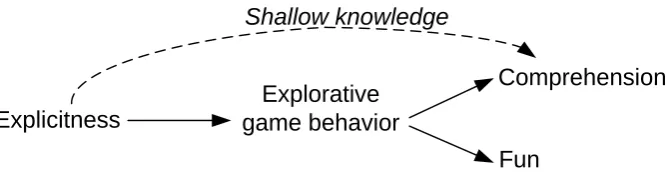
This thesis tries to find out how such an explicit purpose influences how players play the game and what parts of the simulation will they experience. But we also look at how that game behavior impacts the comprehension and perceived fun of the game. Players who did not explore all possibilities of the simulation, are less likely to have knowledge about those aspects of the simulation. They might know how to succeed in the game, but not what happens when things go wrong. In other words, they lack deep knowledge about the simulation. At the same time, the explicitness is expected to make it easier for players to identify what is happening in the game, giving the players more shallow knowledge about the game.
1.7
Fun and challenge
Flow is a state of consciousness where the “concentration so focused that it amounts to absolute absorption in an activity” *Csi90+. When someone is in a flow, they often report great enjoyment of an experience. Chen [Che07] adapted the requirements for a flow experience to computer games, and stated that games should offer a well balanced challenge, clear goals and the feeling of being in control in order for the player to become in the right flow. When the game is not challenging enough players become bored, when the game is too difficult or there are too many choices at hand, they become anxious. Chen pleads that games should adapt themselves or offer multiple choices in order to be attractive for a large group of different gamers.
The importance of a good flow is no different for endogenous educational games14. Fu, Su en Yu [FSY09] developed the EGameFlow, a scale to measure enjoyment in an e-learning activity such as educational games. The main difference between flow in educational games and in normal games, is the role of knowledge acquisition in the flow experience. They state that e-learning games become more fun as players increase their knowledge. Also, the knowledge taught has to be applicable in the game itself.
For an endogenous educational game to be fun, this means that the knowledge should be acquired at the pace of the individual player and should build upon previously gathered knowledge. Explicit educational messages can convey knowledge which is yet too far out of reach for the player, building knowledge which the player can not relate to and apply in the game. Also, the explicit educational messages can alter game behavior in such a way that the application of certain knowledge is not required, making the game less fun.
The goals related to the simulation should be achievable with the knowledge the players have about the simulation at that moment or with knowledge that is not too far out of reach. When players get in a certain state where they do not have enough knowledge about the simulation to get to another state, they are stuck in the simulation and are out of the flow. This would make such players perceive
14
21
the game as less fun. It is important that players have gathered enough information about the workings of the simulation before they get in such a situation. Especially without an explicit purpose, it is possible for players to come in such a situation from which they are unable to recover because they did not gather the knowledge needed from the simulation to proceed.
1.8
Hypotheses
Adding an explicit purpose to an endogenous educational game is expected to change the way the game is played, because an explicit purpose changes the abstract concepts the player has about the game [Kol84]. When the game behavior changes, the player will see different parts of the simulation which influences the comprehension of the game’s educational content and the player’s perceived fun and challenge. The theories discussed in this chapter lead to the following hypotheses:
H1: By adding an explicit purpose to an endogenous educational game, players are likely to show less explorative game behavior than without an explicit purpose.
H2: Players who show more explorative game behavior, will show better deep comprehension of the simulation than people who showed less explorative game behavior.
H3: Players who have showed more explorative game behavior, will have perceived the game as more fun and more challenging than the players who did not.
[image:21.595.131.465.512.605.2]H4: Players who played an endogenous educational game with an explicit purpose, will have more shallow knowledge related to the game than players who played the same game without an explicit purpose.
Figure 4 shows a broad schematic representation of these hypotheses, with each arrow representing an influence corresponding with a hypothesis. The hypotheses will be concretized in section 4.3, after the game design and methodology have been discussed.
Explicitness
Explorative game behavior
Comprehension
Fun
Shallow knowledge
Figure 4: Influence of explicitness on game behavior, comprehension and fun
To discover how the explicitness influences the game behavior and indirectly the comprehension of the educational content, an endogenous educational game which teaches the players about overfishing was developed and evaluated. Two different versions of the game were tested on children, one with explicit messages and presented as an educational game, and one without those aspects.
22
23
2
Game design
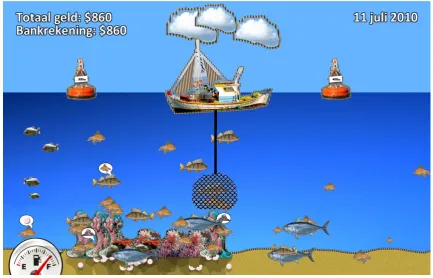
[image:23.595.81.515.233.511.2]This chapter discusses the design of the game developed for this research and explains why certain design choices have been made. The name of the game is Vis B.V. (meaning ‘Fish Inc.’) and the educational goal of the game is to teach players the basic mechanics behind the issue of overfishing. A screenshot of the final version of the game can be seen in Figure 5. This should give a global idea of what the game looks like, which might make it easier to interpret the different aspects of the design which will be discussed in this chapter.
Figure 5: Screenshot from the final version of Vis B.V.
The game described in this chapter is the implicit version of the game, or more appropriate: the basic version of the game. The explicit version has everything that is included in the implicit version, but adds an extra layer of explicitness on top of it. The differences between the two versions are discussed in section 4.1. Everything in this chapter applies to the implicit as well as the explicit version.
2.1
Basic Concept
24
Fish also need coral reefs and other fish species in order to eat and reproduce and by destroying those, the fish reproduction comes to a halt and fish might die from starvation.
The player should find a good balance in his fishing behavior in order to achieve the maximum amount of money in the end, but this insight requires him to comprehend the workings of the ecosystem by observing what happens in the sea. When the player ends up without fish, he should figure out a way to get his fish stock back to the original level, which is by waiting (or skipping ahead in time) until the fish have had the time to reproduce.
This game design is relatively novel, combining elements of a resource management game with a direct input on the fishing mechanics. Where many games either rely on high-level management or quick reflexes with direct input, this game combines both, urging players to find a balance in how they fish instead of trying to achieve the maximum score as quickly as possible.
2.2
Game design context
Certain aspects have to be taken into account when designing the game. The game does not only need to be fun and be able to communicate the educational content to the player, it also has to be suitable for use in a research context.
To test the influence of explicitness, two versions of the game were devised: an implicit and explicit version. The fact that the game had to be playable with and without explicit guidance is an important factor in the game design. The game has to be playable entirely implicitly, explaining the mechanics of the simulation through interaction, but also should remain challenging and interesting when explicit messages are added.
The experiments lead to a limit for the total duration of the game, which lasted about an hour. Within that timeframe, the players do not only have to play the game, but also get seated, instructed and answer a post-game questionnaire. The actual time left to play the game is about half an hour. Within that small period of time, the players need to learn the game, play the game and experience the simulation enough to gasp the educational content. This means the game should be easy to learn and not overly complex, but interesting enough to maintain attention for at least thirty minutes.
The target age of the game also influenced several design choices. The game was designed for children between 8 and 12 years old. These ages were chosen because the players should at least to be able to read and be able to comprehend a concept such as overfishing. At the same time, the players should not be too aware of the issue of overfishing in advance, which would have been the case with older players.
2.3
Educational content
25
interesting about the educational content is if the content that was intended to be learned from the game, has been learned in the end, and to what degree and in what way.
2.3.1 Subject choice
The theme of sustainability is a hot topic nowadays and it is also a very suitable subject for educational games. Sustainability comes with an interesting balance between short-term profit, long-term investments and limited resources. A small subject within the theme of sustainability was chosen: overfishing. This subject is suitable for real-time simulation, because it is not too broad and the basic concepts behind it should be learned within half an hour. Also, the subject is not part of the standard school curriculum, allowing the game to be tested with children of various ages.
2.3.2 Defining overfishing
Overfishing is defined in the Merriam-Webster15 dictionary as “to fish to the detriment of (a fishing ground) or to the depletion of (a kind of organism)”. Overfishing does not imply necessarily that fish species have to go instinct, a change in the balance in an ecosystem is also considered as a result of overfishing. Three different types of overfishing are distinguished, being growth overfishing, recruitment overfishing and ecosystem overfishing [Pau83].
Growth overfishing means that young fish (the so called recruits) are caught before they can grow to a reasonable size, having an impact on the future growth of a fish population. With Recruitment overfishing, too much older fish are caught, reducing the number of new fish (the recruits, hence the name) which are produced. Ecosystem overfishing is the most ‘soft concept’, compromising any type of overfishing which changes a mature, efficient ecosystem to an immature and inefficient ecosystem [Pau83]. For example, fish species can increase fast in number because of the decrease in number of their natural enemies or fish species go extinct because the fish species that serve as food are depleted.
Simulation these three type of overfishing properly requires a complex simulated ecosystem, where fish grow to a certain age, have a certain fertile period where they lay or fertilize eggs, and at a certain point die of old age. Also, coping with growth overfishing requires to have nets of various mesh sizes, which lets the smaller fish escape so only the larger fish get caught. Although very interesting for simulation in an overfishing game for older players, within the scope of Vis B.V. the mechanics of overfishing need to be brought back to a couple of basic elements.
The following aspects of overfishing have been chosen to be part of what the game learns to the player:
1) Growth overfishing: Balance between fishing and reproduction.
2) Recruitment overfishing: New born fish do not immediately reproduce, older fish are worth more money (and more attractive to be caught).
3) Ecosystem overfishing:
a) Larger fish species eat smaller fish species and need the smaller ones to survive.
15
26
b) Smaller fish species eat coral and need coral to survive.
c) When larger fish species are depleted, fish stock of smaller fish grows faster.
4) Income vs. fishing: when fish gets depleted, income decreases. Fish needs to be available in order to gather income on the long term.
2.3.3 Learning content in the game
The concept of overfishing will be simulated in a virtual ecosystem and communicated to the player via the interactions he can make with the ecosystem. How this ecosystem works exactly is explained in section 2.5. This section is about how the player will combine simple facts about the ecosystem to a larger comprehension about the entire simulation.
The first three categories of Bloom’s taxonomy (seen in Table 1) are applicable to Vis B.V. On the knowledge-level there are simple facts about the simulation which a player can know by just observing what happens in the fictional world of the game. These are facts such as “Fish lay eggs” and “Bombs destroy coral”. When the player observes various facts, he can combine them to more complex concepts, which lead to comprehension of the simulation behind the fictional world. The combination of the facts “Larger fish eat smaller fish” and “Fish die when hungry” leads to the conclusion that “Larger fish species need smaller fish to survive”. This comprehension of how the simulation works can cause the player to adapt his game behavior, an application of the knowledge. For example, he might decide not to deplete the smaller fish species. An overview of a fair share of the knowledge embedded in Vis B.V. can be seen in Figure 6. This figure shows how the knowledge adds up to comprehension and application using the first three levels of Bloom’s Taxonomy.
APPLICATION
KNOWLEDGE COMPREHENSION
Larger fish species need smaller fish to survive Larger fish eat smaller fish
Small fish eat coral
By destroying coral small fish have less to eat Fish lay eggs
Fish die when hungry
Fish stock is limited
Fish stock grows over time When you fish you remove
fish from the sea
Eggs create new fish Fishing behavior
should be adapted in such a way that there will be enough
fish left in the sea in order to maximize profit
over time. All fish and coral should
be maintained to keep the ecosystem intact
Bombs destroy coral When you fish you earn
money
Less coral should be destroyed (bombs, dragging) to keep small
fish alive Fishing more will result in
fewer fish in the sea and fewer money to be
earned
Fishing less will result in more fish in the sea When there are fewer fish,
fewer money can be earned
[image:26.595.75.524.432.677.2]Dragging the net through coral destroys it
Figure 6: Knowlegde embedded in Vis B.V. categorized using Bloom's Taxonomy [Blo56, Hui09].
27
players who do not actually witness every event from the first row in Figure 6, but fill in the gaps themselves. Nonetheless, the different levels of comprehension and the concrete examples given will later be used to determine what knowledge has been transferred to the players and how deep they actually comprehended the game. More about that can be read in section 4.2.4.
2.4
Core game mechanics
[image:27.595.150.454.339.516.2]This section gives a broad overview of how the game works, from starting the game to seeing the game completion screen, which takes roughly thirty minutes. Each separate subsystem is explained in detail in the following sections.
Figure 7 shows a state diagram which gives a broad overview of how the game evolves from the start to the end. In Vis B.V., players catch fish and gain money for every fish they catch. With this money, players can go to the shop and buy upgrades for their boat which allows them to catch fish even quicker. As the player is catching fish, the ecosystem goes on as well. Fish eat and reproduce and as long as the player does not catch more fish than the ecosystem regenerates over time, there will be fish in the sea.
Rankings
Fishing Shopping
[Year = 2030]
Year +1 [Date = 30/9]
Enter shop Exit shop
Quick season end
Figure 7: Global state diagram of the game
The game plays out over twenty years, from 2010 to 2030. After each year, the game shows the position of the player compared to the (virtual) competition. This position is based on the total amount of money the player has gathered during the course of the game. The player does not need to wait for the season to end in order to proceed to the next year. In the shop, he can also choose for a ‘quick season end’, which speeds up the simulation to the next season (the boat will stay on the shore for the rest of the season).
2.5
Ecosystem
28
die from starvation after a while. What the different fish species eat is shown in Figure 8. As can be seen in this graph, when the player catches all the smaller fish, the bigger fish will have no food and die as well. When too much coral reefs are destroyed, the smaller fish will be unable to survive. When they go extinct, the big fish will die as well.
Big fish Medium fish
Small orange fish
Small grey fish
Coral reef
$100
$5 $20
[image:28.595.119.482.150.284.2]$250
Figure 8: Illustration of the food chain in the game Vis B.V.
The ecosystem is kept simple, with only four different types of fish and coral reefs as the only food in the low end of the food chain. This small size makes the ecosystem easy to comprehend, while still maintaining the idea of a working food chain where certain links can be removed, disrupting the entire chain. There are two smaller fish on the same level of the food chain, one of which is worth more than the other. This allows the more tactical player to choose to catch the more expensive fish, leaving the food chain intact. In order to make it evident to the players what is happening in the ecosystem, the internal goals of the fish are illustrated by icons which are shown above the fish. These icons are shown in Table 2.
Table 2: Icons explaining fish behavior
Icon Meaning
The fish is planning to lay an egg
The fish is hungry and wants to eat from the coral reefs
The fish is hungry and wants to eat another (smaller) fish
The fish has died from starvation
2.6
Fishing
[image:28.595.195.403.486.652.2]29
worth. Initially the player only has a small fish net with limited capacity, too small to catch the largest fish type. As the player upgrades the fish net, the size and capacity increase.
There is one other fishing method, being the bomb. The bomb represents the dirty way of fishing: quick, efficient, but damaging to nature. Bombs kill all fish in a large area, which will then float upwards. The player only needs to move over the fish in order to catch them, making it the easiest way to catch a large amount of fish. But the bombs have a disadvantage: they destroy the coral reefs, which the smaller fish need in order to survive. Using much bombs can disrupt the ecosystem, especially when many bombs are dropped in quick succession destroying coral reefs in a larger area.
2.7
Items and upgrades
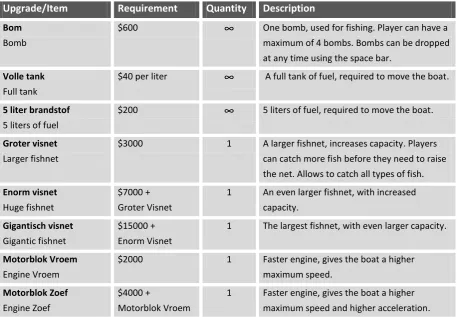
[image:29.595.68.526.428.745.2]The player can spend the money he earns by fishing on various items and upgrades for the boat. The players can choose themselves when he wants to upgrade his boat, so they can first take their time to comprehend the basic mechanics of the game. When they have a certain amount of money on the bank, messages will tell the player to buy upgrades in order to make them aware there is a shop. A list of items and upgrades can be seen in Table 3. The items were chosen in such a way that they allowed enough progression, but could all be purchased when playing decently over the course of half an hour. Additional functionality was considered, such as new boats and fishing methods, but those could have made the game too complex to be fully comprehended in the short available play time.
Table 3: Upgrades and items available in the shop
Upgrade/Item Requirement Quantity Description
Bom
Bomb
$600
∞
One bomb, used for fishing. Player can have a maximum of 4 bombs. Bombs can be dropped at any time using the space bar.Volle tank
Full tank
$40 per liter
∞
A full tank of fuel, required to move the boat.5 liter brandstof
5 liters of fuel
$200
∞
5 liters of fuel, required to move the boat.Groter visnet
Larger fishnet
$3000 1 A larger fishnet, increases capacity. Players can catch more fish before they need to raise the net. Allows to catch all types of fish.
Enorm visnet
Huge fishnet
$7000 + Groter Visnet
1 An even larger fishnet, with increased capacity.
Gigantisch visnet
Gigantic fishnet
$15000 + Enorm Visnet
1 The largest fishnet, with even larger capacity.
Motorblok Vroem
Engine Vroem
$2000 1 Faster engine, gives the boat a higher maximum speed.
Motorblok Zoef
Engine Zoef
$4000 +
Motorblok Vroem
30
Upgrade/Item Requirement Quantity Description
Gevoelige V-Snaar
Engine upgrade
$4000 1 Improves the current engine, increasing acceleration.
Paardenkracht Plus
More horsepower
$2000 3 Allows the boat to move while the fishnet is out. The more horsepower, the faster the boat can move while fishing. Dragging the net through coral reefs destroys them.
2.8
Balancing
Balancing the fish reproduction in the ecosystem along with the fishing of the player, is an important aspect of the game. When both are not balanced right, the game will not communicate the educative message. A good balance of the fish stock should abide the following rules:
When the player does not fish, the fish stock should not grow exponentially. Instead, there should be a natural ceiling in the fish stocks. The total fish stock of a non-fishing player can be seen in Figure 9, stabilizing around 350 fish.
The player needs some time to see the ecosystem working before the fish stocks decline by his fishing behavior, otherwise he might get stuck in a situation without fish which will disrupt the flow of the game. When the player has not upgraded his boat, he should not be able to deplete his fish stock (see Figure 10, section 1).
When the player upgrades his boat, it should be quite easy to get in the negative spiral and depleting the fish stock (see Figure 10, section 2).
When the player stops fishing or skips seasons, the fish stock should restore faster than it declined in the first place (see Figure 10, section 3).
[image:30.595.160.436.530.688.2] When players find a good balance in the amount of fish they catch, the number one spot in the rankings should be achieved while the number of fish in the sea stays at a decent level (see Figure 10, section 4).
Figure 9: Total fish stock of non-fishing player over time, stabilizes at around 350 fish. 0
31
2.1
Goal
The goal of the game as communicated to the player will be to make as much profit as possible over the course of a certain number of years. As should be the case in an endogenous educational game, this goal can only be reached in engaging with the underlying simulation. In the implicit version of the game, it is never communicated that the fish stock is of any importance, but while playing the game and interacting with the fish stock, this should become evident to the player. The way to become most profitable on the long run, will be by not depleting the fish stock.
Because making profit will give the player the ability to buy upgrades for his ship, he will start fishing faster and it will become easier to deplete the fish stock. Spending income does not derive from the goal, because the total income will be the measurement and not the income minus expenses. This was done to make the player not reluctant to spend money in the shop. The total amount of money is used in a similar way as the ‘score’ in arcade video games and does not decrease by other actions. This means that how the more fish the player catches over time, the more money he has made and the higher his score.
1 2 3 4 5
1 2 3 4 5
Total Money Gathered Total Fish Stock
2.2
Presentation
[image:31.595.72.514.325.674.2]The game uses a two-dimensional, sideway view. This gives the player a good view of what happens under sea level, as opposed to a top-down view. A three-dimensional game design was not chosen, because it is easier to get a high level of polish and attractive graphics when using 2D graphics. Figure 11 shows the game screen including a description of several interface elements.
Figure 10: Image showing the fish stock and money over the course of a single game, with five different play styles being adapted:
1) Fishing without upgrades; fish stock grows, money grows slightly
2) Fishing aggressively after buying upgrades; fish stock declines fast, money grows quickly
3) Skipping seasons/slow fishing to make fish stock grow back; fish grows, no money gathered
32
The game world spans several screens which smoothly scroll as the boat moves. The boat can only move from left to right which is done by using the left and right arrow keys. The fishing is done by moving the net up and down with the up and down arrow keys. When the player has bombs, they can be dropped with the spacebar.
1
2
5
4
7
9 8 6
[image:32.595.92.500.148.411.2]3
Figure 11: Screenshot of the game with (1) current and total money (2) the player boat (3) the in game date (4) buoys showing distance (5) the fish net (6) a fish getting caught displaying the money the fish is worth (7) the fuel meter (8)
coral reefs and (9) the message bar displaying when items are purchasable in the shop.
[image:32.595.100.499.467.720.2]33
On the far left end of the world there is a small harbor which serves as the shop. By pressing the ‘Enter’ key, players can enter the shop and purchase stuff from a simple textual menu (see Figure 12). At the far right end, the world just stops scrolling and a buoy shows the end of the world has been reached.
2.3
Evolving design
The design of Vis B.V. has evolved a lot during the development of the game. Many changes were influenced by having people play the game at different phases during its development. In this section, the changes these sessions led to for the final game design are described.
Children as well as adults were used to test the game during development. These ‘pilot tests’ confirmed the idea that the game was more suitable for children, as the adult test persons got the educational goals behind the game quite quickly, sometimes even at a glance. Most adults are aware of over fishing and expect such themes in a game developed for scientific purposes.
The pilot tests were used in particular for balancing the game and the ecosystem. For many players, it took too long to empty the sea and too long for the fish to come back when the fish was finally gone. To improve this, the following changes were done:
Reduced size of the game world
Increased speed of fish reproduction
Removed fish gender and egg fertilization
Quick Season End-option to fast forward the game
When tests were done with children, none of the children really comprehended how the ecosystem worked, which could have been caused by a lack of feedback on the events in the ecosystem. Even simple things such as the eggs which were laid by the fish, were not recognized as eggs by some players. This problems have been addressed by the following changes:
Added sound effects for the most important ecosystem events (chewing for eating, cracking for eggs breaking open)
Added small animation of eggs breaking open when fish comes out
Added cartoon-like icons showing when fish are eaten (with the text ‘Hap’, which means ‘Bite’)
34
3
Development and implementation
The game Vis B.V. was developed using the XNA Framework by Microsoft, a C#-extension which offers various tools and interfaces tailored to game development. For example, XNA offers native support for Xbox 360 controllers and can easily render a large number of two-dimensional images to the screen at once. XNA also supports simple graphical effects such as scaling and alpha-blending sprites, which are good tools for making the graphics look more dynamic without the use of animation.
3.1
Graphics
For the graphical style of the game, a short drawing-time was important, but at the same time the game should look attractive. As noted by professional game developers, games from independent game developers often have great, attractive and original visual styles which do not require the time and resources needed seen in most modern three-dimensional games [IFH10].
[image:34.595.118.471.447.531.2]A similar philosophy was used for the graphical style in Vis B.V, using a cut-out cardboard look, w

![Figure 2: Learning process in experiential learning [Kol84]](https://thumb-us.123doks.com/thumbv2/123dok_us/1190034.642231/16.595.159.433.536.708/figure-learning-process-experiential-learning-kol.webp)
![Figure 3: Game interaction cycle [Fab00]](https://thumb-us.123doks.com/thumbv2/123dok_us/1190034.642231/17.595.157.440.440.617/figure-game-interaction-cycle-fab.webp)
![Table 1: Bloom’s Taxonomy of the Cognitive Domain [Blo56, Hui09] (first three levels)](https://thumb-us.123doks.com/thumbv2/123dok_us/1190034.642231/18.595.95.502.459.622/table-bloom-taxonomy-cognitive-domain-blo-hui-levels.webp)
![Figure 6: Knowlegde embedded in Vis B.V. categorized using Bloom's Taxonomy [Blo56, Hui09]](https://thumb-us.123doks.com/thumbv2/123dok_us/1190034.642231/26.595.75.524.432.677/figure-knowlegde-embedded-vis-categorized-using-bloom-taxonomy.webp)