Purna Ch. Pradhanand Dr Urmimala Das Page 280 MEASURING PERSONALITY OF WOMEN LEADERS FROM THEIR EMOTIONAL
INTELLIGENCE: - A STUDY AMONG WOMEN LEADERS IN ODISHA
Purna Ch. Pradhan
PhD Scholar, WSRC, Berhampur University, Odisha, (India)
Dr Urmimala Das
Director, WSRC, Berhampur University, Odisha, (India)
Abstract
A study was conducted to measure Emotional Intelligence and Personality traits of women leaders of Odisha. In this study, the researcher has taken 2 constructs, one is Personality (measured by Big Five Factor Model) and the other one is Emotional Intelligence (EI- measured by WEIS Scale). The construct personality is having 5 latent variables in short called as OCEAN and the other construct EI is having 4 latent variables like Self emotion appraisal in short SEA, Others emotion appraisal in short OEA, use of emotions in short UOE and Regulation of emotions in short ROE. Help of G Power software was taken to calculate the probable sample size with one tail. Analysis was done by the help of SPSS version 23. A sample comprised of 64 women leaders from different sections were taken. The tests were conducted with the help of likert scale to measure the personality under Big Five Factor Model and Emotional Intelligence under Wongs Emotional Intelligence Scale. For analysis MANOVA test was conducted. The analysis found that, Both Personality and Emotional Intelligence of Women leaders are inter correlated with significant proportions .
Keywords: Emotional Intelligence, Personality, Big Five Factor Model, Wongs Emotional Intelligence Scale, Leadership
Introduction
“Yam hi na vyathayanthyethe purusham purusharshabha
Samadhukha sukham dheeram somruthathvaya kalpathe” [1], [In Sanskrit]
-- Bhagavad-Gita (Chapter II, Verse 15)
Emotional Intelligence (EI) may be a relatively new term, not more than 25 years old , but the roots of Emotional Intelligence (EI) can be found in The Bhagavad-Gita, 5000 years ago (Analytic sloka from the Bhagavad-Gita (Chapter II, Verse 15) sums up the entire concept of Emotional Intelligence (EI). It says: a person who is calm and remains unperturbed by either pain or pleasure is the one who attains immortality) where Lord Krishna‗s Sthithapragnya (Emotionally stable person) is very close to present day‘s Mayer and Salovey‗s Emotionally Intelligent person and also the work of Plato, 2000 years ago where he stated, ― All learning has an emotional base. Since then, researchers, scientists, educators, and philosophers have worked to prove or disprove the importance of feelings and emotions in day to day life.[2]
Purna Ch. Pradhanand Dr Urmimala Das Page 281 intelligence typically measured by IQ
(Intelligent Quotient) and related tests.
In 1990, Mayer and Salovey introduced the concept of Emotional Intelligence as a distinct form of intelligence which can be measured and evaluated. Emotional intelligence is the concept which is widely believed by the public that emotional and social competence is as important, or even more important, than traditional dimension of intellectual ability and personality (Goleman, 1995, 1998). Emotional intelligence is defined as ―the composite set of capabilities that enable a person to manage himself/ herself and others‖ (Goleman, 1995, 1998). ―It is more accurate to say that the frequency with which a person demonstrates or uses the constituent capabilities, or competencies, inherent in emotional intelligence determine the ways in which he/ she deals with themselves, their life, work and others‖ (Boyatzis, Goleman and Rhee, 2000). It is the ability to : 1) be aware to understand and to express oneself; 2) be aware of, to understand, and to relate to others, 3) deal with strong emotions and control one‘s impulses; and 4) adapt to change and to solve problems of a personal or a social nature (Bar-On, 1988).[4]
Personality is, what makes you ―you‖. It encompasses all the traits, characteristics, and quirks that set you apart from everyone else. Personality is: ―the coherent pattern of affect, cognition, and desires (goals) as they lead to behavior‖ (Revelle, 2013). In the words of the American Psychological Association (APA), personality is: ―individual differences in characteristic patterns of thinking, feeling, and behaving‖ (APA, 2017). It is ―the entire mental organization of a human being at any stage of his development. It embraces every phase of human character… and every attitude that has been built up in the course of one‘s life.‖ A person‘s personality tends to be stable throughout life, and it often grows more pronounced over time. In fact, research suggests that as much as half of a person‘s personality is driven by their genetic makeup; it
is biological. The rest is acquired through learning,[5]
Recent debates on EI have focused largely on whether EI has predictive power over above personality traits. Several studies have indicated that, trait EI might be a valid construct in the prediction of life satisfaction, somatic complaints, rumination and coping styles (Kluemper, 2008; Petrides, Pita & Kokkinaki, 2007)[6]. However, the ability of trait
EI in an academic setting is still unclear (Tok & Morali, 2009; Barchard, 2003). Consistent say that emotional intelligence as a construct has been showed to be an independent construct from personality (Caruso, Mayer & Salovey, 2002; McCrae, 2000; Zadal, 2004; Vakola, Tsaousis & Nikolauo, 2004; Shulman & Hemeenover, 2006) [6]. Consensus is emerging
that a five-factor model of personality can be used to describe the most salient aspects of personality (Goldberg, 1990). Women with high on emotional intelligence are also said to be good in using emotions to guide decision making and encourage open – minded in idea generation, because they can consider multiple points of view especially for those possess high in openness to experience domain.
Literature Review
Purna Ch. Pradhanand Dr Urmimala Das Page 282 The concept of emotional intelligence can be
traced to the notable research of Thorndike (1920), followed by the respective work of Moss and Hunt (1927), and Gardner (1983), in which they discussed and developed the related concept of social intelligence or multiple intelligence. As early as the 1930s, there have been studies of a possible emotional aspect to intelligence. In 1934, David Wechsler (of two well known intelligence tests) wrote of ―non-intellective‖ aspect of intelligence. Gardner (1983) proposed a conceptualization of interpersonal intelligence— the competence to understand other people, and intrapersonal intelligence— the competence to understand the self and apply it effectively in life.
The term ‗Emotional Intelligence‘ was coined and defined by Salovey and Mayer (1990). Despite its recent debut, there are already a number of definitions of EI. These conceptualizations can be divided broadly into two streams: ‗ability models‘ in which EI is defined as a set of cognitive abilities in emotional functioning (Mayer & Salovey, 1997) versus ‗mixed trait models‘ that incorporate a wide range of personality characteristics and other traits (Bar-On, 2001; Goleman, 1995, 1998; Petrides & Furnham, 2001)[7]
Some researchers described that, three main models of emotional intelligence exist. The first model by Peter Salovey and John Mayer perceives E.I. as a form of pure intelligence, that is, emotional intelligence is a cognitive ability (Ability Model). A second model by Reuven Bar-On regards E.I. as a mixed intelligence, consisting of cognitive ability and personality aspects. This model emphasizes how cognitive and personality factors influence general well-being. The third model, introduced by Daniel Goleman, also perceives E.I. as a mixed intelligence involving cognitive ability and personality aspects. However, unlike the model proposed by Reuven Bar-On, Goleman's model focuses on how cognitive and personality factors determine workplace success.
Research has found that significant relationships exist between all three models of E.I.. In addition, emotional intelligence has been consistently compared to three other constructs: personality, alexithymia (difficulty in feeling and distinguishing emotions), and leadership. Many traits contained in the Big Five Personality Factor Model are similar to those described by Bar-On and Goleman[4] in
their models of emotional intelligence.
Personality characteristics of a leader can affect his or her organizational behavior. The personality traits of leader often become the center of attention due to its relationship with emotional stability while playing their role as a leader within an organization. Recent studies also demonstrate that personality traits are closely related to the achievement within an organization, especially with work performance, career development, leadership effectiveness (Barrick et.al, 2001, Judge et al., 1999[8]). Emotional intelligence and personality
traits are two important constructs of psychology and there is substantial evidence that how these two constructs are related to each other.
There is another question that whether gender relates to EI and personality traits. There is scarcity of attention paid to gender differences on EI and Personality traits. It has been established stereotype that women tend to be more expressive then their counterpart men. They are believed to understand and recognize other's emotions better and possess greater empathy as being more perceptive (Aquino, 2003; Tapia & Marsh II, 2006). Existing literature yields contradictory findings on EI e.g. females were found higher (Katyal & Awasthi 2005; Singh, 2002) and some others witnessed males as higher on EI (e.g. Chu, 2002)[9].
Mohanty and Devi (2010)[10] conducted study
Purna Ch. Pradhanand Dr Urmimala Das Page 283 (2008) [10] investigated the effect of gender
differences on emotional intelligences. Sample size of 80 participants was used in which 40 were males and 40 were females. Results indicate that gender difference effect emotional intelligence. Males have high score than females which shows that males have more resistant power against difficulties and to control and manage stress and their emotions in more positive way.
Significant gender differences were found in the results, with women scoring higher on Emotionality and men scoring higher on Self-Control, Sociability, and the global score. Such results are consistent with those obtained with the English version of the TEIQue.[11] They also
echo those of Feingold (1994) who meta-analyzed gender differences in personality and found that women were more agreeable (more sensitive, etc.) and men more emotionally stable.[12] Theoretically, the fact that women
scored higher on Emotionality is coherent with Western norms according to which expressing emotions is generally viewed as ―unmanly‖ (Brody, 2000 Brody, L. R. 2000)[13]. Empirically,
it is in line with findings obtained using the EQ–I (Slaski, 2001 Slaski, M. 2001)[14] and with
data that showed that men scored slightly higher on alexithymia than women (Parker, Taylor, & Bagby, 2003 Parker, J. D. A., Taylor, G. J. and Bagby, R. M. 2003.
In the same vein, the fact that men scored higher than women on Self-Control is on one hand consistent with the divergent socialization of emotion as a function of gender (e.g., ―Boys don't cry‖) and on the other hand in line with findings obtained using the EQ–I (i.e., men > women on stress management)[15]
On the other hand, the finding that men scored higher than women on Sociability could seem odd at first sight, especially as women are commonly thought to have higher social skills than men. however, a closer look at the subscales that compose the Sociability factor revealed that this factor does not refer to dimensions such as empathy or ability to initiate/maintain close relationships (which
abilities are part of the Emotionality factor) but rather to dimensions such as the ability to assert oneself or to influence other's emotions and decisions, which are more easily attributed to males.[16]
Literature reveals an established evidence for a strong association between EI and various personality traits.[17] Dawda and Hart reported a
significant relationship between EI and all Big Five personality factors.[18] Day et al. reported
in their study that there exists a high correlation between EI and extraversion and conscientiousness.[19] A study conducted by
Avsec et al. revealed that EI is a predictor of the Big Five.[20]
Method Objectives
To measure the EI of the women leaders
To measure the personality types of the women leaders
To find out the relationship between EI and personality types of women leaders
Hypothesis
The selection of hypothesis relies on the following notions.
H0 = Personality and Emotional Intelligence of
Women are not correlated
H1 = Personality and Emotional Intelligence of
Women are correlated
3.3 Sample
A sample of study conducted among 64 women leaders from Odisha consists of entrepreneurs, social leaders, organizational leaders etc. Since the sample was very much specific, other criteria like Age range, community, educational background etc are not considered. The sampling technique applied for drawing out the sample was convenience sampling. Researcher has set 5% α value, as the maximum chance of incorrectly rejecting the H0. Since the researcher has set
Purna Ch. Pradhanand Dr Urmimala Das Page 284 of the given population sample. Alternatively,
researcher has set power value to 80% (1- β) which is the chance of finding an association of the population. Keeping in view the above value of α , β and power (p), the sample size for this one tail test is 64. And the PSS graph is as below.
(Probability Sample Size (N)=64, considering α error 0.05 and β error 0.20)
And the protocol power analysis value are as follows. (Source- G Power 3.1.9.2)
t tests - Correlation:
Point biserial model
Analysis: A priori:
Compute required
sample size
Input: Tail(s) = One
Effect size |ρ| = 0.3
α err prob = 0.05
Power (1-β err prob) = 0.80
Output: Non centrality
parameter δ
= 2.5158836
Critical t = 1.6698042
Df = 62
Total sample size = 64
Actual power = 0.8005036
(Critical-t- is the standard error which is a measure of the error that we expect to find in the value obtained for the sample mean)
Instruments Big Five Inventory
The most prevalent personality framework is the ―Big Five‖ or the ―Five-factor model” of personality. Not only does this theory of personality apply in multiple countries and cultures around the world (Schmitt et al., 2007), there is a valid and reliable assessment scale for measuring the five factors. The five factors grew out of decades of personality research, growing from the foundations of Cattell‘s 16 factors and becoming the most accepted model of personality to date. This model not only confirms its validity as a theory of personality but also establishes its validity on an international level. These five factors do not provide completely exhaustive explanations of personality, but they are known as the ―Big Five‖ because they encompass a large portion of personality-related terms. The five factors are not necessarily traits in and of themselves, but factors in which many related traits and characteristics fit. A popular acronym for the Big Five is ―OCEAN.‖ The five factors
are Openness to experience,
Conscientiousness, extroversion, agreeableness & neuroticism. A self report 44 item questionnaire is used in a liker scale to measure the Personality of the respondents.
Purna Ch. Pradhanand Dr Urmimala Das Page 285 the two types of abilities that best represents
their strengths. Wong‗s Emotional Intelligence Scale (WEIS) is a self-report EI measure, developed for Chinese respondent (Wong et al., 2007). Wong and Law (2002) explained that EI is an ability to understand ones own emotions and those of others and to control emotions in diverse situations and they suggested that EI consists of four dimensions : Others emotion appraisal (OEA), use of emotion (UOE), self-emotion appraisal (SEA), and regulation of emotion (ROE).
Procedure
A convenient sample of 64 women leaders from Odisha were approached. The respondents were explained about the purpose of the study and their consent were taken for the study participation. They were affirmed that, all the information and identity will be kept confidential and will be utilized for the research purpose only. They were handed over the study questionnaire. Some respondents , those who were not 100% savvy with vernacular language in interpreting the questions, were handed over a translated version (Odia medium- a local language) questionnaire. And in most of the cases, the researched has to explain and clarify some of the questions which are having similar meanings to avoid confusion and bias. All the respondents were asked to complete the questionnaire within 15-20 minutes in order to avoid manipulative answers about their personality factors. After completion of the questionnaire, each participant was thanked for cooperation and participation. The study data was tabulated further and analyzed with the help of SPSS version 23. In the present study, the researcher simply tried to measure the relationship between Emotional Intelligence and Personality of Women Leaders and how EI affect their Personalities.
Results
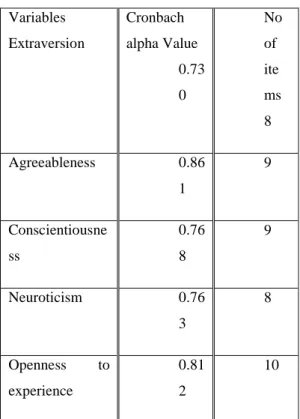
The Table-1 & 2 shows the Cronbach‘s Alpha for WEILS and Five Factor Model. The
Cronbach alpha Value for all variables of BFFM and EI (WEIS) indicates that, all items are having high internal consistency and are suitable for the study population.
Table -1 : Cronbach coefficient Alpha value for internal consistency & Reliability Analysis (BFFM)
Variables
Extraversion
Cronbach
alpha Value
0.73
0
No
of
ite
ms
8
Agreeableness 0.86
1
9
Conscientiousne
ss
0.76
8
9
Neuroticism 0.76
3
8
Openness to
experience
0.81
2
10
Table-2 :– Cronbach coefficient Alpha value for internal consistency & Reliability Analysis (EI)
Variables Cronbach
alpha Value
No of
items
Self Emotion
Appraisal
0.767 4
Others Emotion
Appraisal
0.800 4
Use of Emotions 0.751 4
Regulating of
Emotions
Purna Ch. Pradhanand Dr Urmimala Das Page 286 In SPSS, the researcher has performed
canonical correlation using
the manova command with the discrim option.
Table-3 : EFFECT .. WITHIN CELLS Regression
Univariate F-tests with (4,59) D. F.
Table-3 indicates the F-test for each individual dependent variable (OCEAN), showing the Canonical Loadings for each of the dependent variables. In our case of research, all the dependent variables Openness (ff_mo), Conscientiousness (ffm_c), Extrovert (ffm_e), Agreeableness (ffm_a), Neuroticism (ffm_n)
are strongly related to all the latent variables of Emotional Intelligence like Self Emotion Appraisal, Others Emotion Appraisal, Use of Emotions and Regulation of Emotions. Table-4 : Raw canonical coefficients for DEPENDENT variables Function No.
The traditional approach for interpreting canonical functions involves examining the sign and magnitude of the Standardized Canonical Coefficients assigned to each variable in its canonical variate. Variables with relatively larger standardized canonical coefficient contribute more to the variates. Similarly, variables whose standardized canonical coefficient have opposite signs exhibit an inverse relationship with each other and variables with standardized canonical coefficient of the same sign exhibit a direct relationship. In our Case of research, it is observed that, the raw canonical coefficients above are used to generate the canonical variates, represented by the columns (1 2 3 4) in the coefficient tables, for each set. They are
interpreted in a manner analogous to interpreting regression coefficients i.e., for the variable Openness, a one unit increase in Openness leads to a .04491 increase in the first canonical variate of the COVARIATE set (Self Emotion Appraisal) when all of the other variables are held constant.
Conclusion
Purna Ch. Pradhanand Dr Urmimala Das Page 287 UoE, RoE). So, it can be concluded that, the
Null Hypothesis is rejected and the alternate hypothesis is accepted.
References
[1.] Gayathri, N.Meenakshi, K.Emotional intelligence through the Bhagavad-Gita, International Journal of Research Studies in Psychology, 2012 June, Volume 1 Number 2, 73-80)
[2.] Priyam Dhani, Dr. Tanu Sharma, EMOTIONAL
INTELLIGENCE; HISTORY, MODELS AND
MEASURES, International Journal of Science, Technology & Management, Vol-05, Issue-07, July-2016, Pg-189
[3.] Cary Cherniss, Emotional Intelligence: What it is and Why it Matters, Graduate School of Applied and Professional Psychology (GSAPP) - Rutgers University, Paper presented at the Annual Meeting of the Society for Industrial and Organizational Psychology, New Orleans, LA, April 15, 2000
[4.] SUMMIYA AHMAD*, HAYAT BANGASH* and SHERAZ
AHMAD KHAN** EMOTIONAL INTELLIGENCE AND GENDER DIFFERENCES, Sarhad J. Agric. Vol.25, No.1, 2009
[5.] Do Certain Personality Types Have a Particular Communication Style? By Richard C. Emanuel, INTERNATIONAL JOURNAL OF SOCIAL SCIENCE AND HUMANITIES VOL.2 NO.1 APRIL 2013, ISSN 2166-7721)
[6.] Inter Relationship between Emotional Intelligence and Personality Trait of Educator Leaders By Nurul Hudani Md Nawi, Ma'rof Redzuan, Ph.D, & Hanina Hamsan, International Journal of Academic Research in Business and Social Sciences, May 2012, Vol. 2, No. 5, ISSN: 2222-6990)
[7.] http://shodhganga.inflibnet.ac.in/bitstream/10603/13564/ 8/08_chapter%201.pdf
[8.] Big-Five personality traits and its effect on Emotional intelligence among public school personnel in Malaysia by Nurul Hudani Md Nawi, Marof Redzuan, Shazia Iqbal Hashmi & Anuar Din, Southeast Asia Psychology Journal Vol 3 (2015)1-14)
[9.] Emotional Intelligence and Personality Traits among University Teachers: Relationship and Gender Differences by Mohsin Atta, Muhammad Ather, Dr Maher Bano, International Journal of Business and Social Science Vol. 4 No. 17 [Special Issue – December 2013)
[10.] Big five personality factors and emotional intelligence among university students: A gender perspective by Abbas Munir & Khan Muhammad Nauroze , International
Journal of Research Studies in Psychology, 2018 Volume 7 Number 1, 1-12
[11.] Petrides & Furnham, 2000 Petrides, K. V. and Furnham, A. 2000. Gender differences in measured and self-estimated trait emotional intelligence. Sex Roles, 42(5– 6): 449–461.
[12.] Feingold, A. 1994. Gender differences in personality: A meta-analysis. Psychological Bulletin, 116: 429–456.
[13.] The socialization of gender differences in emotional expression : Display rules, infant temperament, and differentiation‖. In Gender and emotion: Social psychological perspectives, Edited by: Fischer, A. H. 24– 47. New York: Cambridge University Press., p. 26
[14.] An investigation into emotional intelligence, managerial stress and performance in a UK super market chain, Manchester, , England: Manchester School of Management. Unpublished doctoral dissertation, The 20-item Toronto Alexithymia Scale III. Reliability and factorial structure in a community population. Journal of Psychosomatic Research, 55: 269–275
[15.] Bar-On, Brown, Kirkcaldy, & Thome, 2000 Bar-On, R., Brown, J. M., Kirkcaldy, B. D. and Thome, E. P. 2000. Emotional expression and implications for occupational stress: An application of the Emotional Quotient Inventory (EQ–I). Personality and Individual Differences, 28: 1107–1118
[16.] Kray & Thompson, 2005 Kray, L. J. and Thompson, L. 2005. ―Gender stereotypes and negotiation performance: A review of theory and research‖. In Research in organizational behavior series, Edited by: Staw, B. and Kramer, R. 103–182. Amsterdam: Elsevier.
[17.] J. D. Mayer, ―Emotional intelligence: popular or scientific psychology,‖ APA Monitor Online, vol. 30, no. 8, 1999
[18.] D. Dawda and S. D. Hart, ―Assessing emotional intelligence: reliability and validity of the Bar-On Emotional Quotient Inventory (EQ-i) in university students,‖ Personality and Individual Differences, vol. 28, no. 4, pp. 797–812, 2000.
[19.] A. L. Day, D. L. Therrien, and S. A. Carroll, ―Predicting psychological health: assessing the incremental validity of emotional intelligence beyond personality, type a behaviour, and daily hassles,‖ European Journal of Personality, vol. 19, no. 6, pp. 519–536, 2005