Keep Calm and Be Creative:
Exploration of Purchasing Added Value
in Technical Universities
Author: Jinfeng Zhu
University of Twente P.O. Box 217, 7500AE EnschedeThe Netherlands
ABSTRACT
Top technical universities strive to be the pioneers of teaching qualifications and advanced science. Every year, a significant amount of government grant is invested in higher education and research institutes. Therefore, it is important to implement financial control and improve purchasing performance in technical universities. This paper aims to investigate how purchasing services create more added value to faculties, research institutes and other service departments. The literature has been reviewed to examine the types of purchasing added value, as well as the affecting factors and influential strategies. It is found that the purchasing maturity and early involvement positively affect the value added by purchasing. The empirical findings are based on mixed methods research conducted in 58 top technical universities in the world. It is found that purchasing in technical universities serves diverse customers and the commodities can be divided into two groups: facility procurement (“hygiene” nature) and scientific & laboratory procurement (value “motivator”). An attempt has been made to design a creative roadmap to achieve more purchasing added value in a Dutch university. Starting with the assessment of the status quo, a gap analysis has been followed to compare the current performance and desired future position. Subsequently, the step-based development scheme provides the improvement proposals: 1. Develop a more mature purchasing function to nourish value creation, including differentiating purchasing strategy based on portfolio management, creating a technology buying team for the Purchase-to-Pay system and designing a SMART purchasing performance measurement and evaluation system; 2. Promote added value in earlier involvement with internal customers; 3. Explore added value with partner departments and suppliers, as well as other universities through purchasing alliance. The main contribution of the research is a creative purchasing roadmap based on multidisciplinary concepts and best purchasing practices identified in the benchmarking study.
Graduation Committee members:
Prof. Dr. Jan Telgen & Dr. Ir. Fredo Schotanus
Keywords:
Purchasing added value, purchasing maturity, purchasing stakeholder relationships, e-Procurement, purchasing cards, purchasing portfolio management
Permission to make digital or hard copies of all or part of this work for personal or classroom use is granted without fee provided that copies are not made or distributed for profit or commercial advantage and that copies bear this notice and the full citation on the first page. To copy otherwise, or republish, to post on servers or to redistribute to lists, requires prior specific permission and/or a fee.
9th IBA Bachelor Thesis Conference, July 5th, 2017, Enschede, The Netherlands.
1.
INTRODUCTION: A CASE STUDY OF
THE PURCHASING FUNCTION IN
TECHNICAL UNIVERSITIES
The role of purchasing within the organization has evolved from being supportive to increasingly strategic importance within the organization (Easton et al., 2002; Paulraj et al., 2006). Externally, the purchasing function is moving away from the adversarial win-lose approach between buying and selling towards collaborative relationships (McIvor, et al. 1997). The main drivers of these changes include: increasing purchasing volume (Schiele, 2007), more stringent demand for product specifications and service requirements (Stanley and Wisner, 2001), and accelerating complexity of technology (Gadde et al., 2010). The traditional objectives of purchasing function are mainly cost savings and operation efficiency. In today’s business environment, purchasing professionals emphasize increasing value creation (Lindgreen et al., 2009; Van Weele and Rozemeijer, 1996), and also integrated supply chain management (Paulraj et al., 2006).
In commercial businesses, the strategic role of the purchasing function is emphasized and contributes to competitive advantage (Ferguson et al. 1996; Brookshaw and Terziovski, 1997; Van Weele, 2010). The purchasing function in public sectors also attracts considerable attention because of the huge volume. There are over 250,000 public authorities in the EU which spend around 14% of annual GDP on the purchase of services, works and supplies (European Commission, 2017).Eurostat 2015 indicated that general government expenditure on education amounted to 4.9 % of GDP in the EU-28 and 5.4% in NL; public expenditure on tertiary education was equivalent to 1.3 % of GDP. Purchasing expenses on education are accounted approximately to 40% of the above amount, since purchasing is defined as “anything resulting in an invoice” (Telgen, 1994). Due to the enormous purchasing volume in tertiary education, especially in technical universities with research settings, it is very important to explore their purchasing added value.
The challenge of creating more purchasing added value can be observed in a real-life case. The University of Twente (UT) is a Dutch public university leading in socially-relevant technological developments. Its purchasing volume in 2016 is €78.5 million. The Procurement Department of UT (hereinafter referred to as “UTPD” or “PD”) plans to redefine its position and create more value for the University. In this context, position means the role of the PD and to what extent it involves in and contributes to research and teaching activities. To determine its desired future position, the UTPD is seeking for the best practice in top technical universities. Best practice is a relative term and can be defined as a method or technique that achieves superior performance when comparing with others.
2.
RESEARCH GOAL: TO FIND THE
BEST PRACTICE FOR CREATING
PURCHASING ADDED VALUE
The research aims to investigate factors and actions associated with purchasing value creation in technical universities, contributing uniquely to the academic niche of purchasing field. The research question is “What is the best practice for the UTPD to promote more added value?”. The outcome will be presented as concrete advice for the given case study. Specifically, a gap analysis will actualize the department vision in a feasible manner. A roadmap will empower the department to perform its mission and pursue added value using a creative mindset. In order to be able to address the research question sufficiently, there is a need for a coherent understanding about purchasing
added value and examining what drives the UTPD to its desired position. Thus, the study will provide a review of literatures in relation to purchasing added value and conduct a benchmarking study within top technical universities. Based on the expectation of the UTPD, the study includes the following objectives:
a) To review the literature about purchasing added value, especially value created for internal customers;
b) To deliver empirical results of purchasing added value in both UT and target technical universities;
c) To identify commodity characteristics typically found in technical university procurement;
d) To devise solutions for the UTPD to promote more purchasing added value.
The remainder of this paper is structured in a particular order:
Section 3 will explain the procedure of data collection;
Section 4 will be a literature review on the key topics;
Section 5 will be a benchmarking study in target universities;
Section 6 will be the presentation of the UTPD’s status quo;
Section 7 will be the vision of the UTPD about its position;
Section 8 will be the roadmap recommended for improvements;
Section 9 reflects on the present research and suggests for further research.
3.
RESEARCH DESIGN:
MULTIPLE-METHOD TO SEARCH FOR BEST
PRACTICES
The study was conducted between 24 April 2010 and 30 June 2017. It adopted a multiple-method design, an approach that integrates the collection and analysis of both. The literature review focused on purchasing added value, special value added to internal customers. The empirical research included three layers with successively smaller scopes: data collection via websites of top technical universities, remote interviews with target universities, and field research in the UTPD.
For the benchmarking study, a broad desk research at the website of purchasing department was conducted in 56 top technical universities. They were Top 100 universities listed by the Times Higher Education World University Rankings 2016-2017 under two different subjects: a. engineering & technology; b. computer science. The reason is that the UT has been also ranked very high with both subjects in recent years. Assumed that similar scientific and laboratory equipment are needed for the same research subject, this focus makes sensible comparison. In addition to the desk research on best purchasing practices, the interviews via the Internet were conducted with procurement directors/professionals. In the benchmarking study, the investigated universities were still global top technical universities. The selection mainly depended on the response to the email invitation but also the existing personal network from Professor Telgen. In order to gain expected outcomes, the interview questions were designed together with the manager of the UTPD, Geert Jan Westhof.
faculties, and the directors of the institutes. The Executive Board is supported and facilitated by 9 support departments. Facility Service Centre (the FB, “Facilitair Bedrijf” in Dutch) is one of these offering services to the residents. Many buildings in the campus have a service desk one can turn to with any service request, which are the front office of the FB. Its back office consists of the department of Procurement, Logistics, Security and Real Estate & Management. The FB also takes out and manages contracts for facility services, such as cleaning, catering, furniture and hot beverages. These tasks are under the charge of the Procurement Department.
In the field research, extensive involvement with the UTPD was required to assess its status quo and understands its vision. Thus, the researcher worked in the office for part time. Interviews with 8 employees and 5 internal stakeholders were conducted to understand the process and operations of the department. Appendix B shows the latest organizational structure of the PD. The interviewees within the department include: the manager, one procurement analyst, one contract manager, two tactical buyers, and three operational buyers. The interviewed internal stakeholders are the manager from MESA+ Nano Laboratory, the administrative manager and the accounting manager from the FB, two managers from the Logistics Department which also report to the FB. MESA+ Nano Laboratory is one of the five research institutes of the UT, of which all are internal clients of the PD. In addition to reporting to the FB, the PD also serve the FB as an important internal client. The Logistics Department is parallel with the PD and the two departments collaborate closely in daily operations. In order to ensure the accuracy of the assessment, the manager of the PD and one buyer did the final check and confirmation.
4.
PURCHASING ADDED VALUE IN
THE LITERATURE: FACTORS, TYPES
AND STRATEGIES
As the marketplace becomes more competitive and the customer becomes more demanding, the concept of “value” attracts increased attention (Dumond, 1994). Value can be defined as “the customer’s perception about whole bundle of benefits, being tangible or intangible, which satisfy the needs of the customer timely, effectively and efficiently” (Gabriel, 2006). Fawcett and Fawcett (1995) viewed an organization as a value‐added system which integrate logistics, operations and purchasing activities. The system attempts to maximize the value of the supplied products and services and minimize the nonvalue-added activities. Purchasing can add value to products or services through improved interactions with internal customers and external suppliers, and thereby may increase the overall performance (Dumond, 1994). Furthermore, purchasing may contribute to an organization’s long term growth, its strategic positioning and its overall competitive advantage (Van Weele et al., 1998). In Porter's Value Chain, procurement is also viewed as a support activity which contributes to the competitive advantage of an organization by adding value (Porter, 1985). This literature review gives the insight of factors affecting purchasing added value, types of value added by purchasing with emphasis to the internal customer, and strategies to increase purchasing added value.
4.1
Factors affecting purchasing added
value
Dumond (1994) defined the concept of value-based purchasing (VBP), in which the decisions of purchasing professionals focus on the creation of value rather than on the traditional objectives of cost savings and efficiency. The VBP has been increasingly applied, for example in the American health care industry. The Hospital Value-Based Purchasing Program was initiated by Centers for Medicare & Medicaid Services (CMS) since 2010, and it has been formed an integral part of the transformation of the US healthcare system. Dumond (1994) indicates three groups of major organizational variables which empower the performance of value-based purchasing. The first one is performance measurement system, which establishes the means and motivation for effective value chain management. By linking the internal user to the external environment, functional interaction is needed to increase value by focusing on the internal users who require acquisition of the necessary information. Finally, access to external information about market and technology is needed to allow purchasing professionals to increase the value of products and services.
Although the value generated in purchasing activities becomes more diversified, cost savings are still considered to be purchasing's primary objective (Hartmann et al., 2012). Certain empirical studies demonstrated a positive impact of purchasing maturity on cost savings and financial performance (Foerstl et al., 2013; Schiele, 2007). Van Poucke and his associates (2015) explored the effects of early purchasing involvement on cost savings based on 644 sourcing projects from a database of a large, private financial services company. The results confirmed that early purchasing involvement enhances the cost savings outcome and empirically establishes the importance of purchasing professionals for realizing cost savings in sourcing projects.
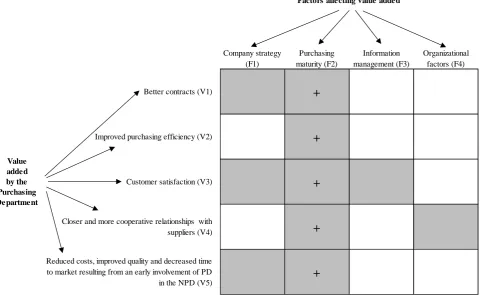
Figure 1. The relation between purchasing added value and affecting factors.
Source: Telgen and Pop Sitar, 2001
4.2
Types of purchasing added value
As shown in the above model, Telgen and Pop Sitar (2001) selected five categories of purchasing added value which they consider to be representative and important for every organization: better contracts, improved purchasing efficiency, customer satisfaction, closer and more cooperative relationships with suppliers, reduced costs, improved quality and reduced time-to-market resulting from an early involvement of the purchasing department in the new product development process. Different experts use different criteria to classify purchasing added value according to the need. “Savings realized” has been validated as a primary purchasing contribution by several researchers, and also considered as an important measurable area in the purchasing maturity process (e.g. Foerstl et al., 2013; González-Benito, 2007; Hartmann et al., 2012; Schiele, 2007). It can be the sum of cost reduction and avoidance realized in proportion to purchasing spend plus savings for one sourcing project (Van Poucke te al., 2014).
The emerging e-Commerce and other information technology enrich the kinds of values added by purchasing function (Telgen & Pop Sitar, 2001). The effects on the purchasing function include: concentration on strategic and value adding activities by transferring operational activities to users; streamline of the entire purchasing process to eliminate all non-value adding activities; a tighter control over the entire process; powerful supplier and end-user databases; information flow of all activities; and comprehensive and flexible management reporting system. Accompanying with the development of technology, the competence of purchasing professionals has been improved and also the maturity of the purchasing function has been accelerated. As stated earlier, purchasing maturity can
facilitate purchasing added values. Van Weele (1998) identified the main values added by purchasing services in each of the evolution stages towards purchasing maturity, as demonstrated in Appendix C. In his model, six purchasing maturity stages were defined: transaction orientation, commercial orientation, purchasing orientation, process orientable, supplier chain orientation, and value chain orientation. The added values expand sequentially along with the first to fourth stage: from assuring the continuity of the supply, to importance in cost structure, to the benefits from internal cross functional co-ordination and uniform buying policies and systems, and finally to the extensive use of cross-functional teams and focusing on reducing total systems cost and satisfying the internal customer. In the stage of supply chain orientation, purchasing is characterized by improved information system, co-development with internal and external stakeholders, and early involvement in the new product development process. The ultimate stage of purchasing maturity aims to design the most effective and efficient value chain to maximize the end customer satisfaction, which is characterized by an extensive use of cross-functional supplier development teams and a close collaboration on advance technology with suppliers.
The purchasing added values mentioned above can be direct or indirect contribution, quantitative or qualitative benefit and also can be categorized in correspondence with its beneficiaries. Leenders and Schiele (1999) identified four ambits where the purchasing function create values and suggested classifying the purchasing added value into four corresponding categories. The first category is value added to the organization, which is reflected in the global results of the organization, for example controlled costs and right supplies. Value added to the Company strategy
(F1)
Purchasing maturity (F2)
Information management (F3)
Organizational factors (F4)
Better contracts (V1)
+
Improved purchasing efficiency (V2)
+
Customer satisfaction (V3)
+
Closer and more cooperative relationships with
suppliers (V4)
+
Reduced costs, improved quality and decreased time to market resulting from an early involvement of PD in the NPD (V5)
+
Factors affecting value added
purchasing process impacts the smoothness of the purchasing process such as streamlined process, better supplier evaluation. Value added to the specifier is better understanding the needs of internal customers (user areas). The final group is value added to the supplier, which contributes to suppliers and influences their relationship with the organization, for example helping them to understand the needs. The focus of this work is the value added provided by the purchasing function to internal customers, which will be expatiated further in Subsection 4.4.
4.3
Strategies to increase purchasing added
value
Through empirical data from 21 organizations in diverse industries, Dumond (1994) recommended a series of changes for managers to support and encourage value-based purchasing: “focus individual purchasers on customers’ needs and identify value-adding processes; develop a performance measurement system that emphasizes quality, process improvement, and customer satisfaction; integrate purchasing into the organizations’ communication system; educate not only individual purchasers but also their customers” (Telgen & Pop Sitar, 2001).
In order to increase resources which can empower the purchasing function to create more added value, O’Reilly (2000) identified five strategic initiatives:
1. Greater involvement with customers: It allows the purchasing department to identify priorities among purchasing tasks and set goals to align with other departments.
2. Expand the role of suppliers: Close relationships between buyer-supplier facilitate the supply chain flow and earlier involvement of suppliers can benefit the development of new products.
3. Be more participative in the planning process: This strategy is related with the first one, since it involves the participation of the purchasing department in the planning sessions of internal customers and vice versa. Reflection of customer feedback in the purchasing plan does not only give new insights to the purchasing professionals, but also transmit the customer a sense of ownership and empowerment.
4. Use technology more effectively: The popularization of the Internet and the implementation of e-Procurement tools has created enormous advantages benefits such as the standardization of procedures and optimization of time and space.
5. Be more results oriented: Indicators of performance must reflect the strategy of the organization and contributes to its goal. As part of its benchmarking efforts in both academia and industry, the Center for Advanced Purchasing Studies (CAPS) has proposed a series of strategic measurements which are applicable for any purchasing department and provide a way to compute and report results periodically and consistently.
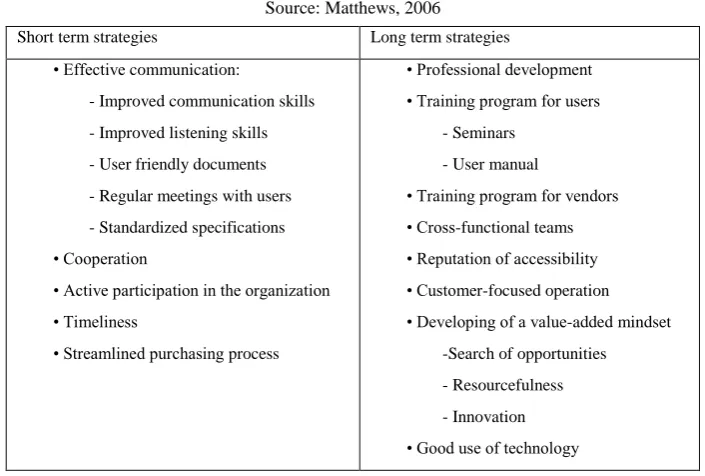
[image:5.595.121.474.478.716.2]Darin Matthews, the current Director of Procurement at UC Santa Cruz who has been interviewed by the researcher in the present study, summarized strategies to increase purchasing added value into two categories (i.e. short term and long term). As listed in Table 1, most of the strategies are practical and easy to understand, and some of them will be recommended to the UTPD later. Matthews (2006) also stressed that added value can and should be created in the different stages of the purchasing process: prior to solicitation (request for proposal process, specification development, etc.); solicitation phase (administration of process, deal with inquiries, etc.); award phase (negotiation, protecting company’s interests, etc.); contract administration (to take care of disputes, ensure delivery, etc.). This means different strategies and approaches are required at each purchasing stage for value creation.
Table 1. Short and long term strategies to increase the purchasing added value.
Source: Matthews, 2006
Short term strategies Long term strategies
• Effective communication:
- Improved communication skills
- Improved listening skills
- User friendly documents
- Regular meetings with users
- Standardized specifications
• Cooperation
• Active participation in the organization
• Timeliness
• Streamlined purchasing process
• Professional development • Training program for users
- Seminars
- User manual
• Training program for vendors • Cross-functional teams
• Reputation of accessibility • Customer-focused operation
• Developing of a value-added mindset
-Search of opportunities
- Resourcefulness
- Innovation
4.4
Value added purchasing for internal
customers
The vision of an origination as a supply chain implies that each function cooperates closely with its internal suppliers and internal customers. Stanley and Wisner (2002) claimed that the organization’s internal environment consists of structures, strategies, and communication patterns between internal suppliers and internal customers. Slack and Roden (2015) also described the internal customer-supplier relationship in their book:
The terms internal customer and internal supplier can be used to describe those micro operations which take outputs from, and give inputs to, any other micro operations. Each micro operation is therefore at the same time both an internal supplier of goods and services and an internal customer for the other micro operation's goods and services. The internal customer–supplier concept is regarded by some as one of the most powerful aspects to emerge from total quality management. It is recognition that everyone is a customer within the organization and consumer goods or services provided by other internal suppliers, but at the same time is an internal supplier of goods and services for other internal customers.
In this concept, processes are broken into micro operations that takes an input from a previous work step (i.e. internal supplier), adds value to it and provides an output to the next work step (i.e. internal customer). Thus, purchasing can be viewed as a supplier within the organization serving its internal customers such as research and manufacturing (Schiele, 2006; Wisner and Stanley, 1999; Wynstra et al., 2003; Young and Varble, 1997). The quality of the output in each micro operation is a prerequisite of a company’s overall performance (Large & König, 2009). When both the customer and suppliers in each micro operation have limited resources, they must work together as partners to maximize the return (Besterfield, 2009), as opposed to a transaction relationship. The quality of internal partnerships can determine supply management in the organization and operates at the tactical or the strategic level (Smith & Nelson, 2009).
The development of strategic internal client partnerships is considered a best practice that can provide significant benefits such as “optimized business results” and “value chain integration” (Smith & Nelson, 2009). Purchasing internal service has also become a critical value driver (Cousins et al., 2006). Jun & Cai (2010) identified six key internal service quality dimensions as perceived by the purchasing department’s internal customers: customer intimacy, team-based continuous improvement, communication, reliability/competence, requisition process and tangibles. In addition, this study reveals that customer intimacy is the most influential dimension to achieve both high internal customer service quality and satisfaction. Furthermore, Sánchez-Rodríguez et al. (2004) conducted an empirical research which showed that the implementation of quality management practices in purchasing is significantly related to the achievement of increasing levels of purchasing’s operations and internal customer satisfaction. Van Pouckea et al. (2014) suggested that purchasing’s internal service quality is also affected by the purchasing maturity process
5.
PURCHASING VALUE
-
ADDING
ACTIVITIES IN PRACTICE: “STANDING
ON THE SHOULDERS OF GIANTS”
Benchmarking in the achievement of better results in the purchasing function positively affects the overall business performance (Sánchez-Rodríguez et al, 2003). When benchmarking externally, the organization examines the same
function in peer organizations for comparative analysis and understands what constitutes “good” performance. The benchmarking study in this research includes the desk research on purchasing added value in 56 top technical universities in UK & US, as well as case studies for the best purchasing practices in 5 universities. The first method aims to grasp the up-to-date value adding activities and innovations of the purchasing function in technical universities, as presented in Subsection 5.1. The second method aims to gain the insight of the internal processes and shares the experience and perspective of purchasing directors. The 5 top technical universities are University of California - Sante Cruz (UCSC), University of California – Irvine (UCI), NC State University (NCSU), ETH Zurich and KU Leuven. The interview questions focus on purchasing process and system, stakeholder management, as well as any best practice. The indicated value adding activities are summarized in Subsection 5.2 to 5.4. The more elaborated description of the purchasing function of each university can be found in Appendix E.
5.1
“Primary impression” of purchasing
services
In order to gain a general understanding about purchasing in technical universities, the researcher has visited the website of many top universities and identified some common features. The list of the desk research is from the Times Higher Education World University Rankings 2016-2017, consisting of 20 top technical universities ranked in “engineering and technology”, 10 top ones in “computer science”, and 26 top ones ranked in both subjects (It should be 27 in total, but University of Southampton was removed because it shares really limited information on its website). Among 56 universities, 14 of them are from UK and the rest are from US. The attention has been paid to purchasing activities and added values, as well as the organizational structure, mission and vision statement of the purchasing department.
It is noticeable that 91% of these universities set up the purchasing function under the finance division. The vision and mission of purchasing in different universities are almost the same. They want to be a high performing strategic partner contributing to the financial health of the university. The mission is normally to provide cost savings and efficient services for teaching and research, as well as professional and qualitative purchases. 30% of the universities claim that they take consideration of the sustainability, environment (e.g. “buying green”, “Planet Blue”) and social responsibilities. Besides, all the procurement departments are also responsible for the compliance of laws, internal and external regulations and rules. The overview of all the universities and the link of their purchasing services, as well as key finds, is attached as Appendix D.
Procurement with the SuperNova Award in the category of Technology Optimization and Innovation. In FY15/16, it is reported that the program delivered $268.7 million in annual benefits, which is one year ahead of the program goal. In 2016, the P200 program has evolved to SC500, as one of the key strategic initiatives to increase the annual benefit to $500 million. SC500 expands upon P200 “by leveraging the successful cross-campus governance model, expanding Centers of Excellence (COE), fully integrating procurement and payable processes, consolidating program benefits, continuously improving procurement processes, and optimizing the supply chain”. Not only purchasing, the program also includes accounts payable, shipping/receiving, warehouse/stockrooms, inventory and equipment management (disposal/surplus/recycling), and travel.
Except UC, some other universities also publish the cost savings at the website to manifest their accomplishments. The main sources of benefits are from competitive bidding and contracted suppliers. Thus, universities stipulate the solicitation of public bids for high value requisitions. For instance, Brown University requires three signed and dated written bids for all purchases of $25,001 or more. For purchases of $5,000 or more, it is also recommended that bids be solicited. Individual purchases from Preferred Contract Suppliers do not require competitive bidding. Since their pricing and other conditions have been predefined, the benefits have been realized by discounting or other negotiated terms. The user only needs to simply indicate on the sole source form that a Purchasing Services Preferred Supplier was used. This policy means the authority of supplier selection has been transferred to the customers within a predefined framework.
For the majority of universities, small purchases are decentralized using procurement cards and e-Procurement system, while higher value purchases are mainly the territory of procurement department. 55 out of 56 universities have procurement card program for small value miscellaneous purchases with a different threshold, and all the visited universities have e-Procurement system (or called iProcurement, eMarket, eStore, and any nickname). e-Procurement is an internal online ordering system connected with external supplier portal. For instance, the MIT's eCatalog is described as “a great first choice for purchasing because no credit cards are necessary and no sales tax will be included in any order”. e-Procurement is generally promoted with efforts by the procurement department.
The website of procurement department is often customer-oriented. It provides clear information for internal customers about the purchasing strategy and instructions for different needs. Commodity management or category management makes the user more convenient to select and order the goods. Code of conduct and policy documents are normally shared. They also provide a training workshop or online tutorial about the purchasing method and process, in particular the training for e-Procurement and purchasing card program. To build connection with customers, some universities publish newsletters regularly. For example, University of Colorado – Boulder sends the PSC Communicator by email, which is a regularly-published 1-page newsletter from the Procurement.
Most of the websites are also supplier-friendly, with a supplier center to guide the supplier to have business with the university. Bid/tender opportunities are also posted and updated at the website. For example, at the University of California Public Bid Site, suppliers can create an account and browse public bid opportunities with the University of California's 10 campuses. Some of universities specially have “Supplier Days” or “Vendor Fair” to create the opportunity for suppliers’ exhibitions. Most of the universities share externally or internally (intranet username and password needed) their own supplier base or so at the website
called supplier directory, the supplier portal, the list of preferred and contract suppliers, or the list of approved or recommended suppliers. When a supplier is qualified under certain conditions, it will be included in the e-Procurement of the university and customers feel free to buy directly from this supplier. Furthermore, most of American universities put the statement of supplier diversity development and similar programs at the website, to protect Small & Medium Size Enterprises (SMEs), local businesses, woman-owned or minority-owned businesses. The best example is the program of SWaM (Small, Woman-owned and Minority-Woman-owned Businesses) of Virginia Polytechnic Institute and State University, which accompanied with an annual SWaM Vendor Fair and SWaM supplier database.
5.2
Visible cost reduction
As mentioned above, financial control is very important for the universities and regarded as the most important purchasing added value at many universities. This purchasing added value is also reflected in the mission statements of the purchasing department of universities. For example, the mission of UCSC Procurement is “Generating strategic procurement opportunities and benefits for the campus while delivering exceptional customer service in support of expanding the boundaries of knowledge”. The mission of UCI Procurement is “To expand opportunities for teaching, research and public service by delivering savings and efficient procurement services across the University of California.”. All the 5 interviewees were willing to share their achievement in this area.
In both UCSC and UCI, the benefits are measured according to a standard developed by the UC system in the program P200 and SC500 which has been introduced earlier. The total annual benefit can be generated from four types of procurement actions:
Cost Reduction. Benefit achieved when procurement action results in a total cost that is lower than baseline cost, and the baseline cost calculation is supported by documented historical price (i.e. previous contract, historical costs, or imputed historical cost).
Cost Avoidance. Benefit achieved when procurement action results in avoidance of additional cost (i.e. maintenance fees, requested price increases, or other ancillary costs).
Incentives. Benefit achieved when procurement action results in new gross incentive (based on volume, compliance/utilization, transaction size, electronic payment, e-commerce, signing bonus, GPO, management fees, etc.).
Revenue. Benefit achieved when procurement action results in revenue generation.
The UC requires that a baseline type and amount must be specified in order to calculate a benefit, and listed the first three baseline types in order of preference. The UC Procurement Services also present a list of examples of activities that may generate benefit. The complete information about this benefit recognition and generation can be found in Appendix F. Both universities have a good achievement in cost reduction. For example, the “Benefits Achieved” in UCSC was over $4 million savings for fiscal years 2015 and 2016, which exceeded annual benefit goals with more than 28%. For Fiscal Year 2017, they set a goal to realize $2 million in benefit. Below are examples of activities that may generate benefit.
discounting for the University. Secondly, the automatic systems such as e-Procurement and Purchase Card save a lot of time and labor cost. According to Snehal Bhatt, the Chief Procurement Officer of SCI, the cost to process one regular purchasing order is $150, while a purchase with procurement card can be one third of it. The NCSU also pays e-Procurement suppliers with the virtual card. Each supplier has an account offered by the bank to pay the e-Orders. In this way, the administrative work and accounting cost are significantly reduced. The third channel is the Surplus inventory catalog, available online, and increases the rate of recycle and resale inside or outside the campus, which saves a lot of costs and generates revenue for the customer.
There is also report in cost reduction through public tenders at ETH Zurich, and it has been less emphasized. However, Stefaan Saeys, the Head of Central Purchasing of KU Leuven, stated that customer service quality is more important than cost savings. “Make customer happy!” is their slogan. Since the resource is limited, if they spend too much effort on the price negotiation, they may not provide high quality of services. To ensure customer satisfaction, every customer has their own purchasing specialist to provide intimate services. For every project, the specially-assigned buyer gets evaluated for his/her performance by the customer. In this way, the customer satisfaction is very high and central Purchasing has a good reputation. Thus, the universities have various goals and strategies.
5.3
Efficient Purchase-to-Pay processes
Compared with the traditional purchasing function “We buy it for you”, the new trend for the university procurement is “We tell you how to buy”, especially for those low value purchases. For example, UCSC states that Procurement Services is responsible for providing the tools and business processes for acquiring goods and services at the University. The vision is “Within the framework of UC guidelines and policies, Procurement Services delivers innovative solutions with professional integrity through simplification and creativity, making us a highly sought after strategic partner”. The most common tools are e-Procurement and Purchase Cards, which are always viewed as the “meritorious statesman” for cost savings, as introduced in Subsection 5.2. In addition, Sharon Loosman from NCSU also stated that one extra value added by the Procurement to the internal customer is annual reporting generated automatically by the MarketPlace and PCard system. The systems collect all the data and provide different reports (spending per category or per department) to all the using departments. The report with visualized chart helps every department to make a good decision on the budget plan for the next fiscal year.
e-Procurement is a very important tool to realize the automation of purchasing control and management. A Purchase Card be used to procure low-risk and low dollar-value goods. All the five interviewed universities have their own developed systems to release e-Procurement. They are similar in structure and integration within the financial system, but tailored according to the need. ETH Zurich has an e-Procurement system where all the customers can order laboratory equipment, office supplies and other products. The purchasing order is sent to the suppliers directly and the goods will be shipped to the customer directly. However, they have no procurement card program yet. In contrast, NCSU has a very mature Purchase Card (PCard) program, which has developed and evolved over 20 years. This is an individual credit card paying for travelling, small services and other urgencies. Currently, 25% of the purchasing volume has been spent via PCard, i.e. $ 100 million per year. The process of PCard is much leaner than a standard purchasing process and leads efficiency and savings. When asking how to ensure the success of automatic system implementation, Ms. Loosman
stressed the key factors: information system support, leadership support, and motivation of the procurement department and partner departments.
5.4
Effective sustainable procurement
In addition to the contribution to cost-reduction, the paperless office is often a resulted from of the automatic Purchase-to-Pay processes. This brings a big value for the environment protection. In addition, all the interviewed universities have sustainable procurement program.
In UCSC, EPP (environmentally preferable products) is an important criterion in the selection of products and services. It is claimed that sourcing from suppliers who promote sustainability within their own companies is making a positive difference within the University. They advertise three main benefits of EPP products: environmental, financial and practices. UCSC has its own annual sustainability metrics. For example, earth friendly janitorial cleaning and paper products have increased up to 80% of the total purchase in 2016. It is the first campus in the UC system to officially make the CEH-Safer Furniture Pledge. This is a pledge developed by the Center for Environmental Health in US. It expresses a commitment by an organization to purchase furniture that is free of chemical flame retardants, fluorinated compounds, and polyvinyl chloride (PVC). In UCI, similar approaches and measurement with UCSC are used to encourage sustainable procurement. Its Green Purchasing includes “the acquisition of recycled content products, environmentally preferable products and services, bio-based products, energy- and water-efficient products, alternate fuel vehicles, products using renewable energy, and alternatives to hazardous or toxic chemicals”.
In NCSU, the Surplus Property Office is specially set up to manage the surplus property, which is has a re-sale value, but is no longer needed by the university department to continue its operation. The surplus property items will be picked up and made available for acquisition by other departments, public agencies or non-profit organizations. Surplus items not acquired by these entities are sold at public surplus sales. This program generates revenue for the customers and also contributes to the environment. Thus, university departments are strongly encouraged to obtain surplus items for their departmental needs, instead of buying new, more expensive supplies and equipment directly.
ETH Zurich Procurement focuses on “an economically viable and sustainable procurement and provision of goods and services”. This means that they not only look at the price, but also check the energy efficiency and lifetime of machines. This concern also is also reflected in tendering. The KU Leuven participates in the Flemish Supercomputer Centre (VSC), which guarantees access to a world-class high-performance computing infrastructure and studies critically into environmental sustainability, atmospheric modeling, researching of new materials, and medical research.
6.
CURRENT POSITION OF THE UTPD:
“WHERE ARE WE?”
far-off it is from the goals. The assessment results allow the PD to provide focused insights into the strengths and areas less developed within the department, as presented in Subsection 6.1. However, this assessment has pros and cons: it is comprehensive and convenient, while lack of flexibility to gain a deep understanding with the limit of all rigid predefined descriptions. Therefore, the complementary interviews have been conducted and brought more insights to the researcher about the department, especially when it comes to the processes and systems. The observation and unstructured communication of the researcher in the field will be also taken into account. In addition, internal reporting and documentation was also offered for more detailed data. The results will be presented in Subsection 6.2 to 6.4.
6.1
Developing purchasing function
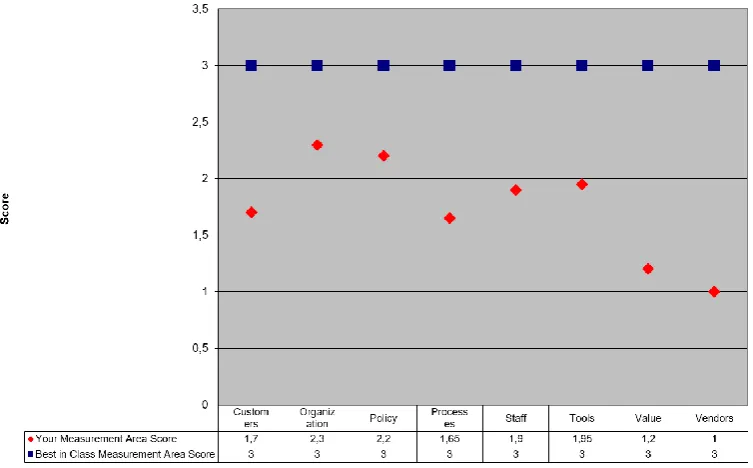
Stephen Guth’s Procurement Maturity Model has been selected for the assessment of the PD, based on two criteria: it is an assessment model with measurable scales, and it is applicable in public procurement. According to Guth (2010), there is a broad set of external factors in the procurement profession which directly affect organizational performance: customers, policy, staff, processes, vendors, tools, and organization. As an assessment model, it facilitates the process of benchmarking by pre-defining over 60 procurement best practices. In each of the practice, there is a clear statement of what is expected in each area, and a definition of each of the three levels of achievement (while “0” means the lowest rating, “×” when no data is available, and “3” is the highest). The results enable a gap analysis between the PD’s performance and the corresponding performance of a best-practice. The overall score of all right areas is interpreted in this way: 0.5 is "Inhibiting", 1.0 "Performing", 1.5 "Enabling", 2.0 "Optimizing", 2.5 "Best in
Class", and 3.0 "World Class". The UTPD got the final score 1.69, which is between “Enabling” and “Optimizing”.
The individual score for each area is shown in Figure 2. The highest score is the area of “Organization” and “Policy”, with 2.3 and 2.2 out 3.0 respectively. “Organization” factors cover strategic plans, structure, mission and vision, while “Policy” includes delegation, authority and standards. This means there is a minimal gap towards the best practices with clearly stated objectives and well-defined structure. The area “Tools” measures the management of contracts and RFx, website, and automatic information systems. It achieved a score of 1.95. In general, The PD is developed sufficiently in the “Staff” area (1.9), with training, engagement and performance management. The following sufficiency is the management of “Customers” (1.7) reflecting the effort of customer relationships and satisfaction. “Processes” scored 1.65, including audit, purchasing planning and forecast, purchasing order generation, and spending analysis. The university's audit department does audit every 3 months and then there is a general audit by KPMG (a large Dutch accounting company). The audit is being done for all purchases of above € 50,000 that have been processed by the PD. The “Value” (1.2) follows sub-questions about risk control, contract ratio and turn-around time, and cost savings. These elements are scored low basically because some of them are not measured by the PD. For example, the Manager stated that it was hard to judge the cost savings for each transaction. The price and quality can be optimized via public tendering, but still it is hard to calculate the cost reduction. The area of “Vendors” got 1.0 overall, which reflects that the PD has paid less effort on supplier management with significant gaps.
[image:9.595.111.488.421.655.2]
Figure 2. Procurement Maturity Model Score Comparison.
6.2
Striving for early involvement
As introduced earlier, the PD is divided into “Operational” team and “Tactical” team. This division corresponds to the steps of the purchasing procedure. Normally, there are 7 steps to complete a purchasing task: 1. Orientate; 2. Specify; 3. Select; 4. Contract; 5. Order; 6. Monitor; 7. Follow-up. The first four steps are in the
manage these various processes, since they have different characteristics and require different strategies and professionals.
It is easy to understand that not all the acquisitions are required to go through all the 7 purchasing steps. For those products with relatively small amount or frequently ordered, Step 1-4 may be skipped and purchasing orders are directly placed with suppliers. Any procurement of goods and services with a value above €50,000 has to be handed by Tactical team. However, no matter what value and nature an acquisition has, its user is not obligated to go through all the steps. Thus, the purchasing procedure can have been completed in any random step when the PD gets involved. Sometimes the pricing and contract clauses have been negotiated already by internal customers. Basically, the PD wants to be involved earlier and the possibility for the PD to add value.
For example, if a high-tech lab wants to buy a big and complex machine system for a new research project, the researchers may start contact with potential suppliers already during planning. The lab applies for the responding budget for each project and the researchers know exactly what equipment they need for the new experiments. Sometimes they even expect ideas and collaboration from suppliers when searching for possibilities of solutions and decide the specifications for an equipment. In this way, suppliers and end users may already have a close cooperation for a long time before informing purchasers. The biggest advantage of this direct contact is that it can be more efficient and more effective in the communication about complex specifications and technology. After all, it is not possible for purchasers to own different specialized knowledge and skills in various high-tech industries. Although professors and other end users may have a good motivation to involve the suppliers directly and early before involving the PD, it brings some potential risks. The greatest risk is that the earlier contact with suppliers may make the UT, in some cases, to be in breach of competition laws in public tenders. The current solution of the PD for this situation is that the end user is required to sign an agreement to acknowledge responsibility for any risk related to laws and regulations. However, although this means avoiding the PD to be the main risk taker, the UT as a public organization still face risk against related laws and regulations. Another potential risk is the fraud during the free cooperation without regulations and rules. Generally, the “seesaw battle” between purchasers and end users exist in this processes of purchasing. Purchasers want to “pull” more work and participate the acquisition as early as possible, while one end user may tend to “bypass” the purchasing function as long as possible. In the past years, the PD put effort to improve the purchasing involvement and made a great progress: the participation of the PD has been promoted from 57% of the purchasing volume in 2012 to 77% in 2016.
6.3
Fragmented Purchase-To-Pay systems
The overall complaint heard in the interviews, especially in the staff of the PD and the Logistic Department, is about the current computer systems. Those systems are expected to support the whole acquisition process from request, to order, to shipment and finally to payment to save manual work as much as possible.
The current order process starting in the Operational team is as follows, of which steps are interpreted if it is a manual or automatic procedure.
1. Fill in a purchase request form (uniform “OTA” form). Use one form for each supplier. This is a PDF form which needed to be filled in and sent to purchasers by email. This is an automated action. After the budget holder has approved of the OFI number, the PDF will automatically be sent to the Procurement mailbox.
2. The Procurement Department processes the purchase request form and enter it in the purchasing module of the Oracle system. An authorized financial person within the applicant’s faculty/service center is asked to approve the order in the system.
3. After approval, the Purchasing Order (PO) will be generated by the system and placed at the supplier in a PDF-file via email, which is also CC to the applicant for follow-up.
4. The Procurement department receives an order confirmation from the supplier by email, with the estimated delivery date. The applicant receives the order confirmation from the supplier or from the PD as well.
In Step 1-4, signed OTA form and confirmed PO will be archived in the Join system by a click in Outlook.
5. The supplier delivers the goods at ‘Centrale Ontvangst’ (Central Reception). The Logistics Department is responsible for the distribution of the goods to the buildings.
As soon as the goods are delivered at the Central Reception, the applicant can trace the order with CEGOON (CEntraal GOederen ONtvangst) with the PO number. The shipment information is entered by the Logistics Department manually, since they do not have a bar-code scanning system.
6. The caretakers within the applicant’s building are responsible for the distribution of the goods. The daily lists are produced out of CEGOON, based on the registered packages.
7. The invoice is sent to FEZ (Financial Services), who takes care of the payment. The payment is executed in the financial module of the Oracle system.
As described above, the manual and automatic operations are intersected. The systems are discontinuous and lack necessary connection, and enormous communication via emails cannot be avoided. When taking into consideration the 7,104 orders in 2015 and 8,275 orders in 2016, the cost of dealing with all the orders manually is incredible. Moreover, the systems do not support the export of needed reporting, which are mainly done in Excel sheets. In fact, the PD has realized the problems with IT systems for a long time, since those systems were developed about 20 years ago. The PD had initiated one new system development in 2010, but it got rejected by the top management due to the great amount of investment. This year, in 2017, a new initiation of Purchase-To-Pay system has been started again. It is expected to be an integrated in-house system to deal with cross-functional processes, with a transparent information flow.
6.4
Challenge in stakeholder relationships
The stakeholders of the PD include executive board, partnering departments like the logistics and finance department, internal customers, as well as external suppliers. The research focus mainly on the internal stakeholders and the related value added by the purchasing to internal customers.
The 2016 report shows that there are over 7,000 suppliers in the business with the UTPD. Currently, every supplier has a folder in the PD’s database, outlining the basic performance records. The main metrics are shipment-on-time and feedback from customer about quality. When there is a problem, the Tactical Purchaser will meet with suppliers. The common complaint about suppliers is that they do not always ship the goods with the required documents, especially the PO number. In order to bridge the supplier and the end user, the PD has a pilot of web portals, via which end users can place orders from the contracted suppliers.
When asking about the cooperation with FEZ, the most frequent answer was the different culture from the PD. Although there are regular meetings between Finance and Procurement, there is still space to improve the collaboration. The cooperation and collaboration between the PD and the Logistics Department is going on smoothly in general. One of the few complaints is that they feel reactive because of the one-way contact and lack of agenda. The Logistics Department is also calling for a new all-in-one system and wish the participation of its development.
7.
VISION & OPPORTUNITY: “WHERE
ARE WE GOING?”
The mission of the PD is the continuous improvement of the procurement services of the UT. The PD functions as an integrated part of the business process and contributes to the unimpeded progress of the primary process. The PD proactively provides advisory services around purchasing activities to administrative departments, faculties and research institutes. In addition, the PD provides professional contract management and supports requesting, ordering and delivering processes.
The main strategy of the UTPD is customer centricity. This means putting the customer at the core of the business. As a department, the PD has to cope with a multitude of internal and external changes. The developments at the UT directly affect and afford opportunities for the PD. It includes the Vision 2020 of the UT and its direction: international, collaborative, entrepreneurial (experimenting, pioneering and taking risks). The external opportunities are mainly the renewed procurement law with more space for innovation and digitization with more space for e-Procurement. Based on the opportunities and customer demands, the UTPD has identified three goals for the period 2017-2020.
1. Fulfilling innovation: The new procurement law stimulates innovative ability. It is the buyer’s job to exploit space and the potential of these legal frameworks. As a launching customer, the UT will be the first customer of innovation developed by the supplier and helps bring the innovation into market. Innovation and launching customers join the theme of “Living Smart Campus” and help the UT companies to commit themselves. (“The Living Smart Campus is a true living lab. In this program, scientists, students, and external parties work on solutions for complex societal matters that require a scientific approach. To explore solutions, the campus is used as an experimental environment where students and scientists live and work, which makes conducting experiments easy and visible. Given its exceptional facilities the campus offers a unique place to prepare solutions before they are introduced into society.”)
2. Set up an efficient pay process: The current order-to-pay process is not optimal and customer are dissatisfied with the laborious process. Therefore, a brand new procurement process will be designed, supported by an e-Procurement system. This can make the biggest impact in terms of lead time, information provision on orders and invoices, insight into budget utilization, efficiency and legitimacy of the process.
3. Professionalization of contract management: It aims to make internal customers more satisfied with supplier performance, to maximize the utilization of contracts, and to minimize contract risks.
All the attempts above aim to improve customer experience. The UTPD expects better customer relationship and early purchasing involvement. They hope the procurement function is known better by the customer and the customer is pleased to contact the PD in any need. They hope learning from “best practices” in other technical universities and want to know what quality and competency they own. In other words, the goal of the UTPD is to add as much value as possible in purchasing process, especially to internal customers.
8.
STRATEGY & ROADMAP: “HOW TO
GET THERE?”
So far, the status quo of the UTPD and its vision for the near future have been identified. It is very easy to make the comparison and identify the gap. This section proposes the strategy and a roadmap for the development of the PD to pursue its goal. As reported earlier, the culture of the UTPD is “customer centric” and its vision is “Happy customer”. Thus, the customer satisfaction is the top priority and the value added by purchasing to internal customers is the primary objective. This philosophy is the same as KU Leuven and different from American universities which normally regard monetary “benefits” as the greatest purchasing added value. However, cost control and reduction is still regarded an important purchasing added value in both literature and practice. It cannot be ignored when looking at the huge amount of savings American universities have reported. Thus, cost savings will be also taken consideration in the further proposals. In order to add more value for the internal customer, the main strategy proposed is developing a more mature purchasing function and improving the early involvement. A roadmap will be developed for the UTPD to pursue its desired performance and create more purchasing added value. It is divided into three main steps, each of which included a number of detailed proposals. The best purchasing practices identified in the research in the literature and top technical universities will be applied. The scope to be developed can be shaped into three concentric circles: the department itself, internal stakeholders which are mainly customers and partner departments, and external stakeholders which are mainly suppliers.
Step 1: Develop a more mature purchasing
function to nourish value creation
As reviewed in the literature, purchasing maturity is the most important factor positively affecting the purchasing added value such as cost savings and financial performance. The more developed the purchasing function is, the more purchasing added values are brought to the organization. A mature purchasing function is highly developed and has sufficient competence to perform its mission. The earlier assessment of purchasing maturity of the UT (Section 6.1) indicates some significant or substantial gaps between best practices. Therefore, the first step of the roadmap is to develop the PD to a higher maturity level.
Step 1.1: Differentiate purchasing strategy based on
portfolio management
universities manage various commodities in two big groups: standard and non-standard products and services, and no portfolio model is formulated. This following portfolio is prepared for the PD to optimize the purchasing process and give the customer a clearer guideline.
On the one hand, the goods and services needed by a technical university can be divided into two big groups, according to their requester and utilization. One is facility purchasing, including office supplies, hygiene, catering, security and surveillance, safety engineering, cleaning, secondary waste management, plant care, maintenance of buildings and fixtures. The common characteristic of these supplies and services it their “hygiene” nature, which means they do not give positive satisfaction, though dissatisfaction results from their absence. The same as Herzberg's Two-Factor Theory of Motivation about job satisfaction, the term “hygiene” is used in the sense that these are maintenance factors (Herzberg, 1959). However, right quality of scientific lab equipment and solutions can help meet research goals. Good performance in these purchases can be motivators of the customer’s positive satisfaction. Thus, the purchasing function in technical universities may make efforts to add more value to professors and researchers by supporting their purchasing.
On the other hand, the amount of purchasing orders is also one of the common criteria for purchase classification. Different universities follow different internal policy and rules, as well as laws and regulations. Normally, there are at least two thresholds, one is defined as small amount purchases financially, and another is public tenders/bids. In the UT, the orders are divided into four groups according to its own policy and EU directives: the requisition up to €5,000 is considered as small amount purchases; the requisition between €5,000 and €50,000 is handled by the Tactical Team; the requisition between €50,000 and the EU public procurement threshold is required for three quotations; and the requisition above the threshold of EU public procurement (varied for different works and services) has to follow the European public tendering procedure.
Therefore, all of the requisitions requested by different departments can be classified into eight segments according to the functional nature of the goods and services and the approximate amount of requisitions. Each item can be marked in the appropriate place on the product purchasing classification matrix. The classification in the matrix can be dynamic according to two criteria, namely flexible ways to divide commodities and variable thresholds. Table 2 presents a proposal for current portfolio management. It distinguishes the characteristics of facility procurement and scientific & laboratory procurement, and devises different purchasing strategy and methods for different segments.
For small purchases of facility supplies, the eProcurement environment accessing the supplier portal is an easy solution. As a one-stop shop, the eProcurement software solution streamlines
purchasing requisition and purchase order processes and lets the customer easily track and manage purchase orders in real-time. The next proposal will give an elaboration about this electronic procurement method. For the small purchases of laboratory supplies, a Procurement Card may also be a feasible method. The customer can utilize a Visa card to make purchases of goods and services (up to policy) of €5,000 or less. Using the Procurement Card for buying and paying is quite cost-effective for the university. The same as eProcurement, Procurement Card allows the customer to make purchases in a timely manner, track expenses, and reduce the accounting work. Both methods decentralize purchasing authority by enabling the customer to make purchases without a paper trail and reduce transaction processing costs considerably. The cost saving facilitated by these adoptions can be significant when considering thousands of orders per year in the UT (80% of purchases may account for 20% payment volume). Low-value items generate low-cost transactions and high-value buying attracts more professional input. This is one of the advantages of purchasing portfolio management.
The strategy devised for each segment is inspired from Porter's Generic Strategies (Porter, 1985). In this context, “Cost Leadership” means focusing on pricing and efficiency. “Differentiation” means creating uniquely desirable services for internal customers. “Focus” means offering a specialized service in a niche market. The “Focus” strategy here can be also subdivided into two parts: “Cost Focus” and “Differentiation Focus”. According to the expectation of customers, different strategy may be used. For “hygiene” commodities, “best value for money” may be the goal. Thus, the strategy can be “Cost Leadership”, which creates cost savings. For those professors and researchers for high technology (like nanoscience and nanotechnology), they have much higher demand on quality and cooperation from suppliers. Thus, “Differentiation Focus” strategy can be used for the purchaser to provide strategically differentiated services to the specific customer niche.