The future of HRM:
an analysis of the symposium
‘back to the future’
Carolien Balvers
Master thesis
December 2016
Supervisors: Prof. Dr. T.V. Bondarouk Dr. J. Meijerink
Business Administration Faculty of Behavioural, Management
2
Acknowledgements
This master thesis is written as the final part of my master in Business Administration. With a bachelor in Psychology, doing a master in Business Administration has been quite challenging sometimes, but now that this master is coming to an end, I know that I can achieve more than I have ever thought. I am very happy and proud to present this final piece of work.
The topic of HRM had my interest from the very first moment that I started with Business Administration. Therefore, I was very excited when I got the opportunity to evaluate the HRM symposium ‘back to the future’ for my master thesis. Futures studies were completely new for me at the start of the writing process, but now I think it is a really interesting field of research. I’ve learned a lot during the writing of this thesis and I got even more enthusiastic about the HRM field.
I would like to thank Prof. Dr. Tanya Bondarouk for her valuable guidance and feedback during the writing process. From the start, she was very willing to help and I really enjoyed our conversations. I also want to thank Dr. Jeroen Meijerink for his feedback on my thesis at the end of the process and for his participation in my interview. I’m also very thankful for the other persons who took the time to talk with me about their opinion regarding the different HRM themes: Dr. Sjoerd van den Heuvel, Dr. Anna Bos-Nehles, Peter Reilly, Cor Polling, and Patrick Willer.
3
Summary
Nowadays, the HRM field is changing a lot. For organizations and researchers, it is of great importance to keep track of these changes in order to respond adequately to them. Within this master thesis, insight is created in the expected future of the HRM field. The goal of this study was to critically look at the data of the symposium ‘back to the future’ and to describe what is expected of the future of HRM, so that organizations and researchers can respond to this.
During the symposium ‘back to the future’ the participants brainstormed using the World Café method, which enables large groups to think together in a constructive way. The themes ‘doing HR without HR’, ‘HR analytics’, ‘from I-nnovation to WE-nnovation’ and ‘smart HRM’ were discussed during the day. The outcomes of the symposium were coded and analyzed. In addition to the outcomes of the symposium, interviews with scientific and business experts were held to expand the research and to broaden the amount of knowledge per theme.
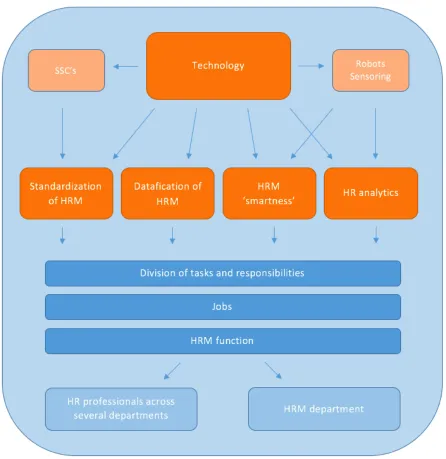
It was found that a few concepts seem to be important when considering the future of HRM. The most recurring concept is technology. Technology will cause most of the changes in the HRM of the future. In the first place, technology will lead to more standardization. It is of great importance in the future to consider how tasks and responsibilities should be divided. Who is responsible for what? And if there will be less human resources, should HR still be a separate function in organizations or is that no longer necessary and can the function be subdivided? Secondly, due to the standardization and automation caused by more advanced technology, there will be a growing amount of available data, that can be used for several purposes. In the future, the data that will be used for HR analytics and for datafication should become more accurate than it is nowadays. HRM practices could be used to support the accuracy of the available data. Another theme that is considered important in the future of HRM is employee-driven innovation. In order to stimulate this more, organizations should create a learning organization in which employees feel supported to come up with ideas, they should think about team composition and they should set the right context.
4
Content
Acknowledgements ... 2
Summary ... 3
1. Introduction ... 6
1.1 World Café 1: Doing HR without HR ... 6
1.2 World Café 2: HR analytics: hello! (and goodbye?) ... 7
1.3 World Café 3: From I-nnovation to WE-nnovation ... 7
1.4 World Café 4: Beyond digitization: what is smart HRM? ... 8
2. Methods to study the future ... 9
2.1 Futures studies ... 9
2.2 The World Café method ... 10
2.2.1 The history of the World Café method ... 10
2.2.2 Characteristics and design of the World Café method ... 10
2.2.3 Comparison with other research methods ... 12
2.2.4 Application of the World Café method ... 13
2.2.5 Limitations of the World Café method ... 13
3. Method ... 14
3.1 Setting of the symposium ... 14
3.2 Research design ... 14
3.3 Participants ... 16
4. Results ... 17
4.1 World Café 1 ... 17
4.1.1 Participants’ point of view ... 17
4.1.2 Scientific point of view ... 19
4.1.3 Business point of view ... 19
4.2 World Café 2 ... 20
4.2.1 Participants’ point of view ... 20
4.2.2 Scientific point of view ... 21
4.2.3 Business point of view ... 22
4.3 World Café 3 ... 22
4.3.1 Participants’ point of view ... 22
4.3.2 Scientific point of view ... 24
4.4 World Café 4 ... 25
4.4.1 Participants’ point of view ... 25
4.4.2 Scientific point of view ... 26
4.4.2 Business point of view ... 27
5
5.1 Summary of the main results ... 28
5.2 How new is the future? ... 29
5.3 Practical implications ... 31
5.4 Limitations and future research ... 32
6. Conclusion ... 33
7. References ... 34
Appendices ... 36
Appendix A: World Café 1 ... 36
Appendix B: World Café 2 ... 41
Appendix C: World Café 3 ... 44
6
1. Introduction
The HRM field is changing a lot nowadays. There are new and more actors in HRM processes, smart industries are appearing, technology is developing, and so on. All these developments and innovations influence the HRM field. For organizations and researchers, it is of great importance to keep track of these changes in order to respond adequately to them. Within this master thesis, insight will be created in the expected future of the HRM field, thereby critically evaluating the output of the HRM-symposium ‘back to the future’.
On Tuesday the 10th of November 2015 the symposium ‘back to the future’ took place on the occasion of the 25th anniversary of HRM technology and innovation. The symposium was held at the University of Twente. During this day over hundred participants assembled to brainstorm about the future of HRM. They brainstormed using the World Café method. The overarching theme of the day was thus the future of HRM. Since this is a rather broad theme, four subthemes were chosen to structure the discussion. The four subthemes were all discussed in a separate room, in a so called World Café. The World Café method is a very applicable method for large group discussions and it is increasingly used.
The domains in which the World Café method is used for research are countless (Brown & Isaacs, 2008). The method has been used in lots of different cultures, among different age groups, with different underlying purposes and in many different types of organizations. According to Brown and Isaacs (2008), it doesn’t matter who uses the World Café method, the process just works. The past couple of years, the method has been successfully used in differing research domains, such as education, politics, information technology, conflict resolution, and evolution biology (Brown & Isaacs, 2008). Researcher Aldred (2011) also confirms that, the World Café method has spread to diverse sectors in the last years, and that diverse types of participants can take advantage of the conversational method.
Since the World Café method is an attractive method that enables large groups, from different backgrounds and hierarchies, to think together, by creating a welcoming and relaxing environment in which people feel free to speak up (Pulles et al., 2015; Tan & Brown, 2005), it is a method that is also good applicable for HRM situations. This is because in HRM (research) situations there are always employees or researchers with different backgrounds and functions who have to work together in order to come with solutions or helpful outcomes. By using the World Café method, they have a usable guidance to share their knowledge and to get the most out of it. During the symposium ‘back to the future’ the next four themes were discussed: doing HR without HR, HR analytics, employee-driven innovation, and smart HRM. In the next paragraphs these themes will be described in more detail.
1.1 World Café 1: Doing HR without HR
7 suggest that the traditional HRM activities are gradually moving away from HR advisors and HR managers: line managers and supervisors get more HR responsibilities, shared service centers anticipate to transition into transformational HRM service provision, and further digitization of HRM services is planned. The future development of HRM responsibilities was discussed in this World Café, according to the following four themes:
o HR Shared Service Centers
o Competences and responsibilities of HR professionals o HRM & Technology
o Employees’ involvement in HRM
1.2 World Café 2: HR analytics: hello! (and goodbye?)
The second World Café was about HR analytics. Over ten years ago it was already mentioned that the traditional service-oriented focus of HR should be extended to a more ‘decision science’, in which decisions about human capital are enhanced (Boudreau & Ramstad, 2005). This way the HR function should be able to find out what it means to be strategic, and to enhance decisions about the human capital. By now, this paradigm shift is slowly taking place. The construct of ‘decision science’ is nowadays referred to with terms like ‘HR analytics’, ‘workforce analytics’ or ‘people analytics’. More and more positive experiences of companies confirm the success and usability of HR analytics, which among other thing led to the fact that advanced HR analytics is becoming mainstream (McKinsey, 2015). HR analytics is increasingly seen as an unmissable tool for HR (Boston Consulting Group, 2014). But on the other side it is also known that organizations are having a hard time to let HR analytics become a reality within their organization. Besides that, it is also suggested that lots of organizations don’t have a clear vision of the ideas about the future of HR analytics within their own company. In this café there was attention for the survival of HR analytics within the HR function, how HR analytics can contribute to business goals, the role of technology to support HR analytics, outsourcing of HR analytics, teaching HR analytics at universities, and the focus HR analytics research. In order to get a clear discussion, there were four themes to discuss. Every table in the café had one of the following themes:
o Technology: future technologies to support HR analytics
o Employees’ responses: generating employee acceptance for HR analytics o Competencies: teaching HR analytics at universities
o Practices: future applications of HR analytics
1.3 World Café 3: From I-nnovation to WE-nnovation
8 that HRM plays an important role in promoting innovation, but nearly none of them use screening tools to select creative job candidates. This are all examples that show that organizations know that innovation and creativity are important factors within their company, however they don’t fully use this knowledge. In this café the focus was on WE-nnovation, where every employee is a potential source of innovation. It was discussed if this is a desirable direction, how a safe climate for sharing ideas can be created, what the management can do to stimulate innovation, etc. The discussions were directed by the following questions:
o Innovation in HRM Practices o Innovation in Networks
o Implementation of Innovations o Employee-Driven Innovation
1.4 World Café 4: Beyond digitization: what is smart HRM?
The last decades, digitization has extended its scope of impact. The term ‘digital economy’ was first mentioned by Tapscott (1995), and in the beginning it was about automating work processes and value creation in the production chain. Digitization is nowadays more and more coming to the core of the knowledge work, involving decision making and taking over cognitive challenging tasks. This has far-reaching effects for organizations. The HRM field enters smart businesses with convergence of human, digital, and high tech dimensions. Former traditional HRM tasks may also become further digitized, or even robotized. The boarders between consumption and production will become tangled: a consumer will convert more into a producer instead of into a co-producer. The consequence of this ‘do-it-yourself’-economy is that the HRM field is forced to become smart, where one may expect the future workforce consisting of the ‘consumer as a producer and a costless employee’. Within this café, smart HRM was discussed, according to the following four sub-themes:
o New competences for HRM Professionals o Datafication of HRM
o New jobs in smart industries o HRM practices in smart industries
9
2. Methods to study the future
The method that was used during the symposium ‘back to the future, the World Café method, will be explained in detail in this chapter. At first a broad explanation of futures studies will be given in order to get an overview of the diverse futures studies. After that, starting with the beginning of the method, the characteristics and design of the World Café will be illustrated. The World Café method will also be compared with other popular research methods. Then some examples of successfully applied World Café studies will be demonstrated, the sustainability of the World Café method for HRM will be explained, and finally implications of the method will be written down.
2.1 Futures studies
Futures studies are nowadays more and more of importance within a broad range of corporations (Hirshfeld, 2001). The futures studies are used for several purposes, with the common goal to be of help and to say something about the future of a corporation. In a study of Schwarz (2008) it is emphasized that a growing number of corporations are using future studies and its methods, and Schwarz states that this suggests that there is a very strong interest in these kind of studies in the field of management. The growing interest in futures studies is also visible through the various publications that recommend corporations to pay attention to their future and to develop foresight (Schwarz, 2008).
Within the HRM field no articles were found that already studied the future of HRM. The issues from the past couple of years till may 2016 of the journals ‘Futures’, ‘Foresight’ and the ‘European Journal of Futures Research’ were viewed in this regard. The scientific journal ‘Futures’ did publish an article about the future of work, in which they looked beyond binary hierarchies, however they didn’t consider the future of HRM as a function. This highlights the relevance of this study.
To get an overview of the different kinds of futures studies, ideas were borrowed from Schwarz (2008), who considered futures studies in a corporate context, with the goal to support strategic future oriented action. A distinction was made between the following methods (Schwarz, 2008):
o Quantitative forecasting
The goal is to make quantitative predictions in order to make the best possible decision about future events, by extrapolating data and trends. The main types of quantitative forecasting are the ‘exploratory method’ and ‘time series’. The exploratory method tries to correlate two or more variables, and time series uses past trends in order to predict the future trend. These methods are used when there is past data available and when it is likely that some patterns will continue in the future. Normally, these methods are applied to short-range decisions.
o Simulation and gaming
These methods can both be seen as being decision-aiding technologies that involve mathematical modelling.
o Delphi technique
10 o Scenario technique
This technique has the goal to identify existing trends and uncertainties and to combine them in a picture of the future. This picture doesn’t have to cover all eventualities, but is has to discover the boundaries of future outcomes. This technique does not use past data and does not expect past observations to be continued in the future, but it just tries to consider possible developments, which may be connected to past experiences.
o Issue management and strategic early warning
The goal of issue management is at first to identify and monitor social, technological, political and economic forces and trends. Then implications and opinions should be interpreted and defined. After that, strategic action should be set to deal with the situation. The underlying goal of this is that early signals of possible environmental change can be identified and detected already underway.
o Creativity
Creativity contains all the methods which foster creative thinking about the future. The World Café method is one of these creative methods. The creative aspect of the World Café method enables participants to come up with a lot of creative and new ideas and to speak out freely. The World Café method is very suitable for exploratory research (Chang & Chen, 2015). Therefore, the World Café method is extremely suitable for the goal of this master thesis to describe the expected future of the HRM field, since this is very explorative.
2.2 The World Café method
2.2.1 The history of the World Café method
The World Café method has emerged in January 1995, during a strategic dialogue on Intellectual Capital (Brown, 2001). The second day of the strategic dialogue had to take place in the garden of David Isaacs and Juanita Brown, but due to the heavy rainfall the dialogue was moved inside. In their living room, Isaacs and Brown put up several TV tables, decorated with tablecloths and stationary. Brown (2001) described the unexpected situation of that day the following way:
“And so it was. The rain falling, hard. People huddling around the TV tables, learning together, testing ideas and assumptions together, building new knowledge together, adding to each others’ diagrams and pictures and noting key words and ideas on the tablecloths” (Brown, 2001, p. 5-6).
After this second day of the strategic dialogue, the idea for the World Café method arose. Several years went by, in which the method was explored and expanded. Nowadays, the World Café method is a well-known, accepted manner to host group dialogues, since it activates the collective knowledge of a group (Brown, 2001; Brown & Isaacs, 2005). Among other things, this is a reason why the World Café method is becoming a popular method for brainstorming.
2.2.2 Characteristics and design of the World Café method
11 o Set the context
It is important that enough attention is paid to the reason of bringing the people together and to what the organization wants to achieve. With keeping these things in mind, it enables the organization to consider and choose the right elements to realize the goals.
o Create hospitable space
By creating a hospitable space, people at the Café will feel safe and welcome. When people feel comfortable and safe, they will come up with more creative ideas. The organization of the World Café should consider how they can contribute to creating a welcoming and pleasant atmosphere. o Explore questions that matter
Knowledge will come up when people are triggered with compelling questions. Therefore the organization of the World Café should find questions that fit the present group well. The questions should help attract the collective energy, insight, and actions of the people.
o Encourage everyone’s contribution
It is important for the Café hosts to give every participant the space and opportunity to participate. The hosts should actively encourage all participants to participate in the process, while on the other hand also respecting that some participants want to participate by solely listening.
o Connect diverse perspectives
A distinguishing characteristic of the World Café method is that there is the opportunity to switch between tables, to meet other people, to actively contribute to the thinking process, and to link the discoveries to ever widening circles of thought, thereby creating more and more insights. o Listen together for patterns and insights
The quality of the listening to each other is one of the most important factors determining the success of a World Café. Not just listening to what is said and shared, but also to what is not said. The participants should be encouraged to pay attention to themes, patterns and insights, so that the larger whole can be seen.
o Share collective discoveries
The conversations that are held at one table are, as part of the whole, connected to the conversations at the other tables. The last phase of the World Café, the ‘harvest’, is meant to connect these different parts and to make the pattern of wholeness visible to all the participants. The small groups can share their patterns, themes and experienced deeper questions with the larger group.
This form of ‘café learning’ enables large groups to think together in a creative way, as part of a single, connected conversation (Tan & Brown, 2005). The method is easy to use and often leads to surprising results (Tan & Brown, 2005). The method gathers information by stimulating café dialogues, through creating a warm and welcoming environment in which people feel good and thus feel free to speak up (Pulles, Schiele, Veldman & Hüttinger, 2015). To set up and host a World Café, the basic model of the World Café method can be used. This model consists of five elements, based on the abovementioned design principles (The World Café, 2016):
o Setting
12 o Welcome and introduction
To give the participants a warm welcome, the host begins with an introduction to the World Café process, thereby explaining the etiquette of the café, answering questions and setting the participants at convenience.
o Small group rounds
The World Café process starts with a round of twenty minutes, where the small groups around the tables can discuss a topic. After these twenty minutes, each person at the table moves to another different table. It is an option that one person per table stays as a ‘table host’ to welcome the new group and to inform them about what was discussed before. In total there should be a couple of these twenty minute rounds, with continuously rotating table members.
o Questions
Prior to each round there will be a question that is set up for the specific purpose of the World Café. There can be some different questions that complement or built upon each other to give direction to the conversation or the same question can be used for a couple of rounds.
o Harvest
After the discussions and/or conversations in the small groups, participants are asked to share their findings and insights with the larger group. These results are reflected visually. This can occur in varying ways.
Thus, in a World Café dialogue different conversations at small café tables are linked to each other since people move to other tables to discuss different questions or sub-topics with different people (Tan & Brown, 2005). All these conversations are connected to the same main topic. By discussing the different subjects this way, the knowledge sharing will grow (Tan & Brown, 2005). At all tables the key ideas are written down, so the key insights can be shared and saved.
2.2.3 Comparison with other research methods
Brennan and Ritch (2010) say that The World Café is in fact a specialized form of the conventional focus group approach. Focus groups can be used for theory building and for gaining more insight in behavior. The main idea of a focus group is to allow a group of people to share their ideas and opinions in regard to their experiences (Murgado-Amenteros, Torres-Ruiz & Vega-Zamora, 2012). This form of sharing thoughts allows for collaborative thinking. This is comparable to the idea of the World Café method, but the World Café method has multiple advantages over other approaches to guide group conversations, such as focus groups and (semi-)structured interviews (Pulles et al, 2015). The participants in the World Café method are active co-researchers that explore a particular topic, they are not interviewees. So the World Café method gives an opportunity for open discussion in which the participants can gain new insights from the experiences of the other participants. Besides that, the World Café often evaluates the outcomes of previous café rounds, which allows the participants to confirm, remodel, sharpen, or reject the previous findings. Through this process, the robustness of the outcomes is increased.
13 respondents that discuss a specific topic with each other in several rounds. However, the data gathered through the World Café method is much more useful for research, since it is much richer and less ambiguous. Within the World Café method, the data gathering consists of multiple data collection methods, such as the free interpretation notes on the paper blocks, and a voice or video recording, instead of only predetermined questionnaire answers. The World Café may take more time, but in the end gives more valuable data.
2.2.4 Application of the World Café method
In the past years several studies have been conducted in which the World Café method has been successfully applied. Pulles et al. (2015) used the World Café method in their study in order to gather theoretical conceptualizations. They wanted to research how a firm can become a preferred customer, however, decent literature about the conceptual variables and their coherence wasn’t available. To solve this problem they used the World Café method and successfully discussed these topics, eventually leading to hypotheses on the link between the constructs and preferred customer status. This way they could continue their study about becoming a preferred customer.
Schiele and Krummaker (2011) also successfully applied the World Café method in their study. In this study, the objective was to discuss risk management systems with various interested firms and universities. The initiators of the World Café first made a conceptual model containing the categories by which to access different factors of risk. Then there were several discussion rounds, with table rotations after the different rounds. Every table has a table host, to guide the discussion and to share previous ideas and knowledge at that table. Each table discussed a predetermined risk category, so that all risk categories were discussed and so that potential risk sources and indicators for monitoring these risk sources were identified by the end of the day.
2.2.5 Limitations of the World Café method
There are plenty successful stories of applied World Café methods in diverse settings, like in large multinationals, small non-profit organizations and educational institutions. However, there is a lack of evaluative studies that have examined the effectiveness of the World Café method (Fouché & Light, 2010). Until today, very little scientific evidence can be found for the effectiveness of the World Café method.
14
3. Method
3.1 Setting of the symposium
The symposium ‘back to the future’ was set up in such a manner that comparison of the different cafés in possible and allowed. In order to reach that comparability, all cafés had the same characteristics. Each of the four cafés consisted of four tables. In each café, the four tables addressed their topic from the four same perspectives: what, who, how and why? The main aim of each café was to formulate five research questions regarding the café theme. The discussions took place in four round, lasting respectively 40, 25, 20, and 15 minutes. In order to ensure a constant time duration of the rounds, each café had a time watcher. Further, each café had a café leader and three moderators. They were in charge of regulating the café. After each round, the participants switched tables, but they always stayed in the same café. The participants of the symposium were free to choose in which café they wanted to participate. However, once they choose one, they had to stay there for the rest of the day. After the four discussion rounds the question in all cafés was: ‘what is the most important/interesting research question/topic for the future of HRM?’ All participants were given stickers, with which they could vote on the statements they found most important. They could use an unlimited number of stickers, however, they could only put one sticker per bullet on the flip charts. In order to set up the symposium in the best possible way, Niels Pulles and Petra Hoffmann, two experts in this field, were involved in monitoring the design.
3.2 Research design
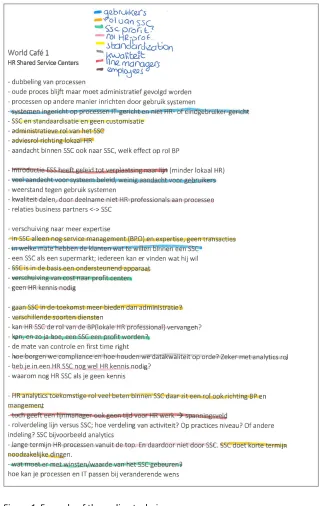
To say something about the symposium, all the available data gathered at the symposium was analyzed. The available data consisted of flip charts and some voice recordings. At first the flip charts were analyzed. At all the café tables the participants wrote down their ideas at the flip charts. In order to digitize the data, all the written text at the flip charts was retyped. This resulted in 24 pages of typescript. This typescript was then coded by hand. With different color markers the returning themes/topics were coded. As can be seen in figure 1, sentences coded with blue, are all related to the users of the HR Shared Service Centers. Using this coding technique, the whole typescript was coded.
15 Figure 1. Example of the coding technique
When the different topics were identified and sorted, provisional conclusions were drawn, hereby taking the importance of the bullets into account. These provisional conclusions were then discussed with the four café leaders of the different World Cafés for a so called member check. The member checks were performed to improve the quality and reliability of the conclusions. During the member checks the findings were discussed to check the conclusions. After that, the conclusions were revised.
16 to find out their corresponding professional and scientific opinions. The business professionals were also asked about their opinion about the future of the corresponding sub-areas of HRM. This way there are three perspectives per topic: the participants’ perspective, the scientific perspective, and the business perspective. The café leaders, and thus the scientific experts, that were interviewed were (from café 1 to 4): Dr. Jeroen Meijerink, Dr. Sjoerd van den Heuvel, Dr. Anna Bos-Nehles, and Prof. Dr. Tanya Bondarouk. They are all working at the University of Twente, for the Behavioural, Management and Social Sciences department, specialised in HRM. The business experts that were interviewed were (café 1, 2 and 4): Peter Reilly (principal associate at the Institute for Employment Studies), Cor Polling and colleagues (HR transforming consultant at Capgemini), and Patrick Willer (workforce innovation consultant at SAP). Unfortunately, the interview about the third café couldn’t take place.
3.3 Participants
17
4. Results
In this chapter the results of the discussion sessions at the symposium and the results of the interviews will be shown per World Café.
4.1 World Café 1
4.1.1 Participants’ point of view
HR Shared Service CentersThe most important question about the role of SSC’s that arose during the rounds is what the main goals of a SSC should be. What will be the tasks of the SSC, which functions will it perform, what kind of services are suited for the SSC? The question is if the SSC will do more than just the administration, or will it also take over other tasks. Besides that, people are curious how the cooperation between the SSC and the employees will be. How are tasks and responsibilities divided? In short, people want to know what the role of the SSC will be exactly. And when the SSC will play a bigger and bigger role within companies, what will be the role of the HR professional therein? Is HR knowledge still required within a SSC? Here arises a conflict; some people believe that HR knowledge is no longer needed within a SSC, but other people believe that the HR professionals are still needed, since they have the overview and can make connections. From this follows the question if the SSC can replace the local HR professionals and the HR business partners or are they still needed? And what is the impact on the HR Business Partners? It is good to figure out how the SSC can cooperate with the local HR and how they can divide responsibilities and tasks.
The role of the line manager is also important. The line managers will take care of the management of the different processes. When they perform better, there will be less questions at the SSC. However, this indicates that the line managers should always work flawless, in order to facilitate the operations well. But on the other hand, line managers don’t have time for HR tasks, so how will the communication with the HR SSC’s be? And how can they successfully control the HR managers, so that there won’t be questions at the SSC. This puts them in a dilemma: they have to do more in less time. The optimal division of tasks between the line managers, HR professionals and the HR SSC should be considered carefully.
Besides the role of the management and the HR professionals, the employees are also important components of this floorer. The concept of employees will change, according to all the changing processes and responsibilities. Some employees will have to work at the SSC, but will they experience job satisfaction in this function? Especially when the SSC will be a standardized process, what will be their task and do they have career opportunities?
Most of the people believe that the SSC is about standardization and not about customization. In addition to figuring out how the SSC can cooperate with the local HR, it is wisely to figure out when a company wants a SSC to standardize, and when to customize. This choice can cohere with the choice for the division of tasks and responsibilities. In this, consideration should be given to indicators for standardization of customization.
18 In the end, people are curious to the possibility of a SSC to become a profit center and how this should or could be accomplished. Nowadays, people see a SSC as a cost center, but if the SSC will play a bigger role in organizations, then how could it become a profit center?
And perhaps one of the most important questions that arose during this café is how to measure the success of the SSC. Because after all, the success of the SSC can tell if it was right to customize or to standardize, and if the division of tasks was done well, and if the end-users were able enough to work with the systems. Some people said that if there are any complaints, than the SSC in unsuccessful. This looks like the SSC should be a standardized process, in which mistakes are less occurring than in customized processes. But in here it is also good to consider if the quality gets worse if the processes are no longer performed by experts, but by ‘normal’ employees. So again it is the question if the HR knowledge is necessary for the SSC.
Competences & responsibilities of HR professionals
The main question that arose at this table was how work will be organized in the future. Will HR still be a separate function? During the symposium lots of the participants had the opinion that HR has to develop its own functionality. Whether HR will be separate function or not, a very important question that remains is what knowledge, skills and attitudes are needed for (future) HR professionals to achieve business and HR strategy, or to achieve the organizational’ goals. During the symposium the participants agreed that HR professionals will need (legal) knowledge, like knowledge of the business goals and strategy, knowledge of the business, and professional HRM expertise, and that the HR professionals will need particular skills/attitudes in coordinating, change management, communication and ethics.
Another question regarding the competences and responsibilities of the HR professionals that arose during the symposium is whether the HR department gives enough room to the line management to take their responsibilities. A recurrent theme was the shift from professionals to line management, and if this should take place or not. In the future it should be considered if this shift should take place, and if it does, how the line management and HR professionals will divide their responsibilities and how they will cooperate. Thereby it should be considered if there are differences between different organizational sizes, sectors and countries.
HRM & technology
In the discussion about HRM & technology the participants mainly explored the advantages and disadvantages of technology within the HRM field. The biggest benefits seem to be that recruitment will get easier, communication will be facilitated, the organization will have less costs, and data can be used to learn about relationships and to eventually improve the organization. As the dark side of technology was mentioned the privacy; how can the privacy of all stakeholders be secured? People are also afraid for unintended consequences of technology. Besides that is was mentioned that the HR department is seldom involved in the development and design of the IT systems, which leads to incomprehension and problems in implementing it. There should be paid more attention to the end-users in the design phase. Thereby it is also of great importance that there is consistency in the company values and the systems that are implemented.
Employees’ involvement in HRM
19 question was that managers become facilitators or coaches through goal setting; they should discuss with their employees how to keep their jobs. The development of employees was an important theme during this discussion. What became very clear during the symposium was that employees do want to develop themselves. As some of the most important interests of employees were mentioned: gaining skills, development, employability, goal setting, giving and receiving feedback. Almost all of these interests relate to the personal development of employees. The question that arose in here is who is responsible of this development. Some say that the line manager or HR professional should make this happen, others say that the employees themselves are responsible. A question that is somehow related to this, that also came up during the discussion was how to customize versus how to standardize HRM for employees. When you standardize HRM, is it then still possible to develop as an employee?
At this café table the discussion also came to the organization and its features. What is an organization? What are implications if there are blurry organizational boundaries? How should an organization cope with conflicting laws, how should an organization deregulate? What is the impact of the regulations on the contracts of employees? This are all questions that came up at this table that have an influence on the involvement of employees within HRM.
4.1.2 Scientific point of view
The scientific expert believes that SSC’s will still exist in the future, just because organizations have put a lot of time, money and effort in them. In terms of what they do, it can go two ways: the SSC’s will be doing HR administration tasks at the lowest possible costs or the SSC’s will become centers which collect and analyse data for the purpose of HR analytics. What also might happen is that the SSC’s become too big and powerful and that they will decide how HR should be implemented. In that case the SSC will not just be an executing part.
The scientific expert also believes that the development of technologies will continue. However, technology will be used in a different way in the future. Technology will more be used to predict, which will become a task of the HR professional. This asks for other competences and responsibilities of the HR professionals.
Regarding the involvement of employees in HRM, the scientific expert wonders if there is an optimum in the amount of tasks and responsibilities for which the employees are responsible themselves and the tasks that should be done by the employer. Besides that, he states that the role of employees changes, due to the changing expectations that we have of customers/clients; we expect them to do more themselves. We should think about how to adapt HRM to that. That made the scientific expert wonder if there’s an optimum in the amount of HRM that organizations should offer. We normally hypothesize that there is a linear relationship between HRM and achievements, which assumes that there is no limit for achieving; the scientific expert believes that there is an optimum in this. This is something to consider for the future.
4.1.3 Business point of view
20 According to the required competences for the professional role of HR professional, the business expert thinks that HR professionals will need the following dispositions, especially for business partners: confidence to challenge, a customer focus, solving problems, motivation to improve, flexibility to adapt, determination to make an impact, creativity, data and business awareness, awareness of technology, and being a chameleon.
The role of technology will mainly be to drive down the costs and improve the quality of HR. Besides that, technology will be used to facilitate distributed working, to make processes more effective, to drive standardization and to enable better data analytics.
The business expert states that the line manager remains the critical interlocutor with employees. This limits HR to deliver services like training, payroll, etc. This doesn’t implicate that HR is not interested in employees, but the function of HR is at the organizational level.
4.2 World Café 2
4.2.1 Participants’ point of view
Technology: future technologies to support HR analytics
Two future technology applications that may support HR analytics that were mentioned in this café were sensoring and robotics. Regarding to sensoring, the main question that arose is how can sensoring support HR analytics? One possible application of sensoring that was mentioned, is that sensors can automatically detect and sent data from employees. This data can then be analyzed. What should be considered is which sensoring data will influence the performance of employees. Regarding the robotics, participants of the symposium wondered what the influence of robotizing will be on well-educated employees. And will the robot be leading, or is the human the leading one? It was also mentioned that HR analytics will develop from analyzing humans to analyzing robots; there will be teamwork between them. That will especially be the case if robots replace employees who cannot do their jobs efficiently enough. If that happens, it should be considered what and how humans can contribute to self-learning robots. So, the role of the human is something to take account of. Will the human still check the system, and how? During the symposium, the overall opinion was that the human will still need to ask the relevant question, so the human is still the most important part. The employee also has to decide which data should be shared and which data not. So, the human is still needed.
The rest of the discussion at this table was especially characterized by questions. The main challenge that was mentioned during the discussion at this table was linking HR to non-HR. According to the participants, this will be the main obstacle. Further, they wondered how the context does influence HR analytics, if data will be collected across organizational boundaries, how technology can bring in intelligence to make suggestions, to connect us and to give feedback.
Employees’ responses: generating employee acceptance for HR analytics
21 players to create acceptance for a culture of leadership and trust, so they should play a role in communicating the benefits. Furthermore, is was mentioned that mandatory participation will increase resistance. Employees would be more willing to participate and eventually to accept HR analytics if this is voluntary.
During the discussion at this table, some other important things came up. The participants of the symposium think that it is very important that the results of HR analytics can be applied by the individual employees themselves. Employees should be motivated to apply it, and it should be clear how they can do that. Regarding the HR analytics itself, long term thinking should be stimulated, according the participants. The business objectives should be translated to people drivers in order to define the data that an organization wants to analyze. The organization should thereby take into account that most data is available already and that HR analytics should be done dosed. Concerning the information of employees, the organization should make clear who has access to the data, what the data is used for and how long the data will be available; there should be clear rules.
Competencies: teaching HR analytics at universities
The main question that arose at this table was how to benchmark HR analytics, compared to other disciplines? During the discussion the participants didn’t come to a clear answer. The remaining of the discussing was mainly about how to teach HR analytics. According to the participants, if you want to teach HR analytics at universities, the following competences are needed: knowing that HR analytics is a team effort, knowing the client environment, understanding the process (communicating and listening), having a distant view. The participants at this table were wondering if HR knowledge is needed in order to teach HR analytics. In teaching it, we can learn from other disciplines. During the teaching process, both theory and practice should be dealt with, but it is preferred by the symposium participants to start with practice, since it is a complete new area.
A recurring theme at this table was ‘disruptive thinking’. The main questions that arose were ‘how can HR analytics contribute to disruptive thinking?’ and ‘which competences are needed for disruptive thinking?’ Most participants thought that HR is able to think disruptive. The question thus remains how HR analytics can contribute to this.
Practices: future applications of HR analytics
In what sector does HR analytics add the most value? That was the most important question at this discussion table. And can universities aid business by designing practical models? The participants also wondered what are factors that determine if HR analytics is needed, enterprise analytics is needed, or nothing should be done.
The participants of the symposium considered a couple future applications of HR analytics. The most important application, according to them, is that HR analytics should find evidence for the HR strategy. Related to that, HR analytics should aid policy decisions. Therefore, HR analytics should be robust and solid, but also fast and flexible.
4.2.2 Scientific point of view
22 Regarding the employee acceptance of HR analytics, it is crucial that from the beginning HR analytics will be put into service of the employees. A focus on the benefits for employees is essential. Employers should try to avoid that, when HR analytics will be really visible for employees, they will turn against it. Nowadays, HR analytics is progressing slowly and only some policies are changed due to the analytics outcomes, this is all far-away from the employee. Eventually organisations want to predict and intervene on an individual level, at that point it is important to take the employees into account, so they won’t turn against it.
Teaching HR analytics at universities is something that should happen more broadly then it occurs now. It should not only be taught at HR educations, but also at other disciplines. Besides that, universities and companies should consider together which competences are needed and what is needed in practice in the coming years, so the education can adapt to that.
The scientific expert thinks that the separate HR function will be disappeared in a couple of years, and that an enterprise analytical function will arise. Simply because all the analytics functions will help to reach the same organisational goals, they will have to work together. If they work separately, they don’t get each other’s data, they don’t see how they can complement each other, etc. So eventually there will be just one enterprise analytics function.
4.2.3 Business point of view
The business experts think that the existing technology will be expanded and more advanced. They also state that future technology should be able to approach relevant data and directly present this, independent of the systems that are being used for personal, financial and organizational information. The business experts all state that in order to obtain employee acceptance for HR analytics, the organization should be very transparent about which data it will gather, what it will be used for, what benefits this will have for the employees and for the organization. Thus in short, the employee should get insight in the HR analytics goals of the organization.
Teaching HR analytics at universities is a must. Especially the link with the practice and the challenges within there, is an important part that should be taught to students. Besides that, the technical analytical skills should be carefully taught.
In the future, HR analytics will mainly be used to support decision making, so this will be more effective. HR analytics will also enable that organizations can act more quickly, targeted and efficient at the market. This way, HR analytics will provide more profit, because organizations can act actively instead of reactively.
4.3 World Café 3
4.3.1 Participants’ point of view
Innovation in HRM practices23 Another idea was to organize central sessions to develop new ideas together. Employees that come up with ideas should also be rewarded for that.
The participants of the symposium wondered how teams should be created in order to be innovative and in order to implement innovation. Who builds those teams? How do you select people for those teams? Does HR play a role in building the teams for innovation? More general, the role of HR (practices) was discussed a lot at this table. Participants wondered how HR can really add value in the transition of organizations. How can HR work beyond their boundaries to empower innovation? How do HR managers have to experiment with the HR practices in order to create innovation? Can HR really make a difference in this, and are there particular (generic) HR practices that create change or innovation? The participants emphasized that the legislation should also be taken into account. The legislation and the culture in the Netherlands make it difficult; there are strict rules for employers and employees. It will be a challenge to create a good balance between legislation and an innovative culture. The participants do think that there should be HR practices that stimulate creative thinking, but what those HR practices exactly should be stayed unclear.
Employee-drive innovation
The first thing that was discussed at this table was what we understand with the definition employee-driven innovation (EDI). The participants believe that EDI is the mobilization of employees to become innovative, by using their innovative thought. With EDI there will be responsibility for everyone, and you will get ideas from more people than just from selected employees. But on the other hand they wonder whether all employees should be involved in innovation.
Further the advantages and disadvantages of EDI were discussed. Employee-driven innovations have a lot of advantages, according to the participants: it offers satisfaction, engagement, more involvement, it creases motivation, it stimulates better performance; so it should be attractive for employees. However, it also has some drawbacks: feedback on ideas is necessary, what costs time and money, it delivers unusable ideas and thus disappointed and frustrated employees, people can have different understandings of innovation and it entails the risk to stay in the idea phase, which also can lead to frustration. Because employee-driven innovation involves (also) so many positive things, it was considered how EDI could best be facilitated. How do you have to facilitate people to be(come) innovative? Are there specific conditions needed for effective implementation of EDI, and what are these conditions? Most of the participants believe that the mindset of the manager/management should change. There should be less hierarchy and more freedom to innovate; the employees should be given autonomy to develop further. The management could also decide to create a learning organization, in which they, for example, provide bonuses or promotions to reward EDI and provide feedback during and after the process.
Innovation in networks
24 Networks have the advantage that they help to create knowledge, and that they create teams, facilitate connections, and facilitate network activity. In other words: they create value. But there were also drawbacks mentioned: there can be conflicting interests, unpredictable outcomes, and it contains risks.
Implementation of innovations
During the rounds at this table, the participants discussed how implementation of innovations should take place. They wondered if EDI enhances implementation of innovations. The participants agreed that implementation of innovations is an ongoing process that involves people, and that it’s not something static. In order to implement well, the benefits should be visible quickly, and a clear goal and purpose is needed.
During the discussion rounds, the participants considered the climate for innovation, the role of the context, and the team composition. They asked themselves how context plays a role in successful implementation of innovations and if innovation skills thus are context-specific. Are there elements that are more generic and elements that are more context-specific? They wondered if a climate for innovation exists. And if it does, what characteristics do people need to create such a climate? And how does a climate for innovation look? Some participants thought that a culture of continuous improvement leads to innovation. Others thought that a climate for innovation can best be described as a safe environment for making mistakes and bringing up ideas. Employees must be able to learn from mistakes. It was also said that it should be an open culture for everything, without judging.
The discussion also came to the compositions of stakeholders/teams. A lot of the participants wondered how the compositions of stakeholders influences the implementation of innovations. And they also wondered how you should compose teams in order to foster innovation. Does team composition have an effect on the implementation anyway? And if it does, how can you identify people with innovation skills? This are all questions that might be relevant for the implementation of innovations in the future.
4.3.2 Scientific point of view
The scientific expert believes that EDI and innovative work behaviour are of great importance for science and business and that they will get more attention in the future. Nowadays, in literature there is only attention for what’s going to lead to innovation, the antecedence side, but there is less attention for the advantages of EDI, the outcome side. The outcome side should get more attention.
She also believes that the practices aren’t that important; the working climate, and the role of the employer or of the managers are. That are the theme’s that will get more attention in the future. An organization may have the best HR practices for innovation, but as long as there is no climate in which employees dare to make mistakes, that won’t happen. So, certain conditions have to be met, before HR practices become important.
25 get lost, simply because people don’t make enough effort for the innovation and there is lack of structure. There are plenty of good ideas, however, there are certain circumstances that make it difficult to really implement them. Selection between good and better ideas should take place; which ideas will really add value? And how to handle with these innovative ideas? Who plays a role in this process? Guidelines are needed to structure this process.
4.4 World Café 4
4.4.1 Participants’ point of view
HRM practices in smart industriesDuring the discussions at this table there was a dichotomy. Some of the participants stated that HRM will not survive in smart industries and others think that it will. From the perspective that it will survive, it was questioned what the role of HRM should be in smart industries. Most of the participants think it’s important that HRM should have a business focus. HRM should be responsible for branding, risk management, supporting transfer skills, finding networks, compose teams, and to empower employees. A networked business seems to be the future, according to the participants. This requires new competences for HRM professionals: curiosity, change management, empathy, agility, and match-making. The participants who stated that HRM will not survive in smart industries, do think that the HRM function will be divided or delegated to teams. They believe that HRM departments can integrate with other departments, such as ICT, F&A, marketing, and purchasing. They do also think that HRM competencies can become a part of every managerial job, not just of HRM professionals. It was also said that HRM will become RM in smart industries, due to digitization and robotization. There will be created new jobs for robots and machines. This will eventually offer more free time to employees, which gives them the change to develop themselves.
At this table, the discussion also came to the boundaries of smart services. What are these new boundaries? It was mentioned that the physical boundaries will disappear and that the types of companies and business models will change. The participants believe that smart industries are multidisciplinary and that the gap between HRM and business will become smaller.
New competences for HRM professionals
It was mentioned that HRM has different roles. The role of HRM will also be depending on the organization. The participants of the symposium think that HR is moving to the organization-side instead of the employee-side. For the HRM function, this means that the tasks are widened. The HRM professionals will need more technical skills, but also more analytical skills, since there is more automation within HRM. However, it was also stated that it is difficult for the HR function to keep track of the technology, and the participants wondered if that is necessary. Does HR need to be able to balance with the new technologies? On the other hand, with technology, HR tasks can be taken over, so we maybe need less HR in the future. The key will be to find the best fit between HR and the system in what is needed.
26 passports could be created to match them to the smart business practices. This way you can match the right persons to the right business processes. Teams should also be composed in such a way that all competences are there. And in the end, ethics and culture should always be taken into account. This in an ongoing process, so it will continuously need the right attention.
Datafication of HRM
The biggest struggle with data is to get it accurate. Nowadays data is still very basic, since the systems are not ready yet for more advanced data collection. In the future sources of data should be combined to get more accurate data, for example combine finance and operations data. There are so many opportunities, but nowadays there are too limited applications. During the discussion rounds the participants came to the question who is responsible for data collection. Some say that the CEO is, others say that the line manager is. But regardless of who is responsible of data collection, the data should be collected reliable.
Suppose that data collection occurs well, how can it be used to help the organization? With datafication, one important aim of the data is that it could be used to predict to which function individuals would function best. The data could also be used to link it to the strategy and to improve decision making. The ultimate aim of data should be to increase productivity and performance.
The question then arose how data will be analyzed. Who is responsible for that? HRM of today misses the analytical skills. Besides that, data is hard and HRM is soft, here lies a gap. How should we deal with this gap? Is it better to let other departments make data based decisions? Should we train the ‘soft’ HRM people in ‘hard’ data analytics?
New jobs in smart industries
Within the smart industries new jobs will arise and other jobs will disappear. According to the participants, the following jobs will disappear: manufacturing jobs, administrative jobs, data collection jobs, staff in supporting functions. Instead, other jobs will arise. For example, HR analytics will become a separate job, there will have to be a data analyst to interpret the automatically collected data, there should be people who transform the data into visually attractive and understandable images, and HR practitioners will mostly move to more managerial, added value tasks.
But, during the discussions, some of the participants also mentioned that there will be new characteristics of work rather than new jobs. They think that the term ‘job’ should be redefined; it must be about capabilities rather than people, the so-called full profiling. In the ideal situation, this will lead to more jobs dedicated to add value, and less jobs dedicated to repetitive.
Within the new smart industries, the challenge will be to not get lost and to belong. For the big corporations it is the question if they will sustain in their advantage, given that the highly-skilled and educated young people don’t want to work for them. And, at least, it is also the question what will happen with the middle- and low-skilled jobs. Are they at risk? innovations in the future.
4.4.2 Scientific point of view
27 column for recruitment and selection, a column for recruitment and selection, and not put them under HR. HR is supposed to be regarding personal and strategy management.
Regarding the new competences for HRM professionals, the scientific expert believes that HRM professionals need basis competences like how to recruit, train, promote, fire, etc. Besides that, they also need innovational oriented skills, such as problem solving, innovative behavior, and creativity. And HRM professionals will also need functional skills, like knowledge of ICT.
HRM practices should be designed in a way that the data that is needed for datafication is accurate, since accuracy in dataficiation is really important. The HRM practices could support this. After datafication, appification will be the new tool. In the future, performance management won’t be needed anymore if appifiction works well; apps can help to regularly keep track on the performance of employees. Apps could be used to build a dossier of good practices and performances. However, there is some danger in this data- and appification. There are still HR professionals needed who overview everything. It is easy to be led by the dat2a, to dive into the data to check all details, but it should be kept in mind that the organization should benefit from it. Therefore, someone should keep an eye on the whole process.
Referring to the new jobs in smart industries, the scientific expert thinks that smart industries are just a fourth industrial revolution and we could better discuss competences instead of new jobs. What are good developments? How to deal with development? How can we train people to adapt to these developments quicker? Those who are able to adapt quicker to the developments will be on the top of new jobs. innovations in the future.
4.4.2 Business point of view
The business expert states that in smart industries the amount of HR needed will decrease. It will develop from shared services to self-services, and eventually to even fewer services. The smarter the industry will be, the earlier this will happen.
The only competence that is important for HRM professionals in smartindustries is empathy. People should be able to connect with each other and therefore they should recognize emotional intelligence, be creative and thus have empathy.
Regarding the datafication in HRM, the business expert also believes that the amount of data will increase enormously. As an organization, it is case to take advantage of the available data and to make use of it. The organizations that anticipate to this the best, will eventually survive, the others will slowly disappear.
28
5. Discussion
5.1 Summary of the main results
World Café 1Regarding the theme ‘doing HR without HR’, SSC’s play a big role. The main question herein is what the role of the SSC should be. Most probably the SSC’s will still be important in the future to reduce costs, due to standardization. It is also possible that SSC’s will become centres that gather data for the purpose of HR analytics. The question remains how the success of SSC’s can be measured. Besides that, it should be considered how division of tasks between SSC’s, line managers and HR professionals should take place. This is also of importance for the HR function. It is the question whether HR will still be a separate function or HR professionals will be working across several departments. In both scenarios, it remains important to consider how tasks and responsibilities should be divided. Even if the HR function will not be a separate function, the HR professionals will still need the following competences: a customer focus, flexibility, legal and business knowledge, HRM expertise, and coordination, communication, change management and ethics skills.
Technology will also remain to play an important role in HR. It is expected that the development of technology will continue. In the future technology may be used to predict, to drive down costs and to improve the quality of HR and the organization. Privacy is an important aspect of technological development that should be kept in mind.
An interesting discussion for the future is to which extent employees should be involved in HRM. The management will probably play a big role in this. They can serve as facilitators or coaches through goal setting. The question remains if they are responsible for the development of their employees. Employees do want to develop, but it’s not clear who should be responsible for that. In a broader sense, it is interesting to wonder if there is an optimum in the amount of tasks and responsibilities for which the employees are responsible themselves and the tasks that should be done by the employer. Building on the previous, it would also be interesting to investigate if there is an optimum in the amount of HRM that organizations should offer.
World Café 2
In the future, HR analytics seems to become bigger and more important than it is nowadays. This is partly due to the development of technologies. It is expected that more and more external sources, like robots and sensors, will deliver data that can be used for HR analytics. With more available data for HR analytics, the applications of it will also expand. HR analytics could be used to find evidence for the HR strategy or to aid policy decisions. However, when HR analytics will be applied more in organizations, it should be considered well how employees’ acceptance can be generated. The best way to do this seems to set very clear rules. From the beginning, it should be clear which data will be used, what the data will be used for, who has access to the data, how long data will be available, and what the benefit for the employees will be.
Teaching HR analytics at universities is something that needs more attention in the coming years. The teaching should be done more broadly then it happens right now. Both theory and practice should be dealt with during education. It should be considered if only HR departments at universities should be taught HR analytics. It might be meaningful to also teach HR analytics in other disciplines.
World Café 3