University of Warwick institutional repository: http://go.warwick.ac.uk/wrap
This paper is made available online in accordance with
publisher policies. Please scroll down to view the document
itself. Please refer to the repository record for this item and our
policy information available from the repository home page for
further information.
To see the final version of this paper please visit the publisher’s website.
Access to the published version may require a subscription.
Author(s): Ursula Kummer, Borut Krajnc, Jürgen Pahle, Anne K. Green,
C. Jane Dixon and Marko Marhl
Article Title: Transition from Stochastic to Deterministic Behavior in
Calcium Oscillations
Year of publication: 2005
Transition from Stochastic to Deterministic Behavior in
Calcium Oscillations
Ursula Kummer,* Borut Krajnc,y Ju¨rgen Pahle,* Anne K. Green,zC. Jane Dixon,§and Marko Marhly *Bioinformatics and Computational Biochemistry Group, EML Research, D-69118 Heidelberg, Germany;yDepartment of Physics, Faculty of Education, University of Maribor, SI-2000 Maribor, Slovenia;zDepartment of Biological Sciences, The University of Warwick, Coventry, CV4 7AL, United Kingdom; and§Leicester School of Pharmacy, De Montfort University, Leicester, LE1 7BH, United Kingdom
ABSTRACT Simulation and modeling is becoming more and more important when studying complex biochemical systems. Most often, ordinary differential equations are employed for this purpose. However, these are only applicable when the numbers of participating molecules in the biochemical systems are large enough to be treated as concentrations. For smaller systems, stochastic simulations on discrete particle basis are more accurate. Unfortunately, there are no general rules for determining which method should be employed for exactly which problem to get the most realistic result. Therefore, we study the transition from stochastic to deterministic behavior in a widely studied system, namely the signal transduction via calcium, especially calcium oscillations. We observe that the transition occurs within a range of particle numbers, which roughly corresponds to the number of receptors and channels in the cell, and depends heavily on the attractive properties of the phase space of the respective systems dynamics. We conclude that the attractive properties of a system, expressed, e.g., by the divergence of the system, are a good measure for determining which simulation algorithm is appropriate in terms of speed and realism.
INTRODUCTION
Improved experimental technology has led to the possibility of studying increasingly large biochemical systems in vivo. However, the experimental results are often very complex, which is of course due to the underlying complexity of the biochemistry in the living cell itself. This has resulted in the more and more heavy use of computational means to support experimental investigations. Simulation and modeling are now being employed regularly to understand the dynamic properties of a biochemical network. The integration of ex-perimental and computational approaches for the investiga-tion of biochemical systems has been termed systems biology. One problem of computational investigations is that the choice of, e.g., the simulation method relies on rather heu-ristic, if any, rules. However, the more intensive use of these methods asks for reliable and analytical decisions.
Simulations of biochemical systems have mostly been per-formed by integrating ordinary differential equations (ODEs) or stochastic algorithms. When using ODEs one computes continuous concentrations of the participating species. The integration is very fast, but of course it is only suitable when the participating molecule numbers are high enough to be approximated as concentrations. For low particle numbers, stochastic algorithms that compute discrete particle numbers are more accurate, but also computationally expensive. The decision regarding which of these methods to employ to get a realistic result and at the same time to use the fastest possible method for this goal has commonly been made using in-tuition because there are no reliable and rational rules.
To compensate for some of the computational expenses of the stochastic methodologies, approximate stochastic meth-ods (1,2) and hybrid methmeth-ods (3–5) have been developed recently. The approximate stochastic methods try to speed up the stochastic simulation by sacrificing exactness whereas the hybrid methods treat parts of the system deterministically and other parts stochastically. The hybrid methods need to partition the system into a deterministic and a stochastic sub-system. Again, this is so far mostly done rather heuristically by considering the velocity of reactions or the particle num-bers of involved species.
This heuristics is partially justified because there are already a lot of heuristics and simplifications involved when setting up the model itself. One example of this is the inclusion or negligence of spatial dimensions in the model. If space is considered as well, the system can be described by ODEs, partial differential equations, or the respective stochastic algorithm. However, even though space doubtlessly plays a very important role in the functioning of the cell, many models are built assuming homogeneity of the system. This is due to multiple reasons. First of all, even modern experi-mental technology still prevents the observation of spatially localized concentration changes in the cell for many species. Therefore, spatially resolved experimental data are still rare. Second, many questions concerning, e.g., biochemical mech-anisms in small cells like the or leukocytes hepatocytes discussed below can be answered to some extent with the homogeneity assumption (e.g., (6)) saving computational time. Still, neglecting the spatial dimension of the system is almost always a severe simplification.
Nevertheless, the simplifications and assumptions made while setting up a model are usually thought through and actively done by the scientist who is studying the respective
Submitted November 30, 2004, and accepted for publication June 16, 2005. Address reprint requests to Dr. Ursula Kummer, Tel.: 49-6221-533225; Fax: 49-6221-533298; E-mail: [email protected].
biochemical system. However, the choice of the suitable sim-ulation method is often more passively done because explicit knowledge about when which method is the appropriate one is largely missing. Gonze et al. related the appropriateness of deterministic simulations to the rate constants in a model of the circadian rhythm (7). However, a generalization of this result for any model is hard to infer.
Therefore, we think that it is of general interest to find a rational basis to actively decide for or against a specific sim-ulation method. This basis should allow the scientist to select the best methodology for his/her specific model with all its assumptions and simplifications.
We therefore studied the transition between stochastic and deterministic behavior in a common model system, namely calcium oscillations, to find a measure that supports this de-cision process. The findings should not only be applicable for the specific system studied, but also for other systems as well.
Calcium ions act as second messengers in a variety of cell types (8). They influence cellular functions such as excit-ability, contraction, metabolism, or exocytosis directly via the modification of enzymatic functions or gene expression (8). Calcium ions are therefore an integral part of the information-processing machinery in living organisms.
Due to its central importance, the function of calcium as second messenger has been studied intensively, e.g., in he-patocytes. In this cell type, the principal chain of events occurring during calcium signal transduction is rather well known. Upon binding of agonist, e.g., a hormone to its spe-cific receptor at cell membrane level, a receptor-coupled G-protein is activated. Its Ga-subunit in turn activates phos-pholipase C (PLC), which then leads to the production of IP3, which diffuses through the cell and binds to receptors at
the endoplasmic reticulum. This leads to the liberation of calcium from endoplasmic reticulum and in some cases to the inflow of calcium from extracellular space.
The rise of calcium concentration in the cytosol is, how-ever, not uniform. In most cases, the calcium concentration oscillates in response to receptor stimulation. Information is encoded in the frequency of these oscillations (e.g., (9–12)). Moreover, there are indications that qualitative differences in the shape of the oscillations are also important for conveying information through the cell. The shape of the oscillations varies from simple periodic (spiking) oscillations to more complex oscillations with secondary oscillations (bursting) and depends on the agonist, which stimulates calcium signal transduction. Stimulation of hepatocytes with, e.g., vaso-pressin results in spiking calcium oscillations (13). When stimulated with ATP, bursting oscillations are observed (14). These differences in dynamic behavior offer an explanation for the differences in physiological response, which occur when different stimuli are applied. Recently, it has been shown how diverse different calcium signals can be easily decoded by calcium-binding proteins making use of the co-operative nature of calcium binding (15).
Many models have been developed to explain the occur-rence of calcium oscillations in the cell (for review, see Dupont et al. and others (16,17)). Most of these models focus on the stimulation of simple periodic oscillations (spiking). Only few models are able to display periodic (18–21), let alone aperiodic bursting oscillations (20,21) in nonexcitable cells. One of these models is able to display simple and complex behavior, depending on the kinetics of the receptor complex and thus depending on the agonist-specific receptor, as occurs in real cells (20).
The number of receptors and ion channels in the cell can be very low (in the range of 103–105per cell), which leads to the question of whether the deterministic approaches used for modeling and simulating this system are valid and to what degree they are valid.
Stochastic simulations of calcium oscillations have been performed in the case of spiking oscillations (e.g., (22,23)). However, in these cases, no detailed comparison to deter-ministic simulations has been done. In the case of bursting calcium oscillations, no simulations on discrete particle basis of a system displaying deterministic bursting have been re-ported at all. However, Falcke et al. showed that bursting behavior can arise during the stochastic simulation of spiking (24,25). Falcke and others also studied under which condi-tions a deterministic description of calcium concentracondi-tions based on channel kinetics is appropriate (25–27). Knowledge like this is necessary to decide which simulation method should be used for a particular system and its particular behavior.
With this in mind, we have studied the stochastic simu-lation of spiking and bursting calcium oscilsimu-lations and the transition from stochastic to deterministic behavior. We pres-ent experimpres-ental data on bursting calcium oscillations that exemplify the need to perform stochastic simulations. For the computational side we used tools developed recently to auto-matically convert the corresponding differential equations to the stochastic discrete equations and to perform the simu-lations. We observed a transition at particle numbers in the range of actual particle numbers in the cell.
The transition became apparent, when we compared the results obtained by stochastic, discrete simulations according to Gillespie (28) and the numerical integration of ODEs. For high particle numbers the resulting simulations were basi-cally the same. However, gradually lowering the number of particles, some significant differences between both compu-tational approaches emerged. Therefore, we defined a tran-sition range as the approximate number of particles at which significant differences between stochastic and deterministic simulation start to occur (the solutions do not match any-more). Minute fluctuations of the trajectory are not consid-ered. It is of special interest to analyze whether this transition range depends on the complexity of calcium oscillations. Our results show that the transition range indeed changes with changing dynamics of the system. Thus, the transition range cannot be generally determined for a system being valid for all parameter values, but is dependent on the
1604 Kummer et al.
individual dynamics of a certain parameter set. However, it is not the degree of complexity (e.g., complex periodic versus simple periodic behavior) that determines the transition range. Our results show that it is rather the attractive property of the respective phase space that plays a more important role than the complexity of Ca21oscillations. The attractive prop-erties of the phase space have been quantified by the sum of Lyapunov exponents (the divergence). Our results indicate that at lower divergence the transition from stochastic to deterministic behavior occurs at lower particle numbers, which means that the system is well characterized by ODEs at realistic particle numbers. At higher divergence values the transition occurs at significantly higher particle numbers, which indicates the need to employ stochastic modeling. These findings are in accordance with the experimental ob-servation that apparently stochastic behavior is more com-mon in bursting calcium oscillations during high agonist doses, which corresponds to high divergence value in the corresponding model. The results were also verified with other models and should apply for many types of bio-chemical models.
MATERIALS AND METHODS
Computations
Deterministic simulations were performed by numerically integrating ODEs with the Rosenbrock and LSODE algorithm.
For the stochastic simulations, we used the stochastic algorithm devel-oped by Gillespie (28). A reaction propensityamis assigned to each reaction on a particle level:
am¼cmhm m¼1. . .: :M; (1)
where
cm¼km Q
ðlmj!Þ
VKm1 ; (2)
and
hm¼Y Lm
j¼1
Yj
lmj
: (3)
In the above, the reaction indexmranges from 1 toM, because we haveM reactions in the system. The ratekmincludes any complex factors that might arise from the kinetics of the reaction. Each reactionmhasKmreactants, i.e., substrate molecules, taking part. There areLmdifferent types of reactants and for each type,lmjis the stoichiometric number, i.e., the number of identical
reactant molecules.
ThusKm¼+lmj: The numbers Yj refer to the total particle number
present, in the volume of interestV, of each reactantj.
The propensityamdetermines the probability of a reaction of the specific type within the next infinitesimal time step. This probability is therefore proportional to the reaction rate, factors arising from the kinetics, the molecularity, and a factor involving the total number of each particle that potentially could react. Instead of solving the master equation, the Gillespie algorithm simulates the reaction trajectory as follows:
1. First, the sum of all propensities for theMpossible individual reactions is calculated:
a0¼ + M
m¼1
am: (4)
2. The stochastic time step is calculated:
Dt¼ 1
a0lnj1: (5)
Herej1 is denoting a uniformly distributed random number in the range ]0, 1].
3. Finally, the reaction taking place is determined. For this purpose, a second uniformly distributed random numberj2is generated and the reactionmchosen according to the following criteria:
+
m1
a¼1 aa
a0#j2# +
m
a¼1 aa
a0 (6)
The corresponding reaction is realized, i.e., the number of the partic-ipating molecules is increased or decreased according to the stoichiometry, and the time is incremented byDt. The whole process (1–3) is repeated as many times as necessary to reach the desired simulation time. On the basis of this algorithm, software was implemented, which is able to automatically convert a system of differential equations into the corresponding stochastic system and to perform the stochastic simulations (e.g., STODE, which is freely available from the authors (http://projects.villa-bosch.de/bcb/software) or Copasi (http://www.copasi.org)).
Experimental
Single hepatocytes were isolated from fed, male Wistar-strain rats (150– 250 g) by collagenase perfusion as described previously (29). Briefly, the hepatic portal vein was cannulated and an initial Ca21-free perfusion was followed by perfusion with collagenase (0.04% w/v) and Ca21(3.8 mM) for 15 min. The perfusion rate was 30 ml/min throughout. The cells were harvested and incubated at 37°C at low density (103cells per milliliter) in 2% type IX agarose in William’s medium E (WME). Single hepatocytes were prepared for microinjection with the bioluminescent Ca21indicator aequorin, as described previously (30). The injected cell was transferred to a perfusable cup held at 37°C, positioned under a cooled, low-noise photo-multiplier, and continuously superfused with WME, to which agonists were added. Photon counts were sampled every 50 ms by computer. At the end of an experiment, the total aequorin content of each cell was determined by discharging the aequorin by lysing the cell. The data were normalized ret-rospectively by computer, by calculating the photon counts per second divided by the total counts remaining. The computed fractional rate of aequorin consumption could then be plotted as [Ca21]i using in vitro
calibration data and exponential smoothing with time constants: for resting [Ca21]i, 12 s; for transients, 1 s.
Materials
Aequorin was provided by Professor O. Shimomura (Marine Biological Laboratory, Woods Hole, MA). Collagenase was obtained from Roche Diagnostics (Lewes, UK) and WME from Invitrogen (Paisley, UK). Agarose and agonists were purchased from Sigma-Aldrich (Poole, UK).
RESULTS
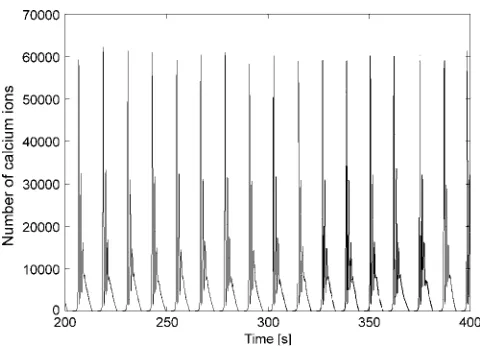
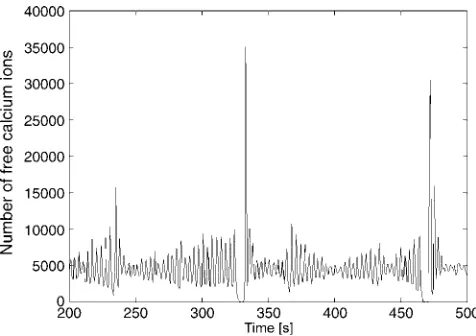
is shown in Fig. 1. Each main spike is followed by a series of secondary oscillations. The overall oscillation is by no means periodic and the number of secondary oscillations varies. Increasing the agonist concentration successively results in bursting oscillations, with increasing amounts and length of secondary oscillations on average (Fig. 2). These bursts are irregular in their nature, meaning that the amplitude of the secondary oscillations are not simply decreasing with time.
Modeling these bursting oscillations in hepatocytes has so far never been able to account for the long stretches of sec-ondary oscillations seen in these time series and only models generating chaotic bursting have been able to account for some of the nonperiodicities visible. Prolonged secondary oscillations might carry important information for the cell because, e.g., a very prolonged elevated level of calcium concentration in the cell can be responsible for apoptosis (8). For a detailed computational analysis of calcium oscil-lations in hepatocytes, we restrict ourselves firsthand to using a core model developed by Kummer et al. (20). This model captures the basic dynamic characteristics of the complete model. Later on, we will see that our findings also hold true for more detailed, physiological models. The core model is represented by three ODEs.
½Ga9¼k11k2½Ga k3
½Ga½PLC ð½Ga1K4Þk5
½Ga½Ca ð½Ga1K6Þ
½PLC9¼k7½Ga k8 ½PLC
ð½PLC1K9Þ ½Ca9¼k10½Ga k11
½Ca
ð½Ca1K12Þ; (79)
whereGadenotes the active subunit of the G-protein,PLC* the activated form of PLC, and Ca the cytosolic calcium concentration.
Gais activated upon binding of an agonist (included ink2)
and this process is autocatalytic. There is also a small term (k1) for the spontaneous activation ofGa. It is inactivated via
two processes, one being activated byCa(via phosphokinase C) and one byPLC*. PLCis activated byGaand inactivated by a simple enzymatic reaction. FinallyGaalso triggers the increase of calcium concentration in the cytosol and calcium is removed by an active transport mechanism.
Again, it has to be emphasized that this model is a sim-plified picture and does not include all the processes that are known to occur in the context of calcium signal transduction. Especially, one variable, namely IP3 has been eliminated
completely. For a more detailed and more realistic model, see, e.g., Larsen et al. (15). However, the basic dynamical characteristics are captured in this model (as was shown in Kummer et al. (20)) and therefore we use it to study the transition from stochastic to deterministic behavior in depen-dence on the system dynamics.
[image:5.603.310.551.56.217.2]The bifurcation diagram of the model is shown in Fig. 3. At smaller values ofk2the system behavior is characterized
FIGURE 1 Experimentally measured calcium concentration in hepato-cytes with 1.2mM ATP added.
[image:5.603.318.539.485.666.2]FIGURE 2 Experimentally measured calcium concentration in hepato-cytes with increasing amounts of ATP added as indicated.
FIGURE 3 Bifurcation diagram of the core model for bursting calcium oscillations (Eqs. 7–9). Parameters are:k1¼0.212,k3¼1.52,K4¼0.19,
k5¼4.88,K6¼1.18,k7¼1.24,k8¼32.24,K9¼29.09,k10¼13.58,
k11¼153,K12¼0.16. Initial conditions are:a¼0.01,b¼0.01,c¼0.01.
1606 Kummer et al.
[image:5.603.53.292.514.684.2]by simple periodic spiking Ca21oscillations. By increasing the value ofk2periodic bursting Ca21 oscillations appear,
and a period adding route leads to a very small chaotic re-gime aroundk2¼2.9259. Beyond the chaotic regime there is
again a small periodic regime before the system settles into a steady state.
In Fig. 4 we show an example of deterministically simu-lated periodic bursting oscillations fork2¼2.85.
We simulated the same time series as obtained by the ODEs (e.g., Fig. 4) on particle basis with the stochastic al-gorithm described above. We varied the number of partici-pating particles to study the transition from deterministic to stochastic behavior with decreasing particle numbers. In the following, we will emphasize the number of calcium ions in the system. However, we want to point out that the number of particles of the other participating species is in the same range or higher (depending on the parameters) in this simple model system. Therefore, we focus on the species with the lowest particle numbers. This was achieved by changing the volume of the system and leaving the concentration constant. Computationally, this is equivalent to letting the volume constant and changing the particle number in this volume plus adjusting the kinetic parameters such that the same qualitative systems behavior will arise. Otherwise, just chang-ing the particle number in the same constant volume will of course result in completely different behavior.
The results of the stochastic simulations fork2¼2.85 are
presented in Figs. 5 and 6 for different particle numbers. Fig. 5 shows that for large particle numbers the particle-based simulations approach the deterministic limit, which is in accordance with theory. The question arises, however, of how to determine the transition between stochastic and de-terministic behavior. This is usually a continuous conver-gence and it is difficult to exactly determine the transition. Therefore, it is reasonable to introduce a transition range as the approximate number of particles at which differences be-tween stochastic and deterministic behavior become
[image:6.603.310.550.54.227.2]negli-gible. To estimate the particle number in the transition range between stochastic and deterministic behavior, we studied the use of standard approaches for estimating differences be-tween noisy signals and the respective deterministic sig-nal. All of these standard approaches like autocorrelation functions, signal/noise ratio, or interspike interval histo-grams (ISIH) face strong limitations in this case. The reason is that in many cases the stochastic simulation does not result simply in a noisy version of the deterministic limit (as shown below). It is rather apparent that the stochasticity of the sys-tem often results in completely different dynamics compared to the deterministic solution. However, the global character of the solution (the attractor) is underrepresented when con-sidering the above-mentioned standard approaches. Thus, on one hand, a noisy limit cycle will result, e.g., in a very dif-ferent ISIH compared to the deterministic solution even if the coarse limit cycle is the same. On the other hand, a comparison between different attractors will of course also
FIGURE 4 Deterministic simulation of periodic bursting of calcium con-centration. Parameters as in Fig. 1;k2¼2.85,Div¼ 401.9.
[image:6.603.54.293.512.684.2]FIGURE 5 Stochastic simulation of bursting calcium oscillations close to the deterministic limit. Parameters as in Fig. 4.
[image:6.603.309.551.513.685.2]result in a very different ISIH. Thus, it is almost impossible to differentiate between a solution that displays a completely different attractor and a solution that still displays the global attractive properties of the deterministic solution, but has added noise. However, a scientist modeling a system will most certainly choose the faster deterministic simulation, if the global picture of the simulation is accurate. A better method would be to use a similarity measure of the global attractors resulting from the different simulations as such. Few ap-proaches for such a similarity measure are described in lit-erature so far (e.g., (31,32)). These need extensive sets of data that are hard to create in stochastic simulations due to the computational expense. Therefore, for this study, we restrict ourselves to matching the solutions in a graphical and/or visual way. However, we want to include and develop such global similarity measures in future studies.
For spiking (k2¼2.0) and periodic bursting oscillations
(k2¼2.85) with ten-thousands of particles, only small
fluc-tuations in the amplitude are observed. However, decreasing the particle number to thousands leads to a system already showing significant stochastic influence (Fig. 6). Stochastic influences are big variations in the amplitude and period as well as prolonged secondary oscillations during bursting be-havior like those seen in the experimental investigations. The transition from deterministic to stochastic behavior occurs in this case in the range of tens of thousands of particles.
For chaotic bursting Ca21 oscillations at k2 ¼ 2.9259
deterministic-like behavior was observed only down to a number of particles in the range of hundreds of thousands. Decreasing the particle numbers down to tens of thousands already showed significant stochastic influences, e.g., a phase space that corresponds more to a noisy limit cycle rather than to a chaotic attractor, i.e., hardly any amplitude variations. Decreasing the particle numbers even further leads to ad-ditional prolonged secondary oscillations. Of course, there is no possibility to simply match the deterministic and the sto-chastic simulation in this case like done above. Therefore, and to get an estimate, we relied on visual inspection taking, e.g., prolonged secondary oscillations as signs for stochas-ticity. These signs ceased to appear in the range of hundreds of thousands of particles in the system in the parameter regime where chaos is displayed in the deterministic limit.
For the steady state at k2 ¼ 3.0, we observe that even
higher numbers of particles are needed to approach the de-terministic limit (Figs. 7 and 8). The dede-terministic limit is not reached with particle numbers in the high hundred-thousands, which is well above the physiological range. Moreover, for lower particle numbers, qualitative behavior is observed that again displays most of the characteristics of the complex periodic regime (Fig. 8).
The above findings are summarized in Table 1. For dif-ferent values ofk2, which correspond to different behaviors
of the system, the number of particles is estimated at which the transition between stochastic and deterministic behavior appears.
To explain the results presented in Table 1 we estimate the attractive properties of the phase space for different values of k2. The hypothesis is that the stochastic influences could be
more pronounced in case of weaker attractive properties of the phase space. Hence, in a weaker attractive phase space a higher number of particles would be needed to reach the deterministic limit. We use the sum of Lyapunov exponents (the divergence) for estimating the attractive properties of the phase space. By varying the parameter value ofk2and
[image:7.603.310.548.56.227.2]corresponding to the different types of oscillations described above, different values of divergence (Fig. 9) were com-puted. Fig. 9 shows that the value of divergence approaches zero with increasing values ofk2. By comparing Fig. 9 with
Table 1, we observe that the sensitivity of the system to stochastic influences increases with increasing divergence. This means that for a dynamic state representative of a highly
FIGURE 7 Stochastic simulation of calcium behavior corresponding to parameters for which the deterministic solution is a steady state (k2¼3.0)
with particle numbers far above physiological concentrations. The dashed line indicates the deterministic steady state.
FIGURE 8 Stochastic simulation of calcium behavior corresponding to parameters for which the deterministic solution is a steady state (k2¼3.0)
with lower particle numbers compared to Fig. 7. The dashed line indicates the deterministic steady state.
1608 Kummer et al.
[image:7.603.311.549.495.663.2]negative divergence value the system is well described by deterministic methods even for relatively low (thousands) particle numbers whereas higher particle numbers are needed to approach the deterministic limit if the divergence of the system is close to zero.
To verify that these findings are not restricted to our small core model, we additionally analyzed a completely different model of Ca21 oscillations proposed by Shen and Larter (18). Likewise, a model of the peroxidase-oxidase reaction (33) was studied (data not shown). This system describes the oxidation of NADH catalyzed by peroxidases. We observed again that the number of particles required to obtain results matching the corresponding deterministic solutions is di-rectly related to the divergence of the attractors, as already described above. A divergence value close to zero implies that the attractor is weak and can easily be altered by the stochastic fluctuations.
Finally, we studied the influence of calcium buffers in the cell. For this purpose, we included a simple linear equation for the binding and release of calcium to protein buffers with the latter being present in large quantities compared to cal-cium and therefore assumed to have a constant concentra-tion. Thus, the equations for calcium concentration reads:
½Ca9¼k10½Ga k11 ½Ca
ð½Ca1K12Þk13½Ca1k14½P; (10)
withPrepresenting the calcium concentration bound to pro-tein buffers.
The inclusion of this simple term leads to a decrease in divergence, because the partial derivation of the equation
describing the evolution of the calcium concentration be-comes more negative and this feeds into the sum of the Lyapunov exponents. This means that according to our hy-pothesis the sensitivity toward stochasticity should decrease as well. Indeed, this is the case. However, even with;80% of the calcium being bound to these buffers, the systems be-havior is still strongly influenced whenever the divergence of the system is large (e.g., fork2¼3). Fig. 10 shows that in this
case the high-frequent part of the noise in the system is filtered out by the participating buffer (compared to Fig. 6). Nevertheless, the system is still not running into a steady state as it would be when calculated deterministically, but rather it shows complex bursting oscillations.
DISCUSSION
[image:8.603.52.294.69.139.2]We studied the transition from deterministic to stochastic behavior in simulations of Ca21 oscillations on a particle basis. We mainly used the model developed by Kummer et al. (20) and studied here in detail the dependency of the transition on the system properties. We observed that the transition from stochastic to deterministic behavior depends heavily on the attractive properties of the corresponding at-tractors in phase space, quantified by the divergence. We conclude that the divergence plays a more important role in determining the transition range from stochastic to determin-istic behavior than the complexity of the Ca21oscillations. The transition occurs at higher particle numbers if the cor-responding value of the divergence is close to zero com-pared to the particle numbers needed when the system has a highly negative divergence. Comparing the ranges of particle numbers sensitive to stochastic influences, we ob-serve that oscillations characterized by a divergence close to zero show a 10–100-fold larger sensitivity compared to the
TABLE 1 Transition ranges in dependence onk2
k2 Number of particles Behavior
2.0 Ten-thousands Periodic spiking
2.85 Ten-thousands Periodic bursting
2.9259 Hundred-thousands Chaos
2.99 Millions Regular oscillations
3.0 Greater than millions Steady state
[image:8.603.311.549.487.655.2]FIGURE 9 Divergence value of the core model for bursting calcium oscillations. Parameters as in Fig. 3.
FIGURE 10 Stochastic simulation of calcium behavior corresponding to the core model with parameters as in Fig. 3, including binding of calcium ions to protein buffers (Eq. 10;k13¼10,k14¼1). Please note that the total
[image:8.603.52.294.526.686.2]oscillations with highly negative divergence in the presented case study.
The real particle numbers in calcium signal transduction correspond roughly to the transition number in the cases with low divergence, namely simple periodic and complex peri-odic oscillations. This is especially true for a model in which calcium buffers are included. However, the number of par-ticles needed to reach the deterministic limit in cases with high divergence values (chaotic, regular oscillations, steady state) is far above the concentrations of receptors, channels, and calcium ions in the real cell, even if buffers are included in the model. This is also in accordance with the experi-mental observation that at high agonist concentrations that correspond to high divergence values in our model, more apparent stochastic influences are visible. Therefore, one can argue on the one hand, that the stochastic influence during simple periodic and complex periodic behavior should not be tremendous, because the real particle numbers are not well below the transition range. On the other hand, pronounced stochastic effects should be present in the real system for high agonist concentrations (corresponding to a high value of k2). However, because the studied model is rather qualitative
in its nature, more studies with more realistic models are needed to clarify this point in sufficient detail. The important issue here is that the transition from stochastic to deter-ministic behavior for certain systems dynamics in general occurs clearly above physiological concentrations and the resulting stochasticity in the system might be of physiolog-ical importance. This is especially true for physiologphysiolog-ical effects that result from the prolonged secondary oscillations of the bursting calcium oscillations as described above. Inter-estingly, such prolonged secondary oscillations have often been observed experimentally (e.g., (34)). If the elevated level of calcium concentration is sustained for considerable time, it will result in different biochemical responses in the cell, e.g., in cell death (35).
Our findings, showing that transition from stochastic to deterministic behavior occurs at higher particle numbers if the corresponding value of the divergence is close to zero, can also be explained intuitively. If the contractive properties of an attractor in phase space are weak, then the attractor can be more easily deformed, if perturbed continuously, which is the case when studying stochastic simulations. Recently, it has been shown that Ca21 oscillations are more flexible in response to external forcing if the divergence takes values close to zero (36,37). Moreover, it has been shown that the flexibility of Ca21oscillations does not significantly depend on the type of Ca21oscillations. Therefore, we argue that in the case of determining the transition from stochastic to de-terministic behavior the divergence plays a major role.
In the studied systems, no noise-induced chaos has been found as reported in a number of cases (for a review, see Gao et al. (38)). However, it has been observed in earlier studies that adding noise to a periodic bursting calcium oscillation could result in deterministic chaotic oscillations (39).
Our results show that it is not sufficient to decide in favor of or against the stochastic simulation of a system on the basis of knowing the number of particles for a certain model in general, but it rather demands taking into account the specific dynamics of the model and the attractive properties of a particular oscillatory regime. Moreover, relatively large concentrations (corresponding to nanomolar and millimo-lar), which often are simulated deterministically, already show a pronounced sensitivity toward stochasticity. There-fore, a careful analysis of this sensitivity should preclude a decision for a certain simulation method in the case of simulating calcium oscillations. Because our results are very general in their nature, this holds for other simulations of biochemical systems as well. Calculating the divergence of the system as one measure for the decision in favor of or against a specific simulation methodology could be easily automated. This could be included in corresponding soft-ware packages to aid the user in his/her decision process. Moreover, calculating the divergence on the basis of deter-ministic simulations is computationally fast compared to many trials of stochastic simulations that would be needed to just try out which method is more appropriate. It is also possible to compute the sensitivity of the divergence with respect to different parameters of the system, which gives a more general view on how robust the decision for or against a specific simulation method is when parameters are changed. However, we also would like to point out, that the absolute values of the divergence might be insufficient as a basis for the decision process, if a system contains, e.g., very positive and very negative Lyapunov exponents at the same time (which was not the case in the studied examples). In this case, a weighting of these individual components might be necessary, which is a topic of our future research. In addition, bistable systems require also a special treatment. Such sys-tems will display both stable solutions when different runs of stochastic simulations are performed whereas, e.g., the initial conditions have to be changed in the deterministic approach to gain the same kind of information. However, the appear-ance of the individual solution is again subject to similar criteria as described above. Moreover, in the case of a stable steady-state solution with no proximity to any other type of solution (e.g., oscillations), there are cases where the am-plitude of the noise due to a stochastic simulation around this steady state stays the same, independent of the divergence of the system (as in the simple system AÛB with influx of A and efflux of B, if all rates are altered such that their ratio stays the same). However, due to the attractive properties of the respective steady state, which is again dependent on the divergence, the individual trajectory is able to stay away from the steady state much longer if the divergence is high compared to a system with rates corresponding to a low di-vergence. Thus, if simulating a short time span representing a real world example, the stochastic simulation of the system with low divergence will quickly fluctuate around the steady state whereas the system with high divergence might deviate
1610 Kummer et al.
from the steady state for the whole time. Therefore, the computation of the divergence again adds to the knowledge in differentiating between the two simulation methods.
Finally, we want to emphasize that inclusion of a spatial dimension will be an important issue in the future. Particle numbers in small discrete volumes will be even lower than considering the particle numbers for the whole cell. We think that at least for systems described by diffusively coupled ODEs, our findings will still be applicable, but this will be a matter of future investigations.
We acknowledge Carel van Gend for fruitful discussions.
Ursula Kummer and Ju¨rgen Pahle thank the Klaus Tschira Foundation and the German Federal Ministry of Education and Research for funding. Anne K. Green and C. Jane Dixon thank the Wellcome Trust for funding.
REFERENCES
1. Gillespie, D. T. 2001. Approximate accelerated stochastic simulation of chemically reacting systems.J. Chem. Phys.115:1716–1733. 2. Resat, H., H. S. Wiley, and D. A. Dixon. 2001. Probability-weighted
dynamic Monte Carlo method for reaction kinetics simulations.J. Phys. Chem. B.105:11026–11034.
3. Haseltine, E. L., and J. B. Rawlings. 2002. Approximate simulation of coupled fast and slow reactions for stochastic chemical kinetics. J. Chem. Phys.117:6959–6969.
4. Puchalka, J., and A. M. Kierzek. 2004. Bridging the gap between stochastic and deterministic regimes in the kinetic simulations of the biochemical reaction networks.Biophys. J.86:1357–1372.
5. Vasudeva, K., and U. S. Bhalla. 2004. Adaptive stochastic-deterministic chemical kinetic simulations.Bioinformatics.20:78–84. 6. Olsen, L. F., U. Kummer, A. L. Kindzelskii, and H. R. Petty. 2003. A
model of the oscillatory metabolism of activated neutrophils.Biophys. J.84:69–81.
7. Gonze, D., J. Halloy, and A. Goldbeter. 2004. Emergence of coherent oscillations in stochastic models for circadian rhythms.Phys. A.342: 221–233.
8. Berridge, M. J., M. D. Bootman, and P. Lipp. 1998. Calcium: a life and death signal.Nature.395:645–648.
9. Li, W. H., J. Llopis, M. Whitney, G. Zlokarnik, and R. Tsien. 1998. Cell-permeant caged InsP3-ester shows that Ca21spike frequency can
optimize gene expression.Nature.392:936–944.
10. Dolmetsch, R. E., K. Xu, and R. S. Lewis. 1998. Calcium oscillations increase the efficiency and specificity of gene expression.Nature. 392:933–936.
11. De Koninck, P., and H. Schulman. 1998. Sensitivity of CaM kinase II to the frequency of Ca21oscillations.Science.279:227–230. 12. Oancea, E., and T. Meyer. 1998. Protein kinase C as a molecular machine
for decoding calcium and diacylglycerol signals.Cell.95:307–318. 13. Woods, N. M., K. S. R. Cuthbertson, and P. H. Cobbold. 1986.
Repetitive transient rises in cytoplasmic free calcium in hormone-stimulated hepatocytes.Nature.319:600–602.
14. Dixon, C. J., N. M. Woods, K. S. R. Cuthbertson, and P. H. Cobbold. 1990. Evidence for two Ca21-mobilizing purinoreceptors on rat hepa-tocytes.Biochem. J.269:499–502.
15. Larsen, A. Z., L. F. Olsen, and U. Kummer. 2004. On the encoding and decoding of calcium signals in hepatocytes. Biophys. Chem. 107:83–99.
16. Dupont, G., S. Swillens, C. Clair, T. Tordjmann, and L. Combettes. 2000. Hierarchical organization of calcium signals in liver cells. Biochim. Biophys. Acta.1498:134–152.
17. Schuster, S., M. Marhl, and T. Ho¨fer. 2002. Modelling of simple and complex calcium oscillations.Eur. J. Biochem.269:1333–1355. 18. Shen, P., and R. Larter. 1995. Chaos in intracellular Ca21oscillations
in a new model for non-excitable cells.Cell Calcium.17:225–232. 19. Houart, G., G. Dupont, and A. Goldbeter. 1999. Bursting, chaos and
birhythmicity originating from self-modulation of the inositol 1,4,5-triphosphate signal in a model for intracellular Ca21oscillations.Bull. Math. Biol.61:507–530.
20. Kummer, U., L. F. Olsen, C. J. Dixon, A. K. Green, E. Bornberg-Bauer, and G. Baier. 2000. Switching from simple to complex oscil-lations in calcium signaling.Biophys. J.79:1188–1195.
21. Marhl, M., T. Haberichter, M. Brumen, and R. Heinrich. 2000. Com-plex calcium oscillations and the role of mitochondria and cytosolic protein.Biosystems.57:75–86.
22. Kraus, M., and B. Wolf. 1993. Cytosolic calcium oscillators: critical discussion and stochastic modeling.Biol. Signals.2:1–15.
23. Prank, K., U. Ahlvers, F. Baumgarte, H. G. Musmann, A. von zur Mu¨hlen, C. Scho¨fl, and G. Brabant. 1998. Methoden der medizinischer Informatik, Biometrie und Epidemiologie in der modernen Informa-tionsgesellschaft. [in German] Jahrestagung der Deutschen Gesellschaft fu¨r Informatik, Biometrie und Epidemiologie, Bremen, Germany. 24. Falcke, M. 2003. On the role of stochastic channel behavior in
intracellular Ca21dynamics.Biophys. J.84:42–56.
25. Falcke, M. 2004. Reading the patterns in living cells: the physics of Ca21signaling.Adv. Phys.53:255–440.
26. Falcke, M. 2003. Deterministic and stochastic models of intracellular Ca21waves.N. J. Phys.5:1–28.
27. Shuai, J. W., and P. Jung. 2002. Stochastic properties of Ca21release of inositol-1,4,5,-trisphosphate receptor clusters.Biophys. J.83:87–97. 28. Gillespie, D. T. 1976. A general method for numerically simulating the stochastic time evolution of coupled chemical reactions.J. Comput. Phys.22:403–434.
29. Dixon, C. J., P. H. Cobbold, and A. K. Green. 1995. Actions of ADP, but not ATP, on cytosolic free Ca21in single rat hepatocytes mimicked by 2-methylthioATP.Br. J. Pharmacol.116:1979–1984.
30. Cobbold, P. H., and J. A. C. Lee. 1991. Aequorin measurements of cy-toplasmic free calcium.InCellular Calcium: A Practical Approach. J. G. McCormack, and P. H. Cobbold, editors. I.R.L. Press, Oxford, UK. 55–81. 31. Kantz, H. 1994. Quantifying the closeness of fractal measures.Phys.
Rev. E.49:5091–5097.
32. Koussoulos, N. T. 2001. Spectral moments and the analysis of chaotic systems.Int. J. Bifur. & Chaos.11:2051–2059.
33. Olsen, L. F., A. Lunding, and U. Kummer. 2003. Mechanism of melatonin-induced oscillations in the peroxidase-oxidase reaction. Arch. Biochem. Biophys.410:287–295.
34. Green, A. K., P. H. Cobbold, and C. J. Dixon. 1995. Cytosolic free Ca21 oscillations induced by diadenosine 59,5999-P1,P3-triphosphate and diadenosine 59,5999-P1,P4-tetraphosphate in single rat hepatocytes are indistinguishable from those induced by ADP and ATP re-spectively.Biochem. J.310:629–635.
35. Nicotera, P., G. Bellomo, and S. Orrenius. 1992. Calcium-mediated mechanisms in chemically induced cell death.Annu. Rev. Pharmacol. Toxicol.32:449–470.
36. Marhl, M., and S. Schuster. 2003. Under what condition signal transduction pathways are highly flexible in response to external forcing? A case study on calcium oscillations.J. Theor. Biol.224:491–501. 37. Perc, M., and M. Marhl. 2003. Sensitivity and flexibility of regular and
chaotic calcium oscillations.Biophys. Chem.104:509–522.
38. Gao, J. B., C. C. Chen, S. K. Hwang, and J. M. Liu. 1999. Noise-induced chaos.Int. J. Mod. Phys. B.13:3283–3305.