1
‘Fostering knowledge sharing; what stimulates Eagerness and Willingness to develop a team’s Shared Mental Model’
Fleur G. Lansink
2
Master Thesis
Fostering knowledge sharing: what stimulates Eagerness and Willingness to develop a team’s Shared Mental Model.
Researcher
Name: Fleur Lansink
Supervisors
Name: R. Bron MSc. Name: dr. M. A. Hendriks
External supervisor
Name: G. Overbeek, Head of the department Support & Care
3
Abstract
Society is becoming increasingly complex and research points out that global economy is gradually moving into a knowledge economy. Within knowledge economy there is an important role for being effective as a team. Team effectiveness depends on a shared mental model, which stimulates task performance and fosters team processes to improve products and services. Stimulating attitudes for knowledge sharing and development of team shared mental models can help governmental organizations to rapidly deal with these complex problems and tasks at the current knowledge economy. Which leads to the goal of this research; measure what stimulates willingness and eagerness for knowledge sharing in order to develop a shared mental model at a governmental organization. An explanatory sequential mixed-method design is used; quantitative data is gathered through an online Survey (May 2016) based on surveys from De Vries et al. (2006) and the Team Assessment and Diagnostic Instrument (TADI). The quantitative analyzes revealed differences across teams about general task and team knowledge, attitudes toward teammates and task, team dynamics and interactions, and team resources and working environment (Johnson et al., 2007). For instance the large, younger aged team and the large mix-aged team differed at attitude towards teammates and task, team dynamics and interactions, and team resources and work environment. Subsequently, interviews were held and qualitative analyzes explored that subject-matter expertise might stimulate eagerness, and collaboration might stimulate willingness for knowledge sharing. Finally two additional factors might directly stimulate the development of a shared mental model, namely job satisfaction and team goals.
4
Foreword
Before you lies the dissertation ‘Fostering knowledge sharing: what stimulates Eagerness and Willingness to develop a team’s Shared Mental Model’. Based on an online survey and interviews with the executive team members at a governmental organisation. It has been written to fulfil the graduation requirements of the Educational Science and Technology Program at the University of Twente (UT).
The process of research was difficult, but conducting extensive investigation has allowed me to answer the main research question that was identified. Fortunately, my graduation supervisors supported me during this process and were always willing to answer my queries. I would like to thank Tim Hirschler and Rike Bron for their guidance and support during this process.
I also benefitted from debating about the thesis with my study friends Maud and Ina. But overall my parents and family deserves a particular note of thanks.
I hope you enjoy reading,
5
Table of content
Abstract ... 3
Foreword ... 4
1. Increasing organizational knowledge sharing ... 7
1.1 Thesis overview ... 8
2. Theoretical Framework ... 9
2.2 The shared mental model and knowledge sharing ... 9
2.3 Willingness and eagerness for knowledge sharing ... 9
2.5 Present research and research questions ... 11
3. Methods section ... 13
3.1 Design ... 13
3.2 Context ... 13
3.3 Study 1: quantitative research ... 13
3.3.1 Procedure ... 13
3.3.2 Participants and sample ... 14
3.3.3 Instruments: online survey ... 14
3.3.4 Quantitative analysis eagerness, willingness, and the shared mental model ... 16
3.4 Study 2: qualitative research ... 16
3.4.1 Procedure ... 16
3.4.2 Participants and sample ... 16
3.5.3 Instruments: interviews ... 17
3.5.4 Qualitative analysis eagerness, willingness and the shared mental model ... 17
4. Results ... 18
4.1 Study 1: results online survey ... 18
4.1.1 Preliminary analysis ... 18
4.1.2 Differences in eagerness and willingness for knowledge sharing ... 19
4.1.3 Differences between shared mental models ... 21
4.1.4 Team differences based on the five factors of a shared mental model ... 23
4.2 Study 2: results interviews ... 24
4.2.1 Interviews ... 24
4.2.2 Eagerness and willingness for knowledge sharing ... 25
4.2.3 Stimulating eagerness and willingness for knowledge sharing ... 25
5. What factors stimulate eagerness and willingness to share a shared mental model? ... 28
5.1 Conclusion and discussion ... 28
5.2 Limitations of this research ... 31
5.3 Theoretical implications for new research ... 31
5.4 Practical implications ... 32
6
7
1. Increasing organizational knowledge sharing
Society is becoming increasingly complex and is shifting toward an economy in which knowledge is crucial. This new knowledge economy is quite different from twentieth-century society (Drucker, 2001), where the main means of production, such as capital, raw materials and labour, have been replaced by the application of knowledge. By generating and distribution of new knowledge, to improve processes, products and services (Kessels, 2001). It is therefore important for governmental organizations to rapidly deal with this knowledge economy and its more complex problems and tasks in order to improve performance level, team effectiveness, and the creation of innovative policies and services (Johnson et al., 2007). An illustrative example is the new Dutch social legislation from early 2015 a decentralization of social services, with the aim to generate and distribute new knowledge and application of this knowledge for improving processes, products and services to rapidly deal with knowledge economy (Van Rijn, 2014).
DeChurch and Mesmer-Magnus (2010) noted that teamwork is becoming increasingly important in order to comply with the main aspects of this knowledge economy. The reality for many organizations is that tasks have become complex enough to require the use of teams at all hierarchical levels (DeChurch & Mesmer-Magnus, 2010). The decentralization of the Dutch social services also leads to new team compositions in practice-oriented teams, which can create uncertainty for instance that teammembers must forfeit old duties to other teammembers or could lose the job fulfilment. The ability of these social teams to collaborate and work effectively toward complex problem solving is important and indicates the organizational success level (DeChurch and Mesmer-Magnus, 2010).
Team effectiveness depends on creating a ‘shared mental model’, which stimulates task performance and fosters team processes important to improve products and services in the social domain (Johnson et al., 2007). In order to build a shared mental model, knowledge sharing between team members of social teams at governmental organizations is required (Johnson, et al., 2007). This is a major challenge, many social teams at governmental organizations struggle with how to shape this in a good pace in a limited amount of time (Trommel & Boutellier, 2018). This asks for individual capability: to understand the nature of the knowledge and to focus on the usability of knowledge, necessary for his or her ability to share knowledge with other team members (Van den Hooff & De Ridder, 2004). Exchanging individual knowledge and creating new knowledge on a team level indicate the team’s level of functioning. If individuals are more capable of sharing knowledge related to the task and the team, then organizations are more likely to achieve their goals (Ipe, 2003; Nonaka, 1994; Spender & Grant, 1996).
8
beliefs of a team member (De Vries et al., 2006). Both of these knowledge-sharing attitudes influence the ways in which the team acts under particular circumstances, as well as the creation of new knowledge (Johnson et al., 2007). However, we do not know much about what stimulates attitudes of individual team members to share knowledge constructing a shared mental model. A further deepening and exploration is needed in order to explore what stimulates willingness and eagerness for knowledge sharing to develop a shared mental model.
1.1 Thesis overview
9
2. Theoretical Framework
This chapter presents the theoretical framework guiding this research study, explains the research model and the research questions.
2.1 Shared mental model
A shared mental model is defined as a shared vision of a group, and it is comprised of the knowledge related to the task and the team (Johnson et al., 2007). It also consists of individual mental models that together form a shared mental model (Van den Hooff & De Ridder, 2004). For example, an individual’s mental model about the concept ‘team’ is shared with other members in order to create a shared mental model of this concept. A shared mental model implies that team members have compatible mental models that lead to shared expectations for the tasks performance carried out by processes at the team level (Johnson et al., 2007). This allows team members to predict behaviour of other team members. A shared mental model contains general and specific task knowledge, individual skills and behaviours for effective task decisions witch affects team’s response (Johnson et al., 2007). Overall knowledge sharing and the development of a shared mental model are positive influencers of task performance (Johnson et al., 2007; Mathieu, Hefner, Goodwin, Salas & Cannon-Bowers, 2000).
2.2 The shared mental model and knowledge sharing
Knowledge sharing between individuals is a requirement for the creation of a team’s shared mental (Johnson et al., 2007). The individual team member’s sense of urgency and a positive attitude are necessary prerequisites for this process of knowledge sharing (Van den Hooff & De Ridder, 2004). Subsequently, knowledge sharing in order to create a shared mental model is based on knowledge donation and collection (Van den Hooff & De Ridder, 2004). The donation of knowledge consists of communicating knowledge to other individuals in order to encourage collaboration with others (Van den Hooff & De Ridder, 2004). Otherwise mentioned donating knowledge focuses on learning through the exchange of knowledge (Van den Hooff & De Ridder, 2004). While donating knowledge stimulates collaboration, collecting knowledge relies on it. Collecting knowledge consists of consulting other individual team members in order to learn what they know (Dillenbourg, 1999; Van den Hooff & De Ridder, 2004). Earlier research of Bock & Kim (2002) pointed out that individual expectations of the usefulness of own knowledge and improvement of knowledge sharing relationships between team members, were related to positive knowledge sharing attitudes, which in turn were related to knowledge sharing intentions and behaviors (Wang & Noe, 2010).
2.3 Willingness and eagerness for knowledge sharing
10
Team members who are willing to share knowledge are more oriented towards the group, by encouraging and facilitating the process of knowledge collection at the team level (De Vries et al., 2006). Also all team members must possess the motivation to share knowledge because knowledge sharing with others cannot be forced (Gibbert & Krause, 2002). Willingness implies a positive attitude towards other group members. For example, willing team members expect other team members to donate and also collect knowledge at the team level, but there can be hesitation to share knowledge with others if team members are uncertain whether the others are also willing to contribute to the team’s interest (De Vries et al., 2006). Earlier research by de Vries et al. (2006) suggested factors that influenced the willingness for knowledge sharing at team level, namely individual agreeableness, extraversion, job satisfaction, and performance beliefs. Where mutuality may explain the relationship between agreeableness and willingness for knowledge sharing with others. Team extraversion may stimulate talkativeness and enthusiasm of other individuals to share experiences and knowledge with more extraverted individuals (De Vries et al., 2006). Also job satisfaction and self-rated performance were found to be related to willingness and eagerness to share knowledge, probably based on a positive sense of self-worth with regard to the organization based on good performance level of personal satisfying tasks (De Vries et al., 2006). Finally pride and empathy were also suggested as two stimulating factors for eagerness and willingness for knowledge sharing (Van Den Hooff, Schouten, & Simonovski, 2012).
In contrast, an eager team member is motivated to share and donate his or her individual knowledge easily and uninvited with other team members (i.e., eagerness), regardless of whether a mutual exchange based on donating and collecting knowledge will take place (i.e., willingness) (De Vries et al., 2006). For example, an individual who has an eager attitude to share knowledge with other team members, whether requested or not, will not feel any boundaries or hesitation to share his or her knowledge with others based on the interest that these individuals have in the subject matter of their work (Wenger, McDermott & Snyder, 2002; Van Den Hooff et al., 2012). An eager team member, who easily shares knowledge with other team members possesses an extravert communication style, job satisfaction and performance beliefs, and can also inspire the willingness of other members to share knowledge (De Vries et al., 2006; Gagne, 2009). This study tries to provide further insight into the individual’s level of willingness and eagerness for sharing knowledge and the motivations for using knowledge sharing to create a shared mental model.
11
have difficulties contributing to the team’s interest and development. On the other hand the knowledge level of individual team members may increase with the aging of individual team members (Van den Berg, 2015). Earlier research stated that older aged team members might share more knowledge, which contribute to the team’s interest and is also helpful for the development of younger team members (Van den Berg, 2015).
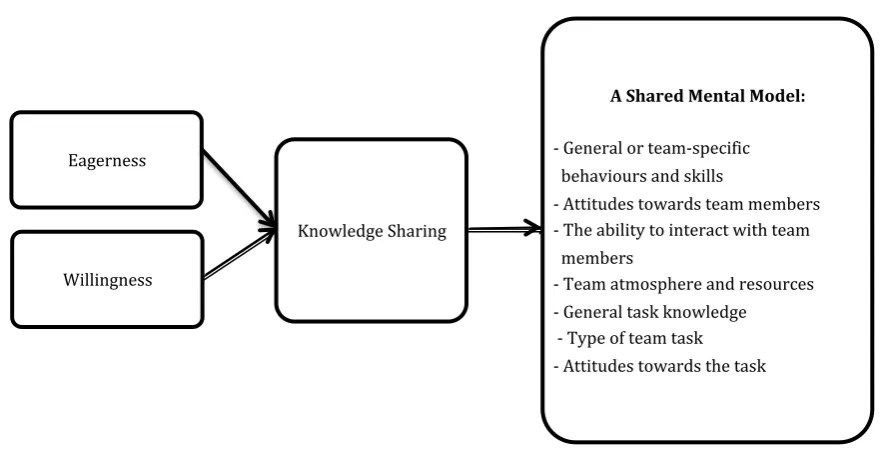
[image:11.595.66.509.246.471.2]The associated research model is depicted in Figure 1, which provides a schematic representation of the concepts measured by this research.
Figure 1. Research model.
2.5 Present research and research questions
The goal of this research was to investigate what stimulates the willingness and eagerness for knowledge sharing to create a shared mental model at governmental teams. Individuals of social teams at governmental organizations mention they stand for a major challenge developing products and services at this current knowledge economy. Stimulating attitudes for knowledge sharing and the development of team’s shared mental models can help governmental organizations to rapidly deal with the complex problems and tasks of the current knowledge economy. To improve the overall performance level, team effectiveness, and the creation of innovative policies and services.
Overall the main research question and sub-questions were formulated as follows:
“What stimulates the eagerness and willingness of team members to develop a shared mental model and is there a difference between governmental teams?”
Eagerness
Willingness
Knowledge Sharing
A Shared Mental Model:
- General or team-specific behaviours and skills - Attitudes towards team members - The ability to interact with team members
- Team atmosphere and resources - General task knowledge - Type of team task
12
Sub-questions:
1. To what extent are there differences between teams in eagerness and willingness for knowledge sharing?
2. To what extent are there differences between teams in shared mental model content?
3. What factors stimulate the eagerness and willingness of team members to share knowledge with others?
13
3. Methods section
This chapter explains the methods used to conduct the research. First, this chapter provides a description of the research design, then explains the context, a discussion of the participants and sample, the instruments and measures, and finally the procedure and methods used for the data analysis.
3.1 Design
This is an explanatory study of what stimulates the willingness and eagerness for knowledge sharing to develop a shared mental model. Quantitative data was gathered using an explanatory sequential mixed-method design, because the researcher first collects and analyzes quantitative data and then the findings inform qualitative data collection and analysis (Fetters, et al., 2013; Ivankova, Creswell, and Stick 2006). For the qualitative research, the quantitative findings were explored through interviews to explain possible motivations for and differences between attitudes for knowledge sharing toward the development of a shared mental model.
3.2 Context
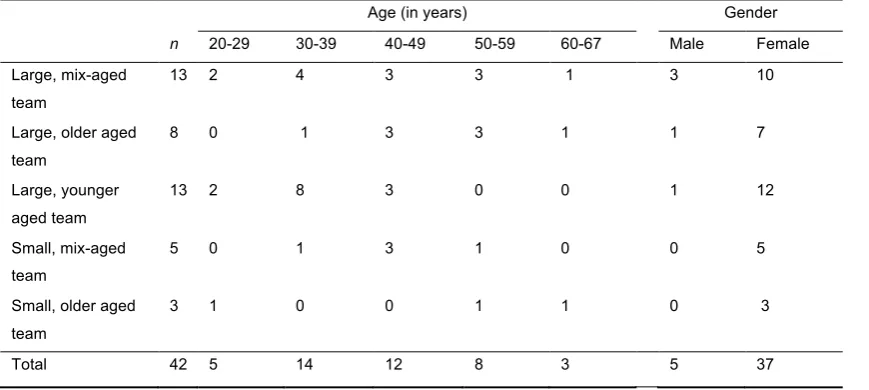
This study focused on a governmental organization, particularly within the social domain of a municipality. It investigated a department with 88 professionals divided at seven teams. The head of the department is accountable for main tasks and personal matters at the department. Four coordinators are responsible for the functioning of the teams, and they are directly accountable to the head of the department. Subsequently, five of the seven teams have the aim to provide support and care to residents, but with different levels of subject matter expertise and skills: the large, mix-aged team focuses on the Social Support Act (SSA, in Dutch Wet Maatschappelijke Ondersteuning 2007) and expanded with external professionals with mixed ages of 30-59 years; the large older aged performs brief question clarifications at the frontoffice and consists of team members who mostly have an age between 40-59 years; the large younger aged team focuses on The new Act on Care for Children and Young People (ACCYP, in Dutch De Nieuwe Jeugdwet 2015) and was partly formed with younger aged external professionals between 20-39 years old; the small mix-aged team provides administrative support is a small team with middle aged team members between 30-59 years ; and the small older-aged team focuses on compulsory education, is a small team and consists of team members with an older age of 50-67 years (Table 1).
3.3 Study 1: quantitative research
3.3.1 Procedure
14
information about the researcher and the goal of the study. Afterwards, a hyperlink to Qualtrics was sent to the employees so that they could fill out an anonymous survey. They also had to give consent to participate in the research study. It was explained that their participation was voluntary, and that they could withdraw their consent without explanation. One invitation and two reminders were sent between June 6, 2016 and July 7, 2016.
3.3.2 Participants and sample
A total of 42 respondents out of 88 professionals from five of the seven different teams: large, younger aged team; large, older aged team; large, mix-aged team; small mix-aged team; and small older aged, participated in the first study. The study excluded the head of the department, the assistant manager, members of two specific teams, and four employees who were on leave due to illness or pregnancy. The two excluded teams were not included in this analysis because one was transferred to another organization, and the other specific team consisted of only one respondent. The measured characteristics of the respondents in the first study were gender and age (Table 1). The study consisted of five men (11.90%) and 37 women (88.10%); five (11.90%) were between twenty and twenty-nine years old, 14 (33.33%) were between thirty and thirty-nine years old, 12 (28.58%) were between forty and forty-nine years old, eight (19.05%) were between fifty and fifty-nine years old, and three (7.14%) were between sixty and sixty-nine years old. A hypothesis explored during this research is that older aged team members show more eagerness and have a stronger agreement about having a shared mental model than younger aged team members.
Table 1.
Age and gender of the participants
Age (in years) Gender
n 20-29 30-39 40-49 50-59 60-67 Male Female Large, mix-aged
team
13 2 4 3 3 1 3 10 Large, older aged
team
8 0 1 3 3 1 1 7 Large, younger
aged team
13 2 8 3 0 0 1 12 Small, mix-aged
team
5 0 1 3 1 0 0 5 Small, older aged
team
3 1 0 0 1 1 0 3 Total 42 5 14 12 8 3 5 37
3.3.3 Instruments: online survey
[image:14.595.65.500.474.669.2]15
were used for the online survey conducted by this study (De Vries et al., 2006). All 18 items were based on an already existing and validated survey, and the items were ranged according to a five-point Likert-type scale, where ‘1’ equals ‘strongly disagree’ and ‘5’ equals ‘strongly agree’ (De Vries et al., 2006).
Willingness for knowledge sharing
Nine items measured willingness for knowledge sharing (De Vries et al., 2006), for example; ‘I try to improve the group’s performance by sharing knowledge’. Cronbach’s alpha was α = .740 for willingness, indicating an acceptable reliability and internal consistency of the scale willingness for knowledge sharing (Field, 2013).
Eagerness for knowledge sharing
Nine items measured eagerness (De Vries et al., 2006), for example; ‘I want to convince others of the importance of “my subject”’. The reliability and internal consistency of the scales was assessed by Chronbach’s alpha, which was α = .771 for eagerness. According to Field (2013) an acceptable value for the reliability of eagerness for knowledge sharing.
Shared mental model
The individual perceptions about the shared mental model of each team consisted of five main factors: general task and team knowledge, general task and communication skills, attitude toward teammates and task, team dynamics and interactions, and team resources and work environment (Johnson, et al., 2007). Johnson et al. (2007) has developed a questionnaire for measuring a shared mental model, namely the ‘Team Assessment and Diagnostic Instrument’ (TADI). This instrument delivers an overall shared mental model without particular distinction between team processes and task knowledge (Johnson et al., 2007). The survey of Johnson et al. (2007) was translated by using the forward-translation and back-forward-translation method in order for usage at this research context (Appendix B) (Brislin, 1970). The final part of the survey consisted of these five validated scales developed by Johnson et al. (2007), based on 42 items ranged according to a five-point Likert-type scale ranging, where ‘1’ equals ‘strongly disagree’ and ‘5’ equals ‘strongly agree’.
16
(TRWE) (nine items), for example “my team has a positive team climate”. TRWE reliability was α = .881. All items used in the online survey can be found in Appendix A.
The data was checked in order to prove normal univariate distribution and values for skewedness and kurtosis between -2 and +2 were considered as acceptable. There were a few skewed items, which created a more leptokurtic distribution but both the instrument of De Vries et al. (2006) and the TADI instrument of Johnson, et al. (2007) were used in earlier research that revealed normal distributions. Therefore, it is chosen to continue the studies with the existing scales from both the instruments.
3.3.4 Quantitative analysis eagerness, willingness, and the shared mental model
Descriptive statistics (e.g., means, standard deviations (SD) and frequencies) were used to analyse both the scores of the individuals as well as the compound scores of the teams. The data distribution was verified by preliminary analyses; correlations between variables were measured through a two-tailed Pearson’s correlation coefficient analysis. Preliminary analyses, such as Levene’s test, mean scores, and SD scores, were used to quantitatively answer sub question 1 and sub question 2. Two aspects were used to determine the strongness of a shared mental model. First, the average score of each factor from the Team Assessment and Diagnostic Instrument (TADI) determined the level of the specific factors contributing to the development of an overall shared mental model. Second, the SD scores indicated the degree of spread around the average score for a specific factor, which determined the level of agreement about having a shared mental model about a specific factor (Johnson et al., 2007). Then the Kruskal-Wallis, a non-parametric test, was used to identify possible differences of a shared mental model between more than three teams (Field, 2013).
3.4 Study 2: qualitative research
3.4.1 Procedure
Semi-structured interviews were conducted on the findings of the quantitative data from the online survey. Interviewees volunteered to participate through email; the researcher selected five professionals and the other professionals were thanked for their willingness and cooperation in the study. Individual appointments were made with one professional from each team, and the interviews were held between July 28 and August 9, 2016. The interviews were recorded with consent of the inteviewee’s and the duration of the various interviews was between 30 minutes and 45 minutes.
3.4.2 Participants and sample
17
3.5.3 Instruments: interviews
Interviews were conducted with one individual from each team. Each interviewee had also filled out the online survey (N = 43) and was well informed about the concepts and well socialised within their own teams. The semi-structured interview guide consisted of the main topics: willingness and eagerness for knowledge sharing, and the five factors of a shared mental model. The researcher established a logical sequence for these topics. The topics were explored by means of an initial open question and probed further by clarification questions (De Vries et al., 2006; Johnson et al., 2007). The clarification questions were spontaneously composed in order to fit the dialogue, and to promote maximum, unbiased disclosure by the interviewee (Dooley, 2001). For example, if a team had an average score of disagree for the survey item ‘I regularly ask for my subject during meetings’, the researched asked the interviewee, ‘do you have an explanation for this disagreement?’
Thereafter the reliability of the codebook was checked by the calculation of the inter-rater reliability (IRR). Two raters coded the first 21 segmentations (12.2%) in order to measure the IRR. The first round of coding revealed an IRR of .84, excellent for a merged codebook based on existing scales (Field, 2013).
3.5.4 Qualitative analysis eagerness, willingness and the shared mental model
The interviews were recorded and fully transcribed in Excel in order to preserve the original conditions when processing and analysing them. The coding scheme was used as a base for content analysis and in order to determine relationships between labels, also known as a deductive approach (Mayring, 2000). The fragments were assigned with labels, based on the constructs determined in advance and merged to a codebook; consisting of willingness and eagerness for knowledge sharing, as well as the five factors of a shared mental model namely; general task and team knowledge, general task and communication skills, attitude toward teammates and task, team dynamics and interactions, and team resources and working environment (Johnson et al., 2007) (Appendix B).
18
4. Results
This chapter describes the results of the quantitative and qualitative data analyzes in order to answer the main research question. It details the results of study 1, including descriptive statistics, preliminary analysis, and non-parametric test results, followed by the qualitative results of study 2. The sub-questions are answered using the results from both study 1 and study 2. The main research question was formulated as follows:
“What stimulates the eagerness and willingness of team members to develop a shared mental model and is there a difference between governmental teams?”
Sub-questions:
1. To what extent are there differences between teams in eagerness and willingness for knowledge sharing?
2. To what extent are there differences between teams in shared mental model content?
3. What factors stimulate the eagerness and willingness of team members to share knowledge with others?
4. What factors stimulate the development of a shared mental model?
4.1 Study 1: results online survey
Preliminary analysis results are given. Then an overview of the descriptive statistics is provided in order to answer sub-question 1 and sub-question 2.
4.1.1 Preliminary analysis
Results from Pearson’s correlation (r) (Table 3) show that that there was no significant relationship between willingness for knowledge sharing and eagerness for knowledge sharing. Subsequently, the factors of the shared mental model influenced each other, because a correlation coefficient is a commonly used measure of the size of an effect: values of .1 represent a small effect, .3 is a medium effect and .5 is a large effect (Table 3) (Field, 2013). General task and team knowledge was moderately correlated with general task and communication skills (r(34)= .44, p < .05) and strongly correlated with attitude towards teammates and task (r(34)= .50, p = .05), team dynamics and
19
Table 3.Pearson correlations between all factors
Effect Age Willingness Eagerness GTTK GTCS ATTT TDI TRWE Age -
Willingness .04 -
Eagerness .12 .16 -
GTTK .31 -.05 -.26 -
GTCS .11 -.12 .20 .44** -
ATTT .11 .06 .11 .50** .51** -
TDI .17 .10 -.08 .74** .49** .42* -
TRWE .24 .12 -.03 .65** .38* .52** .60** - Note. GTTK= general team and task knowledge, GTCS = general task and communication skills, ATTT= attitude toward teammates and task, TDI = tem dynamics and interactions, TRWE = team resources and working environment. Age (N=43), Willingness (N=36), Eagerness (N=36), GTTK (N=36), GTCS (N=36), ATTT (N=36), TDI (N=36), TRWE (N=36) (df = 2).
**. Correlation is significant at the 0.01 level (2-tailed)
4.1.2 Differences in eagerness and willingness for knowledge sharing
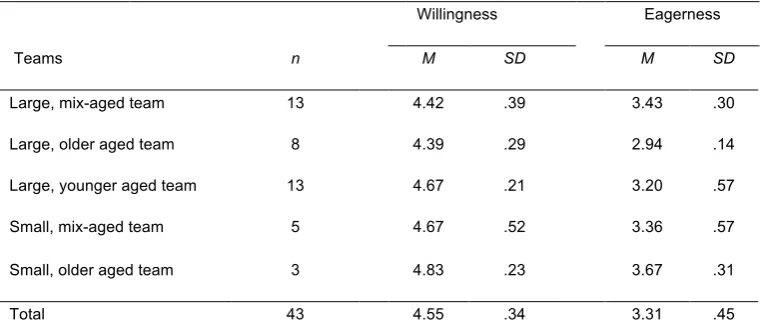
Means and standard deviations are provided in Table 4 in order to answer sub-question 1 on what extent there were differences between teams in eagerness and willingness for knowledge sharing.
Table 4.
Descriptive statistics of willingness and eagerness for knowledge sharing
Willingness Eagerness
Teams n M SD M SD
Large, mix-aged team 13 4.42 .39 3.43 .30 Large, older aged team 8 4.39 .29 2.94 .14 Large, younger aged team 13 4.67 .21 3.20 .57 Small, mix-aged team 5 4.67 .52 3.36 .57 Small, older aged team 3 4.83 .23 3.67 .31 Total 43 4.55 .34 3.31 .45
Note: (N = 37). A five-point Likert-scale: 1 = ‘strongly disagree’ to 5 = ‘strongly agree’ (De Vries et al., 2006).
The mean scores of all teams showed a high average of eagerness for knowledge sharing (2.94 to 3.67). This suggests that in general, individuals reported that they were eager to share knowledge. And the mean scores of all teams showed a high average of willingness for knowledge sharing (4.39 to 4.83), suggesting that there was also a high perception level of individual willingness at the teams (Table 4).
[image:19.595.66.449.417.583.2]20
knowledge sharing at the teams (Table 4). Overall, the mean and the SD scores showed that there seemed to be more consensuses about willingness for knowledge sharing then eagerness for knowledge sharing at the teams.
The variance in willingness and eagerness for knowledge sharing was unequal across the teams. Levene’s test showed that the equality of variance was violated by willingness, F(5.30) = 2.785, p = .35, and eagerness, F(5.30) = 2.756, p = .37 (Field, 2013). There was no assumption that the sampling distribution of the mean was normal distributed. The Kruskal-Wallis, a non-parametric test, was then performed to determine if there were differences among the attitudes for knowledge sharing (eagerness and willingness) between the different teams (Field, 2013).
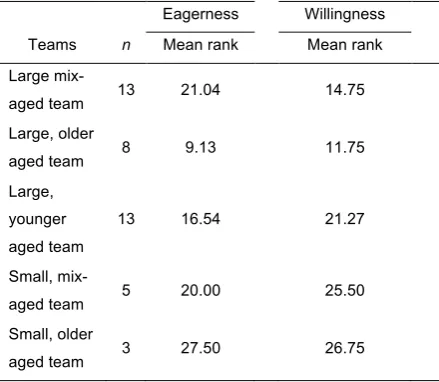
[image:20.595.70.290.390.581.2]The Kruskal-Wallis test evaluates whether the averages on eagerness and willingness are the same at all levels of all teams. Instead of using rough scores, the Kruskal-Wallis orders the scores of the teams from low to high and gives them a rank number (Field, 2013). The mean rank scores for eagerness and willingness are provided at Table 5.
Table 5.
Mean Rank Scores for Eagerness and Willingness for knowledge sharing
Eagerness Willingness Teams n Mean rank Mean rank Large
mix-aged team 13 21.04 14.75 Large, older
aged team 8 9.13 11.75 Large,
younger aged team
13 16.54 21.27 Small,
mix-aged team 5 20.00 25.50 Small, older
aged team 3 27.50 26.75
The test test statistics showed that eagerness, which was corrected for tied ranks, was non-significant
(H(5) = 6.555, p = .256). Indicating no significant difference (p = .256, p > .05) between distributions
21
4.1.3 Differences between shared mental models
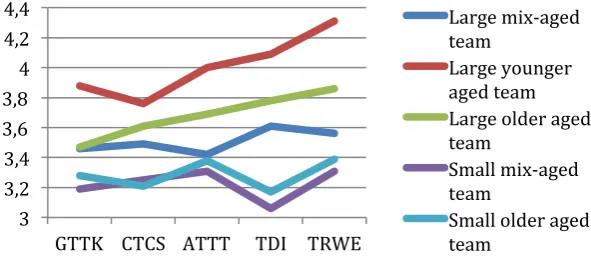
[image:21.595.70.531.314.505.2]Figure 2 and Table 6 show that the average scores of all teams for the five factors of a shared mental model ranged from a high-shared mental model (3) till a very high shared mental model (4) about having a team’s shared mental model. The small mixed-aged team and the small older aged team had lower average scores than the large mix-aged team, the large older aged team and the large younger aged team. This means that the two small teams mention they perceived less of a shared mental model about the five factors then the three larger teams. The factor team resources and working environment showed almost the highest average scores per team, which indicates strong individual mental models about a shared mental model for team resources and work environment. General team and task knowledge showed the lowest averages scores per team, meaning weaker individual mental models about having a team’s shared mental model for general team and task knowledge (Table 6).
Table 6.
Mean scores: shared mental model factors
GTTK GTCS ATTT TDI TRWE Overall Teams n M SD M SD M SD M SD M SD M SD
Large
mix-aged team 13 3.46 .46 3.49 .57 3.42 .40 3.61 .35 3.56 .31 3.51 .42 Large, older
aged team 8 3.47 .36 3.61 .07 3.69 .38 3.78 .27 3.86 .14 3.68 .24 Large,
younger
aged team 13 3.88 .26 3.76 .61 4.00 .34 4.09 .37 4.31 .41 4.01 .40 Small,
mix-aged team 5 3.19 .34 3.25 .59 3.31 .85 3.06 .82 3.31 .65 3.22 .65 Small, older
aged team 3 3.28 .39 3.21 .10 3.38 .53 3.17 .53 3.39 .23 3.29 .36
[image:21.595.76.372.563.691.2]Note. GTTK= general team and task knowledge, GTCS = general task and communication skills, ATTT= attitude toward teammates and task, TDI = team dynamics and interactions, TRWE = team resources and working environment.
Figure 2. Mean scores: shared mental model (scale 1–5).
Note. GTTK= general team and task knowledge, GTCS = general task and communication skills, ATTT= attitude toward teammates and task, TDI = team dynamics and interactions, TRWE = team resources and working environment.
3 3,2 3,4 3,6 3,8 4 4,2 4,4
GTTK CTCS ATTT TDI TRWE
Large mix-aged team
Large younger aged team Large older aged team
Small mix-aged team
22
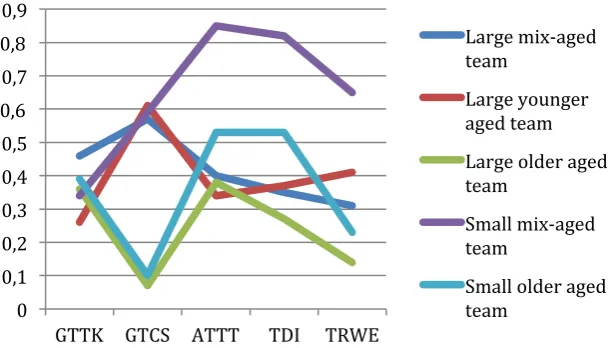
Figure 3. SD scores: shared mental model (scale 0.1–0.9).Note. GTTK= general team and task knowledge, GTCS = general task and communication skills, ATTT= attitude toward teammates and task, TDI = team dynamics and interactions, TRWE = team resources and working environment.
Sub-question 2 is answered using the SD-score of the five factors that contribute to a shared mental model (Table 6 and Figure 3). The SD measures the degree of spread of the mean scores for each of the five factors and indicates the level of agreement about having a shared mental model as a team. Figure 3 show that the large, older aged team and the small, older aged team had almost the same SD scores for all factors of the shared mental model. The large, older aged team showed the strongest shared mental model, followed by the small older-aged team, the large younger aged team, the large mix-aged team and finally the small mix-aged team, who shows the weakest shared mental model of all teams. Table 6 and figure 3 suggest that the teams in general seem to show the strongest shared mental model for general task and communication skills, followed by general task and team knowledge, team resources and work environment, attitude towards teammates and task and finally team dynamics and interactions.
The Levene’s test showed that the equality of variances was violated by all five factors of the shared mental model: general task and team knowledge, F(5,30) = .503, p = .772; general task and communication skills, F(5,30) = 1.693, p = .167; attitude towards teammates and task, F(5,30) = 2.406, p = .06; team dynamics and interactions, F(5,30) = 2.213, p = .079; and team resources and working environment, F(5,30) = 2.479, p = .054 (Field, 2013). These results indicate that the variance in the five factors was unequal across the teams. There was no assumption that the sampling distribution of the mean was normal. The Kruskal-Wallis, a non-parametric test, was then used to determine whether there were significant differences between the five factors of the shared mental model within the teams (Field, 2013).
0 0,1 0,2 0,3 0,4 0,5 0,6 0,7 0,8 0,9
GTTK GTCS ATTT TDI TRWE
Large mix-aged team
Large younger aged team Large older aged team
Small mix-aged team
23
4.1.4 Team differences based on the five factors of a shared mental model
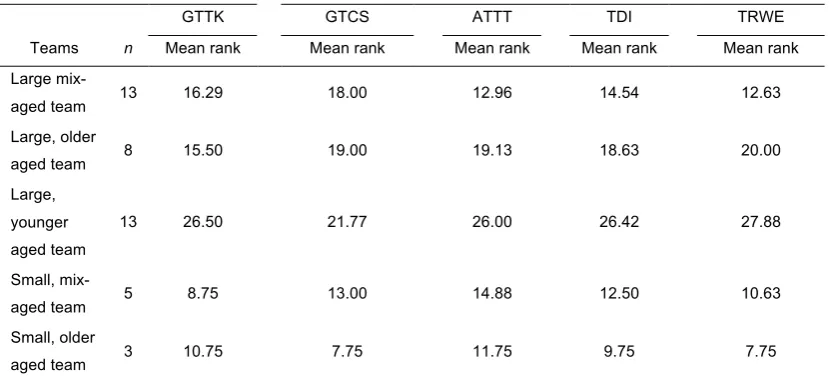
[image:23.595.69.484.264.455.2]A Kruskal-Wallis test was conducted to evaluate whether the population averages on the five factors of a shared mental model (general team and task knowledge, general team and communication skills, attitudes towards teammates and task, team dynamics and interactions and team resources and working environment) are the same at all levels of all teams. Instead of using rough scores, the Kruskal-Wallis test orders the scores of the teams from low to high and gives them a rank number (Field, 2013). The mean rank scores for all five factors of the shared mental model are provided at Table 7.
Table 7.
Mean Rank Scores for the Different Components of the Shared Mental Model
GTTK GTCS ATTT TDI TRWE Teams n Mean rank Mean rank Mean rank Mean rank Mean rank Large
mix-aged team 13 16.29 18.00 12.96 14.54 12.63 Large, older
aged team 8 15.50 19.00 19.13 18.63 20.00 Large,
younger aged team
13 26.50 21.77 26.00 26.42 27.88 Small,
mix-aged team 5 8.75 13.00 14.88 12.50 10.63 Small, older
aged team 3 10.75 7.75 11.75 9.75 7.75
Note. GTTK= general team and task knowledge, GTCS = general task and communication skills, ATTT= attitude toward teammates and task, TDI = tem dynamics and interactions, TRWE = team resources and working environment.
Subsequently the test statistics showed that general task and team knowledge, which was corrected for tied ranks, was significant (H(5) = 14.092, p = .015). Meaning that there was a significant difference (p = .015, p < .05) between general task and team knowledge across the five teams. The test for general task and communication skills, which was corrected for tied ranks, was non-significant
(H(5) = 4.743, p = .448). Indicating no significant difference (p = .448, p > .05) between distributions
of general task and communication skills across the teams. The test for attitudes towards teammates and task, which was corrected for tied ranks, was significant (H(5) = 11.616, p = .040). Indicating a significant difference (p = .040, p < .05) for attitudes toward teammates and task between the five teams. The test for team dynamics and interactions, which was corrected for tied ranks, was also significant (H(5) = 13.849, p = .017). Meaning that there was a significant difference (p = .017, p < .05) between team dynamics and interactions across the five teams. Finally the test for team resources and work environment, which was corrected for tied ranks, was significant (H(5) =
18.801, p = .002). Indicating that there was a significant difference (p = .002, p < .05) for team
24
The Kruskal-Wallis test showed that there were significant differences between teams for the distribution of general task and team knowledge (p = .015, p < .05), attitudes toward teammates and task (p = .040, p < .05), team dynamics and interactions (p = .017, p < .05), and team resources and work environment (p = .002, p < .05). This research suggests that there is more similarity between teams for general task and communication skills (p = .448, p > .05).
Mann-Whitney U tests were conducted between all teams to evaluate pairwise differences for all five factors: general task and team knowledge, attitudes toward teammates and task, team dynamics and interactions, and team resources and work environment, controlling the rate of Type I error over tests by using the Bonferroni approach (α = .005). From all follow-up analyzes the test statistics showed that only the large, younger aged team and the large mix-aged team differed significantly from each other for: attitude towards teammates and task (U = 20,5, Z = -3.15, p = .002, p < .005); team dynamics and interactions (U = 24,5, Z = -2.93, p = .003, p < .005); and team resources and work environment (U = 13, Z = -3.55, p = .00, p < .005) (Field, 2013).
Overall, the quantitative analyzes revealed significant differences between: general task and team knowledge; attitudes toward teammates; team dynamics and interactions; and team resources and working environment. However there might be a more similar level of willingness, eagerness, and the factor general team and task communication skills between the five teams.
Teams also differed in team size and age. The quantitative research revealed (small) differences based on team size, for instance for small teams the quantitative data of eagerness and willingness for knowledge sharing showed a high average score and small SD scores. And there were small differences betweens teams for the factors of a shared mental model based and team size. Future research is needed to investigate if team size influences the level of eagerness and willingness for knowledge sharing, because the sample size of this research is too small to make assumptions in combination with the explanatory nature of this research. Subsequently the two older aged teams showed a perception of a strong shared mental model, which might suggest further research if the increase of age influences the development of a stronger shared mental model.
4.2
Study 2: results interviews
This section provides an overview of the qualitative results given to answer question 3 and sub-question 4. The interviews were used to explore the factors that stimulate attitudes for knowledge sharing and the shared mental model. Finally, the main research question is answered.
4.2.1 Interviews
25
were conducted to explore possible factors that stimulate attitudes for knowledge sharing to develop a shared mental model.
4.2.2 Eagerness and willingness for knowledge sharing
The answers of the small, older aged team, the large mix-aged team, and the large younger aged team could be coded more often as a sign of willingness and eagerness for knowledge sharing, than the small mix-aged team and the large, older aged team. For example the interviewee of the large younger aged team mentioned: ‘teammembers show willingness, but it’s not so much a proactive team that asks, or give unsolicited advice. But if asked then they do and I think that’s positive’
[image:25.595.64.545.422.455.2]The answers of the large mix-aged team could be coded more often as eagerness for knowledge sharing then the large, older aged team, the large younger aged team, the small mix-aged team, and the small older aged team. All teams spoke during the interviews more about willingness for knowledge sharing than eagerness for knowledge sharing (Table 8). The large mix-aged team mentioned: ‘in a meeting you notice that often the same teammembers share a case or else, and others don’t’. Subsequently, the large younger aged team mentioned for instance: ‘team members have to take more responsibility to prepare their subject matter expertise more often in advance, acknowledging the importance. Just like I mentioned earlier about the securing of certain knowledge and projects, and that they can really contribute.’
Table 8. Number of fragments for each factor
Willingness Eagerness GTTK GTCS ATTT TDI TRWE
Total 24 7 25 38 13 37 24
Note. GTTK= general team and task knowledge, GTCS = general team and communication skills, ATTT= attitude toward teammates, TDI = tem dynamics and interactions, TRWE = team resources and working environment.
4.2.3 Stimulating eagerness and willingness for knowledge sharing
The interviews were used in order to answer sub-question 3 consisting of what factors stimulate the eagerness and willingness of team members to share knowledge with others. When asked, which factors were stimulating for willingness and eagerness for knowledge sharing, respondents answered that an already existing level of collaboration in a team was suggested as a possible stimulating factor for the willingness for knowledge sharing with others (29 times) (Table 9). An interviewee said the following about collaboration: ‘No, I find collecting and donating. If I go out of myself, I think so. Because it is, for example, certain knowledge, I have a great deal of knowledge of Wijkracht and social work and another colleague of budget alert. And if I have something and how should I deal with that, then I will go to the other colleague to collaborate and that will explain to me how or what. I think that we do exchange and we collect from each other.
26
[image:26.595.66.329.179.252.2]important. And others keep a little more on the flat because it is not so important, while it is very important. You always have individuals who share subject matter expertise and the people who think of yah .. While it is precisely this contribution that can be of importance.’
Table 9.
Factors that may stimulate willingness and eagerness for knowledge sharing
Stimulating factor for willingness
Mentioned at the interviews
Stimulating factor for eagerness
Mentioned at the interviews Collaboration 27 Subject matter
expertise
9
Table 10.
Factors that may stimulate a shared mental model
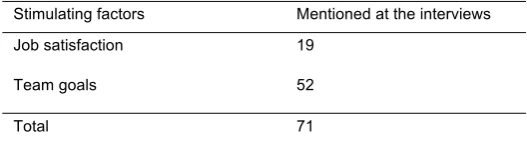
Stimulating factors Mentioned at the interviews Job satisfaction 19
Team goals 52
Total 71
4.2.4 Stimulating factors for a shared mental model
The conducted interviews were used to answer sub-question 4 that focuses on what factors stimulate the development the development of a shared mental model. The interviewees were asked during the interviews which factors they saw as stimulating for the development of a shared mental model; two additional factors may stimulate a shared mental model, namely job satisfaction (19 times) and team goals (52 times) (Table 10). Job satisfaction, which entails the individual degree of satisfaction at work, was mentioned during the interviews as stimulating for the creation of a shared mental model. An interviewee of the large mix-aged team said the following about job satisfaction: ‘I think that the situation is improved from last year, because as a team we have created a team meeting to share and evaluate knowledge’. Subsequently, the second mentioned stimulating factor the creation of a shared mental model was team goal(s). The team determines team goal(s), existing of purposes that need to be achieved by the team, which is suggested as a positively influencing factor for the creation of a shared mental model. The large mix-aged team spoke most about team goals, namely: ‘that you know what the team should focus on and that the goals are clear’.
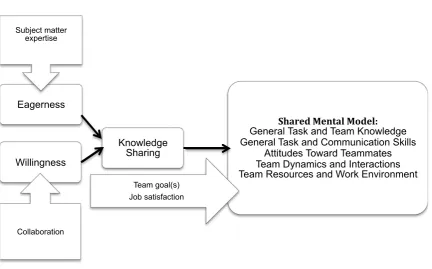
4.2.5 Stimulating eagerness and willingness to share a mental model
[image:26.595.64.328.318.395.2]27
Eagerness
Willingness
Knowledge Sharing
Shared Mental Model:
General Task and Team Knowledge
General Task and Communication Skills Attitudes Toward Teammates
Team Dynamics and Interactions Team Resources and Work Environment
Subject matter expertise
Collaboration
Team goal(s) Job satisfaction
[image:27.595.71.504.240.509.2]for the creation of a shared mental model as a team. Namely subject-matter expertise was suggested as a possible factor that may stimulate eagerness for knowledge sharing (9 times). Interviewee’s mentioned collaboration as a factor, which may stimulate willingness for knowledge sharing (27 times). They also suggested that there were two additional factors that may stimulate the development of a shared mental model, namely job satisfaction (19 times) and team goals (52 times). Overall, the explored factors suggested by the interviewee’s are seen as stimulating for eagerness and willingness to develop a shared mental model (Figure 7).
28
5. What factors stimulate eagerness and willingness to
share a shared mental model?
This chapter elaborates on the most important explanatory findings and limitations of this research, future research suggestions were provided. Finally, theoretical and practical implications are discussed.
5.1 Conclusion and discussion
The aim of this research was to explore and explain what stimulated the eagerness and willingness for knowledge sharing to develop a team’s shared mental model and if there is a significant difference between governmental teams. The quantitative analyses at study 1 revealed significant differences between teams for the distribution of: general task and team knowledge; attitudes toward teammates and task; team dynamics and interactions; and team resources and working environment. Follow-up analyzes showed that the large, younger aged team and the large mix-aged team differed significantly from each other for: attitude towards teammates and task; team dynamics and interactions; and team resources and work environment (Field, 2013).
Subsequently, the qualitative analyzes at study 2 explored stimulating factors for eagerness and willingness for knowledge sharing and the development of a shared mental model. The interviewee’s explained that subject-matter expertise might be stimulating for eagerness for knowledge sharing and collaboration may be a stimulating factor for willingness for knowledge sharing. The interviewee’s also explained that there were two additional factors that may have a direct stimulation on the development of a shared mental model, namely job satisfaction and team goals.
Differences between teams and stimulating factors for agerness and willingness
Study 1 made clear that individual team members at all teams mention there was a strong overall agreement about willingness for knowledge sharing and eagerness for knowledge sharing. Team members at all teams showed consensuses about a very strong level of willingness for knowledge sharing and a strong level of eagerness for knowledge sharing. Overall, the quantitative analyzes showed no significant difference between teams of eagerness for knowledge sharing and also of willingness for knowledge sharing, indicating a more similar distribution between eagerness and willingness for knowledge sharing across the teams.
29
enhance the performance belief motivation to easily share knowledge with other team members. In line with earlier research, which stated that the level of subject matter-expertise of the individual team member can also inspire the willingness of other members to share knowledge positively influence an eager attitude for knowledge sharing (De Vries et al., 2006).
Differences between teams and stimulating factors for a shared mental model
Study 1 made clear that the two older aged teams showed the highest level of consensus about having a team’s shared mental model, against a large younger aged team, a large mix-aged team, and finally a small mix-aged team. In line with Gellart and Kuipers (2008) who stated that teamwork and team performance may benefit from the subject matter expertise of older aged team members (Gellart and Kuipers, 2008). Earlier research suggested that the average age of a team could be increased, by adding older team members to teams with younger team members (Gellart and Kuipers, 2008). However this research explored that adding older aged team members with younger aged team members, for example at: the small mix-aged team and the large mix-aged team, was not beneficial for stimulating the creation of a shared mental model at this research. Subsequently, the quantitative analyzes focused at the distribution of the five factors of the shared mental model. Which revealed a significant difference in distribution of general task and team knowledge, attitude toward teammates and task, team dynamics and interactions and team resources and work environment across teams. These differences might be explained by the major changes in the social domain, which imposes governmental organizations to explore, together with their citizens, how to enable their independent functioning and social participation. It is important to create these tailor-made solutions and differences are aloud, but there is also a need for an overall standard with a weighing-up framework to maintain unambiguousness with regard to the execution of the tasks (Bosselaar and Van der Veer, 2018).
30
mentioned that professionals are asked to show a possitive attitude and connecting skills, in order to act as a moderator more than as problem solver (Bosselaar & Van der Veer, 2018).
Age and team size seem to matter during this research, but it is possible that there are many other factors that may have played a role in these differences found during this study. Earlier research has already shown that the demographic diversity of a team, such as sex, age, or tenure, does not increase the value of intragroup knowledge sharing or external knowledge sharing, unless the demographic diversity exposes team members to the donation of subject-matter expertise of other team members (Chatman and Flynn, 2001; Cummings, 2004).
This research cannot conclude which role age and team size exactly play based on the small sample size of only five teams. However this research showed that out of five factors there were three factors of a shared mental model significant different between two teams with a large team size. And another factor showed a significant difference between a small sized team and a large sized team. These significant differences may be in line with earlier research, which pointed out that the more team members there are, the higher the chance this might result in having difficulties contributing to the team’s interest (De Vries et al., 2006). Also pre-study claimed that team members of smaller teams collaborated more actively and without formal coordination mechanisms compared to members of larger teams (Bradner, Mark, & Hertel, 2005).
To conclude, most of the findings are in accordance with previous research. By using an integrated model, in which the shared mental model and knowledge sharing attitudes coexist and by integrating quantitative research and qualitative research, this study expanded the existing models used in previous research and even explored possible stimulating factors for creating a shared mental model.
31
Secondly, this research may suggest, based on the explorative and explanatory nature, that there are explanatory stimulating factors for individuals’ willingness and eagerness to share knowledge with team members at a governmental organization. Moreover, these stimulating factors differ, namely subject matter expertise might influence an eager attitude and collaboration might influence the willingness for knowledge sharing. Subsequently, job satisfaction and setting team goals might help to create a shared mental in order to improve task performance and team processes, also here further research is needed.
Finally, having older aged team members at a governmental organization might be beneficial for donating subject matter expertise with their often-younger team members. The results of this research might suggest that older aged team members have more agreement about having a shared mental model. Subsequently, this research also explored that large teams might possess a higher level of agreement about having a shared mental model about team dynamics, attitudes towards teammates and skills. But this research cannot conclude which role age and team sizes exactly play based on research of only five teams, therefore further research is needed.
5.2 Limitations of this research
Despite a careful design of the study, some limitations were encountered. First, the data was collected from the team members during the summer vacation, which negatively impacted the number of participants and for the online survey since many civil servants were on leave. Further research is needed to validate the findings of this study by using a larger sample size, with more large teams at several organizations. A larger sample size allows researchers to conduct a better quantitative research based on the instruments used from De Vries et al. (2006) and Johnson et al. (2007).
Second, the usage of multiple measurement instruments within the same study based on different methods can reveal different patterns of findings (Mohammed et al. 2010). In this research the shared mental model was measured through the TADI (Johnson et al., 2007). A limitation of this research, to extensively capture this varied cognitive knowledge, is that the TADI measures the individual perception about having a shared mental model as a team. It would therefore be recommended to design and develop an instrument for measuring the team’s perception about having an agreement of a team’s shared mental model aimed at countering for socially desirable answers of individuals.
The final limitation is the generalizability of the research. This research was conducted at a social domain of a governmental organization, where earlier research focused at defence and naval domains (Smith-Jentsch, et al., 2001). This research differed with earlier research specifically by exploring less influencing elements, such as team size, age and knowledge sharing attitudes. Whereas Smith-Jentsch, et al. (2001) conducted a broader research on high-ranked functions, low-ranked functions, work experience and other variables.
5.3 Theoretical implications for new research
32
individual work experience at narrowly focused and highly differentiated teams. But future research should also investigate what factors stimulate demographic diverse teams to share and create a shared mental model.
Finally future research should expand this performed research by the use of several field settings. In order to compare several shared mental models and the influence of the individual, the team and organization characteristics on the creation of a shared mental model. Only the context-dependent nature of of a shared mental model study asks for controlling for the specific task performance and team processes during future research.
5.4 Practical implications
There were also several practical implications of this study. First, executives should focus on how to involve team members in the knowledge process, in order to improve the skills of team members required for donating and collecting knowledge. One suitable method for stimulating knowledge sharing is peer collaboration between team members: consisting of donating and receiving feedback about task performance and team processes. Peer collaboration reserves time for the creation of these processes and emphasizes the importance of the willingness to share knowledge on the team level. Team members could also evaluate their level of subject-matter expertise in order to know what knowledge needs to be collected from other team members and in order to increase the eagerness for knowledge sharing with others. In addition, it is important to create short spontaneous knowledge sharing moments during a day to donate and collect knowledge, which could stimulate team dynamics and interaction especially at small teams. These moments can also help improve job satisfaction and underscore the importance of knowledge sharing.
Second, this research suggests that it is important for all teams to pay attention to enhancing the individual appreciation of work and to creating a positive mood for social interaction at the team level. Team members have to appreciate personal contact in order to improve general task and communication skills by means of having informal conversations, which could improve the personal well being of a team member. Being part of a team or organization could help to improve the individual team member’s self-efficacy. Especially in this knowledge economy, where technology emerges rapidly and the personal contact between members seems to be more important than ever.
33
Reference List
Bock, G. W., & Kim, Y. G. (2002). Breaking the myths of rewards: An exploratory study of attitudes about knowledge sharing. Information Resources Management Journal (IRMJ), 15(2), 14-21.
Bock, G. W., Zmud, R. W., Kim, Y. G., & Lee, J. N. (2005). Behavioral intention formation in
knowledge sharing: Examining the roles of extrinsic motivators, social-psychological forces, and organizational climate. MIS quarterly, 29(1), 87-111.
Bosselaar, H. & Van der Veer, J. (2018). Creating Connections: the Case of New Welfare. In H. Boutellier, & W. Trommel (Eds.), Emerging Governance: Crafting Communities in an
Improvising Society, (29-35). Den Haag: Eleven Publishers.
Bradner, E., Mark, G., & Hertel, T. D. (2005). Team size and technology fit: Participation, awareness, and rapport in distributed teams. IEEE Transactions on Professional Communication, 48(1), 68-77.
Brislin, R. W. (1970). Back-translation for cross-cultural research. Journal of Cross-Cultural Psychology 1(3), 185–216.
Cabrera, A., Collins, W. C., & Salgado, J. F. (2006). Determinants of individual engagement in knowledge sharing. The International Journal of Human Resource Management, 17(2), 245-264.
Cannon-Bowers, J. A., Tannenbaum, S. I., Salas, E., & Volpe, C. E. (1995). Defining competencies and establishing team training requirements. In R. A. Guzzo, E. Salas, & Associates (Eds.), Team eflectiveness and decision making in organizations, 333-380. San Francisco: Jossey-Bass.
Cannon, M. D., & Edmundson, A. M. (2001), Confronting failure: Antecedents and consequences of shared beliefs about failure in organizational work groups. Journal of Organizational Behavior, 22(2), 161-177.
Chatman, J. A., & Flynn, F. J. (2001). The influence of demographic heterogeneity on the emergence and consequences of cooperative norms in work teams. Academy of Management
Journal, 44(5), 956-974.
34
DeChurch, L. A., & Mesmer-Magnus, J. R. (2010). The cognitive underpinnings of effective teamwork: A meta-analysis. Journal of Applied Psychology, 95(1), 32.
De Vries, R. E., Van den Hooff, B., & De Ridder, J. A. (2006). Explaining Knowledge Sharing: The Role of Team Communication Styles, Job Satisfaction, and Performance Beliefs.
Communication Research, 33(2),115-135. doi:10.1177/0093650205285366.
Dillenbourg, P. (1999). What do you mean by collaborative learning? Consulted from https://telearn.archives-ouvertes.fr/hal-00190240/document
Dooley, K. (2001). Social research methods (4th ed.).Upper Saddle River, NJ: Pearson.
Drucker, P. (2001). The next society. Consulted from https://www.economist.com/node/770819
Fetters, M. D., Curry, L. A., & Creswell, J. W. (2013). Achieving integration in mixed methods designs—principles and practices. Health services research, 48(6pt2), 2134-2156.
Field, A. (2013). Discovering statistics using IBM SPSS statistics. Thousand Oaks, CA: Sage.
Gagné, M. (2009). A model of knowledge-sharing motivation. Human Resource Management, 48(4), 571.
Gellert, F. J., & Kuipers, B. S. (2008). Short-and long-term consequences of age in work teams: An empirical exploration of ageing teams. Career Development International, 13(2), 132-149.
Hendriks, P. H. J. (1999). Why share knowledge? The influence of ICT on the motivation for knowledge sharing. Knowledge and Process Management, 6(2), 91-100.
doi:10.1002/(SICI)1099-1441(199906).
Ipe, M. (2003). Knowledge sharing in organizations: A conceptual framework. Human Resource Development Review, 2(4), 337-359. doi: 10.1177/1534484303257985.
Ivankova, N. V., Creswell, J. W., & Stick, S. L. (2006). Using mixed-methods sequential explanatory design: From theory to practice. Field methods, 18(1), 3-20.
Jackson, S. E. (1996). The consequences of diversity in multidisciplinary work teams. Handbook of
work group psychology, 53-75.
Jonker, C. M., Van Riemsdijk, M. B., & Vermeulen, B. (2011). Shared mental models. In Coordination, organizations, institutions, and norms in agent systems vi, 132-151. Springer, Berlin,