CIEMAT, Madrid 28040, Spain
1)Max-Planck-Institut f¨ur Plasmaphysik, EURATOM Association, Greifswald 17491, Germany
2)Oak Ridge National Laboratory, Oak Ridge, TN 37831-6169, USA
3)Australian National University, Canberra ACT 0200, Australia
4)Kyoto University, Uji 611-0011, Japan
5)National Institute for Fusion Science, Toki 509-5292, Japan
6)Institut f¨ur Plasmaforschung, Universit¨at Stuttgart, Stuttgart 70569, Germany
7)University of Wisconsin, Madison, WI 53706-1481, USA
(Received 16 November 2007/Accepted 15 February 2008)
This work surveys the main results concerning the effects of the rotational transform, its low order rational values and its shear on the confining properties of low shear devices. It is meant to promote further studies aimed at clarifying their role in future, reactor grade, devices. 1-D transport studies are encouraged as the effects of rota-tional transform on confinement appear to be of local nature. Low order rarota-tional values of the rotarota-tional transform are associated with both degraded and improved confinement, being the magnetic shear a plausible cause for the difference. Very small shear values are enough to avoid deletereous effects of the low order rationals in high rotational transform discharges, but further experiments are needed to elucidate whether there is a threshold shear that depends on the rotational transform itself.
c
2008 The Japan Society of Plasma Science and Nuclear Fusion Research
Keywords: stellarator, heliotron, rotational transform, magnetic shear, confinement DOI: 10.1585/pfr.3.S1004
1. Introduction
The fact that the confining field in stellarators is largely independent of the plasma itself provides an ex-traordinary freedom of design and is the reason behind the variety of configurations existing or under construction [1]. A significant degree of freedom is the capability of choos-ing different values and profiles of rotational transform, ¯
ι=ι/2π. Historically, two approaches have been followed to prevent the expected confinement deterioration due to the presence of low order resonances. The first one is to de-sign machines with very flat profiles (extremely low mag-netic shear, ˆs), trying to avoid resonances (for example, the Wendelstein family [2, 3], TJ-II [4], HSX [5], Heliotron-J [6]). W7-X, the large stellarator appearing in the hori-zon follows the low shear approach and its design has been optimized to have a weak dependence of ¯ιon the plasma pressure. The second approach is to look for strongly vary-ing rotational transform profiles that do not avoid the res-onances but force the islands to shrink and prevent them
author’s e-mail: [email protected]
to overlap (for example, Heliotron-E [7], L2 [8], ATF [9], CHS [10], LHD [11]).
After those experiments rotational transform and mag-netic shear remain as two important issues whose role must be considered in future designs of candidates for a stel-larator reactor. The extensive inter-machine 0-D global scaling studies performed to date do not yield a clear pic-ture about the role of ¯ι on confinement, as will be dis-cussed later. Additional 1-D information contained in the temperature and density profiles should be considered as well. Local transport analysis can provide valuable in-formation on the role played by the resonances and help in understanding the influence of rotational transform on confinement. This work points in this direction, within the framework of the International Stellarator/Heliotron Con-finement DataBase (ISHCDB) under auspices of the IEA Implementing Agreement for Cooperation in the Develop-ment of the Stellarator Concept [12]. On the need to clar-ify the true role of rotational transform and shear in these confinement devices, it is advised searching for
appropri-c
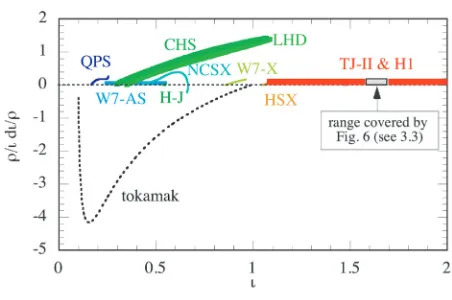
Fig. 1 Range covered by the main operating stellarators in a (¯ι,sˆ) parameter space. The tokamak range is also shown for comparison.
ate figures of merit in the (¯ι,s) parameter space. Figure 1ˆ shows the range covered by the main operating stellarators in (¯ι,s). The tokamak range is also shown for comparison.ˆ As a first step, it has been found convenient starting with a survey based only on low shear machines, which should help in deciding further steps where large shear devices must be included.
A survey of the results obtained so far on the influence of rotational transform value on global confinement is pre-sented in section 2. The effect of low order resonances on confinement is discussed in section 3. The role of magnetic shear is presented in section 4. The work is concluded with a brief summary in section 5.
2. Dependence of Global Confinement
on the Rotational Transform Value
Early tokamak studies predicted that high rotational transform values are favourable for confinement, with ex-ponent 0.4 [13]. In stellarators, the Wendelstein stellarator family was the first to publish experimental results on the confinement dependence on ¯ι owing to the capability of their devices to performιscans. They reported a general improvement (energy confinement time and electron heat diffusivity) at higher rotational transform values provided that distinct optimum confinement windows close to low order resonances (1/3 and 1/2) were chosen [14, 15].
ISS95, the first extensive stellarator study based on international collaboration compiled a database from the main devices at that time and deduced an intermachine scaling law, which predicted an improvement of global confinement with increasing ¯ι [16]. However, the fact that an offset between the shear-less machines and the he-liotron/torsatrons appeared in the unified scaling required the use of an “ad-hoc” parameter to arrive at a unified ex-pression. This so-called “parameter s” accounted for the difference in confinement between stellarators with and without shear.
The individual results from the TJ-II flexible heliac
Fig. 2 Comparison of the dependence of renormalised confine-ment times on ¯ι, for data subsets of W7-AS, TJ-II and Heliotron J.
showed again the beneficial effect of ¯ιon the global energy confinement and supported the W7-AS finding in a wider range (1.2<¯ι <2.2) [17].
For the ISS04 revision of ISS95, new devices en-tered the confinement database: LHD, TJ-II, Heliotron-J and HSX. Particularly important was the contribution from LHD, the largest device, which extended the param-eter regime to substantially lower values of normalized collisionality and ion gyro radius, much closer to reac-tor regimes than those of the ISS95 devices [18]. Be-sides, W7-AS had discovered significant high confine-ment regimes with divertor operation. Thus, a new larger database was compiled including these new results. ISS04, the new scaling expression, was derived from a restricted set from the full database. The dependence of global con-finement onιdeduced from ISS04 is again positive, with exponent 0.4, in line with ISS95, but again a caveat ques-tions this result. In ISS04, the use of the old “parame-ters” was not sufficient to arrive at a unified scaling and a new empirical configuration-descriptive renormalization factor, fren, derived for each configuration subgroup, was
used [19, 20]. This factor was related to specific properties of the helical field structure of each device; it appears to be correlated, for instance, with the corresponding eff ec-tive helical ripple, plateau factor and elongation. Taking into account the corresponding configuration factors, the ¯ι-dependence of different machines can be compared.
transport reduction.
3. E
ff
ect of Low Order Resonances on
Confinement
Both low and high shear approaches face challenges regarding the effect of low order resonances. Examples are i) keeping the configuration free of resonances at highβin low shear devices or ii) maintaining the divertor capabili-ties in high shear machines. In any case, there are some open questions that need to be addressed:
• Is there a threshold for the magnetic shear over which low order resonances lose their detrimental character? Does this threshold depend on the value of the rota-tional transform itself?
• What is the effect of resonances when the shear is above this threshold?
• Is the sign of the shear important, or is only its mag-nitude what matters?
The logic behind this type of questions is clear: Provided that low order resonances do not deteriorate confinement anymore in the presence of enough (perhaps very low) magnetic shear -or, even more, if they can act as regulators of the local transport in both senses (enhance-decrease)-then the design constraints of future stellarators might be relieved: a strict control of the magnetic shear (i.e., inter-nal currents) would no longer be necessary and the avail-able configuration space to optimize other physics aspects (for example, magnetic ripple, field symmetries to improve neoclassical transport, etc) would expand.
In the process of answering the questions posed above (goal beyond this article) a first step would be to summa-rize some well-established results from low shear devices. In the following subsections we try to survey the major effects of the low order rationals on confinement and trans-port. In section 4 we put the emphasis on the effect of magnetic shear through its impact on the low order ratio-nals.
3.1
Degraded confinement due to low order
resonances at low
β
As is well known, in the absence of magnetic shear, low order resonances placed in the confining region
pro-ence with the W7-AS phenomenology is not yet under-stood but it might have to do with the fact that TJ-II is not operated with feedback control of the plasma current by the OH transformer. In conditions of high ECR heat-ing power density (≈ 15 W/cm−3) and low plasma den-sity (≈ 0.5 - 0.7×10¹⁹m−3) transient degraded
confine-ment states —sometimes interspersed with phases of im-proved confinement— are observed in TJ-II in a variety of different experimental conditions, normally associated to the presence of low order rationals. The experimentally measured characteristics of the features associated to the observed transport events depend on the position of the resonance [27, 28]. Examples are: fast transient drops of the electron temperature associated to the 3/2 and 8/5 res-onant surfaces close to the plasma centre [29]; or transient flattenings of the electron temperature profile (ELM-like events) associated to the presence of the 3/2 resonant sur-face in the density gradient region [30, 31].
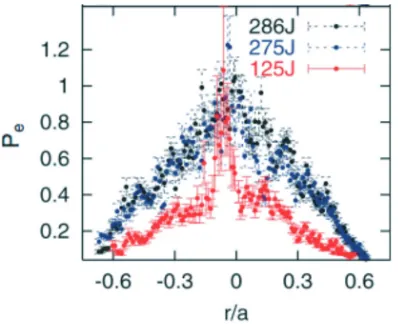
A clear case of flattening of the pressure profile in TJ-II is shown in Fig. 3, where a Thomson Scattering pro-file measured in an ECH discharge with induced OH cur-rent to study magnetic shear effects is shown. The time evolution of the rotational transform can be estimated con-sidering the measured net current as due only to the OH
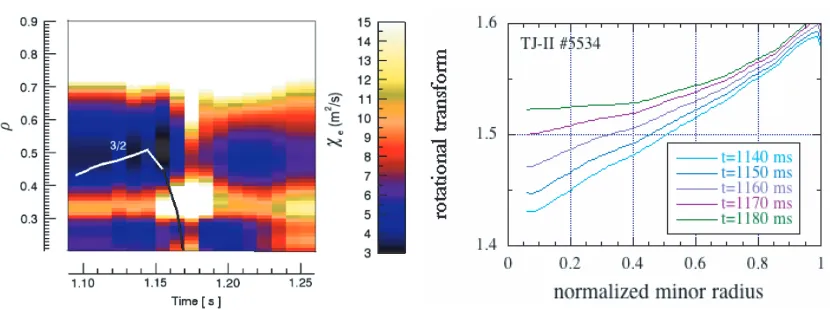
Fig. 4 Left: Time evolution of the effectiveχe∝(∇Te)−1profile obtained from ECE data for a TJ-II ECRH discharge with small induced
OH current. The evolving profile has its 3/2 value moving as shown by the black/white line. Right: Corresponding evolution of the rotational transform.
transformer and taking into account the evolvingTe
pro-files from the ECE diagnostic. As the plasma current den-sity diffuses inwards due to the effect of (Spitzer) resis-tivity, it is found that the 3/2 ¯ι-value disappears from the plasma att ≈1170 ms with null shear. An effectiveχeis
obtained simultaneously from power balance calculations. The results shown in Fig. 4 are a clear indication that the short transient with largeχe(or small∇Te) around 1170 ms
seen in the experimental data are a consequence of the ¯
ι=3/2 resonance occupying a fraction of the plasma core, thus causing a transient flattening of theTeprofile [32]. It
is worth emphasizing that the use of this effectiveχeallows
us to study and quantify the effect of resonances on lo-cal transport without the need to identify its ultimate cause (ergodization, turbulence, loss of confining volume or any MHD-related phenomenon).
Note that the presence of the 3/2 resonance (white/black line in Fig. 4) does not really alter transport unless something in the rotational transform profile favours a singular effect of transient nature. Despite the approxi-mated character of these calculations, the figure suggests that the transient of large diffusivity att ≈ 1170 ms, co-incident with the narrowed profiles shown in Fig. 3, is a consequence of the ¯ι-profile having been forced by the OH current to flatten and occupy a portion of the plasma with very small shear. It is worthwhile noting that, after the clearly degraded transport at t ≈ 1170 ms due to the 3/2 resonance in no shear condition, the resonance disappears completely from the plasma due to the larger induced cur-rent. In spite of this, after the crash, the transport coeffi -cient remains larger than before it. This behaviour is at-tributed to the fact that the shear continues decreasing in the external part of the plasma [33] as Fig. 4 (right panel) illustrates. We shall come back to this in Sec. 4.
In early W7-AS works, transient phenomena which might resemble some of the transient TJ-II events just out-lined above were mentioned: transient maxima of energy confinement interspersed with phases of degraded
confine-ment have been reported in the transient phase of plasma build up (very low or even negative shear), still without feedback control of the plasma current and with ¯ι-values close to low order rationals [14].
3.2
Improved transport in the vicinity of low
order resonances
W7-AS results show that narrow optimum confine-ment windows with smaller transport are located close to (but no at) the low order resonances. The explanation given for this result is based on an empirical model, which as-sumes that transport is always enhanced at resonant sur-faces and that this enhancement is reduced by magnetic shear [22]. This model invokes the rarefaction of high or-der resonances in the immediate vicinity of low oror-der ones, which is expected to decrease the turbulent transport.
There is abundant experimental evidence of the role of low order resonances as triggers for different improved transport events [28]. Transport barriers close to resonant surfaces have been found in tokamaks [34, 35]. Several stellarators like LHD and TJ-II have also found electron transport barriers close to rational surfaces located in the core region [36–40] or in the plasma edge [41, 42]. In TJ-II low collisionality plasmas, when the 3/2 resonance is in the core, an increase of the positive radial electric field is measured, synchronized with the electron transport barrier formation [38, 43]. The phenomenon is similar to the improved heat confinement found in the neoclassical electron root feature in several stellarators, the so-called CERC [44, 45]. Recent experiments in TJ-II, in low colli-sionality plasmas, have shown also for the first time an in-crease in the central ion temperature, simultaneous to the increase of electron temperature and triggered by the 4/2 resonant surface [46].
3.3
Tracking the local lowering of
χ
edue to
low order rationals in TJ-II plasmas
In this section the results of local power balance anal-ysis of a series of TJ-II discharges obtained in several
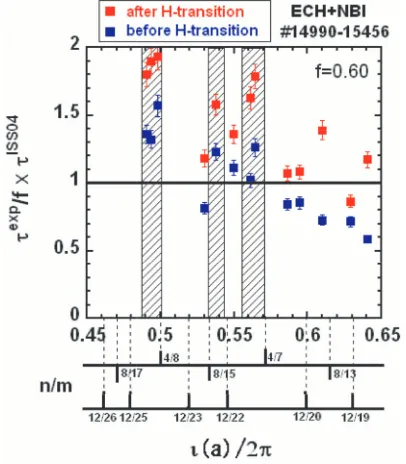
mag-Fig. 5 Quality of the confinement improvement in the L to H transitions found in Heliotron-J depending on the edge rotational transform. The shadded areas mark optimum transitions.
Fig. 6. Note the narrow ¯ι-span of this scan (1.60≤¯ιρ=0.75 ≤
1.71). The consequences of this scan of the rotational transform inχe as obtained from power balance
calcula-tions are shown in Fig. 6, in the form of a contour plot. The experimental data have been interpolated linearly along a rotated mesh aligned with the path of the ¯ι = 8/5 in the range 0.6< ρ <0.8 (see [48] for details). The white solid and dashed lines correspond to the path followed by the lowest order rationals of the vacuum-configuration present in the scan (from left to right, ¯ι = 8/5, 13/8, 18/11 and 5/3). The figure shows a pattern of “ridges” and “grooves” whose direction follows roughly the path of rationals along the minor radius asIhcincreases (i.e., as the rationals move
inwards). Therefore, the power balance analysis suggests that low order rationals retain heat fluxes at their radial lo-cation. This is very likely forρ >0.6, where ¯ιshould be practically the vacuum one due to the small net plasma cur-rents typically found in these experiments. At this respect, preliminary estimations of the bootstrap current [49] indi-cate that there should be a change of sign near half radius, according to which the net current would approach zero as one moves inwards in radius up toρ ≈ 0.6, making the vacuum ¯ι to be even closer to the one with plasma. All these aspects require further study and a careful estimation of internal currents. However, taking as a hypothesis that the grooves are coincident with the low order rationals, the proximity of the grooves and the location of vacuum
ues of the low order rationals in Fig. 6 would be indicating that the bootstrap currents are indeed small in TJ-II ECH discharges. Finally, Fig. 6 corresponds to a very small por-tion in (¯ι,s) as marked in Fig. 1. The reason is that, asˆ seen in the left panel of Fig. 6, there is no shear scan in this experiment and the range of ¯ι values is purposely small in order to follow the displacement of resonances in mi-nor radius. The important fact, however, is that the corre-sponding low shear area marked in Fig. 1 allows for normal magnetic confinement despite the presence of low order ra-tional values of ¯ι.
4. The Role of Magnetic Shear
There is a robust experimental evidence showing that the confinement degradation produced by the presence of low order rationals in the confined plasma is restored if enough magnetic shear is generated, no matter the origin of the current (pressure driven, inductive, EC driven) [24]. An example from W7-AS is shown in Fig. 7, which shows the effect of ¯ιa and plasma current (using the OH
trans-former) on the plasma energy content, for discharges with identical plasma radius and densities. The strong depen-dence on rotational transform of the energy content, at zero current, decreases as the current is raised and disappears at the highest current value.
Local power balance analysis also provides clear evi-dence of restoration of degraded confinement via magnetic shear in W7-AS, as illustrated in Fig. 8. It shows degraded confinement in the no shear situation (0 kA). Increasing the shear with inductively driven current, reduces strongly the electron heat diffusivity in the gradient region. The dis-charges withIp = 10 kA and 25 kA have ¯ι = 1/2 in the
plasma region without any significant local degradation of confinement. It is clear that confinement improves with shear independently of the sign.
It was mentioned before (see Fig. 4) that the effective
χe, after a low order resonance has disappeared, can keep
on increasing in TJ-II ECH plasmas with ohmic currents. This is an indication that something not related with the low order resonance itself is playing a part in the evolu-tion of the discharge. These first experiments with OH in TJ-II [32] put the magnetic shear as one possible intrin-sic cause of the effect on confinement, separated from the presence or not of low order resonances. Later dedicated experiments showed that small shear values, with absolute value of the order 0.1, are enough not only to allow
includ-Fig. 7 Plasma energy content vs. ¯ιfor four values of induced OH current.
Fig. 8 Left:Te(upper box) andχe(lower box) profiles for discharges with ¯ιa=0.42 and different values of plasma current in W7-AS.
Fig. 9 Electron thermal diffusivity atρ = 0.75 vs. magnetic shear in the same radial position for several discharges with induced OH current in TJ-II.
ing the lowest order rationals inside the plasma but even to force the transport to decrease in the gradient region obey-ing the shear strength [33]. Figure 9 shows the effective thermal diffusivity obtained inρ = 0.75 for a number of different ECRH discharges with similar density, in plasmas operated under ohmic induction. Positive induction drives ¯
ιtowards positive values although high ˆs>0 values cannot be reached because the largest plasma current (≈ 10 kA) does not allow for further variation of the rotational trans-form profile. According to these results, the largestχeis
found around zero shear and it clearly decreases for neg-ative shear. Positive shear seems also to reduce transport although the result is less clear due to the smaller explored range. These TJ-II results are in line with the W7-AS con-clusion.
5. Summary
• Keeping the configuration free of low order reso-nances in real experimental conditions is a difficult task for devices with low vacuum magnetic shear. The optimized design of Wendelstein 7-X will allow it to fully explore and characterize this scenario at high
β. The fine-tuning capability of the available modern ECRH systems provides an additional tool, if needed, to compensate undesired internal currents by means of localised heating.
• Certain amount of shear allows the presence of even the lowest order rationals (1/2 in the W7-AS case) within the confinement region without degradation. Low shear values, |sˆ| ≈ 0.1, are enough in TJ-II —which is the stellarator with highest ¯ι— to observe the beneficial effect of the shear. Further comparisons between devices with different ¯ιare needed in order to study whether there is a threshold value for the shear that depends on the ¯ιvalue.
• Narrow optimum confinement windows are found in W7-AS and Heliotron-J close to low order rational values. Provided a small amount of magnetic shear is present, the low order resonances are found to trigger
fact could give rise to misleading conclusions if only the power balance is considered because quite diff er-entTeprofiles, indicating a degraded globalτE, could
have a negligible impact on the localχe. So, complete
analysis of temperature and density profiles would be needed.
This work contributes to the International Stellara-tor/Heliotron Confinement DataBase (ISHCDB) under auspices of the IEA Implementing Agreement for Cooper-ation in the Development of the Stellarator Concept [12].
[1] J. S´anchezet al., Plasma Phys. Control. Fusion47, B349 (2005).
[2] H. Wobig and S. Rehker, Proc. 7th SOFT (Grenoble) (1972).
[3] J. Sapperet al., Fusion Technol.17, 62 (1990). [4] C. Alejaldreet al., Fusion Technol.17, 131 (1990). [5] F. Andersonet al., Fusion Technol.27, 273 (1995). [6] T. Obiki et al., Plasma Phys. Control. Fusion 42, 1151
(2000).
[7] K. Uoet al., Nucl. Fusion24, 1551 (1984).
[8] D.K. Akulinaet al., Proc. 6th Int. Conf. on Plasma Phys. and Control. Fusion (Berchtesgaden)2, 115 (1976). [9] J. F. Lyonet al., Fusion Technol.10, 179 (1986). [10] K. Nishimuraet al., Fusion Technol.17, 309 (1990). [11] A. Iiyoshiet al., Fusion Technol.17, 169 (1990).
[12] The ISHCDB is jointly hosted by NIFS and IPP at the sites http://iscdb.nifs.ac.jp/and http://www.ipp.mpg.de/ISS [13] K. Lackner and N. Gottardi, Nucl. Fusion30, 767 (1990). [14] H. Ringleret al., Plasma Phys. Control. Fusion32, 933
(1990).
[15] R. Brakelet al., Proc. 20th EPS Conf. (Lisbon) 361 (1993). [16] U. Strothet al., Nucl. Fusion36, 1063 (1996).
[17] E. Ascasbaret al., Nucl. Fusion45, 276 (2005). [18] H. Yamadaet al., Fusion Sci. Technol.46, 82 (2004). [19] H. Yamadaet al., Nucl. Fusion45, 1684 (2005). [20] A. Dinklageet al., Fusion Sci. Technol.51, 1 (2007). [21] F. Sanoet al., Nucl. Fusion45, 1557 (2005).
[22] R. Brakel and W7-AS Team, Nucl. Fusion42, 903 (2002) [23] G. Grieger et al., Plasma Phys. Control. Fusion28, 43
(1986).
[24] H. Renneret al., Plasma Phys. Control. Fusion31, 1579 (1989).
[25] R. Brakelet al., Plasma Phys. Control. Fusion39, B273 (1997).
[26] S. Yamamotoet al., Fusion Sci. Technol.50, 92 (2007). [27] E. Ascas´ibaret al., Plasma Phys. Control. Fusion44, B307
[28] F. Castej´onet al., Plasma Phys. Control. Fusion47, B53 (2005).
[29] T. Estradaet al., Plasma Phys. Control. Fusion44, 1615 (2002).
[30] I. Garc´ia-Cort´eset al., Nucl. Fusion40, 1867 (2000). [31] J. A. Jim´enezet al., Plasma Phys. Control. Fusion48, 515
(2006).
[32] J. Romeroet al., Nucl. Fusion43, 387 (2003).
[33] D. L´opez-Brunaet al., Ciemat Technical Report No. 1089 (2006).
[34] N. Lopes-Cardozoet al., Plasma Phys. Control. Fusion39, B303 (1997).
[35] R. Wolf, Plasma Phys. Control. Fusion45, R1 (2003). [36] Y. Takeiriet al., Phys. Plasmas10, 1788 (2003).
[37] T. Shimozuma et al., Plasma Phys. Control. Fusion 45, 1183 (2003).
[38] T. Estrada et al., Plasma Phys. Control. Fusion 46, 277 (2004).
[39] F. Castej´onet al., Nucl. Fusion44, 593 (2004). [40] K. Idaet al., Phys. Plasmas11, 2551 (2004).
[41] C. Hidalgoet al., Plasma Phys. Control. Fusion43, A313 (2001).
[42] N. Ohyabuet al., Phys. Rev. Lett.84, 103 (2000). [43] T. Estrada et al., Plasma Phys. Control. Fusion 47, 57
(2005).
[44] M. Yokoyamaet al., Fusion Sci. Technol.50, 327 (2006). [45] M. Yokoyamaet al., Nucl. Fusion47, 1213 (2007). [46] T. Estradaet al., Nucl. Fusion47, 305 (2007). [47] F. Sanoet al., Fusion Sci. Technol.46, 288 (2004). [48] V.I. Vargaset al., Nucl. Fusion47, 1367 (2007).
[49] V. Tribaldoset al., Proc. 30th EPS Conf. (St Petersburg) 27A P-1.28 (2003).