Education in Medicine Journal
2012, VOL 4 ISSUE 1
DOI:10.5959/eimj.v4i1.15
Shahid Hassan
Department of Medical Education, School of Medical Sciences, Universiti Sains Malaysia
Keywords
Clinical examination, Traditional assessment, OSCE, WPBA, TOACS, TIOSCE
How to cite this article?
Hassan, S. (2012). Task Integrated Objective Structured Clinical Examination (TIOSCE): A modified version of OSCE. Education In Medicine Journal, 4(1). DOI:10.5959/eimj.v4i1.15
INNOVATIVE IDEAS
Abstract
The impact of good assessment in medical education depends on how appropriately the tools measure the clinical performance and how reliable, valid and feasible they are to achieve the logical decision. The traditional methods of clinical examination using long and short cases and orals are often argued for its subjectivity, low reliability and inadequate context specificity. Oral test though comparatively more valid due to its face-to-face questions are considered less reliable for problems of unstandardized questions, inconsistent marking and lack of sufficient testing time. Development of an “objective structured clinical examination” (OSCE) was sought as a solution to these problems. But the fragmented representation of the context in a number of stations in OSCE makes it less authentic for an integrated judgment of performance. Yet another method to thought of, was the workplace-based assessment (WPBA) but it takes a snapshot as a predefined attribute of a more complex integrated assessment such as long case. However due to the problem of feasibility it is less likely that high stakes examination as summative assessment will ever be able to attain workplace-based assessment such as Mini-CEX and DOPS.
A TOACS (task oriented assessment of clinical skills) format currently used in high stakes fellowship examination in one of the center and claimed to have more active role for examiners was analyzed and compared with OSCE. Author however, did not find a difference except the difference of acronyms of the two formats. Both have multiple, fragmented static or interactive stations of 5-10 minutes duration with or without examiners, patients or exhibits and a marking scheme comprising of checklist or global rating. In the backdrop of this context a new assessment format named the ‘taskintegrated objective structured clinical examination” or TIOSCE modified from OSCE is currently developed in School of Medical Sciences (SMS) at USM. However, it is a different version of OSCE in which though the principle concept is the same as that of an OSCE, the continuum of clinical skill’s work up of the same patient’s is followed through to test multiple short attributes of clinical competences. As it retains most of the favorable features, TIOSCE also addresses some of the odds features of OSCE.
Education in Medicine Journal
2012, VOL 4 ISSUE 1
DOI:10.5959/eimj.v4i1.15
Definition
TIOSCE is a modified OSCE as the “Task Integrated Objective Structured Clinical Examination” of a single case, which is developed to assess the attributes of complex clinical skills in fragmented but maintained continuum of clinical performance demonstrated in multiple structured stations and rated as integrated professional judgment.
Rationale
The traditional methods of clinical examination as long and short cases and orals are often challenged for its subjectivity leading to unreliability and inadequate content validity. Long cases are often unobserved and the judgment is mostly made on a student’s presentation of patient’s workup, which makes it an assessment of ‘knows how’ then ‘shows how’ of Miller’s competency pyramid. Similarly short cases though observed, mostly cover the clinical attribute of physical examination based on presentations of signs and symptoms. Other challenges associated with theses assessments are those of standardization, generalization and objectivity. Oral test though comparatively more valid due to its face-to-face questions are also less reliable for problems of standardization of questions, inconsistent marking and lack of sufficient testing time.
Another solution to the problem was sought with the development of an “objective structured clinical examination” (OSCE). However, OSCE is less feasible because it is expensive and labor intensive. Validity in OSCE is also compromised at the cost of achieving reliability. Fragmented representation of the context in a number of stations makes it less authentic for an integrated judgment of performance. It may not be as objective as previously thought
since the interactive stations using examiners who mark the students with checklist or global rating may have subjective bias and inter-rater difference within the stations. These are some of those challenges in OSCE, which makes it less favorable measure to use in high stakes examination particularly in postgraduate assessment in medical education.
To address the shortcoming on a backdrop note of psychometrics of these methods few modifications were attempted, which was a move from traditional assessment to workplace-based assessment. These methods take a snapshot as a predefined attribute of a more complex integrated assessment such as long case. It focuses on a predetermined clinical attribute of medical interviewing skills, physical examination or therapeutic skills in the management of a case. Less than 10 (or more than 4-5) such cases are enough for a reliable judgment of clinical competency to be made (1). However due to the problem of feasibility it is less likely that high stakes examination as summative assessment will ever be able to attain workplace-based assessment such as Mini-CEX and DOPS.
Education in Medicine Journal
2012, VOL 4 ISSUE 1
DOI:10.5959/eimj.v4i1.15
TOACS as modified OSCE
A TOACS (Task Oriented Assessment of Clinical Skills) format currently used in high stakes fellowship examination of College of Physician and Surgeons (FCPS) Pakistan with fragmented stations of multiple tasks particularly those designed, as static stations will have a similar outcome as OSCE. Author did not find a difference except the difference of acronyms of the two formats. Both have multiple, fragmented static or interactive stations of 5-10 minutes duration with or without examiners, patients or exhibits and a marking scheme comprising of checklist or global rating. Arguments to have a role for examiners in interactive TOACS are also the case in OSCE as neither of the two is suppose to be independent of structured questions or a checklist.
TOACS vs. OSCE
Author while attending the 15 OTTAWA conference held in Kuala Lumpur, Malaysia (9-13 March 2012) came across an interesting discussion in a symposium on assessment in which one of the participant (introduced as Dr. Sirajul Haque, The Director Medical Education College of Physicians and Surgeons, Pakistan) ask opinion of the panelist regarding the practice of TOACS (task oriented assessment of clinical skills) modified from OSCE. No conclusive answer was given from the stage since none of the panelist had any experience of this method of assessment. Elaboration given from the floor did not clear the situation and this gave author incentive to explore and compare TOACS vs. OSCE and to introduce TIOSCE developed in SMS, USM as another modified version of OSCE. Author could not search any article on TOACS from literature or Google, which says no explanation available so far. Studying to know about TOACS from all available resources, author could hardly found a difference between TOACS and OSCE though TOACS is
claimed to have an additional interactive role for examiners (in fact the format was introduced to diffuse faculty resistance on OSCE). The most striking feature of TOACS is the claim of interactive role assigned to faculty as examiners, which is denied in OSCE. This however, is not true since the interactive OSCE stations do have examiners but they are provided with printed questions and checklist for marking. In a true OSCE, the questions developed do not stands on its’ own and a relevant context is mandatory between the questions and the exhibit, simulated patient or real patient. This holds true for TOACS as well, which is nothing but another name given to OSCE (at least in author’s opinion). Or for that matter, can one really differentiate a static TOACS station from an OSCE station, which do not have examiners for interaction or observation. How this static OSCE then becomes another format, the so-called TOASC.
Whatever the case may be, one cannot deny that the objectives remain the same in both versions of clinical skill tests, except that objectivity becomes under question in case of TOACS, if the freedom to probe candidate with any question that examiner like is allowed. Changing the format of OSCE to TOACS to satisfy faculty for their role in examination has taken its toll on OSCE modified to TOACS for one of the two reasons.
Education in Medicine Journal
2012, VOL 4 ISSUE 1
DOI:10.5959/eimj.v4i1.15
an OSCE or its modified form, the TOACS. The first option if practiced to create interactive TOACS is beyond the concepts of OSCE. What about the non-interactive TOACS stations for that matter? Isn’t it nothing but OSCE, so why a new name?
2. If the questions in interactive stations are predetermined, formally vetted, well written and produced as question paper together with questions of static stations in TOACS, is very much an OSCE by any criteria. If this is the case how can it satisfy the faculty for being granted an active role in an objective structured clinical examination? This role is always there in OSCE too, allowing examiners to ask question on a patient’s clinical attribute, but those are well defined, predetermined and formally written as a checklist. This again makes it OSCE and not TOACS by any criteria.
TIOSCE as modified OSCE
Tasks Integrated Objective Structured Clinical Examination (TIOSCE) is introduced for postgraduate clinical assessment of medical and surgical based disciplines. TIOSCE may comprise of 15-20 stations of 5-10 minutes each. Stations can be divided into groups based on sub-specialty with 3-5 stations (see stations 1-5 in example below). Each group covering the multiple attributes of same clinical scenario or patient to test a candidate’s abilities in history taking, physical examination, analytic reasoning (diagnostic skills), counseling and problem solving (therapeutic or surgical skills) over a range of context developed as TIOSCE stations. It may also be viewed as a series of Mini-CEX stations employed in summative assessment to test a candidate’s problem solving and analytic clinical reasoning skills as integrated performance over a number of context specific interlinked stations. The stations would either have a real or standardized/simulated patient, a case-based
script of clinical scenario, an examiner, or both.
Structured clinical tasks will be set at each station relevant to its clinical attribute. Tasks can be performed as asked by the assessor or provided as short knowledge-based answers to various questions (SAQ). The interlinked stations 1-5 can be organized somewhat like the progressive stages of modified essay questions (MEQ) format. TIOSCE can be organized as two different types of stations: static and interactive (see example below). In static stations the candidate will be presented with patient data or a clinical problem as pictures, slides, video clips or imaging to give written responses to questions asked. In the interactive stations the candidate will have to perform a clinical skill or procedure, for example, taking history, performing clinical examination, counseling or demonstrating to use an instrument etc. One examiner will be present at each interactive station with checklist to test student’s analytic clinical reasoning and problem-solving skills.
Education in Medicine Journal
2012, VOL 4 ISSUE 1
DOI:10.5959/eimj.v4i1.15
also rate each student as outstanding, pass, borderline or fail (see example below). The mean marks from the station of all borderline students can then be calculated as overall passing marks for each station (2). This is where examiners and the qualitative evaluation will find a role in integrated judgment of performance of trainees in high stake examination. This perhaps may satisfy the faculty insisting for a role claimed in TOACS without breaching the principles of objectivity of assessment observed in OSCE.
TIOSCEvs. OSCE
Proposed TIOSCE format however, is a different version of OSCE in which though the principle concept is the same as that of an OSCE however, the continuum of clinical skills work up of the same patient’s is followed through to test multiple short attributes of clinical competences. As it retains most of the favorable features of OSCE it (TIOSCE) also addresses some of the odds features of OSCE as under:
As a potential solution to problems of adequate sampling like in OSCE, an opportunity is also provided in TIOSCE to judge clinical skills in a range of context. Multiple stations with varying but integrated tasks are key to TIOSCE (see example below). OSCE is criticized for fragmented skills of short duration stations isolated from each other, challenging its context specificity and generalizability across clinical context.
As a solution to objective assessment of clinical competence TIOSCE is also comparable with OSCE, which is proving to be less objective than originally supposed (3). Scoring against a checklist is not ideal (4). On the other hand global rating of performance may reflect more than the sum of the parts (5). Marking of performance using a checklist in which evaluator is more focused to identify degree of correctness for total or partial
credit and in the process distracted from real task of observing the clinical skills because of constant referral to checklist. To overcome the evaluator’s distraction from observing the candidate’s performance checklist is designed to have “Yes” or “No” options only, which is quick to decide (see stations 2 and 3 in example below). However, provision to have global rating is also retained in this format on stations where examiners are involved. This is to look at the consistency of scores between quantitative checklist judgments vs. qualitative global judgment. Another reason for retaining global rating is its utility in standard setting method by trained and experience examiners and their role as integrated professional judgment in TIOSCE. This is the fundamental claim made for creation of TOACS.
TIOSCE can be viewed as a practical approach to using the underlying concepts of testing the competency of the candidates in various clinical attributes by Mini-CEX as workplace-based assessments in summative examination. Reverting to mock environment of clinical stations set in TIOSCE like in OSCE, though it deviates from the principles of workplace-based assessment employed in Mini-CEX and DOPS, it still maintains the assessments of clinical skills in multiple attributes facilitating the evaluators to judge the overall clinical competence.
Core skills in curriculum can be structured in each clinical attributes of history taking, physical examination, analytic clinical reasoning to test the diagnostic and investigative skills in a complex problem solving clinical situation (see example below). Management as therapeutic or surgical skills however, can be the other clinical attributes in TIOSCE.
Education in Medicine Journal
2012, VOL 4 ISSUE 1
DOI:10.5959/eimj.v4i1.15
given clinical attributes (under evaluation) can also be observed in TIOSCE as clinical competence demonstrated in integrated skills with each clinical attribute. This will allow evaluator at interactive stations to observe candidate’s professionalism and attitude towards patient while assigning him a grade that also reflects his/her overall clinical competence (see stations 2 and 3 in example below).
Reflective skills often demonstrated in long case assessment in which students present the case after work-up, can also be integrated and judged in one of the station provided with assessor in TIOSCE. Reflection of experience acquired as a result of exposure to a patient or clinical scenario can also be judged through communication skills, application of knowledge and problem solving abilities shown to do the task.
The overall reliability is improved in TIOSCE with lengthening the time taken to evaluate problem-solving abilities of a candidate through a complex case. Sampling broadly across the competencies to be assessed and increasing the number of examiners as in OSCE, improves the reliability. However,
performance tested in TIOSCE like an OSCE is arguably not the same as the performance tested in real life situation of a clinical environment (6). For that matter even Mini-CEX and DOPS can also be questioned for assessment of performance at work, once the trainee and the patient both are aware of situation.
Validity, which may be compromised at the expense of reliability requiring multiple cases and multiple examiners in a series of fragmented stations isolated from each other in OSCE (7) is addressed by integrating the stations of clinical attributes of same patient or case in TIOSCE.
Education in Medicine Journal
2012, VOL 4 ISSUE 1
DOI:10.5959/eimj.v4i1.15
Example from “Head and Neck” Subspecialty of ENT Assessment as Five Integrated
Stations of TIOSCE
Station No: 1. (History Taking)
Exhibit as Picture or Video Provided:
Examiner not provided: Students have to write down the answer to following questions in a sheet provided and marked 1 to 10.
Question:
Watch the video/picture carefully (see figure 1, provided as video/picture in real session) and write down the questions that you would like to ask from the patient in medical interview to help you in subsequent surgical management of this case.
Figure 1: This picture or a 45 seconds video clip will be run for candidates to figure out the nature of the lesion and get prepared to write down the relevant questions if the candidate has to take the history this patient.
Answer and the marking scheme provided to evaluator:
For each correct answer student will receive 1 mark. Total 10 marks for station No 1 (see table below).
No Inquiry in history taking Score No Inquiry in history taking Score
1 Duration of the lesion 1 6 Numbness or weakness 1 2 Onset of the lesion 1 7 Time that tumor ulcerated 1
3 Occupation of the patient 1 8 Bleeding tendency 1
4 Similar lesion in family 1 9 Sudden change in tumor size
1
Education in Medicine Journal
2012, VOL 4 ISSUE 1
DOI:10.5959/eimj.v4i1.15
Station No: 2 (Physical Examination)
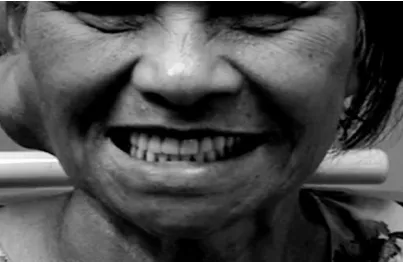
Patient provided: as a simulated patient for this session will be trained to mimic the facial nerve palsy of the buccal branch of facial nerve on the right side and the candidate has to identify that.
Examiner provided: will ask the following question from the candidates:
Question NO 1:
You have a simulated patient (see figure 2) without the lesion shown in picture or video in the preceding station to examine. A) Choose the physical examination that concerns you most to decide on surgical management of this lesion and B) demonstrate each step of that examination.
Figure 2: A simulated patient trained to perform on command from the candidate and in process demonstrate the buccal branch of facial nerve palsy while testing the facial nerve function.
Question NO 2:
A) What is the sign of mandibular branch of facial nerve palsy and B) how it can be differentiated in a patient with cervical branch palsy. Explain it to the examiner.
Checklist and marking scheme provided to evaluator:
For correct answer of question 1A candidate will receive 2 marks and for right command to elicit the function of each of the five branches of facial nerve as steps of examination in question 1B candidate will receive I mark. For correct answer of question 2A candidate will receive 1 mark and for 2B 2 marks each. Total 10 marks for station No 2 (see table below).
Q. No Answer/Performance Response Score
Q1A Examination of facial nerve function Yes No 2
Q1B
1 Examining the FN branch 1 (frowning of forehead) Yes No 1
2 Examining the FN branch 2 (tight closing of eyes) Yes No 1
3 Examining the FN branch 3(blowing or whistling) Yes No 1
4 Examining the FN branch 4 (smiling or showing teeth)
Yes No 1
Education in Medicine Journal
2012, VOL 4 ISSUE 1
DOI:10.5959/eimj.v4i1.15
Station No: 3 (Investigations: CT scan)
Exhibit as CT scan provided:
Examiner provided: will ask the candidates to answer the following questions
Question NO 1:
Select 2 most important investigations (write as A and B in the answer sheet) and give reasons for selecting those 2 investigations before reaching to a diagnosis.
Question No 2:
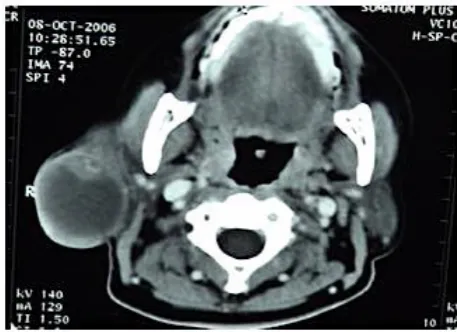
Examiner as the next step will display the CT scan (see figure 3) if candidate has correctly answered the Q1A and will ask to, 2A) interpret the CT scan findings to the examiner and 2B) examiner must take not of comment or no comment on the deep lobe of the parotid gland.
Figure 3: C.T. Scan displayed after the candidate answers the 1st question rightly at station No 2.
Checklist and marking scheme provided to evaluator:
Candidate will receive 1 mark each for correct answer to question 1A and 1B and 2 marks for question 2A and 1 mark for question 2B respectively. Total 5 marks for station No 3 (see table below).
Q2A Obvious deviation of opposite angle of the mouth Yes No 1
Q2B
Deviation of angle of mouth appears on smiling or
grinning Yes No 2
Education in Medicine Journal
2012, VOL 4 ISSUE 1
DOI:10.5959/eimj.v4i1.15
Station No 4: (Investigations: HPE)
Exhibit as HPE: slide or picture provided:
Examiner not provided: students have to write down the answer to following questions in a sheet provided and marked as answer to question 1 and 2.
Question No1:
Give your differential diagnosis at this point before proceeding to read the HPE slide/picture.
Question No 2:
Examine the histopathological slide (see figure 4) and write your diagnosis. Write three (3) characteristic features that support your in diagnosis?
Figure 4: HPE slide as picture or displayed with help of a microscope for the students to answer the question number 2.
Q. No Answer/Performance Response Score
Q1A C.T. scan or MRI of the parotid region Yes No 1 Q1B Tissue biopsy from the ulcerated lesion Yes No 1
Q2A
Axial view of the C.T. scan, which shows a well circumscribe homogenous mass arising from the superficial lobe and implicating the deep lobe.
Yes No 2
Q2B
Involvement of the deep lobe of the parotid gland
Education in Medicine Journal
2012, VOL 4 ISSUE 1
DOI:10.5959/eimj.v4i1.15
Answer and marking scheme provided to evaluator:
For each correct differential diagnosis asked in question 1 and correct provisional diagnosis in question 2, candidate will have 1 mark and 3 marks respectively. For each characteristic feature 1 mark. Total 10 marks for station No 4 (see table below).
Station No 5: (Surgical management)
Exhibit as Picture or specimen provided:
Examiner not provided: Students will write down the answers in a sheet provided.
Question No 1: If Acinic cell carcinoma parotid was the diagnosis, what surgical procedure would you like to do in this case?
Question No 2: Carefully watch the specimen/ picture provided as exhibit (see figure 5) and tell the type of parotidectomy performed and gives two evidences in favor of your answer on a sheet specified to write surgical procedure and two evidences.
Q. No Answer/Performance Response Score
Q1
The differential diagnoses are:
1 Muccoepidermoid carcinoma Yes No 1
2 Acinic cell carcinoma/lymphoma Yes No 1
3 Adenocarcinoma Yes No 1
4 Pleomorphic adenocarcinoma Yes No 1
Q2
Acinar cell carcinoma or lynphoma is the most likely diagnosis with following characteristics
Yes No 3
1 Abundance of acinar cells/lymphoma Yes No 1
Abundance of lymphoid tissue Yes No 1
2 Some mitotic figures Yes No 1
Education in Medicine Journal
2012, VOL 4 ISSUE 1
DOI:10.5959/eimj.v4i1.15
Figure 5: Picture or the specimen provided to answer the questions on this station by the candidates.
Answer and marking scheme provided to evaluator:
2 marks are allocated for correct answer of Q1 and 1 mark each for 3 components of Q2 respectively. Total 5 marks for station No 5 (see table below).
Q. No Answers Response Score
Q1 Total paritodectomy with excision of involved skin and preservation of facial nerve.
Yes No 2
Q2 Total paritodectomy specimen, which shows the following structures
Yes No 1
Superficial lobe Yes No 1
Deep lobe Yes No 1
Education in Medicine Journal
2012, VOL 4 ISSUE 1
DOI:10.5959/eimj.v4i1.15
Conclusion
Task integrated objective structured clinical examination is a modified OSCE developed to assess the clinical attributes of complex cases in fragmented but maintained continuum of overall clinical performance rated as integrated professional judgment. TIOSCE retains most of the favorable features of OSCE as well as addresses some of the odds features that intend to improve the psychometrics of this method of assessment. However, care is taken that the modifications made do not question the major objectives of the instrument that it is derived from and in current exercise objectivity of the instrument is the major issue taken into account. Rating of the performance of candidate is also modified to reduce the subjectivity of scoring using a modified checklist. In addition to checklist examiners are also recommended to use a global rating scale to assign each student as outstanding, pass, borderline or fail. The mean marks of all borderline students can then be used for standard setting methods of each group of stations. This is where examiners and the qualitative evaluation will find a role in integrated judgment of performance of trainees in high stake examinations.
Reference
1. Durning SJ, Cation LJ, Markert RJ, Pangaro LN. Assessing the reliability and validity of Mini-Clinical Evaluation Exercise for Internal Medicine residency training. Acad. Med. 2002; 77: 900-904
2. Byrne G. Hill J. Dornan T. O’Neill P. Core clinical skills for OSCE in surgery. Churchill Livingston Elsevier Limited, 2007: P 7-20 3. Jackson N, Jamieson A and Khan A. Assessment in medical education and training. Oxford: Radcliffe Publishing, 2007: P 11-26.
4. Reznick RK, Regehr G, Yee G, Rothman A et al. Process rating forms versus task-specific-checklist in an OSCE for medical licensure. Acad. Med. 1998: 73: S97 S98
5. Tablot M. Monkey see, monkey do: A critic of competency model in graduate medical education. Med Educ. 2004: 38: 587-592 6. Ram P, Grol R, Rethans JJ, Schouten B et al. Assessment of general practitioners by video observation of communicative and medical performance in daily practice: issues of validity, reliability and feasibility. Med Educ. 1999; 33: 447-454
Education in Medicine Journal
2012, VOL 4 ISSUE 1
DOI:10.5959/eimj.v4i1.15