An ion-based chromogenic method of detecting for
inorganic phosphate in serum and milk
Cai-Xia Yin1*, Jing Su1, Fang-Jun Huo2*, Pin Yang1
1Institute of Molecular Science, Key Laboratory of Chemical Biology and Molecular Engineering of Ministry of Education, Shanxi
University, Taiyuan, China; [email protected]
2Research Institute of Applied Chemistry, Shanxi University, Taiyuan, China; [email protected]
Received 10 July 2009; revised 21 July 2009; accepted 22 July 2009.
ABSTRACT
A rapid method for the determination of inor-ganic phosphate in serum and milk by an ion-based chromogenic is described. Serum samples were detected directly by our system, and milk was also detected after degreased through centrifugation. By this procedure the samples are not diluted. Mean serum inorganic phosphate concentration found in healthy indi-vidual is 1.14mmol/L. Values found in serum is in good agreement with those previously re-ported. Mean inorganic phosphate concentra-tion from foremilk and commercial milk are 2.5mmol/L and 12.5mmol/L respectively.
Keywords: UV-Vis Spectra; Pyrocatechol Violet; Ytterbium Chloride; Phosphate; Serum; Milk
1. INTRODUCTION
Phosphate is involved in important biomineralization processes such as bone formation and also processes that are clearly pathological such as the genesis of renal stones. Consequently, its determination in biological fluids is important [1]. In a clinical setting, inorganic phosphate levels in serum are determined as part of a routine blood analysis. The typical inorganic phosphate concentration in human serum range is 0.81-2.26mmol/L [2]. Individuals with abnormally high phosphate levels are diagnosed with hyperphosphatemia, which manifests in acute or chronic renal failure, hypoparathyroidism and excessive Vitamin D intake. And we know that higher serum phosphate levels would be associated with in-creased mortality risk among people with CKD [3-5]. Those with low inorganic phosphate levels suffer from hypophosphatemia which can be associated with rickets, hyperthyroidism, or Fanoci Syndrome [6-8]. In addition, there is generally a reciprocal relationship between se-rum calcium and inorganic phosphorus levels. High
in-organic phosphorus in serum restrains the intake of cal-cium.
Regarding the newborn baby, foremilk or milk is the most main headspring they grow on. But exactly this time is the quickest time when young child grows, being in the bone blooming period and the cerebrum and the intelligence still being imperfect stage. So the right amount nutrition could guarantee the normal growth, and prevent malnutrition, rickets, anemia and so on. Espe-cially if absorbing calcium phosphorus imbalance, can cause the low calcium blood sickness, the rickets [9]. Moreover iron in the milk is easy to form insolubly iron compound when affected by high phosphate and calcium, cannot be absorbed by the human body, which may cause the young child to occur lacking the iron anemia. In normal foremilk the calcium phosphorus proportion is 2: 1, is easy to be absorbed, to prevent and control the rickets. But the milk is 1: 2, is not easy to be absorbed. Therefore, determination the calcium phosphorus con-tent from foremilk and milk is very important.
Most of the procedure for the colorimetric determina-tion of inorganic phosphate are based on the formadetermina-tion of molybdophosphoric acid with further reduction to heteropolymetric molybdenum blue [10-12] on direct measurements of molybdo- and vanadomolybdophos-phoric acid [13,14], or on complex formation between molybdophosphoric acid and basic dyes [15]. These chemical methods have serious shortcomings, however: Molybdate reduction is affected by slight changes in pH, the rate of complex formation is markedly influenced by protein concentration, and the acidity required leads to hydrolysis of organic phosphate, which results in over estimates of Pi concentration [16].
C. X. Yinet al. / HEALTH 1 (2009) 76-82
SciRes Copyright © 2009 http://www.scirp.org/journal/HEALTH/ 77
Openly accessible at the molybdenum reagent.
2. MATERIAL AND METHODS
2.1. Reagents and Chemicals
The chemicals used were of analytical-reagent grade. PV (Pyrocatechol violet) was purchased from Shanghai and sodium monhydrogenphosphate was purchased from Beijing. Ytterbium oxide was a product of Rare Earth Graduate School of China. HEPES was purchased from Sigma. All solutions were made up with deionized water. HEPES buffer solutions were obtained by adding NaOH 0.1M solution into 10 mM aqueous HEPES using a Beckman Φ50 pH meter. Ytterbium chloride was pre-pared from ytterbium oxide and 37% hydrochloric acid. Ytterbium ion solution was prepared by dissolving ytter-bium chloride in water. Serum samples were collected from health volunteers and stored at -17℃ until ana-lyzed. Cow serum was purchased from commercial pured product. Human milk and commercial milk were degreased through a Centrifugal filter.
2.2. Instruments and Apparatus
pH determinations were performed using a Beckman 50 pH meter. UV-v(V)is spectra were recorded on a HP8453 spectrophotometer. PO-120 quartz cuvettes (10mm) were purchased from Shanghai city of China. Finnpipette Digitals were purchased from Shanghai of China. BFX5-320 Low Speed Automatic Balance Cen-trifuge was purchased from Baiyang CenCen-trifuge factory. Olympus 2700 Complete Automatic Clinical Biochemis-try Analysis Apparatus was purchased from Japan. 2.3. Measurement Procedure
Using the PV-HEPES-Yb3+ ensemble, we detected
inor-ganic phosphorus in serum and milk samples. The pro-cedures were as follows. In 10mM, pH 7.0 HEPES buffer containing 50μM PV and 100μM Yb3+ (a blue
solution), the serum sample from one healthy volunteer was gradually titrated into the solution. At the same time the changes in the absorption peaks of solution in the UV–Vis spectrum were recorded. When no more changes in the absorption peaks of the system took place, titration came to a halt. Then we could calculate the in-organic phosphorus concentration in serum. Likewise, the inorganic phosphorus concentrations of human milk degreased or commercial milk were obtained by above detecting method.
3. RESULTS AND DISCUSSION
3.1. UV–Vis Spectra
Figure 1a shows the UV–v(V)is spectra obtained when
(a)
[image:2.595.311.537.84.444.2](b)
Figure 1. (a) The serum from human was added into PV-HEPES-Yb3+ with Vserum=0-215 μl; (b) the serum from
cow was added into PV-HEPES-Yb3+ with Vserum=0-90 μl.
titrating the serum from a health human into the 10 mM, pH 7.0 HEPES buffer solution containing 100 μM YbCl3
and 50 μM PV. With the addition of serum, the absorp-tion peak at 623 nm decreased, while the peak at 444 nm increased. When the total volume of added serum reached 210 μL, titration ended. The concentration of inorganic phosphorus was 0.95 mmol/L. Similarly,
Fig-ure 1b shows UV–v(V)is spectra of serum from cow
selectivity towards phosphate anions over other common anions, including Cl−, SO
42−, CH3COO−, HCO3− and
ClO4− [17]. Serum contains many other organic and
in-organic compounds, such as creatinine, bilirubin, sugar, albumen, inorganic salts and transition ion besides the aforementioned ordinary anions. Do these compositions show some responsibility for the changes in the UV–v(V)is spectra and color? We took the HEPES buffer as a blank, and then added 200 μL serum into it. The result shows that there is no UV–v(V)is absorbance in the range of from 350 to 1,000 nm, suggesting that there are no other absorbance peaks coming from other compounds of the serum in the range of detection in the UV–v(V)is spectra (Figure 3a). Thus, we may conclude that the changes in the absorbance peak in this range resulted completely from the measurement processes and there was no cumulation or disturbance. To prove that the universal existence of anions in serum incurs no
dis-turbance to exclude the possibility of interference from iron or other cations in the measurement, the following experiments were carried out. Firstly, as soon as the ex-cessive 2 mM YbCl3 was added into the 2 mM HPO42−
solution (VYbCl3/VHPO42−=1.02:1), precipitation occurred,
a clear solution was gained through centrifugation and decantation processes; the solution (from 0 to 500 μL) was then added into 2 mL 10 mM HEPES buffer con-taining 50 μM PV and 100 μM Yb3+, and no changes in
absorption peak intensity and color were observed, i.e., no phosphate was detected in the solution, thus suggest-ing that the Yb3+ could completely remove HPO
42− from
solution by forming sediment. Similarly, we added the excessive YbCl3 into the collected serum samples whose
content of HPO42− was presumably quantitated with our
methods. After the mixture had been treated in accor-dance with the aforementioned procedures, a great deal of the disposed serum sample(0–500 μL) was added into
[image:3.595.60.541.301.477.2]
(a) (b)
Figure 2. (a) The milk from woman was added into PV- HEPES-Yb3+ with Vmilk=0-65 μl; (b) the serum from cow was added into
PV-HEPES-Yb3+ with Vmilk=0-13 μl.
(a) (b)
[image:3.595.61.537.517.698.2]C. X. Yinet al. / HEALTH 1 (2009) 76-82
SciRes Copyright © 2009 http://www.scirp.org/journal/HEALTH/ 79
Openly accessible at
[image:4.595.73.528.79.267.2](a) (b)
Figure 4. (a) the disposed serum sample (0-500 μl) was added into PV-HEPES-Yb3+.(b) UV/Vis spectra (λ=350~800nm): no
pretreatment serum sample (500 μl) was added into HEPES-PV (50 μM).
the 2 mL 10 mM HEPES buffer containing 50 μM PVand 100 μM Yb3+, and no changes were observed in
absorption peak intensity and system color(Figure 4a). The experiments excluded the possibility of interference from other anions with the measurement. In addition, we added an adequate amount of unpretreated serum sample into 2 mL 10 mM HEPES buffer only containing 50 μM PV, and no change in either the UV–v(V)is spectra or the system color was observed (Figure 4b). The system was still yellow. The experiments excluded the possibility of interference from iron or other cations with the meas-urement.
Now, we see about the selectivity of the detection system for milk. We took the HEPES buffer as a blank, and then added 50 μL milk into it. The result shows that there is no UV–v(V)is absorbance in the range of from 350 to 1,000 nm, suggesting that there are no other ab-sorbance peaks coming from other compounds of the milk in the range of detection in the UV–v(V)is spectra
(Figure 3b). Similary process was done for proving no
disturbance from other composition of milk. All results ensure that our system is special to phosphate of milk. 3.3. Linearity and Detection Limits
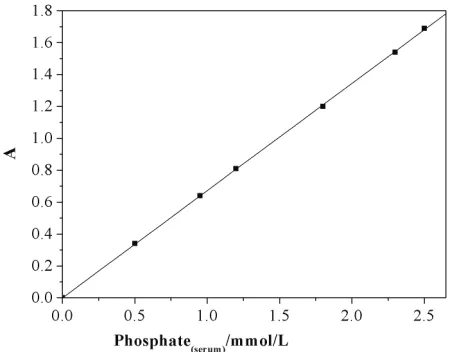
Most instrumental methods available for the determina-tion of phosphate in clinical samples have a common drawback; that is, their linear calibration range is too narrow. In our experiment, we plotted the curve with absorbance values at 623 nm against concentrations /0–2.5 mM/ of serum added to the PV-HEPES-Yb3+
sys-tem. We found our measurement obeyed the Beer– Lambert absorption law very well within the serum con-centration range of 0–2.5mM. Linear regression with least-squares fitting yielded a correlation coefficient of
Figure 5. The working curve for serum measurement was plot-ted with the absorbance value against various concentrations of serum(0-2.5 mM).
0.99995 (Figure 5). The lower detection limit of our method is around 10-4 M. And before, we have gotten
our measurement obeyed the Beer–Lambert absorption law very well within the urine concentration range of 0–70mM [18]. Phosphorus concentrations of milk from woman or commerce are not higher than 70mM, so this linear calibration range is enough for milk.
3.4. Validation
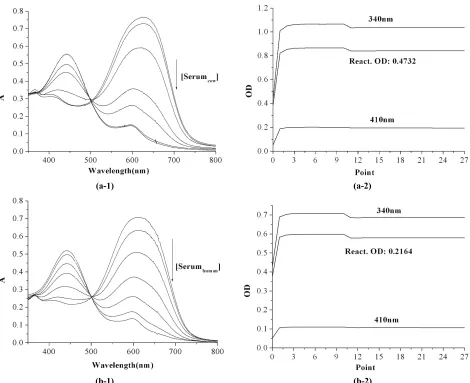
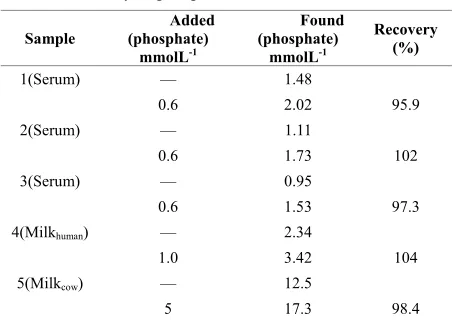
In order to validate the accuracy of the method, we de-tected serum samples by the standard procedure (mo-lybdenum blue assay for phosphate) and obtained equivalent results with our measurement. Figure 6 and
Table 1 give the results (spectra) for serum obtained
[image:4.595.310.535.307.483.2]
(a-1) (a-2)
[image:5.595.64.534.94.477.2]
(b-1) (b-2)
Figure 6. (a)Left: Uv-Vis spectra of cow serum sample Inorganic Phosphorus concentration from our method(2.20 mmol/L); Right: the results from Molybdenum blue assay for phosphate respectively(2.22 mmol/L; (b) Left: Uv-Vis spectra of serum sample Inor-ganic Phosphorus concentration from our method (0.95 mmol/L); Right: the results from Molybdenum blue assay for phosphate(0.93 mmol/L).
compiled in Table 2. The results indicated the accuracy of the method, as expressed by the calculated recovery values, was satisfactory.
3.5. Analysis of Results
From our data, we can see inorganic phosphorus content of milk is higher than foremilk about five times. This indicates the excessive inorganic phosphorus is disad-vantageous to young child’s growth. And with the people level of living enhancement, the commercial milk be-comes the people basic nutriment. But in the processing commercial milk many important ingredients content are insufficient, for instance, the calcium, phosphorus ratio of is 2: 1 in milk containing the few calcium, many phosphorus, is easy to form the insoluble calcium phos-phate, affects the intestinaltract absorbing calcium and
phosphorus. If provide turnips containing many calcium, few phosphorus for the child who eats the milk, can cor-rect calcium and phosphorus proportion, namely can enhance the calcium absorbing capacity. Therefore, the reasonable increase and the adjustment can only prevent to be out of nutrition balance for one people drink milk. 3.6. Assay Advantage
C. X. Yinet al. / HEALTH 1 (2009) 76-82
SciRes Copyright © 2009 http://www.scirp.org/journal/HEALTH/ 81
[image:6.595.58.284.105.204.2]Openly accessible at
Table 1. Results of our method against the method (molybde-num blue assay for phosphate).
Numbers of serum sample
Phosphate (mmolL-1) from Molybdenum blue
assay
Phosphate (mmolL-1) from
our method
1(Serumhuman) 0.96 0.97
2(Serumhuman) 0.93 0.95
2(Serumcow) 2.20 2.22
Table 2. Recovery of phosphate in serum and milk.
interfere with the elution profile; organic solvents such as acetonitrile lead to damage to the column and sul-phosalicylic acid is often contaminated with sulphate, lead to sample dilution. And our method decreases the cost of analyses with respect to batch methods involving enzymes in solution. All these advantages make the method reported here be a valid alternative for the de-termination of phosphate in serum.
4. CONCLUSIONS
To sum up, we developed a sensitive, rapid and direct method for detecting serum and milk phosphate spec-trophotometrically. Our method is suitable for perform-ing direct determinations of phosphate in serum without any pretreatment and any interference. Now more and more people are suffering from lithiasis as a result of better living standards. Timely inspection of serum phosphate is one of the clinical means of diagnosis. Since long-time, people only pay attention to the inor-ganic phosphorus determination in the urine and the blood serum, to determine the inorganic phosphorus in the foremilk mother’s milk and milk method very little was mentioned. In this paper, we use our invention sys-tem to quantificationally determine inorganic phospho-rus concentration from milk degreased through centrifu-gation, the results are accurate, suit to clinical and the commerce use.
5. ACKNOWLEDGEMENTS
We acknowledge to the financial support of this work by the National Natural Science Foundation of China (No. 20801032), Shanxi Provincial Natural Science Foundation (No. 2009021006-2) and the Shanxi Province Foundation for Re-turness (2008).
REFERENCES
[1] Grases, F. and March, J. G. (1990) Determination of phosphate based on inhibition of crystalline growth of calcite. Analytica Chimica Acta., 229, 249-254.
[2] Ender, D. B. and Rude, R. K., (1999) Mineral and bone metabolism, In Tietz Textbook of Clinical Chemistry (C. A. Burtis, E. R. Ashwood, Eds.), W. B. Saunders, com-pany: P. A. Philadelphia, 1406-1408,1439-1440. [3] Kestenbaum, B., Sampson, J. N., Rudser, K. D., et al.
(2005) Characterization of phosphate transport in rat vascular smooth muscle cells. J Am Soc Nephrol., 16, 520-528.
[4] Levi, M. and Knochel, J. P. (1990) The management of disorders of phosphate metabolism. In Therapy of Renal Diseases and Related Disorders (S. G. Massry, W. N. Suki,), Boston, Martinus Nijhoff.
[5] Levi, M., Cronin, R. E., and Knochel, J. P. (1992) Disor-ders of phosphate and magnesium metabolism. In Disor-ders of Bone and Mineral Metabolism (F. L. Coe, M. J Favus,), New York: Raven Press.
[6] Biochrom Ltd Certificate No: 890333 Determination of phosphate in clinical samples.
[7] Popovtzer, M., Knochel, J. P., and Kumar, R. (1997) Disorders of calcium, phosphorus,vitamin D, and para-thyroid hormone activity. In Renal Electrolyte Disorders, edn 5 (R. W. Schrier,) Philadelphia: Lippincott-Raven. [8] Hruska, K. and Gupta, A. (1998) Disorders of phosphate
homeostasis. In Metabolic Bone Disease, edn 3 (L. V. Avioli, S. M. Krane,) New York: Academic Press. [9] Greer, F. R., Steichen, J. J., and Tsang, R. C., (1982)
Calcium and. phosphate supplements in breast milk- re-lated. Rickets. Am J Dis Child., 136, 581-583.
[10] Fiske, C. H. and Subbarow, Y. J. (1925) The colorimetric determination of phosphorus. Biol. Chem.,66, 375-400. [11] Lowry, O. H. and Lopez, J. A. (1946) The determination
of inorganic phosphate in the presence of labile phos-phate ester. J. Biol. Chem.,182, 421.
[12] Bartles, P. C. and Roijers, A. F. M. (1975) A kinetic study on the influence ofparameters in the determination of in-organic phosphate by the molybdenum blue reaction. Clin. Chim. Acta.,61, 153-4.
[13] Daly, J. A. and Ertingshausen, G. (1972) Direct method for determining inorganic phosphorus in serum. with the Centrifichem. Clin. Chem., 18, 263-265.
[14] Urban, A. E. (1972) Simplified. serum phosphorus. analyses. by continuous-flow. ultraviolet. Spectropho-tometry. J. Clin. Chem.,18, 601-4.
[15] Fogg, A. G., Soleymanloo, S., and Burns, D. T. (1977) The spectrophotometric determination of inorganic phosphate in biological system with crystal violet. Anal. Chim. Acta., 88, 197-200.
Sample Added (phosphate) mmolL-1 Found (phosphate) mmolL-1 Recovery (%)
1(Serum) — 1.48
0.6 2.02 95.9
2(Serum) — 1.11
0.6 1.73 102
3(Serum) — 0.95
0.6 1.53 97.3
4(Milkhuman) — 2.34
1.0 3.42 104
5(Milkcow) — 12.5
[image:6.595.57.283.218.378.2][16] Endres, B. D. and Rude, R. K. (1994) Mineral and bone metabolism. Tietz textbook of clinical chemistry (C. A. Burtis, E. R. Ashwood, eds.), Philadelphia: W. B. Saun-ders, Co., 1887-973.
[17] Yin, C. X., Huo F. J., and Yang, P. (2005) An ion-based chromogenic detecting method for phosphate-containing
derivatives in physiological condition. Sensors and Ac-tuators B Chemical., 109, 291–299.