ORIGINAL ARTICLE
KNOWLEDGE, ATTITUDE AND PRACTICE OF DENGUE FEVER AND HEATH
EDUCATION PROGRAMME AMONG STUDENTS OF ALAM SHAH SCIENCE
SCHOOL, CHERAS, MALAYSIA
Balsam Mahdi Nasir Al-Zurfi1, Maher D. Fuad Fuad1, Mohammed A. Abdelqader1, Mohammed Faez Baobaid1, Maged Elnajeh1, Hasanain Faisal Ghazi2, Mohd Hairulnizam Ibrahim3, Mohammad Rusli Abdullah4,
1Community Medicine Unit, International Medical School, Management and Science University, Malaysia. 2Department of Community Health, UKM Medical Centre, Malaysia
3 International Medical School, Management and Science University, Malaysia. 4 Dean, International Medical School, Management and Science University, Malaysia.
ABSTRACT
Dengue Fever is a major public health issue in Malaysia. This study aimed to assess knowledge, attitude and practice regarding dengue fever and effectiveness of health education programme among 204 students of Alam Shah Science School, Cheras/Kuala Lumpur. Study design was a cross sectional study followed by an interventional (pre-post) Study. The self-administered questionnaire included questions on sociodemographic factors, knowledge, attitude and practice regarding dengue fever. Majority of respondents were Malays (96.6%), monthly family income more than RM 3000 (64.6%) and lives in urban area (64.6%). There was no significant association between knowledge status and socio-demographic factors (p-value>0.05). Most of the respondents had good knowledge (63.2%) good attitudes (79.9%) regarding dengue fever. However, practices to prevent dengue was poor(74.0%). Only about one-fifth of the respondents (18.2%) believed that dengue fever is a flu-like illness. Knowledge score was significantly increased after health education programme (p value <0.001). There is a need to increase health education activities through campaigns and mass media to increase knowledge regarding dengue fever. This would help to inculcate positive attitudes and cultivate better preventive practices among the public to eliminate dengue fever in the country.
Key words: Dengue fever, knowledge, attitude, and practice, students, Kuala Lumpur.
INTRODUCTION
Dengue fever is a mosquito-borne viral infection found in most tropical and subtropical areas of the
world. It is a major public health problem in
Malaysia. The reported number of dengue cases in Malaysia rose each year, from 7103 cases in 2000 to 49335 in 2008, an increase of nearly seven
times[1]. Wan Rozita et al.[2] conducted a
knowledge, attitude and practices (KAP) study in
an urbanized residential area of Kuala Lumpur and
concluded that there is a need to strengthen
health promotion activities to increase the
knowledge that forms the basis for preventive
practices as part of the strategy to control dengue
outbreaks. Other study has shown that good knowledge does not necessarily leads to good practice. This is most likely due to certain practices like water storage for domestic use, which is deeply ingrained in the community[3].
Dengue vector control requires effective participation of the local community. Although education campaigns have increased people‟s awareness of dengue, it remains unclear to what extent this knowledge is put into practice, and to what extent this practice actually reduces mosquito populations[4]. This study aims to assess
the knowledge, attitude, and practice of school students regarding dengue fever, as well as to
assess the effectiveness of a health education programme to improve students‟ knowledge.
MATERIALS & METHODS
Study Design and Population
The study was conducted in two phases at Alam Shah Science School. It is an upper secondary residential school established on 16 June 2003 and located at Bandar Tun Razak, Cheras/Kuala Lumpur. The first phase was a cross sectional study while the second was an interventional (pre-post) study design. Study population was students of the above-mentioned school (form 4). Their age ranged from 16-17 years old. A total sample of 204 students was selected using non-probability convenient sampling. Inclusion criteria were student from Alam Shah School, form 4, willing to participate, and who attended both days of the assessment (i.e. Pre and post). Response rate was 100%.
Study Instruments and Data Collection
The questionnaire consists of 4 parts: socio-demographic and personal information of the participants, knowledge of dengue fever, attitudes towards dengue fever prevention and practice regarding dengue fever prevention. Questions on knowledge, attitudes, and practices were summed, and the total score of each part was obtained. For each knowledge item, a correct answer was coded „1‟ and wrong answer was coded „0‟. Therefore, the total knowledge scores ranged from 0 to 15. A score of 12 and above is considered good knowledge. For attitude items, a positive attitude was coded „1‟ and the negative attitude was coded „0‟. Thus, the total scores ranged from 0 to 10. A score of 8 and above is considered good attitude. Practice items was coded „1‟ for „yes‟ and „0‟ was for „no‟. The total scores ranged from 0 to 11. A score of 6 and above is considered good practice.
After answering the pre-intervention questionnaires, the participants were given a lecture by head of community medicine unit to explain dengue fever, and its microscope examination. A flex, posters, and video exhibition were used throughout the health education programme. After one month, the participants were given the post-questionnaires.
Statistical analysis
The data were entered and analyzed using the Statistical Package for the Social Sciences (SPSS) Programme version 20.0. Descriptive statistics was conducted to obtain frequencies and percentages. The results were considered statistically significant at p< 0.05. Simple logistic regression was used to study the association between knowledge status and sociodemographic factors and paired t test was used to study the difference in mean knowledge score between pre and post health education programme.
Ethical consideration
The research and ethical committee of the Management and Science University (MSU), Shah Alam, Malaysia had approved the study (ref. No. SG-251-1114-IMS). A written consent was obtained from the students who agreed to participate in the study.
RESULTS
Socio-demographic
Majority of the participants were Malays (96.6%) and the rest were Indians (3.4%).
For sociodemographic variables, 68.6% of the participants come from high socioeconomic background whereby the family monthly income are more than RM 3000. The remaining 31.4% had an income of less than RM 3000. Regarding living area, 68.6% of the participants live in an urban area whereas 31.4% of them live in rural area.
Table 1: Knowledge, Attitude and Practice of Dengue Fever among Form 4 Students of Alam Shah Science School, Kuala Lumpur (n=204)
VARIABLES GOOD n (%) POOR n (%) Knowledge Attitude Practice 129 (63.2) 163 (79.9) 53 (26.0) 75 (36.8) 41(20.1) 151 (74.0)
Factors affecting knowledge
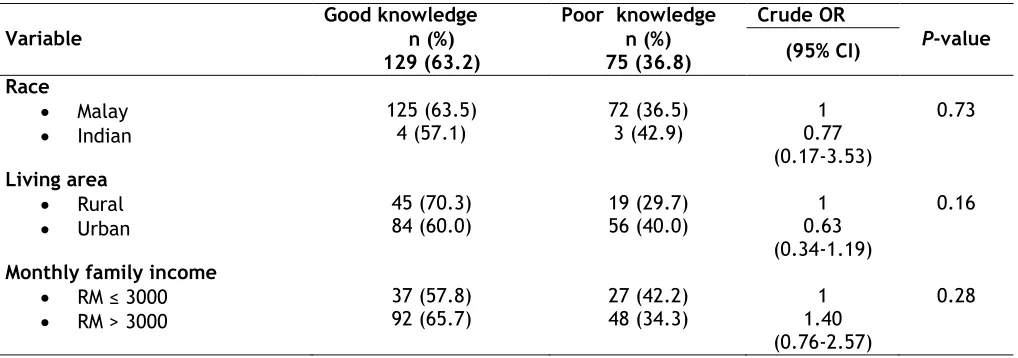
Simple logistic regression was performed in the bivariable analysis and was demonstrated by OR (95% CI) and p value. The association of race, living area and family monthly income with knowledge status was not statistically significant as shown in Table 2.
Table 2 The association between socio-demographic factors and pre-intervention knowledge status in simple logistic regression (n=204)
Variable
Good knowledge Poor knowledge Crude OR
P-value n (%) n (%) (95% CI)
129 (63.2) 75 (36.8) Race Malay Indian 125 (63.5) 4 (57.1) 72 (36.5) 3 (42.9) 1 0.77 (0.17-3.53) 0.73 Living area Rural Urban 45 (70.3)
84 (60.0) 19 (29.7) 56 (40.0) 0.63 1 (0.34-1.19)
0.16
Monthly family income
RM ≤ 3000
RM > 3000
37 (57.8)
92 (65.7) 27 (42.2) 48 (34.3) 1.40 1 (0.76-2.57)
Effect of the educational programme
Paired t test was conducted to study knowledge score difference between pre and post health
education programme and it was significant (p < 0.001) as shown in Table 3.
Table 3 Knowledge score difference between pre and post health education programme (n=204) Variables Pre-HEP knowledge
score Post-HEP knowledge score Mean score difference t-statistic P value1
Mean (SD) Mean (SD) (95% CI) (df)
Knowledge 11.95 (1.43) 12.61 (1.26) - 0.66
(-0.87,0.54) -6.2 (203) <0.001
1 paired t test
DISCUSSION
Knowledge
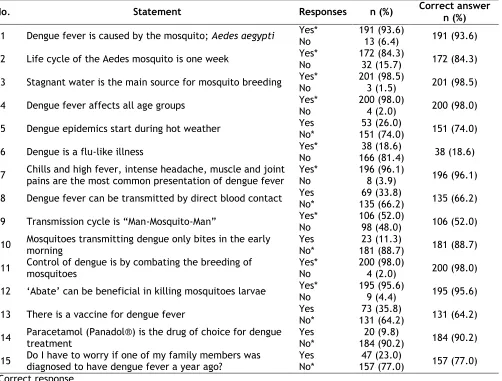
The study showed that 63.2% of students have a good level of knowledge about dengue fever while 36.8% of students have moderate to poor level of knowledge. In this study, it was reported that 93.6% of students have good knowledge on the
mode of the transmission (A vector borne disease by the mosquito, Aedes aegypti). Our result was similar to other research from Malaysia which was conducted by Al-Dubai et al.[1], and the data
revealed that 97.7% of respondents mentioned mosquito Aedes aegypti as a cause of dengue and similar results were found in other study[5].
Table 4 Knowledge of dengue fever; number and percentage of respondents who answered the items correctly (N=204)
No. Statement Responses n (%) Correct answer n (%)
B1 Dengue fever is caused by the mosquito; Aedes aegypti Yes* No 191 (93.6) 13 (6.4) 191 (93.6)
B2 Life cycle of the Aedes mosquito is one week Yes* No 172 (84.3) 32 (15.7) 172 (84.3)
B3 Stagnant water is the main source for mosquito breeding Yes* No 201 (98.5) 3 (1.5) 201 (98.5)
B4 Dengue fever affects all age groups Yes* No 200 (98.0) 4 (2.0) 200 (98.0)
B5 Dengue epidemics start during hot weather Yes No* 151 (74.0) 53 (26.0) 151 (74.0)
B6 Dengue is a flu-like illness Yes* No 166 (81.4) 38 (18.6) 38 (18.6)
B7 Chills and high fever, intense headache, muscle and joint pains are the most common presentation of dengue fever Yes* No 196 (96.1) 8 (3.9) 196 (96.1)
B8 Dengue fever can be transmitted by direct blood contact Yes No* 135 (66.2) 69 (33.8) 135 (66.2)
B9 Transmission cycle is “Man-Mosquito-Man” Yes* No 106 (52.0) 98 (48.0) 106 (52.0)
B10 Mosquitoes transmitting dengue only bites in the early morning Yes No* 181 (88.7) 23 (11.3) 181 (88.7)
B11 Control of dengue is by combating the breeding of mosquitoes Yes* No 200 (98.0) 4 (2.0) 200 (98.0)
B12 „Abate‟ can be beneficial in killing mosquitoes larvae Yes* No 195 (95.6) 9 (4.4) 195 (95.6)
B13 There is a vaccine for dengue fever Yes No* 131 (64.2) 73 (35.8) 131 (64.2)
B14 Paracetamol (Panadol®) is the drug of choice for dengue treatment Yes No* 184 (90.2) 20 (9.8) 184 (90.2)
B15 Do I have to worry if one of my family members was diagnosed to have dengue fever a year ago? Yes No* 157 (77.0) 47 (23.0) 157 (77.0) *Correct response
When the knowledge scores were analyzed, it was observed that 98.0% of students answered correctly that by combating the breeding of
mosquitoes could control dengue fever. This result is similar with a study by Al-Dubai et al [1], which
However, 81.4% of students did not realize that dengue is a flu-like illness. This is found to be inconsistent with the study findings from Sami et al, 2013 which showed that 70% of respondents agreed that dengue is a flu-like illness. Even
though 89.3% of the respondents agreed that eliminating the mosquito breeding sites would control the outbreak of dengue, only third of them believed that combating larvae is a waste of time.
Table 5 Attitude of dengue fever; number and percentage of respondents who answered the items correctly (N=204)
No. Statement Responses n (%) Correct answer Agree Disagree n (%)
C1 I am afraid of dengue fever 186 (91.2)* 18 (8.8) 186 (91.2)
C2 Dengue is a serious illness 197 (96.6)* 7 (3.4) 197 (96.6)
C3 Dengue fever cannot be prevented 12 (5.6) 192 (94.1)* 192 (94.1) C4 I am at risk of getting dengue 116 (56.9)* 88 (43.1) 116 (56.9) C5 It is not necessary to seek immediate treatment for
dengue fever as there is no cure for it 11 (5.4) 193 (94.6)* 193 (94.6) C6 The public has the most important role in dengue control 192 (94.1)* 12 (5.9) 192 (94.1) C7 It is not the responsibility of the public health staff and
local government in the prevention of dengue 163 (79.9) 41 (20.1)* 41 (20.1) C8 Fogging is not essential enough for prevention of dengue 170 (83.3)* 34 (16.7) 170 (83.3) C9 Elimination of larvae breeding is a complete waste of time 4 (2.0) 200 (98.0)* 200 (98.0) C10 There is a high chance for dengue to spread in the future 180 (88.2)* 24 (11.8) 180 (88.2) *Correct response
Attitude
Although, the study showed that around 80% of the participants had good general attitude towards dengue, only half of them answered the question that they are at risk of getting dengue fever
correctly and around 20.0% of them answered the question “It is not the responsibility of the public health staff and local government in the prevention of dengue” correctly.
Table 6: Practice dengue fever; number and percentage of respondents who answered the items correctly (N=204)
No. Statement
Responses n (%) correct answer Yes No n (%)
D1 Do you practice covering water jars at home? 174
(85.3) 30 (14.7)
174 (85.3)
D2 Do you cover water tanks at home? 191
(93.6) 13
191 (93.6)
D3 Do you regularly inspect refrigerator tray? 102
(50.0) (50.0) 102 102 (50) D4 Do you examine mosquito larvae both indoors and outdoors? 106
(52.0) 98 (48.0) 106 (52) D5 Do you practice draining water from flower pot? 139
(68.1) 65 (31.9) 139 (68.1) D6 Do you examine any discarded material that may hold water?
Eg: car tyres, empty bottles (62.7) 128 76 (37.3) 128 (62.7)
D7 Do you use mosquito net or mosquito coil at home? 96 (47.1) 108 (52.9)
96 (47.1)
D8 Do you use mosquito repellant? 178
(87.3) 26 (12.7)
178 (87.3)
D9 Do you participate in community cleaning activities? 151
(74.0) 53 (26.0)
151 (74)
D10 Do you participate in community fogging in your area? 70 (34.3) 134
(65.7) 70 (34.3) D11 Do you use temephos, eg: Abate® to eliminate of mosquito
Practice
Even though the study showed that a total of 74.0% of students have poor practices towards dengue fever, the majority of the students (93.6%) cover water tanks at home. This is a good sign that they do take actions to reduce the mosquitoes breeding sites. Only 34.3% of the students are involved in the community fogging in their housing area. Half of the respondents practice inspection of the refrigerator tray regularly as well as 50.0% inspect mosquito larvae indoors and outdoors. Less than half of them used mosquito net or coil at home and use abate to eliminate mosquito larvae.
Association between knowledge and race The study showed that there was no significant association between knowledge status and race (p-value 0.73). This result can be explained by the fact that 97.0% of our respondents were Malays so our sample does not represent all the races.
Association between knowledge and socioeconomic status
This study showed that there was no significant association between knowledge status and socioeconomic status (p-value 0.16). This is in contrary to a study conducted previously which reported that there was a significant correlation between knowledge and socioeconomic status (p=0.02) [6].
Association between knowledge and living area Localities of students were not affecting their knowledge status as the relationship between localities and knowledge status was not significant (p=0.156). This finding was inconsistent with a study conducted in India that showed 70.4% of respondents in urban area had sufficient knowledge on dengue fever when compared to only 29.6% in the rural area[7].
The effect of the health education programme on knowledge of dengue fever
There was a significant increase in the mean score of knowledge after the conduction of the health education programme (p value < 0.001).
CONCLUSION
This study has shown that the students were aware about dengue fever (more than 60.0%). However, there was a lack of concern about the importance of dengue control and the impact of dengue outbreak in the community. It is shown by their poor practice on dengue prevention. More practical health education programmes should be organized. It will give more benefits and exposure about the effect of good practice towards dengue fever prevention.
ACKNOWLEDGEMENT
The researchers would like to express their sincere appreciation and deepest gratitude to the students from Alam Shah Science School on their willingness to cooperate in this study and had spent their time answering questionnaires.
REFERENCES
1. Al-Dubai, S., et al., Factors affecting dengue fever knowledge, attitudes and practices among selected urban, semi-urban and rural communities in Malaysia. Southeast Asian Journal of Tropical Medicine and Public Health, 2013. 44(1): p. 37-49.
2. Wan Rozita, W., et al., Knowledge, attitude and practice (KAP) survey on dengue fever in an urban Malay residential area in Kuala Lumpur. Malays J Public Health Med, 2006.
6(2): p. 62-67.
3. Hairi, F., et al., A knowledge, attitude and practices (KAP) study on dengue among selected rural communities in the Kuala Kangsar district. Asia-Pacific Journal of Public Health, 2003. 15(1): p. 37-43.
4. Koenraadt, C.J., et al., Dengue knowledge and practices and their impact on Aedes aegypti populations in Kamphaeng Phet, Thailand. The American journal of tropical medicine and hygiene, 2006. 74(4): p. 692-700.
5. Degallier, N., et al., People's knowledge and practice about dengue, its vectors, and control means in Brasilia (DF), Brazil: its relevance with entomological factors. Journal of the American Mosquito Control Association, 2000. 16(2): p. 114-123.
6. Syed, M., et al., Knowledge, attitudes and practices regarding dengue fever among adults of high and low socioeconomic groups. Journal of the Pakistan Medical Association, 2010.
60(3): p. 243.
7. Raghuveer, P., M.S. Sherkhane, and J.V. Chowti, Comparative Study of Dengue Knowledge among Adults of Urban and Rural Population in India. International Journal of Health and Rehabilitation Sciences (IJHRS), 2013.