Global Mode Analysis of Ion-Temperature-Gradient Instabilities
Using the Gyro-Fluid Model in Linear Devices
Tomotsugu OHNO, Naohiro KASUYA
1), Makoto SASAKI
1)and Masatoshi YAGI
2)Interdisciplinary Graduate School of Engineering Sciences, Kyushu University, 6-1 Kasuga-Koen, Kasuga, Fukuoka 816-8580, Japan
1)Research Institute for Applied Mechanics, Kyushu University, 6-1 Kasuga-Koen, Kasuga, Fukuoka 816-8580, Japan 2)National Institutes for Quantum and Radiological Science and Technology, 2-166 Omotedate, Obuchi, Rokkasho-mura,
Aomori 039-3212, Japan
(Received 19 February 2018/Accepted 21 May 2018)
In order to understand turbulent transport phenomena in magnetized plasmas, an excitation condition of the ion-temperature-gradient (ITG) instability is investigated in linear device PANTA. Numerical analyses using a global gyro-fluid code in linear devices are performed to obtain mode structures and parameter dependences of the ITG instability. Parameter scans of the linear growth rate show the destabilization condition of the ITG modes. The global analysis considers the boundary condition and determines the radial mode structure, which gives the values of the wavenumber in the direction perpendicular to the magnetic field. The local analysis confirms to reproduce the global analysis result by using the wavenumber obtained from the global analysis. The wavenumber is a parameter in the local model, and the global analysis of the radial mode structure is necessary for the selection of this important parameter.
c
2018 The Japan Society of Plasma Science and Nuclear Fusion Research
Keywords: ion-temperature-gradient instability, finite-Larmor-radius effect, gyro-fluid equation, linear device, radial eigenmode structure
DOI: 10.1585/pfr.13.1401081
1. Introduction
It is important to understand turbulent phenomena in magnetically confined plasmas. A level of turbulent transport is determined by competition of several instabil-ities and formation of turbulent structures [1]. Fundamen-tal mechanisms of structural formation in turbulent plas-mas can be studied in simple cylindrical configurations [2]. Structural formations with nonlinear mode coupling of un-stable modes in resistive drift wave turbulence have been revealed by experiments [3–6] and simulations [7, 8] using linear devices. One of the candidates to cause anoma-lous transport in fusion plasmas is the microscopic instabil-ity due to the ion temperature gradient (ITG) [9]. Studies of excitation conditions of the ITG instability have been carried out in basic experiments [10]. The ion tempera-ture can be measured using diagnostics as an ion-sensitive probe [11]. On linear device PANTA [12], ion tempera-ture measurements and numerical analyses of the ITG in-stability have been progressing. The purpose of our re-search is to predict excitation conditions of the ITG insta-bility in PANTA. The ITG instainsta-bility is predicted to be excited when the ratio of the ion temperature gradient to the density gradient exceeds the threshold value near the unity. Numerical simulations by using the fluid model [13] in PANTA shows that a mode withk⊥ρs ∼1 can become
unstable even in low ion temperature plasmas as in linear
author’s e-mail: [email protected]
devices [14]. Here,k⊥ andρs are the wavenumber in the
perpendicular direction to the magnetic field and the ef-fective Larmor radius, respectively. Therefore, a detailed analysis including the finite Larmor radius (FLR) effect is required. Analyses using a set of localized gyro-fluid equa-tions have been carried out [15]. The ion Larmor radius is not much smaller than the plasma radius in the linear de-vice, so the global mode structure must be calculated. In this research, a numerical simulation code is developed to solve global eigen-functions of the ITG instability. A gyro-fluid model [16] without magnetic curvature and nonlinear terms is used as same in Ref. [15]. In Ref. [15] a local as-sumption for∇⊥ operator gives a single value ofk⊥, but in this article combination of variousk⊥ values is intro-duced by the Bessel expansion to determine global mode structures. Here we report mode structures and parameter dependences of the ITG instability in PANTA by using the global code.
This paper is organized as follows. In the next section, the set of gyro-fluid equations and the numerical scheme to calculate the radial mode structure are described. In Sec. 3, the excitation condition of the ITG instability is evaluated by linear analyses. In Sec. 4, comparison between the lo-cal and global analyses is performed by lo-calculating the ion mass dependence. Finally, we summarize our results in Sec. 5.
c
2. Global Mode Analysis
2.1
Gyro-fluid model
A set of gyro-fluid equations is derived by taking the moments of the electrostatic gyro-kinetic equation in the velocity spaces [16]. The target plasma has a cylindrical configuration with a homogeneous magnetic field parallel to the axial direction, so the magnetic curvature terms can be eliminated. Applying the gyro-kinetic ordering, the lin-ear forms of the equations in the cylinder are given to be
dn
dt +∇//u//+ ⎛
⎜⎜⎜⎜⎝1+η⊥∇ˆ
2 ⊥ 2 ⎞ ⎟⎟⎟⎟⎠ 1 Ln ∂Ψ
∂y =0, (1)
du//
dt +∇// τ
n+T//+Ψ =0, (2)
1
τ
dT//
dt +∇//
2u//+q// τ
+η// 1
Ln
∂Ψ ∂y
=−2νii
3τ(T//−T⊥), (3)
1
τ
dT⊥
dt +∇// q⊥
τ +
⎡ ⎢⎢⎢⎢⎣∇ˆ2
⊥
2 +η⊥
1+∇ˆˆ2⎤⎥⎥⎥⎥⎦ 1
Ln
∂Ψ ∂y
= νii
3τ(T//−T⊥), (4)
wherenis the ion density,u//is the ion velocity,T is the ion temperature,τ=Ti0/Te0,Ti0andTe0are ion and
elec-tron temperatures at the plasma center,η = Ln/LT, Ln is
the density gradient length,LTis the ion temperature
gra-dient length,qis the heat flux, andνiiis the collision
fre-quency between the ions. The subscripts//and⊥represent the quantities in the parallel and perpendicular direction to the magnetic field, respectively. The time and spatial length are normalized withΩci andρs, whereΩci is the
ion cyclotron frequency. Ψ is the gyro-averaged potential
Ψ≡Γ1/2
0 Φ, whereΓ 1/2
0 =(1+bτ/2)−
1andb=−∇2
⊥.
Op-eratorb gives the square of the perpendicular wavenum-berk2
⊥, which corresponds to the magnitude of the FLR
effect. Two modified Laplacian operators ˆ∇2
⊥ and ˆˆ∇2 are
introduced to be ˆ ∇2
⊥
2 Ψ≡ −
bτ/2
(1+bτ/2)Ψ=Ψ1, (5) ˆˆ
∇2Ψ≡2Ψ 1+
b2τ2/2
(1+bτ/2)2Ψ, (6)
which are given by the moments of the gyro-averagedE×B
velocity term. The FLR effects are included inΨ, ˆ∇2
⊥ and
ˆˆ
∇2terms. The quasi-neutrality relation is given to be
Γ0
n− b/2
1+bτ/2T⊥
−(1−Γ0)Ψτ =Ψ, (7)
to determine the relation between the density and poten-tial. Collisions are dominant in this system, and higher or-der moments of the gyro-kinetic equation give simplified forms of the heat flux as follows:
q//=− 3 νiiτ∇//
T//, (8)
q⊥=− 1 νiiτ∇//
T⊥. (9)
The following normalizations are used: (r,t,n,u//,T//,T⊥,q//,q⊥, Ψ)
=
r ρs,
tΩci,
n1
n0,
u// cs ,
T//1
Te0,
T⊥1
Te0,
q//1
n0T//0cs
, q⊥1
n0T⊥0cs
,eΨ Te0
, (10)
wherecs = Ωciρs is the ion sound velocity, and the
sub-scripts 0 and 1 denote the equilibrium and fluctuating com-ponent, respectively.
2.2
Numerical scheme
To obtain the linear eigen-mode and -frequency, a spectral code is developed. The Bessel expansion in the
rdirection and Fourier expansions in theθ,zdirections are applied on Eqs. (1) - (4) and (7) by using
Φ(r, θ,z)= M
m=−M J
j=1
L
l=1
Φm jlJm(λm jr/a)eimθ
×cos
π
2(2l−1)z/Lz
, (11)
u//(r, θ,z)= M
m=−M J
j=1
L
l=1
u//m jlJm(λm jr/a)eimθ
×sin
π
2(2l−1)z/Lz
. (12)
Densitynand temperatureT are also expanded in the same way as in Eq. (11). The equations are solved in the region betweenr = 0 (center of the plasma) and r = a (outer boundary of the plasma). The boundary condition in the radial direction are set tof =0 atr=0,awhenm0, and
∂f/∂r=0 atr=0, f =0 atr=awhenm=0. Functions
Jm(λm jr/a) are used for the expansion to satisfy the bound-ary conditions, where Jm(r) is the Bessel function,λm jis the j-th point with Jm(λm j) = 0, andmis the azimuthal mode-number. The boundary condition is important in the case when the typical wave length is comparable to the system size. With the parameters for the linear devices, the radial wave length of the unstable mode is compara-ble to the plasma radius, and the mode structure is strongly restricted by the plasma radius. This is our target for de-termination of the global radial mode structure, so we put
ηto be constant in space for simplicity. Periodic boundary conditions are used in the axial direction, and the effect of the end plate is not considered. We solve the matrix of the equations with the spectral expansion using the eigenvalue method. In the eigenvalue method, the eigenvalues of the matrix are obtained using the mathematic library MKL to give the linear growth rate.
For the linearization, the differential operator d/dtand ∇//are replaced toiωandikz, wherekzis the wavenumber
Lzis the device length. Operatorbgives
bJm(λm jr/a)eimθ
=−∇2
⊥
Jm(λm jr/a)eimθ
=
λ
m j
a 2
Jm(λm jr/a)eimθ, (13) for the component with azimuthal and radial mode num-bers (m, j), so ˆλm j = λm j/a corresponds to the magni-tude ofk⊥ in this model. In the local analysis in Ref. [15], the radial and azimuthal wavenumbers are assumed to be same to reduce a parameter, sok⊥2 is give ask2⊥ =2kθ2 =
2(m/(a/2))2.
2.3
Target plasma
The geometry of the plasma is a simple cylindrical shape, and the magnetic field has only the axial component with a uniform intensity. For the simulations, experimental parameters in PANTA are used; device lengthLz=4.0 m,
plasma radiusa = 0.07 m, densityn0 = 1.0×10¹⁹m−3,
Ln =0.07 m,νii =350 s−1, magnetic fieldB=0.1 T,
tem-peraturesTe0 =3 eV andTi0 =0.3 eV. The temperatures
and magnetic field giveρs = 1.1 cm, ρi = 3.5 mm and
Ωci/2π=3.8×104Hz for argon plasmas. With these
pa-rameters,ρi/Ln =0.05 1.0,kzρi =5.5×10⁻³ 1.0
withl = 1 andk⊥ρi = 0.02 1.0 with m = 1, so the
gyro-kinetic ordering is satisfied. The other parameters for the analysis areτandηi.
3. Linear Instability
Numerical analyses are carried out using the devel-oped gyro-fluid code. Figure 1 shows the dependences of the growth rate on the azimuthal and axial mode number. Here simplification withη// = η⊥ (= η) is applied. The mode numbers of the most unstable modes in this param-eter are m = 2 andl = 1. The critical valueηc of the
instability in this condition is about 1.2, and the value of the growth rate increases asηincreases. The global code can give the radial distribution ofT⊥,T//,n,u//, Φ, andΨ in addition to the growth rate and eigen-frequency. Fig-ure 2 shows the radial profiles ofT⊥,T//,n andu// with
m=2,l=1,η =1.2 andτ=1 of an argon plasma. The growth rate and frequency are given to beωi =2.9×10⁻³
andωr=−9.6×10⁻³. Similar results were obtained by the
analysis with the local model introducing thekrvalue as a
parameter.
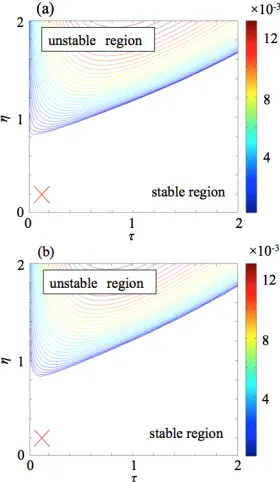
The ion temperature is the most important parameter for the ITG instability, so the dependency on the magni-tude and gradient length of the ion temperature is evalu-ated. Figure 3 (a) shows the contour plot of the growth rate in theτandηspace. The critical valueηcfor the ITG
in-stability changes depending on the magnitude ofτ. The minimum ofηcisηc = 0.8, and increases asτincreases
(ηc=1.7, whenτ=2.0, for example). These are the same
tendencies as in the local model analyses as in Fig. 3 (b). The cross in Fig. 3 indicates one of the experimental con-ditions in PANTA (τ=0.1,η=0.2 with an argon plasma).
Fig. 1 Dependency of growth rate onmandlwithτ = 1, an argon plasma.
Fig. 2 Radial profiles of eigenmodes of (a)T⊥, (b)T//, (c)nand (d)u//withm=2,l=1,η=1.2,τ=1, an argon plasma.
Fig. 3 Contour plot of the growth rate in theτandηspace with m =2,l= 1, an argon plasma. The cases with the (a) global and (b) local analysis are plotted.
4. Parameter Dependency of Radial
Structures
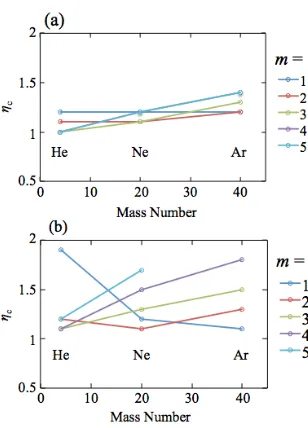
Dependencies on the other experimental parameters are also evaluated. The ion mass depends on the using dis-charge gas, which makes the Larmor radius different. The effective plasma radius changes, because the spatial length is normalized by the Larmor radius. Figure 4 shows the ion mass dependences of criticalηcwithm=1 - 5 in the cases
with the global and local analyses. The cases of helium, neon, and argon discharges are plotted. The difference in the dependency on the mode number is partly due to the selection of kr. In the global model, kr of the most
un-stable mode is determined by calculating the eigenmode, though it is only a parameter in the local model. In the case with helium, as shown in Fig. 4, them dependence is greatly different. The local analysis gives critical value
ηc = 1.9, which is larger than thatηc = 1.2 in the case
with the global analysis, whenm=1. This is because the value ofk⊥ of the most unstable mode is larger than the value obtained from the relationkr =kθassumed in the
lo-cal analysis. Figure 5 shows the relative amplitudes of the
k⊥components in the eigenmodes of the density. The max-imum value is normalized to be the unity. ˆλm j represents the normalized wave length of the base Bessel functions. As is seen in Fig. 5, there is a peak at ˆλm j=0.7, but in the local analysis the smaller valuek⊥ = √2(2m/a)ρs =0.14
is used. The deviation ofk2
⊥arises in the highermmodes,
because the radial wave length of the unstable mode is also comparable to the plasma size. Figure 5 also shows that the value of ˆλm jgiving the maximum amplitude is almost the same in spite of the ion mass variation.
In addition, the difference in the treatment ofkθis the other cause. In the global model, since the radial depen-dence (1/r) in thekθ terms must be expanded with com-bination of the various Bessel components, the following relation is used for the azimuthal derivative;
∂
∂yAj= ikθAj
=i
K
k=1
2mAk
J2
m+1(λm j)
1
0
dr∗Jm(λmkr∗)Jm(λm jr∗). (14) This calculation gives connection between various Bessel functions. On the other hand, the value ofkθis given as (m/r), and is evaluated with a singlervalue, typically at
r=a/2 in the local model. The results of the global anal-ysis imply that the difference of the radial structure also affects evaluation of the effectivekθvalue. Figure 6 shows the radial profiles of the amplitudes ofnwhenm=2,l=1,
η=1.2 andτ=1. In the case of helium, the structure is localized near the center of the plasma in comparison with the cases of argon and neon. This is because the charac-teristic spatial scaleρs is changed. From this result, it is
not appropriate under this condition to set the evaluation position of thekθ value atr = a/2 in the local analysis.
Fig. 4 Ion mass dependences of the critical valueηc, whenτ=
1. Those of modes withm=1 - 5 are shown in the case with the (a) global and (b) local analyses.
Fig. 5 Relative amplitudes of thek⊥ components in the eigen-modes of the densityn, whenτ=1,η=1.2,m=1 and l=1. Dependences on ˆλm j, normalized wave length, are plotted.
Fig. 6 Radial profiles of amplitudes of the densitynwithm=2, l=1,η=1.2,τ=1.
5. Summary and Discussion
To investigate the excitation conditions of ITG modes in PANTA linear device, the linear instability analyses were carried out. A gyro-fluid code, which solves global eigen-functions including the FLR effect, was developed and used for the analysis. The same tendency from the lo-cal model was obtained, which gives the threshold for the instability in the linear device. Wavenumberk⊥of the most unstable mode was obtained with the radial mode structure analysis. The radial structure is affected by the relative size between the plasma radius (to give the boundary condition) and the Larmor radius (to give the typical spatial length of the instability). The mode is more localized near the center of the plasmas in the case of a discharge gas with a smaller mass number as helium.
The strong restriction by the boundary condition is the main target in this article, and the effect of the background profile is not considered. If the radial dependencies of the density and temperature are introduced, they normally in-clude various Bessel components, so the coupling terms between different Bessel jcomponents in Eqs. (11) - (12) become more complex. The effect of theη profile is im-portant for quantitative evaluation to compare with experi-ments, and is left for the future work.
From the gyro-fluid model, it was found that the ex-perimental parameters of PANTA are present in the stable region, and for excitation of the ITG instability theηvalue larger than 4 times is required. In linear machine CLM, the ITG instability has been observed in the case when the ra-dial positions of the steep temperature and density gradient are different from each other to satisfy the excitation
con-dition onη[10]. The condition of destabilization should be explored by the distribution controls of the temperature and density in the future.
Acknowledgments
This work is supported by JSPS KAKENHI Grant Number JP16K06938, and the collaboration program of NIFS (NIFS17KNST112, NIFS16KNXN323) and RIAM of Kyushu University.
[1] P.H. Diamondet al., Plasma Phys. Control. Fusion47, R35 (2005).
[2] G.R. Tynan, A. Fujisawa and G. McKee, Plasma Phys. Control. Fusion51, 113001 (2009).
[3] T. Windisch, O. Grulke and T. Klinger, Phys. Plasmas13, 122303 (2006).
[4] T. Yamadaet al., Nature Phys.4, 721 (2008).
[5] P. Manz, M. Xu, S.C. Thakur and G.R. Tynan, Plasma Phys. Control. Fusion53, 095001 (2011).
[6] Y. Nagashimaet al., Rev. Sci. Instrum.82, 033503 (2011). [7] N. Kasuyaet al., Phys. Plasmas15, 052302 (2008). [8] P. Vaezi, C. Holland, S.C. Thakur and G.R. Tynan, Phys.
Plasmas24, 092310 (2017).
[9] W. Horton, Rev. Mod. Phys.71, 735 (1999). [10] A.K. Senet al., Phys. Rev. Lett.66, 429 (1991). [11] N. Ezumiet al., J. Nucl. Mater.337, 1106 (2005). [12] S. Inagakiet al., Sci. Reps.6, 22189 (2016).
[13] S. Hamaguchi and W. Horton, Phys. Fluids B 2, 1833 (1990).