Original Research Article
A comparative study of sleep habits among medical and non-medical
students in Saifai, Etawah
Ankita Sharma
1, Anand Mohan Dixit
1*, Kiran Krishnappa
1, Ruchita Sharma
2,
S. K. Shukla
1, P. K. Jain
1INTRODUCTION
Sleeping is a natural repetitive state of rest for the mind and body which is crucial to life.1 Quality sleep and getting enough of it at the right times is as essential to survival as food and water. It is an important part of our daily routine and we spend about one-third of our time doing it.2 Good quality sleep and adequate amount of sleep are important in order to have better cognitive
performance, academic performance and avoid health problems and psychiatric disorders.3
It is an important component of normal human physiology as it serves a restorative homeostatic function and appears to be crucial for normal thermoregulation and energy conservation.3 Sleep disturbance is a distressing and disabling condition that affects many people, and can affect on quality of work and education
ABSTRACT
Background: Good quality sleep and adequate amount of sleep are important in order to have better cognitive performance, academic performance and avoid health problems and psychiatric disorders. Sleep disturbance is a distressing and disabling condition that affects many people, and can affect on quality of work and education of students. Thus the aim of the study is to assess and compare the sleep habits of medical and non-medical students in Etawah city.
Methods: A cross-sectional study was carried out among 200 college students (100 medical and 100 non-medical) using convenience sample size. A self-questionnaire developed based on Pittsburgh Sleep Quality Index was used. Data was analyzed by using SPSS version 23. Mean, standard deviation and t-test is applied for analysis. The Chi square test statistic (χ2
) and fisher exact test were used to test the significance of association between various factors.
Results: It was observed that mean age of the medical student was 22.8 whereas the mean age of non-medical student was 17.4. Sleep duration of less than 7 hours was seen 60% in medical students and 47% in non-medical students. PSQI score was high in medical students (6.42) in comparison to non-medical students (5.15). A total score of 5 or greater is indicative of poor sleep quality.
Conclusions: Despite the numerous studies regarding the subject, students and professionals tend to ignore the sleep disorders and their possible consequences. Proper counselling, better planning and support should be provided to students likely to suffer from sleep disorders.
Keywords: Sleep quality, Comparative study, Medical students, Non-medical students
1
Department of Community Medicine, Uttar Pradesh University of Medical Sciences, Saifai, Etawah, Uttar Pradesh, India
2
Department of Obstetrics and Gynaecology, Kasturba Hospital, New Delhi, India
Received: 19 July 2018
Revised: 05 August 2018
Accepted: 06 August 2018
*Correspondence:
Dr. Anand Mohan Dixit, E-mail: [email protected]
Copyright: © the author(s), publisher and licensee Medip Academy. This is an open-access article distributed under the terms of the Creative Commons Attribution Non-Commercial License, which permits unrestricted non-commercial use, distribution, and reproduction in any medium, provided the original work is properly cited.
of students. It was postulated that sleep deprivation may be associated with defect in the immune function, and may be implicated in the pathogenesis of psychological problems and metabolic problems (diabetes mellitus, metabolic syndrome and obesity).4
The sleep wake cycle of the students is quite varies significantly between the type of professional student.5 Medical students are vulnerable group to poor sleep.6 They are are considered a stressful group of students and this may be attributed to their extended study years, high academic load (long duration and high concentration), clinical duties, emotionally challenging work, and the highly demanding lifestyle.6-8 Other college students also experience a number of sleep problems, which may impact academic performance, health, and mood.9 Sleep disturbances is a distressing and disabling condition that affects many people, and can affect on quality of work and education of students.5
Unable to fall asleep earlier in the evening, young adults cannot get enough sleep if they must get up early. In addition, sleep may be voluntarily sacrificed due to social factors or involuntarily curtailed because of living in a noisy residence hall or apartment.9 Some studies have shown that sleep disturbances are found more frequently among women than men, some studies have shown a positive relationship between smoking a sleep disturbance and same was true of the relationship between drinking and sleep disturbance.10-12
The consequences of sleep problems, whether due to insufficient sleep or an untreated sleep disorder can be serious. Sleep problems have been associated with deficits in attention and academic performance, drowsy driving, risk taking behaviour, impaired relationships, and poor health.13 Over a decade, a rapid diffusion of computers and proliferation of audio and video gadgets and late night video-gaming zones among people and especially among students has occurred. Due to these cultural changes, sleep patterns of young adults tend to become irregular and many of them experience sleep deficiency, which could have detrimental effects on daytime activities including study.14
Numerous studies conducted within the past decade have analyzed the deleterious effects of sleep deprivation on medical as well as non-medical students.15,16 Hence, this study intends to explore the effects of sleep habits on the medical students of UPUMS, Saifai, etawah and non-medical students of and Chaudhary Charan Singh PG College, Heonra, Saifai, Etawah.
METHODS
The present study was college based cross sectional study carried out in Uttar Pradesh University of Medical Sciences, Saifai, Etawah and Chaudhary Charan Singh PG College, Heonra, Saifai, Etawah for a period of one month in September 2017. The necessary ethical approval was taken from university ethical committee. A Total of
Two hundred college students (100 medical and 100 non-medical students) were purposively selected as study subjects. Medical college students were from second year MBBS and non-medical students were from BSc second year.
Data was collected using semi-structured and self-administered questionnaire which was explained to the students to help them understand the questions well. Questionnaire was prepared in English and then translated to local language (i.e. Hindi) which most students could understand. No names or identifying information were indicated on the questionnaires, and all participants were assured of absolute confidentiality. Purpose of the study was explained to the students and informed consent was taken. Students who were not willing to participate and who were absent are excluded from study. Information regarding socio-demographic profile and BMI, addictions, stress, use of mobile/laptops before going to sleep was gathered with distributed questionnaires.
Pittsburg Quality of Sleep Indexwas also used to assess the quality of sleep.17 This scale comprised of several factors such as sleep quality, sleep latency, sleep duration, sleep efficiency, sleep disturbance and use of sleep medication. Sleep latency is the length of time it takes from lying down for the night until sleep onset. Sleep efficiency is the ratio of the total time spent asleep (total sleep time) in a night compared to the total amount of time spent in bed. Most people who get less than 7-9 hours of sleep have daytime dysfunction symptoms like irritability, fatigue, and inability to concentrate. Collected data was analysed by Microsoft excel sheet and analysed by SPSS version 23. Mean, standard deviation and t-test is applied for analysis. The Chi square test statistic (χ2) and fisher exact test were used to test the significance of association between various factors. A value of p<0.05 was considered statistically significant.
RESULTS
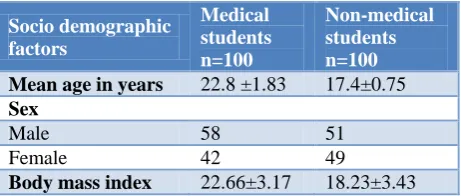
Overall there were 109 (54.5%) males and 91 (45.5%) females. It was observed from Table 1 that mean age of the medical students was 22.8 whereas the mean age of non-medical student was 17.4. The mean BMI was higher in medical students (22.6) in comparison to non-medical students (18.2). Sleep duration of less than 7 hours was seen 60% in medical students and 47% in non-medical students (Figure 1).
Table 1: Characteristics of study population.
Socio demographic factors
Medical students n=100
Non-medical students n=100
Mean age in years 22.8 ±1.83 17.4±0.75
Sex
Male 58 51
Female 42 49
Figure 1: Sleep duration of study population.
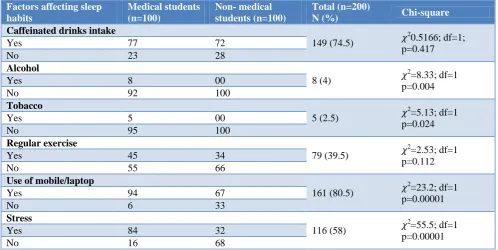
It was seen from Table 2 that, out of 200 students, regular coffee intake was reported by 149 (74.5%) students, out of which 77 students were from medical college and 72 students were from non-medical college. Regular alcohol intake was reported by 8 (4%), out of which 100% students were from medical students. Tobacco intake was reported by 5 (2.5%) medical students. No alcohol and tobacco consumption was reported by non-medical students. Regular exercise was done by 79(39.5%) students, of which 45 students belong to medical college. Use of mobile/laptop before sleep was reported by 80% of students (94 medical and 67 non-medical students). Stress was reported by 116 (58%) students (84 medical and 32 non-medical students).
Table 2: Distribution of factors affecting sleep habits of study population.
Factors affecting sleep habits
Medical students (n=100)
Non- medical students (n=100)
Total (n=200)
N (%) Chi-square
Caffeinated drinks intake
149 (74.5)
2
0.5166; df=1; p=0.417
Yes 77 72
No 23 28
Alcohol
8 (4)
2
=8.33; df=1 p=0.004
Yes 8 00
No 92 100
Tobacco
5 (2.5)
2
=5.13; df=1 p=0.024
Yes 5 00
No 95 100
Regular exercise
79 (39.5)
2
=2.53; df=1 p=0.112
Yes 45 34
No 55 66
Use of mobile/laptop
161 (80.5)
2
=23.2; df=1 p=0.00001
Yes 94 67
No 6 33
Stress
116 (58)
2
=55.5; df=1 p=0.00001
Yes 84 32
No 16 68
Table 3: Comparison of sleep component of PSQI among medical and non-medical students.
Component Medical students
(n=100)
Non-Medical students (n=100)
Total
N (%) Chi- square
Subjective sleep quality
Good 73 95 168 (84) 2
=18.01; df =1 p=0.00002
Bad 27 5 32 (16)
Sleep latency
0 20 18 38 (19)
2
=10.81; df=3 p=0.0127
1-2 37 40 77 (38.5)
3-4 19 33 52 (26)
5-6 24 09 33 (16.5)
Sleep duration
>7 hrs 17 21 38 (19) 2
=0.51; df=1 p=0.47
<7 hrs 83 79 162 (81)
Sleep efficiency
>85% 86 96 182(81) p=0.023
<84% 14 04 18 (9)
0 10 20 30 40 50 60 70
less than 7 hours more than and equal to 7 hours
medical students non medical students
Component Medical students (n=100)
Non-Medical students (n=100)
Total
N (%) Chi- square
Sleep disturbance
0-9 90 93 183 (91.5) 2
=0.578; df=1 p=0.446
10-27 10 07 17 (8.5)
Use of sleep medication (in the last month)
Not used 90 99 189 (94.5)
p=0.0096*
Used 10 01 11(5.5)
Daytime dysfunction
0 21 38 59 (29.5) 2
=6.94; df=1 p=0.008
2-6 79 62 141 (70.5)
*Fisher exact test.
Table 4: Comparison of mean of global PQSI.
n Mean Std. deviation t-value
Medical students 100 6.42 2.80
3.737; p˂0.001
Non-medical students 100 5.15 1.91
The results for the seven components of the PSQI were analyzed for the total sample and for the two study groups (Table 3). Among study population, 27% medical and 5% of non-medical students reported their subjective sleep quality as bad and this difference found to be significant. 24% of medical participants and 9% of non-medical participants reported their sleep latency score 5-6 (higher the score, poorer the sleep latency) and this difference was also significant. Other components like sleep duration, sleep efficiency and sleep disturbance were not significantly different in both groups. Use of medication and daytime dysfunction was significantly higher among medical as compared to non-medical students.
PSQI score was higher (Table 4) in medical students (6.42) in comparison to non-medical students (5.15) and significant differences were found in both groups. A total score of 5 or greater is indicative of poor sleep quality.
DISCUSSION
Sleep quality among college students is a subject that has been studied worldwide because of its effects on the academic routine and personal life of this population. Medical students are a special group of young adults who have life constraints that can cause irregular sleep habits or shortening of mean sleep length, compared with individual’s sleep need. There is some evidence in literature supporting the hypothesis that sleep difficulties and deprivation can significantly impair student’s academic performance.18 Total sleep duration less than 7 hours was observed in 60% of medical students and 47% of non-medical students. Giri et al found that only 19% medical students sleep for more than 7 hours.19
The mean BMI was more in medical students and they refrained from regular exercise. A study by Veldi et al also found that high BMI was related to sleep problems.20
The global PSQI score shows a higher disturbance of sleep in medical students. Other studies also corroborate this findings.21-23 In the present study, excessive coffee intake, alcohol abuse, tobacco use and use of mobile/laptop were the habits adversely affecting sleep in students. Similar findings were shown by Marzieh et al.23
Students suffer high level of stress due to academic demands, particularly during examination periods. Stress associated with insufficient sleep can lead to difficulties in interpersonal relationship, depression, anxiety and alcohol and drug abuse.24,25
Nearly 16% of the students in our sample classified their sleep quality bad, however Corrêa et al found that 40% of the study subjects reported their life.26 Poor sleep quality is associated with excessive daytime sleepiness.27,28 In the present study, daytime dysfunction was reported by 70% of the participants, who had difficulty staying awake during the day at least once a week. This is consistent with the literature, although there are variations across studies in the proportion of medical students reporting daytime sleepiness: 31%; 42.1%; and 63%.27,29,30 Therefore, medical students experienced greater deleterious effects on subjective sleep quality and daytime dysfunction than non-medical students. This can be explained by the fact that attending a medical course requires a high level of dedication and selflessness, signifying harmful lifestyle changes, such as sleep deprivation and poor sleep hygiene habits.31-34
CONCLUSION
In the present study, we have found that medical students had more disturbed sleep patterns than the non-medical student as they showed a higher global PSQI score. Use of laptop and mobile and stress in life is higher among medical college in comparison to non-medical students. Despite the numerous studies regarding the subject, students and professionals tend to ignore the sleep disorders and their possible consequences. Proper counselling, better planning and support should be provided to students likely to suffer from sleep disorders.
Funding: No funding sources Conflict of interest: None declared
Ethical approval: The study was approved by the Institutional Ethics Committee
REFERENCES
1. Hamed H, Miskey A, Alkurd R, Ghazal Z, Sami R, Absuljaleel N, Shawan M. The Effect of Sleeping Pattern on the Academic Performance of Undergraduate Medical Students at Ajman University of Science and Technology. RRJPPS. 2015:4(4):18-21.
2. Brain Basics: Understanding Sleep. National institution of neurological disorder and stroke. Available at: https://www.ninds.nih.gov/Disorders/ Patient-Caregiver-Education/Understanding-Sleep. Accessed on 21 July 2018.
3. Kaplan HI, Sadock BJ. Synopsis of Psychiatry. 8th ed. Baltimore (MD): Williams and Wilkins; 1998: 737-741.
4. Aldabal L, Bahammam AS. Metabolic, endocrine, and immune consequences of sleep deprivation. Open Respir Med J. 2011;5:31-43.
5. Yang C, Wu C, Hsieh H. Coping with sleep disturbances among young adults: a survey of first – year students in Taiwan. Behav Med. 2003;29;133-8.
6. Azad MC, Fraser K, Rumana N, Abdullah AF, Shahana N, et al. Sleep disturbances among medical students: A global perspective. J Clin Sleep Med. 2015;11:69-74.
7. Waqas A, Khan S, Sharif W, Khalid U, Ali A. Association of academic stress with sleeping difficulties in medical students of a Pakistani medical school: A cross sectional survey. Peer J. 2015;3:840.
8. Ibrahim N, Al-Kharboush D, El-Khatib L, Al-Habib A, Asali D. Prevalence and predictors of anxiety and depression among female medical students in king Abdulaziz university, Jeddah, Saudi Arabia. Iran J Public Health. 2013;42:726-36.
9. Wolfson AR, Carkadon MA. Understanding adolescents’ sleep patterns and school performance: a critical appraisal. Sleep Med Rev. 2003;7:491-506.
10. Doi Y, Minowa M, Okawa M. Prevalence of sleep disturbance and hypnotic medication use in relation to socio-demographic factors in general Japanese adult population. J Epidemiol. 2000;10:79-86. 11. Philip BA, Danner FJ. Cigarette smoking and sleep
disturbance. Arch Intern Med. 1995;155:734-7. 12. Janson C, Gisalason T. De Backer W. Prevalence of
sleep disturbances among young adults in three European countries. Sleep. 1995;18:589-97.
13. Anjum A, Bajwa A, Saeed R. Sleep patterns;among medical and non-medical students of university of lahore, Professional Med J. 2014;21(1):148-56. 14. Deck JB, Tae JL. Sleep duration, subjective sleep
disturbances and associated factors among university students in Korea. J Korean Med Sci. 2001;16:475-80.
15. Howard SK, Gaba DM, Rosekind MR, Zarcone VP. The risks and implication of excessive daytime sleepiness in resident physicians. Acad Med. 2002;77:1019-25.
16. Veasey S, Rosen R, Barzansky B, Rosen I, Owens J. Sleep loss and fatigue in residency training: A reappraisal. JAMA. 2002;288:1116-24.
17. Buysse DJ, Reynols CF, Monk TH, Berman SR, Kupfer DJ. The Pittsburg Sleep Quality Index:a new instrument for psychiatric practice and research. Psychiatry Res. 1989;28:192–213.
18. Lack LC. Delayed sleep and sleep loss in university students. J Am Coll Health. 1986;35:1105-9. 19. Giri PA, Baviskar MP, Phalke DB. Study of sleep
habits and sleep problems among medical students of Pravara Institute of medical sciences Loni, Western Maharashta, India. Ann Medical Health Sci Res. 2013;3:35-9.
20. Veldi M, Aluoja A, Vasar V. Sleep quality and more common sleep related problems in medical students. Sleep Med. 2005;6:269-75.
21. Lima PF, De Medeiors AL, Rolim SA, Junior SA, Amondes KM, Araujo JF. Changes in sleep habits of medical students according to class starting time: A longitudinal study. Sleep Sci. 2009;2:92-5. 22. Parthasarathy S. Sleep and the medical profession.
Curr Opin Pulm Med. 2005;11:507-12.
23. Nojomi M, Ghalhe Bandi MF, Kaffashi S. Sleep pattern in medical students and residents. Arch Iran Med. 2009;12:542-9.
24. Jean Louis G, Von Gizycky H, Zizi F, Nunes J. Mood states and sleepiness in college students:Influences of age, sex, habitual sleep and substance use. Percept Mot Skills. 1998;87:507-12. 25. Santibanez I. Estudo de habitos normais e
patologicos de sono e vigilia de estudantes de medicina: Estudo de prevalencia. J Bras Psiq. 1994;43:33-7.
26. Corrêa C, OliveiraF, Pizzamiglio D, Ortolan E, Weber S. Sleep quality in medical students:a comparison across the various phases of the medical course. J Bras Pneumol. 2017;43(4):285-9.
Portuguese]. Rev Soc Bras Clin Med. 2014;12(1):8-14.
28. Cardoso HC, Bueno FC, Mata JC, Alves AP, Jochims I, Vaz Filho IH, et al. Assessing quality of sleep in medical students [Article in Portuguese]. Rev Bras Educ Med. 2009;33(3):349-55.
29. Rique GL, Fernandes Filho GM, Ferreira AD, de Sousa-Muñoz RL. Relationship between chronotype and quality of sleep in medical students at the Federal University of Paraiba, Brazil. Sleep Sci. 2014;7(2):96-102.
30. Pagnin D, de Queiroz V, Carvalho YT, Dutra AS, Amaral MB, Queiroz TT. The relation between burnout and sleep disorders in medical students. Acad Psychiatry. 2014;38(4):438-44.
31. Mirghani HO, Mohammed OS, Almurtadha YM, Ahmed MS. Good sleep quality is associated with better academic performance among Sudanese medical students. BMC Res Notes. 2015;8:706. 32. Mota MC, De-Souza DA, Mello MT, Tufik S,
Crispim CA. Lifestyle and medical education: impact on the nutritional profile [Article in
Portuguese]. Rev Bras Educ Med. 2012;36(3):358-68.
33. Azad MC, Fraser K, Rumana N, Abdullah AF, Shahana N, Hanly PJ, et al. Sleep disturbances among medical students:a global perspective. J Clin Sleep Med. 2015;11(1):69-74.
34. Pérez-Olmos I, Ibáñez-Pinilla M. Night shifts, sleep deprivation, and attention performance in medical students. Int J Med Educ. 2014;5:56-62.
35. Al-Sayed AA, Al-Rashoudi AH, Al-Eisa AA, Addar AM, Al-Hargan AH, Al-Jerian AA, et al. Sedative Drug Use among King Saud University Medical Students: A Cross-Sectional Sampling Study. Depress Res Treat. 2014;2014:378738.
Cite this article as: Sharma A, Dixit AM, Krishnappa K, Sharma R, Shukla SK, Jain PK.A comparative study of sleep habits among medical and non-medical students in Saifai, Etawah. Int J