1008
NEW MODEL OF TURING MACHINES WITH GENETIC
ALGORITHMS
EMAN ALI HUSSAIN1, YAHYA MOURAD ABDUL – ABBASS2 1Department of Mathematics, Al- Mustansiriya University, College of Science, Iraq
2 Ministry of Education, Educational Directorate Babylon, Iraq 1[email protected] 2[email protected]
ABSTRACT
In this paper we introduced new model of Turing machine, and represented the Turing Machine in the space of matrices size 𝛼∗ 𝜆, is called Turing Matrices Space (TMS), denoted by M(𝛼 , 𝜆),and construct the formulate which translate the Turing machine to Turing Matrices Space Then the space is called Standard Turing Matrices Space (Standard TMS). In the second phase of the work we using the Turing Machines with crossover operators to accelerated the work of the genetic algorithms then we have provided many of theorems and lemma to use as a mathematical form in this new model of Turing machine
Key-Words: - Genetic Algorithms, Crossover Method, Turing Machine, Multidimensional Turing Machines
1. INTRODUCTION
A Turing machine is a mathematical model of computation that we can used a predefined set ofrules, which to determine the result on a strip of tape according to a table of rules .In 1936 the notion of Turing machines appeared introduced by Alan M. Turing [1]. Claude Shannon was studied the problem which called now the discretional complexity of Turing machines in the 1950s [2]. Philipp K. Hooper first studied The immortality problem, by consists from finding an initial infinite configuration on which the Turing machine never halts, whatever the initial state during 1966,[5]. Yurii Rogozhin’s introduced in 1982 the smallest Turing machine, nothing changed during the next 10 years. In 1992, only improved universal machine by Rogozhin[6].Stephen Wolfram in 2002 introduced very small weakly universal Turing machines [3]. Pavlotskaya in 2003 proved that a Turing machine instructions has a decidable halting problem even coupled with a finite automaton [4].In 2007, by Wolfram the tape of the Turing machine is initially fixed. Its initial configuration is not exactly periodic, but it is “regular” in the sense that the infinite word written on the tape [2]
2. Multidimensional Turing Machines [7, 8] Multidimensional Turing machine, the Turing machine tape is viewed as having the ability to extend infinitely in more than one dimension [9]. A two–dimensional machine has a transition defined as 7–tuple (S, Σ, Γ, δ, S0, B, F) where,
S is a set of finite states.
Σ is the set of input symbols (alphabet).
Γ is the tape alphabet.
The blank symbol.
δ is The transition function for an t–tape Turing machine can be defined δ: S × Γt → S × Γt × {L,R,U,D}t where L ,R ,U, and D are left, right , up, and down respectively which indicates the direction to move the read/write head.
is the start state.
F is the set of final (accepting) states
Figure (1)
Definition: HALT
In computability theory, During analysis a Turing Machine halts if there is no leaving arc from the current state for the character read from the tape 1 and the character read from tape 2 or if a ‘HALT’ state is reached. A sentence is accepted if a machine ends in the ‘HALT’ state. [10, 11]
3. 2-2: Example
1009 Figure (2)
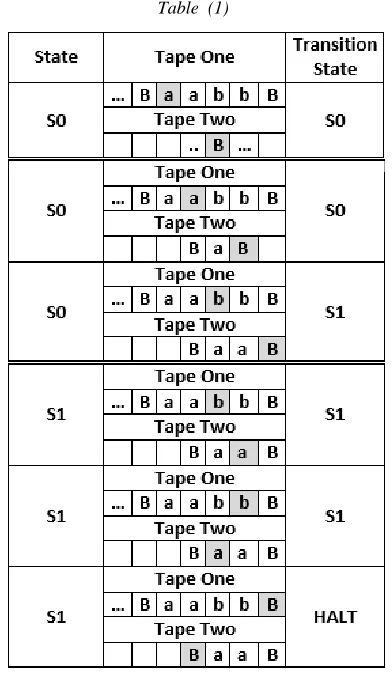
Table 1 shows the analysis of a sentence (‘aabb’) for the Turing machine acceptor existing in Figure (3). Initially the sentence ‘aabb’ is placed on Tape (1) with the head pointing to the initial ‘a’ in the sentence. Blank symbols are placed to the right and left of the sentence. Tape( 2). Since the input characters are ‘a’ and ‘B’ from Tape 1 and Tape 2 respectively, the Turing machine follows the change with the corresponding input characters. The change followed is shown in Figure 3. The head moves right on Tape 1. The character ‘a’ is written to Tape 2 and the head moves right. Table 1 shows each change made, and the contents of the tape after each change. The arrows indicate the characters read from the tapes. The machine ends in the ‘HALT’ state which involves that the sentence is accepted
Figure (3)
Table (1)
2-4 :( N-dimensional) Turing Machines
N-dimensional Turing machine. The Turing machine tape is viewed as having the ability to extend infinitely in more than one dimension [9]. A N–dimensional machine has a transition defined as 7–tuple (S, Σ , Γ, δ, S0,B, F) where,
S is a set of finite states.
Σ is the set of input symbols (alphabet).
Γ is the tape alphabet.
The blank symbol.
δ is The transition function for an t–tape Turing machine can be defined δ: S × Γt→ S × Γt × {d0,d1,d2,…dN-1}t where d0,d1,d2,…dN-1 which indicates the direction to move the read/write head.
is the start state.
F is the set of final (accepting) states.
2-5:Example
Suppose dh= h=0,1,2 … -1 for example if h=0,1 then d0= 0 ,direction right ( R ) and d1= ,direction left ( L ) if h=0,1,2,3 then d0= 0 ,direction right ( R ) , d1= ,direction up ( U ) a/R , B/a/R
b/R , a/L b/N , B/L
S0 S
1
[image:2.612.82.522.65.750.2] [image:2.612.321.517.95.432.2]1010 , d2= direction left ( L ) and d3= ,direction down ( D )
2-6: Definition
The space of each matrices of size 𝛼 ∗ 𝜆, it's representation of Turing Machine, is called Turing
Matrices Space (TMS), denoted by M(𝛼 , 𝜆),
Where 𝛼=|Γ| (|S|-1), 𝜆= t |S|, and t denoted to the number of tapes.
2-7: Example
From the example (2-2), |Γ| =3, |S|=3, and t=2, then from definition (2-6) 𝛼=6, and 𝜆=6.
Also from the example (2-3), |Γ| =3, |S|=4, and t=2, then 𝛼=9, and 𝜆=8.
2-8: Definition (Label Read/Write/Diction) The label X/Y/d (Read/Write/Diction) in tape τ from state qi to qj , X is represent of the read XΓ from tape τ , Y is represent of the write YΓ in tape τ , and d move the head in direction d, we have a transition defined by δ(qi,X)=(qj,,Y,d) which replaces X with Y, transitions from qi to qj state , and moves the "read head" in direction d (left, right, up, …) to read the next input.
2-9: Definition
Tape set of integer numbers , is define the function ω to convert the elements of tape alphabet symbols Γ to integer numbers from 3 to |Γ|+2.
If Γ={α1,α2,…, α|Γ|-1,B}, and B is a blank element,
then , where
corresponding , and B
corresponding to ω (B)=|Γ|+2. 2-10: Example
From example (2-2) and (2-3) , Γ={a, b, B}, then
2-11:Definition: Standard Turing Matrices Space( Standard TMS).
If , where A=[aij], and
δ(k1,x)=(k2,,u,d), for the label x/u/d (read/write/direction) between the states Sk1, and Sk2 , such that
,
,
Where S is a set of finite states, and Γ is the tape alphabet Γ={B} ∪ Σ, Then when read xΓ in τ tape x=ω-1( y ), where y=((i-1) mod | Γ |)+3, with the following
1. aij=0 if there no transition between the state Sk1, and state Sk2 .
2. aij=+1 if doesn’t write on tape ( that mean null (N) ), and doesn’t move head on tape between state Sk1, and state Sk2.
3. aij=+2 if doesn’t write on tape, and right move head on tape
4. aij=-2 if doesn’t write on tape, and left move head on tape.
5. aij ≥ +3 if to write x=ω-1( aij ) on tape, and right move head on tape where (Tape integer numbers).
6. aij ≤ -3 if to write x=ω-1(-aij ) on tape, and left move head on tape where (Tape integer numbers).
Then the space TMS is called Standard Turing Matrices Space (Standard TMS).
2-12:Example
Suppose the graph of Standard TMS with S= {S0, HALT}, Γ= {0,1,B},and t=2, see figure (4)
Figure (4)
Then ,
2-13: Definition (6): The rows of a matrix , and corresponding to the specific states Si (state of index i) is called state rows denoted by (SRi).
2-14: Example
In the figure (4) the state rows of index 0 denoted by SR0, it’s corresponding to the state S0 such that:
SR0=
Where S= {S0,S1,HALT}, Σ ={a,b}, and Γ={a,b,B}, B/N, B/0/L
1/R, B/1/R 0/R, 1/N
1011 Figure (5)
2-15: Lemma :If , represent the space of Multidimensional Turing machine of Standard TMS , then for each transition between Sk1 and SK2 with x/y/z in tape τ , where 1≤τ≤t, and τN, it’s correspond to , such that
i=| Γ| K1 + ( ω(x)-2) ………(1) j=(τ-1)|S| + (K2+1) …………..(2)
where ‘x’ is the symbol read from the tape τ, and ‘y’ is the symbol to be written to the tape τ, and ‘z’ denoted to the movement of the head in the direction z of tape τ.
proof:
Since from definition (2-7) and the reminder of is (i-1) mod , and r= (i-1) mod
, then (i-1) –r = k1 i= k1+r+1
From definition (4), y= ω(x) = ((i-1) mod | |) +3, Then r=y-3
i=| Γ| K1 + (ω(x)-2).
also from definition (5) ,
j-1= + , ,
j= + +1
the value is a number of multiple of tapes, because the number of columns in standard Turing matrix is a multiple of tapes (=t |S|), in the first tape q=0, in the second tape q=1, then in the τ’th tape q=τ-1, then
j= + +1
j=(τ-1)|S| + (K2+1) ■
2-16:remark (1) : case τ =1 then j=(K2+1) from lemma ( 2-15 )
2-17: Example (7):
Suppose S={ S0, S1, S2,S3,S4,S5,HALT}, Γ={a ,b ,c ,B}, and t=2, then α= |Γ| (|S|-1)=24, and =t |S|=14.
Figure (6)
From above for first tape τ=1: (a/L), and by using lemma (1)
Then i=| Γ| K1 + (ω(x)-2) =4 * 2 + (ω (a)-2) = 8+ (3-2) =9
j= (t-1) |S| + (K2+1) = (1-1) * 7+ (4+1) =5 then from definition(5), a95=-2.
2-18: Example
Figure (7)
From figure (7) S= {S0, S1, HALT}
Γ= {a, b, B}, t=2, 𝛼=|Γ| (|S|-1) =3 (3-1) =6, and 𝜆= t |S|=2×3=6,
, If , then by definition
(2-7)
A= For example if a55
=-3, i=5, and j=5 then
k1= ,
K2=
From state S1 to same state S1, then
The first tape read x , when x=ω-1( y ), and y=(i-1) mod | Γ |)+3,
a/R , B/a/R
b/R , b/a/L b/N, B/L
S0
S1
HALT
B/N , B/N
a/ L , b / c /R
S2
S4
a/R , B/a/R
b/R , b/a/L b/N , B/L
S0
S1
1012 y= ((5-1) mod 3) +3=4, then x= ω-1(4) =b,
from definition(5) if a55≤ -3, the head in the second tape write
x=ω-1(-a
55) = ω-1(3) =a, and move left in the first tape. That mean is b/a/L.
2-19: Definition (7):( Elect vector)
The vector X=(x1,x2,…,x| S |-1) of zero-one, and the size | S |-1, where x1,x2,…,x| S |-1 corresponding to states S0,S1, … , S| S |-2, x1=0, and the number of ones in X is less than, called Elect vector.
2-20: Definition (8):(The Norm of Elect vector) The number of ones in the elect vector called norm of Elect vector, denoted by || X|| , where x is Elect vector, and
2-21: Remark(2): From definition (2-19) and definition (2-20) the norm of Elect vector is
2-22: Definition (9): (Shave Matrix)
The matrix of size α×α, denoted by I(X), where X is Elect vector, then
The matrix I(X) called shave matrix.
2-23:Example(9):
Let S={S0,S1,S2,H}, Γ={a, b,B}, t=3, and X=(0,0,1), then α=9, =12, and k=2 by definition of the Shave Matrix I(X), the nonzero element is I77= I88= I99=1, because 7 , then
= diag((1,1,…,1)-( x1,x2,…,x| S |-1))
= diag(1,1,…,1)- diag(x1,x2,…,x| S |-1) = I-I(X) ■
2-28:Example(11):
From example (2-23) the complement of shave matrix I(X) is
I(X′)=diag(1,1,1,1,1,1,0,0,0,1,1,1). 3. Genetic Programming Operators.
Genetic operators are used to transform the population of the individuals from one generation to another. Genetic operator consists of three types of operator's mutation, crossover and selection which must work in conjunction with one another in order for the algorithm to be successful. Genetic operators are used to transform the population of the individuals from one generation to another [12].now we use Turing machine with Genetic operators to acceleration the work of Genetic algorithms
3-1: Crossover [13]
Crossover is the process of taking more than one parent solutions and producing a child solution from them. After the selection (reproduction) process, the population is supplemented with better individuals. By recombining operator that proceeds in three steps
1. The selection operator choosing at random a pair of two individual strings for the mating.
2. A cross location is selected at random along the string length.
3. The position values are swapped between the two strings following the Cross location.
3-2:Definition (11) (Transformation Row Echelon) If Iα=diag(I1,I2,…,I|S|-1) is Identity matrix of size α, and Ij identity matrix of size |Γ| (where j=1,2,…, |S|-1), and Iα=(SR1,SR2,…SR|S|-1), where SRj is |Γ| rows that include Ij, then the definition of transformation row echelon T(X,Y), where ||X||=1 with one nonzero element of X at position h, and ||Y||=1 with one nonzero element of Y at position k, where
1- if h=k, then T(X,Y)=Iα 2- if h≠k, then
T(X, Y) = (SR1,…, SRk-1, SRh, SRk+1,…, SRh-1, SRk, SRh+1,…,SR|S|-1), k<h
or
T(X, Y) = (SR1… SRh-1, SRk, SRh+1,… SRk-1, SRh, SRk+1,….,SR|S|-1), h<k
3-3: Remark (3): From definition (3-2), suppose a=|S|-1, then
3-4: Example (12):
Suppose S={ S0,S1,S2 ,H} ,|S|=4 , Γ={a,b.B} ,and |Γ|=3
Let X=(0,1,0) and Y=(0,0.1) ,h= 2 ,k=3 , a=|S|-1=3
T(X,Y)=
1013 3-6: Definition(13) : the child matrices which introduce from exchanging segments in the parents matrices
3-7: Theorem (1):
Let and , are
Standard TMS, and the parent matrices
, , = = ,X ǂ Y (where X,
and Y are Elect vectors for A, and B respectively), and ||X||=||Y||=1,then child matrices C, and D are C=I (X′) A+ T(X, Y) I(Y) B (3) and
D= I (Y′) B+ T(Y, X) I(X) A (4) Proof :
Suppose the Elect vector X from graph T1 corresponding to matrix A where
X=(00,01,….0k-1,1k,0k+1,..,0 ) and A= and
Elect vector Y from graph T2 corresponding to matrix B where Y=(00,01,…. 0h-1,1h,0h+1,..,0 ) ,
B= ,
From the left side of (3), then
C= C= +
C=I(X′) + T(X,Y) ( because
T(X,Y) swap between and )
C=I(X′) + T(X,Y) I(Y)
C=I(X′) A+ T(X,Y) I(Y)B
By the same way we can prove D= I(Y′)B+ T(Y,X)(I(X)A ■
3-8: Example (13)
in this example choose state S2 as Elect vector from graph (p1) and choose state S1
from graph (p2) as Elect vector and swap him such that insert S2 to graph (p2),
insert S1 to graph (p1)
P1=
P2=
Graph (p1) b/R , B/a/R
b/R , B/N
S0 S1
H
B/N , B/N
S2 a/R , B/b/R
1014
Graph (p2)
By proposition (2-24) , I(X)= diag (0,0,0,0,0,0,1,1,1) ,
I(Y)= diag (0,0,0,1,1,1,0,0,0) and I(X′)= diag (1,1,1,1,1,1,0,0,0) then
C=I(X′) A+ T(X,Y) I(Y)B ,and D= I(Y′)B+ T(Y,X)(I(X)A
,
then A=
,
then B=
C=I(X′) A+ T(X,Y) I(Y)B
=diag(1,1,1,1,1,1,0,0,0) + T(X,Y)
(diag (0,0,0,1,1,1,0,0,0))
= + T(X,Y)
= + =
C==
Figure (C) 3-9:lemma (2):
Let and , are
Standard TMS, and parent
matrices, , = = , X = Y,
and ||X||=||Y||=1,then child matrices are C=I(X′) A+ I(Y)B ( 5)
and
D= I(Y′)B+ I(X)A (6) B/N, B/N
b/R , a/L b/N , B/L
a/R , B/a /R
a/N , B/a/R
S0 S
1
HAL T S2
B/N , B/N a/R , B/b/R
b/R , B/a/R
b/R , B/N
S0 S
1
H B/N , B/N
S2
1015 Proof :
By then definition (3-2) if h=k, then T(X,Y)=Iα and by theorem (3-7)
C=I(X′) A+ T(X,Y) I(Y) B D= I(Y′) B+ T(Y,X) I(X) A
This impels C=I(X′) A+ I(Y) B and
D= I(Y′) B+ I(X) A ■
3-10:Example (14)
From example (3-4) and suppose choose S1from graph T1 and from graph T2,
I(X)= diag (0,0,0,1,1,1,0,0,0) , I(Y)= diag
(0,0,0,1,1,1,0,0,0) and I(X′)= diag
(1,1,1,0,0,0,1,1,1) and from example (3-8)
A= B=
Then C=I(X′) A+ I(Y)B
C= diag (1,1,1,0,0,0,1,1,1) + diag
(0,0,0,1,1,1,0,0,0)
= + = by the same way to
fined D= I(Y′)B+ I(X)A .
3-11:Definition (12) (Echelon block)
if X=(0,0,0,…,1h ,0,..0) and Y=(0,0,0,…,1k ,0,..0) are elect vectors ,||X||=||Y||=1 then
Tblock (X,Y)=(b1,b2,…br) where (r=|S|-1) such that bh=k ,bk=h and h ǂ k
3-12:Remark(4): If h = k then Tblock (X,Y)= I 3-13:Example (15):
Suppose S={ S0,S1,S2,S3 ,H} ,|S|=5 , Γ={a,b.B} ,and |Γ|=3
Let X=(0,1,0,0) and Y=(0,0,1,0) h= 2 ,k=3 , a=|S|-1=4 Tblock (X,Y)=( 1,3,2,4)
3-14:Remark:The AND operator is a Boolean operator denoted by (˄) used to implement a logical conjunction on two logical expressions, where theAND operator choose a value of one if both its operands are ones, otherwise the value is zero [9].
3-15:Definition (14) : If X,Y are elect vectors and ||X˄Y||=0, X=X1+X2 ,Y=Y1+Y2
, ||X1˄Y1||=0 , ||X1˄Y1||=0 , Tblock (X,Y)=(c1,c2,…cr) , Tblock (X1,Y1)=(a1,a2,…ar) ,
Tblock (X2,Y2)=(b1,b2,…br) Where r= =|S|-1, and ai,bi, ci=1,2, …, r , and 1≤i≤r then
ci
Tblock (X,Y)= Tblock (X1,Y1)+ Tblock (X2,Y2)
Note: the case aiǂi and biǂ i there are not exist because ||X˄Y||=0
3-17:Example (16):
Suppose S={ S0,S1,S2,S3 ,S4,S5 ,H} ,|S|=7 , Γ={a, b, B} ,and |Γ|=3
Let X1=(0,0,1,0,0,0) , X2=(0,0,0,0,1,0) and Y1=(0,1,0,0,0,0) , Y2=(0,0,0,1,0,0) Tblock (X1,Y1)=( 1,3,2,4,5,6)
Tblock (X2,Y2)=( 1,2,3,5,4,6)
If X=X1+X2, Y=Y1+Y2, then by definition (3-11) then Tblock (X,Y) =( 1,3,2,5,4,6)
3-18: Theorem (2):
If Iα=diag(I1,I2,…,I|S|-1) is Identity matrix of size α, and Ij identity matrix of size |Γ| (where j=1,2,…, |S|-1), Iα=(SR1,SR2,…SR|S|-1), where SRj is |Γ| rows that include Ij, and ||X||=||Y|| >1,||X˄Y||=0
X=X1+X2+…+Xn, Y=Y1+Y2+…+Yn,( where n=||X||), and ||Xi||=||Yi||=1 ,
Xi Xj, Yi Yj ,where i j, ∀ i, j =1,2,….n then
proof:
Since X, and Y are elect vectors , such that ||X||=||Y|| >1and ||X˄Y||=0,
Suppose
, where
, ||Xi˄Yi||=0 , ∀ i=1,2,….n
Let Tblock (X,Y)=(c1,c2,…cr) , and Tblock (Xi,Yi)=(ai1,ai2,…air) , where r=|S|-1, and i= 1,2,…,|S|-1, see definition (3-15), by induction proof, let the base case n=2, is true see definition (2-4), now suppose for n=z is true, it’s easy proof for n=z+1. ■
3-19:Remark(5): there is no case ||X|| ||Y|| 3-20:Lemma (3):
Let and , are
Standard TMS, and parent
matrices, , = = ,X = Y, and
1016
C=I(X′) A+ Tblock (X,Y) I(Y) B (7)
and
D= I(Y′)B+ Tblock (Y,X) I(X)A (8)
Proof:
Suppose the Elect vector X from graph T1 corresponding to matrix A where
and A= and Elect vector Y
from graph T2 corresponding to matrix B where
, B= then I( Xi
)=diag(0,0,0,1i,…,0), i=1,2,….,n
I(Yi) =diag(0,0,0,1i,…,0), i=1,2,….,n ,then
X′= ,and
= C= +
C=( + +…+ )+(
+ +…+ )
C=(I(X1′) +I(X2′) +…+I(Xn′)
)+(Tblock (X1 ,Y1) +Tblock (X2 ,Y2)
+…+Tblock (Xn ,Yn)
1017 (X1 ,Y1)I(Y1) + Tblock (X2 ,Y2)I(Y2)
+…+ Tblock (Xn ,Yn)I(Yn)
C=(I(X1′)+I(X2′)+…+I(Xn′)) +
(Tblock (X1 ,Y1)I(Y1) + Tblock (X2 ,Y2)I(Y2)
+…+ Tblock (Xn ,Yn)I(Yn))
C=
Suppose [ block (Xi, Yi) I(Yi)]= Tblock (X,Y)I(Y) then
Then C= I(X′)A+ Tblock (X,Y)I(Y) B
By the same way we can prove D= I(Y′)B+ T(Y,X)(I(X)A ■
REFERENCES:
[1] A. M. Turing, “On Computable Real Numbers, with an Application to the Entscheidungs problem,” Proceedings of the London Mathematical Society, 42(2), pp. 230-265, 1936.
[2] A. Smith, “Wolfram’s 2,3 Turing Machine Is Universal,” Complex Systems, to appear. (Aug 12, 2010)
[3] M. A. Harrison, "Introduction to Formal Language Theory", Addison-Wesley Longman Publishing Co., Inc., Boston, MA, USA, 1st edition, 1978.
[4] M. Ma, M. Friedman and A. kandel,
"Numerical Solutions of Fuzzy Differential Equations"Fuzzy Sets and Systems, 105 (1999), 133-138.
[5] P. A. M. Dirac " The Principles of Quantum Mechanics (4th ed.)" Oxford University Press. ISBN 0-198-51208-2,1958.
[6] X. Wang, and E.E. Kerre, "Reasonable properties for the ordering of fuzzy quantities I and II" Fuzzy Sets and Systems, V.118, pp.375-385, pp.387-405, 2001
[7] AMASHINI NAIDOO , “Evolving Automata Using Genetic Programming”, Master of Science thesis in the Faculty of Science and Agriculture, University of KwaZulu-Natal, Durban,2008.
[8] Michael C. Loui ,“Simulations among
multidimensional Turing machines”,
Theoretical Computer Science Journal, Volume 21, Issue 2, November 1982, Pages 145-161. [9] P. Linz. “An Introduction to Formal Languages
and Automata” Third Edition. Addison-Wesley
Publishing Company, Inc., Reading,
Massachusetts, 418 pp, 2001.
[10]Kozen, D.C. “Automata and Computability”, Springer, 1997.
[11]Sipser, M. ” Introduction to the Theory of Computation”, PWS Publishing Co.1996.
[12]Pereria, F.B., Machado, P., Costa, E., Cardoso, A.” A Graph Based Crossover – A Case Study with the Busy Beaver Problem” In: Banzhaf, W., Daida, J. (eds.) Proceedings of the Genetic and Evolutionary Computation Conference vol. 2, pp. 1149–1155. Morgan Kaufmann, San Francisco ,1999.