https://dx.doi.org/10.24001/ijaems.3.10.8 ISSN: 2454-1311
Interconnected Simultaneous Tuning of Power
System Stabilizers in a Multi machine Power System
A. Mahabuba
Applied Technology Faculty Member, Institute of Applied Technology, U.A.E
Abstract — This paper presents a new method based on the optimization technique for the interconnected simultaneous tuning of the parameters of all the power system stabilizers in multimachine power system. For tuning the parameters of PSS, linear optimization technique is used. In this non-linear optimization, the objective function is the maximization of damping ratio of the critical modes of rotor oscillations. The time domain simulation results of multi machine power system validate the effectiveness of the proposed approach. In this paper, the 10 machine 39bus New England system is used as the test system.
Keywords— Comprehensive damping index (CDI),
damping control, Interconnected Simultaneous tuning, non-linear optimization, PSS, tuning.
I. INTRODUCTION
Due to the rapid growth in electric power demand, and increasingly more complicated non-linear network structure, the damping in power systems deteriorates. Several unacceptable dynamic stability problems, e.g., low frequency oscillations become important to electric power utilities [1]. Low frequency oscillations (0.2-2.5 Hz) restrict the steady-state power transfer limits, which therefore affect the operational system economics and security [2].
These oscillations are mainly due to the dynamic interactions between the various generators of a system through its transmission network. So considerable efforts have been placed on the application of Power System Stabilizers to damp low frequency oscillations and thereby improve the system stability.PSSs is well known for improving the dynamic stability of the system.
In the application of PSSs to increase the damping of certain critical modes in multi machine power system, the very first step is to determine the best location(s) for the PSS. At present, there are several methods [3, 4] based on right and left Eigen vectors which can accurately identify the best location of PSS.After selecting the very best location(s) of PSS, anyone of the tuning methods [1] can be applied for various operating condition.
In multimachine system, in order to avoid the destabilizing interactions among the PSSs, simultaneous tuning of all the controller parameters is very essential. To improve the overall system performance many researches were made on the co-ordination between PSSs.Some of these methods are based on the complex non-linear simulation, the others are based on the linearized power system model.
In this paper, an optimization based tuning algorithm is proposed to co-ordinate among multiple PSSs simultaneously. This algorithm optimizes the total system performance by means of sequential quadratic programming. Interaction among PSSs is improved by minimizing the objective function. This will optimize the over all system damping performance.
The layout of the paper is like this: following the introduction, multi machine test system is described in section II. Design of power system stabilizers (conventional approach) is included in section III. In section IV, the interconnected simultaneous tuning method is described in detail. Section V, comprises the simulation results and finally the brief conclusion in section VI.
II. MULTI MACHINE SYSTEM
https://dx.doi.org/10.24001/ijaems.3.10.8 ISSN: 2454-1311 In stability analysis of multimachine system, modeling of all
machines in a more detailed manner is a complex task in view of large number of synchronous machines in the system. System investigated for this work comprises 10 machines, 39 bus shown in Fig(1).
All the machines are assumed to be the two axes fourth order model. IEEE type ST1A model excitation system has been included in generators. System data and excitation system parameters are included in [5].Assumptions for the two axis model and linearized equations used for the system modeling are described in [6]. Non–linear power system model is linearized around an equilibrium point, in order to get system model in state space form.
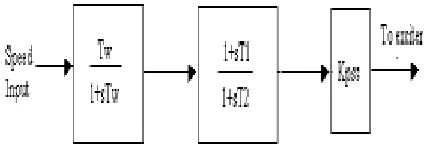
III. PARAMETER TUNING OF PSS PSSs are supplementary controllers in the excitation system. Main function of PSS to add damping to the generator rotor oscillations by controlling its excitation using auxiliary stabilizing signal. To provide damping, PSS must produce a component of electric torque in phase with the rotor speed deviation [7]. It involves a transfer function consisting of an amplification block, a wash out block, and a lead-lag block. Amplification block determines the amount of damping introduced by the PSS in terms of gain (Kpss) .Wash out block serves as high pass filter with time constant Tw . The lead-lag block provides the appropriate phase lead characteristics to compensate the phase lag between the exciter input and the generator electric torque with time constants T1 and T2. The structure of PSS used is illustrated in Fig(2).
Fig .2. PSS controller
The intention of PSS tuning is particularly for the damping of critical modes. Well designed PSS can provide damping over wide range of operating conditions. Based on the modern control theory, the design methods for PSS are well developed for single machine systems. But the design of PSS in multi machine system is much more complicate than that in single machine system. Commonly, the conventional tuning methods are always based on modal analysis and the process is shown as follows [1].The existing conventional approaches have some disadvantages .so this novel approach based on optimization is introduced.
IV. SIMULTANEOUS INTERCONNETED
TUNING OF PSS
Many researches were made on parameter tuning of PSS. Non-linear optimization based global tuning procedures are introduced for minimizing the interactions among the controllers in multi machine system. In this section, an optimization based method for the co-ordinated tuning of PSSs is presented.
The objective of the simultaneous parameter tuning is to globally optimize the overall system performance. This requires the simultaneous optimization and co-ordination of parameter settings of PSS controllers to maximize the damping of all modes of oscillations. Here parameters of each controller are determined by non-linear programming technique [8].The main procedure is as follows:
a) System linearization for analyzing the dominant modes of oscillations in large systems.
b) Allocation of controllers based on the participation factor method.
c) Using the parameter constrained Non-linear optimization to optimize the global system behavior.
This paper mainly focuses on the optimization based parameter setting of PSS. This simultaneous tuning is done by non-linear optimization algorithm using linearized system model.
4.1. Linearized system model
Once the optimal allocation of the controllers is chosen, the total system linearized system model extended by PSS can be derived and represented by the following equation: ∆ x = A∆ x + B ∆ u (1)
∆ y = C ∆ x + D∆ u
From (1), the Eigen values λi = σi ± jωi (for the mode i) of the total system can be evaluated. The proposed method is to search the best parameter sets of the of the PSS controllers, so that a comprehensive damping index (CDI) (2) can be minimized.
CDI =
∑
(
n
1 = i
1- ζi) (2)
Where ζi = -σ (if σ ± j ω are (σ2 + ω2) ½
Dominant roots) is the damping ratio and n is the total number of dominant Eigen values which include the local modes, inter area modes.
https://dx.doi.org/10.24001/ijaems.3.10.8 ISSN: 2454-1311 Maximization of damping ratio is carried out by moving the
considered Eigen values to the left in the optimization technique as shown in Fig.(3).
Fig.3: objective of optimization + Eigen value before optimization
* Eigen value after optimization
In order to minimize the comprehensive damping index, the non-linear optimization technique implemented in Matlab optimization technique is used.
4.2. Non-linear Optimization technique
The objective of the parameter optimization can be formulated as non-linear programming problem expressed as follows:
Min. f (z) = CDI (from equation 2)
S.t E (z) = 0 F (z) ≥ 0
where f (z) is the objective function defined. z is a vector, which consists of the parameters of PSSs have to be tuned. E (z) are the equality functions and F (z) are the inequality functions respectively. For this proposed method only the inequality functions which presents the parameter constraints of each controller are used [8].
The above mentioned method is a general parameter constrained non-linear optimization problem, which can be solved successfully by selecting appropriate function from the Matlab optimization tool box [9]. In order to select the function the objective function is derived in terms of PSS parameters [10]. The flowchart of the optimization based co-ordinated tuning algorithm is shown in Fig. (4)
The optimization begin with the pre-selected initial values of the PSS parameter z0.Then the non-linear algorithm is applied to tune the parameters of the controller iteratively until the objective function is minimized. These so determined parameters are the optimal settings of the
PSScontrollers.The proposed method permits considering several operating points of the system simultaneously. In this case, the CDI is calculated for each state successively and added to global CDI provided for the optimization algorithm.
Fig.4. Flowchart of Optimization
V. SIMULATION RESULTS
To verify the performance of the proposed tuning method, the algorithm is tested in a multi machine test system. Firstly the test system is evaluated without PSS controllers. The system is unstable as shown in Fig.(5)[rotor angle (radians) δ vs. time (sec)].
https://dx.doi.org/10.24001/ijaems.3.10.8 ISSN: 2454-1311
Rotor angle δ (radians) vs Time (sec) Fig.5:unstable system (without PSS)
After co-ordinated tuning, as shown in fig.(6),local modes and inter area modes of oscillations are now well damped. So this results demonstrates the improvement in damping of overall power oscillations in the system. The detailed controller parameters after optimization based co-ordinated tuning are shown in Appendix. A.
Fig.6. simulation result (after optimization based co-ordinated tuning)
VI. CONCLUSION
This is a novel approach for the simultaneous tuning of PSS controllers in multimachine system. The optimization algorithm is based on linearized power system model and parameter constrained non-linear optimization technique. Simulation results reveal that this proposed method effectively damp the system oscillations and the system become stable. This optimization based co-ordinted tuning is simple and easy to realize in large power system.
VII. APPENDIX
Table.1: Optimized controller parameters
Gen kpss T1 T2 Tw
1 12.0432 0.0010 0.010 10
2 38.064 0.0010 0.010 10
3 11.2791 0.0010 0.010 10
4 11.2792 0.0010 0.010 10
5 9.0056 0.0010 0.010 10
6 11.2792 0.0010 0.010 10
7 10.6075 0.0010 0.010 10
https://dx.doi.org/10.24001/ijaems.3.10.8 ISSN: 2454-1311 REFERENCES
[1] Y.Y.Hong.,W.C.Wu, “A new approach using optimization for tuning parameters of power system stabilizers”, IEEE trans. Energy conversion, vol .14, no. 3, pp 780-786,1999.
[2] P.Zhang, H.Coonick,”Co-ordinated Synthesis of PSS Parameters in multiachine powersystems using the method of inequalities applied to genetic algorithms” IEEE Trans.on Powersystems, vol.15, no.2, May 2000. [3] Z.Zhout,O.P.Maltiz, .S.Hope”Theory and method for
selection of power system stabilizer Location”IEEE Trans.on Energy conversion, vol.6, no.1, March 1991. [4] Y.Y.Hsu,L.Chen,”Identification of optimum location
for stabilizer Applications using participation factors”IEEE Proceedings-C, vol.134, no.3, pp238-244, May 1987.
[5] Padiyar. K.R., (2002), ‘Power system Dynamic stability and Control’ second edition, BS publication. [6] Anderson, P.M. and Fouad, A.A., (2003), ‘Power
system control and Stability’, vol.1, The Iowa state university press, Ames, IOWA, USA, Galgotia publication.
[7] Kundur.P,(1994),’Power System Stability and Control’, McGraw Hill Inc, New York.
[8] L.J.Cai, I.Erlich, “Simultaneous co- ordinated tuning of PSS and Facts Controller for damping power system oscillations in multi machine systems”, IEEE Trans.on Power systems, vol.5, no.1, 2002.