Effect of Constructive Leader Behaviors on R & D
Team Learning
Seçil SELÇUK1 and Hakan KİTAPÇI2
1 TÜBİTAK Marmara Research Center, Gebze, Kocaeli, TURKEY 2
Faculty of Business Administration, Gebze Technical University, Gebze, Kocaeli, TURKEY
Abstract
In today's increasingly competitive conditions, the need for business to have their own technology is increasing day by day. In business that strategically embraces the realization of R & D in their own right, the most important resource is human resources. Just from here, it was aimed to investigate the relationship between concepts that play a key role in R & D management in the enterprises, R & D team leader behavior and R & D teams' critical knowledge, experience and learning, in this study. In line with this objective, a study was conducted on the R & D employees working in public and private sectors. The analyzes of the study included data from 305 participants. Results show that team leader behaviors have positive and negative effects on R &D team learning. Interestingly; although task-oriented leadership behavior is positively related to team learning, there is almost no effect on team learning on either the positive or the negative side. It was detected that the leader's recognising and inspiring behaviors are positively related to team learning and have more positive influence specifically on continuous learning and capturing learning. Finally; it is seen that the demonstration of the leader's exemplary behavior is influential in continuous learning, inquiry and dialogue, and capturing learning of the team at the highest level. Keywords: R &D Team Leadership, Constructive Team Leader, Team Learning
1.INTRODUCTION
R & D team leader behaviors, which are related to concepts that play a key role in the management of successful R & D teams; Teams formed from the R & D members with high equipment and the information in question has features that can be managed in the best way, be described as a open leader in innovation and learning. Many years of research on leaders and managers have been described in many types of behavior (Bass, 1990, Yukl, 2006). Leader behaviors; task-oriented, relationship-oriented behavior as defined (eg, Blake and Mouton, 1982, Fleishman, 1953), the researchers then discovered that another different commodity categories, change-oriented behavior (Ekvall & Arvonen, 1991, Yukl, Gordon and Taber, 2002) . Although not fully defined in constructive leadership behaviors literature, it appears these behaviors in different leadership definition, such charismatic leadership (Waldman and Yammarino, 1999), transactional leadership, transformational leadership (Bass, 1985, Bucic et al., 2010, Pin Lu, 2010), and such. In his study, Yung-Pin Lu (2010) calls constructive behavior with conditional rewarding. In particular, research and development teams differ from classical teams and perform non-routine tasks. Team work in a study on R & D team work by Levi and Slem (1995); the ability to work in harmony with a number of people who have complementary abilities and share specific goals. In this study, many field technical skills are needed in R & D projects dealing with complex tasks; thus, the use of tools for challenging tasks has been suggested that different skills needed to be an inevitable necessity (Levi and Slem, 1995). Gupta et al., in its study (2013), noted that traditional leadership features could be partially implemented around R & D and developed a new leadership dimension for R & D teams.
The second of these concepts is learning; confronts with many different definitions (Fiol & Lyles, 1985, Senge, 1990a, Crossan et al., 1999, etc.). Crossan et al. (1999) distinguishes between the various organizational levels, and the institutionalization process distinguishes learning at the organizational level from learning at the individual and group level, which becomes the means by which the organization strengthens learning by individual members. Team learning is important for teams to work effectively together and learn how organizations manage their ever-changing environment (Senge, 1990a, Zaccaro, Ely and Shuffler, 2008). For this reason, teams are considered not only important work units but also important learning units within institutions (Caldwell and O'Reilley, 2003; Kirkman, Rosen, Tesluk and Gibson, 2004). When the literature is examined, there are many team learning definitions, such as; a process of continuous thinking and action that involves asking questions, taking feedback, experimenting, reflecting on results, discussing mistakes or unexpected outcomes of results (Edmonson, 1999). Crossan et al. (1999) and Vera and Crossan (2004) describe two processes that constitute team learning: feedback learning (exploitation type) and feedforward learning (exploration type).
Poole & Hollingshead, 2005, Vennix, 1996, Bontis et al., 2002, Marsick and Watkins, 2003, Haar et al., 2017). Nevertheless, there has been no study of the effects of R & D team leaders' behavior on R & D team learning, and it is necessary to investigate more deeply what their effects may be. In this study, to examine the effects of constructive leadership behaviors on learning in R & D teams, R & D team leader independent variables; "Task Oriented Behavior", "Recognising and Inspiring Behavior", "Empowering Behavior, "Leading by Example" determined from the scale developed by Gupta and Singh (2013) to measure R & D team leadership behaviors. Marsick and Watkins (2003) distinguish between the organizational layers at the individual, team and organizational levels; team level learning, processing of individual information in the group and transformation into results. In our study, team learning dependent variables; "Continuous Learning", "Inquiry and Dialogue" and "Capture Learning" determined to make use of the criteria established for measuring learning by Marsick and Watkins (2003).
From this point of view, this study has two main research objectives;
(1) determine the constructive leadership behaviors commonly applied in R & D teams and (2) explain how constructive leadership behaviors in R & D teams influence learning.
2.CONSTRUCTIVE LEADERSHIP BEHAVIORS AND R & D TEAM LEARNING MODEL
The theoretical model is given in Figure 1.
2.1. Effect of Task-Focused Leadership Behavior on R & D Team Learning
Task-oriented leadership behavior involves attitudes towards achieving an assignment, using human and material resources effectively, and ensuring that activities are carried out safely and regularly. Task-oriented behavior of the leader is grouped by Gupta and Singh, 2013 as follows: a) Clarifying; assigning tasks, giving instructions on how to do the work, and clearly describing job responsibilities, task objectives, deadlines and performance expectations; b) Problem Solving; to identify problems related to the business, to voice the problems and to make suggestions to improve them, and to act resolutely to implement solutions to resolve major problems or crises, c) Monitoring; to gather information about work and external conditions affecting their work, to check the progress and quality of work, to evaluate the performance of the individuals by making regular meetings, d) Buffering; serves as the main buffer between laboratories and teams to filter unnecessary administrative tasks to maintain staff time, while ensuring communication between laboratory and members. Barczak and Wilemon (1992) conducted a study on successful new product team leaders; the technical skills of the project leaders are determined by three key areas of competence: technical, human relations and management. Leadership technical skills contribute to the innovative performance of the project team, administrative skill also hinders innovation, and a moderate human relationship skill in addition to a highly innovative team (Farris, 1973) suggests that the impact of a more participatory leadership style on project performance is related to more innovation by the project team (Allen et al., 1980, Barnowe, 1975, Pelz and Andrews, 1966, Zachary and Krone, 1984).
Bucic et al. (2010) in their study; it is suggested that the transactional leadership style easily puts a rigid structure, rules and boundaries on employees, and refuses to integrate individual learning into team learning processes.
Continuous Learning;
Learning by creating opportunities is designed in such a way that people can learn on the job; ongoing training and development opportunities are provided. A study of multi-disciplinary emergency command control teams argues that team leaders need to initiate team learning processes at team meetings, particularly in constructive conflicts, to support organizing work and facilitate team learning (Haar et al., 2017).
Inquiry and Dialog;
Promote inquiry and dialogue – People gain competent reasoning skills to express people's views and the capacity to interrogate and question others' views; culture, inquiry, feedback and experimentation (Marsick & Watkins, 2003, Yung-Pin Lu, 2010). The sharing obtained through the integration of individual information leads to more actions for innovation applications. Interpreting and integrating, dialogues and conversations are both important for teams (Crossan et al., 1999). In dialogue, people discover problems from multiple perspectives. With continuous and active chats, common understanding and solutions for conflicts develop (Bontis et al., 2002, Lin et al., 2017).
Capturing Learning;
Create systems to capture and share learning - both high and low-tech systems are built and shared with business to share learning; access is provided; systems are protected. Some organizations systematically try to capture and place new learning in a way that will facilitate the widespread dissemination of this learning for both current and future employees.
provides multiple perspectives and produces enriched interpretations that are inputs for innovation (Crossan et al., 1999).
In the research on Barczak and Wilemon's (1992) successful new product development team leaders, they suggest that new product development teams have important mechanisms for creating and learning. Moreover, the ability to learn from the past can affect future project performance. In particular, Meyers and Wilemon (1989) show that while effective NPD teams search for and add information to previous projects, ineffective teams do not do this. Similarly, Maidique and Zirger (1984) state that team experiences with unsuccessful products can and should be used for the development of future products. Meyers and Wilemon (1989) have discovered in their work on the learning of the New Product Development (NPD) team that NPD teams often repeat mistakes. In other words, if learning is not captured within the team, it cannot be transferred to other projects or transferred to team members. Moreover, team leaders are discovered to be a more important tool than formal learning modes (eg, project reports, meetings) that NPD teams have from previous experiences (Barczak and Wilemon, 1992). The following hypotheses are suggested;
H1. Task-oriented behavior of the leader affects continuous learning in R & D teams positively. H2. Task-oriented behavior of the leader affects inquiry and dialogue in R & D teams positively. H3. Task-oriented behavior of the leader affects capturing learning in R & D teams positively.
2.2. The Impact of Recognizing and Inspiring Behavior on R & D Team Learning
Recognising and Inspiring (approver behavior); praise for special contributions, effective performance, and significant achievements, and an appreciation statement for one's contributions and special efforts. Encouragement of creativity and enthusiasm stands out as constructive leader behavior in the collective interpretation and integration of new knowledge with existing knowledge in order to appreciate the achievements of team members and facilitate team learning. Inspiration; the use of affective techniques that appeal to emotion or sense for compliance with work, commitment to goals, and co-operation, assistance, support, or resource requirements. Encouraging prospective learning can be effective in inspiring members, gaining trust and respect, and promoting a creative environment. Moreover, this approach is consistent with charismatic leadership as a sign of a transformational leader (Waldman and Yammarino, 1999). For this reason, the leader must be open-minded and create an environment of trust in which failures can be clearly shared. In real discovery, the leader also gets both positive and negative results without learning prospectively and is assertive.
Team learning is caused by interpersonal perceptions and interests; for example, the ambiguity between the work teams, the lack of experimentation, the acceptance of mistakes, or team practices (Edmonson, 1999). On the contrary, a sense of positive certainty and security can support research learning.
Affirmative behavior includes behavior that praises and appreciates others because of their effective performance, loyal advances, and their significant contribution to formal education (Yukl, 2002). Affirmative behavior may be in the form of praise, reward and award ceremonies. Supportive, collaborative and participatory leadership style is thought to encourage innovation in the business (technical and managerial innovation) rather than operational style of leadership (Kanter, 1983; Larsen et al., 1991, Montes et al., 2005). According to Yung-Pin Lu (2010) research, inspirational motivation of leader’s behaviour has a positive correlation with organizational actions to create continuous learning opportunities, raise people to a collective vision, connect the organization to the environment, promote cooperation and team learning and provides strategic leadership for learning. However, there is no statistically significant relationship between the leader's inspirational motivation and the promotion inquiry and dialogue. From here, the following hypotheses are suggested;
H4. The leader's recognising and inspirational behavior positively affects learning continuously in R&D teams. H5. The leader's recognising and inspirational behavior positively affects inquiry and dialogue in the R&D
teams.
H6. The leader's recognising and inspirational behavior positively affects capturing learning in the R&D teams.
2.3. The Impact of Empowerment Behavior on R & D Team Learning
Empowerment Behavior is to check with people before making changes that affect them, encourage improvement suggestions, invite participation in the decision making process, and involve others' ideas and suggestions in decisions. The conduct of business activities is to allow subordinates to have significant responsibility and discretion in handling issues and making important decisions.
their own decisions about their roles and responsibilities and how to solve specific problems (Barczak and Wilemon, 1992).
In Bucic et al.'s (2010) study, team leaders argue that team members' contributions to team decision-making are more critical by discussing the proposals within the team, thus endorsing their participation in the intellectual and intellectual decision-making process under the name of "empowerment". From here, the following hypotheses are suggested:
H7. Empowerment behavior of the leader positively affects learning continuously in R&D teams. H8. Empowerment behavior of the leader positively affects inquiry and dialogue in R & D teams. H9. Empowerment behavior of the leader positively affects capturing learning in R & D teams.
2.4. The Impact of Leading by Example Behavior on R & D Team Learning
Leading by Example Behavior of the leader is; to set high standards of behavior and intensive work and to lead as an example in punctuality, doing business, meeting deadlines and optimizing time. Yammarino (1999)’s study on the charismatic leader; the role model was used as a mechanism to carry out the staging process (Bass, 1985; Shamir, 1995; Yammarino, 1994), for example, Walt Disney, the CEO of Disney, a creative, innovative and risk-averse person, has encouraged others to encourage others to try new and different things. In the same study, it is expressed that the creative process enthusiasm is contagious and spreads to its employees, inspiring commitment and harmony among followers (Hughes et al., 1996). This encouraging behavior can be a good example of the impact on team learning.
In Barczak and Wilemon’s study (1992); he emphasized that an interesting difference between successful and less successful R & D project leaders is that less successful leaders are most concerned with the technical aspects of the project and that they cannot establish a connection and understanding between all aspects of a project's success. Moreover, these leaders may have faced very difficult problems, or they may not have the skills necessary to effectively manage their projects. On the contrary, successful leaders sharpen project objectives, integrate the contributions of other groups and succeed in developing an acceptable product for the target market(s). This result shows us that more effective leaders have a broader perspective on their own projects. It is acknowledged that your technological development alone does not lead to successful R & D projects (Barczak and Wilemon, 1992).
In line with organizational goals, the goals of R & D teams and team members are compatible and supported with leadership behaviors and transformed into team learning. In Bucic et al. (2010)'s study, it is suggested that the leader has an influence on the team and that model leadership behaviors are critical to team-level learning. From here, the following hypotheses are suggested:
H10. Leading by example behavior positively affects continuous learning in R & D teams. H11. Leading by example behavior positively affects inquiry and dialogue in R & D teams. H12. Leading by example behavior positively affects capturing learning in R & D teams.
3. RESEARCH METHODOLOGY AND DATA ANALYSIS 3.1 Procedure
In this research, 305 R & D employees who work in the public / private sectors have been participated.
Figure 1. Theoretical Model CONSTRUCTIVE LEADERSHIP
Task Oriented Behavior
Recognising and Inspiring Behavior
Empowering Behavior
Leading by Example
R & D TEAM LEARNING
Continuous Learning
Inquiry and Dialogue
The data were collected using questionnaires and most of the feedback from the questionnaires was collected face to face and the rest was collected electronically. Private sector organizations; was selected from among the organizations that carried out R & D activities in particular. The questionnaires were also sent to the registered organizations in Istanbul Chamber of Industry and R & D employees registered in Researcher Information System of Turkey (ARBIS) in electronic environment and returned.
3.2 Measurements
For the creation of scales in the questionnaire; Survey questions on constructive leadership behaviors were drawn from a new behavioral leadership measure developed by Gupta and Singh (2013) to measure R & D leadership behaviors in response to the needs of the R & D environment. Four different features have been dealt with for leadership behaviors.
For Team Learning Behaviors; Questionnaires were formed by taking the relevant parts of the measure created by Marsick and Watkins (2003). There are 3 different learning styles for team learning. For the measurement of the relationship between constructive leadership behavior in R & D teams and R & D team learning in the research, 12 hypotheses given in Chapter 2 are proposed.
Research analyzes were done using SPSS (Windows statistical program). Leader's constructive behavior and learning performance in R & D teams were evaluated on a Likert-type scale of 5 points: “1” "I strongly disagree”, "2" "I do not agree", "3" "I am undecided", "4" "I agree" and "5" "Absolutely I agree".
Table 1 shows Cronbach's alpha values (α) for all variables. As can be seen in the Table 1, all variables (with the exception of Empowering Behavior, α = .63) have a reliability higher than 0.7 with Cronbach's alpha. Cronbach's alpha value is a measure of reliability; this is between 0 and 1 with the values of 0.6 to 0.7 accepting the lower limit of acceptability (Hair et al., 1998).
Table 1. Reliability of Instruments Used
Construct Cronbach’s Alfa (α) Variables Number of Questions
Constructive Leadership Behaviour
,90 Task-Oriented Behavior (TOB) 10
,92 Recognising and Inspiring Behaviour (RIB) 6
,63 Empowering Behaviour (EB) 5
,87 Leading By Example Behaviour (LBEB) 5
R & D Team Learning
,94 Inquiry and Dialog (ID) 7
,94 Continuous Learning (COL) 6
,93 Capturing Learning (CAL) 6
3.3 Results
3.3.1 Descriptive Statistics
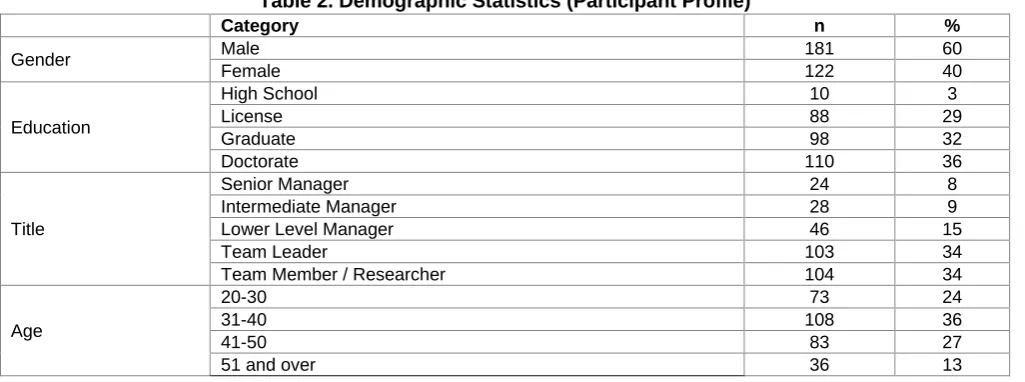
Approximately 400 R & D personnel were surveyed in face-to-face and electronic environment and 320 of them (80%) were available for the survey. From the answers we received, 15 responses were evaluated that were randomly selected. The number of valid returns accounted as 305, 76%. Table 2 shows the profile of 305 valid responses, and Table 3 shows the field of activity and industry of the institutions / organizations participating in the study. The institutions / organizations listed in Table 3 have a balanced distribution in public and private sectors. Looking at the sectoral distribution, it appears that many sectors engaged in R & D activities participate in the work.
Table 2. Demographic Statistics (Participant Profile)
Category n %
Gender Male 181 60
Female 122 40
Education
High School 10 3
License 88 29
Graduate 98 32
Doctorate 110 36
Title
Senior Manager 24 8
Intermediate Manager 28 9
Lower Level Manager 46 15
Team Leader 103 34
Team Member / Researcher 104 34
Age
20-30 73 24
31-40 108 36
41-50 83 27
Table 4 shows the mean and standard deviation of the investigated variables together with the correlation coefficients. Correlation coefficients given in Table 4 can also be used to test relationships between variables used in a search. Correlation coefficients (r-values) for various leadership behaviors are between 0.559 (p <.01) and 0.756 (p <.01), indicating moderate to high correlations.
Table 3. Demographic Statistics (Institution /Organization Information)
Category n %
Activity area Public Sector 160 52
Private sector 145 48
Sector
R & D 87 28,5
Chemistry 41 13,4
IT 19 6,2
Education 18 5,9
Construction / Building Products 18 5,9
Environment 13 4,3
Textile 12 3,9
Food 11 3,6
Automotive 11 3,6
Genetic 10 3,3
Material 9 2,9
Health 9 2,9
Medicine 8 2,6
Electronic 6 2,0
Defense 5 1,6
Energy 4 1,3
Nanotechnology 4 1,3
Plastic 4 1,3
Logistics / Transportation 3 1,0
Metal / Mining 3 1,0
White goods 2 0,7
Industry 2 0,7
Metrology 2 0,7
Machine 2 0,7
Other 2 0,7
As seen in Table 4, All four leadership behaviors showed significant positive relationships between r-values ranging from 0.429 (p <.01) and 0.250 (p <.01) to team learning at different levels.
Table 4. Correlation Coefficients and Descriptive Statistics
µ δ TOB RIB EB LBEB ID COL
1 Task-Oriented Behavior (TOB) 3,90 ,72
2 Recognising and Inspiring Behaviour (RIB) 3,74 ,90 ,756(**)
3 Empowering Behaviour (EB) 4,06 ,92 ,598(**) ,643(**)
4 Leading By Example Behaviour (LBEB) 3,93 ,82 ,635(**) ,692(**) ,559(**)
5 Inquiry and Dialog (ID) 3,56 1,11 ,306(**) ,344(**) ,294(**) ,347(**)
6 Continuous Learning (COL) 3,56 1,07 ,323(**) ,393(**) ,272(**) ,363(**) ,887(**)
7 Capturing Learning (CAL) 3,35 1,13 ,360(**) ,433(**) ,250(**) ,429(**) ,855(**) ,852(**) ** P< 0.01
3.3.2 Model Test
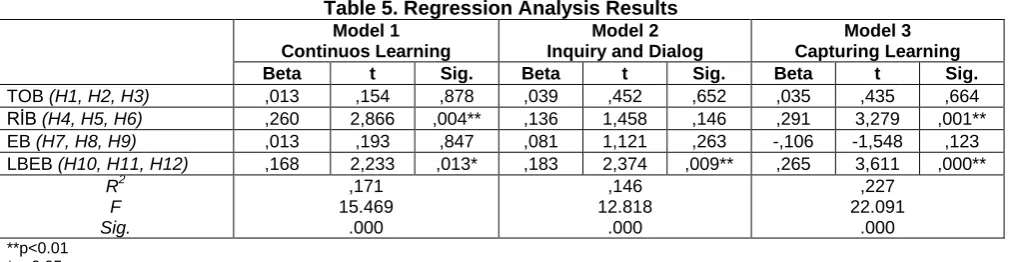
Regression analysis was conducted to test the effect of constructive leadership behaviors on R & D team learning (Table 5). Leader behaviors, which is considered as the independent variable, explain 17% of changes in the team's continuously learning (R2 = .171, F-value = 15.469, p = .000), 15% of changes in team learning through inquiry and dialog (R2 = .146, F-value = 12.818, p = .000), and 23% of changes in team’s capturing learning (R2 = .227, F-value = 22.091, p = .000), and the established model is meaningful.
Table 5. Regression Analysis Results Model 1
Continuos Learning
Model 2 Inquiry and Dialog
Model 3 Capturing Learning
Beta t Sig. Beta t Sig. Beta t Sig.
TOB (H1, H2, H3) ,013 ,154 ,878 ,039 ,452 ,652 ,035 ,435 ,664
RİB (H4, H5, H6) ,260 2,866 ,004** ,136 1,458 ,146 ,291 3,279 ,001**
EB (H7, H8, H9) ,013 ,193 ,847 ,081 1,121 ,263 -,106 -1,548 ,123
LBEB (H10, H11, H12) ,168 2,233 ,013* ,183 2,374 ,009** ,265 3,611 ,000**
R2
F Sig.
,171 15.469
.000
,146 12.818
.000
,227 22.091
.000 **p<0.01
*p<0.05
In Model 2, "Leading by Example Behavior" positively affects "Inquiry and Dialogue" (β = .183, p <0.01). Thus, our H11 hypothesis was supported.
In Model 3, “Recognising and Inspiring Behaviour” (β = .291, p <0.01) and "Leading by Example Behavior" (β = .265, p <0.01) positively affect “Capturing Learning”. H6 and H12 hypothesis were thus supported.
4. DISCUSSION
Today, organizations that make research and development work using internal resources expect R & D teams to develop product / technology developments that can sometimes be unique and leading in the industry and even in the world, and sometimes to develop high-end products. In this case, the features of the managers who are leading the R & D teams gain more importance. It is inevitable that leaders with such diverse characteristics are on the forefront of success. Certain aspects of managers who lead R & D teams have a positive impact on the success of the team, while others have a completely negative impact, even preventing the formation of the team and leading to individual achievements. R & D activities, especially for high technology products, consist of many subcomponents and require researchers / specialists from different disciplines within the team. The R & D teams established for this purpose; team leaders with different characteristics that are successful in technical and managerial sense are needed while being formed with technically successful researchers and equipped infrastructure. Along with the success of the R & D team leaders, it also reveals the necessity to examine their relationship with team learning in order to ensure the sustainability of the success achieved in the teams.
As the first hypothesis group in this study; it is suggested that the task-oriented behavior of the leader affects learning (Continuous Learning (H1), Inquiry and Dialogue (H2), Capturing Learning (H3)) positively in R & D teams. Based on the findings of the study, it is seen that task-oriented leadership behavior, which is known as traditional leader behavior from leadership behaviors, has no effect on three different dependent variables, namely continuous learning, inquiry and dialog and capturing learning (H1, H2 and H3 rejected) in R & D teams. The results of this study are consistent with the findings of Bucic et al. (2010)’s study (an easy on employees of transactional leadership style, solid structure, rules and limits imposed, and individual learning team has rejected the opportunity to integrate the learning process). Therefore, it can be said that realizing task-oriented leadership behaviors (clearly showing all the details of the work, avoiding the problems that may arise, preventing unnecessary costs from being delayed, monitoring progress, following up the results, providing financing resources) does not have an effect on R & D teams' learning, it cannot provide learning within the team by encouraging team cohesion or interaction, even if it can provide individual learning. Especially in businesses that see R & D as a key to competitiveness, it can be considered as a reason for the failure of managers to lead R & D teams to be purely task-oriented, and it is recommended that these behaviors be kept at a minimum level as much as possible.
Yung-Pin Lu (2010) also suggests that there is no statistically significant relationship between inspirational motivation and inquiry & dialogue.
The processes of capturing of learning include encouraging two-way communication between leaders and employees, providing the necessary resources, giving them access easily, giving the systems that employees can follow their performance continuously, measuring the results of education, the expected results to be reached can be determined again, and so on. It is suggested that these leadership behaviors can only be achieved through appreciative and inspirational behavior. Encouraging prospective learning can be effective in inspiring members, gaining trust and respect, and promoting a creative environment. Moreover, this approach is consistent with charismatic leadership as a sign of a transformational leader (Waldman and Yammarino, 1999). For this reason, the leader must be open-minded and allow failure; in real discovery, the leader also gets both positive and negative outcomes without learning from the future and is internalizing it.
Frequently mistakes can be repeated in new product development (NPD) teams, and if learning is not internalized within the team, it cannot be transferred to other projects or transferred to team members (Meyers and Wilemon, 1989). Moreover, it is emphasized that team leaders are a more important tool than formal learning modes (eg, project reports, meetings) that NPD teams have from previous experiences. The interest here is not what NPD teams learn, but what NPD team leaders have learned.
As the third hypothesis group in this study; it is suggested that the empowering behavior of the leader affects learning (Continuous Learning (H7), Inquiry and Dialogue (H8), Capturing Learning (H9)) positively in R & D teams. According to findings, empowering behavior does not affect learning in R & D teams (continuous learning (H7), inquiry and dialogue (H8), capturing learning (H9)).
In different studies on R & D project teams; where team members have contributed their ideas to the project, and where responsibility for making important decisions has been the best result of project teams (Powell and Posner, 1984), who wish to make their own decisions about their roles and responsibilities and how to solve specific problems (Barczak and Wilemon, 1992), suggest that Team Leaders (TMT) leaders' contributions to team- to be discussed more critically, and thus to approve their participation in the process of decision making, in the name of "empowerment", intellectually. Based on the findings of our study, it is seen that there is a weak positive relationship between the learning variables in the R & D teams and the leader empowerment behaviors when the correlation values are examined.
Team members can make decisions on their own, provide support and resources in solving their problems, consider proposals when decisions are taken, give their opinions a serious rest and give them a chance to express their views, and so on. An interaction environment is provided which, as a result of the empowerment behaviors, allows team members to be based on mutual interrogation, to listen to the mutual views of the team and to establish a trust-based relationship. However, it is important to keep the size of the empowerment behavior under control. Excessive empowering may lead to corruption of the team spirit and individual priorities within the team. Highly technical, competent and successful R & D team members may not able to make contributions at the top level of the team they are involved in, to prevent unity and cohesion among team members, such attitudes may cause the team and therefore the organization to fail. Uncovering the creative aspects of team members, realizing unity and cohesion at the highest level, making team members feel that the achievement achieved is the team's success, and targeting the achievement at the highest possible level constitute the leading features of the team leader.
As the fourth and final hypothesis group in this study; it is suggested that the leading by example behavior of the leader affects learning (Continuous Learning (H10), Inquiry and Dialogue (H11), Capturing Learning (H12)) positively in R & D teams. Analysis results show that the Leading by Example Behaviors exhibits a positive effect on all learning variables (H10, H11, and H12), it seems that there is a significant level of influence on capturing of learning: the ability of the R & D teams to gain from the successes of the successful outcomes, the sustainability of the achievements and the opportunities for experience and improvement it is possible that the team leader has internalized the learning of the team members, and the leader's example behaviors, for example the use of potential until the end, the hard work, the expertise, the positive and thoughtful accepting their own mistakes, not looking for a criminal, showing positive attitude, accepting them as if they are events and people, etc. it is important to create an environment in which employees can easily share.
Result
One of the most important factor in the success of R & D teams is; the results of the teams and their experiences can be transferred to the next studies and thus the learning of the sustainability of the successes. While some of the behaviors of leaders who manage R & D teams have a positive effect on the success of the team, some uncontrolled behaviors may have a completely negative effect, even preventing the formation of the team and underlining individual achievements. R & D activities consist of many subcomponents, especially for high technology products, and researchers from different disciplines are required to work together. R & D teams established for this purpose; it is necessary to have team leaders who are successful in technical and managerial sense from different directions, technically successful researchers and equipped infrastructure. Combining high-tech, successful R & D team members with expertise may not be sufficient for teamwork; these members may not be able to achieve the highest performance on the teams they are attending and may block the association between the team members, which may cause the team and therefore the R & D project and the organization to fail.
As a result; emphasizing the creative aspects of team members, achieving unity and harmony at the highest level, emphasizing that the way to success for team members is sharing experiences within the team, and aiming at the highest level of internalization so that the learning can be fully realized, and most importantly, to reduce task-oriented behaviors to the optimum level, R & D team leaders are at the forefront of their behavior.
Limitations
Findings must be carefully interpreted as a means of drawing attention to the limitations of this work. For example, by examining the impact of different dimensions of leadership behavior (such as destructive leadership behaviors) on the learning of R & D teams, it is possible to address R & D team leaders' behavior in all dimensions at the highest possible level.
REFERENCES
Allen, Thomas. J., Lee, Denis M. S., and Tushman, Michael L. (1980). R&D Performance as a Function of Internal Communication, Project Management, and the Nature of the Work, IEEE Transactions on Engineering Management 27, 2-12.
Arrow, H., McGrath, J. E., & Berdahl, J. L. (2000). Small groups as complex systems: Formation, coordination, development and adaptation. CA: Sage.
Barnowe, J. Thad, (1975). Leadership and Performance Outcomes in Research Organizations: The Supervisor of Scientists as a Source of Assistance, Organizationul Behavior and Human Performance 14, 264-280.
Barczak, G. ve Wilemon, D. (1992). Succesfull New Product Team Leaders, Industrial Marketing Management 21, 61-68. Bass, B. M. (1985). Leadership and performance beyond expectations. New York: Free Press.
Bass, B. M. (1990). Handbook of leadership: a survey of theory and research. New York: Free Press.
Blake, R. R., & Mouton, J. S. (1982). Management by grid principles or situationalism: which? Group and Organization Studies, 7, 207−210.
Bontis, N., Crossan, M.M. and Hulland, J. (2002). ‘Managing an organizational learning system by aligning stocks and flows’. Journal of Management Studies, 39: 4, 437–469.
Bucic, T., Robinson, L., Ramburuth, P. (2010). Effects of leadership style on team learning, Journal of Workplace Learning Vol. 22 No. 4, pp. 228-248.
Caldwell, D. F., & O’Reilley, C. A. (2003). The determinants of team-based innovation in organizations: The role of social influence. Small Group Research, 34(4), 497–517.
Aragon-Correa, J. A., Garcia-Morales, V. J., Cordon-Pozo, E., (2005).Leadership and organizational learning’s role on innovation and performance: Lessons from Spain.
Dechant, K., Marsick, V. J., & Kasl, E. (1993). Towards a model of team learning. Studies in Continuing Education, 15(1), 1– 14.
Crossan, M., Lane, H. and White, R. (1999). “An organizational learning framework: from intuition to institution”, Academy of Management Review, Vol. 24 No. 3, pp. 522-37.
Edmondson, A. C. (1999). Psychological safety and learning behaviour in work teams. Administrative Science Quarterly, 44(2), 350–383.
Ekvall, G., & Arvonen, J. (1991). Change-centered leadership: an extension of the two-dimensional model. Scandinavian Journal of Management, 7, 17−26.
Elkins, T. and Keller, R.T. (2003). “Leadership in research and development organizations:a literature review and conceptual framework”, Leadership Quarterly, Vol. 14 Nos 4/5,pp. 587-606.
Farris, G. (1973). The Technical Supervisor: Beyond the Peter Principle, Technology Review IS, 26-33. Fleishman, E. A. (1953). The description of supervisory behavior. Personnel Psychology, 37, 1−6.
Fiol, C. and Lyles, M. (1985), “Organizational learning”, Academy of Management Review, Vol. 10 No. 4, pp. 803-13. Gupta, V., Singh, S., Khatri, N., (2013). Creativity in research and development laboratories: A new scale for leader
Hair, J. F., Anderson, R. E., Tatham, R. L., & Black, W. C. (1998). Multivariate data analysis, Englewood Cliffs, NJ: Prentice-Hall.
Hughes, R. L., Ginnett, R. C., & Curphy, G. J. (1996). Leadership: Enhancing the lessons of experience. Boston: Irwin/McGraw-Hill.
Homan, T. (2001). Teamleren: Theorie en facilitatie. Schoonhoven: Academic service. Kanter, R.M., (1983). The Change Masters, Simon and Schuster, New York.
Kirkman, B. L., Rosen, B., Tesluk, P. E., & Gibson, C. B. (2004). The impact of team empowerment on virtual team performance: The moderating role of face to face interaction. Academy of Management Journal, 46(2), 1–15. Larsen, H.H., O’Driscoll, M.P., Humphries, M., (1991). Technological innovation and the development of managerial
competencies. Technovation 11(7), 419–428.
Levi, D., and C.Slem (1995). Team work in research and development organizations: The characteristics of successful teams. International Journal of Public Administration,15, 1757-1801 (October).
Lin, C., Sanders, K., (2017). HRM and innovation: a multi-level organisational learning perspective, Human Resource Management Journal, Vol 27, no 2, pages 300–317.
Liu, S., Schuler, R. S., Zhang, P., External learning activities and employee creativity in Chinese R&D teams, Cross Cultural Management Vol. 20 No. 3, 2013, pp. 429-448.
Lu, Yung-Pin, (2010). The Relationship Between Leaders’ Behaviors & Organizational Learning Actions, MARIAN UNIVERSITY, Doctoras Thesis.
Maidique, Modesto, and Zirger, Billie Jo, A Study of Success and Failure in Product Innovation: The Case of the U.S. Electronics Industry, IEEE Transactions on Engineering Management 31, 192-203 (1984).
Marsick, V. J., & Watkins, K. E. (2003). Demonstrating the value of an organization's learning culture: This dimensions of the learning organization questionnaire. Advances in Developing Human Resources, 5(2), 132-151.
Meyers, P., and Wilemon, D., (1989). Learning in New Technology Development Teams, The Journal of Product Innovation Management 6, 79-88.
Montes, F.J.L, Moreno, A.R., Morales, V.G., (2005). Influence of support leadership and teamwork cohesion on organizational learning, innovation and performance: an empirical examination, Technovation 25, 1159–1172. Pelz, D., and Andrews, F., (1966). Scientists in Organizations. John Wiley, New York.
Poole, M. P., Hollingshead, A. B., McGrath, J. E., Moreland, R. L., & Rohrbaugh, J. (2004). Interdisciplinary theoretical perspectives on small groups. Small Group Research, 35, 3–15.
Powell, G., Posner, B., (1984). Excitement and Commitment: Keys to Project Success, Project Management Journal xx, 39-46.
Senge, M. (1990a). The leader’s new work: Building learning organizations. Sloan Management Review, 32(1), 7–23. Senge, M. (1990b). The fifth discipline: The art and practice of the learning organization. New York: Currency Doubleday. Senge, P., Roberts, C., Ross, R. B., Smith, B. J., & Kleiner, A. (1994). The fifth discipline fieldbook. New York’ Doubleday
Publ.
Haar, S., Koeslag-Kreunen, M., Euwe, E., Segers, M., (2017). Team Leader Structuring for Team Effectiveness and Team Learning in Command-and-Control Small Group Research, Vol. 48(2) 215–248.
Shamir, B. (1995). Social distance and charisma: Theoretical notes and an exploratory study. Leadership Quarterly, 6: 19-47.
Tushman, M. L., & Nadler, D. A. (1986). Organizing for innovation. California Management Review, 28(3), 74–92.
Waldman, D.A., Yammarino, F.J., (1999). CEO Charismatic Leadership: Levels-of-Management and Levels-of-Analysis Effects, Academy of Management Review, Vol. 24, No. 2, 266-285.
Vennix, J. A. M. (1996). Group model building: Facilitating team learning using system dynamics. Chichester, U.K.: Wiley. Vera, D. and Crossan, M. (2004), “Strategic leadership and organizational learning”, Academy of Management Review, Vol.
29 No. 2, pp. 222-40.
Yammarino, F. J. (1994). Indirect leadership: Transformational leadership at a distance. In B. M. Bass and B. J. Avolio (Eds.), Improving organizational effectiveness through transformational leadership: 26-47. Thousand Oaks, CA: Sage.
Yukl, G. (2002). Leadership in Organizations (5th ed.). New Jersey: Prentice Hall.
Yukl, G. (2006). Leadership in organizations, 6th edition Upper Saddle River, NJ: Prentice Hall.
Yukl, G., Gordon, A., & Taber, T. (2002). A hierarchical taxonomy of leadership behavior: integrating a half century of behavior research. Journal of Leadership and Organization Studies, 9(1), 15−32.
Zaccaro, S. J., Ely, K., & Shuffler, M. (2008). The leader’s role in group learning. In V. Sessa, & M. London (Eds.), Work group learning. Understanding, improving & assessing how groups learn in organizations (pp. 15–44). Mahwah, NJ: Lawrence Erlbaum Associates.