Original Research Article
Medication non-adherence related to patients’ attitudes and knowledge
rather than socio-cultural factors: a study of cardiac clinic attendees
at a public healthcare institute
Mandreker U. Bahall*
INTRODUCTION
Non-adherence to medication regimens could effectively
reduce positive outcomes.1 The cost of non-adherence in
the USA is approximately $105.4 billion annually.2
Patients might make a conscious decision to avoid filling a prescription (primary non-adherence) or taking medication when available (secondary non-adherence). Previous studies conducted in several centres in various
countries identified the following reasons for
non-adherence: unavailability, prescription inadequacy,
inaccessibility, lack of social support, medication
concerns, miscommunication,generic alternatives, being
tired of taking the medication, side effects,
treatment/regimen complexity, economic factors, and
health illiteracy.3-8 However, reasons vary between
settings. This study identified reasons for non-adherence and associations with selected factors in patients with
ABSTRACT
Background: Medication non-adherence contributes significantly to sub-optimum care, for reasons that could be unique to specific localities. The study sought to identify reasons for non-adherence and associated factors in cardiac clinic attendees at a leading tertiary health institution in Trinidad and Tobago.
Methods: This cross-sectional study included a convenience sample of cardiac clinic attendees. The data collection instrument was a questionnaire comprising items regarding socio-demographic characteristics, medical history, social support and reasons for medication non-adherence. Data were collected between March and July, 2016. Non-adherence was identified with total scores of >1 using selected similar questions to that used in the Morisky four-item adherence instrument. Data analyses involved both descriptive and inferential methods.
Results: Non-adherent patients represented the largest proportion of participants (n=270, 78.3%). Participants were predominantly women, aged >50 years, of Indo-Trinidadian descent, married, and unemployed. Carelessness (n=251, 93.0%), ceasing medication use when feeling well (n=217, 80.4%), forgetfulness (n=187, 69.3%), and ceasing medication use when feeling worse (n=151, 50.6%) were the leading reasons for non-adherence, followed by unpleasant effects of medication and cost (n=144, 53.3%). Associated factors included feeling that one would become more ill upon ceasing medication use (p=0.003), the importance of understanding the reasons for taking medication (p=0.017), the importance of following physicians’ instructions (p=0.023), and educational level (p=0.040).
Conclusions: Effective communication regarding patients’ concerns and potential adverse medication effects between patients and healthcare providers could promote greater adherence.
Keywords: Medication non-adherence, Cardiac patients, Reasons for non-adherence
School of Medicine and Arthur Lok Jack Graduate School of Business, University of the West Indies, St. Augustine, Trinidad and Tobago
Received: 19 November 2018
Revised: 10 January 2019
Accepted: 11 January 2019
*Correspondence:
Dr. Mandreker U. Bahall,
E-mail: [email protected]
Copyright: © the author(s), publisher and licensee Medip Academy. This is an open-access article distributed under the terms of the Creative Commons Attribution Non-Commercial License, which permits unrestricted non-commercial use, distribution, and reproduction in any medium, provided the original work is properly cited.
cardiac disease in a public health care institution. The identification of adherence gaps could facilitate medication adherence.
METHODS
Participants
A cross-sectional, descriptive study was conducted, and data were collected by trained medical students between 1 March and 31 July 2016 at a public health institution, the San Fernando General Hospital, which is a 745-bed hospital with a medical admission rate of approximately 33%; approximately 15% of these admissions were for
cardiac disease. The institution serves half the population of Trinidad or approximately 600,000 people. Medical admissions account for a total of approximately 1,400 patients per month, of which 15 to 20% have cardiac diseases involving mainly unstable angina, arrhythmia, heart failure, or valvular heart disease. A single institution was chosen, as cardiac disease prevalence is similar across hospitals.
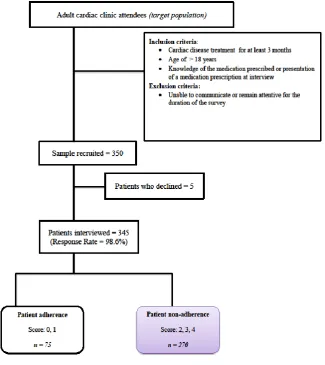
All cardiac clinic patients receiving treatment were eligible to participate in the study. A convenience sample of 350 cardiac clinic attendees, for which the size was determined via methods described by Lwanga et al, was recruited, with a 5% margin of error (Figure 1).9
Figure 1: Recruitment process.
To complete the list of cardiac clinic attendees, systematic quota sampling was performed, with every tenth patient on a list of adult cardiac clinic attendees with an appointment the following day selected and contacted on the afternoon prior to attendance. Contacted patients were offered the option to participate voluntarily after the nature of the study was discussed. Patients who declined were not replaced. Consenting patients were asked to bring their medication or prescription sheets to
obtained from the ethics committees at the South–West Regional Health Authority.
Data collection tool
The data collection instrument was a pre-tested (for content, readability, design and comprehension) 126-item questionnaire. Selected items of interest included selected socio-demographic variables (nine items: age, sex, ethnicity, marital/civil status, employment status, monthly income, highest level of education, duration of clinic attendance, and the period during which patients knew that they had a heart condition); medical history (30 items); patient support mechanisms (four items); patient perspective/ information /knowledge (eight items); medication non-compliance because of medication/health issues (eight items), personal issues (18 items), social/cultural/economic issues (eight items), healthcare provider issues (five items), and compliance (six items); general information (six items); and lifestyle-related factors (five items). Patient’s response to many questions were ‘Yes’ or ‘No’. Included among these questions were similar questions used in the Morisky Medication Adherence Scale (MMAS-4). The questions selected as reasons for noncompliance dealt with ‘forgetfulness’, ‘carelessness’, ‘feeling well and does not need medication’ and ‘feeling worse or experiencing unpleasant effects or complications’. Though questions
are not identical they carry a similar meaning in our local population. A score of 0 was assigned to a ‘Yes’ response (or adherence), and a score of 1 was assigned to a ‘No’ response (non-adherence). Maximum total summed scores ranged from 0 to 4. The MMAS-4 which utilises similar scoring has been used to assess medication adherence in similar studies.10 The non-adherent patients identified as having total scores of >1 (or scores of 2, 3, and 4) were interviewed to determine their reason or reasons for non-adherence in a local setting.
All collected data were entered into a secure database, which was accessible to the researcher, statistician, and assistants. In the data analyses, both descriptive and inferential statistics were obtained using chi-squared tests with a significance level of p<0.05. Data were analysed using SPSS 21 (IBM).
RESULTS
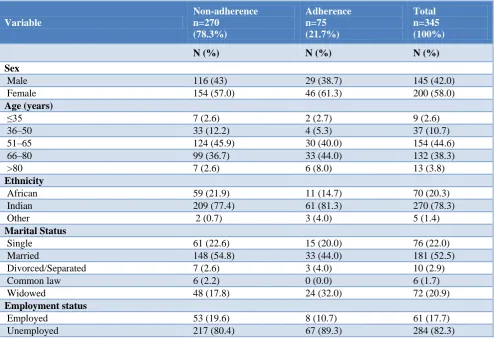
In total, 345 patients were included in the analyses (valid response rate=98.6%). Participants’ mean age was 61.2 (SD=11.27) years. The socio-demographic characteristics of non-adherent, adherent, and all patients are shown in Table 1. The proportion of non-adherent patients was 78.3% (n=270). These patients were mainly severely non-adherent (73.7%), with scores of 3 (45.2%), 4 (28.5%), and 26.3% of patients had a score of 2.
Table 1: Patients’ socio-demographic characteristics (n=345).
Variable
Non-adherence n=270
(78.3%)
Adherence n=75 (21.7%)
Total n=345 (100%)
N (%) N (%) N (%)
Sex
Male 116 (43) 29 (38.7) 145 (42.0)
Female 154 (57.0) 46 (61.3) 200 (58.0)
Age (years)
≤35 7 (2.6) 2 (2.7) 9 (2.6)
36–50 33 (12.2) 4 (5.3) 37 (10.7)
51–65 124 (45.9) 30 (40.0) 154 (44.6)
66–80 99 (36.7) 33 (44.0) 132 (38.3)
>80 7 (2.6) 6 (8.0) 13 (3.8)
Ethnicity
African 59 (21.9) 11 (14.7) 70 (20.3)
Indian 209 (77.4) 61 (81.3) 270 (78.3)
Other 2 (0.7) 3 (4.0) 5 (1.4)
Marital Status
Single 61 (22.6) 15 (20.0) 76 (22.0)
Married 148 (54.8) 33 (44.0) 181 (52.5)
Divorced/Separated 7 (2.6) 3 (4.0) 10 (2.9)
Common law 6 (2.2) 0 (0.0) 6 (1.7)
Widowed 48 (17.8) 24 (32.0) 72 (20.9)
Employment status
Employed 53 (19.6) 8 (10.7) 61 (17.7)
Variable
Non-adherence n=270
(78.3%)
Adherence n=75 (21.7%)
Total n=345 (100%)
N (%) N (%) N (%)
Monthly income (Trinidad & Tobago Currency)
Under $3,000 86 (31.9) 15 (20) 101 (29.3)
$3,000–5,000 1175 (64.8) 59 (78.7) 234 (67.8)
>$5,000 9 (3.3) 1 (1.3) 10 (2.9)
Highest educational level
Below primary school 8 (3.0) 5 (6.7) 13 (3.8)
Primary school 178 (65.9) 58 (77.3) 236 (68.4)
Secondary school 69 (25.6) 9 (12.0) 78 (22.6)
Tertiary education 15 (5.6) 3 (4.0) 18 (5.2)
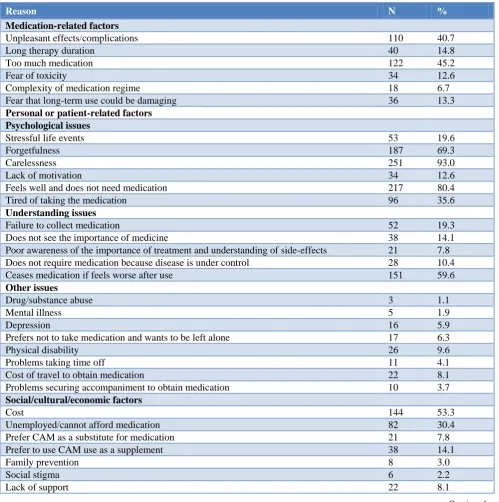
Table 2: Reason for medication non-adherence (n=270).
Reason N %
Medication-related factors
Unpleasant effects/complications 110 40.7
Long therapy duration 40 14.8
Too much medication 122 45.2
Fear of toxicity 34 12.6
Complexity of medication regime 18 6.7
Fear that long-term use could be damaging 36 13.3
Personal or patient-related factors Psychological issues
Stressful life events 53 19.6
Forgetfulness 187 69.3
Carelessness 251 93.0
Lack of motivation 34 12.6
Feels well and does not need medication 217 80.4
Tired of taking the medication 96 35.6
Understanding issues
Failure to collect medication 52 19.3
Does not see the importance of medicine 38 14.1
Poor awareness of the importance of treatment and understanding of side-effects 21 7.8
Does not require medication because disease is under control 28 10.4
Ceases medication if feels worse after use 151 59.6
Other issues
Drug/substance abuse 3 1.1
Mental illness 5 1.9
Depression 16 5.9
Prefers not to take medication and wants to be left alone 17 6.3
Physical disability 26 9.6
Problems taking time off 11 4.1
Cost of travel to obtain medication 22 8.1
Problems securing accompaniment to obtain medication 10 3.7
Social/cultural/economic factors
Cost 144 53.3
Unemployed/cannot afford medication 82 30.4
Prefer CAM as a substitute for medication 21 7.8
Prefer to use CAM use as a supplement 38 14.1
Family prevention 8 3.0
Social stigma 6 2.2
Lack of support 22 8.1
Reason N %
Healthcare provider factors
Poor patient-physician communication 40 14.8
Language/jargon barrier 46 17.0
Insufficient explanation of medication regimen 44 16.3
Insufficient time with doctor to understand medication regimen 48 17.8
Difficulty understanding information 28 10.4
Overwhelmed with leaflet information 8 3.0
Lack of confidence in prescribing doctor 40 14.8
Healthcare system factors
Lifestyle change required 26 9.6
Unavailability of medication 31 11.5
Note. CAM = complementary and alternative medicine.
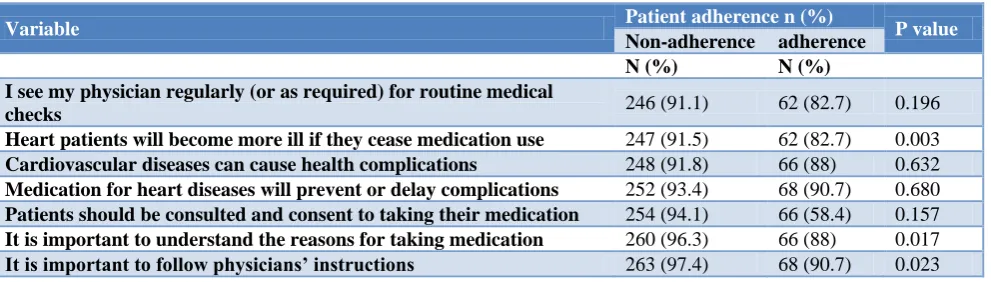
Table 3: Patient attitudes and adherence.
Variable Patient adherence n (%) P value
Non-adherence adherence
N (%) N (%)
I see my physician regularly (or as required) for routine medical
checks 246 (91.1) 62 (82.7) 0.196
Heart patients will become more ill if they cease medication use 247 (91.5) 62 (82.7) 0.003
Cardiovascular diseases can cause health complications 248 (91.8) 66 (88) 0.632
Medication for heart diseases will prevent or delay complications 252 (93.4) 68 (90.7) 0.680
Patients should be consulted and consent to taking their medication 254 (94.1) 66 (58.4) 0.157
It is important to understand the reasons for taking medication 260 (96.3) 66 (88) 0.017
It is important to follow physicians’ instructions 263 (97.4) 68 (90.7) 0.023
Reasons for non-adherence
The reasons for non-adherence provided by patients were classified into five categories: personal or patient-related, medication-related, social/cultural/economic, healthcare provider, and healthcare system factors. Of these, carelessness, ceasing medication use when feeling well, forgetfulness, and ceasing medication use when feeling worse were the leading reasons for non-adherence (Table 2). Other common reasons included cost and having to take too much medication. Several patients claimed that being tired of taking their medication led to their non-adherence, while others attributed it to unpleasant effects and/or complications.
Associations
There were no associations between patient adherence and age (p=0.077); sex (p=0.597); ethnicity (p=0.052); monthly income (p=0.071); social support from spouse (p=0.214), family/children (p=0.194), friends (p=0.589), or caregiver (p>0.217); self-assessment of medication compliance, which was described as good (n=161; 59.6%), very good (n=87; 32.2%) or poor (n=22; 8.1%; p=0.293); social status (p=0.171) or self-reported health status (p=0.354). However, patient adherence was
associated with educational level (p=0.040) andpatients’
attitudes or knowledge. Non-adherence was significantly associated with the feeling that one would become more ill upon ceasing medication use, the importance of
understanding the reasons for taking medication, the importance of following physicians’ instructions, and educational level (Table 3).
DISCUSSION
The proportion of non-adherent patients in the cardiac disease clinic was 78.3%, based on scores of >1 (i.e. scores of 2, 3 and 4). This proportion is rather high, but similar findings have been reported in many countries
including Yemen (54.2%) and Malaysia (74.0%).10,11
Further,Mujtaba et al showed that 72.7% of patients with
heart failure were non-compliant with medication,Desai et al. reported that more than 50% of patients with coronary artery disease did not adhere to their prescribed therapies, and Sundbom et al reported that 66.4% of participants using prescription medication were non-adherent to their prescribed regimens.12,13 In the current study, non-adherent patients were predominantly women, aged 51–65 years, earned a monthly household income of $3,000–5,000 (Trinidad and Tobago dollars), and were educated up to primary school level. Maan et al. reported a similar profile for non-adherent patients, who were mainly younger, women (72%), married (60%), and less well educated (28%) with low socio-economic status (54%).14
factors. This is similar to the classification proposed by Frances et al. who categorized the reasons for non-adherence in elderly patients into patient, medication, healthcare provider, and socio-economic factors.15 All patients identified personal factors as contributory to non-adherence. The most common reasons reported by Santra et al., who examined non-adherence in patients with ischaemic heart disease but to a lesser extent, were carelessness, ceasing medication use when feeling well, forgetfulness, and ceasing medication because of feeling worse upon use.16 Moreover, lack of understanding of medication use was reported by Mujtaba et al, who found that 15.5% of patients do not feel the need to take medication.3 Less common patient factors identified in the current study included access challenges, such as physical disability; problems getting time off; travel costs; and difficulty finding someone to accompany patients.
Medication-related factors
Less common medication-related factors included long therapy duration, fear of toxicity, lifestyle changes, feeling overwhelmed with leaflet information, and
difficulty understanding information. Medication
characteristics, including pill appearance (colour and shape) and compliance,were not analysed in this study because of the relatively small sample size.17 However, pill characteristics, such as changes in colour and shape, have been reported to improve adherence.17 In addition, knowledge of side effects, which is a major barrier to compliance with dosing regimens; fear of dependence; feeling stigmatized by one’s disease; and having no
medicine or running out of medicinehave been found to
lead to non-adherence.18-20
Healthcare provider factors
The results showed that non-adherence was related to poor patient-physician communication, language/jargon barriers, insufficient explanation of medication regimens, and insufficient time with doctors to understand medication regimens. This is consistent with the findings of similar studies. In addition, side effects, lack of understanding of benefits, lack of education regarding
medication, distance from the hospital, and poor
physician communicationhave been associated with
non-adherence.21-23
Social, cultural, and economic factors
In addition to cost and unemployment, family prevention, lack of support, social stigma, and a preference for complementary and alternative medicine contributed to non-adherence. Ganasegeran et al. reported that a preference for traditional medicine was associated with medication non-adherence in survivors of myocardial infarction.11 Further, inadequate prescriptions (20.2%), financial issues (15.5%), medication cost,social stigma, and family support have been associated with improved medication adherence in patients with heart failure.3,24-27
Health system factors
Few patients reported that unavailability of medication or a requirement for lifestyle changes resulted in non-adherence. However, with the lack of public health facilities and infrastructure in the country, along with the considerable number of complaints regarding the health service,one would expect these factors to contribute to non-adherence.28 This finding is inconsistent with the findings reported by Al Hamid et al, who showed relationships between adherence and the source and availability of medication, easy accessibility, and patient satisfaction with healthcare providers.29
Associations
With the exception of educational level, socio-demographic factors (e.g. age, ethnicity, marital status, social suppport, and employment status) were not significantly associated with medication adherence. With respect to social support, this finding could have occurred because of the unreliability or unavailability of support. Some studies have reported a direct relationship between the receipt of practical support and the extent of medication adherence.30-32 Non-adherence to medication was associated with patients’ attitudes, knowledge, and educational levels. Other factors contributing to adherence, such as patients’ belief that they would become more ill if they ceased medication use, the importance of understanding the reasons for taking medication, and the importance of following physicians’ instructions, were reported by Lan et al, who showed that compliance was positively correlated with patients’
attitudes toward treatment.33 Knowledge was also a
determinant of medication adherence, as reported by Van der Waland et aland Hope et al.34,35
Limitations
This study relied heavily on participants’ recall, which could have resulted in over- or under-estimation of medication use. In addition, the sample size was too small to allow analysis of sub-groups of cardiac patients. The selection of only cardiac patients from a single institution limited the generalizability of the findings to other centres and patients with other diseases. However, in Trinidad and Tobago, patients’ behaviour is consistent across diseases and locations, and similar findings could be observed throughout the country and for other diseases.
CONCLUSION
Recommendations
A multi-pronged approach involving practices such as training physicians in communication skills, addressing patients’ concerns and potential adverse effects of drugs, and increasing patient empowerment, is required to improve adherence.
ACKNOWLEDGEMENTS
I wish to acknowledge the medical students Kristian Sookram and Kesley Rampersad who assisted with data collection, and the participants who gave their time to participate in the study.
Funding: No funding sources Conflict of interest: None declared
Ethical approval: The study was approved by the
Institutional Ethics Committee at the South–West
Regional Health Authority
REFERENCES
1. Leporini C, De Sarro G, Russo E. Adherence to
therapy and adverse drug reactions: is there a link? Expert Opin Drug Saf. 2014;13(Suppl. 1):S41-S55.
2. Avoidable costs in US health care. IMS Institute for
Healthcare Informatics, 2013. Available at
http://offers.premierinc.com/rs/381-NBB-525/ images/Avoidable_Costs_in%20_US_Healthcare-IHII_AvoidableCosts_2013%5B1%5D.pdf. Accessed 9 April 2018.
3. Mujtaba S, Masood T, Saad M. Reasons of medical
noncompliance in heart failure patients. Pakistan Heart J. 2010;43(3-4).
4. Kronish IM, Ye S. Adherence to cardiovascular
medications: lessons learned and future directions. Prog Cardiovasc Dis. 2013;55(6):590-600.
5. Bosworth HB. Enhancing medication adherence: the
public health dilemma. Available at:
http://www.springer.com/cda/content/document/cda _downloaddocument/9781908517470-c2.pdf?
SGWID=0-0-45-1461128-p174690395. Accessed
13 April 2018.
6. Hekmatpou D, Mohammadi E, Ahmadi F, Arefi SH.
Noncompliance factors of congestive heart failure patients readmitted in cardiac care units. Iranian J Critical Care Nursing Fall. 2009;2(3):91-7.
7. Kolandaivelu K, Leiden BB, O’Gara PT, Bhatt DL.
Non-adherence to cardiovascular medications. Eur Heart J. 2014;35:3267-76.
8. Mujtaba SF, Masood T, Khalid D. Personal and
social factors regarding medical non-compliance in cardiac failure patients. J College Physicians Surgeons Pak. 2011;21(11):659-61.
9. Lwanga, SK, Lemeshow S, World Health
Organization. Sample size determination in health studies: a practical manual. Geneva: World Health Organization; 1991.
10. Alakhali KM, Daniel PS, Noohu AM, Sirajudeen
SA. Patient medication adherence and physician prescribing among congestive heart failure patients of Yemen. Indian J Pharm Sci. 2013;75(5):557–62.
11. Ganasegeran K, Rashid A. The prevalence of
medication non-adherence in post-myocardial
infarction survivors and its perceived barriers and psychological correlates: a cross-sectional study in a cardiac health facility in Malaysia. Patient Preference and Adherence. 2017;11:1975-85.
12. Desai N, Choudhry N. Impediments to adherence to
post myocardial infarction medications. Current Cardiol Rep. 2012;15(1):1.
13. Sundbom LT, Bingefors K. Women and men report
different behaviours in, and reasons for medication non-adherence: a nationwide Swedish survey. Pharm Pract. 2012;10(4):207-21.
14. Maan CG, Munnawar Hussain MS, Heramani N,
Lenin RK. Factors affecting non-compliance among psychiatric patients in the Regional Institute of Medical Sciences, Imphal. IOSR J Pharm. 2015;5(1):1-5.
15. Frances A, Thirumoorthy T, Kwan YH. Medication
adherence in the elderly. J Clin Gerontol Geriatrics. 2016;7(2):64-7.
16. Santra G. Assessment of adherence to
cardiovascular medicines in rural population: an observational study in patients attending a tertiary care hospital. Indian J Pharmacol. 2015;47(6): 600-4.
17. Kesselheim AS, Bykov K, Avorn J, Tong A,
Doherty M, Choudhry NK. Burden of changes in pill appearance for patients receiving generic
cardiovascular medications after myocardial
infarction: cohort and nested case-control studies. Ann Intern Med. 2014;161(2):96-103.
18. Ehrlich S, Newkirk T, Pallas S, Riedinger T,
Jackson D. Why are patients with chronic disease nonadherent with their prescription medications? Presented at the American Academy of Physician Assistants 2017 conference, 2017. Available at https://www.clinicaladvisor.com/aapa-2017-annual- meeting/side-effects-affect-nonadherence-in-patients-with-chronic-disease/article/662649/. Accessed 23 April 2018.
19. Ferdinand KC, Senatore FF, Clayton-Jeter H, Cryer
DR, Lewin JC, Nasser SA, et al. Improving medication adherence in cardiometabolic disease. J Am Coll Cardiol. 2017;69(4).
20. Martin M, Kohler C, Kim Y, Kratt P, Schoenberger
Y, Litaker M, et al. Taking less than prescribed: medication nonadherence and provider-patient relationships in lower-income, rural minority adults with hypertension. The Journal of Clinical Hypertension 2010;12(9):706-13.
21. Bener A, Dafeeah EE, Salem MO. A study of
22. Sharma AK, Gupta R, Tolani SL, Rathi GL, Gupta HP. Evaluation of socioeconomic factors in
noncompliance in renal transplantation.
Transplantation Proceedings. 2000;32(7):1864.
23. Zolnierek KBH, DiMatteo M. Physician
communication and patient adherence to treatment. Med Care. 2009;47(8):826-34.
24. Dhaliwal KK, King-Shier K, Manns BJ,
Hemmelgarn BR, Stone JA, Campbell DJT. Exploring the impact of financial barriers on secondary prevention of heart disease. BMC Cardiovascular Disorders. 2017;17:61.
25. Chandra IS, Kumar KL, Reddy MP, Kumar Reddy
CMP. Attitudes toward medication and reasons for non-compliance in patients with schizophrenia. Ind J Psycholog Med. 2014;36(3)294-8.
26. Sharif SA, Ogunbanjo GA, Malete NH. Reasons for
non-compliance to treatment among patients with psychiatric illness: a qualitative study. South African Family Pract. 2003;45(4)10-3.
27. Rosland AM, Heisler M, Choi H, Silveira MJ, Piette
JD. Family influences on self-management among functionally independent adults with diabetes or heart failure: do family members hinder as much as they help? Chronic Illn. 2010;6(1):22-33.
28. Gaffoor G, Hosein W, Pilgrim Y, Wilson G,
Frankson G. Report of the Commission of Enquiry into the Operation and Delivery of Public Health Care Services in Trinidad and Tobago. Port of Spain: Ministry of Health, 2007.
29. Al Hamid AM, Ghaleb M, Aljadhey H, Aslanpour
Z. Factors contributing to medicine-related
problems in adult patients with diabetes and/or cardiovascular diseases in Saudi Arabia: a qualitative study. BMJ Open. 2017;0:e017664.
30. Molloy GJ, Perkins-Porras L, Bhattacharyya MR,
Strike PC, Steptoe A. Practical support predicts medication adherence and attendance at cardiac rehabilitation following acute coronary syndrome. J Psychosom Res. 2008;65:581-6.
31. Kulkarni SP, Alexander KP, Lytle B, Heiss G,
Peterson ED. Long-term adherence with
cardiovascular drug regimens. Am Heart J. 2006;151:185-91.
32. Scheurer D, Choudhry N, Swanton KA, Matlin O,
Shrank W. Association between different types of social support and medication adherence. Am J Manag Care. 2012;18(12):e461-7.
33. Lan C, Shiau S, Lin L. Knowledge, beliefs,
attitudes, and drug compliance in schizophrenic patients. Tzu Chi Med J. 2003;15(6):369-75.
34. Van der Wal MH, Jaarsma T, Moser DK, Veeger
NJ, Van Gilst WH, Veldhuisen D. Compliance in heart failure patients: the importance of knowledge and beliefs. Eur Heart J 2006;27(4):434-40.
35. Hope CJ, Wu J, Tu W, Young J, Murray MD.
Association of medication adherence, knowledge, and skills with emergency department visits by adults 50 years or older with congestive heart failure. Am J Health Syst Pharm. 2004;61(19):2043-9.
Cite this article as: Bahall MU.Medication non-adherence related to patients’ attitudes and