Optimal Resource Allocation and Reservation
using DAR in Large Scale Applications
Dr. G. Rama Subba Reddy
Associate Professor,Dept. of CSE, Mother Theresa Institute of Engineering & Technology, Palamaner, Andhra Pradesh Email: [email protected]
---ABSTRACT ---In the current IT industry, big data analytics and Cloud Computing are the two most basic advancements. Amazingly these two innovations are come up together to give the best outcomes for different multinational business companies. In the former case, it requires huge amount of resources such as memory or hardware to store, process and other kinds of big data analytics. The cost to store this data is greatly expanded and requires innovative algorithms to reduce this complexity and this will be easy to process less information using machine learning algorithms. Distributed applications are using cloud service providers (i.e. Amazon AWS) to host and process this data with different cost to meet service level agreements. However, the customers are interested in reliable SLAs with minimized cost to store and process their data. The data centers maintained at different locations throughout the world are giving services with different get/put latencies. Allocation of data to multiple data centers and resource reservation are the two primary issues and yet to be solved. In this work, we proposed a method to reduce the cost by meeting the SLOs with integer programming. Also, we proposed an efficient method to store the data files by the optimal selection by minimizing the cost along with resource reservation. Our experimental study shows that our technique is giving the best result by selecting the optimal selection of data center along with resource reservation and its effective utilization.
Keywords: Big data, CSP, Resource reservation, Optimal Selection, SLOs
--- Date of Submission: June 30, 2018 Date of Acceptance: July 30, 2018 ---
1.
I
NTRODUCTIONF
rom beginning onwards Information Technology is capable of being used for innovation and wide organizations, government and educational institutions. The democracy concept of Information Technology was not only affects the cloud storage but also influences big data too. The innovation of Hadoop (an open source) is enhancing at rapid pace and ability to do analytics on non-proprietary and provided resources is putting an end more pervasively. Surprisingly by the side, in today’s we are seeing data explosion provided by the social networking, messaging, e-mails and so on via web. The unstructured information does not match with the conventional RDBMS structure. Nearly 3 billion GB data is producing 250 million tweets every day and 35 billion fragments of data shared through Facebook every month [1, 2]. How one can imagine storing this huge data. From another point of view Cloud Computing is one more technology where several organizations are offering particular services to its customers and most of other organizations for storing data and process it further. Even though the cloud computing and big data are still in static evolution and are proving to be an ideal combination. These dual technologies jointly furnishes a cost-effective and infrastructure which is scalable in order to support big data, business analytics. In this paper, we focused on reducing the storage cost in cloud applications and so that it will have a benefit of the big data applications. In Our work we put up an effort especially on cloud services, but it is applicable in various applications that are used for storing their data by using multiple data centers [2].are expanding faster and needs the scalability and management or else there will be a greater impact on computations and networking because of load balance [5, 6].
Challenges in Big data and Cloud Computing
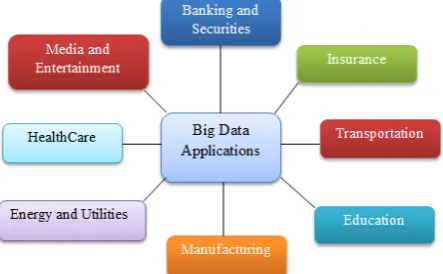
The fact is that, important company’s and personal data will stores in remote organizations outside the company there raises severe issues and raises more challenges. Data Storage, Quality of data, security and privacy, service delivery, billing, reliability, availability, performance are the typical examples are to be considered in a first glance. We took one of the issue here i.e. Data Storage. For large companies it is essential that to store and analyze huge data and need a high infrastructure for storing and computing for different analysis [7]. By this serial expansion of data it is needed to generate an algorithm for data storage in a place i.e. Cloud Service with least computational cost and this problem is being provided a good solution in our work. This paper is organized as below. Under section 2 we have described the preliminaries of cloud and data center, CSP’s features and related work that is done prior on cost related resource allocation. Section 3 covers our proposed work in this paper. Our practical results and discussion are covered in section 4. Conclusions are drawn in Section 5. The following Figure 1 represents the applications of Big Data.
Figure 1: Applications of Big Data.
2.
R
ELATED WORKIn this section, we only depicted a few basics regarding Cloud and datacenters including security and the cost in recent IT industry.
2.1 Role of Data center
2.1.1 Cloud vs. Datacenter
There are having two identical terms are “cloud” and “data center” which are related to the same infrastructure. But both the computing systems are especially for storing data as in common and not more. Cloud is an outermost form of computing where the information resides in internet, whereas the datacenter is an innermost hardware where the
information resides in organizations LAN [8]. Another difference is that the cloud services are provided by third party since the interior IT department hosts the datacenters. The common objective of cloud and the servers is storing physical entity data and other relevant infrastructure is utilized in datacenter. There poses some typical questions for organizations such as whether to proceed with cloud or build their own datacenter. The opinion depends on three factors such as business requirements, data security and data storage cost [10].
2.1.2 Cloud security vs. data center security
Since cloud is an outer form of computing where there is less chance of security than in the datacenter. In datacenters we are able to provide security by our self and there is no presence of third party in this. If your cloud prevails on different datacenters in different locations, every location needs particular security measures. A datacenter is mapped with physical network at locally which makes easier to the company-approved credentials and equipment would access apps and stored data [15]. Nevertheless a cloud is accessible by anyone with specified credentials from anywhere by using internet.
2.1.3 Cloud vs. data center costs
A cloud is high cost-effective option than a datacenter for small scale businesses. Since you can construct an infrastructure and are responsible for managing and administration by yourself, a datacenter consumes more time for the start and more pricey approximately $30 million per year [20]. To distinguish with a datacenter, no time or capital is needed to start and run a cloud computing. Possibly most cloud providers provide a range of introduced subscription schemes to meet your budget and evaluate the service of your performance requirements. Whereas the datacenters takes time to form, depending on your provider. In addition to this there is availability of utilization of cloud services immediately after the registration is done [9].
2.1.4 Single vs Multi Computing Model
infrastructure that guarantees the security for user data and provides greater accessibility. The data availability is the basic issue. In this strategy we can observe that a single CSP is not enough and do not provide availability bitterly and so that there is no guaranty on stored data. For suppose if CSP fails technically at that time we are not able to get the data. This structure is shown in Figure 2.a. Then a new notion is that to describe this issue known as multiple CSP, in which we can store user data in various datacenters. If CSP has technical failure we can access our data from the corresponding CSP, as we are maintaining CSP replications with similar data and this is shown in Figure 2.b.Critical system
2.2 Features of Various CSPs
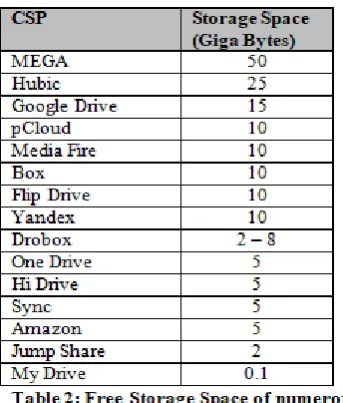
CSPs provide services to users on their request basis via wireless medium i.e. the internet. It is contrasted with the company’s provided services private on proved services. These CSPs provided services are easy in usage and are scalable in accessing remote data and other hardware resources. In this section we illustrated some of the extensively used CSPs and its offered computer services, key cloud tools, pricing, pros and cons and are listed in Table 1.
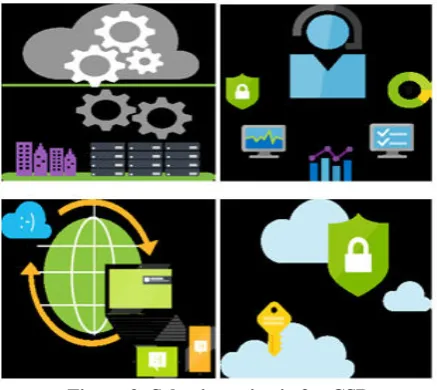
2.3 Selection Criteria
Figure 3: Selection criteria for CSP
2.4 Dominant Cost Based Data allocation
In our work, we used the DAR concept. It involves with two phases. In the first phase, a dominant cost based data allocation algorithm is used. In the final phase, optimal resource reservation algorithm is used to reserve a particular resource for specific period.
Algorithm 1: DCBA Algorithm foreach ci in Dcdo
, and are are sorted in an increasing order of unit Storage/Get/Put price, respectively.
foreach dlwith tk dl do
H=100 switchdlwith =H do casedominant
L= or or, according to the
dominant cost is Storage or Get or Put casebalanced
Find pj ∩ with the smallest and satisfies all constraints foreach pj with pj L ∩ do
if ( =1 → <0) ( =0) then Continue;
Find the largest satisfying 0 H ;
if when
= then =1;H=H- ; else
if H=o then
break;
Algorithm 2: BSRR Algorithm
Sort A={ in ascending order;
N1= +1;
x1= the N1th smallest value of A;
x2= the N2th smallest value of A; if (x1) (x2)then
x1;
else
x2;
3.
PROPOSED WORKIn this paper we represented a resource allocation algorithm particularly used in big data applications. To this we have induced distributed clouds in which the computational resources are very closely available to users i.e. inside the routers itself. It is very essential to have new algorithms for storing the data in CSP with lesser storage space and computational cost. As a solution to this solution, we proposed geo distributed cloud storage system for data storage allocates request and reservation of a particular resource for instance memory on multiple CSPs by using DAR algorithm. It directly helps the users to restrict their payment cost to ensure their SLOs and it also prevent the vendor lock-in issue as client would not constrain to an imperfect provider and can simply choose the optimal CSPs for storing their data. We clearly depicted our work here. Initially datacenters can be included from an organization in different locations globally. The clients can buy varied data centers owned by multiple CSPs. There have an opportunity to client for storing their data in a particular data center.
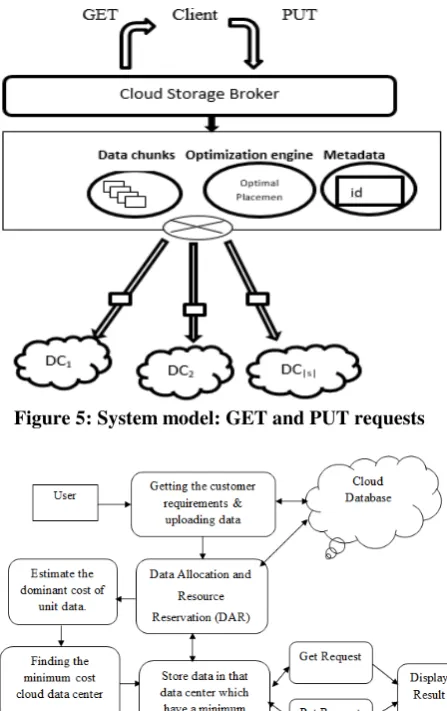
Our methods instantly select the optimal data center for storing user’s data among various CSPs owned by the client for a specific time. To this we adopted a cost based allocation paradigm where if finds the predominant cost on the basis of data size, get or put requests etc. besides we also reserve a resource for a particular time by using resource reservation algorithm as PAYG manner. The Figure 4 represents the system architecture, the Figure 5 represents the system of get/put requests and our work process is shown in Figure 6 and is adopted from Guoxin Liu et.al [16].
replicas can be stored in remote data center. The definition of the problem here is that, there is having ‘p’ number of data centers for every CSP. The primary objective of our work is to choose the optimal data center to store the data for a customer with minimal cost. Data Storage and Transfer are charged on the basis of pay as you go (PAYG) manner and Get/Put operations among the two hosts are based upon PAYG manner and reservation. In our work we have considered Get Requests, Put Requests, Reservation Period, Size of the data are the primary factors to evaluate the total cost to store the data in a specified data center.
DAR (Data Allocation and Resource reservation) It is a mechanism to optimize the cloud services cost across multiple cloud providers. It performs- a. Gathering the customer essentials when they
storing the data.
b. Estimates the dominant cost of unit data. c. Finding the optimum cost cloud data center. d. Store data in that data center which have a
minimum cost.
Figure 4: Overview of DAR’s Structure The main advantage of the work we proposed is that we took a small file and found storage cost of every service provider and optimized the cost for storage by selecting the optimal storage service which is mandatory in Big Data applications. In those types of applications, storage cost is an important factor that influences the growth of IT industries and further where the replication occurred; on those situations our work performs the outstanding outcomes with minimal cost.
4.
EXPERIMENT
WORK
&
COMPARATIVE
STUDY
This section shows the experimental study of our work. We have taken a sample data set of data centers of four types of cloud service providers i.e. Azure, AWS, iCloud, Google Cloud services. The works is comprised using the set of languages Java as a front end and MySQL as backend to store the data files. The files are stored in remote location and the user can store any number of replicas of it. The primary goal of this work is to reduce
the cost from the user end so that most of service level agreements should be minimized.
Figure 5: System model: GET and PUT requests
Figure 6: Flow of proposed work
For the major CSPs, the data centers are established at different locations, where the actual data is being stored. In genera;, the data files are stored in their nearest locations, the problem with this approach is that if the size of file is increased, to store the replicas, it require even more storage space.
To reduce this we have used DAR algorithm, where the company can place the data centers at different locations. The users can opt the number of data centers from 1 to n from these cloud service providers. If user wants to store a data file, he is able to save the file with less cost in an appropriate data center automatically. Our data set contains different data centers and we have stored the test files in all the data centers with different put/ get frequencies and compared the results. The sample data set is shown in Figure 7.
optimal cloud service provider i.e. the while uploading the data, after selecting the file our DAR algorithm will find the better place to store the data by considering all the parameters which we have discussed earlier.
Figure 7: Input data with Certain Parameters.
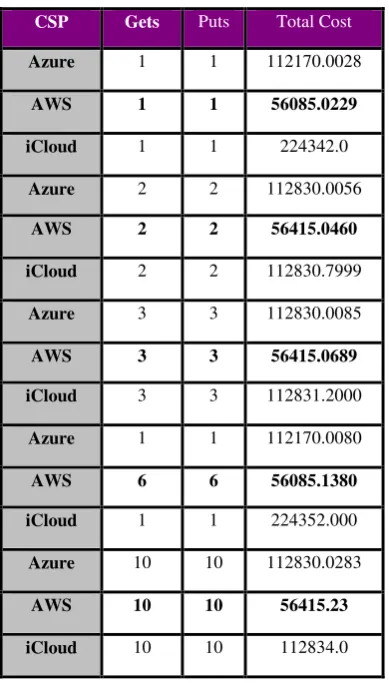
We compared by taking a test file of size of 11 kilo bytes. We have taken a file which has small in size, but in real time the size of the file is huge i.e. typically in Giga Bytes. The cost is computed for the test file with different get/put frequencies as shown in Figure 8.
CSP Gets Puts Total Cost
Azure 1 1 112170.0028
AWS 1 1 56085.0229
iCloud 1 1 224342.0
Azure 2 2 112830.0056
AWS 2 2 56415.0460
iCloud 2 2 112830.7999
Azure 3 3 112830.0085
AWS 3 3 56415.0689
iCloud 3 3 112831.2000
Azure 1 1 112170.0080
AWS 6 6 56085.1380
iCloud 1 1 224352.000
Azure 10 10 112830.0283
AWS 10 10 56415.23
iCloud 10 10 112834.0
Figure 8: Comparison result of Computational cost with different get/put latencies
The get/put frequency of the CSP is shown in Figure 9 and the cost to store the file and error percentage with each data center are shown in Figure 10 and Figure 11.
Figure 9: Get/Put requests of each CSP
Figure 10: Comparison of Total cost of each CSP
5. CONCLUSION
utilization and reservation. In this paper we have implemented an algorithm with least cost requirement to choose the optimal datacenters. Additionally we also took latency into sight. These works are continued on the basis of derived methods from coefficient-based totally statistics reallocation, multicast-primarily based information moving and request redirection-based congestion manipulate.
REFERENCES
[1] Fan Zhang, Se- Nior Member, Ieee, Kai Hwang, Life Fellow, Ieee, Samee U. Khan, Senior Member, IEEE, And Qutaibah M. MalluhiIEEE Paper on Skyline Discovery and Composition of Multi-Cloud Mashup Services, IEEE Transactions On Services Com- Puting, Vol. 9, No. 1, January/February 2016
[2] Prof. J. M. Patil , Ms. B. S. SonuneData Security Using Multi Cloud Architecture, international Journal on Recent and Innovation Trends in Computing and Communication, Volume: 3 Issue: 5 Ijritcc — May 2015
[3]. Jens-Matthias Bohli, Nils Gruschka, Meiko Jensen, Member, IEEE, Luigi Lo Iacono, And Ninja Marnau, IEEE Paper on Security And Privacy Enhancing Multi cloud Architectures, , IEEE Transactions On Dependable And Secure Computing, Vol. 10, No. 4, July/August 2013.
[4]. Fan Zhang, Se- Nior Member, Ieee, Kai Hwang, Life Fellow, IEEE, Samee U. Khan, Senior Member, IEEE, And Qutaibah M. Malluhi IEEE Paper on Skyline Discovery And Composition Of Multi-Cloud Mashup Services , , Ieee Transactions On Services Com- Puting, Vol. 9, No. 1, January/February 2016.
[5]. Dr. K. Subramanian1, F. Leo John, Data Security In Single And Multi-Cloud Storage, ISSN(Online): 2320-9801, Vol. 4, Issue 11, November 2016
[6]. Assistant Professor, Department of MCA, Visvesvaraya Technological University Post Graduate Centre, Multi-Cloud Data Storing Strategy with Cost Efficiency and High Availability, , ISSN (Online): 2319-7064 Index Copernicus Value (2013): 6.14 — Impact Factor (2015): 6.391 Kalaburagi, Paper ID: ART20161263 , Volume 5 Issue 8, August 2016.
[7]. Prof. J. M. Patil , Ms. B. S. Sonune “Data Security Using Multi Cloud Architecture ,international Journal on Recent and Innovation Trends in Computing and Communication, Volume: 3 Issue: 5 Ijritcc — May 2015.
[8] Amazon S3, accessed on Jul. 2015. [Online]. Available: http://aws. amazon.com/s3/
[9] Microsoft Azure, accessed on Jul. 2015. [Online]. Available: http://www. windowsazure.com/
[10] Goolge Cloud Storage, accessed on Jul. 2015. [Online]. Available:
https://cloud.google.com/products/cloud-storage/
[11] R. Kohavl and R. Longbotham. (2007). Online Experiments: Lessons Learned, accessed on Jul. 2015. [Online]. Available: http://exp-platform.
com/Documents/IEEEComputer2007OnlineExperiments.p df
[12] B. F. Cooper et al., “PNUTS: Yahoo!’s hosted data serving platform,” Proc. VLDB Endowment, vol. 1, no. 2, pp. 1277–1288, Aug. 2008.
[13] A. Hussam, P. Lonnie, and W. Hakim, “RACS: A case for cloud storage diversity,” in Proc. SoCC, Jun. 2010, pp. 229–240.
[14] Amazon DynnamoDB, accessed on Jul. 2015. [Online]. Available: http://aws.amazon.com/dynamodb/
[15] Z. Wu, M. Butkiewicz, D. Perkins, E. Katz-Bassett, and H. V. Madhyastha, “SPANStore: Cost-effective geo-replicated storage spanning multiple cloud services,” in Proc. SOSP, Nov. 2013, pp. 292–308.
[16]. Guoxin Liu et.al.,” Minimum-Cost Cloud Storage Service Across Multiple Cloud Providers” in IEEE/ACM TRANSACTIONS ON NETWORKING, VOL. 25, NO. 4, AUGUST 2017.
[17] E. Anderson et al., “Hippodrome: Running circles around storage administration,” in Proc. FAST, Jan. 2002, pp. 175–188.
AUTHOR’S BIOGRAPHY: