Original Research Article
Does emotional intelligence upon interaction with perceived stress,
moderate burnout among resident doctors?
A study from West Bengal, India
Indrajit Saha
1, Satabdi Mitra
2*
INTRODUCTION
Medical residency is the period of apprenticeship when being at the first line of service provision in a health care facility, a medical graduate, under close supervision of senior attending physicians have to pass through demanding expectations and responsibilities to be conversant and proficient clinician, educators, researcher and administrator.1-3 Accelerating complexity out of
interplay between quality healthcare and patient satisfaction makes the junior residents with their powerless responsibility to stand between conflict among autonomy, prestige, personality and income.
Burnout is essentially a combination of three elements, namely a) emotional exhaustion, b) depersonalization and c) low personal accomplishments.4 Burnout results in loss of emotional, mental and physical energy due to
ABSTRACT
Background: Burnout as a result of perceived stress is a jeopardizing condition for a medical graduate during the years of acquiring proficiency. Emotional intelligence (EI) is a coping strategy to handle vocational stress. The objectives of the study were to assess the effects of various predictors on resident doctors’ burnout and moderation effects of TEI by interaction with perceived stress.
Methods: A descriptive cross-sectional study was conducted from February to April 2016 among 61 postgraduate trainees and 54 internees/ house staff respectively over various departments of Bankura Sammilani Medical College and Hospital. Data were collected through a self-administered questionnaire for background characteristics and work-related variables. Cohen perceived stress scale, Trait EI questionnaire and Shirom-Melamed burnout questionnaire were applied for measuring perceived stress, EI, and burnout, respectively. Statistical analysis was done with of SPSS version 22.0, and for moderation analysis, Andrew F. Hyne’s SPSS macro was adopted. Nonparametric bootstrapping was done.
Results: In binary logistic regression, residents’ burnout was found to have significant association to heavy duty load and negative life event in recent past. In moderation analysis, a significant interaction effect with coefficient=0.031 (p=0.002) indicating that the relationship between the perceived stress (PS) and burnout was moderated by TEI.
Conclusions: TEI is an important moderator of stress and resultant burnout of resident doctors. Training of EI of these professionals might bring about better work performance, psychological adaptation and well-being of individuals and society as a whole.
Keywords: Burnout, Emotional intelligence, Perceived stress, Moderation, Post graduate trainee
1
Department ofCommunity Medicine, Bankura Sammilani Medical College, West Bengal, India
2
State Epidemiologist, NPCDCS, West Bengal State Health and Family Welfare Samity, Govt. of West Bengal, West Bengal, India
Received: 06 July 2018
Accepted: 09 August 2018
*Correspondence:
Dr. Satabdi Mitra,
E-mail: [email protected]
Copyright: © the author(s), publisher and licensee Medip Academy. This is an open-access article distributed under the terms of the Creative Commons Attribution Non-Commercial License, which permits unrestricted non-commercial use, distribution, and reproduction in any medium, provided the original work is properly cited.
continued work-related stress.5 Stress can be defined as emotional and physiological reaction to demand, situation or circumstance that disrupts a person’s equilibrium and acts as initiator of increased autonomic arousal and burnout at the end.6
Various personal, interpersonal and organizational factors also have been reported to contribute towards stress and burnout.7
Various researches have shown that emotional intelligence (EI) is associated with stress-coping strategies and conflict-handling styles as well as ethical behavior in health care setting.8 Trait Emotional Intelligence (TEI) or trait emotional self-efficiency comprises a personality facet deemed to reasoning and problem-solving in emotional domain.9
The inverse relationship between (a) EI and stress (Slaski and Cartwright 2002, Gardner 2005, Landa et al 2008), and (b) EI and burnout (Mikolajczak et al 2007) is well established. Gerits et al also showed low burnout among nursing personnel with high EI than their counterparts with lower EI.
News channels frequently cover agitations even in health care premises with resultant unwanted events mostly involving junior residents.
Though, with all the consequences burnout is jeopardizing health service provisions, but still it is a less traversed field all over the world, thus necessitating further research.
In this backdrop the current study was conducted a) to assess effects of various work and life-events on residents’ burnout and b) to estimate the role of TEI as moderator by interacting with perceived stress to affect burnout among them working in different disciplines of study area.
METHODS
Study type, design and study setting
An institution-based descriptive study with cross-sectional design was conducted from February to April, 2016 in Bankura Sammilani Medical College and Hospital. This teaching hospital is located in Bankura district, in the western part of the state of West Bengal. It is running since 1956 with current bed strength of 1287 comprised in several departments; with 150 MBBS and 78 post graduate seats sanctioned for every academic year.
Study population and sampling
The junior resident doctors comprising internees, house staff and post graduate trainees posted over different specialty and super specialty departments were the study
population. Following probability proportionate to size (PPS), out of 212 postgraduate trainees and 165 internees/house staffs, 61 and 54 respectively were approached for data collection, on fulfillment of inclusion criteria, that is who stay in hostels. The total sample size was computed as 115. Those with history of any psychiatric illness, at present or in past were deliberately excluded from participation.
Tools and techniques of data collection
Data collection was done with:
1. Self administered questionnaire: pertaining to age, gender, permanent address, marital status, current discipline of posting with duration of service, working hours, number of night duties and emergency duties in preceding month, occurrence of any adverse life event in last one year etc.
2. Cohen perceived stress scale (PSS): 10-item instrument meant to measure individual stress level. It was originally developed in 1983 and helps to understand how different situations, as endured in the preceding month, affect feelings and personal stress.10
3. Trait emotional intelligence questionnaire short form (TEIQue-SF): this 30-item questionnaire was developed by K.V. Petrides. It is used to measure Global TEI where questions are distributed over four domains namely well-being, self-control, emotionality and sociability and a 7-point Likert scale is used for each one of the responses.11
4. Shirom-Melmed burnout questionnaire: this 22-item questionnaire is designed to respond over 7-point Likert scale ranging from 1(almost never) to 7 (almost always). It comprises 3 subscales for physical fatigue factor, cognitive weariness factor and emotional exhaustion factor.12
The study was embarked upon obtaining ethical clearance from Institutional Ethics Committee of Bankura Sammilani Medical College and informed written consent from all the study participants. After ensuring for maintenance of anonymity, the study participants were contacted over telephone day before visit for availability and approached during their hostel hours preferably by evening on working days as well as on weekends.
Data management and analysis
predict burnout. Here the predictors have been transformed using grand mean centering where a variable has been transformed into deviations around a fixed point that is the grand mean. As the proposed model contains interaction centering was needed here. Bootstrapping technique was applied for resampling with replacement to 1000 to overcome the problem of model fit.
RESULTS
Baseline characteristics
Among the total 115 participants, 46.9% were internees/house staffs and 53.1% were post graduate
trainees mean age was 22.0±3.4 years and 28.7±5.6 years respectively. Nearly half of the PGTs were married (44.2%) whereas only 3.7% of internees/house staffs were married. Weekly working hours for PGTs was more than 120 hours (126.0±9.3 hours) whereas number of night duties and emergency duties were high for both the groups. More than 1/3rd of the PGTs admitted any history of adverse life event in last one year which could be found in only 3.7% of the internees and house staff. Significant difference among the two groups was found in respect to duration of service, weekly working hours, night duties and emergency duties per month and occurrence of any adverse life event in preceding year (Table 1).
Table 1: Background characteristics of study participants.
Characteristics Internees and house staff PGTs χ2, df, p
46.9% 53.1%
Age [mean±SD] 22.0±3.4 years 28.7±5.6 years 1.72, 1, 0.66
Gender Male 55.6% Male 64.5% 2.01, 1, 0.80
Female 44.4% Female 35.5%
Permanent residence Rural 50.0% Rural 31.1% 1.42, 1, 0.20
Urban 50.0% Urban 68.9%
Marital status Married 3.7% Married 44.2% 2.52, 1, 0.32
Single 96.3% Single 55.8%
Duration of service 9.0±2.7 months 24.0±2.0 months 6.72, 1, 0.01
Working hours/week in preceding month 64.5±6.6 hours 126.0±9.3 hours 2.14, 1, 0.03
Night duties in preceding month 4.9±1.2 15.3±1.6 9.09, 1, 0.01
Emergency duties in preceding month 6.5±2.0 11.9±2.0 4.92, 1, 0.03
History of adverse life event in last one year Present 3.7% Present 31.1% 5.91, 1, 0.002 Absent 96.3% Absent 68.9%
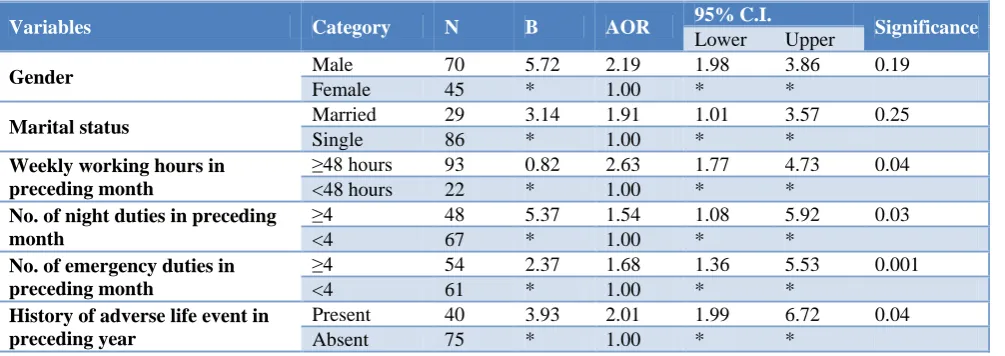
Table 2: Binary logistic regression for determinants of residents’ burnout.
Variables Category N B AOR 95% C.I. Significance
Lower Upper
Gender Male 70 5.72 2.19 1.98 3.86 0.19
Female 45 * 1.00 * *
Marital status Married 29 3.14 1.91 1.01 3.57 0.25
Single 86 * 1.00 * *
Weekly working hours in preceding month
≥48 hours 93 0.82 2.63 1.77 4.73 0.04 <48 hours 22 * 1.00 * *
No. of night duties in preceding month
≥4 48 5.37 1.54 1.08 5.92 0.03
<4 67 * 1.00 * *
No. of emergency duties in preceding month
≥4 54 2.37 1.68 1.36 5.53 0.001
<4 61 * 1.00 * *
History of adverse life event in preceding year
Present 40 3.93 2.01 1.99 6.72 0.04
Absent 75 * 1.00 * *
Effects of determinants on junior doctors’ burnout
Binary logistic regression revealed that, statistically significant association (p<0.05)of high burnout among residents of both the groupswith a) ≥48 hours of working in week (AOR 2.63, 95% C.I. 1.77-4.73), b) more than 4
night shifts in a month (AOR 1.54, 95% C.I. 1.08-5.92), c) more than 4 emergency duties in a month (AOR 1.68, 95% C.I. 1.36-5.53) and d) history of adverse life event in last one year (AOR 2.01, 95% C.I. 1.99-6.72). The Hosmer and Lameshow test (χ2
Table 3: Moderation analysis for effect of PS on burnout at values of the TEI.
Model summary
R R2 MSE F df1 df2 P value
0.6 0.4 634.0 49.6 3.0 111.0 0.00
Model Coeff SE t P value LLCI ULCI
Constant 91.8 2.6 34.8 0.000 86.5 97.0
TEIQue 0.51 0.10 7.4 0.000 0.46 0.77
PSS 1.6 0.43 3.9 0.000 0.84 0.24
int_1 0.031 0.09 2.68 0.002 0.01 0.04
Interactions: int_1 PSS X TEIQue
Conditional effect of X on Y at values of the moderator(s)
TEIQue Effect se t p LLCI ULCI
-29.0 1.3 0.8 1.7 0.18 -0.3 2.8
0.0 1.6 0.4 3.9 0.02 0.008 2.4
29.0 1.9 0.4 4.2 0.00 1.0 2.8
Model = 1; Y = burnout; X = PSS; M = TEIQue; Sample size 115
Outcome: burnout; Values for quantitative moderators are the mean and plus/minus one SD from mean.
Effect of perceived stress (PS) on burnout as moderated by trait emotional intelligence (TEI)
Table 3 shows that, once the coefficient value for each predictor and the associated standard error were adjusted for heteroscedasticity, moderation was shown up by a significant interaction effect, coefficient=0.031, 95%C.I. (0.01-0.04), t=2.68, p=0.002 indicating that the relationship between the perceived stress (PS) and burnout was moderated by TEI. Conditional effect of X on Y at the values of moderator was also found to be significant. These all indicate that moderation was present.
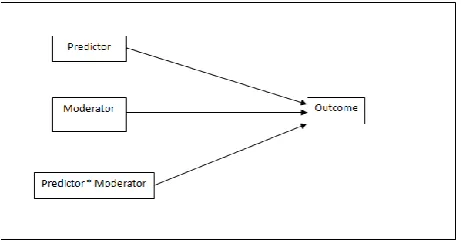
Figure 1: Statistical moderation model.
The statistical moderation model reflects effects of predictor, moderator and multiplicative effect of both to predict the outcome (Figure 1).
DISCUSSION
Burnout has been described as a syndrome in which emotional depletion and maladaptive detachment develop in response to prolonged occupational stress, which is often subjective in perception.13 Emotional intelligence (EI) or more specifically trait emotional intelligence
(TEI), which is person’s inherent ability of adaptation and coping up with surrounding, individual and environment, acts as an important positive mental health determinant.9
Baseline characteristics
As compared to the current study wherein participants were categorized as PGTs and internees/house staff, in the study by El-Masry et al among medical students for perceived stress and burnout, the participants were distributed/categorized in three different academic years and Sajid et al categorized the participants over five academic years in their study.14,15 Visser et al undertook similar study among doctors in various specialties.16 The mean age of current study subjects was found to be similar to the study by Swami et al, Al-Dubai et al, El-Masry et al whereas Tomljenovic et al had higher age grouped physicians as participants.14,17-19 Regarding residence, there was similarity with the study by Swami et al.17 Marital status of the current study participants was in agreement to the study by Swami et al, Al-Dubai et al, El-Masry et al but was dissimilar to Tomljenovic et al and Visser et al.14,16,18,19
Work related factors
PGTs as compared to the other group in the present study which was also closely supported by Tomljenovic et al.19
Determinants of burnout
In conformity to the current study, Swami found significant association of burnout with residents’ workload which also was supported by Rajan.17,20 However, Gander found long working hours and roster instability to be independently related to fatigue-related clinical errors; and sleepiness while driving.21 In contrast to these findings, Shirom et al found that workload was the sole factor which mediated its effects through perceived stress on burnout.22
Regarding moderation by TEI
In line with the current study, where PS and burnout were found to be moderated by TEI, Augustine et al. showed in their study that, composite scores on PS, coping, life events and general health questionnaire in step-wise regression analysis revealed coping as the only significant predictor.23 Ekermans et al found emotional management (EM) and emotional control (EC) to be negatively associated with self-reported stress and burnout. Significant positive correlation emerged between general work stress, depersonalization and emotional exhaustion. Work-home interface was the only significant predictor in their study. They found weak evidence for EI as a moderator and differential effect of high versus low EI on stress and emotional intelligence relationship.9
CONCLUSION
In the current study, resident doctors (PGTs and internees/house staffs) posted in various disciplines perceive stress and resultant burnout emanating out of different factors like, high workload and work-home interface. TEI plays an important role in coping up with the stress and burnout experienced by resident doctors. TEI was shown to be a significant moderator in the stress–burnout relationship as evidenced from moderation analysis.
Various stress busters like as transcendental meditation, relaxation exercises, participating in indoor and outdoor sport, music therapy, developing hobbies etc. can be contemplated and implemented to promote job satisfaction, commitment, residents’ well-being and help them to develop coping strategies to combat stress and burnout.
Furthermore, training and proper counseling to develop favorable TEI, can also help to overcome PS and burnout. Funding: No funding sources
Conflict of interest: None declared
Ethical approval: The study was approved by the Institutional Ethics Committee
REFERENCES
1. Cohen JS, Patten S. Well-being in residency training: a survey examining resident physician satisfaction both within and outside of residency training and mental health in Alberta. BMC Med Educ. 2005;5:21.
2. Yusoff MSB, Jie TY, Esa AR. Stress, stressors and coping strategies among house officers in a Malaysian hospital. ASEAN J Psychiatry. 2011;12(1).
3. Woloschuk W, Harasym P, Mandin H. Implementing clinical presentation curriculum: impact on students stress and workload. Teaching and Learning in Medicine. 1995;10(1):44–50. 4. Maslach C, Schaufeli WB, Leiter MP. Job burnout.
Annual Rev Psychol. 2001;52:397–422.
5. Maslach C, Jackson SE, Leiter MP. Maslach Burnout Inventory Manual. Third edition. Palo Alto, Calif: Consulting Psychologists Press; 1996. 6. Lloyd C, King R, Chenoweth L. Social work, stress
and burnout: A review. J Mental Health. 2002;11(3):255–65.
7. Schaufeli WB, Enzmann D. The burnout companion to study & practice: a critical analysis. London: Taylor Francis; 1998: 77-78
8. Mayer JD, Salovey P. Qué es la Inteligencia Emocional? In: Mestre JM, Navas, Fernández- Berrocal P. (Coords.), Manual de Inteligencia Emocional, Pirámide, Madrid; 2007: 25-45.
9. Go¨ rgens-Ekermans G, Brand T. Emotional intelligence as a moderator in the stress–burnout relationship: a questionnaire study on nurses. J Clin Nursing. 2012;21:2275-85.
10. Cohen S, Kamarck T, Mermelstein R. A global measure of perceived stress. J Health Soc Behav. 1983;24:385-96.
11. Petrides KV, Furnham A. The role of trait emotional intelligence in a gender-specific model of organizational variables. J Appl Soc Psychol. 2006;36:552-69.
12. Shirom A. Burnout in work organizations. In: Cooper CL, Robertson I, editors. International Review of Industrial and Organizational Psychology. New York: Wiley; 1989: 26-48. 13. Shaufelli WB, Bakker AB, Van der Heijden MMA,
Prins JT. Workholism, burnout and well-being among junior doctors: the mediating role of role conflict. Work Stress. 2009;23:155–72.
14. El-Masry RE, Ghreiz SM, Helal RM, Audeh AM, Shams T. Perceived Stress and Burnout among Medical Students during the Clinical Period of Their Education. Ibnosina J Med Biomed Sci. 2013;5(4):179-88.
15. Sajid A, Ahmad T, Khalid T. Stress in medical undergraduates; its association with academic performance. Bangladesh J Med Sci. 2015;14(2):135-41.
medical specialists. Canadian Med Association J. 2003;168(3):271-5.
17. Swami MK, Mathur DM, B.K. Pushp BK. Emotional intelligence, perceived stress and burnout among resident doctors: An assessment of the relationship. National Med J India. 2013;26(4)210-3.
18. Al-Dubai SAR, Ganasegeran K, Perianayagam W, Rampal KG. Emotional Burnout, Perceived Sources of Job Stress, Professional Fulfillment, and Engagement among Medical Residents in Malaysia. Scientific World J. 2013:137620.
19. Tomljenovic M, Branko Kolaric B, Stajduhar D, Vanja Tesic V. Stress, depression and burnout among hospital physicians in rijeka, Croatia. Psychiatria Danubina. 2014;26(3):450-8.
20. Rajan P, Bellare B. Work Related Stress and Its Anticipated Solutions among Postgraduate Medical Resident Doctors: A Cross-sectional Survey Conducted At A Tertiary Municipal Hospital In Mumbai, India. Indian J Med Sci. 2011;65(3):100-6.
21. Gander P, Purnell H, Garden A, Woodward A. Work patterns and fatigue-related risk among junior doctors. Occup Environ Med. 2007;64:733-8. 22. Shirom A, Nirel N, Vinokur AD. Physician burnout
as predicted by subjective and objective workload and by autonomy. In: Halbesleben JR, editor. Handbook of Stress and Burnout in Healthcare. Hauppauge, NY: Nova Science Publishers; 2009: 141-55.
23. Augustine LF, Vazir S, Rao SF, MVV, Laxmaiah A, Nair KM. Perceived stress, life events & coping among higher secondary students of Hyderabad, India: A pilot study. Indian J Med Res. 2011;134(1):61–8.