Original Research Article
Hand washing practices amongst mothers of under-fives
in an urban slum
Sana Quazi, Satish Kishanrao Wadde*, Ajit Shripal Nagaonkar
INTRODUCTION
Hands are central to many of our daily activities and use of contaminated hands enhances transmission of microorganisms into body thereby causing ill-health. Large number of diseases can be transmitted due to lack of hand washing ranging from diarrhea to many other life threatening diseases.1 Hand washing with soap is one of the cost-effective tool of disease prevention, but most of the time it is overlooked.2,3 Need of hand washing is more
in developing countries but practices are found to be poor due to lack of either awareness or infrastructure or combination of both.4-6
Importance of hand washing and its role in reducing incidence of communicable diseases like diarrhoea, acute respiratory infections have been highlighted in many studies across world.6-8 About 1.8 million under five die every year from diarrhoeal diseases and pneumonia across the world.9 Diarrhoea is second most common cause of children death worldwide.10 India, Nigeria,
ABSTRACT
Background: Hand washing with soap is a cost-effective tool of disease prevention, but most of the time it is overlooked. Use of contaminated hands enhances transmission of germs into body causing ill-health. Mothers clean, prepare, serve and feed the food. If this is coupled with poor knowledge and practice of hand washing it increases risk to spread of diseases to self, other family members especially to under-fives. Present study was conducted to address this issue being a critical factor in disease prevention. The objective of the present study was to determine the knowledge and practices of hand washing amongst mothers of under-fives.
Methods: Present cross sectional study was conducted at UHTC, field practice area of Community Medicine, GMC, Latur amongst mothers of under-fives visiting UHTC to avail health services. The data was collected in a predesigned, pretested questionnaire by interviewing them.
Results: Out of 204 mothers, 38.24% were from the age group of 24-26 and majority i.e., 69.61% were housewives. 99.02% mothers were aware that unwashed hands can transmit the diseases. Most of the mothers told that clean hands reduces food and water contamination. Maximum i.e., 97.57% mothers washed hands before eating and 71.57% washed before cooking. All the mothers washed hands after visiting toilet. Most mothers used soap and water (85.3%) for hand washing. Significant numbers of mothers, under-fives and other members suffered from diarrhea in last six months (p<0.05).
Conclusions: Hand washing practices need to be followed at all critical moments for prevention of the faeco-oral infections.
Keywords: Hand washing, Mothers of under-fives, Practices
Department ofCommunity Medicine, Government Medical College, Latur, Maharashtra, India
Received: 19 July 2019
Revised: 03 September 2019
Accepted: 04 September 2019
*Correspondence:
Dr. Satish Kishanrao Wadde, E-mail: [email protected]
Copyright: © the author(s), publisher and licensee Medip Academy. This is an open-access article distributed under the terms of the Creative Commons Attribution Non-Commercial License, which permits unrestricted non-commercial use, distribution, and reproduction in any medium, provided the original work is properly cited.
Democratic Republic of the Congo, Pakistan, Ethiopia which are amongst the five most populous and poor countries contributes nearly 90 percent of child deaths due to pneumonia and diarrhea.11 Hand washing with soap decreases diarrheal attacks by 47 percent and incidence of acute respiratory infections by 23 percent.12 One out of every three young children who get sick with diarrhea and almost one out of five young children with respiratory infections like pneumonia could be protected by hand washing with soap.12-14 One of the study showed 41 percent lower mortality among neonates exposed to birth attendant and mothers who practices hand washing.15 A recent study showed that mother’s hand washing practices also helps in reduction of malnutrition among children.16
Mothers play many roles at home like cleaning, preparing, serving and feeding food to children. If this is coupled with poor knowledge and practice of hand washing it increases risk to spread of diseases to self as well as other members of family, especially to the under-five children. Young children might benefit from a lower rate of diarrheal pathogen transmission from parents who wash their hands frequently with soap and water.17 Proper hand washing by mothers of under-fives may act as a crucial factor in reducing prevalence of infectious diseases, hospital admission, mortality and morbidity in these children.18,19 Considering all this, the present study was conducted to determine the knowledge and practices of hand washing in these mothers.
METHODS
The present cross sectional study was conducted at Urban Health Training Centre which is a field practice area of Department of Community Medicine, Government Medical College, Latur. The study was conducted from 1st October 2018 to 31st December 2018 with an objective to determine knowledge and practices of hand washing amongst mothers of under-five in an urban slum. The mothers of under-fives who were coming to UHTC for antenatal check-up or immunization services were enrolled in the study. Total 204 mothers participated in the study. Data was collected using a predesigned and pretested questionnaire by interviewing them in local language. The questionnaire included sociodemographic data, questions about mothers’ knowledge and practices regarding hand washing. They were also asked about any episode of diarrhoea, acute respiratory or other gastrointestinal infection in any of the family members. At the end of interview they were told regarding importance of hand washing. Mothers who refused to participate were excluded from the study.
Statistical analysis
Data was entered in Microsoft Excel and analysed with percentages, Fischers’ exact test and Chi-square was used as test of significance.
RESULTS
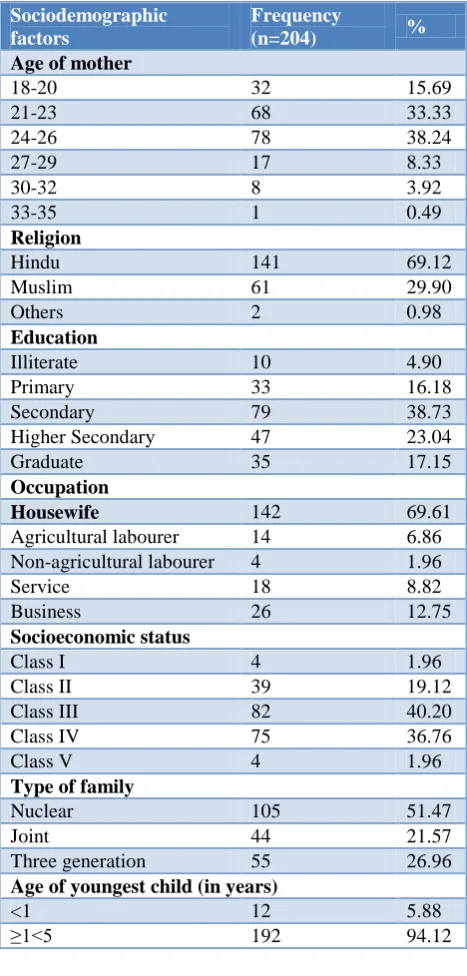
Out of 204 mothers who participated in the study majority i.e., 78 (38.24% were from the age of 24-26 years followed by 68 (33.33%) aged 21 to 23 years. Most of the mothers were Hindus i.e., 141 (69.12%). Majority of them were educated upto secondary level (38.73%) and were housewife (69.61%) by occupation. Eighty two (40.20%) were from class II socioeconomic status and 105 (51.47%) were from nuclear family (Table 1).
Table 1: Sociodemographic profile of mothers of under-fives.
Sociodemographic factors
Frequency
(n=204) %
Age of mother
18-20 32 15.69
21-23 68 33.33
24-26 78 38.24
27-29 17 8.33
30-32 8 3.92
33-35 1 0.49
Religion
Hindu 141 69.12
Muslim 61 29.90
Others 2 0.98
Education
Illiterate 10 4.90
Primary 33 16.18
Secondary 79 38.73
Higher Secondary 47 23.04
Graduate 35 17.15
Occupation
Housewife 142 69.61
Agricultural labourer 14 6.86 Non-agricultural labourer 4 1.96
Service 18 8.82
Business 26 12.75
Socioeconomic status
Class I 4 1.96
Class II 39 19.12
Class III 82 40.20
Class IV 75 36.76
Class V 4 1.96
Type of family
Nuclear 105 51.47
Joint 44 21.57
Three generation 55 26.96
Age of youngest child (in years)
<1 12 5.88
≥1<5 192 94.12
aware of the fact that clean hands reduces food contamination and 80 (39.22%) were not aware that
water may be contaminated due to unclean hands.
Table 2: Knowledge of the mothers regarding hand washing.
Sr.
No. Questions about Yes No
1. Unwashed hands can cause diseases. 202 (99.02) 2 (0.98)
2. Unwashed hands can transmit diseases to others. 135 (66.17) 69 (33.83)
3. Clean hand reduces water contamination. 124 (60.78) 80 (39.22)
4. Clean hands reduces food contamination. 170 (83.33) 34 (16.67)
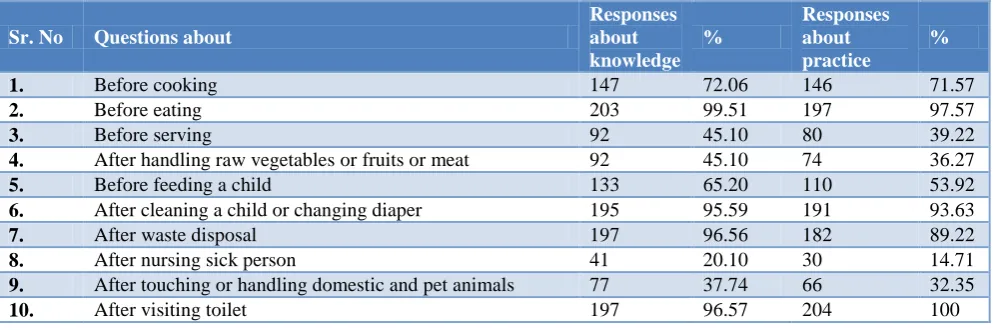
Table 3: Knowledge and practice of the mothers regarding critical moments when hands should be washed.
Sr. No Questions about
Responses about knowledge
%
Responses about practice
%
1. Before cooking 147 72.06 146 71.57
2. Before eating 203 99.51 197 97.57
3. Before serving 92 45.10 80 39.22
4. After handling raw vegetables or fruits or meat 92 45.10 74 36.27
5. Before feeding a child 133 65.20 110 53.92
6. After cleaning a child or changing diaper 195 95.59 191 93.63
7. After waste disposal 197 96.56 182 89.22
8. After nursing sick person 41 20.10 30 14.71
9. After touching or handling domestic and pet animals 77 37.74 66 32.35
10. After visiting toilet 197 96.57 204 100
Table 4: Medium used to wash the hands.
Sr. No. Material used for hand washing No. of responses %
1. Water only 17 8.33
2. Soap and water 174 85.30
3. Water with antiseptic 10 4.90
4. Water with ash or mud 03 1.47
Total 204 100
Majority of mothers i.e., 203 (99.51%) had correct knowledge of washing hands before eating followed by 197 (96.57%) had knowledge that one should was hands after visiting the toilet and waste disposal. It was satisfactory that all the mothers (100%) were practicing
hand washing after visiting toilet while 97.57% and 93.63% were practicing hand washing before eating and after cleaning the child or changing the diaper respectively. Only 41 (20.1%) mothers had knowledge that the hands should be washed after nursing a sick person and of these 30 (14.71%) practiced it actually.
Table 5: Hand washing practices amongst the mothers of under-fives.
Sr.
No. Question asked
Responses
Yes No
1. Do you wipe your hands till dry? 112 (54.90) 92 (45.10)
2. Have you washed hands today after any critical moments of hand washing? 192 (94.11) 12 (5.88)
3. Do you ask your child to wash hands with soap and water regularly? 198 (97.06) 6 (2.94)
Hundred and eighty four (90.2%) mothers used water with soap or antiseptic while 17 (8.33%) used only water for hand washing.
Most of the mothers (97.06%) told that they advise their children to wash their hands regularly but 12 (5.88%)
mothers had not washed their hands on the day of interview after critical moment.
under-fives who used only water with ash or mud for hand washing all had at least an episode of diarrhea in last six months showing significant association (p<0.001 by
Fischers’ exact test). Most of the other family members (85%) had the same illness as they didn’t use soap and water (X2=12.88 p=0.0003).
Table 6: Association of hand washing practices and history of episodes of diarrhoea in the family.
Episode of diarrhea in last 6 months
Medium used for hand washing
Total P value Significance
Water with soap or antiseptic
Only water or water with mud or ash
Self No 120 (65.22) 00 (0.00) 120 0.001* Significant
Yes 64 (34.78) 20 (100) 84
Under five child No 143 (77.72) 00 (0.00) 143 0.001* Significant
Yes 41 (22.28) 20 (22.28) 61
Other family members
No 110 (59.78) 03 (15.00) 113
0.003 Significant Yes 74 (40.21) 17 (85.00) 91
*Fischers exact test; Figures parentheses indicate percentages.
Table 7: Association of hand washing practices and history of episodes of ARI in the family.
Episode of diarrhea in last 6 months
Medium used for hand washing
Total Chi-square
at df=2 Significance
Water with soap or antiseptic
Only water or water with mud or ash
Self No 149 (80.98) 03 (15.00) 152 37.95
0.0001 Significant Yes 35 (19.02) 17 (85.00) 52
Under five child
No 153 (83.15) 02 (10.00) 155 48.96
0.0001 Significant Yes 31 (16.85) 18 (90.00) 49
Other family members
No 113 (61.41) 02 (10.00) 115 17.35
0.0003 Significant Yes 71 (38.59) 18 (90.00) 89
Figures parentheses indicate percentages.
Chi-square revealed a significant association between medium used for hand washing and episodes of ARI in last six months (Table 7; p<0.001).
DISCUSSION
The present cross sectional study was conducted to assess the knowledge and practices of mothers of under-fives in an urban slum area. Hand washing practices in these mothers affect health of children in many ways. Many studies have shown that washing hands with soap can reduce the risk of diarrhoeal diseases and ARI, which might save millions of lives every year.5,18
In the present study most of the mothers were in age group of 20-30 years, educated upto primary level and above, were housewife by occupation and were from nuclear family. Similar study conducted by Yerpude et al in urban slum of Andhra Pradesh also reported similar findings, in which most of the mothers were between age 20-30 years, educated primary and above (61.9%), housewife by occupation (71.9%) and were from nuclear family (69.01%).20 In present study 202 (99.02%) mothers told that unwashed hands can cause diseases. Another study conducted in Karnataka by Aithal et al found that 96.7% of respondents had knowledge regarding prevention of diseases with hand washing was.21
participants were not washing their hands before and after attending to sick person.29 Lack of knowledge amongst the mothers regarding mode of spread of diseases may be responsible for this.
Most of the mothers (85.30%) were using water with soap for hand washing which was quite satisfactory. Pandve et al and De et al observed that 80% and 74.67% of participants were using water with soap as medium of hand washing respectively which was comparable with the present study findings.22,24
Many studies demonstrated that communities which practice hand washing with soap and water have less incidence of diarrhoea and respiratory disease.5,13,30 In the present study significant association was found between medium of hand washing and episodes of diarrhoea and ARI in last 6 months amongst mothers under five children or other family members. Significantly more numbers of family members suffered from diarrhoea, ARI or both diseases who used ash or mud with water as compared to those who used soap or antiseptic with water (p<0.001). Pandve et alalso found significant relationship between medium of hand washing and episodes of diahroea or URTI in last three months.22 Borah et al and Freeman et al revealed that there was greater incidence of diarrhea amongst children of the mothers who didn’t practice hand washing with soap and water.28,31
Limitations
As the present study was conducted amongst the mothers visiting urban health centre, the findings cannot be generalized. The sample size is also small and may not be representative of the community.
CONCLUSION
The present study found that a good number of the mothers were washing hand at some crucial moments like after defecation, before eating, after cleaning or changing the diaper and waste disposal. But nearly half of the mothers were not washing hands before feeding child which needs to be addressed as common gastrointestinal infections are spread faeco-orally. The favourable changes in behavior towards hand washing by mothers could be achieved by health education highlighting its importance.
Funding: No funding sources Conflict of interest: None declared
Ethical approval: The study was approved by the Institutional Ethics Committee
REFERENCES
1. Black RE Morris SS, Bryce J. Where and why are 10 million children dying every year? Lancet. 2003;361:2226-34.
2. Cairncross S, Valdmanis V. Water supply, sanitation, and hygiene promotion. In Disease Control Priorities in Developing Countries. New York: Oxford University Press; 2006: 771-792. 3. Boyce JM, Pittet D. Guideline for hand hygiene in
Health care settings; recommendations of the health care infection control practices advisory committee and the HICPAC/SHEA/APIC/IDSA hand hygiene task force. Society for Healthcare Epidemiology of America/Association for professionals in Infection Control/Infectious Diseases Society of America. MMWR Recomm Rep. 2002;51:1-45.
4. Curtis V, Danquah L, Aunger R. Planned, motivated and habitual hygiene behaviour: an eleven country review. Health Educ Res. 2009;24(4):655-73. 5. Luby SP, Agboatwalla M, Feikin DR, Painter J,
Billhimer W, Altaf A, et al. Effect of handwashing on child health: A randomised controlled trial. Lancet. 2005;366(9481):225-33.
6. Ansari SY, Warbhe PA. Assessment of the Knowledge and Practice Regarding Personal Hygiene among School Children. Int J Curr Med Appl Sci. 2014;4(1):1-12.
7. Shahid NS, Greenough WB, Samadi AR, Huq MI, Rahman N. Handwashing with soap reduces Diarrhoea and spread of bacterial pathogen in a Bangladesh village. J Diarrhoeal Dis Res. 1996;14:85-9.
8. Ray SK, Amarchand R, Srikanth J, Majumdar KK. A study on prevalence of bacteria in the hands of children and their perception on hand washing in two schools of Bangalore and Kolkata. Indian J Public Health. 2011;55:293-97.
9. Liu L, Johnson HL, Cousens S, Perin J, Scott S, Lawn JE, et al. Global, regional, and national causes of child mortality: an updated systematic analysis for 2010 with time trends since 2000. Lancet. 2012;379:2151-61.
10. Bhan MK. Accelerated progress to reduce under-5 mortality in India. Lancet Glob Health. 2013;172-3. 11. UNICEF. Pneumonia and diarrhoea. Tackling the
deadliest diseases for the world’s poorest population 2012. Available at: http://www.unicef.org/eapro/ Pneumonia and Diarrhoea Report 2012.pdf. Accessed on 12 April 2016.
12. Rabie T, Curtis V. Evidence that handwashing prevents respiratory tract infection: a systematic review. Trop Med and Int Health. 2006;11:1-10. 13. Ejemot RI, Ehiri JE, Meremikwu MM, Critchley
JA. Hand washing for preventing diarrhoea. Cochrane Database Syst Rev. 2008;1:CD004265. 14. Aiello AE, Coulborn RM, Perez V, Larson EL.
Effect of hand hygiene on infectious disease risk in the community setting: a meta-analysis. Am J Public Health. 2008;98(8):1372-81.
16. Rah JH, Cronin AA, Badgaiyan B, Aguayo VM, Coates S, Ahmed S. Household sanitation and personal hygiene practices are associated with child stunting in rural India: a cross-sectional analysis of surveys. BMJ Open. 2015;5:e005180.
17. Luby SP, Agboatwalla M, Painter J, Altaf A, Billhimer W, Hoekstra RM. Effect of intensive handwashing promotion on childhood diarrhoea in high-risk communities in Pakistan: a randomized controlled trial. JAMA. 2004;291(21):2547-54. 18. Curtis V, Cairncross S. Effects of washing hands
with soap on diarrhoea risk in the community: a systematic review. Lancet Infect Dis. 2003;3:27581. 19. Curtis V, Danquah L, Aunger R. Planned, motivated and habitual hygiene behavior: an eleven country. Health Education Res. 2009;24:655-73.
20. Yerpude PN, Jogdand KS, Sumra NA. A cross-sectional study on hand washing practices among mothers in an urban slum area. Int J Health Sci Res. 2014;4(10):1-5.
21. Aithal KS, Ogorchukwu MJ, Prabhu V, Shriyan P, Yadav UN. Hand washing Knowledge and Practice among mothers of under-five children in coastal Karnataka, India- a cross sectional study. Int J Med Health Sci. 2014;3(4):266-71.
22. Pandve HT, Chawla PS, Giri PA, Fernandez K, Singru SA. Study of hand washing practices in rural community of Pune, India. Int J Community Med Public Health. 2016;3:190-3.
23. Rafath UB, Bhavani K. Study of knowledge and practices of hand washing among mothers having children under 5 years of age in urban field practicing area of Kakatiya Medical College, Warangal, Telangana, India. Int J Community Med Public Health. 2016;3:2035-9.
24. Maumita De, Taraphdar P. A study on water sanitation hygiene and hand washing practices among mothers of under 5 children attending tertiary care hospital in Kolkata, India. IOSR J Dent Med Sci. 2016;15(7):54-9.
25. Ray SK, Dobe M, Lahiri A, Basu SS. Hand washing practices in urban and ruralcommunities in and around Kolkata, West Bengal. Indian J Public Health. 2009;53(3):192-5.
26. Ray SK, Zaman FA, Laskar BN. Hand washing practices in two communities of two states of eastern India: An Interventional Study. Indian J Pub Health. 2010;54:32-8.
27. Thapa G, Barau A, Dowerah S. Study of hand washing practices among mothers having children under 5 years of age. Int J Basic Appl Med Sci. 2015;2:201-4.
28. Borah M, Kakati R. Hand washing practices among mothers of children under 5 years of age in rural area of Kamrup District, Assam. Indian J Basic Appl Med Res. 2016;5(3):687-94.
29. Pang J, Chua SWJL, Hsu L. Current knowledge, attitude, and behavior of hand and food hygiene in a developed residential community of Singapore: a cross-sectional survey. BMC Public Health. 2015;15:577.
30. World Bank. The hand washing handbook: a guide for developing a hygiene promotion program to increase hand washing with soap. Washington, DC: World Bank. 2005. Available at: http://documents.worldbank.org/curated/en/2005/01/ 5794173/hand washing-handbook-guidedeveloping-hygiene-promotion-program-increasehandwashing – soap. Accessed on 11 January 2014.
31. Freeman MC, Stocks ME, Cumming O, Jeandron A, Higgins JPT, Wolf J et al. Hygiene and health: systematic review of hand washing practices worldwide and update of health effects. Trop Med Int Health. 2014;19 (8):906-16.