Licensed under Creative Common Page 1
http://ijecm.co.uk/
ISSN 2348 0386
‘
ORGANIZATIONS OF THE FUTURE
’
CONCEPTS AND DIRECTION OF THEIR DEVELOPMENT
Sławomir Czarniewski
University of Finance and Management in Bialystok, Poland
Abstract
Currently, we are at the turn of an era of civilization, in a time of transition from an industrial
civilization to an economy and society based on knowledge. Therefore, intangible factors (such
as politics of knowledge as a determinant of competitiveness and entrepreneurship of
commercial entities) are increasingly important. Stimulating investment in human capital to
create well-organized teams that know how to utilize the potential of each individual member, is
becoming a conscious activity in modern organizations. An important attribute of such
organizations is their pro-active reaction to new knowledge from various fields of science and its
efficient utilization in solving emerging problems. The aim of this work is to present the concept
of organizations of the future and the key factors of their operation and development.
Reflections contained in the paper do not have definite characteristics and should be treated as
an opinion in the discussion.
Keywords: development, management, organizations, knowledge, innovation.
INTRODUCTION
There is a growing complexity in the structural organization of companies, which entails the
need to increase the degree of integration of internal departments. There are also problems of
strategy, for which there should be prepared concepts for how to run organizations of the future.
In the past, there were schools which created models of future organizations. The aim of these
schools was to achieve constant evolution of functions, tasks and methods of organization and
Licensed under Creative Common Page 2
Competitiveness, which is a multi-faceted category, is particularly important during the
intensification of globalization and integration processes. With progressive consumerism and
unlimited desires, as well as the need to fulfill these desires with limited resources, strong
competition among companies forces rational management of these resources. This stimulates
innovation and socio- economic development.
In the microeconomic scale, competitiveness refers mainly to businesses which in order
to succeed on the market, must gain a competitive advantage. Striving to achieve a stable and
high competitive position causes a constant search for new sources of competitive advantage.
The results of this constant search are new concepts and trends in the development of the
company.
THE STUDY
There is still insufficient knowledge about how companies today should choose the direction of
development and what are the main challenges they face. Another problem is how to form a
model of the organization of the future. The author of this publication has set a target to fill, at
least partially, this information gap.
The purpose of this work is to present a proposal for the direction of modeling
organizations of the future, which would take form through the integration of knowledge and
structure, and through a holistic approach to managing organizations. Navigating in accordance
with these trends create new opportunities and take into account the characteristics of
organizational forms and the factors essential in the design of models of organizations of the
future.
The theoretical output used include both Polish and foreign, mostly English-language,
literature on governance mechanisms in an economy based on knowledge and mechanisms for
achieving competitive advantage in the market. The use of foreign literature was necessary
because of the dearth of Polish studies. This enriched reasoning and reflection on new aspects,
and allowed to show the research problem in a broader perspective.
This study used the results of studies carried out by well-known scientists from around
the world, including:
• C. K. Prahalad and G. Hamel, • J. Hagel and J. S. Brown.
The main determinants of competition in enterprises
The company, in its operations, mainly uses two types of resources:
Licensed under Creative Common Page 3
intangible (arise as the result of the accumulation of know-how, including decisions
regarding various activities, such as research. The company cannot buy these
resources, but can produce them in the long term, e.g. image, prestige, loyalty of
buyers)
In view of the fact that intangible resources cannot be purchased, in order to acquire an
advantage on the market, the competition can choose a path of imitation or substitution
(accumulation of other resources). Therefore, achieving and maintaining a competitive
advantage depends on the degree of difficulty with which the possessed intangible resources
may be subject to substitution or imitation by competitors. The smaller the potential for
substitution and imitation by competitors, the more durable the competitive advantage of the
company. Creators of the concept of resource accumulation emphasize that low mobility of
intangible resources can also influence the durability of competitive advantage.
C. K. Prahalad and G. Hamel view organizations as sets of resources and skills, which
build the core competencies of organizations (Prahalad & Hamel, 1990). They believe that the
best strategy for gaining competitive advantage is to make the most efficient use of the
resources available within the company. The knowledge and skills of managers are at the
forefront of the construction and configuration of strategic business resources. These factors
determine the effectiveness of the company to a much greater extent than the environment and
the structure of the industry.
Thus, of essential importance for the success of the company are its unique and often
intangible resources and skills, which are the basis of its success in any environment. On
account of these skills, the company has the ability to use resources better than their competitors. A company’s resources and skills form the core competencies of the company that
often allow it to gain a competitive advantage on the market.
J. Hagel and J.S. Brown focused their attention on development opportunities and
achievement of a competitive advantage through the use of external resources, which are
located outside the company, opposed to the potential present inside it (Hagel, Brown, 2006,
pp. 35-38). According to this concept, in order to achieve strategic advantage, the company
should make best use of all available resources present outside the enterprise.
Hagel, J. and J. Brown distinguish three waves which lead to the rapid building of a
company's potential through the use of external resources located outside the company (Table
1). According to the presented concept, a company can achieve strategic advantage by
focusing on its internal development, and by increasing its internal potential, so that they can
start using complementary external potential of other business entities in a more creative and
Licensed under Creative Common Page 4
Table 1. J. Hagel and J.S Brown’s “waves”, leading to the building
of the potential of the company
Name of the wave The effects of the wave on the company
Wave of dynamic specialization Moving away from constantly attempting to generate saving to finding ways to narrow the company’s specialization, entrusting certain operations to other companies specialized in outsourcing processes. During this wave, the company makes choices in order to focus on areas of world-class potential and resigns from other activities, ensuring the development of the company on the basis of “dynamic specialization”
Wave of connectivity as a result of the ability to connect and coordinate
The attention of the company is focused on the coordination of activities and processes between multiple cooperating entities in order to effectively use their common potential in terms of the opportunities offered by the market.
For this purpose, the companies master the techniques of loose association in order to create a more extensive and flexible network of processes. During this wave, the company learns and develops ways to access and mobilize the resources of other specialized companies in order to produce even greater value for the customer. Wave of supported capacity building Companies move away from coordinating existing
resources to more advanced techniques that magnify opportunities for capacity building in a larger network of enterprises. The network of specialized companies comes to the conclusion that the most effective way to speed up capacity building is to cooperate closely with one another in order to mobilize one another to achieve better results quicker.
Source: Adopted & Compiled from Hagel, J. & Brown, J.S. (2006)
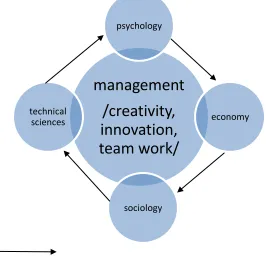
Interdisciplinary exploration can relate to the technical sciences, economics, psychology,
sociology (Figure 1). Management science can integrate other sciences to create new
substantive and methodological links for the designers of future enterprises.
Research teams working in particular areas develop their own resources of knowledge,
but their creative energy can rarely be added together to create a value greater than its parts. This is because team leaders have a tendency to create “small words” that do a poor job of
exchanging knowledge with their environment. It is even more difficult to exchange information
between different disciplines and intellectual groups, which are often not very flexible in the
pursuit of unifying their resources for a common goal. Referring to the graphical interpretation of
Licensed under Creative Common Page 5
five fields of science highlighted below, in order to form “healthy” interdisciplinary teams with
positive processes of knowledge exchange.
Figure 1. Dimensions and environmental factors for the exchange of knowledge
Flow of knowledge
Source: Own research
The exchange of knowledge resources among specific areas of science can create new
knowledge to be shared and integrated into management science, which in some ways acts as
a knowledge broker. By forming a partnership based on knowledge resources and the potential
synergistic value of various fields of science, companies can develop a new system of
cooperation under the leadership of management science. The value of rational reasoning taken
from the most "hard" engineering methods and econometric models, can be complemented by
the "soft" dimensions of psychology and sociology (which are closely related to human
resources), integrated by management science.
The synergistic binder of exchange and learning makes it possible to achieve common
organizational and strategic goals (e.g. for the organizations of the future), which would be
difficult to obtain by individual companies. Cooperation releases extra energy and creates a
process-oriented company focused on creativity, innovation, learning and team work.
management
/creativity,
innovation,
team work/
psychology
economy
sociology technical
Licensed under Creative Common Page 6
The ability to gain new common knowledge and transdisciplinary, resulting from the pooling of resources held by individual members of creative teams − understood here as integrated teams of university researchers and creative workers of enterprises in various fields − may be used in
developing models for organizations of the future (Czarniewski, 2015, pp. 1-8). The formation of
various solutions is carried out for a defined purpose and as various levels of effectiveness in
teams at different levels of the organization. Their forms are selected depending on the
conditions and needs of its users, using instruments of management sciences.
Structural integration as a new challenge for the organization of the future
An environment for the exchange and integration of diverse knowledge is created with four main
dimensions in mind: creativity, innovation, learning and teamwork, which serve as the pillars of
the future potential of knowledge. Stimulating a knowledge sharing environment occurs through
dynamic interpenetration of these dimensions, in which the circulation of knowledge can be
directed and channeled as an integration process, process-network or network. This is
dependent on the conditions and development phases of specific forms of organizations of the
future.
Since process and network organizations are prepared for continual change, combining
their attributes can provide adaptive solutions where there is more process or network
characteristics between the different levels of the organization. Dynamic diffusion of knowledge
and fragments of the accepted approach to structural integration would aim to harmonize the
four environment dimensions of knowledge exchange in order for the creative teams responsible for various processes to be “entwined” by the network structure, enabling
communication, flow of the knowledge etc., for the integration of various tasks and
harmonization of knowledge potential.
Important issues include the duplication of creativity and the acquisition of experienced
employees gifted with great creative potential, as well as the ability to search for teams with a
penchant for innovation, generative thinking and acting, etc. Organizations built on such teams
will be in constant motion and will be subjected to constant transformation. The ability of future
organizations to adapt to change will be the result of successful integration of processes,
networks, and teams with individual and diverse characteristics. This new form of organization,
treated as a whole, will trigger the phenomenon of synergy and stimulate continual change
(Czarniewski, 2014, pp. 259-269). Models of future organizations created by theorists and
practitioners take into account such qualities as:
focus on creativity, innovation and team work,
Licensed under Creative Common Page 7
creation of organizations based on knowledge,
resources dominated by the human factor,
processes dominated by learning,
management dominated by knowledge,
a structure dominated by flexible structural solutions.
Creativity and innovation as determinants
of the optimal development of the company of the future
The term creativity has made an outstanding career in recent years and unfortunately, there
have been several examples of misuse of the term. It is important to understand that creativity
includes creative potential and ingenuity (Luecke, 2005, p. 121). Creativity is the capacity to
create new ideas, unconventional solutions and concepts. The most significant elements of
innovation are creative solutions.
Creativity plays a key role in the Cyber-Age. In the present reality we need creative
solutions and ideas in order to maintain competitiveness and to cope with the continually
accelerating development of technology and all the burdensome changes around us. This leads
to continuous innovation, visible in all the changes that allow for the creation of new values and
have a lasting impact on reality. Innovation is a combination of key issues connected with
creative solutions and building rational case for why an initiative is worth implementing. The
scope of innovation is very wide and can literally concern everything. It can start with small
changes and end at groundbreaking transformation. That is why it should be remembered that
as the scope of innovation expands, it becomes increasingly risky.
Innovation is context sensitive. Depending on the context, innovation can have a positive
or negative effect on the value created. We tend to associate innovation only with its positive
effects. But we should keep in mind that what for one group of beneficiaries is positive, for
another group can be seen as a negative. To describe innovation in simple words, it is the ability
to innovate. To develop this ability the following is necessary:
The ability to use one’s legacy by exploring and evaluating its value. Being able to
abandon the shadows of the past and focus on the future, oriented towards a desirable
vision (designing the future).
Creativity and innovation. Creative people are the most valuable resource of the
organization, but today most innovation is implemented by carefully selected teams.
Partnership and cooperation. Most innovation is the result of the team effort. The key is
Licensed under Creative Common Page 8
Computer literacy skills. Nowadays it is difficult to develop innovation without adequate
competence and deliberate planning in the area of ICT.
Providing adequate resources and support such as: open space, technology, qualified
people, access to information and knowledge.
Education plays a significant role in the development of key competencies associated
with innovation. Self-education and self-leadership has become very important in the
development of skills.
How can one develop a culture of innovation in the company which has not yet benefited from
innovative program implementation? Culture, in economic terms, is the expression of attitudes,
behaviors, and preferences of customers. A culture of innovation in the enterprise is achieved
when employees at all levels of the organization are committed to supporting, promoting and
implementing new products / services / business models, and the three main roles adopted by
them in the performance of innovation, are leaders, creators and champions of innovation
(Schwartz, 2013).
The creator (genius) develops ideas, starting from constructive criticism, to new
solutions, to inspection and evaluation of innovative products. One cannot innovate if one
accepts reality as it is now or as it was yesterday. A creator has a vision of how to improve or
modify a product or service to increase its functionality. Such a person has the ability to build
and transform, has unconventional ideas and is able to rise above the gray reality.
A champion of innovation supports, encourages, and directs the course of the innovation
process in the enterprise in a practical and systematic way. They take direct responsibility for
finding creators of new ideas (geniuses) and support them in finding innovative solutions, acting
as mentors. They are at the center of the company's organizational hierarchy, acting as links
between senior managers and other employees.
Innovation leaders shape, or influences the shape, of the basic structure of a company
clearly focused on innovation. They build the base structure of the company, starting from the
organizational structure, to its principles, objectives, and priorities. By setting ambitious goals,
they highlight the link between the strategy of the organization and the desire to innovate
(Sungmin, Soonhong & Nobuhide, 2008, pp. 48-58).
Innovation leaders put innovation at the top of their list of priorities. The ideal situation in
an organization is for the creator, champion and leader to work together, complementing each
other, exchanging roles, being contextual and consciously pursuing the strategy of innovative
Licensed under Creative Common Page 9 CONCLUSIONS
1. It seems that the organization of the future will increasingly have influence over the
attitudes and behaviors of customers in the market. The economics of consumer
experience is one such global trend, resulting from increasing consumer demands and
experiences, which is underrated by the theory and practice of business. Meanwhile, a
proper consumer experience can significantly increase the value of the product, and
the value of experience can be a strategic tool used by organizations in a similar way
as to marketing. It is therefore worthwhile to properly shape the emotions and
experiences of customers. One way to do this is to be engaged in the design phase of
consumer goods and services, an activity which is increasingly being used by
companies that have already realized it is one of the sources of competitive
advantage.
2. The inevitability of the exchange of intangible resources between organizations
stimulates the process of sharing up to date and diverse knowledge. The expansion of
cooperation between enterprises enable these processes through the holistic
integration of knowledge and structural interdependence. It has become more
important for individual organizations to possess the ability to work together with others
rather than their ability to excessively compete. The new structure of organizations,
defined by their ability to reconfigure processes, by their ability to learn and be
creative, by their flattened team structures, etc., is triggered by a new organizational
reality, requiring preparation for the creation of new concepts of organization and
management.
3. Organizations of the future based on various paradigms can enrich not only the theory
but also the practice of management. Under the leadership of creative teams
specializing in management science, new paradigms can be developed by specialists
in various sciences. Business models of organizations of the future will evolve in the
direction of integration and cooperation. There will be an emergence of multi-faceted
relationships based on processes, teams and networks. We do not know what form
future organizations will take, but probably they will have most of the features listed
above. Variable structures of the common resources of knowledge, awareness of
change and the willingness to facilitate continuous learning to achieve adaptability and
flexibility are the emerging models for organizing in the future.
4. The issue of reconciling scientific theory with practice in models for organizations of
the future is made possible by the integration by management of the problems
Licensed under Creative Common Page 10
and experience, and by fulfilling the need for dialogue between theory and practice.
Prospects for practical applications of methodological assumptions and design models
for organizations of the future will depend on the short and long term trends occurring
on the global knowledge-based economy.
FUTURE RESEARCH
Future studies (analysis) should be focused on create new concepts of organization and
management in business. Developing countries can improve their growth rates through trade by
importing knowledge from selected countries. The benefits (also selected organizations) may
occur through increased innovation, imitation or the use of such knowledge in production
(services). Market size and competitive are dominant factors in explaining innovation in
developing organizations, whereas high-technology imports, human capital to have a stronger
impact on developed organizations.
Future empirical research should be focused main in areas high-technology (information
technology). Modern information technologies contribute to overcoming physical barriers such
as time and space, and greatly reduce transaction costs. The use of technology allows the
company to move a part of their activities into virtual space and make their operations more
dynamic. Organizations of the future are often treated as network organizations that intensively
use modern technologies, which affects their reaction time in specific areas of business.
REFERENCES
Ackoff, R.I., Magidson, J. & Addison H.J. (2007). Projektowanie ideału. Kształtowanie przyszłości
organizacji. Warsaw: Wydawnictwo Akademickie i Profesjonalne.
Alvesson, M. (2004). Knowledge Work and Knowledge-Intensive Firms. Oxford: Oxford University Press. Brett, R. (2002). Creating Intelligent Organization. The Journal for Quality Participation, Winter.
Czarniewski, S. (2014). Types of Competition in the Market in the Context of New Value for Customers. International Journal of Academic Research in Business and Social Sciences, 4(12): 259-269.
Czarniewski, S. (2015). New Dimensions of Marketing and the Economic Condition of the Company.
European Journal of Research and Reflection in Management Sciences, 3(1): 1-8. Gabriel, Y. (2008). Organizing Words. Oxford: Oxford University Press.
Hagel, J. & Brown, J.S. (2006). Organizacja jutra. Zarządzanie talentem, współpracą i specjalizacją. Gliwice: Wydawnictwo Helion.
Luecke, R. (2005). Zarządzanie kreatywnością i innowacją. Warsaw:MT Business. Morris, L. (2006). Permanent Innovation. California: Innovation, Labs.
Porter, M.E. & Kramer, M.R. (2011). Creating Shared Value. Harvard Business Review, January-February.
Licensed under Creative Common Page 11 Raich, M. & Dolan S. (2008). Beyond Business and Society in Transformation. Palgrave MacMillan. Raich, M., Dolan, S. & Klimek, J. (2011). Globalna transformacja biznesu i społeczeństwa, Warsaw: Publishing Difin.
Schwartz, T. (2013). Sześć tajemnic tworzenia kultury innowacji, www.hbrp.pl/news.