2906
Reading Program Delivery In Public Elementary
Schools: Students’ Perspective
Glenda L. Morales, Dr. Eugenio S. Guhao Jr.
Abstract: This study investigates the phenomenological experiences of pupils in reading program delivery in public elementary schools, their coping mechanisms and insights utilizing qualitative data gathering techniques through in-depth-interview and focus group discussion to solicit responses from 21 key informants in Sarangani Division for the School Year 2016-2017. The students shared that among their experiences were sense of learning inadequacy; sense of insecurity; lacklustre strategies in teaching reading; and disinterest and lack of enthusiasm. As to th e coping mechanism of the students, the themes generated were: family assistance and involvement; reading consistently and regularly; being resourceful and seeking help; and being focused and self-controlled. Finally, the students stressed their insights as to: good reading brings advantages and benefits; good reading requires focus and hard work; and good reading requires discipline.
Keywords: Educational Management, Reading Program Delivery, Public Elementary School, Student Perspective, Philippines
————————————————————
1. INTRODUCTION
―Reading should not be presented to children as a chore or duty. It should be offered to them as a precious gift‖ -Kate DiCamillo-The quotation explains how reading should be loved among children without forcing them to read but letting them embrace the passion, for them to appreciate its importance. The fascination and the joy of reading in their primal years is a vital achievement among children in school and subsequently, they will grow successfully in the future. They find pleasure in the construction and creation of chunky and folly words on games and utterances. Global publication of the National Endowment for the Arts(NEA) showed an alarming data that less than one third of 13-year olds are daily readers, a 14% decline from 20 years earlier and which has been found to continually decrease. Most are engaged in other things like texting, watching videos, games and the like; as a result to their interest and amusement brought by reading is non-enjoyable anymore (Moss &Schutz, 2001; Riley, 2010; Dyslexia International, 2014).Nowadays all facets of life are linked to reading. Reading and studying foreign or local news journals to appreciating classical materials, make an individual grasp and understand its meaning and importance but still millions worldwide in needy places hover to improve literacy, while others in modern countries, refuse to learn more and prefer not to learn despite the innate capacity to improve themselves, making them steadily illiterates (UNESCO, 2005). Researches show that despite reading interventions, a number of slow and non-readers are still existing in schools. An argument on the potency of a Reading Program is still accessible among many specialists and investigators but developing sum of information showed that these programs are helpful for students educational learning (Dubois, Holloway, Valentine, & Cooper, 2002; Ritter, Denny, Albin, Barnett, & Blankenship, 2006; Zief, Lauver, & Maynard, 2006; Gordon, Morgan,
OMalley, & Ponticell, 2007). To understand how the reading program is being delivered in schools, it is necessary to identify the gaps in the existing research. One of these is the very low results of the reading assessment in public schools in the Philippines, particularly in my handled district using the Philippine Informal Reading Inventory (Phil- IRI). More study is needed on the delivery of reading program in schools to better understand if and how much reading programs have impacted the learning of the students. This study reveals limited qualitative studies on students perspective as a whole. Although numerous researches on reading and its interventions were conducted, but few researches have aimed to understand students perspective, experiences, and thoughts (Denton, Solari, Ciancio, Hecht & Swank, 2010).The majority of my teaching experience has focused on teaching primary grade children how to read. As a district head, reading specialist, and a teacher, I have observed how a child's early successes or failures in learning to read notably influence the child's life. Currently, I have had the opportunity to evaluate reading methods and K-12 language arts methods to students and supervise teachers as part of the reading delivery program. As a result of my experience, I have become increasingly interested to emphasize with the side of the students, as to their plights about the program.I have not come across a similar study that dealt with the reading program delivery in public elementary schools: students perspective. Therefore, in this context, I am interested to know the experiences of these students as these can raise concern to the intended beneficiaries of the study, and to come up with the implication to practice; thus, the need to conduct a study.
1.1.Purpose of the Study
The purpose of this phenomenological study was to describe how the reading program delivery is being conducted in public schools with the contention to gain better understanding on students perception in reading.This study envisioned to document the different experiences of students in reading on the context of their understanding and motivation in the reading program delivery in school. This will present the students information on their personal views in reading, their experiences in school and peers, how they cope with the challenges they have experienced, _________________________________________
Glenda L. Morales, Dr. Eugenio S. Guhao Jr.
University of Mindanao Professional Schools
and what insights they could give as a students. In this study, the intention was to hear intently and to take the full grasp of the different unfolded stories of the students perception in the reading program delivery in schools as they shared and narrated the complexities they experienced.
1.2.Research Questions
1. What are the experiences of students in the Reading Program delivery?
2. How do students cope with the difficulties of improving their ability under the Reading Program?
3. What insights can students share in relation to the Reading Program of the school?
1.3.Theoretical Lens
This study is viewed from the lens of Bandura (1986) on Social Learning Theory since people learn from one to another via observation, imitation, and modelling which bridge between behaviour and cognition skills among learners. This encompasses attention, memory, and motivation with the belief that one is capable of performing in a certain manner to attain certain goals. Bandura also stressed that motivation, performance, and feelings of frustration associated with repeated failures determine behaviour relations. Since reading requires rigorous action, learners have the option to read or not to read. However, this still needs the personal willingness to learn (Baker & Wigfield, 1989). This is also supported by Lewins (1999) Expectancy-value Theory which stressed that when a learner felt resentful due to their low confidence to carry out an assignment, still their interest will fail to endure. This requires teachers to give immediate interference due to the absence of interest among students.The level of aspiration that man has stored strength is labeled as pressure. This pressure developed in human beings behaviour that gives absolute or adverse effect over his/her intentions. This explains that the affective domain of a certain individual such as behaviour, emotions, and experiences manifested unjustifiable and undetectable issues which contributed to students learning, particularly in reading. The significance of ones affective domain is considered one of the very important variables in the study of motivation, which is synonymously considered as the study of learning (Brophy, 2006; Kohn, 1999; Lewin, 1999; Lewin & Leonard, 1940; Schunk et al., 2013; Weiner, 1990). Furthermore, Social Constructivism Theory is viewed as the basics in the facilitation of instruction. In a constructivist class environment, various strategies are used in bracing students learning. One of this is a minute group which focuses on instruction of reading skills and pedagogies. Benefits to the constructivists learning approach include individualized or differentiated instruction with small groups proportionate to the number of learners and teachers (Tomlinson, 2001). This only shows that learning is highly determined by social interaction and enforces unique considerations (Gergen, 1985). This further tells us that each learner is special, and has the dimensions to facilitate and improve his/her knowledge, and is being influenced through the environment of peers, and the people surrounding him. Social constructivism emanated from Piaget (1954), Vygotsky (1978), and Jerome Bruner (1986).
It is well-understood that the learning perceived by the mind is the by-product of learners’ active presence within the environment he/ she is playing in, which is so-called an open system (Vygotsky (1978). Human beings’ social attributes have made their intellectual nature through the process of internalizing what is within the world where he/she had been immersed for quite some time (Luria, 1982). When a very young kid manifested ways of learning from the self, surely this is made through the influence and support of others. This further explains that the child’s cognitive development happens when there is a skilled and proficient person who would be an aid to him/her, and whatever learning they have perceived earlier will intervene in their intellectual exercise (Rogoff, 1990). Certainly, when a learner translates words into correct actions on which he/she perceives, the child is expected to grow as a productive individual in the community (Tomasello, 2003). Through these cited theories, teachers are considered as the persons capable to facilitate, bridge, and influence learners to cope with their reading difficulties, so that in one way or the other, the reading learner can comprehend the association and relativity between the material and its meaning (Atkinson, 2002). This further explains that the child’s learning is being formed and fitted into common and healthy exercises in their day-to-day life. It is not just in the mind but housed in all reading resources and peers that an individual has; therefore, when a student learns, he/she interacts, then intellectual development is formed (Bruner, 1990).
2.
REVIEW OF RELATED LITERATURE
2.1.The Nature and Importance of Reading
2908 pastime exercises than reading. Students of today who can
read are predicted to resist reading due to the monotony of materials within the curriculum, which they have found so tough and uninteresting and not related to their interest. The 1987 Philippine Constitution also stressed the right to education of every Filipino and the State shall protect and promote the right of all citizens to quality education at all levels and shall take appropriate steps to make education accessible to all. This has been reiterated in Republic Act 9155, on the accountability of school heads to facilitate innovative strategy to achieve higher learning outcomes among learners (Cornwall, 2010; Bureau of Labor Statistics, 2005). Reading is a fundamental need among schoolers before reaching third grade in schools. Learners who have been identified with below-proficiency readiness crave a continuing reinforcement and has lesser opportunity to be in the formal program and most likely to be left behind from their classmates in reading performance and other subjects within the program. Poor academic performance, interest and self-confidence, and the struggle with attitude have had adverse result. Nonetheless, reading skills can be corrected by descripting interference in the early grades. A Compelling reading plan, and actions of interference produce competent readers which would impede and cut down the figure of slow and non-readers (Duffy-Hesler, 1999; Allor, Mathes, Roberts, Cheatham, & Champlin, 2010; Sloat, Beswick & Williams, 2007). One of the most critical arguments and concerns in learning is the reading disparity among graders during their fundamental school years in school. Teachers are required to produce sound readers after learners are through with their prime years. It was revealed in a study that 40% of schoolers from the public is a taboo in reaching the ideal standards in reading. This consists of schoolers who belong to the deprived group, of an indigenous condition, and with few English-competent youngsters. Coping learners will gain from the teachers when given extra means of instructional delivery in their everyday routine in school, coupled with adequate intervention (Allington & Gabriel, 2012; Chambers et al., 2011; Haagar, Dimino, & Windmueller, 2007; Hester-Duffy, 1999). Reader is to resolve the reading problems among children through proper teaching. The choice of teachers in the delivery of teaching frequently thwart the process which satisfying readers demand. Given engaged teaching in reading, educators can be assure that each learner can read. The Number of good and engaging teachers need to be allowed and exposed to primary readers. The farther the learners will be exposed to reading, the better they will comprehend and endure reading in later years. In addition, connection to personal choice of words enhances reading skills (Allington & Gabriel, 2012; Honig, Diamond, & Gutlohn, 2000). To and hasten reading skills and understanding, learners are required to read with 98% mastery. Proper placement which is parallel to each learner, allows them the possibility to comprehend correctly what they have read. The availability of reading materials is not just the need of every learner to acquire and improve comprehension skills but they need to have a correct, fierce, and laudable advancement in instructional reading. Paragraph reading with appropriate words and correctness at their aligned level will surely develop word appreciation, translation, and text-inquiry proficiency. More exposure of
learners to words that they cannot read will make them deprived of the skills and the more that they will be discouraged on the complexities of the words, the more they will fail to develop their comprehension, inspiration, and certainty of learning (Apthorp et al., 2012; Carlisle, Kelcey & Berebitsky, 2013; Allington & Gabriel, 2012). In addition, reading fluency and effectiveness of interventions can be done in many ways. This can be made through small group discussion, individualized teaching, computer-aided facilitation, book provisions to bring home as reinforcement, auxiliary vocabulary programs and skills development for teachers. Educators therefore should give resources appropriate to each learners level to frame and flourish efficiency in skills and knowledge in reading, since the contention for every learner is to read (Chambers et al., 2011; Davidson, Fields, & Yang, 2009; Gibson et al., 2014; Harding, 2012; Kennedy, 2010; Tivnan & Hemphill, 2005).
2.2.Issues, Barriers, and Concerns on Reading Delivery
role is very crucial and challenging upon identifying the different needs of struggling readers with various reading difficulties to provide the best reading intervention practices. Getting the proper instruction in reading from teachers is a very effective way to harness their knowledge building since reading is a very essential tool for learning. Becoming an effective reader affects all the learning areas of a student which therefore strengthens their foundation during their elementary years to achieve academic success that has a big impact in the success of their future career paths. Living in the information age poses a lot of challenges for educators in using technology to enhance reading instruction and reshape reading habits (Kruidenier, MacArthur, & Wrigley, 2010; McShane, 2005; Van Dyke, Fixsen, Blase, Duda, Metz & Naoom, 2010). However, even if the teacher learns to meet this challenge, the principal concern today still has to do with how reading instruction can be improved using tested strategies and techniques by translating teaching theories into practice. In short, the main challenge to educators is to focus on effective classroom work and to help the readers-at-risk. Reading is the basic tool for learning in all subject areas to be successful in school, a child must have skills in reading (Brooks, 2007; Hidalgo, 2001). Because of this, reading has always been regarded as the primary key to learning in the total educational process. A child who learns this skill quickly and easily is often considered as superior and is likely to experience academic success. On the other hand, poor reading skills lead to a lower overall academic achievement and first grade seems to be a critical development period. It is possible that some children are falling behind their peers and they could be at risk of failure (Eurydice Network, 2011; Guthrie & Ludz Klauda, 2007). Furthermore, the population of students considered at high risk of reading failure is increasing. The gap between poor readers and their progressing peers widens over the elementary years. This is the reason why most schools organize remedial reading programs to fill the gap between children reading within the grade level and those who are reading below grade level. Reading gap is a term used to describe the difference between the target level of proficiency and the actual level of proficiency. With proper instruction, about 85% to 90% of students in any classroom should be able to read text for a particular grade level (Kennedy et al., 2012; Nugent, 2001; Nugent, 2010).
2.3.DepEd Reading Programs
Nevertheless, in the Philippines, few classrooms attain this goal. The Department of Education Region 1 implements the Every Child a Reader Program (ECARP) and administers a region-wide Oral Reading Diagnosis which is usually done in July. Another oral reading test is conducted before the school year ends. In July 2002, an Informal Reading Inventory (IRI) was given to Grades II-VI pupils in all schools in the region. Out of 346,625 pupils tested, 31,695 or 9.14 percent were found to be non-readers (most are from Grade II); 100,091 or 28.87 percent were on frustration level; 160,840 or 46.40 percent were on instructional level; and 53,999 or 15.58 percent were on independent level (Rief & Stern, 2010).This shows that some children are still reading below grade level. This even shows that by the end of Grade I, there are still
2910 constancy on the practices of learned experiences in school
is a consideration of reading beliefs. The attitudes to reading of children mean appreciation and the feelings of antipathy is within their experience in reading. Statistics on various researches have been combined to prove the relation of reading attitudes and comprehension and prevailing feelings about reading. More so, emotion on the other hand is a very important element of the communal development of inspired schooling. The essential consideration on the features of the interest to acquire knowledge, is always considered as part and parcel of a huge integrated structure which consists of intellectual and physical segments of activities that persuade literature and wisdom (Conlon, Zimmer-Gemeck, Creed & Tucker, 2006; Petscher, 2010; Reschly, 2009). Empathy as defined in relation to societal synergy and is a critical indicator for learners intellectual and interest. Adverse affection has verified to block the intellectual accuracy necessary to gain interest in learning while affirmed affection had displayed importance on rewarding attainment. Manifested success on interest is directly referred to the product of action of a certain individual. Triumph on accomplishing a function is an output of an achievement interest and the teacher-learner assessment had given impact on attainment disposition (Meyer & Turner, 2006; Pekrun, 2006). Retrospective or reflective affection is related to earning advancement or breakdown, and the sense of cheer, and grief, or resentment which is secondary or the by-product of a task. The decisive condition of affection can be capable immediately upon a learner awaits a common reading class full of cheers. A denying reflective affection may be felt when a learner will trash to join a meeting due to experiences which is related to low output. Emotions can be repeated which can advance to negative attitude’s, and continual adversity employs apprehension over the given task. This can recommend immediately an intervention or program addressing the negative emotions (Pekrun, 2006).Further, decisive and adverse emotions absorb strength, and can trim down the intellectual investment required to facilitate completion of a certain work. If decisive emotions is on the right track, absorption of cognitive development will prosper, and the pressing results will have a higher learning outcome which is formative and will create various approaches of learning. On the contrary, adverse emotions tend to develop minimal facilitation of learning. It portrays weaker ways in resolving issues and problems. This only tells that decisive emotions promote better learning and is independent, while adverse emotions are dependent on the outside (Pekrun, 2006). Many experiences have been encountered in reading. Monotony, failure, embarrassment are just but few of the emotions that learners have encountered. When the learner starts reading which resources are within his reach and meaningful, appreciation sets in, but when a learner starts reading of which materials not within his reach, the feelings of antipathy will be experienced, and no engaging development will occur. Outside forces which enable human beings to respond is an incitement that allows individual to balance or to stand with evenness and maintain the systems structure (D’Mello & Graesser, 2012; Schunk & Rice, 2018). Nonetheless, educators should implement the best possible instructional tools for reading
entire school staff in disseminating the vision of making reading instruction to deliver quality education is only attainable through effective leadership (Fong, Finkelstein, Jaeger, Diaz, & Broek, 2015; Gatti, 2016; Gatti & Miller, 2011) Effective research-based proven practices should be the school’s objective, and should be prioritized by the school principal through nurturing a culture that value research oriented reading programs, responsible for proliferating resources, allocating time, and continuing the course pattern maintenance. He should be armored with firm ideals that enable others to resist the stumbling blocks to implement effective reading program, and equipped with values and high spirit to proactively participate in other curriculum building areas or to any locality and state mandated reforms (IEE, 2016; Jaciw, Schellinger, Lin, Zacamy, & Toby, 2016). It is not just the task of the school principal but also the school administrator to create a working committee that will identify a leader in every specialized task to form an organization of unified leadership team.This team will be essential to successful program implementation. The first year of the implementation of a new reading program hosts the challenges of changing teachers beliefs about reading instruction and introducing and familiarizing the new reading research-based approach. The second year tackles about the refinement of the approach while promoting consistency and sticking to the design of the program. The third year, however, poses a new challenge, described by one Sacramento educator as domestication (Kidron & Lindsay, 2014; Kim et al., 2017). Educators familiarity with a program could result to innovation by wanting to alter, adjust and introduce personal ways in applying it or in simplest terms domesticating it that latter results to program diminished effectiveness, for other materials opposing the objectives with the selected program such as old ineffective reading methods may be put again into practice and the core elements of the chosen program may be neglected. It is during the second and third year of an implementation that the school leadership faces its most pressing obstacles. This is when staying in power is essential. During these periods the school leadership should have the best research to support the continuity of the reading program. The principals, will serve many roles as the responsibility implementer of the reading program. Principals should be able to come up to a strategic plan and research based evaluation through intensive intervention to measure teacher's efficacy in implementing the reading program through assessing students achievement (King & Kasim, 2015). A summary of research findings shows that reading performance of students in Americas middle and high schools is one of the most important problems in American education. In 2015, the National Assessment of Educational Progress of American schools (NAEP; NCES, 2016) reported that only 34% of eighth graders scored at or above proficient. This is up somewhat from 1992, when 29% of eighth graders scored proficient or advanced. At the twelfth grade level, 37% of students scored at or above proficient, a slight decrease from 40% in 1992. Secondary reading is advancing very slowly, despite the schools substantial focus on reading at all levels, paired with massive federal and local reading programs and fund allocation. According to the OECD Program for International
Student Assessment (PISA), the mean performance of American 15-year-old students have been from 2000 to 2009, proportionate to the struggling reader (King & Kasim, 2015; OECD, 2010). Furthermore, the OECD (2013) survey of adult competencies shows that the average reading level of American young adults (16-24 years old) is below the international average for developed countries. Significant gaps continue to exist between groups. While 44% of white eighth graders scored at or above proficient on NAEP, only 16% of African American students, 21% of Hispanic students, and 22% of American Indian/Alaska Natives did so (NCES, 2016). Among students qualifying for free lunch, only 20% scored at or above proficient. At the twelfth grade level, 46% of white twelfth graders scored at proficient or better, but the proportion was 17% for African Americans, 25% for Hispanics, and 28% for American Indian/Alaska Natives. In all of these groups, scores have been essentially static since 1992, the first year NAEP currently reports. The lack of progress in twelfth grade reading, combined with recent increases in high school graduation rates (from 73% to 82% from 2006 to 2013; NCES, 2016), suggests that the number of students graduating from high school with very low reading levels must be increasing substantially (Kushman, Hanita, & Raphael, 2011; Little, McCoach, & Reis, 2014). As a result, students who are not good readers during their high school years have higher chances of dropping out or to graduate, but landing menial jobs. Serious difficulties await those entering college, being poor readers in their high school, and passing remedial English courses would still be a tough deal. Building reading capacities as early as elementary level would prevent this untoward incidences to happen in child's academic path. Building the reading habits and skills of students in secondary level requires even more advance strategies; nevertheless, innovating and devoting time for research and extension should be a never ending conquest for educators as oath to the commitment of delivering a quality education for all (Little et al.,2014; Lloyd et al. 2015; Lord, Bradshaw, Stevens, & Styles, 2015).
3.
METHODOLOGY
2912 applied to minimize presuppositions to prevent potential
harmful effects of presumptions that may affect the research process, thereby improving the precision of the research study. The researcher will be vigilant at all times, aware of his/her own views and the pre-existing beliefs on the study, and must learn to set aside his/ her own prior knowledge and experiences to fully capture the experiences being told by the participants with an open mind (Starks & Trinidad, 2007; Taylor, 2012; Taylor & Francis, 2012; Tufford & Newman, 2010). In the conduct of this qualitative study, I will be interested to know how things happened and how people interpret their experiences, and how they find meaning to these (Merriam, 2009). Through phenomenological reduction, the researcher will simply reduce the realm from its being perceived naturally, with all biases and judgement to a realm of pure phenomena (Dowling, 2007). Thus, the essence of the phenomena is allowed to surface. In addition, the participants own words will be used throughout the process of data analysis and phenomenological description. The process of bracketing will be employed throughout the course of the study. The method will be examined and phenomena scrutinized through the subjective eyes of the participants, which will be focused on subjectivity of reality and will continually pointing out the need to understand how humans view themselves and the world around them, and in the process, the researcher will set aside her personal experiences and opinion to fully grasp the experiences of the participants, identifying its essence (Creswell, 2007). This makes the phenomenological approach very good at surfacing deep issues. In my study, I needed to make the voices of the secondary students heard, regarding their experiences and challenges as they venture the reading delivery of teachers in school. It will be focused on what the participants have in common in their experiences of the phenomenon. I will consider the multiple realities experienced by the participants themselves---the insiders’ perspectives (Davis, 2007). Nonetheless, sources of qualitative data included interviews, observations, and documents (Creswell, 2007; Giorgi, 2009; Locke et al, 2010; Suter, 2012), emphasizing two ways of collecting data if one wanted information about the living experience of a phenomenon from another person, the traditional face-to- face interview and the written account of the experiences, both could not be broken down easily by statistical software. In this study, I will use specific methodologies such as in-depth interviews, focus group discussions, and note-taking, giving much attention to details and importance of the emotional content to open up an array of human experiences of the subjects in the study. What one seeks from a research interview on phenomenological research is a complete description as possible of the experience that a participant has lived through (Giorgi, 2009). By using a descriptive phenomenological approach, preconceptions about the students experiences will be documented before the study and will be compared to what will transpire and flexibility and openness will be observed, which will be connected maintain a fair amount of ambiguity (Strauss & Corbin, 2008) have a useful and positive output. In this research study, I needed to classify themes of the phenomena with twelve participants for in-depth interviews and nine participants for focus group discussion. According to
Creswell (2006) in qualitative research such as phenomenology, it is recommended that for in-depth interviews, researchers could interview 5-25 participants who had experienced the same phenomenon, if one would want to achieve the goal of representativeness and generalizability as criterion, from a small number of research participants . Nevertheless, sample sizes of 10-15 are adequate provided participants can to provide rich descriptions of the phenomena (Speziale & Carpenter, 2007). Moreover, Hancock et al., (2009) further stated that focus groups are considered to work quite well approximately with eight people.
3.1.Ethical Consideration
Since my research study involved secondary students, they were hesitant to disclose information due to fear of their teachers and the administration. To ensure they have trust, the study was guided with ethical principles namely respect, persons, beneficence, justice, consent, and confidentiality( Mack et al., 2005). Respect for persons requires a commitment to uphold the autonomy of the research participants. This will protect them from exploitation of their weaknesses. Before conducting the study, I secured permission from the Division Heads, Superintendents, and Head of Colleges or schools where the data from (Creswell, 2012). Informed and voluntary consent is a mechanism to ensure that people understand what it means to participate in a particular research study, for them to decide in clear and deliberate manner. This is one of the most important instruments for ensuring respect to the seated person in authority. Letter content bearing the objectives, purpose, beneficiary and all should be indicated to establish support from them. Participants will likewise be informed of the findings and results in respect to their participation on the research to be conducted. Beneficence requires a commitment to minimize the risks which may be associated to the participants, including psychological and social risks and to maximize the benefits that the participants may have (Mack et al, 2005). Confidentiality of the findings and protection of the identities of the participants by hiding their true names/identities. Participants need to be informed that Maree and Van der Westhuizen (2007) recommended that the entire database be destroyed upon completion of analysis. Justice requires a commitment in ensuring fair distribution of the risks and benefits resulting from the research. It is imperative to make a method of acknowledging the contributions that research participants will make to the success of the research process and to pay them or reimburse them in their efforts (Bloom & Crabtree, 2006).
4.
RESULTS
4.1.Experiences of students in the reading program delivery
in your reading ability after the pretest? How do you feel every time the teacher asks you to read in front of the class? What did your teacher do to improve your reading ability? Why? Do you think your teacher is successful in helping you improve your reading skills? How about your parents? What motivates you to read? From the data collected on the experiences of the study participants four main themes emerged as presented in Table 1. These are the following: Sense of learning inadequacy; Sense of insecurity; Lacklustre strategies in teaching reading; and Disinterest.
Table 1
Themes and Core ideas on Experiences of Students in the Reading Program Delivery
Major
Themes Core Ideas
Sense of learning inadequacy
Teacher need to strengthen her teaching so we will learn some more
Teachers effort not enough; there are still many who cant read
She does not really teach reading all the time; only when she has time
We are just told to read; teacher has other work to do
We do nothing else but read by ourselves in class.
Teacher needs to push us some more; many still cant read
It seems our reading practice is not sufficient. Sometimes we have no class; when teacher is called at the office.
We dont really read every day; I have no confidence yet
We just read; teacher does no explanation
Sense of insecurity
I get frustrated because I know little about reading.
I dont know much because there is more writing activity than reading.
My reading level is just ordinary; there are some words I cant read.
I feel edgy because classmates might tease me when I read incorrectly
I get tense and uneasy when I read; nervous that I might slip up.
I am rather slow in reading; cant read some books in school yet
I cant read complex English words.
Lackluster strategies in
teaching reading
Sometimes we read then have dialogue; do puzzle
We are told to read from 7:50 to 8:10 then answer questions
She makes us read one by one in front of the class so that all will hear.
We read and then analyse the story teacher told us to read.
After reading, we answer the questions on the story we are reading.
We read individually and also as a group; she reads then we repeat
Our teacher gives us activities like writing, listening; makes us behave
If something is wrong with our reading, teacher corrects it right away.
We are made to read over and over again every afternoon.
I do not really listen in class; just keep clowning around
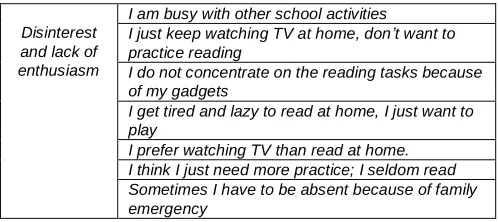
Disinterest and lack of enthusiasm
I am busy with other school activities
I just keep watching TV at home, don’t want to practice reading
I do not concentrate on the reading tasks because of my gadgets
I get tired and lazy to read at home, I just want to play
I prefer watching TV than read at home. I think I just need more practice; I seldom read Sometimes I have to be absent because of family emergency
4.2.Coping with the difficulties of improving your reading ability under the reading program. From the data collected through the above questions, four main themes emerged from the responses as shown on Table 2. These are Family assistance and involvement; Reading consistently and regularly; Being resourceful and seeking help; and being focused and self-controlled.
Table 3
Themes and Core Ideas on How Students Cope with the Difficulties of Improving Reading Ability under the Reading
Program
Major Themes Core Ideas
Family assistance and
involvement
Mother helps me in reading, spelling and writing essays.
My tita helps me with my lesson; parents are not around.
My father, mother and sister help me with my reading subject.
Mother guides me in reading correctly. Parents help me; also my grandma.
Mother and father wants me to read instead of watch TV
My mother assists me in making my reading assignments
It helps if someone guides me in reading, I easily learn
Reading consistently and
regularly.
I try to read every day at home; concentrate in reading
I answer questions and practice oral reading especially of difficult words.
I read sometimes though I get bored reading. I just practice reading books so that my speed in reading improves.
I read morning, noon and night time.
I study every day; practice reading; concentrate
Read frequently; I keep practicing
Keep practicing to increase vocabulary
Being resourceful and
seeking help
I read the dictionary to increase vocabulary words
Reading Apps in the gadget can help a lot
Learn to use the dictionary when reading I use E-book on Wattpad for my reading material
I ask help from teacher for some difficult words. Seek help from others if there is difficulty in reading some words
Ask assistance from classmates and peers We have reading enhancement after flag ceremony.
I participate in reading remedial.
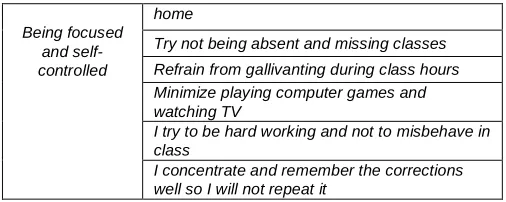
2914 Being focused
and self-controlled
home
Try not being absent and missing classes
Refrain from gallivanting during class hours Minimize playing computer games and watching TV
I try to be hard working and not to misbehave in class
I concentrate and remember the corrections well so I will not repeat it
4.3.Students’ insights on the value of reading
In support to this research problem, three questions were raised during the in-depth interview and FGD namely: What insights can you share as a student in relation to the reading program of the school? What advice can you give to your classmates in order that they can improve their reading ability? What do you think are the importance of reading in your study? The responses of the informants are presented in Table 3.
Table 4
Themes and Core Ideas onInsights that Student can Share about the Value of Reading
Major Themes Core Ideas
Good reading brings advantages and
benefits.
Life is difficult for those who cant read Reading will help us understand our lesson better
Learning how to read properly is very important in life
Wherever one goes, reading will be an advantage
When you grow up, you will easily get hired for a job
We can use skill in reading when we get a job in the future
When you have your own family, you can also teach your children
If you know how to read, you will feel confident When you apply for a job, your reading skill will be useful
Reading well will help me realize my goal to be a teacher
Good reading requires focus and hard work.
Increase the effort to read with comprehension Practice at home what teacher taught in the classroom
Always remember for whom the efforts are for Concentrate and keep trying even if it is difficult Endeavour to understand the lesson
Be hard working and exert more effort in reading
Give value to your studies
Take to heart what teacher taught in the classroom
Listen to teacher always even if reading is tiresome and boring
Good reading requires discipline.
Minimize playing computer games; high tech gadgets
Avoid cutting classes and being absent from classes
Do not be lazy to read; do not misbehave in class
Lessen play; behave properly; understand what teacher is saying
Listen to your parents advice; be serious with studies
5.
DISCUSSION
5.1.Experiences of Students in Reading Program Delivery
Yes, its definitely true, but how can we instill it in the young minds of the students. We do all know that confidence in reading is silence but insecurities are loud. Half of the participants revealed that they are so afraid to commit mistakes while reading in front because they will be bullied and teased by their classmates. Anna told me that she was nervous on reading then committing mistakes. This was also too the feeling of Edmund, he was afraid because his classmates will tease him if read the words incorrectly. With the study of L. Murphy (2012) the paradox that teachers face in developing students’ personal relationships to reading is that readers who do not feel confident about their abilities are less likely to take the risks involved in approaching new kinds of texts. Meanwhile, there are those who belong to the confidently beautiful reader, as they evaluate their skills in reading. Sally proudly said that she can read, she is confident. While Jane with humbleness in her heart said that she can read but she will be very happy if she reads correctly as she has now the idea of reading it right. Talking still about confidence in reading, Murphy (2012) also added that teachers can build confidence to students who have insecurities in reading. Moreover, during the FGD, some participants revealed that because they are too shy to read in front, when they were called up to read in front, they felt shocked and uneasy the moment they read. But unlike Daniel( pseudonym) a grade six student, he was excited to be called because he wanted recognition from his teacher. This was substantiated by Fletcher et al., (2011) and Daves et al., (2011) that at-risk students who respond inadequately to empirically validated instruction differ from at-risk students with adequate intervention responsiveness in the severity of their impairment in key cognitive domains and also in brain function, when engaged in reading tasks. Majority of the participants in FGD felt nervous and excited. So, teachers really need to extend hours a little bit in the reading delivery remediation. This would help enough them realize that reading is a cool, magical and interesting habit to develop. Lackluster Strategies in Teaching Reading. The participants also vented out their emotions towards the reading delivery program. In the case of informant Anna(pseudonym) she shared that they only have this reading program for 20 minutes. They read also in the afternoon, but after that the teacher will give activities. Comparing answers from the FGD participants two of them mentioned that they just read a short story then answer the questions after reading. Lackluster which means lacking of interest of teacher in reading activity, it was discussed a while ago on teachers overlapping of works as well as activities in school. As explained by De Bruijn and Leeman, (2011) that teachers have a lot of works. On this theme also some participants like Daniel, (not his real name) said that their teacher, just let them read, this was also concurred by Jane, she didn’t know about reading delivery program, all she knew that there is a so-called reading enhancement in English subject, if they pronounce incorrectly then they repeat it again for corrections. In the case of Kevin (pseudonym) they read sometimes and Jolly’s (pseudonym) statement is parallel also with Kevin. According to them both of their teachers were busy doing paper works and asked for cooperation not to disturb while they are working. As viewed by Fisher (2011), because of the workoverload of a
teacher she/he will most likely have a loss of idealism and enthusiasm for teaching that will ultimately lead to poor teaching practices, thus leading to poor student achievement. Disinterest and Lack of Enthusiasm. While airing out their sentiments, it was also revealed that the problem on reading program delivery is this theme as based on the consensus of the participants answers. As quoted by Dennis Mannering that enthusiasm is contagious, start an epidemic today. That’s why there are students influenced by their environment to engage more in leisure time than reading. They think that of reading as an obstacle in their lives. Yet, our students are called as the millennial as what they saying. Being a millennial you must be into high-end technology, which mainly students nowadays are engaged in. During the FGD (focus group discussion), one participant vented that she loves playing than reading, enjoys running, and playing more than anything. Some cases were, because of the gadgets given by his mother, he cannot concentrate then and others mentioned their being busy in school activities. According to Palani (2012) nowadays, reading habit has lost its importance as both the young and the old are glued to the television. Parallel to idea of Palani, she pointed out that many students nowadays prefer to watch movies and other shows on the television, listening to audio-CDs and watching video-CDs (Issa 2012). In the foregoing views of our participants, when analyzing, it seemed that they are confronted with not just their ability to read but the lack of interest. It was affirmed by Sally (pseudonym) that she always watches T.V and hang-out with friends rather do the reading enhancement program. In the case of Anna (pseudonym) she plays always than expanding her vocabulary through reading. With the statement of Edmund ( not his real name) he is not listening to his teacher while having reading remediation, he straightforwardly said. Alden (pseudonym) revealed that he is not listening too and he likes talking much to his seatmate. Some says they are always absent in school. Adıgüzel and Karadaş (2013) found out on their study that students with a high level of absenteeism will result poor attitudes towards school. It was stressed by Lin et.al (2012) that some of the reasons why student tend not to attend school more often associated with unfavorable school setting conditions. Participants also revealed their laziness during the reading program and being noisy in the class, talking a lot that annoys some classmate and even the teacher. There was also one participant bravely said, the lack of books, they shared most of the time, where the ratio is 1:2. So it disrupted her and she lost her motivation in reading. But, whatever their sentiments, they are just expressed what they feel and know.
2916 disclosed family involvement and assistance as a strategy
in coping with difficulties in improving reading ability. The majority of the participants said that their mother took the initiative to develop reading abilities at home. Alden (pseudonym) said that sometimes his mother teaches him how to read. Unlike Sally and Jane ( not their real name) that both their parents really assist them in reading, and seldom their siblings. Meanwhile in Anna’s (pseudonym) situation, because her parents were too busy at work, so her aunt took their place. Janine’s (pseudonym) statement agrees with Anna. Although, some parents’ time in assisting in their children’s needs were limited, but they can still be aware of and supportive on child’s progress (Grolnick, Friendly, & Bellas, 2012). Parents’ beliefs and expectation strongly influence students academic success. Gayle (2010) is of the opinion that parents who introduce their preschool aged children to books and read to them on a daily basis resulted in to greater reading knowledge and is linked to school readiness in later years. The earlier parents become involved in their children’s reading practices, the more profound the results and the longer lasting the effects. But, unlike Janine, although her both parents wanted her to read with their assistance, she was reluctant because she wanted much to play outside with friends. Remember the fact that the child who reads a lot out shines the one who does not read. Another theme which emerged from the study participants is reading consistently and regularly is a favored to be a coping mechanisms of the students in improving reading ability. As confirmed by the informants, persistent reading improves your ability in reading. Anna said that if you are a good reader then you can teach children in the future. Likewise Sally, expected the benefit of reading habitually is that if somebody asks your help in reading then you can share your knowledge. As substantiated by Green (2011) the reading habit is best formed at a young impressionable age in school, but once formed it can last a life time. When you develop it then it becomes your life. You cannot live a day unless you have read one book. Bashir and Mattoo (2012) pointed out that reading habit is the strongest weapon to excel in life. It is parallel to Janine and Jane’s responses, as reading will improved them so much, specially during the question and answer portion in teaching-learning processes. As far as Kevin’s statement is concerned, reading is needed to have comprehension. But, Daniel’s perspective was he needs to read regularly for him not to be bullied during the reading enhancement program. Some stated that reading consistently teaches you to be a fast reader and will improve you a lot. Reading habitually creates a literate society as Palani(2012) stressed in his studies on the reading habit. It shapes the personality of individuals and it helps them to develop proper thinking methods, and creates new ideas. Additionally Issa (2012) pointed out that reading consists of the individual’s purpose- it’s either for relaxation or information. Like Jolly, she reads because she was entertained by the pictures. Reading is the most important skills to develop and reading is also the key to all forms of information for our survival and growth (Issa, 2012). Improving skills on reading ability is difficult, so you need to be resourceful and you must seek help. This theme emerged based on the participants’ points of views; generally, they seek help to improve their abilities
5.3.Insights of Students about the value of reading Typically the study participant disclose that reading is significant in helping others who do not know how to read. As Mentioned above, the NAEP found out that out of 10 students, 7 of them have difficulties in reading. It good to share to the students the benefits of reading. Daniel expressed his deep notion towards the importance of reading; through reading you gained lot of ideas. Strive more in reading, because if not there was no learning at all, he exclaimed. On the other hand, Sally and Kevin shared that wherever you go there is reading. Reading is everywhere. Consequently, Capen (2010) stated that even if the student is a reader, she/he has an option to read or not; unless motivated, that is the time she/he reads. It is a challenge to teachers how to create a motivated reader. But as described by Becker, McElvany, and Kortenbruck (2012) a student is motivated if the setting of classroom environment is good and there is rapport. Teachers should begin having this intrinsic motivation in reading (Froiland et al., 2012). Thinking for the future brought the ideas of Jane and Kevin, that for them this is for their future. Reading is where their future life begins. They both have the same idea of using it in work. Sharing what you have learned in reading and helping others to be corrected is what some of the participants believed. In addition to the above responses, Gambrell (2011) stated that the most important thing the student can learn during her/his career is learning to read. Nowadays, as students belong to millennials, increasingly year by year, the habit of reading slowly fades away because of the gadgets, so teachers had this hard time to motivate children to read (Froilan et, al. 2012). So, therefore teachers must create and cultivate the love of reading in the students for them to become life-long readers. Jolly’s statement concurred with this. Learn to read for you to answer those questions asked by the teacher. Good Reading requires focus and hard work.The value of reading makes everything worth learning for. But reading requires focus and hard work. It is not simplex, it is complex. Kevin reiterated that one must push harder and give more effort to improves one’s reading skills. Reading skills is needed to learn everything. In connection with Kevin’s statement, Jane too, answered that reading harder and balancing between in reading and playing is a must. She also added reading at home is significant and a key to uncovering difficult words. Edmund stressed the importance of listening to the teacher would be a great help. Furthermore, majority of the participants in the focus group discussion (FGD) responses focused on refraining from playing and concentrating on improvement. For a fact, it is advantageous on students’ part if she/he knows how to read. Reading needs discipline. Based on the general responses of the participants in their insights on the value of reading, good reading requires discipline. This major theme emerged because they believe it has many benefits, such as academic excellence, reading accuracy and speed and communication skills. Alden’s view is that listening and refraining from playing too much is discipline. Parallel to it Jane said laziness in reading is a hindrance towards achieving good reading skills. Unlike Sally, who said that seeking help from the teacher and siblings would help too. Behaving properly and understanding what the teacher is saying is part also of discipline.
5.4.Implications For Practice
2918 their guardians and siblings. Summarizing their responses
as a whole, it gives positive result if parents do promote the importance of reading. Those students with active parental involvement are most likely to excel at school and develop good relationship on their peers, teachers and principal. On Reading consistently and regularly. Through the responses of the study participants it was shown the effectiveness of reading regularly and consistently to develop the reading habit to bridged the gap between difficult words and their meanings. It improves their ability a lot. Furthermore, we know in fact that reading is the fundamental skills a child needs to learn. Developing reading habits early leads to a life long love of books. This implies that the Deped, again together with the whole department should provide enough books, more references, more variety of books to all places that have a school, whether the school is located in the rural or urban, books sufficiency should be visible. School heads and teachers should also promote the love of reading, do everything to awaken students interests to read. That printed materials are more important than those soft copies in internet. Neuman (2014) stressed the ways children will be motivated to read, first reading for them as early as the young age, be a model in reading habits and asking him what he/she reads all about. In that way, you can develop a good reader who is motivated enough to read through the rest of his/her life. The results of this study imply that students are more active in playing games rather reading. Teachers should promote also the reward system as part of discipline. Absenteeism will not help also. Students and teachers should collaborate to maintain the importance of focusing and having discipline in reading.
5.5.Concluding Remarks
The investigation on the students’ perspective on the reading delivery program has accentuated the relevance and the essential component to the learning process of elementary students. As a researcher and educator, I have done my contribution towards the realities behind the reading program delivery. I do believe that the findings of this study would lead towards students realization on the importance of reading.The results of this study clearly substantiated the effectiveness of the reading delivery program whose purpose is that, students ability in reading will be given the topmost strategic plan in the school implementation plan, as it addresses children with reading difficulties and for children to perform well academically to improve their reading accuracy speed and comprehension. The findings have proven that if a student will read regularly, the improvement in reading skills will follow through.The data from the two methods of data gathering employed in this study proved to be similar and parallel. The focused group discussion further validate the components of the qualitative method triangulation technique. Validation of data through cross validation comes from more than two sources: First, the literature on the reading delivery program; second, the in-depth interview, and the third, the focus group discussion. In this study, I learned that the most important lesson in the implementation of reading delivery is to make good use of time to maximize learning. In addition to student learning time, teachers need regular time to collaborate and plan together, and to analyze and plan from student assessment
data. On the other hand, in the most effective schools, teachers spend more time in small-group instruction. This can be a powerful means of providing differentiated instruction to meet students needs. During small-group instruction, both the pace and complexity of teaching can be adjusted. To make the best use of small-group instruction, the most effective schools function as teams. For implementation to be effective, there must be a interrelated connection and interplay between the schools and the students’ parents. After class, reading through follow up reading assignments is so important to develop reading proficiency. Parents must thoroughly understand the school expectations for outside reading, as an important aspect of the nature of the reading program, so they can have strategies that they can use at home. Parent education and parent engagement are vital, in the early grades of developing children. Supplementary readings taken at home such as decodable books is necessary for fluency development. Parents should understand what these books are used for and how to help their youngsters use them. Parents can also fill vital tutoring roles. Children who need additional support can receive it through well-trained parent volunteers.This study contributes to the collection of experiences, insights and perspectives from the key informant students to shed light on the phenomenon of the effective delivery of the reading program. It also bring opportunities and ideas for future researchers to study related researches in the field of reading programs. I have validated that by improving child ability in reading, positive results are shown in their academic performance, reading accuracy and rate, vocabulary, pronunciation of the words,and attitudes in their school life.
6 REFERENCES
[1] Adıguzel, A., & Karadas, H. (2013). The level of effect of high school students’attitudes towards school on their absenteeism and school success. YYÜEğitim Fakültesi Dergisi, 10(1), 49-66.
[2] Albin, R. C., Barnett, E. H., Blankenship J., Denny A., & Ritter I. A. G. (2006). Becoming a nation of readers: The report of the commission on reading. Washington, DC: National Academy of Education, National Institute of Education, Center for the Study of Reading.
[3] Allington, R. L., & Gabriel, R. E. (2012). Every child, every day. Educational Leadership, 69(6), 10-15.
[5] Amendum, S. J., Vernon-Feagans, L., & Ginsberg, M.C. (2011). The effectiveness of a technologically facilitated classroom-based earlyreading intervention. The Elementary School Journal, 112(1), 107-131. doi: 10.1086/660684
[6] Amparo, L. (2011). Stress, culture, and community: The psychology and philosophy of
stress. New York: Plenum Press. [7] Anderson, N.J. (2012). Reading instruction. In J.
Richards & A. Burns (Eds.),Cambridge guide to pedagogy and practice in language teaching (pp. 218-225).Cambridge, UK: Cambridge University Press
[8] Apthorp, H., Randel, B., Cherasaro, T., Clark, T., McKewon, M., & Beck, L. (2012) Effects of supplemental vocabulary program on word knowledgeandpassage comprehension.Journal of Research on Education Effectiveness,5(2), 160-188.
[9] Atkinson, M.(2002). Multi-agency working: models, challenges and key factors for
success. Journal of Early Childhood Research, 3(1), 7-17.
[10] Baker, F., & Wigfield, M. (1989). Effects of a peer-mediated phonological skilland reading comprehension program on reading skill acquisition of middleschool students with reading disabilities. Journal of Learning Disabilities,
38(5),424–433
[11] Bandura, A. (1977). Social learning theory. New York: General Learning Press
[12] Bandura, A. (1986). Social foundations of thought and action. Englewood Cliffs, NJ: Prentice-Hall. [13] Bashir,I. & Mattoo, N. H.(2012). A study on study
habits and academicperformance among adolescents (14-19) years. International Journal of
Social Science Tomorrow, 1, (5)1-5. [14] Bashir, M., & Mattoo, A. G. (2014). Reading habits
among students and its effecton academic performance: A study of students of Koforidua Polytechnic.Library philosophy and practice, 0_1. [15] Bashie, A. L., Olabisi, O. T., & Temitayo, O. O.
(2019). Research Article Palynological Analysis of Late Holocene Sediments and its
Paleoenvironmental Interpretations from Lagos Coastal Environment, Southwestern Nigeria.
[16] Becker, M., McElvany, N. and Kortenbruck, M. 2010. Intrinsic and extrinsicreading motivation as predictors of reading literacy: A longitudinal study.
Journal of Educational Psychology, 102(4): 773–785.
[17] Bhan, K. S., & Gupta, R. (2010) Study habits and academic achievementamong the students belonging to scheduled caste and non scheduled
caste group. Journal of Applied Research in Education, 15(1),1-9
[18] Brooks, G. (2007). What works for children with literacy difficulties? Theeffectiveness of intervention schemes. London: Department for Children, Schools and Families.
[19] Bloom, B., & Crabtree, B. F. (2006). The qualitative
research interview. Medical
education, 40(4), 314-321.
[20] Boyce, C., & Neale, P. (2006). Conducting in-depth interviews: A guide for designing
and conducting in-depth interviews for evaluation input.
[21] Bricki, N., & Green, J. (2007). A guide to using qualitative research methodology.
[22] Brophy, J. E. (2006). History of research in classroom management. In C. M.
[23] Evertson & C. S. Weinstein (Eds.), Handbook of classroom management: Research, practice, and contemporary issues, 3(43). Mahwah, NJ: Lawrence Erlbaum.
[24] Bruner, J. (1990). Narrative learning. Routledge. [25] Bruner, J. (1986). Using narrative inquiry as a
research method: An introduction to using critical event narrative analysis in research on learning and teaching. Routledge.
[26] Bureau of Labor Statistics (2005). Emerging benefits: access to health promotion benefits in the United States, private industry, 1999 and 2005. Washington, DC: US Department of Labor, Bureau of Labor Statistics,104.
[27] Calisle, J. F., Kelcey, B., Berebitsky, D. (2013). Teachers’ support of students’
vocabulary learning during literacy instruction in high poverty elementary schools. American Educational Research Journal, 50(6), 1360-1391.
[28] Campbell, A. (2015). Polygamy in Canada: legal and social implications for women and children, a collection of policy research reports. The Alberta Civil Liberties research Centre. Retrieved from from qix.sagepub.com/content/16/6/441.refs.html. [29] Campbell, J. (2011).Introductive methods to
qualitative research: course notes.
[30] Retrieved from
jasonjcampbell.org:http://www.jasonjcampbell.org.
[31] Capen, R. (2010). The role of the teacher and classroom environment in reading
motivation. Illinois Reading Council Journal, 38(4), 20-25.
[32] Carcary, M. (2009). The Research Audit Trial—
Enhancing Trustworthiness in
Qualitative Inquiry. Electronic Journal of Business Research Methods, 7(1). [33] Chambers, B., Slavin, R. E., Madden, N. A.,