File fragment recognition based on content and statistical
features
2
. Ahmad Keshavarz
1
Marzieh Masoumi
1Deparment of Computer Engineering, Tehran Science and Research Branch, Islamic Azad University, Bushehr, Iran.
2Electrical Engineering Department, School of Engineering, Persian Gulf University, Bushehr, Iran.
Email: [email protected], [email protected]
Abstract: Nowadays, speed up development and use of digital devices such as smartphones have put people at risk of internet crimes. The evidence of present crimes in a computer file can be easily unreachable by changing the prefix of a file or other algorithms. In more complex cases, either file divided into different parts or the parts of a file that has information about the file type are deleted, where the file fragment recognition issue is discussed. The known files are divided into different fragments, and different classification algorithms to solve the problems of file fragment recognition. A confusion matrix measures the accuracy of type recognition. In the present study, first, the file is divided into different fragments. Then, the file fragment features, which are obtained from Binary Frequency Distribution (BFD), are reduced by 2 feature reduction algorithms; Sequential Forward Selection algorithm (SFS) as well as Sequential Floating Forward Selection algorithm (SFFS) to delete sparse features that result in increased accuracy and speed. Finally, the reduced features are given to 3 classifier algorithms, Multilayer Perceptron (MLP), Support Vector Machines (SVM), and K-Nearest Neighbor (KNN) for classification and comparison of the results. In this paper, we proposed the algorithm of file type recognition that can recognize 6 types of useful files ( pdf, txt, jpg, doc, html, exe), which may distinguish a type of file fragments with higher accuracy than the similar works done
Keywords: Classification Algorithm, Feature Reduction, File Fragments, File Fragment Recognition, SFS, SFFS.
1. Introduction
Computers deal with a large number of file
with different formats, which are transmitted
among networks. The format of a file is an initial
design of it that tells the processor devices how
to organize the file information and describe
their decoding algorithm in digital storage
devices. The security of computers and networks
reduces without the correct detection of the file
type. Detecting the file type is a significant step
in adequate proceed of operating systems,
firewalls, intrusion detection systems, and
anti-viruses.
The content-based algorithm includes
investigating the file content and using static
techniques. The contents of the file are a chain of
bytes, and each byte has 256 unique characters
(0-255). Therefore, the calculation of the byte
pattern rate, referred to as the byte distribution
rate provides a recognizable pattern for different
file types.
McDaniel and Heidari [1] were the first to
develop an algorithm for recognizing the file
types based on content. Their proposed
algorithms are used to generate a "fingerprint" of
each file, which are detected compared with the
known types, and file types. The accuracy varies
between 23% and 96% depending on the
algorithm used.
Li et al. [2] made slight changes to the
McDaniel's model, which increased its accuracy.
They provided a set of central models and used
the categorization to find the minimum number
of centers set with good performance while using
more data patterns. This research has the
accuracy of 82% (single central) and 89.5%
(multi-center) with 93.5% of more sample files.
Karresand and Shahmehri [3] provided an
algorithm for file fragments, which used the BFD
and the standard deviation concept for file type
modeling. Karresand and Shahmehri proposed
the Oscar methodology for detecting the file
fragments. They generated single-center printing
files but used a quadratic distance metric and a
norm-1 as the metric distance to compare the
center with the byte frequency distribution of the
file. Although Oscar recognized any file type,
they reported their algorithms for jpg files using
the specified pair bytes of the optimized file and
the detection rate of 99.2%.
Veenman [4] extracted three features from
the file's content. These features include:
1. Frequency byte distribution
2. The entropy obtained by frequency byte
distribution of files
3. The complexity of the algorithm or the
Kolmogorov that uses the sequence of the
substring
Fisher’s linear discriminant analysis has
been applied to these features to recognize the
file types.
Calhoun and Coles [5] used a static
algorithm and the linear FISHER one for a
dataset containing 100 fragments of 2 different
(depending on the tested bytes chain). They have
developed the Veenman works by the
constructed classification models and presented
the linear discriminant to recognize the file types.
Further, they have examined machine learning
algorithms to solve the data classification
problem and achieved a reasonable accuracy.
Sportielo and Zanero [6] have considered a
set of SVM classifications for each file type. The
results of several experiments show that the
features based on the byte frequency distribution
have the best performance for most of the
examined file types, where the SVM is very
effective in distinguishing file types from the
data blocks.
Gopal et al. [7] introduced the File Type
Recognition (FTI) as a significant issue in digital
rules and provided a systematic review of the
problem, algorithmic solutions, and evaluation
methodologies. They analyzed the power of
various algorithms in examining the files and
damaged fragments. They also proposed two
criteria for replacement in performance
measurement as follows:
1. Considering the file name extension as the
correct tags (labels)
2. Considering the prediction by
knowledge-based algorithms in healthy files as the
correct tags (labels)
The conclusion was that the SVM and KNN
are better than COTS (Commercial off-the-shelf)
in files that the extensions for sound files are
available. Also, some COTS algorithms can
detect the corrupted files by no means.
Moody and Erbacher [8] used the static
analysis to recognize the file type (SADI), which
includes the mean, standard deviation, average
distance, standard deviation distance, and
calculation of the bytes values. They used the
fragments of 200 files from a dataset of 8 known
files, which had a 74.2% result.
Dunham et al. [9] applied the neural
networks for categorizing ten file types from a
dataset, including 760 archived files with an
accuracy of 91.5%.
Like et al. [10] adapted the BFD model with
the Manhattan distance for comparison to
determine whether the calculated files are
executable or not.
Cao et al. [11] used the Gram frequency
distribution and the vector space model with a
40.34% result.
Ahmad et al. [12] presented two algorithms.
First, they applied the cosine distance as a metric
of similarity when comparing the file contents.
Secondly, they divided the recognition process
into two steps by Dividing and Conquering
algorithms. In the first step, the similar files with
the same byte frequency patterns are classified in
different clusters. In the next phase, the
classification, including various file types, is
given to the neural networks to improve the
categorization. They used 2000 different file
Ahmad et al. [13] also proposed two new
algorithms to reduce the classification time. First,
they used the Feature Selection technique and
KNN classifier. The second algorithm was the
sample content technique in which they used a
small portion of the file to achieve the byte
frequency distribution.
As described in this section, many works
have been done in this approach, but then again,
unfortunately, they did not specify their datasets.
Moreover, they used both different types of files
and datasets, which caused impossible conditions
to compare them correctly with each other.
In 2015, in an experiment, Nasser Alamri
[14] compared six different file types (pdf, txt,
jpg, doc, html, and exe) with 5 algorithms
presented on the specific database, and then
provided the way of comparison in future
studies. We also chose Nasser Alamri's article to
compare the suggested algorithms. Thus, we
applied the same database and file types with
Alamri [14] that provides a reasonable
comparison for the present study. The purpose of
this research was to recognize the file fragment
types with higher accuracy than the similar
research works due to the widespread use of this
issue as well as its sensitivity to the correct
recognizing file type. In the following, the
dataset, the methodology of the proposed
algorithm, and the obtained results were
described. Finally, the results of this study were
compared with the results of Naser Alamri study
in 2015.
2. Methodology
The train and test sets provided by dividing a
file into small fragments. Hence, we fragment
complete files, but at first, we cut the header and
prefix of files, which may contain information
about files type. Then, we divided the rest of
each file into 2 fragments of 500 and 1000 bytes,
to show the effect of fragment size on the
accuracy of the presented methods in the study.
As illustrated in figure 1, SFS and SFFS
algorithms were used to reduce the fragment size
of the studied file and select the dynamic
features. The KNN, SVM, and MLP algorithms
were employed as file type detection algorithms.
The LIBSVM Package was employed for SVM
classification and, MATLAB Toolbox
AutoEncoder was utilized for the neural network.
DATASET
(FILES) BFD
SFFS SFS
CLASSIFIER
KNN, SVM OR MLP
TXT
JPG
DOC
HTML
EXE PDF
Fig.1.The Methodology implemented in this work
2.1 BFD Extraction and BFD Normalization
The byte frequency distribution (BFD) was
used as the feature extraction algorithm. After
obtaining the array bytes values rate, each
member of the array was distributed by the byte
frequency rate. Accordingly, the array was
normalized to values between 0 and 1. Figure 2
displays the BFD diagram for the 500-byte
fragments and Figure 3 further shows the BFD
Fig.2. The BFD graph for the 500-fragment
Fig.3.The BFD graph for the 1000-fragment
2.2 Feature Reduction
Different feature selection algorithms strain
to find the best subset among the n2 candidate
subsets. These algorithms increase the accuracy
and speed by eliminating the outliers. We
adopted SFS and SFFS algorithms in the present
study as feature reduction algorithms. We tried
several parameters for k, and finally, the KNN
algorithm with K = 5 was considered as the
criterion for feature selection. With the
algorithms mentioned, 256 features, which
obtain from BFD, were reduced to 24 and 39
features. We performed the feature selection
process on all 500 and 1000 byte fragments. The
corresponding results are given in Table 2.
2.2.1 Preliminaries
In advance of describing the corresponding
algorithms formally, the following definitions
have to be introduced. Let 𝑋𝑘 = {𝑋𝑖: 1 ≤ 𝑋𝑖 ≤
𝐾, 𝑋𝑖 ∈ 𝑌} be the set of k features from the set
𝑌 = {𝑦𝑖: 1 ≤ 𝑖 ≤ 𝐷 } of 𝐷 available features.
The value 𝐽 (𝑦𝑖) of the feature selection criterion function if only the 𝑖𝑡ℎfeature𝑦𝑖 = (𝑖 =
1,2,) used will be called the individual
significance 𝑆0(𝑦𝑗)of the feature.
The significance 𝑆𝑘−1(𝑥𝑗)of the feature 𝑋𝑗, 𝑗 =
1,2, … , 𝑘 in the set 𝑋𝑘is defined by:
𝑆𝑘−1(𝑋𝑗) = 𝐽(𝑋𝑘) − 𝐽(𝑋𝑘− 𝑋𝑗)
The significance 𝑆𝑘+1(𝑓𝑗) of the feature 𝑓𝑗from
the set 𝑌 − 𝑋𝑘
𝑌 − 𝑋𝑘 = {𝑓𝑖: 𝑖 = 1,2, … , 𝐷 − 𝑘, 𝑓𝑖 ∈ 𝑌, 𝑓𝑖
≠ 𝑋𝑡 𝑓𝑜𝑟 𝑎𝑙𝑙 𝑥𝑡 ∈ 𝑋𝑘}
So, 𝑋𝑘is defined by
𝑆𝑘+1(𝑋𝑗) = 𝐽(𝑋𝑘+ 𝑓𝑗) − 𝐽(𝑋𝑘)
For K = 1 the term feature significance in the set
coincides with the term of individual
We shall say that the feature 𝑥𝑗 (b) from the set
𝑋𝑘is (a) the most significant (best) feature in the
set 𝑋𝑘 if
𝑆𝑘−1(𝑋𝑗) = max
1≤i≤k𝑆𝑘−1(𝑋𝑖) ⇒ 𝐽(𝑋𝑘− 𝑥𝑗)
= 𝑚𝑖𝑛
1≤i≤k 𝐽(𝑋𝑘− 𝑥𝑖)
(b) The least significant (worst) feature in the set
𝑋𝑘 if
𝑆𝑘−1(𝑋𝑗) = 𝑚𝑖𝑛
1≤i≤k𝑆𝑘−1(𝑋𝑖) ⇒ 𝐽(𝑋𝑘− 𝑥𝑗)
= 𝑚𝑎𝑥
1≤i≤k 𝐽(𝑋𝑘− 𝑥𝑖)
We shall say that the feature 𝑓𝑗 from the set
𝑌 − 𝑋𝑘 is (a) the most significant (best) feature
with the set 𝑋𝑘 if
𝑆𝑘+1(𝑓𝑗) = max
1≤i≤D−k𝑆𝑘+1(𝑓𝑖) ⇒ 𝐽(𝑋𝑘+ 𝑓𝑗)
= 𝑚𝑎𝑥
1≤i≤D−k 𝐽(𝑋𝑘+ 𝑓𝑖)
(b) The least significant (worst) feature
concerning the set 𝑋𝑘 if
𝑆𝑘+1(𝑓𝑗) = min
1≤i≤D−k𝑆𝑘+1(𝑓𝑖) ⇒ 𝐽(𝑋𝑘+ 𝑓𝑗)
= 𝑚𝑖𝑛
1≤i≤D−k 𝐽(𝑋𝑘+ 𝑓𝑖)
2.2.2 Sequential Forward Selection (SFS) Algorithm
In the "sequential feature selection" (SFS)
algorithm, the process starts with an empty set.
Then, in each repetition, a feature is added to the
answer set by employing the evaluation function
used. This is repeated until the selection of the
required features [15]. Using SFS, we achieved
24 features and 36 for 500-byte and 1000-byte
fragments, respectively.
1. start with an empty set 𝑦0 = {∅}
2. Choose the next best features
𝑥+ = 𝑎𝑟𝑔x∉yk𝑚𝑎𝑥𝑗(𝑦𝑘+ 𝑥)
Update set
𝑥+ = 𝑎𝑟𝑔
x∉yk𝑚𝑎𝑥𝑗(𝑦𝑘+ 𝑥)
3. Return to step 2
2.2.3 Sequential Floating Forward Selection (SFFS) Algorithm
First, the sequential floating forward
selection (SFFS) algorithm begins with an empty
set of features. For each step, the best feature that
satisfies the criterion function is placed in the
current set. That is, one stage of the sequential
forward selection is performed. The SFFS
progresses with dynamic increasing or
decreasing of the feature numbers to achieve the
optimal number of them [16]. Using SFFS, we
obtained 36 and 39 features for the 500-byte and
1000-byte fragments, respectively.
1. start with an empty set 𝑦0 = {∅}
2. Choose the next best features
Update set 𝑘 = 𝑘 + 1 و 𝑦𝑘+1= 𝑦𝑘+1+ 𝑥+ 3. Choose the worst features 𝑥− =
𝑎𝑟𝑔x∉yk𝑚𝑎𝑥𝑗(𝑦𝑘− 𝑥)
4. If 𝑗(𝑦𝑘− 𝑥) > 𝑦𝑘
𝑘 = 𝑘 + 1 و 𝑦𝑘+1= 𝑦𝑘− 𝑥−
Return to step 3
Else
2.3Classification
At the stage of categorizing the type of file
fragments, the acquired features are used as
inputs in three algorithms, KNN, SVM, and
MLP as described below.
The KNN algorithm is a simple supervised
algorithm that stores all available cases in
different categories based on a similarity
measure and classifies new cases [17]. The k
parameter displays the number of closest
neighbors in the feature space. We used a KNN
algorithm with k = 4, 6, 8, and 10; the results are
illustrated in table 3 for 1000-byte and table 5 for
500-byte fragments.
The SVM algorithm is a supervised
algorithm that performs classification by finding
the hyperplane, which maximizes the margin
between the two classes [17]. In this study of file
fragment recognition, we use SVM algorithm as
the second classification approaches with Radial
Basis Function (RBF) kernel as well as a
different c parameter, c = 0.1, 0.2, 0.3, as shown
in table 3 for 1000-byte and table 5 for 500-byte
fragments.
The MLP is the third classification algorithm
used in the study. It is a type of feedforward
neural network, which may differentiate data that
is not linearly separable [17]. We use MLP with
1 hidden layer and sigmoid activation function as
shown in Figure 4 and the result in Table 3 for
1000-byte and table 5 for 500-byte fragments.
Fig.4.The MLP used model in this study
We tried several parameters in each
algorithm to obtain the best result. The
corresponding results are given in Table 4 for
1000-byte and Table 6 for 500-byte fragments.
3.Dataset
The standardized Govdocs1 dataset,
containing 1,000 lists of 1,000 content files, was
used in this research. From 3 random folders of
this database, we extracted 100 files from each
sample of txt, jpg, htm, and pdf (totally 600 files)
with a minimum size of 4Kb. The exe files were
obtained from Windows system files by
considering their minimum size. The data
applied in the program are standard data that are
used extensively in similar studies; these are
available at the following address:
http://digitalcorpora.org/corpora/govdocs.
In the present research, we focused on the
file types included in the dataset section; the
Table 1.files types type numbe r minimu m size maximum size average size doc 100 12,800 9,023,488 345,796 exe 100 4,724 6,440,448 187,498 txt 100 4,061 1,063,025 391,526 htm 100 4,008 16,497,395 76,370 jpg 100 4,023 7,778,639 162,012 Pdf 100 4,710 10,891,418 608,778
4. Implementation Results
In this section, the results obtained from the
implementation are analyzed, and finally, the
result of the proposed algorithm is compared
with other available algorithms. We presented
the results of the implementation of the proposed
solution in two parts of 1000-byte and 500-byte
fragments. For both 1000-byte and 500-byte
fragments, we reduced the features obtained
from BFD components via SFS and SFFS
algorithms. At that point, we gave the reduced
set of features to the SVM, KNN, and MLP
classifier algorithms. The accuracies of the
classifiers are given in the tables. The results
presented in the tables are the outcomes of 10
repetitions of the algorithm with various
parameters. The best result of each classifier
algorithm with a different combination of the
training rate and the corresponding parameters of
the feature reduction algorithm for 1000-item
fragments are shown in Table 3.
Table 2.Feature reduced results
algorithm The Number of
features selected
For 500
fragments The Number of
features selected For
1000 fragments SFS 24 36 SFFS 35 39
Table 3.Results of 1000 fragments
para meter classifi er algorith m Number of features Train∕ test accur acy
MLP SFFS 39 90/10 95%
K=4 KNN SFS 36 90/10 96%
K=6 KNN SFS 36 90/10 97%
K=8 KNN SFFS 39 90/10 97%
K=10 KNN SFS 36 90/10 97%
C=0.1 SVM SFFS 39 90/10 97%
C=0.2 SVM SFFS 39 90/10 98%
C=0.3 SVM SFFS 39 90/10 98%
The best results obtained in 1000-byte
fragments with the best possible combinations
are given in Table 4 below.
Table 4.The best results of 1000 fragments
classifi er algorith m Number of features Train∕tes t accuracy
MLP SFFS 39 90/10 95%
KNN SFS و SFFS
36 or 39 90/10 97%
SVM SFFS 39 90/10 98%
According to Table 4, the MLP algorithm
accuracy of 97%, and the SVM algorithm with
an accuracy of 98% completed their process in
the 1000-byte fragments. Accordingly, the SVM
algorithm is considered the best algorithm for
recognizing the 1000-byte files with an accuracy
of 98%.
The best result of each classifier algorithm
with a different combination of the training rate
and the corresponding parameters of the feature
reduction algorithm for 500-item fragments are
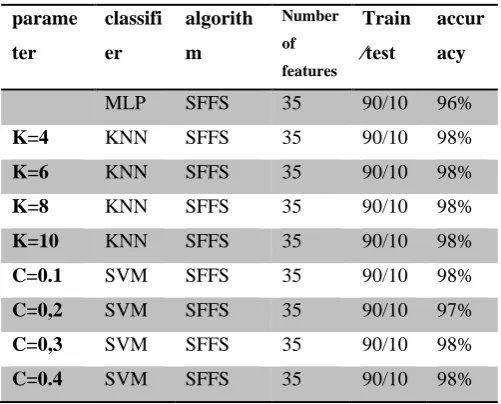
shown in Table 5.
Table 5.Results of 500 fragments
parame
ter
classifi
er
algorith
m
Number of features
Train ∕test
accur
acy
MLP SFFS 35 90/10 96%
K=4 KNN SFFS 35 90/10 98%
K=6 KNN SFFS 35 90/10 98%
K=8 KNN SFFS 35 90/10 98%
K=10 KNN SFFS 35 90/10 98%
C=0.1 SVM SFFS 35 90/10 98%
C=0,2 SVM SFFS 35 90/10 97%
C=0,3 SVM SFFS 35 90/10 98%
C=0.4 SVM SFFS 35 90/10 98%
The best results obtained in 500-byte
fragments with the best possible combinations
are given in Table 6.
Table 6.The best results of 500 fragments
classifie
r
algorithm Number of
features
Train ∕test
accuracy
MLP SFFS 35 90/10 96%
KNN SFS & 36 or 39 90/10 98%
SFFS
SVM SFFS 39 90/10 98%
According to Table 6, the MLP algorithm
with 95% accuracy, the KNN algorithm with an
accuracy of 98%, and the SVM algorithm with
an accuracy of 98% completed their process in
the 500-byte fragments. Accordingly, the KNN
and SVM algorithms are considered the best
algorithms for recognizing the 500-byte files
with an accuracy of 98%.
5. Analysis of the Research Results
The best results of the research by
comparing two SFS and SFFS algorithms, as
well as both 500-byte and 1000-byte fragments,
are presented in Table 7.
Table 7.Results to be compared
classifie
r
Number of
features
Fragme
nt size
Train ∕test
accurac
y
MLP-s 35 500
Byte
90/10 96%
K-NN-s 35 500
Byte
90/10 98%
SVM-s 35 500
Byte
90/10 98%
Referring to Table 7, the MLP algorithm
provides its best result on the 500-byte fragments
with SFFS feature reduction algorithm by
selecting 35 features. The best result recorded for
KNN algorithm also provides its best result on
the 500-byte fragments with the SFFS feature
reduction algorithm by selecting 35 features. The
best result recorded for the KNN algorithm in the
current study is 98%. The SVM algorithm also
provides its best result on the 500-byte fragments
with the SFFS feature reduction algorithm by
selecting 35 features. The best result recorded for
the SVM algorithm in this research is 98%. We
called these proposed algorithms SVM-s,
KNN-s, and MLP-KNN-s, respectively.
As specified by the results, by increased
length of the fragments from 500 to 1000 bytes,
the examined algorithms provide either weaker
or similar results with a minimal alteration,
which can be due to a small difference in the
number of features obtained from SFS and SFFS
reductions algorithms for 1000-bytes fragments
compared to 500-byte fragments.
As illustrated in Table 7, the SVM and KNN
algorithms with similar accuracy of 98% are at
the highest place, and the MLP algorithm with an
accuracy of 96% occurs in a lower place. This
means feature reduction by SFFS algorithm will
provide better results than the SFS algorithm for
1000-byte and 500-byte fragments. Moreover,
the SVM and KNN algorithms have a better
performance than the MLP algorithm.
6. Comparison of the Proposed Algorithm
with other Algorithms
The study in the field of recognizing the file
type includes a large number of file types as well
as different databases. This leads to complexity
in the comparison and conclusion of the research.
In 2015, in an experiment, Nasser Alamri
selected 6 different file types (pdf, txt, jpg, doc,
html, and exe) and reduced the features via the
PCA feature reduction. Then and there, he
compared the reduced features set with 5
algorithms of SVM, KNN, the neural network
based on the core function radius, the neural
network with perceptron core, and linear
discriminant analysis on the same database. The
relevant database has randomly extracted the
sample data from the Govdoc dataset, and 100
samples were taken from each file of which the
subsets are also randomly extracted. The results
are shown in Table 8. We also matched a variety
of file types with the files provided to compare
our work with other research.
Table 8.Results obtained in Alamri′s 2015 paper
classifie
r
Number of
features
fragm
ent
Train∕te
st
accuracy
LDA 64 500
Byte
90/10 93%
SVM 64 500
Byte
80/20 94%
K-NN 8 500
Byte
90/10 97%
NN-RBF
4 1000
Byte
80/20 88%
NN-MLP
64 500 Byte
90/10 94%
As shown in Table 8, the KNN algorithms
with the accuracy of 97% and the NN-RBF
algorithm with an accuracy of 88% have the least
shows the comparison between our proposed
research algorithms and the Alamri's paper.
Fig.5. Comparison of the proposed algorithm of this research with the results of Alamri's paper (2015)
In Figure 5, the MLP-s column describes the
MLP classification algorithm by SFFS feature
reduction approach, and the K-NN-s column
represents the K-NN classification algorithm by
the same approach. Further, the SVM-s column
represents the SVM classification algorithm by
SFFS feature reduction approach.
According to Figure 5, the KNN-s, SVM,
and MLP-s approaches by respectively 1%, 4%,
and 2% increase in the accuracy rate show the
increasing trend in the accuracy of this research
compared to Alamri’s. Also, KNN and SVM
algorithms combined with the SFFS feature
reduction approach indicate the highest accuracy
of the categorization (98%) among the eight
algorithms examined.
7. Conclusion
File type’s detection is an essential task for
many security programs. Although there are lots
of programs to deal with detection of computer
file types, there are just minimal algorithms for
detecting them. However, the primary issue in
detecting the file type is the classification of the
file fragments since there are no headers (a part
of the file containing information about the file
type) or systemic file information, which can
specify the file type. The general algorithm to
classify file fragments is to examine the
histogram of its byte frequency and sometimes
analyze other statistics obtained. The statistical
distance between the histogram and the known
distributions of different files types can be
calculated, which will be used to distinguish
different data types. Based on recent research,
although the classification of file fragments in
many common file types can be done with high
accuracy, this algorithm has some limitations to
detect the type of file, running time and
accuracy. A higher degree of accuracy obtained
in this study compared with previous studies.
In this paper, the problem of recognizing the
file fragment was begun by considering
1000-byte and 500-1000-byte fragments of each file. The
BFD algorithm extracted the features of each file
fragment. Then, by two SFS and SFFS feature
reduction algorithms, the features extracted from
each fragment were reduced to 24-39 features
depending on the length of the file fragment. The
reduced features were considered as inputs of
three MLP, KNN, and SVM classification
algorithms to obtain the accuracy of the
classification algorithms. The best result in this
study was achieved as 98% 96%98% 98%
93% 94% 97%
88% 94%
82% 84% 86% 88% 90% 92% 94% 96% 98% 100%
classification accuracy
MLP-s
K-NN-s
SVM-s
LDA
SVM
K-NN
NN-RBF
References
1. McDaniel M, Heydari M H. Content-based file type detection algorithms. In Proc. the 36th IEEE Annual Hawaii International Conference. System Science, Jan 2003, pp.10.
2. Li W, Wang K, Stolfo S J, Herzog B. Fileprints: Recognizing file types by n-gram Analysis. In Proc. the 6th IEEE Systems. Man and Cybernetics Information Assurance Workshop, West Point, New York, Jane 2005, pp.64-71.
3. Mabodi, K., Yusefi, M., Zandiyan, S., Irankhah, L., & Fotohi, R. Multi-level trust-based intelligence schema for securing of internet of things (IoT) against security threats using cryptographic authentication. The Journal of Supercomputing, 1-25.
4. Fotohi, R., Jamali, S., Sarkohaki, F., & Behzad, S. (2013). An Improvement over AODV routing protocol by limiting visited hop count. International Journal of Information Technology and Computer Science (IJITCS), 5(9), 87-93. 5. Zandiyan S, Fotohi R, Koravand M. P‐method:
Improving AODV routing protocol for against network layer attacks in mobile Ad‐Hoc networks. International Journal of Computer Science and Information Security. 2016 Jun 1;14(6):95.
6. Jamali, S., & Fotohi, R. (2017). DAWA: Defending against wormhole attack in MANETs by using fuzzy logic and artificial immune system. the Journal of Supercomputing, 73(12), 5173-5196.
7. Lodeiro-Santiago, M., Caballero-Gil, P., Aguasca-Colomo, R., & Caballero-Gil, C. (2019). Secure UAV-Based System to Detect Small Boats Using Neural Networks. Complexity, 2019.
8. Fotohi, R., Heydari, R., & Jamali, S. (2016). A Hybrid routing method for mobile ad-hoc networks. Journal of Advances in Computer Research, 7(3), 93-103.
9. Fotohi, R., & Bari, S. F. (2020). A novel countermeasure technique to protect WSN against denial-of sleep attacks using firefly and Hopfield neural network (HNN) algorithms. The Journal of Supercomputing, 1-27.
10. Karresand M, Shahmehri N. File Type Identification of Data Fragments by Their Binary Structure. In Proc. the IEEE Workshop. Information Assurance, July 2006, pp.140-147. 11. Veenman Core J. Statistical disk cluster
classification for file carving.In Proc. The 3rd IEEE international symposium. information assurance and security, Aug 2007, pp. 393-398. 12. Behzad, S., Fotohi, R., & Dadgar, F. (2015).
Defense against the attacks of the black hole,
gray hole and wormhole in MANETs based on RTT and PFT. International Journal of Computer Science and Network Solutions (IJCSNS), 3, 89-103.
13. Seyedi, B., & Fotohi, R. NIASHPT: a novel intelligent agent-based strategy using hello packet table (HPT) function for trust Internet of Things. The Journal of Supercomputing, 1-24. 14. Fotohi, R., Bari, S. F., & Yusefi, M. (2019).
Securing Wireless Sensor Networks Against Denial‐of‐Sleep Attacks Using RSA Cryptography Algorithm and Interlock Protocol. International Journal of Communication Systems. 15. Sarkohaki, F., Fotohi, R., & Ashrafian, V.
(2017). An efficient routing protocol in mobile ad-hoc networks by using artificial immune system. International Journal of Advanced Computer Science and Applications (IJACSA), 8 (4).
16. Fotohi, R., Ebazadeh, Y., & Geshlag, M. S. (2016). A new approach for improvement security against DoS attacks in vehicular ad-hoc network. International Journal of Advanced Computer Science and Applications, 7(7), 10-16. 17. Behzad, S., Fotohi, R., Balov, J. H., & Rabipour, M. J. (2018). An Artificial Immune Based Approach for Detection and Isolation Misbehavior Attacks in Wireless Networks. JCP, 13(6), 705-720.
18. Calhoun W, Coles D. Predicting the types of file fragments. Journal Digital Investigation: The International Journal of Digital Forensics & Incident, 2008, 5: S14-S20.
19. Sportiello L, Stefano Z. Context-Based File Block Classification. Advances in Digital Forensics VIII, Springer Berlin Heidelberg, 2012, pp. 67-82. 20. Gopal S, Yang Y, Salomatin k, Carbonell j.
Statistical learning for file-type recognition. In Proc. The 10th IEEE International Conference . Machine Learning and Applications and Workshops (ICMLA), 2011, vol. 1, pp. 68-73. 21. Fotohi, R. (2020). Securing of Unmanned Aerial
Systems (UAS) against security threats using human immune system. Reliability Engineering & System Safety, 193, 106675.
22. Fotohi, R.; Nazemi, E. An Agent-Based Self-Protective Method to Secure Communication between UAVs in Unmanned Aerial Vehicle Networks. Preprints 2020, 2020010229 (doi: 10.20944/preprints202001.0229.v1).
24. Erbacher R F, Moody S J. Sadi-statistical analysis for data type recognition. In Proc. The 3rd International Workshop. Systematic Approaches to Digital Forensic Engineering, May 2008, pp.41-54.
25. Dunham J G, Sun M T, Tseng J. Classifying File Type of Stream Ciphers in DepthUsing Neural Networks. In Proc. The The 3rd ACS/IEEE International Conference. Computer Systems and Applications, Jan 2005, pp.97.
26. Like Z, White G B. An Approach to Detect Executable Content for Anomaly Based Network Intrusion Detection. In Proc. IEEE International Conference. Parallell and Distributed processing Symposium, IPDPS, Long Beach, California, 2007, pp.1-8.
27. Cao D, Luo J, Yin M, Yang H. Feature selection based file type recognition algorithm. In Proc. IEEE International Conference. Intelligent Computing and Intelligent Systems, (ICIS), 2010,vol 3, pp.58-62.
28. Ahmed I, Lhee K, Shin H J, Hong M. Content-based file-type recognition using cosine similarity and a divide-and-conquer approach. IETE Technical Review, 2010, vol. 27(6), pp. 465-477. 29. Ahmed I, Lhee K, Shin H J, Hong M P. Fast Content-Based File Type Recognition. In Proc. The 7th Annual IFIP .Advances in Digital Forensics VII, Orlando, FL, USA, Springer Berlin Heidelberg, 2011, pp. 65-75.
30. Alamri N S, Allen W H. A Comparative Study of File-Type Recognition Techniques. In Proc. Proceedings of the IEEE SoutheastCon, Fort Lauderdale, Florida, April 2015, pp.1-5.
31. Wayne Whitney A. A Direct algorithm of Nonparametric Measurement Selection. IEEE Transaction on Computers, 1971, pp. 1100-1103. 32. Pudill p, Novovi j, Kittler J. Floating search
algorithms in feature selection. Department of Electronic and Electrical Engineering, ElSEVIER, 1994, pp. 1119-1125.
33. Kulkarni S, Harman G. An elementary introduction to statistical learning theory. John Wiley & Sons, 2011.
34. Fotohi, R., & Jamali, S. (2014). A comprehensive study on defence against wormhole attack methods in mobile Ad hoc networks. International journal of Computer Science & Network Solutions, 2, 37-56.
35. Jamali, S., & Fotohi, R. (2016). Defending against wormhole attack in MANET using an artificial
immune system. New Review of Information Networking, 21(2), 79-100.