A New Functional Dependency in a Vague Relational
Database Model
Jaydev Mishra
College of Engineering and Management, Kolaghat
West Bengal, India.
Sharmistha Ghosh
Vellore Institute of Technology University,
Vellore, Tamilnadu, India.
ABSTRACT
In order to model the real world with imprecise and uncertain information, various extensions of the classical relational data model have been studied in literature using fuzzy set theory. However, vague set, as a generalized fuzzy set, has more powerful ability to process fuzzy information than fuzzy set. In this paper, we have proposed a vague relational database model and have defined a new kind of vague functional dependency (called
-vfd) based on the notion of
-equality of tuples and the idea of similarity measure of vague sets. Next, we present a set of sound vague inference rules which are similar to Armstrong‟s axioms for the classical case. Finally, partial
-vfd and vague key have been studied with the new notion of
-vfd and also tested with examples.General Terms
Vague Database Design
Keywords
Vague set, similarity measure of vague sets,
-vfd, partial
-vfd, vague key.1.
INTRODUCTION
Information in the real world is very often imprecise or uncertain in nature. Fuzzy set theory, introduced by Zadeh in 1965 [1] has been widely used in literature [2, 3, 4, 5, 6, 7, 8, 9] to incorporate such imprecise data into classical relational databases. Extensive research has been carried out in this direction and several fuzzy relational database models have been proposed to model vague information in relational databases. Also, based on such fuzzy relational models, there have been many studies on different data integrity constraints [2, 3, 4, 8, 9], fuzzy relational algebra [5], fuzzy query languages [10] and so on.
However, vague set theory was put forward by Gau and Buehrer [11] in 1993 as a more efficient tool to deal with imperfect or ambiguous data. A vague set, conceived as a generalization of the concept of fuzzy set, is a set of objects each of which has a grade of membership whose value is a continuous sub-interval of [0,1]. On the contrary, it is well known that a traditional fuzzy set F in the universe of discourse U is characterized by a single membership function
F that assigns to each object u
U a single membership value
u
F
which is a real number lying between 0 and 1.
u
F
is called the grade of membership of the element u in the set F. However, in real life it is hard to make sure of the precision degree that an element belongs to a fuzzy set. Further, it was pointed out by Gau et al. in [11] that the single membership value in the fuzzy set theory combines the evidence for u
U and the evidence against u
U without indicating how much there is of each. To resolve this problem, they had introduced the concept of vague set V which ischaracterized by a truth membership function
t
V and a falsemembership function
f
V. Thus, a vague set separates the positive and negative evidence for membership of an element in the set and provides lower and upper bounds on the grade of membership of an element in the set. These lower and upper bounds are used to create a sub-interval on [0, 1], namely,
t
V(
u
),
1
f
V(
u
)
, to generalize the membership function)
(
u
V
of fuzzy sets, where)
(
1
)
(
)
(
u
u
f
u
t
V
V
V .Since vague sets have been introduced to deal with imprecise information in a more efficient manner than traditional fuzzy sets, classical relational databases may also be extended to represent and deal with uncertain data with the concept of vague set theory. The extended database model is then called a vague relational database model. However, compared to fuzzy relational databases, much less research has been reported so far in the area of vague relational database. This is, in particular, true for the study of vague functional dependency. But, it is well known that data dependencies play an important role in any database design and implementation of functional dependency of one set of attributes upon another is one of the most vital concepts in relational databases. Thus, similar to the theory of classical relational databases, vague functional dependencies can also be used as a guideline for the design of a vague relational schema.
Zhao et al. [12] have proposed a vague relational model based on vague set theory and a new similarity measure (SE) between vague sets. They have also extended and studied the vague relational algebra in ref. [13]. In particular, Zhao et al. have focused on the issues of vague functional dependency and vague Armstrong‟s axioms in [12]. According to Zhao et al., a vague relation ron a relational schema R satisfies the vague functional dependency vfd:
X
vfdY
, where XY
R if]))
[
],
[
(
(
])
[
],
[
(
)(
)(
(
t
r
s
r
SE
t
X
s
X
SE
t
Y
s
Y
. It may be clearly observed that the above definition of vfd fails if theSE
(
t
[
Y
],
s
[
Y
])
is slightly less than])
[
],
[
(
t
X
s
X
In this paper, we propose a new kind of vague functional dependency (called
-vfd ) based on the concept of
-equality of tuples and the notion of similarity measure between vague sets which can resolve the problem in such situations at definition level. Next, we present a set of sound vague inference rules which are similar to Armstrong‟s axioms for the classical case. Finally, partial
-vfd and vague key have also been studied with the new notion of
-vfd and tested with examples.The organization of the paper is as follows:
The basics of vague set theory have been reviewed in section2. The vague relational model has been proposed in section 3.
Section4 discusses the similarity measure of vague sets used in this study. We present the newly proposed vague functional dependency (
-vfd) in section5. The vague inference rules have also been investigated and the definitions of partial
-vfd and vague key have been introduced in the same section. The final conclusions are reported in section6.2.
BASICS OF VAGUE SET
In this section, we review some basic definitions on the theory of vague sets [11].
Let U be the universe of discourse where an element of U is denoted by u.
Definition 2.1
A vague set V in the universe of discourse U is characterized by two membership functions given by:
(i) a truth membership function
t
V:
U
0
,
1
,and
(ii) a false membership function
f
V:
U
0
,
1
,where
t
V(
u
)
is a lower bound of the grade of membership of u derived from the „evidence for u‟, andf
V(
u
)
is a lower bound on the negation of u derived from the „evidence against u‟, andt
V(
u
)
f
V(
u
)
1
.Thus, the grade of membership
V(
u
)
of u in the vague set V is bounded by a subinterval
t
V(
u
),
1
f
V(
u
)
of [0,1] i.e.,t
V(
u
)
V(
u
)
1
f
V(
u
)
.Then, the vague set V is written as
u
t
u
f
u
u
U
V
,
V(
),
1
V(
)
:
.Here, the interval
t
V(
u
),
1
f
V(
u
)
is said to be the vague value to the object u and is denoted byV
V(
u
)
. For example, in a voting process, the vague value [0.5, 0.8] can be interpreted as “the vote for a resolution is 5 in favour, 2 against and 3 neutral (abstentious).”The precision of knowledge about u is clearly characterized by the difference
1
f
V(
u
)
t
V(
u
)
. If this is small, the knowledge about u is relatively precise. However, if it is large, we know correspondingly little. Ift
V(
u
)
is equal to
1
f
V(
u
)
, the knowledge about u is precise, and vague settheory reverts back to fuzzy set theory. If
t
V(
u
)
and
1
f
V(
u
)
are both equal to 1 or 0, depending on whether udoes or does not belong to V, the knowledge about u is very exact and the theory goes back to that of ordinary sets. Thus any crisp or fuzzy set may be considered as a special case of vague set.
However, it may be noted that interval-valued fuzzy sets (i-v fuzzy sets) [15] are not vague sets. In i-v fuzzy sets, an interval based membership value is assigned to each element of the universe considering only the “evidence for u”, without considering the “evidence against u”. In vague sets both are independently proposed by the decision maker. This makes a major difference in judgment about the grade of membership. Next, we present several special vague sets and various operations on vague sets that are obvious extensions of the corresponding definitions for ordinary sets and fuzzy sets.
Definition 2.2
A vague set Vis an empty vague set, denoted by
, if and onlyif its truth-membership function
t
V
u
0
and false-membership functionf
V
u
1
for all u on U.Definition 2.3
The complement of a vague set V is denoted by
V
cand is defined by the truth-membership and false-membership functionst
Vc(
u
)
andf
Vc(
u
)
as follows:
t
(
u
)
f
V(
u
)
Vc
andf
Vc(
u
)
t
V(
u
)
. Definition 2.4A vague set A is contained in another vague set B, written as A
B, if and only if,t
A
t
B andf
A
f
B.Definition 2.5
Two vague sets A and B are equal, written as A = B, iff, A
B and B
A, that is,t
A
t
B andf
A
f
B.Definition 2.6
The union of two vague sets A and B is a vague set C, denoted as C = A
B, whose truth-membership and false-membership functions are related to those of A and B by
A B
C
t
t
t
max
,
andf
C
min
f
A,
f
B
.Definition 2.7
The intersection of two vague sets A and B is a vague set C, written as C = A
B, such thatt
C
min
t
A,
t
B
and
A B
C
f
f
f
max
,
.Definition 2.8
Let
U
U
1
U
2
U
n be the Cartesian product ofn
universes, andV
i,
i
1
,
2
,
,
n
be vague sets in theirrespectively. Also, let
u
i
U
i,
i
1
,
2
,
,
n
. Then the Cartesian productV
V
1
V
2
V
n is defined to be avague set of
U
U
1
U
2
U
n with the truth and false membership functions defined as follows:
n
V
V V
n
V
u
u
u
t
u
t
u
t
u
t
n,
,
,
min
,
,
,
2 1 21
1 2
n
V
V V
n
V
u
u
u
f
u
f
u
f
u
f
n,
,
,
max
,
,
,
2 1 21
1 2
.
3. VAGUE RELATIONAL DATABASE
MODEL (VRDB)
In this section, we make an attempt to extend the classical relational database model to incorporate imprecise or vague data by means of vague set theory, which results in the Vague Relational Database model (VRDB).
Table-I : A vague relational instance r of “EMP_SAL” relation
NAME EXP SAL
Smith {<12, [1, 1]>, <15, [.9, .95]>, <20, [0, 0]>} {<45000, [.8, .95]>}
David {<12, [.9, .95]>, <15, [.95, 95]>, <20, [.2, .3]>} {<45000, [1, 1]>, <75000, [.1, .2]>} Sachin {<12, [.1, .15]>, <15, [.2, 3]>, <20, [1, 1]>} {<75000, [1, 1]>}
John { <20, [.9, .95]>} {<45000, [.2, .3]>, <75000, [.9, .95]>}
Definition 3.1
Let
A
i,
i
1
,
2
,
,
n
ben
attributes defined on the universes of discourse sets Ui, respectively. Then, a vaguerelation r on the relation schema
R
A
1,
A
2,
,
A
n
is defined as a subset of the Cartesian product of a collection of vague subsets:r
V(U1) × V(U2) × … × V(Un),where V(Ui) denotes the collection of all vague subsets on a
universe of discourse Ui .
Each tuple t of r consists of a Cartesian product of vague subsets on the respective Ui‟s, i.e., t[Ai] =
(Ai), where
(Ai)is a vague subset of the attribute Ai defined on Ui for all i. The
relation r can thus be represented by a table with n columns. It may be observed that the vague relation can be considered as an extension of classical relations (all vague values are [1, 1]) and fuzzy relations (all vague values are
[a, a], 0 ≤ a ≤ 1). It is clear that the vague relation can capture more information about vagueness.
Example 3.1.1: Consider the vague relational instance r over EMP_SAL (NAME, EXP, SAL) given above in Table-I. In r, EXP(Experience) and SAL(Salary) are vague attributes. The first tuple in r means the employee with NAME = “Smith” has the experience of {<12, [1, 1]>, <15, [.9, .95]>, <20, [0, 0]>} and the salary of {<45000, [.8, .95]>}, which are vague sets. Here the vague data <12, [1, 1]> means the evidence in favour of “The experience is 12” is 1 and the evidence against it is 0. Similarly the vague data <45000, [.8, .95]> indicates the evidence in favour of “The salary is Rs. 45000” is 0.8 while the evidence against it is 0.05 and so on.
4. SIMILARITY MEASURE OF VAGUE
DATA
There have been some studies in literature which discuss the topic concerning how to measure the degree of similarity between vague sets [16, 17, 18]. In [18], it was pointed out by Lu et al. that the similarity measure in [16, 17] did not fit well in some cases. They have proposed a new similarity measure between vague sets which turned out to be more reasonable in more general cases. The same has been used in the present work which is defined as follows:
Definition 4.1: Similarity Measure between two vague values Let x and y be two vague values such that x = [tx, 1-fx], y = [ty,
1-fy], where 0
tx
1-fx
1, and 0
ty
1-fy
1. Let SE(x, y)denote the similarity measure between x and y. Then,
y x y x y x y x f f t t f f t t y xSE
1 2 1 ) , (
Definition 4.2: Similarity Measure between two vague sets
Let U = { u1, u2, u3………, un} be the universe of discourse. Let A
and B be two vague sets on U, where:
}
,
)]
(
1
),
(
[
,
{
u
t
u
f
u
u
U
A
i A i
A i
i
,where tA(ui)
A(
u
i)
1- fA(ui) and 1
i
n.}
,
)]
(
1
),
(
[
,
{
u
t
u
f
u
u
U
B
i B i
B i
i
,where tB(ui)
B(
u
i)
1- fB(ui) and 1
i
n.Now, the similarity measure between A and B, denoted by SE (A, B) is defined as:
n i i B i B i A iA u f u t u f u
t SE n B A SE 1 )]) ( 1 ), ( [ )], ( 1 ), ( ([ 1 ) , (
n i i B i A i B i A i B i A i B i A u f u f u t u t u f u f u t u t n 1 )) ( ) ( ( )) ( ) ( ( 1 2 )) ( ) ( ( )) ( ) ( ( 1 15. DESIGN OF VAGUE RELATIONAL
DATABASE MODEL
5.1 Vague Functional Dependency (vfd)
Definition 5.1.1:
- equality of two vague tuplesLet r(R) be a vague relation on the relational schema R(A1, A2
,…… , An). Let t1and t2 be any two vague tuples in r. Let
[0, 1] be a threshold or choice parameter, predefined by the database designer, and X = { X1, X2 ,…… , Xk }
R. Thenthe vague tuples t1 and t2 are said to be
-equal on X ifSE(t1[Xi], t2[Xi])
i=1,2,3…..k. We denote this equalityby the notation
t
1[
X
](
VE
)
t
2[
X
]
.Then, the following proposition is straightforward from the above definition.
Proposition 5.1.1: If 0
2
1
1,then 1
[
](
)
2[
]
1
t
X
VE
X
t
1[
](
)
2[
]
2
t
X
VE
X
t
.Next, we define our
-vfd as follows:Definition 5.1.2: Vague Functional Dependency (
-vfd)Let X, Y
R = {A1, A2… An}. Choose a threshold value
[0, 1]. Then a vague functional dependency (vfd),denoted by
Y
vfd
X
, is said to exist if,whenever
t
1[
X
](
VE
)
t
2[
X
]
, it is also the case that]
[
)
](
[
21
Y
VE
t
Y
t
.We may read this vfd as follows: the set of attributes X vague functionally determines the set of attributes Y at
-level of choice. In another terminology, the set of attributes Y is vague functionally determined by the set of attributes X at
-level of choice. During the course of analysis, different
values may be set by the database designer so, that the above vfd may be termed as
-vfd. Also, we have the following straightforward proposition for
-vfd.Proposition 5.1.2 : If 0
2
1
1,then
Y
vfd
X
1
Y
vfd
X
2
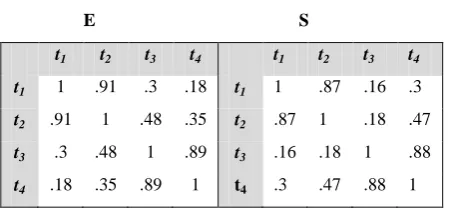
.Example 5.1.1: Consider the vague relational instance r presented in Table-I. Let us now check whether
SAL
vfd
EXP
holds to a certain
-level of choice or not.First, we obtain SE(tp[EXP], tq[EXP]) and SE(tp[SAL],
tq[SAL]) for every pair of tuples tp & tq in r, respectively, using
[image:4.595.304.530.75.180.2]Definition 4.2. The results are shown below by the matrices E and S respectively in Table-II.
Table-II : Matrices E & S showing Similarity Measure
E S
t1 t2 t3 t4 t1 t2 t3 t4
t1 1 .91 .3 .18 t1 1 .87 .16 .3
t2 .91 1 .48 .35 t2 .87 1 .18 .47
t3 .3 .48 1 .89 t3 .16 .18 1 .88
t4 .18 .35 .89 1 t4 .3 .47 .88 1
For
= 0.8 (given by decision maker), we can see from the above two matrices, that for any pair of tuples tp & tqif SE(tp[EXP], tq[EXP]) ≥
, then it is also the case thatSE(tp[SAL], tq[SAL]) ≥
.So, we can say that the vfd
SAL
vfd
EXP
8
.
holds for thevague relational instance r.
Also, from above matrices E and S, we can say that the vfd
SAL
vfd
EXP
85
.
holds true. However the vfdSAL
vfd
EXP
9
.
does not hold because for tuples t1 and t2,SE(t1[EXP], t2[EXP]) = 0.91 ≥ 0.9, but SE(tp[SAL], tq[SAL]) =
0.87 ≤ 0.9.
5.2 Inference rules for
-vfd
It is well known that in classical relational databases, functional dependencies satisfy a set of inference rules called Armstrong‟s axioms. In this section, we have derived a set of inference rules for our proposed
-vfd. These vague inference rules are similar to Armstrong‟s axioms for fd. We call them vague Armstrong’s axioms and are given as follows:(A1)
-vfd reflexive rule: If Y
X
R,then
Y
vfd
X
.(A2)
-vfd augmentation rule: IfY
vfd
X
and Z
R,then
YZ
vfd
XZ
(A3)
-vfdtransitive rule: IfY
vfd
X
1
andZ
vfd
Y
2
,then
Z
vfd
X
)
,
min(
1
2
.Theorem 5.2.1 : Vague Armstrong’s axioms (A1)- (A3) are sound.
Proof:
(A1)
-vfd reflexive rule:Let
t
1[
X
](
VE
)
t
2[
X
]
is true, i.e., SE(t1[Xi],t2[Xi])
Xi
X.Then, SE(t1[Xi], t2[Xi])
Xi
Y holds(
Y
X) i.e.,t
1[
Y
](
VE
)
t
2[
Y
]
is also true.This implies
Y
vfd
X
holds. Hence proved.(A2)
-vfd augmentation rule:Let
Y
vfd
X
. Now, from Definition 5.1.2, for any twotuples t1and t2 if
t
1[
X
](
VE
)
t
2[
X
]
……….(i) is true, thent
1[
Y
](
VE
)
t
2[
Y
]
……….(ii) is also true. Next, supposet
1[
XZ
](
VE
)
t
2[
XZ
]
……….(iii) is true. This implies,SE(t1[Xi], t2[Xi])
Xi
XZ
SE(t1[Xi], t2[Xi])
Xi
Z
t
1[
Z
](
VE
)
t
2[
Z
]
……….(iv)Then from (ii) and (iv), we get
]
[
)
](
[
21
YZ
VE
t
YZ
t
……….(v)Thus,for any two tuples t1and t2 if
t
1[
XZ
](
VE
)
t
2[
XZ
]
, then it is also the case that]
[
)
](
[
21
YZ
VE
t
YZ
t
which impliesYZ
vfd
XZ
. Henceproved.
(A3)
-vfd transitive rule:Let us assume that both the vfds
Y
vfd
X
1
andZ
vfd
Y
2
hold in the relation r(R).
Case I:
1
2 so that min (
1,
2) =
2.Given that
Y
vfd
X
1
and 0
2
1
1.So, using Proposition 5.1.2we get
Y
vfd
X
2
. ---(i)Then, from (i) we can write
]
[
)
](
[
21
X
VE
2t
X
t
1[
](
)
2[
]
2
t
Y
VE
Y
t
----(ii)Again, since
Z
vfd
Y
2
holds, so we have]
[
)
](
[
21
Y
VE
2t
Y
t
1[
](
)
2[
]
2
t
Z
VE
Z
t
---(iii)Combining (ii) and (iii), we get
]
[
)
](
[
21
X
VE
2t
X
t
1[
](
)
2[
]
2
t
Z
VE
Z
t
which implies
Z
vfd
X
2
.Hence for
2= min (
1,
2), ifY
vfd
X
1
andZ
vfd
Y
2
,then
Z
vfd
X
2
.Case II:
2
1follows similarly. Hence proved.(A4)
-vfd decomposition rule: IfYZ
vfd
X
, thenY
vfd
X
andZ
vfd
X
.Proof: Given that
YZ
vfd
X
--- (i)Since Y
YZ, by
-vfd reflexive rule, we haveY
vfd
YZ
--- (ii)From (i) and (ii) using
-vfd transitive rule, we getY
vfd
X
.Z
vfd
X
also follows similarly.Thus, if
YZ
vfd
X
, thenY
vfd
X
andZ
vfd
X
. Henceproved.
(A5)
-vfd union rule: IfY
vfd
X
1
andZ
vfd
X
2
,then
YZ
vfd
X
)
,
min(
1
2
.Proof: Given that
Y
vfd
X
1
--- (i) andZ
vfd
X
2
---(ii)
From (i) we may write
XY
vfd
X
1
--- (iii) (using
-vfdaugmentation rule).
Similarly, from (ii) we can write
YZ
vfd
XY
2
--- (iv) .Thus from (iii) and (iv) using
-vfd transitive rule, weget
YZ
vfd
X
)
,
min(
1
2
. Hence proved.(A6)
-vfd pseudo transitive rule: IfY
vfd
X
1
andZ
vfd
WY
2
, thenZ
vfd
WX
)
,
min(
1
2
.Proof: Given that
Y
vfd
X
1
--- (i)and
Z
vfd
WY
2
--- (ii)From (i), using
-vfd augmentation rule we can writeWY
vfd
WX
1
. --- (iii)From (iii) and (ii) using
-vfd transitive rule, we getZ
vfd
WX
)
,
min(
1
2
. Hence proved.5.3
Partial vague functional dependency
(partial
-
vfd)
After validation of Armstrong‟s axioms in the vague environment with our present notion of
-vfd, let us define partial vague functional dependency (partial
-vfd ) as follows:Definition 5.3.1: Partial vague functional dependency (partial
-vfd )Y is called partially vague functionally dependent on X at
-level of choice, i.e.,
Y
vfd
X
partially, ifY
vfd
X
also there exists a non empty set X´
X, such that,Y
vfd
X
´
.The concept of partial
-vfd then expresses the fact that after removal of an attribute Xi from X, the dependency still holdsi.e., for an attribute Xi
X, X-{ Xi} still vague functionallydetermines Y at
-level of choice. The notion of partial
-vfd is needed to define vague key.
Example 5.3.1
Let the relational schema be R={A, B, C, D, E} and the set of
vfds Von R be given by
V={
D
vfd
ABC
75
.
0
andD
vfd
AC
8
.
0
}. Then it may be easilyobserved that the vfd
D
vfd
ABC
75
.
0
is a partial
-vfd.5.4 Vague Key
In classical relational database, key is known to be a special case of functional dependency. Let us now extend the idea of classical key in the vague environment to define vague key with
-level of choice where
[0, 1] is a choice parameter defined by the database designer. A formal definition of vague key is as follows:Definition 5.4.1: Vague Key
Let K
R and V be a set of vfds for R. Then, K is called avague key of R at
-level of choice where
[0, 1] iffR
vfd
K
V andR
vfd
K
is not a partial
-vfd.Example 5.4.1: Let us assume a relation schema R= (A, B, C, D) and a set of vfds
V = {
B
vfd
A
75
.
0
,C
vfd
A
8
.
0
,D
vfd
A
7
.
0
} of R. Find avague key of R.
Solution: Given
B
vfd
A
75
.
0
---(i),C
vfd
A
8
.
0
--- (ii) and
D
vfd
A
7
.
0
--- (iii)Applying
-vfd union rule on (i) and (ii), we getBC
vfd
A
75
.
0
--- (iv)Again, applying
-vfd union rule on (iii) and (iv), we getBCD
vfd
A
7
.
0
--- (v) Also,A
vfd
A
1
is trivial ---- (vi)Thus from (v) and (vi) using
-vfd union rule, we getABCD
vfd
A
7
.
0
i.e.,R
vfd
A
7
.
0
which implies that A is a vague key of R at 0.7-level of choice.
6. CONCLUSION
In this paper, we present an extension of the classical relational database model with the concepts of vague set theory, a generalized version of fuzzy sets. The paper mainly concentrated on the study of functional dependency in vague relational database. For this purpose, we have introduced a new kind of vague functional dependency (called
-vfd) based on the idea of
-equality of tuples and similarity measure of vague sets. We have also derived the vague inference rules and defined partial
-vfd and vague key in the paper.The work may be extended to study Multivalued Dependency and Normalization using
-vfd which constitute an important part of a relational database design.7. REFERENCES
[1] Zadeh L. A., 1965, “Fuzzy Sets”, Information and Control, Vol. 8, No.3, pp. 338-353.
[2] Al-Hamouz S., Biswas R., 2006, “Fuzzy Functional Dependencies in Relational Databases”, International Journal of Computational Cognition, Vol. 4, No.1, pp. 39-43.
[3] Liao S. Y., Wang H. Q. and Liu W.Y., 1993, “Functional Dependencies with Null values, Fuzzy values, and Crisp values”, IEEE Transaction on Fuzzy Systems, Vol. 7, No. 1, pp. 97-103.
[4] Liu, W. Y., 1997, “Fuzzy Data Dependencies and Implication of Fuzzy Data Dependencies”, Fuzzy Sets and Systems, Vol. 92, No. 3, pp. 341-348.
[5] Ma Z. M., Zhang W.J., Ma W. Y., and Mili F., 2002, “Handling Fuzzy Information in Extended Possibility-Based Fuzzy Relational Databases”, International Journal of Intelligent Systems, Vol. 17, No. 10, pp. 925-942. [6] Mishra J. and Ghosh S., 2008, “A Study of Fuzzy
Relational Database”, International Journal of Computational Cognition, Vol. 6, No. 4, pp. 45-50. [7] Yazici A. and Sozat M. I., 1998, “The Integrity
[8] Yazici A. and Sozat M. I., 2001, “A Complete Axiomatization for Fuzzy Functional and Multivalued Dependencies in Fuzzy Database Relations”, Fuzzy Sets and Systems, Vol. 117, No. 2, pp. 161-181.
[9] Singaraju J., 2010, “Fuzzy Subset Dependencies”, International Journal of Computer Applications, Vol. 8, No. 13, pp. 29-36.
[10] Bosc P. and Pivert O., 1995, “SQLf: A Relational Database Language for Fuzzy Querying”, IEEE Transactions on Fuzzy Systems, Vol. 3, No. 1, pp. 1-17. [11] Gau W. L. and Buehrer D. J., 1993, “Vague Sets”,
IEEE Trans. Syst. Man, Cybernetics, Vol. 23, No. 2, pp. 610-614.
[12] Zhao F. and Ma Z. M., 2006, “Functional Dependencies in Vague Relational Databases”, IEEE International Conference on Systems, Man and Cybernetics.
[13] Zhao F., Ma Z. M., and Yan L., 2007, “A Vague Relational Model and Algebra”, Fourth International
Conference on Fuzzy Systems and Knowledge Discovery, (FSKD).
[14] Lu A. and Ng W., 2009, “Maintaining consistency of vague databases using data dependencies”, Data and Knowledge Engineering, Vol. 68, No. 7, pp. 622-641. [15] Zadeh L. A., 1975, “The Concept of a Linguistic
Variable and its Application to Approximate Reasoning - I”, Information Sciences, Vol. 8, pp. 199-249.
[16] Chen S. M., 1997, “Similarity Measure between Vague Sets and between Elements”, IEEE Trans. Syst. Man, Cybern., Vol. 27, No. 1, pp.153-158.
[17] Hong D. H. and Kim C., 1999, “A Note on Similarity Measures between Vague Sets and between Elements”, Information Sciences, Vol. 115, pp. 83-96.