Supplement
Critical Assessment of Massive Data Analysis (CAMDA)
One of the CAMDA 2018 Challenges was The MetaSUB Forensics Challenge where hundreds of novel city microbiome profiles from MetSUB have been provided. The challenge was to construct urban microbiome fingerprints and identify the geographical origin of mystery samples. Some of the mystery samples were from already known locations (classification problem) while other were from the new, unknown location (prediction problem). The prediction problem is still not solved and inside CAMDA and MetaSUB communities we are actively investigating different paths and the required data types and sizes.
In terms of classification problem results from CAMDA 2018 have shown, that already existing approaches can provide accuracy of 90% or more. In fact, all conceptual groups can classify that well. On next pages the descriptions of presented at CAMDA 2018 methods are provided. Taxonomy/species centric: Harris 2019, Walker 2019, and Ryan 2019
Massive metagenomic data analysis using abundance-based machine learning
Zachary N. Harris, Eliza Dhungel, Matthew Mosior & Tae-Hyuk Ahn Biology Direct 2019 14:12
With over half of the world’s population living in urban areas, mass-transit systems like subways and buses represent some of the most shared environments in the world. While effectively transporting millions of people around urban areas, these transit systems also serve as a home to a rich community of microbes that share DNA and RNA with their human passengers. These unseen genetic interactions play important roles in public health and disease outbreak, yet little is known about mass-transit biomes. Fortunately, metagenomics, defined as the direct analysis of genetic material found in an environment, offers an opportunity to better understand the microbial communities present in our mass-transit systems.
To analyse the genetic interactions and community compositions of mass-transit biomes, The MetaSUB International Consortium has collected whole-genome sequencing (WGS) data from multiple cities across the world. Further, the Conference on Critical Assessment of Massive Data Analysis (CAMDA) has released their Metagenomics Forensic Challenge - predict the geographic origin of a metagenomic sample when no reference samples from that location are known. For this challenge, CAMDA has provided access to the MetaSUB WGS data.
The WGS (also called as shotgun metagenomics) data can be analysed using several different approaches, but the methodological approaches can be divided into two categories: read-based and assembly-based. Read-based metagenomics analysis is useful for quantitative community profiling and identification of organisms especially if relevant references are available. MetaPhlAn2 identifies clade-specific marker genes for evidence of the associated clade presence. This allows for rapid assignment relative to a small database as compared to a full database including many whole genomes and fast mapping aligner, Bowtie2. Assembly-based workflows attempt to assemble the reads from one or more samples, group (bin) the contigs from these samples into genomes, then analyse the genes and contigs. Megahit, MetaSPAdes, and IDBA-UD are the most widely used k-mer based assemblers for high-throughput MPS metagenomic data. Most metagenomic classification tools match reads or assembled contigs against a database of microbial genomes to identify the taxon of each sequence. Several strain-level resolution taxonomic profilers were recently developed.
prediction but require careful inspection before making any decisions due to sample noise or complexity.
Identification of city specific important bacterial signature for the MetaSUB CAMDA challenge microbiome data
A. R. Walker and S. Datta Biology Direct 2019 14:11
Whole genome sequencing of metagenomic samples collected from subways station in several countries has been used to train and predict sample provenance. As part of CAMDA, in our second year follow up of the “MetaSUB Forensic Challenge” we have implemented appropriate machine learning techniques and statistical inferences on this massive dataset in order to find distinguishing microbiome signatures associated with different city subway swab samples. As these analyses were done within a time constrained manner and also only part of the entire data was released for the analysis through the CAMDA challenge initiative, we might not have obtained the maximal information from the data. However, it was evident that lot more results are obtainable from the full data and more in-depth analysis. Room for improvements may involve better sequencing protocols, choosing better open reference OTU picking algorithms, and better training and predictions stages of the data. Up to this point this work has produced two publications and a third ongoing draft all with better results. Here we provide a brief summary of the results that we obtained so far, in our two previous publications.
In our first work136 the most critical issues were the disparity in the quality of the sequencing
data, DNA amplification protocols, and number of samples per city. This led to a highly unbalanced design and analysis, which required a bootstrap analysis in order to verify the how consistent the mean species diversity was across cities. This analysis showed opposing results when comparing both values of the “q” parameter in the species diversity equation. The classification error in this work ranged between 1-34% the city and taxonomic rank (“order”, “family”, “genus”) and was highly influenced by the number of samples in the city and the quality of the DNA sequences. The network analysis showed interesting similarities in the nodes-connections for both east cities (Boston and New York) when compared with Sacramento (West coast) across all taxonomic ranks.
In our second publication139 the unsupervised PCA analysis has shown interesting clustering
Application of machine learning techniques for creating urban microbial fingerprints
Feargal Joseph Ryan Biology Direct 2019 14:13
In the CAMDA challenge I built a random forest classifier which was capable of identifying city of origin of a MetaSUB metagenomic sample with a high degree of accuracy141. The basic
principles which led to the approach that was finally used were that it should be capable of assigning as many sequences reads as possible to a useable/informative count feature and it should be easily reproducible by other researchers. This was achieved through the use of the Kaiju metagenomic classifier which performs a 6-frame translation of each read and then classifies this against the nr database202. Such an approach is beneficial as sequence may be
highly conserved at the amino acid level but divergent at the nucleotide level. The main limitation of this approach is the computational requirements, specifically the very high amount of RAM required for indexing the nr database for use with Kaiju. From this, the count of reads classified to each possible taxonomic rank for any domain of life were included as a count feature. Initially count features were filtered simply for presence in a certain percentage of samples in order to remove counts with majority zeroes. Next, t-Distributed Stochastic Neighbour Embedding (t-SNE) performed on the resulting count matrix showed a startling level of clustering by city of origin, similarly random forest was also capable of accurately identifying the city of origin in many cases. While this approach was largely successful it highlighted some key limitations in sample origin prediction with current resources. Most importantly, even using amino acid translation to the largest sequence database available, many samples were still primarily unclassified. Samples may contain organisms which perfectly predict a city of origin but that is of no use if researchers are unable to identify that organism. Recent work in the human microbiome field has highlighted the utility of in-silico approaches alone to mine for uncultured or unrepresented organisms that may be useful in constructing a database of representatives for sample origin prediction180.
Furthermore incorporation of community diversity statistics in a database independent manner may aid prediction203. Finally, the impact of temperature, humidity and more
Antibiotic resistance and metabolic profiles as functional biomarkers that accurately predict the geographic origin of city metagenomics samples
Carlos S. Casimiro-Soriguer, Carlos Loucera, Javier Perez Florido, Daniel López-López and Joaquin Dopazo
Biology Direct 2019 14:15
The availability of hundreds of city microbiome whole genome shotguns (WGS), is fostering the development of increasingly accurate predictors of the origin of a sample based on its microbiota composition. Currently, bacterial abundance profiles are used as features for the classification. However, bacterial genomes carry a wealth of information in their genomes regarding functionality, virulence, antibiotic resistance, etc. In fact, the value of existing functional profiling tools, which provide an extra perspective on biological interpretation, remains unexplored for classification purposes of environmental microbiota and, more specifically, urban metagenomes.
Here we study different transformations of the conventional bacterial strain or gene abundance profiles to functional profiles that account for bacterial metabolism and other interesting bacterial functionalities such as antibiotic resistance. These profiles are used as features for city classification in a machine learning algorithm that allows the extraction of the most relevant features for the classification.
From the sequencing reads we followed the MOCAT2 pipeline that maps the sequences to the corresponding genes of the different strains and carry out the functional annotation process using different databases (here KEGG -metabolism- and CARD -antibiotic resistance- modules). Thus, we generated KEGG and CARD functional profiles for each sample. The training set samples are labeled according to their city of origin. Then, to classify each sample into one of the known cities a classification pipeline was developed which mainly consists of: i) A base learner with decision trees, ii) An ensemble of base learners via Scalable Tree Boosting and, iii) A Bayesian optimisation framework for tuning the hyper parameters. Functional profiles can be used alone or combine them by means of a pipeline that can fuse different functional profiles by learning an approximation of the latent space by means of Canonical Correlation Analysis and then applying the machine learning pipeline already proposed.
Fingerprinting cities: differentiating subway microbiome functionality
Chengsheng Zhu, Maximilian Miller, Nick Lusskin, Yannick Mahlich, Yanran Wang, Zishuo Zeng and Yana Bromberg
Biology Direct 2019 14:19
Environmental metagenome classification for constructing a microbiome fingerprint
Jolanta Kawulok, Michal Kawulok, Sebastian Deorowicz Biology Direct 2019 14:20
In our full paper, we focus on the MetaSUB Forensics Challenge (organized within the CAMDA 2018 conference) which consists in predicting the geographical origin of metagenomic samples (environmental classification). Most of the existing methods for environmental classification are based on taxonomic or functional classification. We demonstrate that it is not necessary to identify the organisms or their functions to perform effective environmental classification. Hence, we do not need large databases of annotated metagenomic reads (like the NCBI (nt) nucleotide database), which substantially decreases the amount of data we have to process. Furthermore, this makes it possible to exploit the organisms specific to each location, even if their genetic material is not included in the databases. In the paper, the microbiome fingerprint is defined as a set of DNA fragments (k-mers) derived from organisms living in a given place.
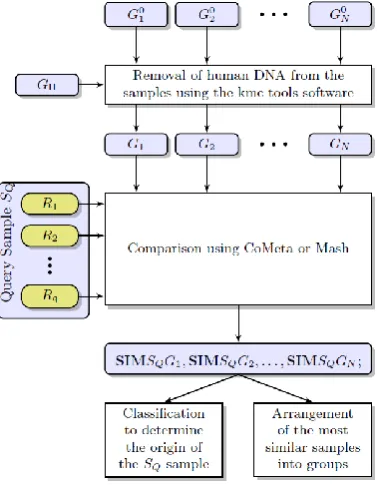
In our method, we exploit our CoMeta program and the Mash program which are applied to classify the extracted unknown metagenomes to a set of collections of known samples. We construct separate groups (Gi) of metagenomic reads for each city to compare the samples
on the basis of their similarity, measured directly in the space of the metagenomic reads. Moreover, we use the CoMeta program to cluster the samples based on their mutual similarities, which allows us to identify several groups that have been derived from the same origin.
A simplified diagram of our classification scheme is shown in Figure 1. At first, N groups (classes, samples for clustering, Gi), containing some reads
(reference sequences for classification) are created and the reads from the query sample are compared with them. Before comparing, the human fragments (GH) are removed from the groups using the KMC
software. Each read Ri derived from a query sample
(SQ) is compared against each class using CoMeta or
Mash. From the comparison, we obtain their mutual similarity values SIMSQGi, which are used to
determine the origin of an environmental sample or to arrange the most similar samples into groups. The MetaSUB Challenge embraces three complementary independent test sets and a primary dataset (i.e., the reference set with all the metadata provided, including geographical origin of the data). To evaluate our method, we perform leave-one-out cross validation for the primary dataset. For the first test set, we classify the samples against the primary dataset to check whether they are classified correctly. The second and the third test sets come from cities that are not included in the primary dataset. Hence, we only present the similarities between them and the classes from the primary dataset. In addition, we show the mutual similarities between 16 samples in the third test set. These similarities are used to arrange the samples into groups.